One Minute of Light Reveals What a Single MXene Flake Does
German and Israeli physicists found a way to measure individual atom-thin MXene flakes without destroying them, clearing a bottleneck for batteries and flexible electronics.
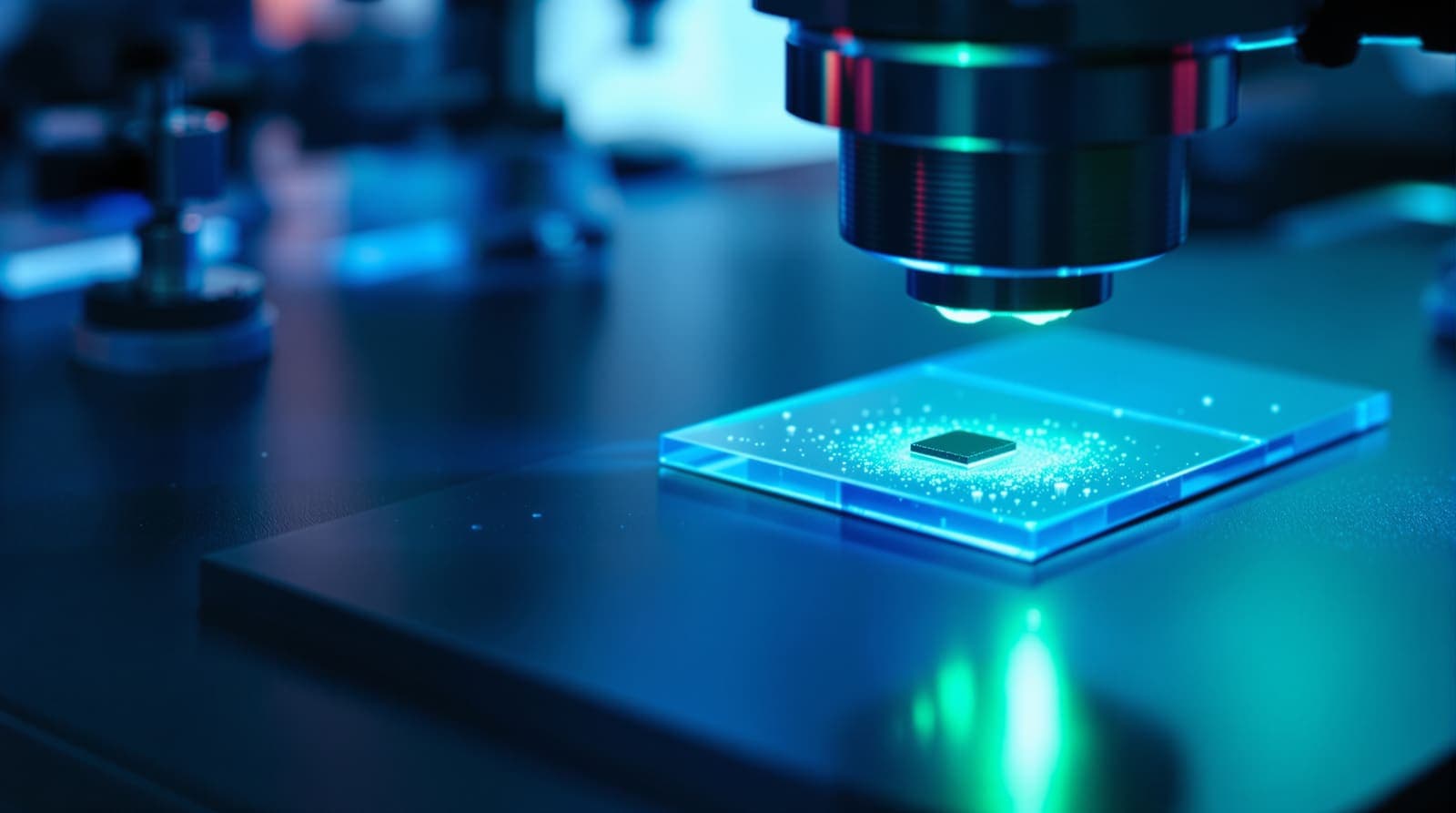
איור
הכתבה המלאה עדיין לא נכתבה בעברית, ולכן היא מובאת כאן באנגלית.
Researchers in Germany and Israel have found a way to study individual flakes of one of the most closely watched families of nanomaterials, an advance that could help in the design of better batteries, flexible electronics and clean-energy devices. The materials are called MXenes: sheets only a few atoms thick that conduct electricity, store energy and interact with light.
The difficulty until now was that MXenes could only be studied in large stacks of overlapping layers, which made it hard to know what any single layer was actually doing. A team led by Dr Andreas Furchner of the Helmholtz-Zentrum Berlin and Dr Ralfy Kenaz of the Hebrew University of Jerusalem used a new optical method, spectroscopic micro-ellipsometry, to examine individual flakes one at a time. Their findings were published in the peer-reviewed journal ACS Nano.
How you measure something a few atoms thick
Ellipsometry works by shining carefully controlled light on a sample and measuring how the polarisation of that light changes when it reflects back. From the reflection, researchers can work out how well the material conducts electricity and how its structure affects performance. Unlike older approaches, the technique does not damage the sample, and a full analysis takes less than a minute.
"What is truly outstanding with this work is that in less than one minute, we can directly measure the optical, structural, and electrical properties of individual MXene flakes, all in a non-destructive way," said Kenaz, who co-invented the method. "Normally, these measurements require three different instruments and a lot more time."
Furchner described what the resolution bought them. "Measuring how single MXene flakes interact with light allowed us to pinpoint tiny variations in thickness and conductivity," he said. "We were excited to see how closely the results matched much slower and more destructive techniques."
The finding that matters for device design
The team found that as MXene layers get thinner, their electrical resistance rises, a detail that has to be known before anyone can design reliable components around the material. The technique also matched the accuracy of powerful imaging tools such as electron microscopes.
The Helmholtz-Zentrum Berlin said in its announcement of 1 October 2025 that the method proved precise enough to match destructive techniques including scanning transmission electron microscopy, and described the approach as a form of optical fingerprinting for two-dimensional materials. Phys.org reported the same work on 6 October 2025 and gave the ACS Nano digital object identifier, 10.1021/acsnano.5c06938. The Jerusalem Post carried an account on 8 October 2025.
Why anyone cares about MXenes
"This work provides a roadmap for integrating MXenes into real technologies by offering a direct view of their intrinsic properties without the interference of stacked layers or impurities," said Professor Ronen Rapaport of the Hebrew University. "By refining how we study these materials, we're paving the way for their use in energy and optoelectronic devices."
Dr Tristan Petit of the Helmholtz-Zentrum Berlin argued the significance runs wider than the material itself. "This opens up new fields of research that were previously only possible with large, expensive X-ray facilities," he said. "Now we can do similar work in a regular lab, much faster."
The candidate applications are broad. MXenes can store and release electrical energy efficiently, which makes them of interest for next-generation lithium-ion and solid-state batteries; being thin and bendable, they are a candidate for wearable devices, smart clothing and foldable electronics, and for supercapacitors that deliver quick bursts of power and recharge faster than ordinary batteries. Their combination of light interaction and conductivity puts them in play for solar cells and photoelectrochemical systems, and possibly as catalysts in the water-splitting reactions used to produce hydrogen. Because they can filter heavy metals and salts out of water, they are also being examined for desalination membranes and environmental clean-up, as well as for biosensors, drug delivery and medical diagnostics.
What the announcement did not settle
The work is a measurement advance, not a device. The statement did not say how quickly the technique can be scaled to production-line use, whether it works on other classes of two-dimensional materials, or how far MXenes are from commercial batteries or screens. As Petit put it: "MXenes are just the beginning."
מקורות וקריאה נוספת
פתחנו ובדקנו כל קישור כאן בזמן כתיבת העמוד. הודעות רשמיות מסומנות ככאלה: זו הגרסה של הגורם עצמו, לא גרסה עצמאית.
- רשמיHelmholtz-Zentrum Berlinhelmholtz-berlin.deNovel technique shines light on next-gen nanomaterials: how MXenes truly work
The research institute's own announcement, dated 1 October 2025
- כתבותPhys.orgphys.orgHow MXenes truly work: Novel technique shines light on next-gen nanomaterials
Independent write-up with the ACS Nano DOI and publication date
- כתבותThe Jerusalem Postjpost.comScientists unveil nano technique that could transform clean energy and tech
Second account of the method and its potential applications
איך בדקנו את זה
The description of the method, the researchers and all quotations come from the announcement of 8 October 2025 carried in the original text. The publication in ACS Nano, the institutional roles and the comparison with electron microscopy were confirmed against the Helmholtz-Zentrum Berlin press release, Phys.org and Jerusalem Post pages, all fetched.
מדיניות המקורות והתיקונים שלנו →השבוע מישראל, במייל אחד
הכתבות שהיו חשובות, עם מקורות ובדיקה של מערכת Israel.com. חינם, פעם בשבוע, הסרה בלחיצה אחת.
רשימה אחת, הסרה בלחיצה. קראו את מדיניות הפרטיות שלנו.
עוד במדור ישראל
למדור ישראל →

הכתבות האחרונות
- צה"ל: המעצרים בקבאטיה היו חלק מפעילות רחבה יותר בגדה ביום כיפור
- טראמפ נשא דברים בלי קול אחרי שהרשתות באמריקה השביתו את סיקור הפול
- תקלה בכבל סיבים אופטיים שיבשה טיסות בחוף המזרחי של ארה"ב
- רשתות הטלוויזיה בארה"ב השביתו את מאגר הכתבים בבית הלבן, טראמפ נשא דברים בלי קול
- מאות ליוו בלילה את נתנאל שקרון שנהרג ליד נווה צוף
- מד"א טיפל ב-3,322 איש ביום כיפור; שלושה נהרגו בתאונות דרכים