25 Handguns and Four M16s Seized in Lahav 433's 'Nomad' Sting
Israel Police said an undercover agent was deployed in the Bedouin sector for the first time, implicating 45 targets and yielding a haul of guns and cocaine.
איור
הכתבה המלאה עדיין לא נכתבה בעברית, ולכן היא מובאת כאן באנגלית.
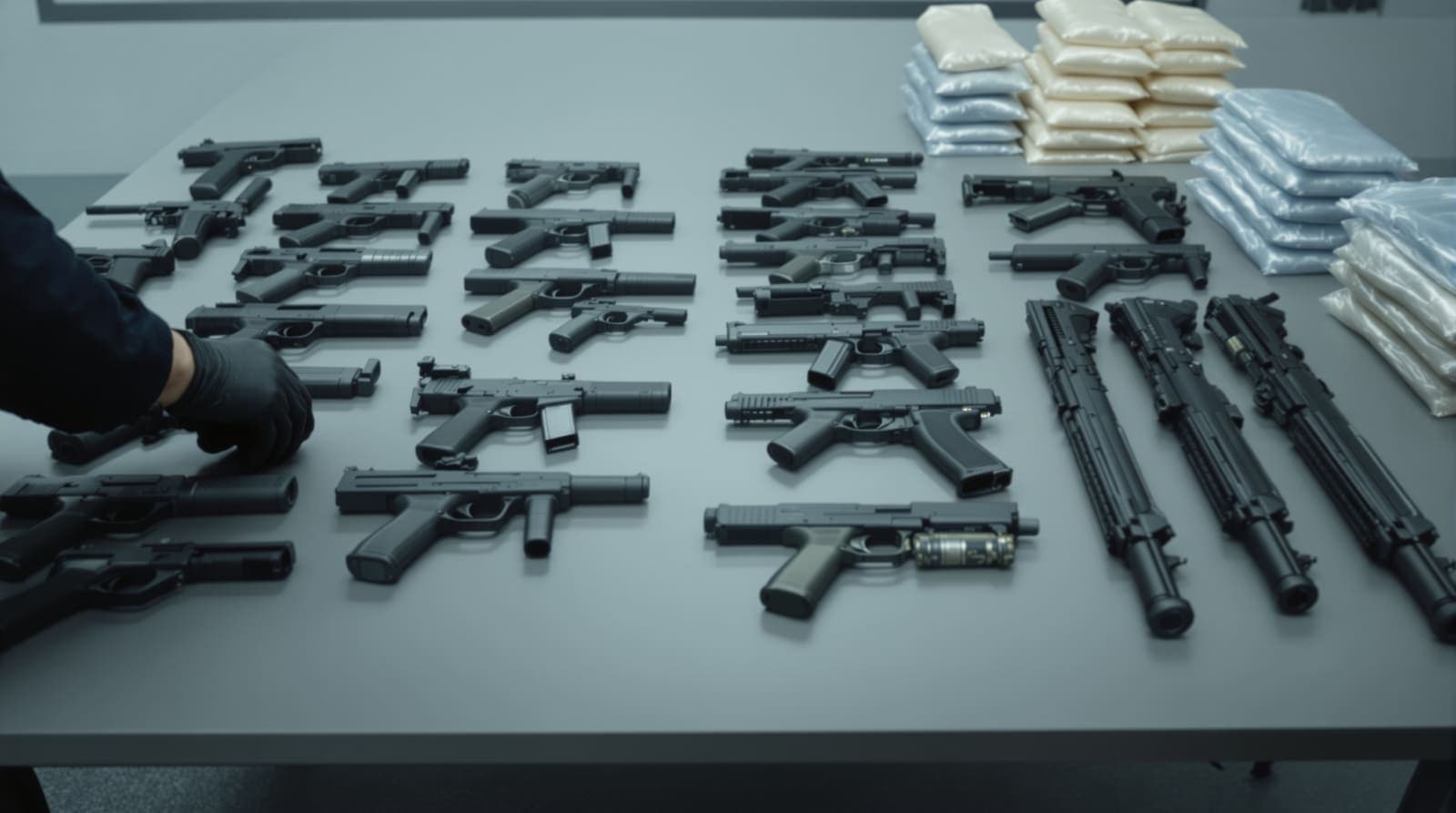
The Israel Police displayed 25 handguns, four M16 rifles and about half a kilogram of cocaine seized in an operation it called the “Nomad” affair, which concluded on the morning of 14 July 2026. According to the police, the case was built by Lahav 433, the national major-crimes unit, at the end of a covert investigation in which the unit deployed an undercover agent in the Bedouin sector for the first time.
The force said 45 targets were implicated in the affair, of whom 20 are significant crime targets. The findings were presented during a visit to Lahav 433 by the Minister of National Security, MK Itamar Ben-Gvir, the Police Commissioner, Lt. Gen. Danny Levy, and the head of the Investigations and Intelligence Directorate, Commissioner Boaz Balt, who were briefed by the head of Lahav 433, Commissioner Meni Benjamin. Ben-Gvir said the operation showed “what a proactive, offensive, and professional police force looks like”. The commissioner said the force would “not accept a reality of illegal weapons on the streets” and would not allow crime organisations “to believe they are stronger than the state”.
Lahav 433, the force Israelis call their FBI
Lahav 433 is not an ordinary police unit. It was created on 1 January 2008 by merging five separate law-enforcement bodies into a single national organisation headquartered in Lod, and it houses the national fraud, financial, cyber and international organised crime investigation units, along with an undercover unit known as the Gideonites. The name encodes its make-up: the 4 stands for the four regional departments that formed it, the 33 for that undercover unit. It handles the files considered too large or too sensitive for a regional district, and it is the body Israeli commentators habitually compare to the American FBI.
Why the guns are the point
The commissioner's line about weapons on the streets reflects the central fact of Israeli crime statistics: the country's homicide problem is overwhelmingly a firearms problem. The Abraham Initiatives counted 252 crime-related killings in Arab society in 2025, the highest total it has recorded, and The Times of Israel reported that 88 per cent of the victims were shot dead and that the toll amounted to more than 80 per cent of all violent killings in Israel that year. Research by the Taub Center, published in February 2024, put the ratio of Arab to Jewish homicide victims at 13 to 1 in 2023, against 4 to 1 in 2015.
A new national programme, and the argument over it
Two days after this operation was announced, the government approved a broader plan on the same problem. The Times of Israel reported on 16 July 2026 that ministers voted to bring in the Shin Bet security agency against organised crime in Arab communities, redirecting roughly NIS 497 million from a community development programme: about NIS 345 million to a dedicated Shin Bet unit against drug and weapons smuggling and NIS 132.4 million to a new national police unit. Rights groups objected. The Abraham Initiatives called it “not a campaign against crime” but a step “turning citizens into a security threat”, and the Association for Civil Rights in Israel warned it would deepen inequality. Policing in the Negev has been criticised from the other direction too: the State Comptroller found in April 2026 that stations there were 205 officers short as of 2024.
What the police did not say
The statement did not say how many people were arrested or charged, what “implicated” means in legal terms for the 45 targets, or where the weapons and drugs were seized. It gave no locations, no names, no ages and no account of how the agent operated or for how long. Nor did it say where the M16 rifles or handguns originated.
מקורות וקריאה נוספת
פתחנו ובדקנו כל קישור כאן בזמן כתיבת העמוד. הודעות רשמיות מסומנות ככאלה: זו הגרסה של הגורם עצמו, לא גרסה עצמאית.
- רשמיThe Times of Israeltimesofisrael.comCrime rampant in the Negev, police understaffed, governance broken down
State Comptroller findings on police staffing in the south, April 2026
- כתבותThe Times of Israeltimesofisrael.comArab society marks deadliest year on record, with 252 murder victims in 2025
Homicide toll and the share of victims killed with firearms
- כתבותThe Times of Israeltimesofisrael.comGovernment okays Shin Bet to fight crime in Arab society, sparking rights concerns
The July 2026 national plan, its budget breakdown and criticism of it
- נתוניםTaub Center for Social Policy Studiestaubcenter.org.ilHomicide Rates in Israel: Recent Trends and a Crossnational Comparison
Comparative homicide rates between population groups
- רקעWikipediaen.wikipedia.orgLahav 433
Formation, structure and remit of the national major-crimes unit
איך בדקנו את זה
The seizure figures, the number of targets, the quotations and the description of the undercover deployment come only from the Israel Police statement of 14 July 2026 and were not independently verified. The homicide figures come from the Abraham Initiatives via The Times of Israel and from the Taub Center; the national plan and the comptroller's staffing findings are from Times of Israel reporting.
מדיניות המקורות והתיקונים שלנו →השבוע מישראל, במייל אחד
הכתבות שהיו חשובות, עם מקורות ובדיקה של מערכת Israel.com. חינם, פעם בשבוע, הסרה בלחיצה אחת.
רשימה אחת, הסרה בלחיצה. קראו את מדיניות הפרטיות שלנו.
עוד במדור משפט ופלילים
למדור משפט ופלילים →

הכתבות האחרונות
- צה"ל: המעצרים בקבאטיה היו חלק מפעילות רחבה יותר בגדה ביום כיפור
- טראמפ נשא דברים בלי קול אחרי שהרשתות באמריקה השביתו את סיקור הפול
- תקלה בכבל סיבים אופטיים שיבשה טיסות בחוף המזרחי של ארה"ב
- רשתות הטלוויזיה בארה"ב השביתו את מאגר הכתבים בבית הלבן, טראמפ נשא דברים בלי קול
- מאות ליוו בלילה את נתנאל שקרון שנהרג ליד נווה צוף
- מד"א טיפל ב-3,322 איש ביום כיפור; שלושה נהרגו בתאונות דרכים