Nature reserve · The Dead Sea
Ein Gedi Nature Reserve
Four springs push about three million cubic metres of fresh water a year through two desert canyons here, and the parks authority has been rebuilding the trails between them since a flood tore through the reserve in May 2025.
In-bar / CC BY-SA 4.0 · Wikimedia Commons
Reserve area
14,350 dunams
1,435 hectares, declared a protected nature reserve in 1971, per the parks authority's own brochure
Spring water
about 3 million m³ a year
the combined output of four perennial springs (Israel Nature and Parks Authority)
Adult ticket
₪31
child ₪16, as posted by the parks authority in 2026; the antiquities site alone is ₪16
Visitors
about 318,000
in 2024, against roughly 700,000 in the record year of 2019, per Ynet
In short
- How long to give it
- about an hour for lower Nahal David as the parks authority times it, and three to five hours for Nahal Arugot to the Hidden Waterfall and back
- Summer, Sunday to Thursday and Saturday
- 08:00 to 17:00
- Adult
- ₪31
שמורת טבע עין גדי
Ein Gedi Nature Reserve is a pair of spring-fed canyons cut into the cliffs above the western shore of the Dead Sea, kept as a reserve since 1971 and run by the Israel Nature and Parks Authority. Its brochure puts the protected area at 14,350 dunams, or 1,435 hectares, on the eastern edge of the Judaean Desert. Nahal David runs through the northern half and Nahal Arugot through the southern, and both carry running water every day of the year in a place that gets almost no rain.
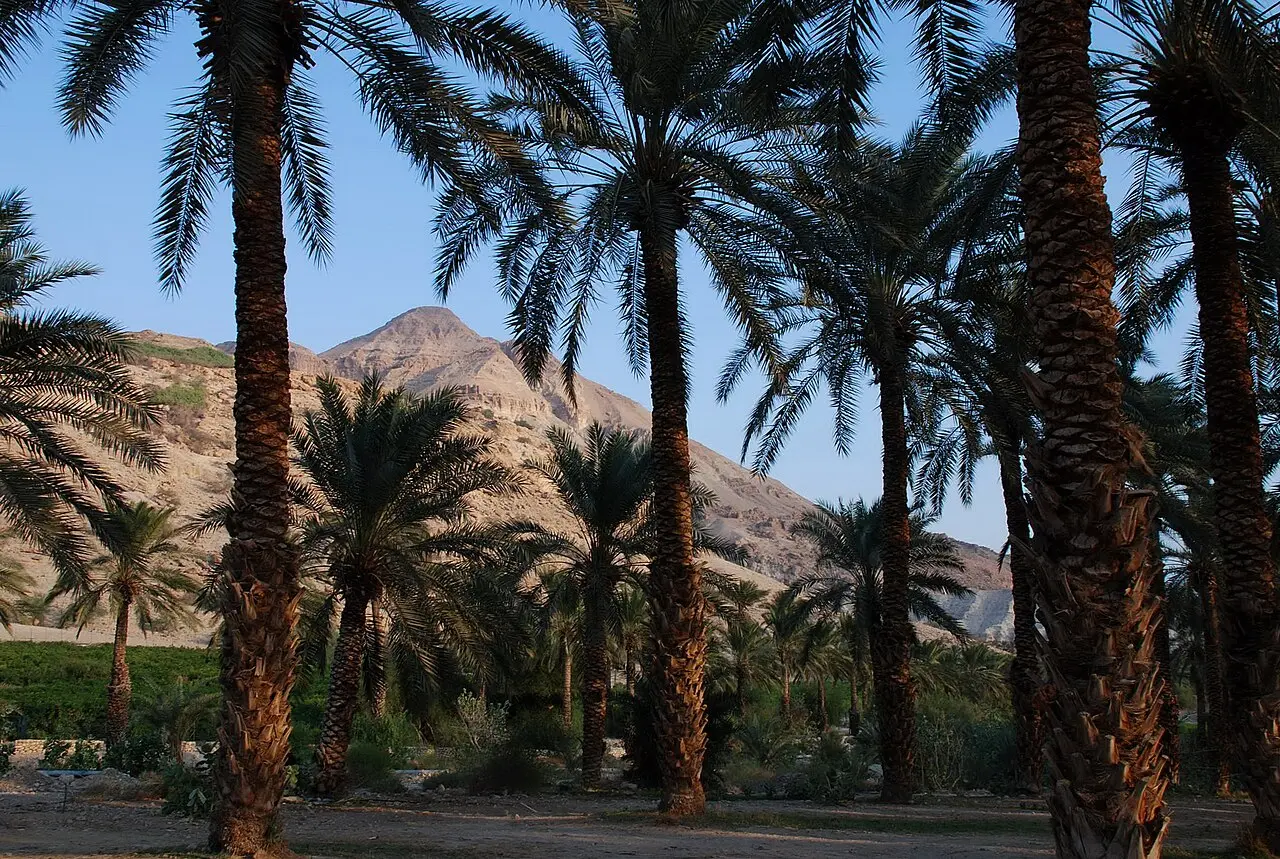
The water is the whole point, and it does not fall here. Rain on the Judaean Mountains soaks into the water table, travels east underground and wells up at four springs inside the reserve: David's Spring into Nahal David, Arugot Spring into Nahal Arugot, and the Shulamit and Ein Gedi springs down the slopes between the two. Together they yield roughly three million cubic metres a year. That single supply has held people here since the fourth millennium BCE and holds the densest concentration of tropical plants growing anywhere in Israel, along with Nubian ibex and rock hyraxes that most visitors see within twenty minutes of the gate.
It is not currently the reserve its own brochure describes. On 8 May 2025 Ynet reported a flash flood that washed trails away, flooded the ancient synagogue and closed the reserve outright. More than a year on, parts of it are open, parts are not, and the operator's English and Hebrew pages do not entirely agree about which is which.
Layout
Two canyons, three gates, and one ticket that covers all of them
The parks authority sells Ein Gedi as three separate visits, not one. Nahal David has its own entrance and ticket office in the north, Nahal Arugot has its own in the south, and the En Gedi Antiquities site, built around a sixth-century synagogue mosaic, has a third gate between them. Each has its own telephone number. Each has to be booked separately. The saving grace is the ticket itself: entry bought for any one of the three is good for same-day entry to the other two.
The two canyons are not variations on each other. Nahal David is short, steep-sided and busy, and its lower section leads in about an hour, on the parks authority's own timing, to David's Waterfall. Nahal Arugot is the longer and harder of the two, and the authority's route notes give it as 4.5 kilometres there and back to the Hidden Waterfall or 7 kilometres to the upper pools, at three to five hours and up to about half a day. The Arugot walk splits into a red trail that stays dry on the northern bank and a blue trail that goes down into the streambed and gets wet.
Linking the three is Shvil HaNaveh, the oasis path, with interpretation panels on the wildlife, the invasive species and the sinkholes along the shore below. The stretch between Nahal David and the antiquities gate is accessible and gently graded; the continuation to Nahal Arugot is steeper. A vehicle road runs alongside it with parking bays, for anyone who would rather drive between the gates.
The catchments explain why the two streams behave so differently in a storm. The parks authority's brochure gives Nahal David a collecting area of about 18 square kilometres, so it floods only when rain falls on Ein Gedi itself. Nahal Arugot is about 40 kilometres long and gathers from roughly 200 square kilometres reaching back to the Hebron hills, so it can run hard on a day that is dry at the gate.
- Nahal David: the short canyon, the waterfall, the accessible path, and the crowds
- Nahal Arugot: the long canyon, the Hidden Waterfall and the upper pools, graded for fit walkers
- En Gedi Antiquities: the synagogue and village, a separate cheaper ticket, no reservation needed on the English page
- Shvil HaNaveh: the linking oasis path, accessible between Nahal David and the antiquities
- One ticket to any of the three admits you to all three on the same day
In-bar / CC BY-SA 4.0 · Wikimedia Commons
Water
Three million cubic metres, and who gets to keep them
The springs are not fed by local weather. The parks authority describes rain falling on the Judaean Mountains, seeping into the underground water table, moving east and finally welling up inside the reserve, which is why the canyons run in August as well as in February. The four springs are unequal: David's Spring feeds Nahal David and Arugot Spring feeds Nahal Arugot, while the Shulamit and Ein Gedi springs emerge on the slopes between them and support the vegetation there rather than a stream.
Not all of that water reaches the streams. The parks authority states plainly in its own brochure that a significant amount of the reserve's spring water is trapped and used by Kibbutz Ein Gedi and its surroundings. It goes further, and says the oasis flora has been greatly diminished since neighbouring settlements began taking part of the reserve's water for agriculture, and that the authority is now investing considerable effort in restoring the rare plant populations. It is an unusual thing for an operator to print about the community next door, and the clearest published statement of the trade-off the oasis lives under.
The comparison the brochure reaches for is the botanist Michael Zohary's description of Ein Gedi in the 1920s: dense groves of trees and bushes dominated by jujube, acacia, maerua and cordia. What a visitor walks through now is thinner than that, and the restoration is deliberate rather than natural. At the Ein Gedi spring an irrigation system installed in recent years is being used to bring the vegetation back, which the parks authority's route notes describe without euphemism.
עוזי פז / CC BY 2.5 · Wikimedia Commons
Now
What the flood of May 2025 took, and what has come back
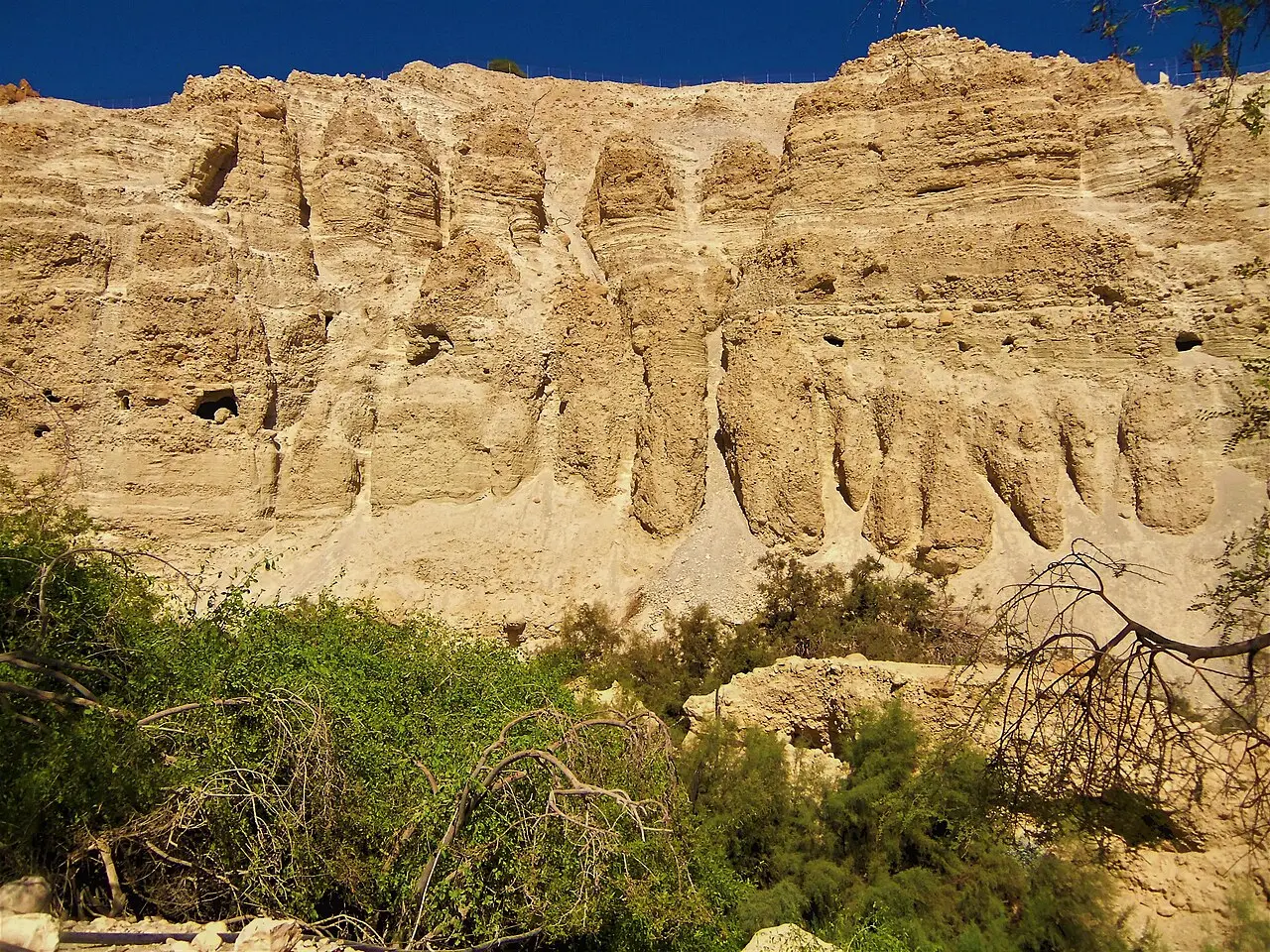
The parks authority called the flood an extreme event, unlike anything seen in the area for many years. Ynet reported on 8 May 2025 that about 35 millimetres of rain fell in a very short period; that many trails were washed away entirely and others badly eroded; that the ancient synagogue was flooded and would need conservation work; and that footbridges, railings, steps, signage, roads, power, water, sewage and public toilets were all hit. Rare plants were damaged. The reserve closed completely.
What is open in August 2026 depends on which of the operator's pages is read. The English page still carries a notice saying Wadi David is open only along the accessible path to the first waterfall, a walk of about five minutes each way, and that all other areas including the Ein Gedi Spring and Dodim Cave remain closed until further notice. The Hebrew page, which is updated more often, describes the same shortened Nahal David walk as about ten minutes, and then goes on to offer a strenuous three-hour route from Tel Goren up to the Ein Gedi Spring, Dodim Cave and Gev Halon, with entry from 08:00 and last admission at 10:00. Those two statements cannot both be current. Telephone *3639 before setting out, which both pages ask visitors to do.
Nahal Arugot is open and altered. The parks authority's own trail article, published in January 2026, is candid about what floods do to it: the upper pools were blocked and emptied by the May 2025 flood, then the floods of December 2025 filled one of them to about two metres, while the deep pool under the Hidden Waterfall was itself temporarily blocked. The waterfall is about eight metres high; as of mid-January 2026 the authority reported it flowing but its pool dry. The advice on the page is to ask the rangers at the gate what the pools are doing that week.
Restoration is not finished and the authority does not pretend it is: its Hebrew page says work is continuing and that it hopes to open further parts of the reserve soon. Treat any published trail list, this one included, as a description of Ein Gedi in normal times rather than a promise about the day of the visit.
- Open: Nahal Arugot to the Hidden Waterfall and the upper pools, graded for fit walkers
- Open: the En Gedi Antiquities site and synagogue, on the usual hours
- Shortened: Nahal David, to the first waterfall only on the accessible path
- Disputed between the operator's own pages: the Ein Gedi Spring, Dodim Cave and Gev Halon route
- Booking: advance reservation for each area separately, per the parks authority
Fabric
What is wild here, and what was put back by hand
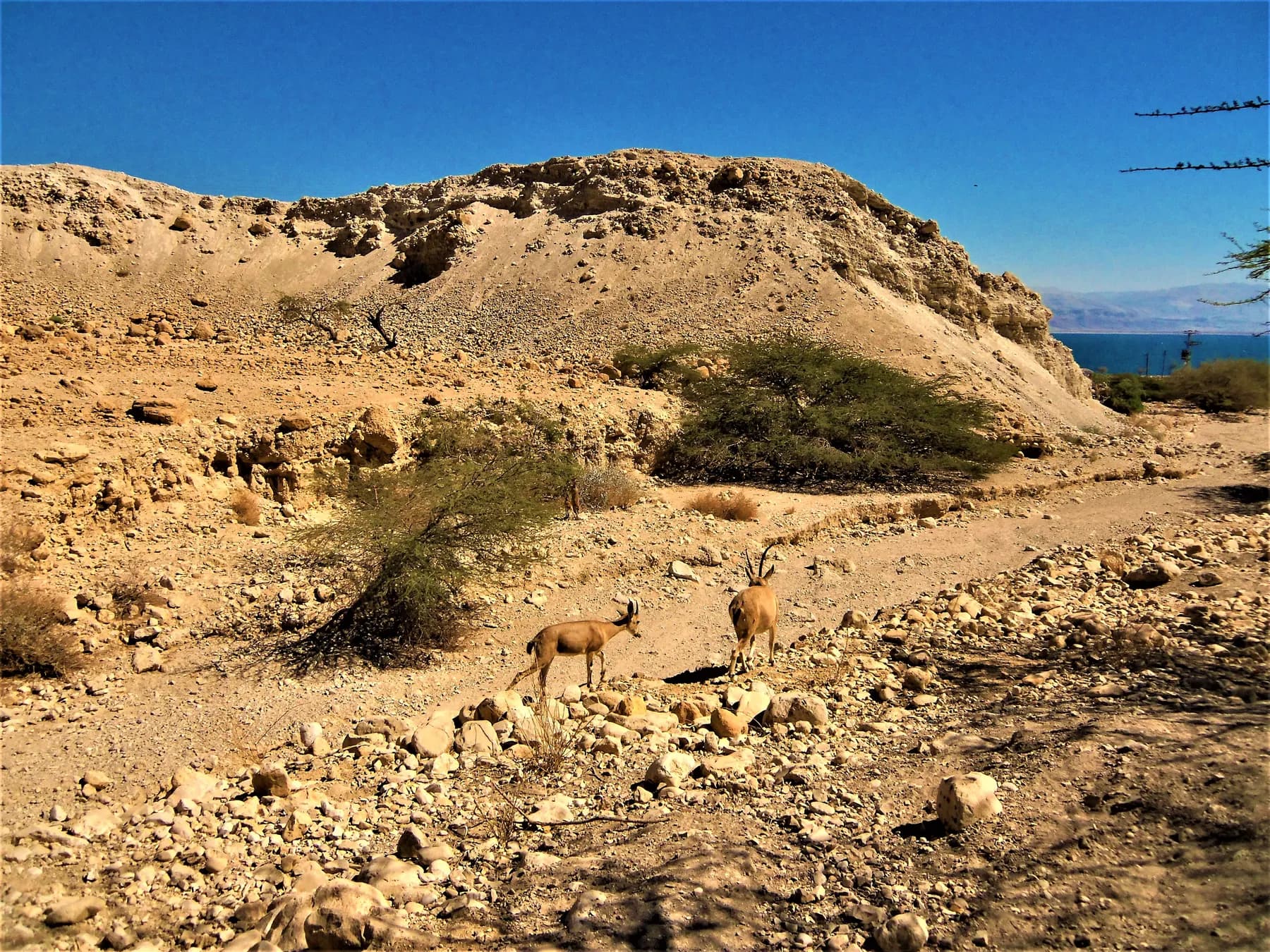
The animals people come for are genuinely wild and genuinely easy to see. Nubian ibex and rock hyraxes live along the lower paths of both canyons and often sit within a few metres of the accessible trail in Nahal David. The ibex is here because of a law: the parks authority's brochure records that Judaean Desert ibex were hunted to the brink of extinction, that the Wild Animal Protection Law of 1955 turned that round, and that the head of an ibex was put into the authority's own emblem in recognition of the rescue. Male ibex rut between September and November and the kids are born between March and April.
The leopards are the harder question. The brochure lists the leopard among the reserve's nocturnal mammals and says that although sightings are rare, footprints, diggings and droppings can sometimes be found. The parks authority's January 2026 trail article puts it in the past tense instead: several leopards called Nahal Arugot home in the early 2000s, probably 200 to 250 of this small desert subspecies survive worldwide, mostly in Yemen, Oman and Saudi Arabia, and the Israeli population at its peak was estimated at 10 to 20 animals.
Some of the botany is not original either, and the parks authority says so. None of the Jericho balsam trees that stood in the reserve in the 1940s survives. The Jericho balsam growing at Ein Gedi today was raised from seed collected in the balsam groves near Ma'oz Chaim in the northern Jordan Valley and planted here in 1962. It is a nature reserve with a replanting date, and knowing it changes what the grove is.
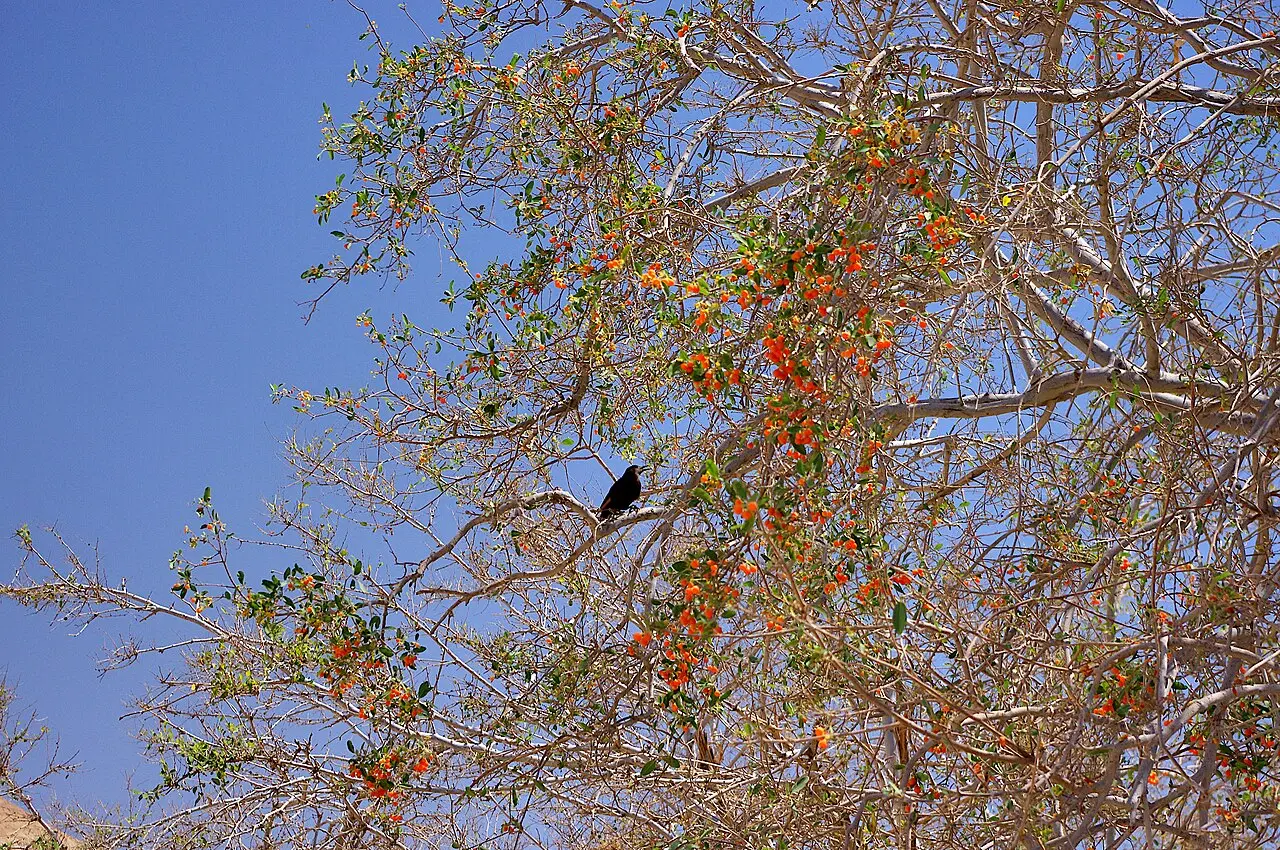
The rarities that are original are worth the detour. About ten specimens of Maerua crassifolia are left in Israel, and five of them are in this reserve. Ein Gedi also holds the country's largest concentration of Cordia sinensis, whose sticky orange fruit feeds Tristram's grackle, bulbuls and fruit bats. For several tropical species the oasis is simply the northernmost point at which they grow at all, which is the sentence that explains why a fourteen square kilometre patch of desert has a national reserve wrapped around it.
Jan Helebrant / CC0 · Wikimedia Commons
The past
A temple above the spring, and a hoard nobody can tie to it
Above the Ein Gedi spring, on the crest of a cliff looking out over the Dead Sea and the mountains of Moab, stand the walls of a Chalcolithic temple built roughly five thousand years ago. Yohanan Aharoni found it in a survey in 1956, Yosef Naveh dug a trial trench the following year, and systematic excavation began in 1962 within Benjamin Mazar's project for the Hebrew University of Jerusalem and the Israel Exploration Society, with David Ussishkin supervising the temple itself. The enclosure has a main northern building, a smaller eastern one, a circular installation about three metres across and two gatehouses giving on to the springs.
It is bound up with the most famous hoard in Israeli archaeology, and the binding is contested. In 1961 Pessah Bar-Adon found 429 objects, 416 of them copper, in a cave in Nahal Mishmar to the south; the parks authority's brochure describes them flatly as ceremonial vessels that had apparently been used in this temple, and they are on show at the Israel Museum in Jerusalem. Ussishkin proposed the link in 1971 and it became the standard reading. The objection is simple and has never been answered: not a single find directly connects the hoard to the temple, and Bar-Adon himself suggested ruins nearer the cave as the source.
The reserve holds a long settlement history besides. Tel Goren, excavated by Mazar between 1961 and 1965, carries remains from the Iron Age, the Persian, Hellenistic and Roman periods, and the ovens and vessel fragments found in its courtyards are read as the residue of the balsam perfume industry that made Ein Gedi rich and secretive. Two water-powered flour mills survive from the Mamluk period, one of them beside the Ein Gedi spring. The parks authority notes that David is said to have hidden from Saul at Ein Gedi, and adds that there are no archaeological finds to support the story.
The most recent thing worth stopping at is a memorial. At the foot of the path up to the Ein Gedi spring near Tel Goren stands a curved concrete bench in the shape of people sitting round a campfire, designed in 1972 by the architect Dan Zur, whose brother was among the dead. On 9 April 1942 seven Hashomer Hatzair members of about seventeen and their Palmach escort were killed at Ein Gedi when hand grenades exploded beside a campfire during a Passover trek to Masada. How the grenades reached the fire has never been established.
What to look for
Things not to walk past at Ein Gedi Nature Reserve
The details that repay knowing about before you are standing in front of them.
The accessible path in Nahal David
About half a kilometre of wheelchair-usable trail with rest and viewing areas, an audio station and a lookout over the waterfall above the pool the parks authority calls the Olympic. Ibex and hyraxes graze beside it under acacia shade.
David's Waterfall
The perennial fall at the head of the lower Nahal David walk, timed by the parks authority at about an hour from the ticket office in normal conditions. Since the 2025 flood the walk has been cut back to the first waterfall only.
The Hidden Waterfall, Nahal Arugot
About eight metres of water dropping into a canyon pool 2.2 kilometres up the red trail, roughly an hour to an hour and a half from the gate. Whether the pool below it is deep, shallow or blocked with gravel changes with every flood.
Dodim Cave
A small wet cave above David's Waterfall, reached on a strenuous route that includes a descent on metal rungs, with maidenhair ferns hanging over clear water. Check before travelling: the operator's English and Hebrew pages disagree about whether it is open.
The Chalcolithic temple
Five-thousand-year-old enclosure walls on the cliff crest above the Ein Gedi spring, with the Dead Sea and the mountains of Moab laid out beyond. Its ritual vessels are thought by many, though not all, to be the Nahal Mishmar hoard in the Israel Museum.
The campfire memorial
A curved concrete bench near Tel Goren, built in 1972 in the shape of people sitting round a fire, for the seven Hashomer Hatzair hikers and their escort killed by a grenade explosion here on 9 April 1942.
The long view
Ein Gedi Nature Reserve, in order
c. 3500 BCE
A temple is built on the cliff above the Ein Gedi spring in the late Ghassulian stage of the Chalcolithic period, overlooking the Dead Sea.
7th century BCE
A permanent settlement is established at Tel Goren under the kings of Judah, irrigating fields from the springs and, on the excavated evidence, processing balsam for perfume.
68 CE
Josephus records zealots from Masada raiding Ein Gedi at Passover for agricultural supplies and killing 700 women and children.
130–135 CE
During the Bar Kokhba revolt the Dead Sea region supplies the rebels; letters found in Nahal Hever record Bar Kokhba complaining that Ein Gedi was not sending enough.
Mid-6th century CE
The Jewish village at Ein Gedi is destroyed by fire and abandoned, its synagogue mosaic left under the debris.
13th–14th centuries CE
A small Mamluk village works a water-powered flour mill beside the Ein Gedi spring. Its remains still stand.
9 April 1942
Seven Hashomer Hatzair members of about seventeen and their Palmach escort are killed at Ein Gedi when hand grenades explode beside a campfire on a trek to Masada.
1953
Kibbutz Ein Gedi is founded about a kilometre from the oasis, growing dates, bananas and early vegetables on the spring water.
1956
Yohanan Aharoni finds the Chalcolithic temple during a survey; Yosef Naveh digs a trial trench in 1957.
1961
Pessah Bar-Adon excavates 429 objects, 416 of them copper, from a cave in Nahal Mishmar to the south. Their connection to the Ein Gedi temple is proposed a decade later and still cannot be demonstrated.
1961–1965
Benjamin Mazar excavates Tel Goren, a burial cave, a lime kiln and a Roman bathhouse, and from 1962 the Chalcolithic temple, with David Ussishkin supervising the temple.
1962
Jericho balsam is replanted in the reserve from seed collected near Ma'oz Chaim in the northern Jordan Valley. None of the trees that stood here in the 1940s survives.
1971
Ein Gedi is declared a protected nature reserve, covering 14,350 dunams.
1972
The architect Dan Zur, whose brother died in the 1942 disaster, designs the concrete campfire memorial that stands near Tel Goren.
8 May 2025
Ynet reports an extreme flash flood after about 35 mm of rain: trails washed away, the ancient synagogue flooded, infrastructure destroyed and the reserve closed to visitors.
December 2025
Further floods reshape Nahal Arugot again, filling one upper pool to about two metres while temporarily blocking the pool under the Hidden Waterfall.
Practical
Visiting Ein Gedi Nature Reserve
Where
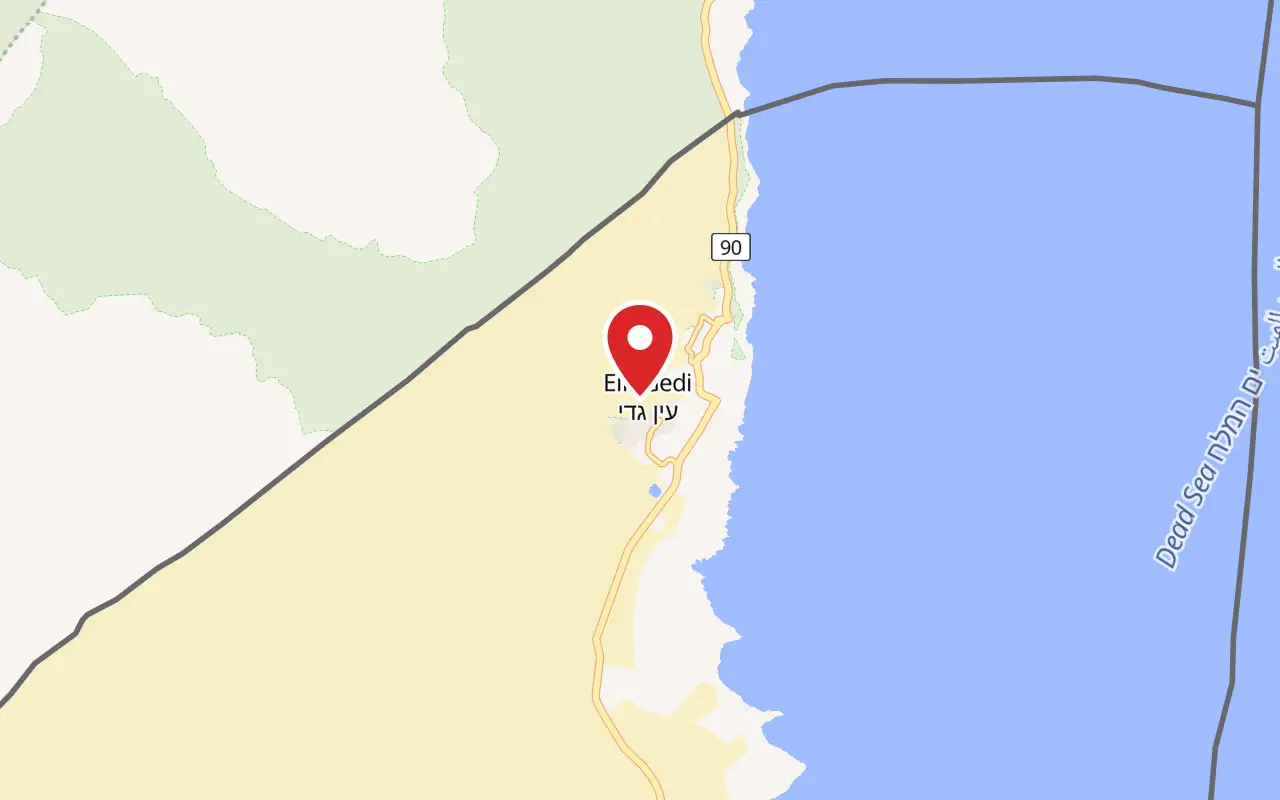
Route 90 (Dead Sea road), about 1 km north of Kibbutz Ein Gedi
What ticket you need
This page covers the nature reserve, which is a different ticket from the En Gedi Antiquities site around the synagogue: the reserve is ₪31 for an adult and the antiquities alone are ₪16. A ticket bought for any one of Nahal David, Nahal Arugot or the antiquities admits the holder to all three on the same day, so the cheap antiquities ticket does not work the other way round.
Opening hours
- Summer, Sunday to Thursday and Saturday
- 08:00 to 17:00source
- Summer, Friday and holiday eves
- 08:00 to 16:00source
- Winter, Sunday to Thursday and Saturday
- 08:00 to 16:00source
- Winter, Friday and holiday eves
- 08:00 to 15:00source
- Rosh Hashanah eve, Passover eve and Yom Kippur eve
- 08:00 to 13:00source
- Last entry to the reserve
- one hour before the closing time listedsource
- Last entry to the Nahal Arugot trail
- three hours before closing, which the English page gives as 14:00source
- Ein Gedi Spring and Dodim Cave route, where open
- opens 08:00, last entry 10:00; leave Dodim Cave by 14:30 and the spring by 15:00source
Admission
Access
Partly good, and honest about where it stops. The parks authority has made the main entrance, its car park, service station and toilets accessible, and built about half a kilometre of wheelchair-usable trail in Nahal David with rest bays, an audio station and a lookout over the waterfall. An accessible promenade with benches, handrails on the steeper sections and parking bays runs between the Nahal David and Nahal Arugot entrances, gently graded as far as the synagogue and steeper after it. At the synagogue, concrete paths reach into the ancient building itself, but the compacted paths through the ancient village are described as unsuitable for wheelchair users. Beyond the accessible section, Nahal David and the whole of Nahal Arugot are natural ground following the streambed and cannot be done on wheels; the upper routes involve climbing, and the descent to Dodim Cave uses metal rungs. Service animals are not permitted in the reserve, and the authority offers only a cage at the entrance for the duration of a visit.
On site
- Ticket offices at Nahal David, Nahal Arugot and the antiquities gate
- Car parks at each gate
- Visitor service stations
- Accessible toilets
- Drinking water at the entrance only
- Shaded picnic areas at the entrance
- Kiosk
- Souvenir shop
- No dogs, and no service animals
Booking
The parks authority requires a reservation in advance for Nahal David and for Nahal Arugot, booked separately, through its own booking system. Its Hebrew page currently says advance registration is needed for each area of the reserve; its English page says the En Gedi Antiquities site needs no reservation and can be paid for at its own gate. Telephone *3639 for current trail conditions before travelling, which both pages ask visitors to do.
Hours and prices are given as the operator publishes them and change without much notice, particularly around Shabbat and the festivals. Check the operator's own page before you travel for this.
Official page at en.parks.org.il →What people wish they had known
- The gate shuts an hour before the closing time the parks authority prints, and Nahal Arugot has its own earlier cutoff three hours before closing. Arriving at 15:00 on a summer afternoon means the antiquities and nothing else.
- Book each area separately. Nahal David and Nahal Arugot are two reservations, not one, and turning up at the Arugot gate on a David booking is a wasted drive.
- Nahal David is not currently the walk the guidebooks describe. Since the 2025 flood it runs only as far as the first waterfall, so anyone whose plan is a canyon hike should be booking Nahal Arugot instead.
- Fill water bottles before going through the gate. The parks authority puts the filling points at the entrance only, and asks for three litres a person on the upper routes.
- Eating is not allowed inside the reserve at all. The picnic tables are outside the entrance, which catches out people who packed lunch for a waterfall.
- Dogs are banned, and so are service animals, which is unusual and worth knowing in advance. The authority offers a cage at the entrance for the length of the visit.
The figures
Ein Gedi Nature Reserve by the numbers
Each figure carries the year it belongs to and links the source it came from.
| Measure | Figure | As of | Source |
|---|---|---|---|
| Adult admission to the reserve | ₪31 (child ₪16, student ₪26, Israeli senior ₪16) | 2026 | en.parks.org.il |
| Area of the reserve | 14,350 dunams (1,435 hectares), declared 1971 | 2026 | static.parks.org.il |
| Combined output of the four springs | about 3 million cubic metres a year | 2026 | static.parks.org.il |
| Catchment feeding each canyon | about 18 sq km for Nahal David, about 200 sq km for Nahal Arugot | 2026 | static.parks.org.il |
| Maerua crassifolia surviving in Israel | about ten specimens, five of them in this reserve | 2026 | static.parks.org.il |
| Rain in the flash flood that closed the reserve | about 35 mm in a very short period | 2025 | ynetnews.com |
| Visitors to the reserve | about 318,000 in 2024, against roughly 700,000 in 2019 | 2024 | ynetnews.com |
| Height of the Hidden Waterfall, Nahal Arugot | about 8 metres, 2.2 km up the red trail from the gate | 2026 | parks.org.il |
While you are here
The rest of The Dead Sea
Everything else in this destination with a page of its own.
ישראל פרקר Israel Preker / CC BY 2.5 · Wikimedia Commons
Archaeological site
Ein Gedi Ancient Synagogue
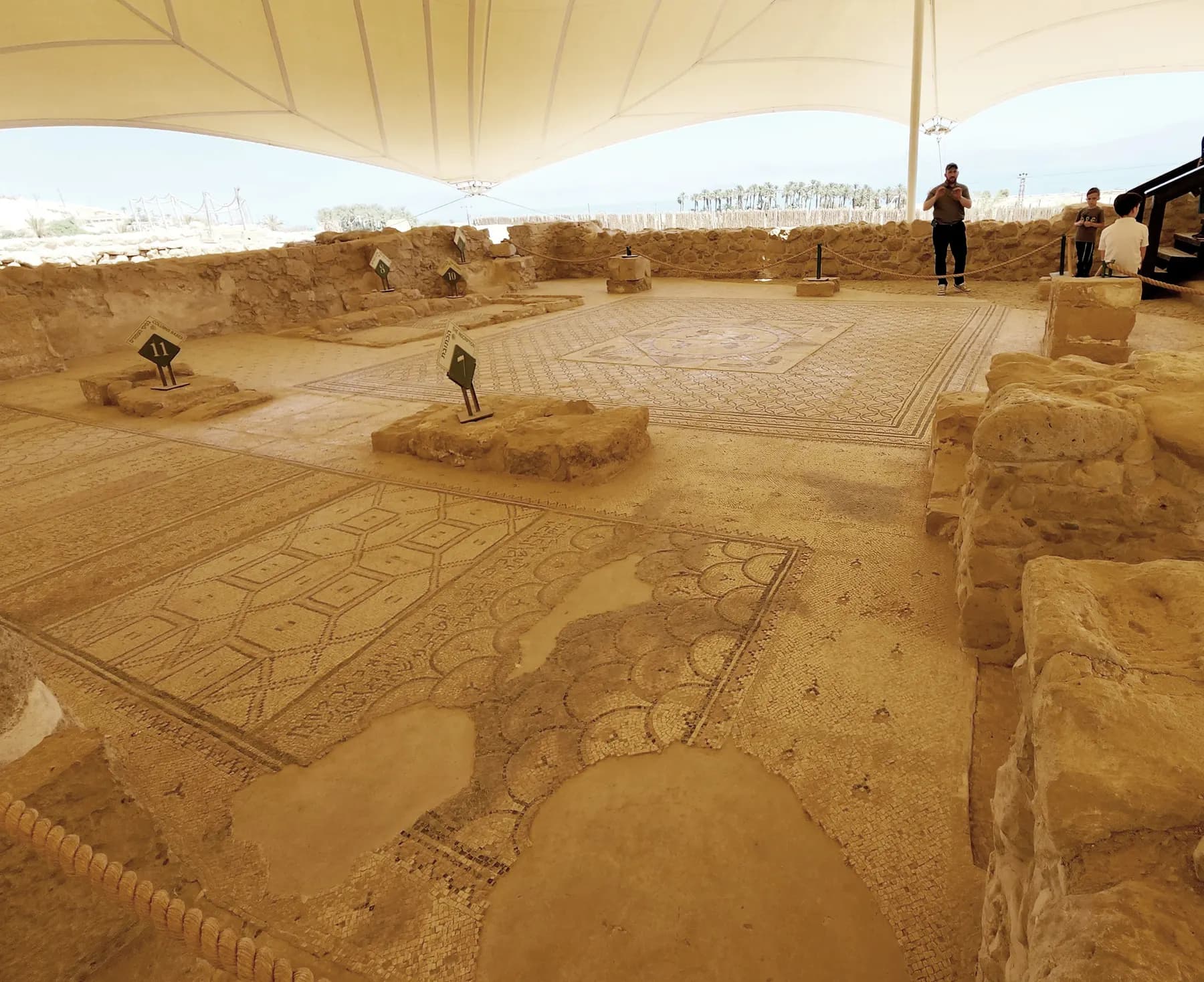
The mosaic floor of this village synagogue carries a Judeo-Aramaic curse on anyone who reveals the secret of the town, and the parks authority's own brochure suggests the secret was how to grow and process balsam.
ישראל פרקר Israel Preker / CC BY 2.5 · Wikimedia Commons
Nature reserve
Ein Gedi Botanical Garden
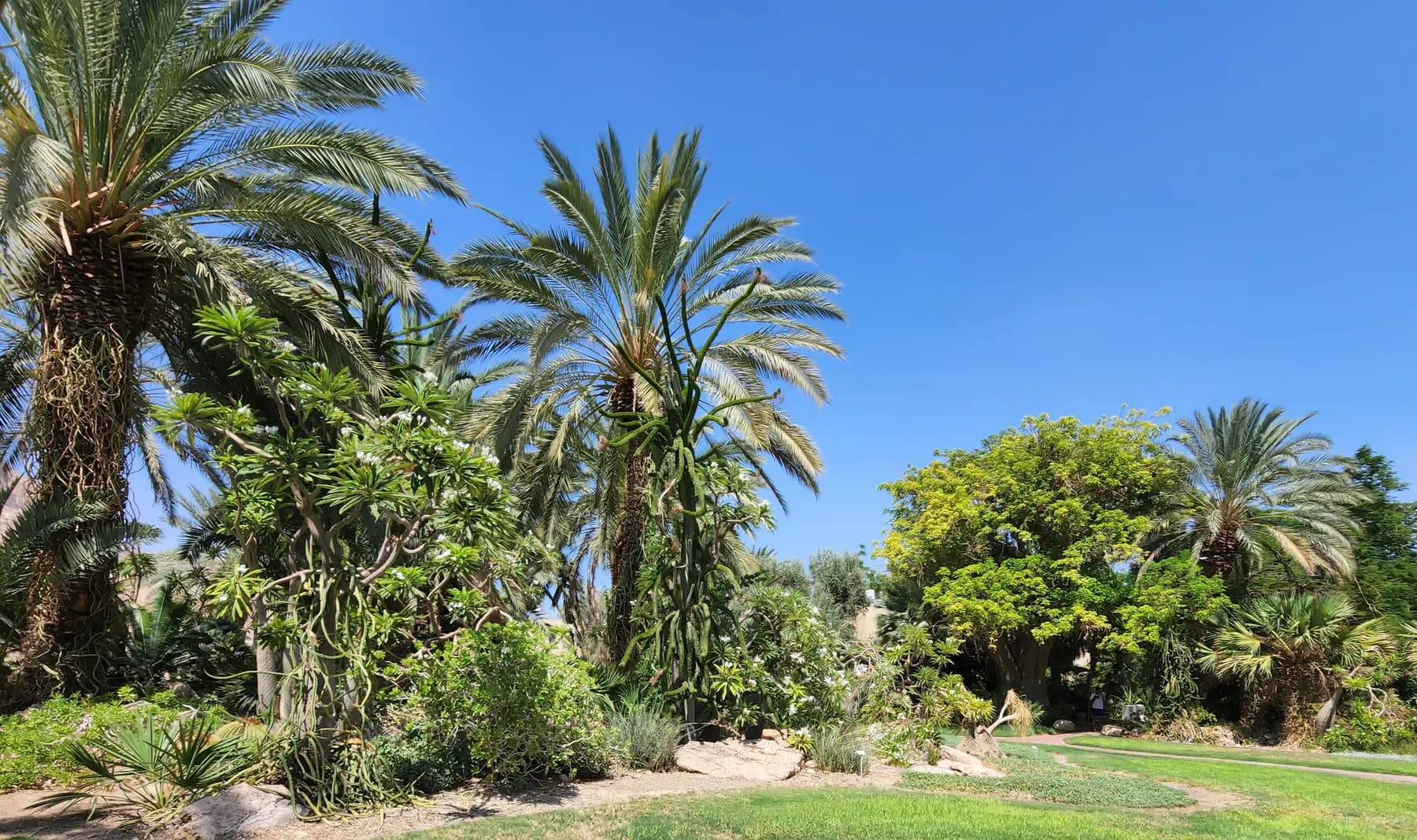
About 80 date palms went into a bare plateau south of Nahal Arugot in April 1959, and the collection that grew out of them was catalogued in the 1980s at more than 900 species, with a kibbutz of some 700 people living inside it.
DinaKuzia / CC BY-SA 4.0 · Wikimedia Commons
Nature reserve
Einot Tzukim (Ein Feshkha) Nature Reserve
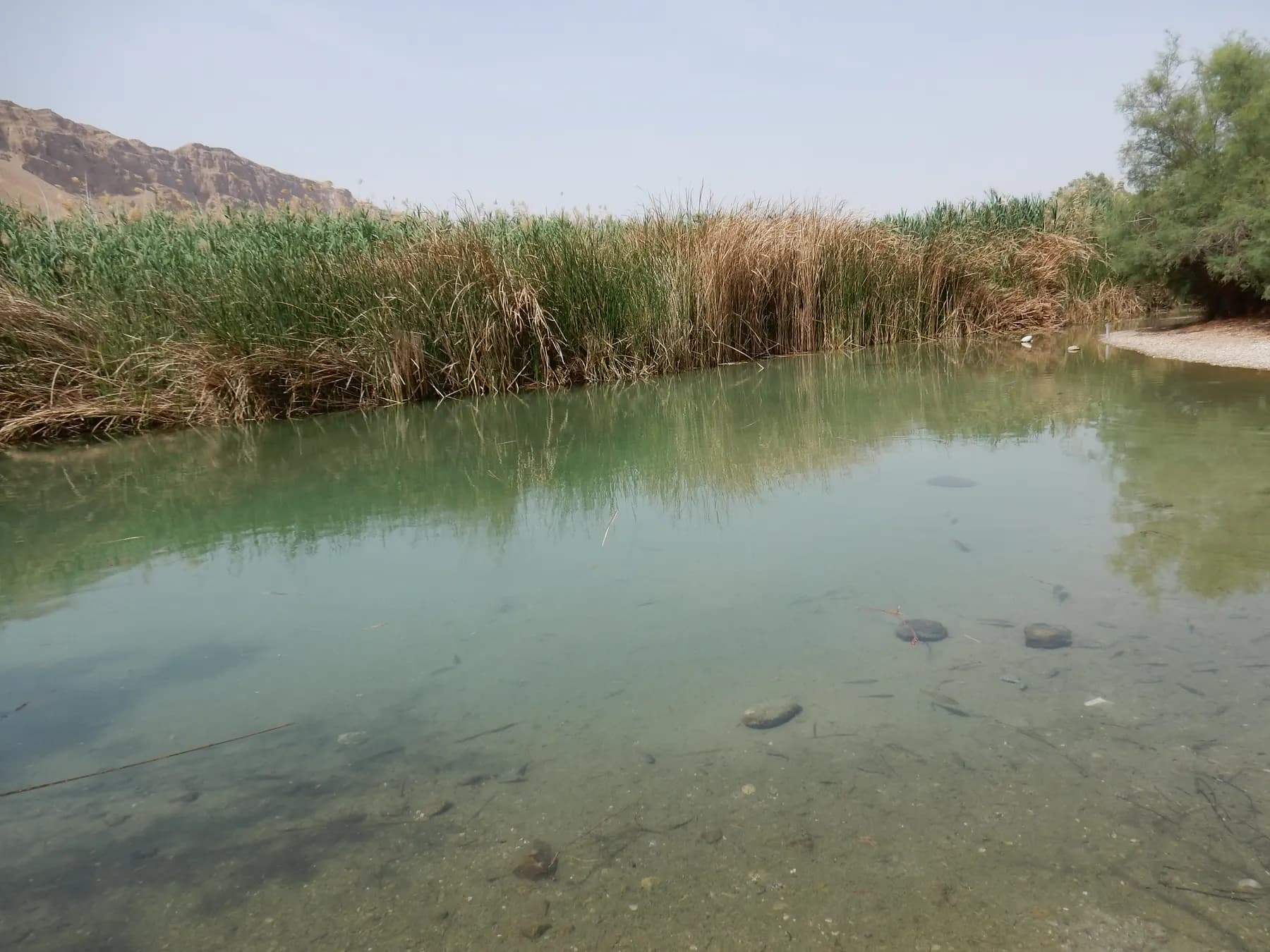
Brackish springs surface at the foot of the escarpment here and run into pools you can get into, and the Israel Nature and Parks Authority puts the point where they emerge at 390 metres below sea level.
Sources and further reading
Every link below was opened and checked when this page was written. Official statements are marked as such: they are the subject's own account, not an independent one.
- OfficialIsrael Nature and Parks Authorityen.parks.org.ilEn Gedi Nature Reserve
Summer and winter opening hours, the one-hour entry cutoff and the 14:00 last entry to Wadi Arugot, the full fee table (₪31/₪16/₪26/₪14, antiquities ₪16/₪7), the division of the reserve into three separately booked areas with one ticket good for all three, the accessible half-kilometre trail in Wadi David, the ban on dogs and service animals, and the standing notice that Wadi David is open only to the first waterfall while the Ein Gedi Spring and Dodim Cave remain closed
- OfficialIsrael Nature and Parks Authorityparks.org.ilשמורת טבע עין גדי (En Gedi Nature Reserve, Hebrew site)
The more recent closure notice: several extreme flood events over the past year, advance registration for each area, Nahal David shortened to about ten minutes, a strenuous three-hour route from Tel Goren to the Ein Gedi Spring, Dodim Cave and Gev Halon with last entry at 10:00, the red and blue trails in Nahal Arugot, the fuller fee table, the accessibility provision area by area, Shvil HaNaveh, the ascents, Tel Goren, the Chalcolithic temple and the 1942 memorial
- OfficialIsrael Nature and Parks Authoritystatic.parks.org.ilEn Gedi Nature Reserve visitor brochure (PDF)
Area of 14,350 dunams (1,435 hectares) and declaration in 1971; the four springs and their combined 3 million cubic metres a year; recharge from rain on the Judean Mountains; the statement that a significant amount of spring water is trapped and used by Kibbutz En Gedi and that the oasis flora has been greatly diminished as a result; catchments of about 18 and 200 square kilometres; Michael Zohary on the 1920s groves; the 1962 replanting of Jericho balsam from Ma'oz Chaim seed; five of Israel's ten Maerua crassifolia; the largest concentration of Cordia sinensis in Israel; the ibex rescue and the 1955 Wild Animal Protection Law; the graded trail table; and the history panels from the Chalcolithic era to the Mamluk period
- OfficialIsrael Nature and Parks Authority (Eyal Shapira), 11 January 2026parks.org.ilהפתעות בנחל ערוגות: מסלול אתגרי וטבילות בשמורת טבע עין גדי
Nahal Arugot at 4.5 km to the Hidden Waterfall and back or 7 km to the upper pools, three to five hours; the red dry trail and the blue wet trail; 2.2 km and about an hour to an hour and a half to the Hidden Waterfall; the waterfall at about 8 metres with its pool dry as of 12 January 2026; the upper pools blocked and emptied in May 2025 and one refilled to about two metres by the floods of December 2025; the reserve at about 14,350 dunams; and the leopards of the early 2000s with the subspecies figures
- OfficialIsrael Nature and Parks Authority, 26 September 2025parks.org.ilמסלול מתל גורן למעיין עין גדי מערת דודים וגב חלון
The strenuous Tel Goren route of about three hours, the descent to Dodim Cave on metal rungs, the maidenhair ferns in the cave, the Ein Gedi spring rising at the foot of an old jujube with an irrigation system now restoring the vegetation, the Chalcolithic temple viewpoint over the Dead Sea and Moab, three litres of water per person, water points at the entrance only, no eating inside the reserve, and booking in advance at the David, Arugot or antiquities ticket offices
- ReportingYnetnews, 8 May 2025ynetnews.comSevere damage to Ein Gedi Nature Reserve, which will remain closed following flash flood
About 35 mm of rain in a very short period, described by the parks authority as an extreme event unlike anything seen in the area for many years; trails washed away and eroded; the ancient synagogue flooded and needing conservation; bridges, railings, steps, signage, roads, power, sewage, water and toilets damaged; rare plants harmed; the reserve closed until restoration is complete; and visitor figures of about 318,000 in 2024 against roughly 700,000 in 2019
- ReferenceWikipediaen.wikipedia.orgChalcolithic temple of Ein Gedi
Discovery by Yohanan Aharoni in 1956, Yosef Naveh's trial excavation in 1957 and systematic excavation from 1962 under Benjamin Mazar for the Hebrew University and the Israel Exploration Society; the plan of the enclosure with its northern and eastern buildings, circular installation and two gatehouses; dating to about 3500 BCE; Bar-Adon's 1961 discovery of 429 objects, 416 of them copper, in Nahal Mishmar; Ussishkin's proposed link; and the objection that no single find directly connects the hoard to the temple
- ReferenceWikipediaen.wikipedia.orgEin Gedi (archaeological site)
Benjamin Mazar's excavations at Tel Goren from 1961 to 1965, including a burial cave, a lime kiln, a Roman bathhouse and the Chalcolithic temple; the strata from the Iron Age through the Roman, Byzantine and Mamluk periods; and the balsam perfume production facilities
- ReferenceWikipediaen.wikipedia.orgEin Gedi Nature Reserve
The reserve declared at the end of 1971 and expanded in 1988, given here as 14,000 dunams against the operator's 14,350; the elevation range from the Dead Sea shore to the Judean Desert plateau; the four springs; the tropical, desert, Mediterranean and steppe vegetation; the Nubian ibex and rock hyrax; and the Chalcolithic shrine, Tel Goren and the two Mamluk flour mills inside the reserve
- ReferenceEncyclopaedia Britannicabritannica.comEn Gedi
En Gedi as a spring in an otherwise totally arid country on the west bank of the Dead Sea; the Chalcolithic sanctuary of the fourth millennium BCE and occupation from the 7th century BCE through Byzantine times; and Kibbutz Ein Gedi, established in 1953, growing dates, bananas and early vegetables
- ReferenceHebrew Wikipediahe.wikipedia.orgאסון המטיילים בעין גדי (The Ein Gedi hikers disaster)
The disaster of 9 April 1942, in which seven Hashomer Hatzair members of about seventeen and a Palmach escort were killed by hand grenades exploding beside a campfire on a Passover trek to Masada; the note that the sequence that put a grenade in the fire was never established; and the 1972 memorial by the architect Dan Zur, whose brother died there, built as a curved concrete bench in the form of people sitting round a fire, with the original 1943 stone set into it
Ein Gedi Nature Reserve: common questions
Is Ein Gedi Nature Reserve open?+
Yes, but not all of it. The reserve reopened in stages after the flash flood of May 2025, and the parks authority still lists restrictions: Nahal Arugot and the En Gedi Antiquities site are open, while Nahal David runs only as far as the first waterfall on the accessible path. The English and Hebrew pages disagree about the Ein Gedi Spring, Dodim Cave and Gev Halon route, so telephone *3639 before setting out.
How much does it cost to get into Ein Gedi?+
The parks authority lists ₪31 for an adult and ₪16 for a child, with ₪26 for a student or an adult in a group, ₪14 for a child in a group and ₪16 for an Israeli senior citizen. The En Gedi Antiquities site alone is cheaper, at ₪16 for an adult and ₪7 for a child. A ticket to any one of the three areas covers the other two on the same day.
Which is better, Nahal David or Nahal Arugot?+
They are different walks rather than better and worse. Nahal David is short, shaded in places, busy, and reaches David's Waterfall in about an hour in normal conditions; it also holds the only wheelchair-usable trail in the reserve. Nahal Arugot is 4.5 kilometres there and back to the Hidden Waterfall, graded by the parks authority for fit walkers, and much quieter. With Nahal David cut short by flood damage, Arugot is currently the substantial option.
How long do you need at Ein Gedi?+
About an hour for lower Nahal David and three to five hours for Nahal Arugot to the Hidden Waterfall and back, on the parks authority's own timings. Adding the antiquities site takes another half hour or so. Doing both canyons and the synagogue properly is a full day, and the reserve's closing time, not daylight, is the constraint.
Can you swim in the pools?+
Paddling is permitted, and the parks authority marks the reserve as a place where entering the water is allowed. What is actually in the pools varies: the authority's own trail article records the upper Arugot pools being blocked and emptied by the May 2025 flood, one of them refilled to about two metres by the floods that December, and the pool under the Hidden Waterfall dry in mid-January 2026. Ask the rangers at the gate what the water is doing.
Is Ein Gedi wheelchair accessible?+
In part. About half a kilometre of trail in Nahal David is built for wheelchairs, with rest bays, an audio station and a lookout over the waterfall, and an accessible promenade links the Nahal David entrance to the antiquities and on to Nahal Arugot. Concrete paths reach inside the ancient synagogue. Beyond that the canyons follow the natural streambed and the parks authority states plainly that those trails are unsuitable for people using wheelchairs.
Will I see ibex?+
Very probably, and often within a few minutes of the gate. Nubian ibex and rock hyraxes both live along the lower paths of the two canyons and are used to people; the parks authority's accessible trail in Nahal David is laid out with them in mind. Do not feed them, which the authority asks for directly, and keep a distance. Leopards are a different matter: the authority's own 2026 account of Nahal Arugot describes them in the past tense.
Is there any shade?+
Some, in the right places, and not much of it. Acacia trees shade rest corners along the accessible trail in Nahal David, and the blue trail in Nahal Arugot runs in the streambed where the canyon walls and vegetation give cover. The red trail on the northern bank of Nahal Arugot climbs in the open and the parks authority warns against walking it on heat-wave days at all. This is one of the hottest inhabited places in the country, so the first hours after the 08:00 opening are the usable ones.
Can I visit the synagogue on the same ticket?+
Yes. The En Gedi Antiquities site is a separate gate with its own cheaper ticket, but a reserve ticket admits you there the same day, and an antiquities ticket admits you to the canyons the same day too. The parks authority's English page says the antiquities need no reservation and can be paid for at their own entrance, while its Hebrew page currently asks for advance registration to every area.
Is Ein Gedi worth it if I have already been to Masada?+
They answer different questions and the pairing is the standard one, fifteen minutes apart by car on Route 90. Masada is a built site on a rock with no water; Ein Gedi is running water, tropical trees and animals in the same desert. If the trip is short and the reserve is still restricted to the first waterfall in Nahal David, the honest answer is that Nahal Arugot justifies the stop and the shortened Nahal David walk on its own does not.