
Masada · Best time to visit
The best time to visit Masada
On days of extreme summer heat the parks authority stops Snake Path ascents at seven in the morning, which is the published fact that decides when to come.
Walking season
November to March
The five months whose mean daily high at Masada's own coordinates sits between 17.4°C and 24.2°C, over the decade to 2024
Extreme-heat cut-off
07:00
Last Snake Path ascent on days of extreme summer heat, with the last descent an hour later, as the Israel Nature and Parks Authority publishes it
Hottest month
36.9°C
Mean daily high in July on the rock, against 38.5°C at the Dead Sea shore some 450 metres below it
Rain in a year
112 mm
The twelve monthly normals added together, across about 25 days with a millimetre or more, none of them in July or August
Masada is governed by a timetable rather than by a temperature. Hot weather changes the opening hours of the Snake Path, and the Israel Nature and Parks Authority sets those hours from the Israel Meteorological Service forecast: in normal hot weather the last ascent is 10:00 and the last descent 11:00; when the weather is very hot those become 08:00 and 09:00; in extreme summer heat they are 07:00 and 08:00, and the Roman ramp from Arad is the only walking route still open. Almost everything else on this page follows from that ladder.
The normals below were computed at Masada's own coordinates rather than at the lake, which matters more here than at most sites. The summit stands about 450 metres above the Dead Sea, and the figures come out one to four degrees below the shore: a mean daily high of 36.9°C in July on the rock against 38.5°C down at the water. Milder is not mild. August has the warmest nights of the year here, a mean daily low of 25.8°C, so the stone gives its heat back all night and a pre-dawn start in August begins warm. July and August record no rain at all in the ten-year series, and the whole year brings 112 mm.
What that leaves is a walking season from November to March, a shoulder month either side of it that works only if the day starts before light, and three months in which the honest advice is to take the cable car or come back. Laid across it is the Jewish festival calendar, which decides whether the plateau is empty or carrying a share of the 32,000 visits the parks authority counted here in one Sukkot week.
The year
What the weather actually does in Masada
Monthly normals computed from daily reanalysis at this destination's own coordinates, 2015 to 2024. Not a forecast and not an impression.
Month by month
When to go to Masada
January
Best17.4°C by day, 10.4°C at night, 5.3 wet days
The best walking month of the year on the rock, and among the quietest. The heat ladder is irrelevant, so the Snake Path can be started at nine in the morning rather than in the dark, and the plateau at midday is comfortable rather than survivable. It is also near the top of the rain table at 23 mm across about five days, and the parks authority's flooding warning covers winter, so check the forecast before the drive and stay out of the wadi beds. The night show does not run at all between January and April.
February
Best18.9°C by day, 11.2°C at night, 5 wet days
The wettest month in the ten-year normals at 25 mm, which in a place with fewer than 25 wet days in the entire year means a handful of dramatic days rather than a soaked fortnight. Conditions on both paths are as good as they get, and with no festival between Hanukkah and Purim the weekdays are close to empty. The Cisterns Trail at the foot of the ramp closes on and after rainstorms, so it is the one part of the site a wet February can take away. Winter hours still shut the park at 16:00, with the entrance closing an hour before that.
March
Best22.4°C by day, 13.4°C at night, 3.8 wet days
Warm enough for a comfortable dawn and still cool enough at noon, with rain down to 18 mm across under four days. Purim falls on 22 and 23 March in 2027; it is a school holiday that crowds the site midweek rather than a shutdown, and it does not touch the opening hours. Spring is still flood season by the parks authority's own reckoning, and a sharav can drop a summer day into March with almost no notice. The night show remains closed until May.
April
Good27.9°C by day, 17.5°C at night, 2.1 wet days
Excellent before eight in the morning and increasingly hard after ten, which makes April the first month in which the start time decides the visit. Passover runs from 21 to 29 April in 2027 and its intermediate days fill every national park in the country, so book a slot rather than turning up. April is also the month of the Tzafit flash flood of 2018 on this same shore, and a mean of 12 mm at the rock is no guide to what the Judaean hills can send down the wadis. The night show is still out of season.
Godot13 / CC BY-SA 4.0 · Wikimedia Commons
May
Mixed32.4°C by day, 21.2°C at night, effectively no rain
Rain effectively stops at 2 mm and the heat ladder starts to bite, moving the last Snake Path ascent earlier on the hotter days. Dawn is still pleasant, and the ramp path from Arad is the sensible half-hour alternative once the eastern side has shut for the morning. The night show returns on Tuesdays and Thursdays at 20:30, so May is the first month in which a show and a morning climb can be paired. Israeli schools are still in session, which makes weekdays markedly quieter than they will be in July.
June
Hard going35°C by day, 23.6°C at night, effectively no rain
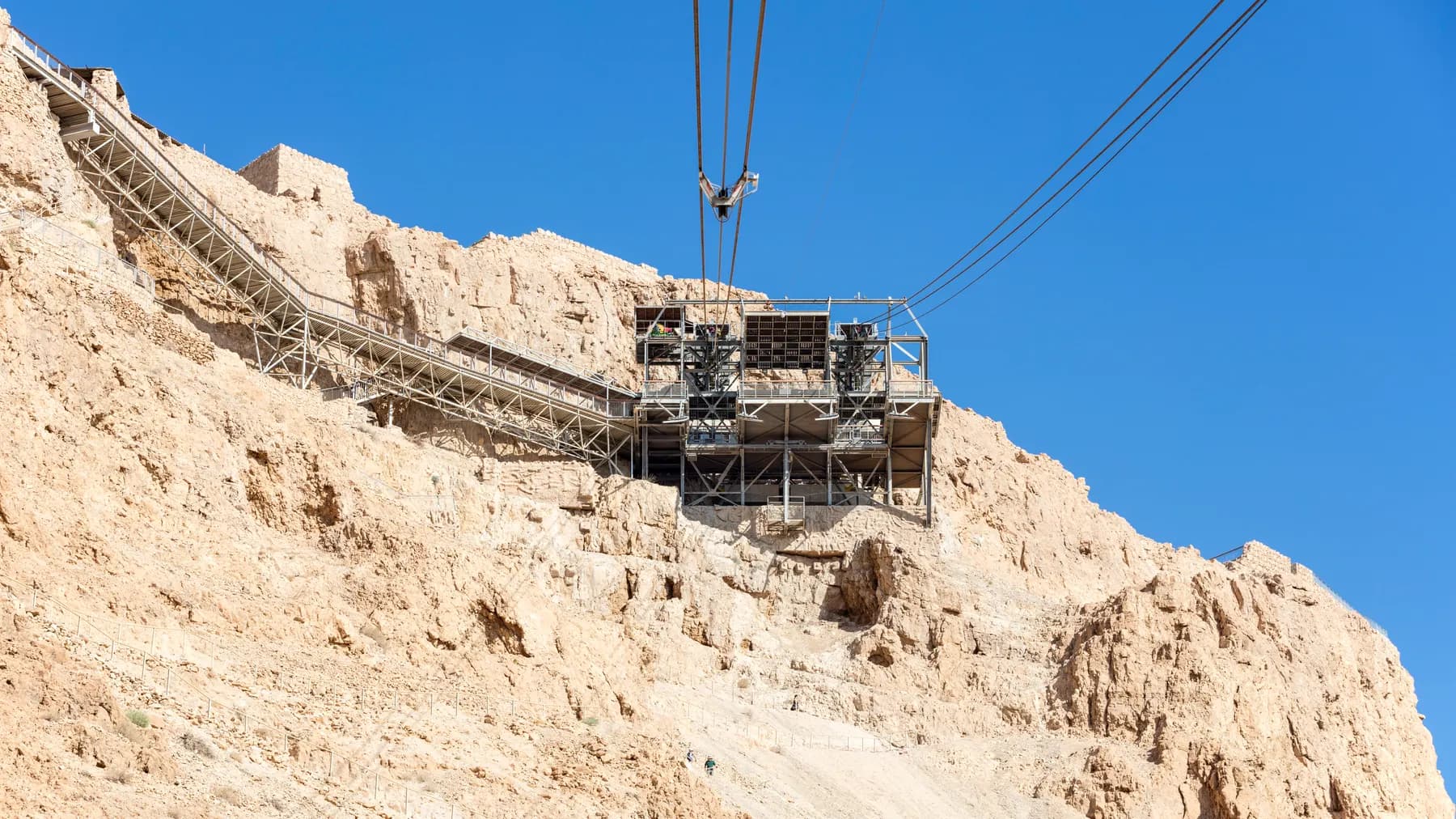
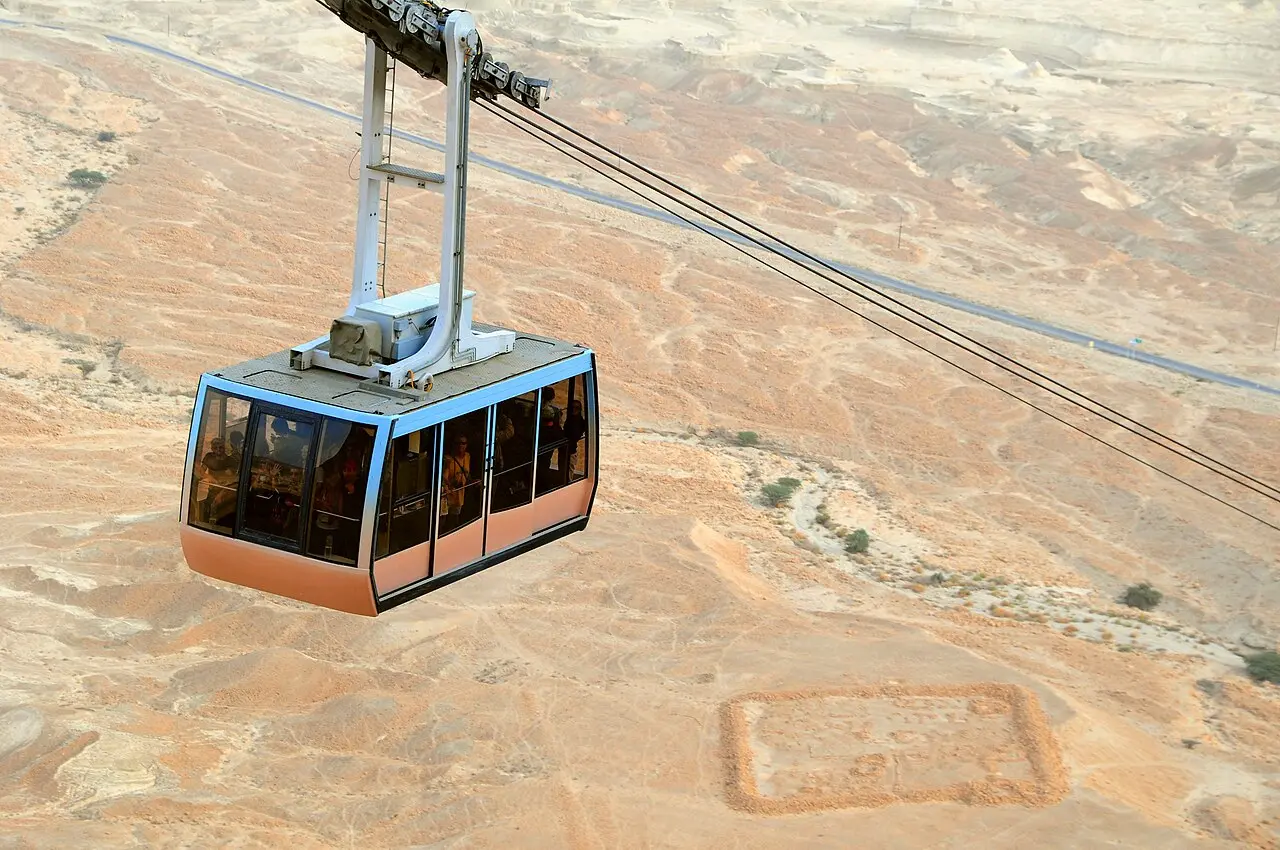
A mean daily high of 35.0°C with essentially no rain, and the month in which Masada becomes a sunrise trip or nothing. The Snake Path opens about an hour before sunrise and the parks authority suggests arriving half an hour before that to buy a ticket, so a realistic start is around half past four in the morning. Anyone unwilling to do that should plan on the cable car, which takes about three minutes and is limited to 65 passengers a trip. The night show runs at 20:30 and is the pleasant half of a June day here.
July
Hard going36.9°C by day, 25.5°C at night, effectively no rain
The hottest month, averaging 36.9°C by day with no rain at all in the ten-year record, and the month in which extreme-heat days push the last Snake Path ascent to 07:00 and the last descent to 08:00, and close the Runner's Path and the Elazar Ascent outright. The Roman ramp holds out until an 11:00 ascent on those days and is the only walking route worth planning around. It is also the school summer holiday, so the cable car and the plateau are busy at exactly the hours when nobody should be on a path. On 17 July 2019 the station at Sedom on this shore recorded 49.9°C.
August
Hard going36.6°C by day, 25.8°C at night, effectively no rain
The genuinely difficult month, and not because of the daytime figure. August has the warmest nights of the year on the rock, a mean daily low of 25.8°C against 29.4°C at the lake, so the stone radiates all night and a pre-dawn climb starts hot rather than cool. There is no rain, no shade on either path and no water on either path. Tisha B'Av falls on 11 and 12 August in 2027, a fast day on which restaurants and places of entertainment close from the previous evening; the night show runs at 21:00 on the other Tuesdays and Thursdays.
Carole Raddato from FRANKFURT, Germany / CC BY-SA 2.0 · Wikimedia Commons
September
Mixed34.2°C by day, 24.6°C at night, effectively no rain
The first half is still summer at a mean 34.2°C, and the second half belongs to the festival calendar. Rosh Hashanah falls on 11 to 13 September 2026 and Yom Kippur on 20 and 21 September, when the country stops: businesses close nationwide and airports and border crossings suspend for roughly 28 to 30 hours. Masada shuts at midday on Yom Kippur eve according to the park page and the cable car page, though the two trail pages say one in the afternoon, so telephone rather than guess. Sukkot begins on 25 September 2026 and the plateau fills from that day.
October
Good29.9°C by day, 21.5°C at night, 1.2 wet days
A month of two halves. Sukkot runs to 2 October in 2026, with Shmini Atzeret and Simchat Torah immediately after it, and during that week Masada carries some of the heaviest domestic traffic of the year: the parks authority counted 32,000 visits here over the Sukkot week of 2022. Once the festival ends, October is one of the best months on the calendar, with a mean daily high of 29.9°C, only 6 mm of rain and the night show still running at 20:30. Winter hours return and the autumn flood warning returns with them.
November
Best24.2°C by day, 16.9°C at night, 3.3 wet days
Arguably the single best month here: 24.2°C by day, comfortable rather than cold before dawn, no heat cut-offs, no festival and no school holiday. Rain is back at 12 mm across about three days, which is enough for the parks authority's autumn flooding warning to apply, so the forecast is worth reading even on a clear morning. The night show moves to 19:30 and is explicitly weather dependent from November onwards. Sunset comes early, so plan the plateau around a 16:00 closing rather than a 17:00 one.
December
Good19.4°C by day, 12.6°C at night, 3.1 wet days
The walking is excellent at a mean daily high of 19.4°C, but the shortest days of the year work against a long visit: the park closes at 16:00 from Sunday to Thursday and on Saturday, the entrance stops admitting an hour before that, and the Snake Path closes to ascent two hours before closing. Hanukkah runs from 4 to 12 December in 2026, a school holiday that fills the site midweek without shortening the hours. Rain is 13 mm across about three days and the flooding warning applies. The night show runs at 19:30 weather permitting, then stops until May.
The table
Every month in figures
| Month | Average high | Average low | Rain | Wet days |
|---|---|---|---|---|
| January | 17.4°C | 10.4°C | 23 mm | 5.3 |
| February | 18.9°C | 11.2°C | 25 mm | 5 |
| March | 22.4°C | 13.4°C | 18 mm | 3.8 |
| April | 27.9°C | 17.5°C | 12 mm | 2.1 |
| May | 32.4°C | 21.2°C | 2 mm | 0.4 |
| June | 35°C | 23.6°C | 1 mm | 0.2 |
| July | 36.9°C | 25.5°C | 0 mm | 0 |
| August | 36.6°C | 25.8°C | 0 mm | 0 |
| September | 34.2°C | 24.6°C | 0 mm | 0.2 |
| October | 29.9°C | 21.5°C | 6 mm | 1.2 |
| November | 24.2°C | 16.9°C | 12 mm | 3.3 |
| December | 19.4°C | 12.6°C | 13 mm | 3.1 |
2015 to 2024 averages at 31.3157, 35.3536, elevation 44 m. Source: European Centre for Medium-Range Weather Forecasts (IFS, ERA5). A wet day has 1 mm of rain or more.
The season
November to March is the season, and the shoulders reward an early alarm
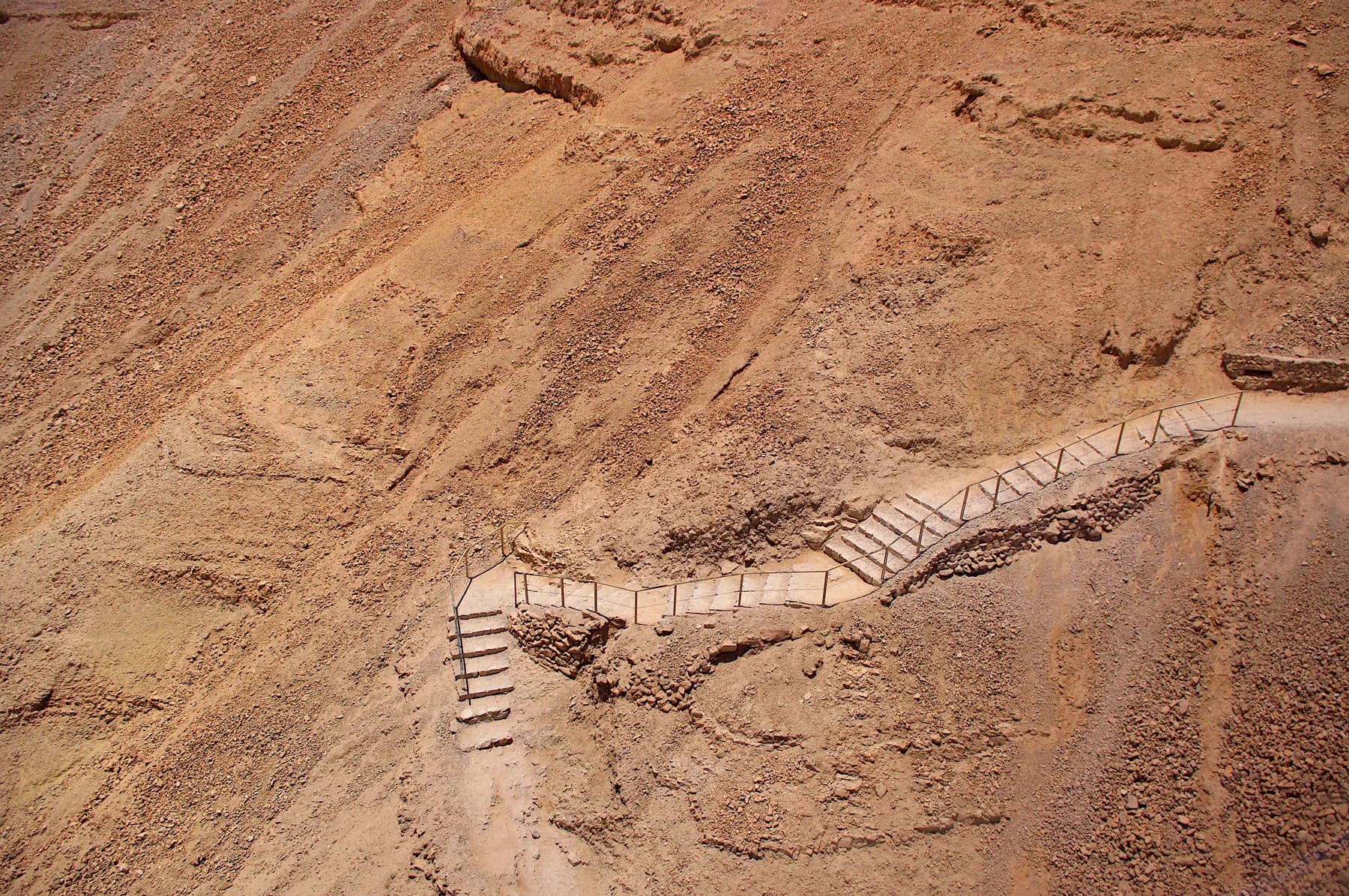
Between November and March the mean daily high on the rock runs from 17.4°C in January to 24.2°C in November, and the heat ladder stops governing the day. The Snake Path is still a serious climb: the parks authority puts it at about 2 km long, 350 metres of ascent and roughly 900 steps, an hour to the top, graded high difficulty. What winter changes is that it can be started at nine in the morning rather than in the dark, and that the plateau at noon is somewhere to linger rather than somewhere to cross.
October and April are the shoulders. Mean daily highs of 29.9°C and 27.9°C are comfortable at dawn and unpleasant by eleven, which makes them early-start months rather than flexible ones. Each also carries a festival that fills every national park in the country: Sukkot usually falls in the first half of October, Passover in April.
Winter takes its price at the other end of the day. The park closes at 16:00 rather than 17:00, entrance closes an hour before that, and the Snake Path shuts to ascent two hours before closing, so a December climb has to begin by 14:00.
Jan Helebrant / CC0 · Wikimedia Commons
The heat
In summer the walking day is over before the gate opens
The park gate opens at 08:00 all year. The paths do not wait for it: the Snake Path opens for ascent about an hour before sunrise, the Roman ramp about half an hour before, and the authority recommends arriving some thirty minutes before that to buy a ticket. In June, July and August that margin is the entire walking day. By the nominal opening hour, an extreme-heat cut-off has already shut the path behind whoever is on it.
On the hottest days the western side is the answer. The Roman ramp trail takes about half an hour, is graded intermediate, and is reached from Arad on road 3199; the bottom of the ramp is only about 60 metres below the summit, which is why the Romans built it there. On extreme-heat days it stays open to an 11:00 ascent when the Snake Path has been closed since seven. The cable car takes about three minutes each way and is limited to 65 passengers of the 80 it can carry, which is worth knowing on a holiday morning when everyone has been pushed off the paths and onto it.
A Judaean Desert summer deserves stating plainly rather than being called warm. July and August average 36.9°C and 36.6°C by day with no rain in the ten-year record, and the August mean daily low of 25.8°C means the night resets nothing. On 17 July 2019 the station at Sedom, on the same shore, reached 49.9°C, the highest measured anywhere in Israel since 1942. There is no shade on either path and no water on either path.
Sarah Murray from South Bend, IN, USA / CC BY-SA 2.0 · Wikimedia Commons
The calendar
Two festival weeks fill the plateau, and one day closes the country
Passover and Sukkot are the dates that most often catch visitors out. Their intermediate days are a school holiday with collective paid leave in many businesses and government offices, and the country goes outdoors together. Over the Sukkot week of 2022 the parks authority counted about 1.5 million visits across its sites, with Ein Gedi at 35,000 and Masada at 32,000; on one Sunday during Passover 2023 it counted roughly 200,000 in a day and shut two national parks to new arrivals once they filled. Booking is the difference between entering and not: the authority says a reservation guarantees entry at the chosen time, and that it will ask to see the confirmation when a slot is full.
The dates move each year with the Hebrew calendar. Sukkot runs from 25 September to 2 October 2026, with Shmini Atzeret and Simchat Torah on the three days after it, and Passover from 21 to 29 April 2027. Hanukkah, 4 to 12 December 2026, and Purim, 22 and 23 March 2027, crowd the site midweek without closing anything, and both land inside the best walking months of the year.
Yom Kippur, 20 and 21 September 2026, closes rather than crowds. Businesses shut nationwide, the roads empty, and services that normally run on holidays, airports and border crossings among them, suspend for about 28 to 30 hours. The day before is shortened too, and the operator's own pages disagree about by how much: the park page and the cable car page list a Yom Kippur eve of 08:00 to 12:00, the Snake Path and Roman ramp pages 08:00 to 13:00. Treat the earlier hour as the real one, or telephone *3639.
The school summer holiday, meanwhile, falls on the months when the mountain is least walkable, so the plateau can be busy on a day when the Snake Path has been shut since seven, because everyone who came up took the cable car.
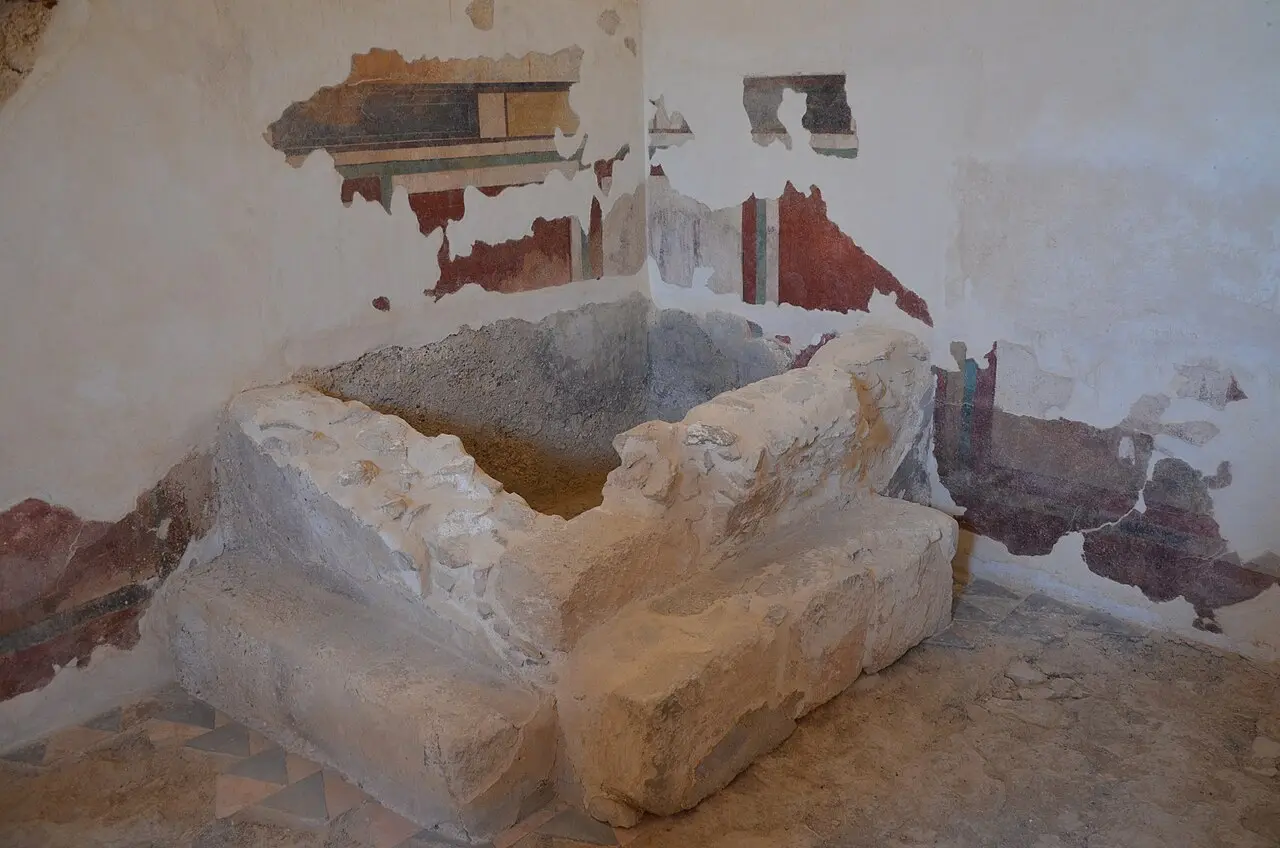
Carole Raddato from FRANKFURT, Germany / CC BY-SA 2.0 · Wikimedia Commons
The hazard
Rain that never falls on Masada still arrives at its foot
The parks authority's notice on the Masada page is unambiguous: in winter, spring and autumn flooding is a danger, visitors should check the weather independently shortly before the visit on the Israel Meteorological Service website or on newscasts, and when flooding appears likely they should not walk in or cross wadi beds. Two wadis cut past the mountain, Wadi Ben Yair on the west and Wadi Masada on the south and east, and Herod's engineers dammed the second to divert flood water into twelve rock-cut cisterns holding 40,000 cubic metres. That system is the proof of the hazard: the catchment is the Judaean hills behind, so 112 mm a year at the rock says nothing about what an hour of rain up there sends down the channel.
The authority applies the same logic to its own shortest walk. The Cisterns Trail at the foot of the ramp, about 200 metres and half an hour there and back, is published as suitable year-round but closed on and after rainstorms because of flooding risk, and on extremely hot days. Those two exceptions bracket the calendar between them.
On 26 April 2018 ten teenagers were killed by a flash flood in the Tzafit riverbed on this shore, and the court that later sentenced the trip's organisers found they had disregarded repeated inclement weather warnings. April carries a mean rainfall of 12 mm at Masada, which is the point: a monthly normal is not a forecast.
The other weather to know is the sharav. The heatwave that took Sedom to 49.9°C in July 2019 came from a sharav depression arriving from North Africa, with relative humidity across the country falling to between 10 and 25 per cent, and the Israel Meteorological Service noted that such a system is unusual in the main summer months and mostly occurs in spring. A March or April day here can therefore behave like a July one on a day's notice.
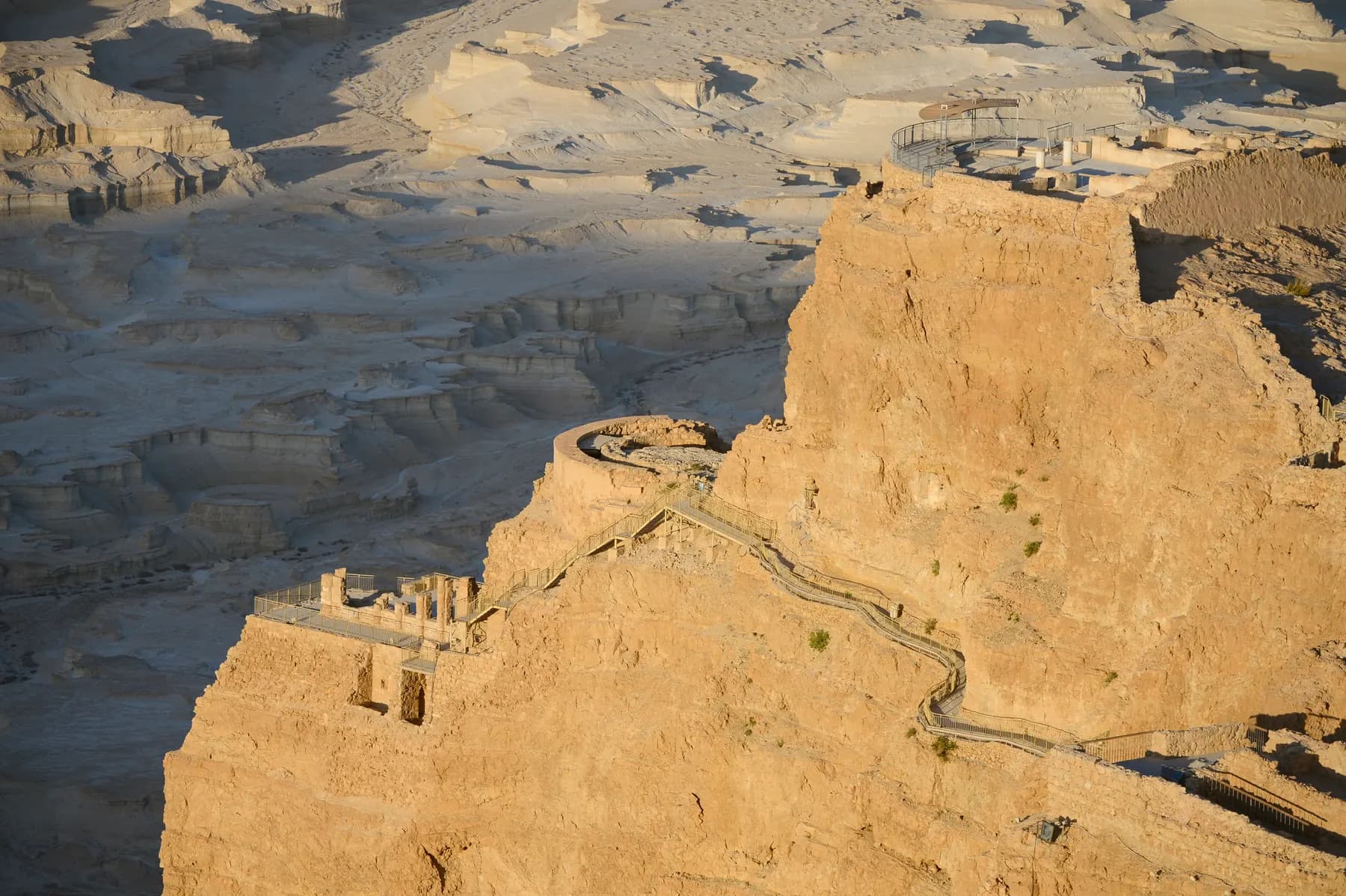
Godot13 / CC BY-SA 4.0 · Wikimedia Commons
After dark
The night show keeps the opposite season to the walking
Masada from Dusk to Dawn is projected onto the mountain's western slope, between the Roman ramp and the northern palace, using video mapping and a score written for it by Shlomo Gronich. It runs on Tuesdays and Thursdays after sunset and lasts about 45 minutes, and its season is the inverse of the walking season: closed from January to April, then 20:30 in May and June, 21:00 in July and August, 20:30 in September and October, 19:30 in November and December. A January visitor gets the best hiking of the year and no show. A July visitor gets the reverse.
The show is on the western side, reached from Arad, as is the Masada West campground, which is why the standard pairing is a show one evening and the ramp path before dawn the next morning rather than a night at the Dead Sea hotels. When the parks authority's pages were checked in 2026 the show was listed at ₪45 for an adult, ₪35 for Matmon club members and campground guests, with translation headphones at ₪15. That pairing is the practical answer to a summer visit: if the walking has to be over by six in the morning and the plateau is unpleasant by ten, the evening is the only other part of the day worth being here for.
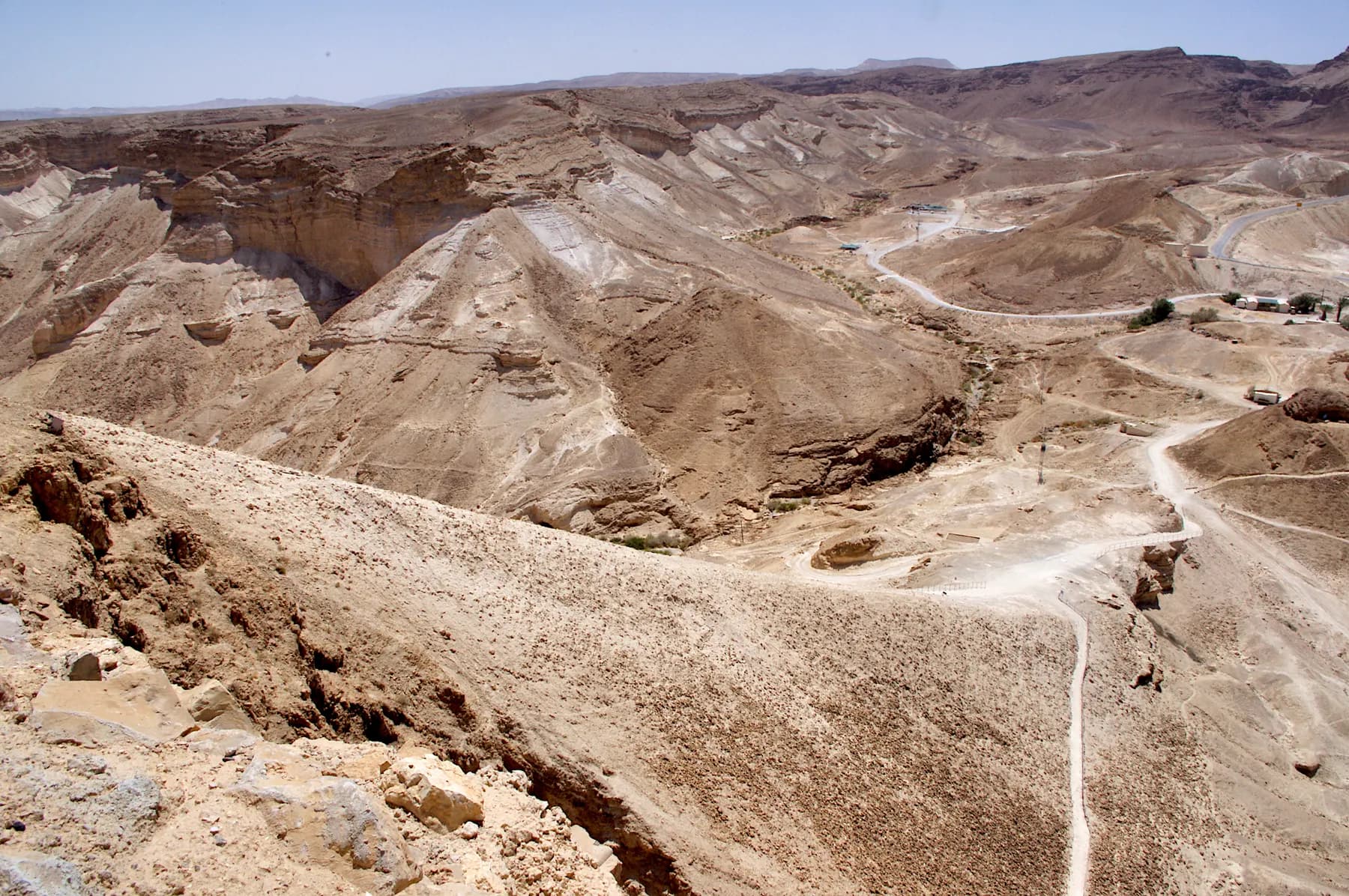
Jan Helebrant / CC0 · Wikimedia Commons

Practical
What to know before you go
- Read the heat ladder before booking anything between May and September. In normal hot weather the last Snake Path ascent is 10:00 and the last descent 11:00; when it is very hot those become 08:00 and 09:00; in extreme heat they are 07:00 and 08:00, and the Runner's Path and Elazar Ascent close at 07:00 too.
- Treat the Roman ramp as the summer route. It takes about half an hour against the Snake Path's hour, is graded intermediate rather than high, is reached from Arad on road 3199, and stays open to an 11:00 ascent on the days the Snake Path has shut at seven.
- Arrive about half an hour before the Snake Path opens, which is roughly ninety minutes before sunrise. The parks authority asks for that margin so there is time to buy a ticket and start climbing before the cut-off.
- Check the Israel Meteorological Service forecast in any month from October to May. The parks authority's instruction is to check independently shortly before the visit, and not to walk in or cross wadi beds when flooding appears likely.
- Count backwards from closing rather than forwards from opening. Entrance closes an hour before the stated time, the last cable car goes up an hour before closing, and the Snake Path closes to ascent two hours before closing and to descent one hour before.
- Book a slot online for Passover, Sukkot and Hanukkah. The parks authority says a booking guarantees entry at the chosen time, and that it will ask for the confirmation once a slot is full.
- Telephone *3639 about Yom Kippur eve. The park page and the cable car page give an 08:00 to 12:00 day; the Snake Path and Roman ramp pages give 08:00 to 13:00, and the site is closed on Yom Kippur itself.
- If the night show is part of the plan, do not come between January and April, when it does not run at all. Its season is May to December, on Tuesdays and Thursdays after sunset.
The figures
Numbers behind this page
Each figure carries the year it belongs to and links the source it came from.
| Measure | Figure | As of | Source |
|---|---|---|---|
| Mean daily high at Masada, July | 36.9°C | 2015-2024 | cds.climate.copernicus.eu |
| Mean daily low at Masada, August | 25.8°C, the warmest nights of the year | 2015-2024 | cds.climate.copernicus.eu |
| Mean daily high at Masada, January | 17.4°C, the coolest month | 2015-2024 | cds.climate.copernicus.eu |
| Mean daily high at the Dead Sea shore below, July | 38.5°C, against 36.9°C on the rock | 2015-2024 | cds.climate.copernicus.eu |
| Mean rainfall over the year, and days with a millimetre or more | 112 mm across 24.6 days | 2015-2024 | cds.climate.copernicus.eu |
| Mean rainfall, July and August | 0 mm, on no days, in either month | 2015-2024 | cds.climate.copernicus.eu |
| Highest reading at Sedom, on the same shore | 49.9°C on 17 July 2019, the highest in Israel since June 1942 | 2019 | wmo.int |
| Visits to Masada National Park over the Sukkot week of 2022 | 32,000, within about 1.5 million across all parks authority sites | 2022 | timesofisrael.com |
The rest of the Masada guide
Sources and further reading
Every link below was opened and checked when this page was written. Official statements are marked as such: they are the subject's own account, not an independent one.
- OfficialIsrael Nature and Parks Authorityen.parks.org.ilMasada National Park
Summer and winter hours, holiday eve and Yom Kippur eve closings, the one-hour rules for the gate and the last cable car, the full Snake Path heat ladder of 10:00, 08:00 and 07:00 last ascents, the Roman ramp timings on extreme-heat days, the booking guarantee, and the winter, spring and autumn flooding warning
- OfficialIsrael Nature and Parks Authorityen.parks.org.ilThe Snake Path at Masada National Park
The path measured at about 2 km, 350 metres of ascent and roughly 900 steps, the hour it takes, the high difficulty grading, the opening an hour before sunrise, the two-hour ascent and one-hour descent closings, and the 13:00 Yom Kippur eve that differs from the park page
- OfficialIsrael Nature and Parks Authorityen.parks.org.ilThe Roman Ramp Trail at Masada National Park
The bottom of the ramp about 60 metres below the summit, the half-hour intermediate climb from Arad on road 3199, the opening half an hour before sunrise, the 11:00 ascent and noon descent limits on extremely hot days, and the twelve cisterns of 40,000 cubic metres fed by dams in Wadi Masada
- OfficialIsrael Nature and Parks Authorityen.parks.org.ilThe Masada Cable Car
The three-minute ride each way, the limit of 65 passengers a trip against a capacity of 80, the suspension bridge at the upper station, and the same summer and winter hours with a 12:00 Yom Kippur eve
- OfficialIsrael Nature and Parks Authorityen.parks.org.ilAn Ancient Engineering Marvel: the Cisterns Trail at Masada
The 200 metre trail at the foot of the Roman ramp, the half hour it takes there and back, and the rule that it is suitable year-round but closed on and after rainstorms because of flooding risk and on extremely hot days
- OfficialIsrael Nature and Parks Authorityen.parks.org.ilMasada from Dusk to Dawn
The show's month-by-month season, closed January to April and starting at 20:30, 21:00, 20:30 and 19:30 through the rest of the year, the Tuesday and Thursday schedule, the 45 minute running time, the projection onto the western slope, the Shlomo Gronich score, and the ₪45, ₪35 and ₪15 prices
- OfficialIsrael Meteorological Serviceims.gov.ilWarnings, forecasts and climate data
The national forecast and warning service whose output the parks authority uses to set the Snake Path heat closures, and which it directs visitors to check before travelling in flood season
- ReportingThe Times of Israeltimesofisrael.comRecord 1.5 million Israelis visit national parks during Sukkot break
The parks authority's count for the Sukkot week of 2022, with Caesarea at 44,000, Ein Gedi at 35,000 and Masada at 32,000, and a rise of 22 per cent on the previous year
- ReportingThe Times of Israeltimesofisrael.comHundreds of thousands flock to beaches, parks during intermediate days of Passover
About 200,000 visits to parks authority sites on one Sunday of Passover 2023, and the closing of the Yarkon and Ein Hanya national parks to new arrivals once they filled
- ReportingThe Times of Israeltimesofisrael.comEducators sentenced to 7 years over deaths of 10 students in flash flood disaster
The Tzafit riverbed flood of April 2018 near the Dead Sea, the ten teenagers killed, and the court's finding that the organisers disregarded repeated inclement weather warnings
- DataEuropean Centre for Medium-Range Weather Forecastscds.climate.copernicus.euERA5 reanalysis and IFS model archive
The ten-year monthly normals on this page, computed for 2015 to 2024 at Masada's own coordinates and separately at the Dead Sea coordinates for the shore comparison
- DataHebcalhebcal.comJewish Holidays 5787 (2026-2027)
Gregorian dates for Rosh Hashanah, Yom Kippur, Sukkot, Shmini Atzeret, Simchat Torah, Hanukkah, Purim, Passover and Tisha B'Av across 2026 and 2027
- ReferenceWorld Meteorological Organization, reporting the Israel Meteorological Servicewmo.intRecord-Breaking Temperature in Israel, July 2019
The 49.9°C maximum at Sedom on the southern Dead Sea on 17 July 2019, the highest in Israel since 54°C at Tirat Tzvi in June 1942, the sharav depression from North Africa behind it, the 10 to 25 per cent relative humidity, and the note that sharav is unusual in high summer and mostly occurs in spring
- ReferenceWikipediaen.wikipedia.orgPublic holidays in Israel
The intermediate days of Passover and Sukkot as a school holiday with collective paid leave in many businesses and government offices, and the scale of the Yom Kippur shutdown including the 28 to 30 hour suspension of airports, border crossings and broadcasting
The best time to visit Masada: common questions
When is the best time to visit Masada?+
November to March, and November or March if it has to be one month. Those are the months when the mean daily high on the rock sits between 17.4°C and 24.2°C and the parks authority's hot-weather restrictions on the Snake Path stop governing the day. January and February are the coolest and quietest but carry the year's heaviest rain and the flooding warning that goes with it. November is the compromise most people want: mild at noon, no heat cut-offs, no festival and no school holiday.
Is Masada bearable in July and August?+
Only very early, and for most people only as a cable car visit. July averages 36.9°C by day and August has the warmest nights of the year at a mean 25.8°C, with no rain in either month in the ten-year record. On extreme-heat days the parks authority closes the Snake Path to ascent at 07:00 and to descent at 08:00, and shuts the Runner's Path and the Elazar Ascent entirely. The Roman ramp from Arad holds out until an 11:00 ascent on those days and is the only walk worth planning.
How early do I actually have to start in summer?+
About ninety minutes before sunrise. The Snake Path opens for ascent roughly an hour before sunrise, the Roman ramp about half an hour before, and the parks authority recommends arriving at the Snake Path some thirty minutes before it opens so there is time to buy a ticket. In June that means a start in the region of half past four in the morning, which is what the campground on the western side exists for.
Does it ever rain at Masada?+
A little, and almost all of it between November and March. The ten-year normals give 112 mm for the whole year across about 25 days with a millimetre or more, with February the wettest month at 25 mm and July and August recording nothing at all. The rain matters less for what falls on the rock than for what it does in the wadis below, where the parks authority warns of flooding in winter, spring and autumn.
Will Passover or Sukkot ruin the visit?+
They will make it crowded and they will not close anything. The intermediate days of both are a school holiday with collective paid leave in many workplaces, and the country goes to the national parks: the parks authority counted 32,000 visits at Masada over the Sukkot week of 2022, and about 200,000 across all its sites on one Sunday of Passover 2023. Book a time slot online, because the authority says a reservation guarantees entry and it asks to see the confirmation once a slot is full. Sukkot runs 25 September to 2 October 2026 and Passover 21 to 29 April 2027.
Is Masada open on Yom Kippur?+
No, and nor is much else in Israel. Businesses close nationwide, the roads empty, and services that normally run on holidays, including airports and border crossings, suspend for about 28 to 30 hours. Yom Kippur falls on 20 and 21 September in 2026. The day before is shortened too, and the operator's pages disagree about by how much: the park page and the cable car page list an 08:00 to 12:00 Yom Kippur eve, while the Snake Path and Roman ramp pages give 08:00 to 13:00, so telephone *3639 rather than relying on either.
Which months does the night show run?+
May to December, on Tuesdays and Thursdays after sunset, lasting about 45 minutes. It is closed from January to April, starts at 20:30 in May and June, 21:00 in July and August, 20:30 in September and October, and 19:30 in November and December, the last of those weather dependent. It plays on the western slope and is reached from Arad, so it pairs naturally with the campground and a ramp climb the next morning rather than with the Dead Sea hotels.
Is the top of Masada cold in winter?+
Cool rather than cold, and cooler than the shore. The mean daily low on the rock is 10.4°C in January against 14.2°C at the lake, and the plateau is exposed on every side, so a windproof layer for the hour before sunrise earns its place in the bag. By mid-morning the January mean high of 17.4°C makes it the most comfortable walking on the Israeli calendar.
How much difference does the 450 metres of height make?+
Between one and four degrees, depending on the month, which changes the arithmetic without changing the season. July on the rock averages 36.9°C against 38.5°C at the lake, and August nights average 25.8°C against 29.4°C. That is a real gain, and it still leaves a summer in which the parks authority is closing paths at seven in the morning.
What is the quietest time of year on the plateau?+
Weekday mornings in January and February, outside any school holiday. There is no festival between the end of Hanukkah and Purim, foreign arrivals are at their winter low, and the heat restrictions that funnel everyone onto one early cable car in summer do not apply. The trade is short days, a 16:00 closing and the year's highest chance of rain.