
Activity · The Negev
Stargazing in the Ramon Crater
The Israel Nature and Parks Authority won the International Dark Sky Park title for the Ramon Crater in September 2017 after three years of assessment, and the research observatory five kilometres west of the town logs about 170 nights a year with no cloud at all.
Designated
September 2017
International Dark Sky Park, the first recognised country in the Middle East
Nights with no cloud
about 170 a year
and about 240 usable nights, on the Wise Observatory's own record
Rain on the crater floor
about 25 mm a year
cloud cover rare throughout the year, per the USGS calibration site
Free viewpoints published
nine
five inside the makhtesh, four near the town, listed by Mitzpe Ramon's tourism office
In short
- How long to give it
- About two hours at a viewpoint, of which the first 40 minutes go on the eyes adjusting. A guided session runs three to five hours, and the August meteor night runs five and a half.
- The sky
- No gate and no closing time. Route 40 crosses the makhtesh at all hours and the viewpoints along it are open
- Looking at the sky
- Free. The crater is not gated and the viewpoints carry no charge
צפייה בכוכבים במכתש רמון
Stargazing in the Ramon Crater is not an attraction with a gate, a ticket or an opening time. It is a stretch of protected desert that has been managed since September 2017 to keep artificial light out of it, and the practical form it takes is a car park, a mat and a couple of hours of sitting still. The Israel Nature and Parks Authority announced that month that the crater had been awarded the title of International Dark Sky Park by the International Dark-Sky Association, after three years of scrutiny and at the strictest sky-quality level the organisation requires.
The reason the sky is good here is measured rather than asserted, and the measurements come from an unusual neighbour. Tel Aviv University has run the Florence and George Wise Observatory on the plateau five kilometres west of Mitzpe Ramon since 1971, and it publishes its own weather record: about 170 nights a year with zero cloudiness, about 240 nights usable for observing, and average seeing of two to three arcseconds. The US Geological Survey, which uses the crater floor as a satellite calibration target, records about 25 millimetres of rain a year there and notes that cloud cover is rare throughout the year.
What a visitor does with that divides cleanly in two. The free version means driving to one of the nine spots the town's tourism office lists, most of them roadside car parks inside the makhtesh, and lying on the ground. The paid version means booking one of the seven guides the same office lists, who bring telescopes, a laser pointer and a fire. The mistake first-timers make is neither of those: it is arriving on a bright moon, keeping a phone screen on, and leaving before their eyes have finished adjusting.
The certificate
What the 2017 title actually commits anyone to
The parks authority's own release sets out the terms. At the time of the award, 54 other reserves and parks in 15 countries held the International Dark Sky Park title, and Israel was the first recognised country in the Middle East region. The application ran for three years. What carried it, the authority says, was the quality of the night sky in the reserve at the strictest level the organisation requires, a lighting programme written for the campgrounds, and an educational programme to go with it.
The designation is a zoning decision as much as a label. It defines the western Ramon Crater as an undisturbed core area, and the eastern part as the half where the authority allows visitors a night-time experience inside campgrounds adapted to minimise light pollution. Shaul Goldstein, then director general of the parks authority, described preserving the night, the dark skies and the starlight of the Negev as among the conservation priorities for the region, and undertook to work with nearby communities, the Israeli armed forces, the community of astronomers and the residents of Mitzpe Ramon. J. Scott Feierabend, then executive director of the International Dark-Sky Association, called the designation a watershed moment in the history of the Dark Sky Places programme. The release was issued by Dr Noam Leader of the parks authority.
Locally the award has acquired a second name and, on one page, a second author. Mitzpe Ramon's tourism office markets the area as the Starlight Reserve, which is not the title the parks authority was given. Its stargazing page goes further and describes the reserve as a place defined by UNESCO. Its own festival page states the position correctly: the crater was declared in September 2017 by the International Dark-Sky Association, in collaboration with the parks authority and the Mitzpe Ramon and Ramat Negev councils. Visitors will meet both versions on the ground, and the parks authority's release is the one that says what was awarded and by whom.
- Awarded September 2017 by the International Dark-Sky Association, to the Israel Nature and Parks Authority
- 54 other reserves and parks in 15 countries held the title at that point
- Three years of assessment, at the organisation's strictest sky-quality level
- Western crater kept as an undisturbed core; eastern campgrounds lit to minimise spill
- No UNESCO involvement, despite what the town's stargazing page says
Conditions
Height, dryness, and the number of nights with no cloud at all
Three things make a dark site, and only one of them is the absence of streetlights. The other two are altitude and dry air, and the central Negev has both. Britannica puts the Negev's central plateau between 250 and 1,035 metres and its annual rainfall at 76 to 102 millimetres. The US Geological Survey, which maintains a hyperspectral calibration site on the makhtesh floor at 557 metres, records average annual precipitation of about 25 millimetres and states plainly that cloud cover is rare throughout the year. Tel Aviv University gives the altitude of its observatory on the plateau above the town as 950 metres.
The university's observatory publishes the only long-run night-sky statistics anyone in the country keeps for this ground, and they are worth reading before booking. About 170 nights a year have zero cloudiness; about 240 are useful for observing. The best season, when practically no cloud is observed, is June to August. The highest chance of cloud runs from January to April. Winds are usually moderate from the north-east and north, storm winds above 40 kilometres an hour occur but are rare, and wind speed tends to fall through the night. Average seeing is two to three arcseconds, with a few good nights at one arcsecond or better and some worse than five.
For a visitor this changes the arithmetic of the trip. A dark site that is clear one night in three is a gamble an itinerary has to absorb. A site that is completely cloudless on roughly half the nights of the year is something a traveller can plan around: pick the moon rather than the weather, and accept that summer is the safer half of the calendar even though it is also the hot half.
The observatory
The research telescope five kilometres west, and why nobody gets to look through it
Tel Aviv University's account of its own founding is blunt about where Israeli astronomy started. Until 1965, observational astronomy in the country was entirely a matter of amateurs. In that year the university began astronomical research, by 1969 it had a Department of Physics and Astronomy, and it was still the only one in the country in 1982. In 1971 it inaugurated the Florence and George Wise Observatory on the plateau near Mitzpe Ramon, with the help of the Smithsonian Astrophysical Observatory. The initial funds came primarily from the late Dr George S. Wise, the first president of the university, and from the Smithsonian Institution.
The main instrument is still the one that went in at the start: a one-metre Boller and Chivens wide-field Ritchey-Chrétien reflector, now tied to a high-resolution spectrograph full time. Around it the university has added a Centurion 18-inch prime-focus telescope in 2003, a Centurion 28-inch in 2013, an 80-centimetre Ritchey-Chrétien belonging to the University of Haifa, and a 50-centimetre imaging telescope operated remotely from the Korea Astronomy and Space Science Institute in South Korea.
The reason to build here rather than anywhere else was not only the weather. The university describes much of its output as taking advantage of the clear desert skies and of the favourable geographic longitude, which lets it track transient and time-variable events while it is still daytime at most other observatories on Earth. That is a working argument about where Israel sits on the globe, and it is the same argument the tourism industry makes about the sky, arrived at from the other end.
None of this is open to visitors, and the town's own guidance is emphatic about it. Its list of free stargazing spots carries a warning not to park near the grove beside the observatory: it is a nature reserve and a site for scientific observation, there are sensors that detect parked vehicles, and hidden speakers deliver recorded warnings to anyone who ignores them. People looking for a telescope should book one of the guides in town.
On the ground
Nine free places, seven guides, and the difference between them
Mitzpe Ramon's tourism office publishes a list of places to look at the sky for nothing, split between the makhtesh and the ground around the town. Inside the crater it names the Wind Stone site at the coloured sands, the Ramon Colours axis east off Route 40, and the overnight car parks at Nahal Gvanim, Nahal Nekarot and the gypsum site. Nearer the town it names the alpaca farm car park, the grove by the Sde Har Hanegev school, the Sukkah in the Desert area and the Desert Sculpture Park on the lip of the cliff. It is honest about the trade-off: the alpaca farm car park is convenient and sits close enough to Mitzpe Ramon to be under the town's halo of light, so anyone who can drive further should.
The etiquette attached to that list is not decorative. Park somewhere safe and well clear of the traffic line, so that headlights coming up behind do not destroy everyone else's night vision. Do not pitch a tent at a viewpoint, do not light a fire or a barbecue, do not use a white torch, and do not play music. Take rubbish away: the town says animal deaths have risen because travellers leave packaging behind and goats and other animals eat it, and residents run clean-up days after the busiest nights. Leave the stones where they are, because scorpions live under them.
The paid version is a different evening. The tourism office lists seven stargazing guides working out of the town, and its August 2026 calendar shows what the sessions look like in practice: starts between 18:00 and 20:30, finishes between 23:00 and after midnight, telescopes, a guide who can name what is overhead, and in most cases a fire and hot drinks. The same calendar prices a Meteor Night at ₪300, running from 00:30 to 06:00, which is the shape of the thing during the August shower rather than a typical session.
Staying out all night is a third option and it is the one with a published price. The parks authority runs the Be'erot campsite in the middle of the makhtesh, reachable in an ordinary car, at ₪75 an adult and ₪65 a child per night, with a group leaders' room at ₪350 for up to six people. Night use inside the crater is deliberately funnelled into marked campgrounds, both to serve visitors and to keep human activity off the floor after dark, when most of the wildlife is moving.
- Inside the makhtesh: the Wind Stone site at the coloured sands, the Ramon Colours axis, and the Nahal Gvanim, Nahal Nekarot and gypsum overnight car parks
- Near the town: the alpaca farm car park, the Sde Har Hanegev school grove, the Sukkah in the Desert area and the Desert Sculpture Park
- Seven guides listed by the tourism office, sessions typically starting 18:00 to 20:30
- ₪300 for the Meteor Night on the August 2026 programme, 00:30 to 06:00
- ₪75 an adult and ₪65 a child a night at the parks authority's Be'erot campsite
Timing
The moon, the month, and the night the town switches itself off
The single variable that decides whether a night here is worth the drive is the moon, and it is the one most visitors never check. A dark sky park with a bright moon in it is simply a moonlit desert: the planets and the brighter clusters survive, and everything faint does not. Nothing about the designation, the altitude or the cloud statistics changes that, and no guide can work around it. Look at the phase before booking anything, and if the choice is between a clear night with a full moon and a slightly hazier one without, take the second.
The town's calendar is built around one month. Summer of Stars runs every August, when the Perseids arrive and the university's own records say cloud is practically absent. In 2026 the tourism office announced that Mitzpe Ramon would be darkened on 12 August from 20:30, and that the street lighting of the Perfume Road district would be turned red from 6 to 14 August to protect visitors' night vision. A town switching off its own lights for a night is the clearest statement anyone here makes about what the designation is for.
Against that, August is the crowded month. The tourism office warns that the festival draws thousands of travellers, and that a desert day at 30 degrees will easily fall to about 15 degrees at night, so wool hats and blankets belong in the car even in summer. Winter nights are colder still and the cloudiest stretch runs from January to April, which makes spring and autumn the quiet compromise.
Whichever month, allow more time than seems necessary. The tourism office's own explainer on night vision makes the point that adaptation to light is fast and adaptation to darkness is slow, and that it takes about 40 minutes to reach maximum vision in the dark. An hour at a viewpoint with the car interior light going on and off is most of an hour wasted.
What to look for
Things not to walk past at Stargazing in the Ramon Crater
The details that repay knowing about before you are standing in front of them.
The Ramon Colours axis
The graded road running east off Route 40 into the coloured sands, with parking along it. Far enough into the makhtesh that the town's glow is behind the rim rather than in the sky.
The Wind Stone site
A signed car park at the coloured sands, with room to walk away from the vehicles before spreading a mat. Dry most of the year; after a wet winter the pools fill.
The Desert Sculpture Park on the rim
Sculptures on the edge of the crater cliff, best reached on foot. The tourism office asks visitors to arrive before dark and to keep well back from the drop.
The Be'erot campsite
The parks authority's serviced campsite in the middle of the makhtesh, reachable in an ordinary car. The one way to be on the crater floor from dusk until dawn without breaking the reserve's rules.
The Wise Observatory dome, from a distance
Tel Aviv University's working research facility five kilometres west of the town, in operation since 1971. It is not a visitor attraction, and the ground around it is a nature reserve with vehicle sensors on it.
The long view
Stargazing in the Ramon Crater, in order
1965
Tel Aviv University begins astronomical research. Until that year, on the university's own account, observational astronomy in Israel was entirely a matter of amateurs.
1969
The university establishes a Department of Physics and Astronomy, still the only one in the country in 1982.
1971
The Florence and George Wise Observatory is inaugurated on the plateau five kilometres west of Mitzpe Ramon, at 950 metres, with help from the Smithsonian Astrophysical Observatory and funds from Dr George S. Wise and the Smithsonian Institution. Its one-metre Boller and Chivens reflector goes in.
1 February 2003
Columbia is lost on re-entry with Ilan Ramon aboard, sixteen days after launch. The parks authority's visitor centre on the crater rim now tells his story.
2003
A Centurion 18-inch prime-focus telescope is installed at the Wise Observatory.
2013
A Centurion 28-inch prime-focus telescope follows.
September 2017
The International Dark-Sky Association awards the Ramon Crater the title of International Dark Sky Park, after three years of assessment. Israel becomes the first recognised country in the Middle East region.
August 2026
Mitzpe Ramon announces that the town will be darkened on 12 August from 20:30, with the Perfume Road district's street lighting turned red from 6 to 14 August.
Practical
Visiting Stargazing in the Ramon Crater
Where
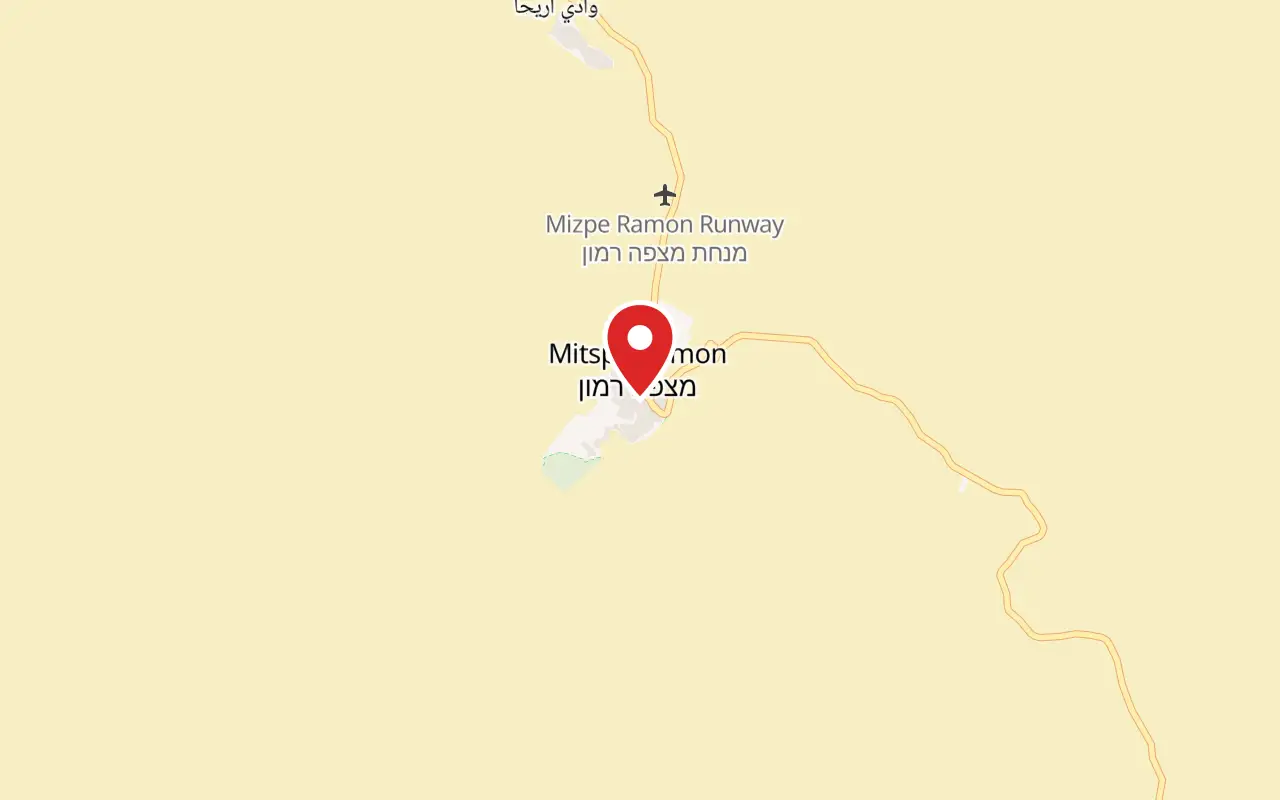
The northern rim of Makhtesh Ramon at Mitzpe Ramon, and the car parks along Route 40 inside the crater, between Beersheba and Eilat
What ticket you need
The crater lies inside the Matsok HaTsinim and Har HaNegev nature reserves, which are not gated and carry no admission charge, so the dark sky area needs no ticket. The ₪31 visitor centre ticket on the rim buys a daytime museum about the makhtesh and the astronaut Ilan Ramon, and nothing after dark. Camping on the crater floor is confined to the marked campgrounds.
Opening hours
- The sky
- No gate and no closing time. Route 40 crosses the makhtesh at all hours and the viewpoints along it are opensource
- Guided sessions, as listed for August 2026
- Starts between 18:00 and 20:30, finishing between 23:00 and 00:45source
- Meteor Night, 14 August 2026
- 00:30 to 06:00source
- Makhtesh Ramon visitor centre, summer, Sunday to Thursday and Saturday
- 08:00 to 17:00, entry by reservation only and the museum closing an hour earliersource
- Makhtesh Ramon visitor centre, winter, Sunday to Thursday and Saturday
- 08:00 to 16:00source
- Makhtesh Ramon visitor centre, Friday and holiday eves
- 08:00 to 16:00 in summer, 08:00 to 15:00 in winter, 08:00 to 13:00 on holiday eves and the eve of Yom Kippursource
Admission
- Looking at the sky
- Free. The crater is not gated and the viewpoints carry no chargesource
- Meteor Night, August 2026 programme
- ₪300source
- Other guided sessions
- Priced individually by each of the seven guides the tourism office lists; the office does not publish one rate for all of themsource
- Be'erot campsite, per night
- Adult ₪75, child ₪65; group leaders' room ₪350 for up to six peoplesource
- Makhtesh Ramon visitor centre, daytime only
- Adult ₪31, child ₪16, student or adult in a group ₪26, child in a group ₪14, Israeli senior citizen ₪16source
- Parking
- Charged at the visitor centre; free at the Hai Ramon car parksource
Access
Better than most desert activities and worse than it looks. The free viewpoints inside the makhtesh are car parks, several of them directly off the tarmac of Route 40, so a wheelchair user can be at a genuinely dark site without walking; the Nahal Gvanim car park is the exception, about fifteen minutes down a dirt road. What is not adapted is the ground itself: there are no paths, no lighting by design, no kerbs and no surfaced surrounds, and the advice to walk well away from parked vehicles before settling assumes someone can cross loose desert gravel in the dark. The Desert Sculpture Park sits on the edge of a cliff and is recommended on foot. The parks authority's visitor centre on the rim publishes an accessible visit coordination form, but it is a daytime museum and closes long before any of this starts.
On site
- Roadside car parks at the free viewpoints
- No lighting, by design
- No toilets or water at the viewpoints
- Be'erot campsite on the crater floor, with water and toilets
- Guides with telescopes, bookable in town
- Visitor centre, shop and restaurant on the rim, daytime only
- Fuel and shops in Mitzpe Ramon, and no pharmacy open late
Booking
Guided sessions are sold by seven separate operators through the town's tourism office rather than by a single ticket desk, and the August programme sells out. Nothing needs to be booked to sit at a free viewpoint. The parks authority's Be'erot campsite and its visitor centre are booked separately, through the authority's own reservation system.
Hours and prices are given as the operator publishes them and change without much notice, particularly around Shabbat and the festivals. Check the operator's own page before you travel for this.
Official page at en.mitzpe-ramon.co.il →What people wish they had known
- Check the moon phase before booking anything. A clear night with a full moon in it is a worse night here than a slightly hazy one without, and the designation makes no difference to that.
- Bring a red torch and leave the phone in the car. The tourism office puts the time to reach maximum night vision at about 40 minutes, and one white light restarts the clock for everyone in the car park.
- Park well clear of the traffic line and switch the headlights off, not down. Following cars are the commonest way a good viewpoint gets ruined.
- The visitor centre on the rim is a daytime museum. Its ₪31 ticket, its reservation and its closing time have nothing to do with stargazing, and the sky costs nothing.
- Do not park by the grove beside the observatory west of town. It is a nature reserve and a working scientific site, and the tourism office warns that sensors there trigger recorded warnings over hidden speakers.
- Take warm clothes in August. The tourism office's own figure is 30 degrees by day falling to about 15 at night, and it feels colder in wind on open ground.
- Leave the stones alone. Scorpions live under them, and the town asks that children are not allowed to turn them over at all.
The figures
Stargazing in the Ramon Crater by the numbers
Each figure carries the year it belongs to and links the source it came from.
| Measure | Figure | As of | Source |
|---|---|---|---|
| Nights a year with zero cloudiness at the Wise Observatory | about 170, with about 240 useful observing nights | 2022 | physics.tau.ac.il |
| Average seeing | two to three arcseconds, occasionally one arcsecond or better | 2022 | physics.tau.ac.il |
| Average annual rainfall on the crater floor | about 25 mm, with cloud cover rare throughout the year | 2025 | calval.cr.usgs.gov |
| Wise Observatory altitude and distance from the town | 950 m, five kilometres west of Mitzpe Ramon and 86 km south of Beersheba | 2025 | physics.tau.ac.il |
| Dark Sky Parks worldwide when the crater was designated | 54 other reserves and parks, in 15 countries | 2017 | darksky.org |
| Time for eyes to reach maximum vision in the dark | about 40 minutes | 2026 | en.mitzpe-ramon.co.il |
| Be'erot campsite, per night | ₪75 an adult, ₪65 a child | 2026 | en.parks.org.il |
| Night temperature drop in summer | from about 30°C by day to about 15°C at night, on the tourism office's guidance | 2026 | en.mitzpe-ramon.co.il |
While you are here
The rest of The Negev
Everything else in this destination with a page of its own.
Orhat / CC BY-SA 4.0 · Wikimedia Commons
Nature reserve
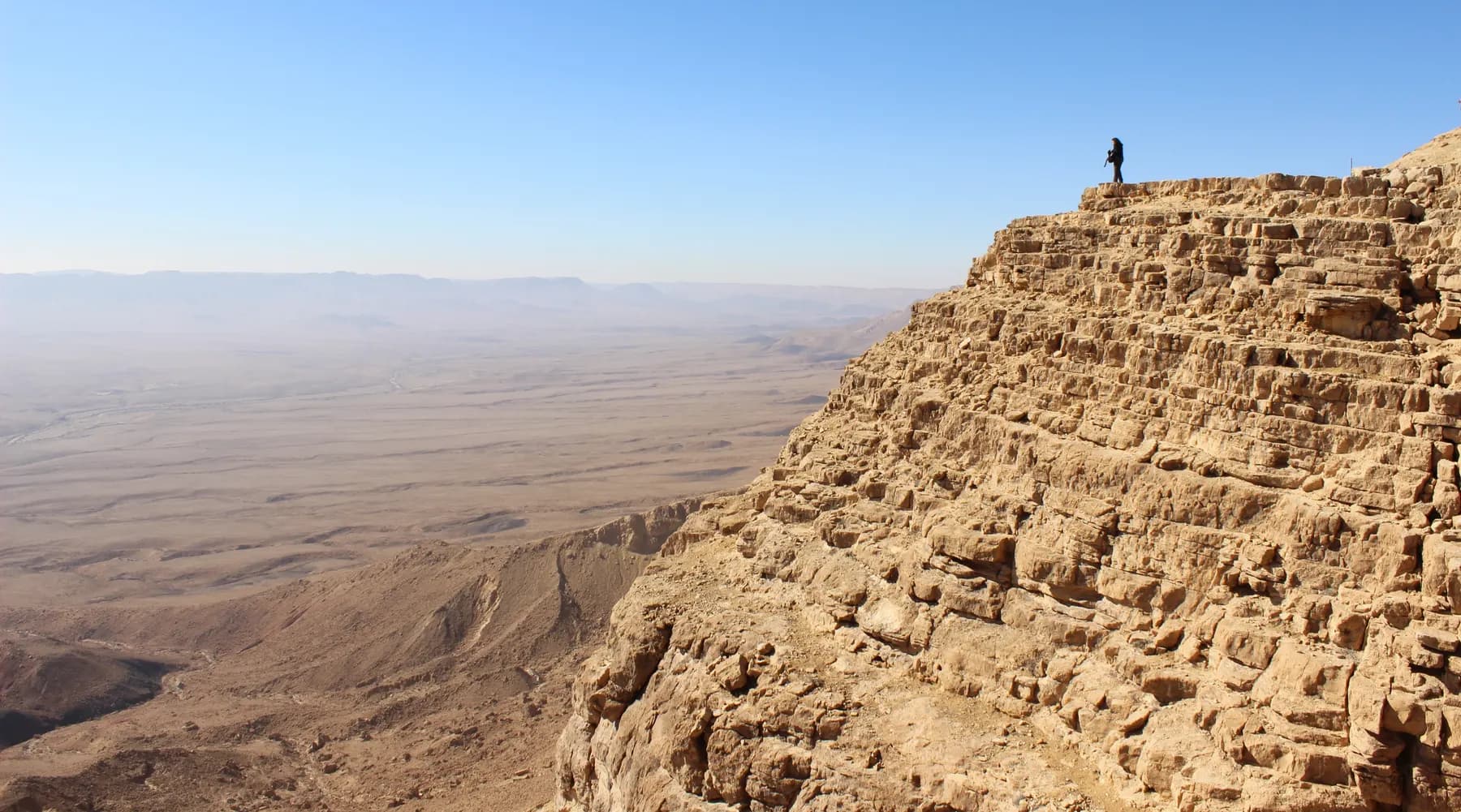
Makhtesh Ramon (Ramon Crater)
The floor of the makhtesh was quarried for clay and quartz before it was protected, and the parks authority's scenic road across the eastern half runs over ground it had to rehabilitate.
ישראל פרקר / CC BY 2.5 · Wikimedia Commons
Archaeological site
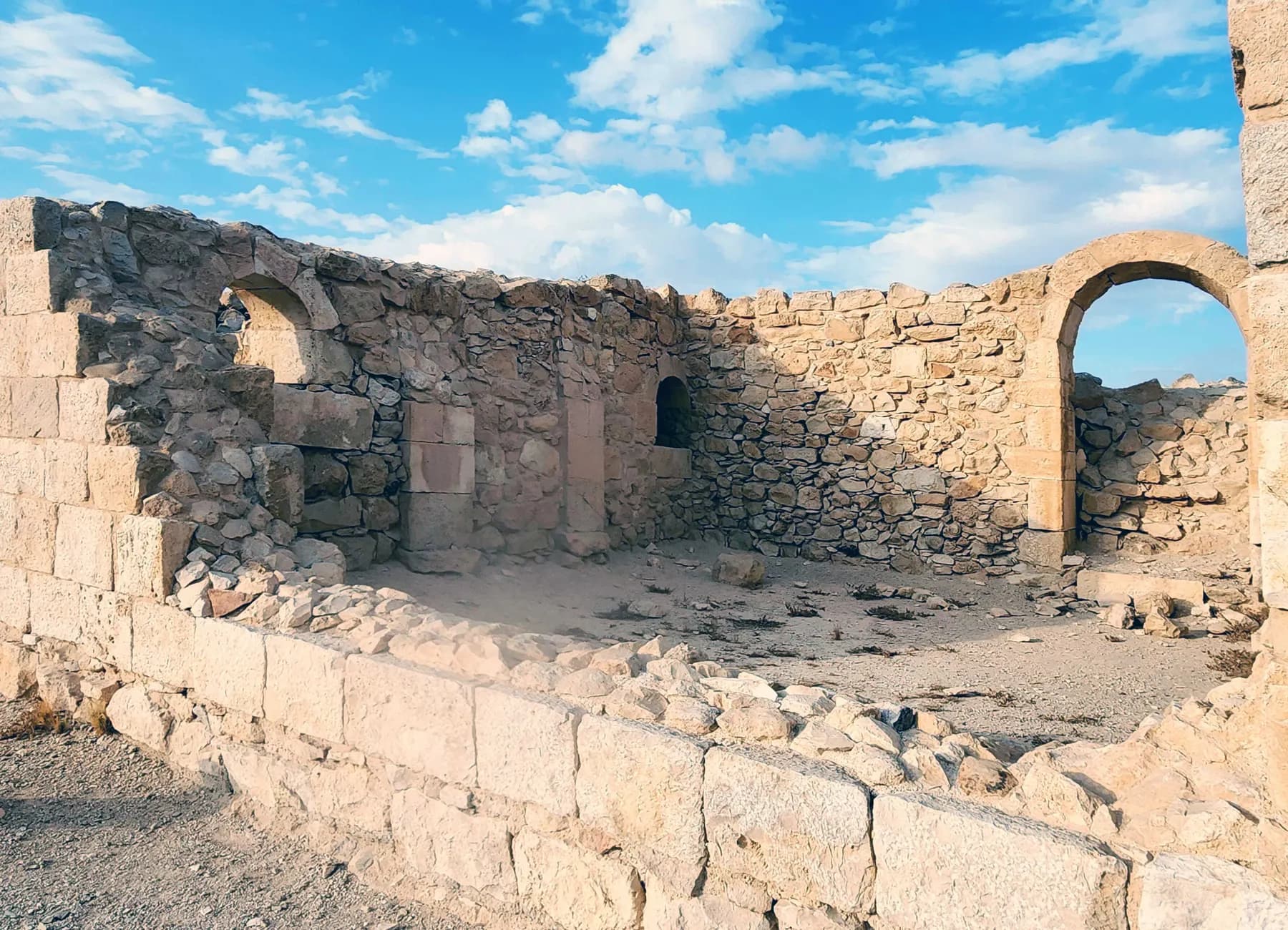
Avdat National Park
Avdat was station number 62 on the Incense Route, and the caravan road that brought frankincense from Arabia towards the port of Gaza can still be picked out climbing to it from the southeast.
רחל וייסלר / CC BY 2.5 · Wikimedia Commons
Nature reserve
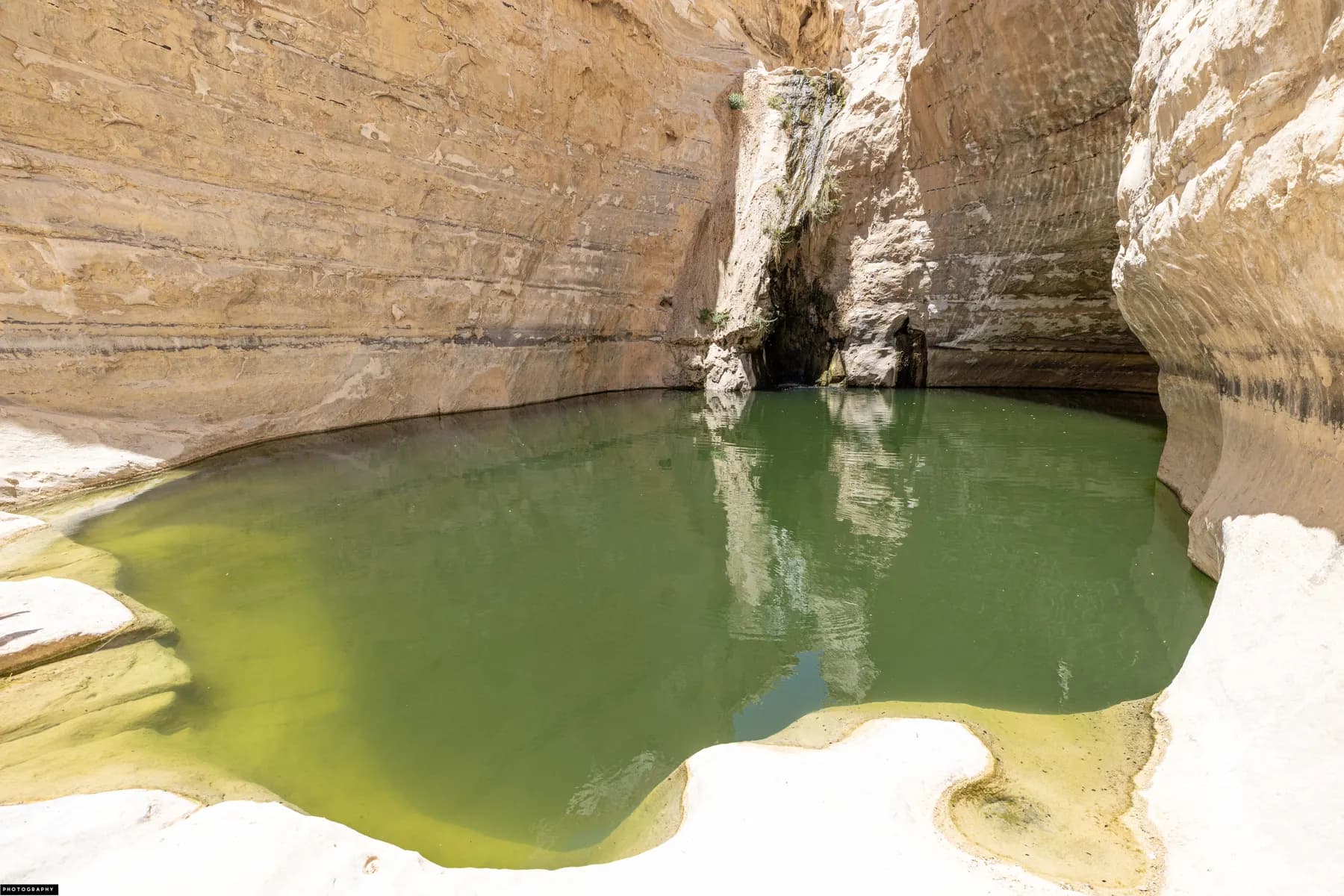
Ein Avdat National Park
Three springs keep water running all year at the bottom of a white chalk canyon that was cleared, laid out and opened to the public in 1961 as a seventy-fifth birthday present for David Ben-Gurion.
Sources and further reading
Every link below was opened and checked when this page was written. Official statements are marked as such: they are the subject's own account, not an independent one.
- OfficialInternational Dark-Sky Association and Israel Nature and Parks Authoritydarksky.orgDesignation of the Ramon Crater, Israel as an International Dark Sky Park
September 2017 designation; 54 other reserves and parks in 15 countries held the title at that point and Israel was the first recognised country in the Middle East; three years of scrutiny at the strictest sky-quality level; western crater as undisturbed core and eastern campgrounds adapted to minimise light pollution; quotes from Shaul Goldstein, director general of the parks authority, and J. Scott Feierabend, IDA executive director; communicated by Dr Noam Leader.
- OfficialIsrael Nature and Parks Authorityen.parks.org.ilMakhtesh Ramon Nature Reserve and Visitors Center
Visitor centre hours (summer 08:00 to 17:00, winter 08:00 to 16:00, Friday and holiday eves earlier), reservation-only entry with the museum closing an hour before the stated time, admission of ₪31 adult and ₪16 child, Be'erot tent camp at ₪75 an adult and ₪65 a child with a ₪350 group leaders' room, and paid parking at the centre with free parking at Hai Ramon. Read 13 August 2026.
- OfficialMitzpe Ramon tourism officeen.mitzpe-ramon.co.ilStargazing at Mitzpe Ramon
The seven guides the office lists; the August 2026 events calendar with session times of 18:00 to 23:00, 20:00 to 23:30 and 20:30 to 00:45, and the Meteor Night of 14 August at ₪300 running 00:30 to 06:00. This is also the page that describes the area as a Starlight Reserve defined by UNESCO, which the parks authority's own release contradicts.
- OfficialMitzpe Ramon tourism officeen.mitzpe-ramon.co.ilSummer of stars at Mitzpe Ramon 2026
The September 2017 declaration attributed to the International Dark-Sky Association in collaboration with the parks authority and the Mitzpe Ramon and Ramat Negev councils; the nine free viewpoints and their individual access notes; the town darkened on 12 August from 20:30 and the Perfume Road district lit red from 6 to 14 August; etiquette and safety rules; about 40 minutes to reach maximum night vision; 30°C by day falling to about 15°C at night; the warning about parking near the grove by the observatory.
- OfficialWise Observatory, Department of Astrophysics, Tel Aviv Universityphysics.tau.ac.ilAbout the Observatory
Observational astronomy in Israel entirely amateur until 1965; a Department of Physics and Astronomy by 1969, still the only one in the country in 1982; the Florence and George Wise Observatory inaugurated in 1971 with help from the Smithsonian Astrophysical Observatory and initial funds from Dr George S. Wise and the Smithsonian Institution; altitude 950 m, five kilometres west of Mitzpe Ramon and 86 km south of Beersheba; the favourable longitude for tracking transients when it is daytime at other observatories. Page updated 7 December 2025.
- OfficialWise Observatory, Department of Astrophysics, Tel Aviv Universityphysics.tau.ac.ilTelescopes and Instruments
The one-metre Boller and Chivens wide-field Ritchey-Chrétien of 1971, connected to the NRES spectrograph full time; the Centurion 18-inch of 2003 and Centurion 28-inch of 2013; the University of Haifa 80 cm; and the 50 cm operated remotely from the Korea Astronomy and Space Science Institute.
- OfficialNASA Earth Observatoryscience.nasa.govIsrael's Heart-Shaped Crater
How a makhtesh forms by differential erosion rather than impact or volcanism, and the dimensions of the Ramon Crater, which is the landform the dark sky designation covers.
- OfficialNASAnasa.govSTS-107
Launch on 16 January 2003 and the loss of Columbia over east Texas on 1 February 2003, sixteen days later, with Ilan Ramon of the Israeli Space Agency among the seven crew. The parks authority's visitor centre on the crater rim is built around his story.
- DataWise Observatory, Department of Astrophysics, Tel Aviv Universityphysics.tau.ac.ilWeather Conditions
About 170 nights a year with zero cloudiness and about 240 useful nights; best season June to August with practically no cloud, highest chance of cloud January to April; moderate north-easterly and northerly winds with storm winds above 40 km/h rare; average seeing of two to three arcseconds, a few nights at one arcsecond or less and some worse than five. Page updated 23 June 2022.
- DataU.S. Geological Survey, EROS CalVal Center of Excellencecalval.cr.usgs.govMakhtesh Ramon calibration site
About 40 km long, 2 to 10 km wide and about 500 m deep at 557 m altitude; average annual precipitation of about 25 mm; cloud cover rare throughout the year; used for radiometric calibration because of the range of mineral compositions across 400 to 2500 nm.
- ReferenceEncyclopaedia Britannicabritannica.comNegev
Central plateau at 250 to 1,035 metres with 76 to 102 mm of rain a year; 200 to 305 mm near Beersheba in some years and negligible rainfall at Eilat; year-round sunlight and winter flash flooding.
Stargazing in the Ramon Crater: common questions
Is stargazing in the Ramon Crater free?+
Yes. The crater is not gated and there is no charge for the viewpoints, so the free version costs a tank of fuel and a mat. Mitzpe Ramon's tourism office publishes nine specific places to do it, five inside the makhtesh and four near the town. The paid alternative is a guided session with a telescope, sold by seven separate operators in town.
How much does a guided stargazing session cost?+
It depends on the operator, because there is no single ticket. The tourism office's August 2026 calendar prices a Meteor Night at ₪300 for a session running from 00:30 to 06:00, and lists other evening sessions without a common rate. Prices are set by each of the seven guides, so compare before booking rather than assuming one figure covers the town.
What is the best time of year?+
June to August for reliability, spring and autumn for comfort. Tel Aviv University's observatory record says practically no cloud is observed from June to August, and that the highest chance of cloud runs from January to April. August is also when the Perseids arrive and when the town runs its Summer of Stars programme, which means the best sky and the largest crowds at the same time.
Does the moon matter more than the weather?+
Here, yes. Cloud is rare enough at this site to be a minor risk, and a bright moon is a certainty on roughly half the nights of any month. Nothing about a dark sky designation removes moonlight, so the phase is the first thing to check and the season is the second.
Can you visit the Wise Observatory?+
No. It is Tel Aviv University's working research facility, five kilometres west of the town and operating since 1971, and it publishes no public opening hours. The town's guidance goes further and asks visitors not even to park near the grove beside it, because the ground is a nature reserve and a scientific observation site with vehicle sensors on it.
Was the crater really designated by UNESCO?+
No. The title came from the International Dark-Sky Association, which announced it through the Israel Nature and Parks Authority in September 2017. The town's tourism site markets the area as a Starlight Reserve and one of its pages credits UNESCO, but its own festival page gives the correct account, naming the association and the parks authority together with the Mitzpe Ramon and Ramat Negev councils.
Can you sleep out in the crater?+
Only in the marked campgrounds. The parks authority runs Be'erot in the middle of the makhtesh at ₪75 an adult and ₪65 a child a night, reachable in an ordinary car and supplied with water and toilets. Night use is deliberately concentrated there rather than spread across the floor, because most of the crater's wildlife moves after dark.
Is it safe at night?+
Broadly yes, with three real hazards, none of them dramatic. Cars in unlit car parks are the first, which is why the town asks visitors not to lay mats near parked vehicles and to keep children close. Scorpions under stones are the second. The third is the drive itself: ibex cross the roads around Mitzpe Ramon after dark, and there is no pharmacy open late in town if something goes wrong.
How long should a first visit take?+
About two hours at minimum, because the first 40 minutes go on the eyes adapting. A guided session runs longer, typically starting between 18:00 and 20:30 and finishing between 23:00 and just after midnight on the town's own listings. Anyone driving down from Tel Aviv or Jerusalem for the evening should plan on getting back very late or sleeping locally.
Is there anything to see with the naked eye, or do you need equipment?+
The naked eye is enough, and it is what the town's free guidance is written for: a mat, a red torch, a thermos and time. Telescopes add planets, clusters and lunar detail, which is why the guided sessions exist, but the thing people come for is a wide dark sky, and no equipment improves on lying flat and waiting.