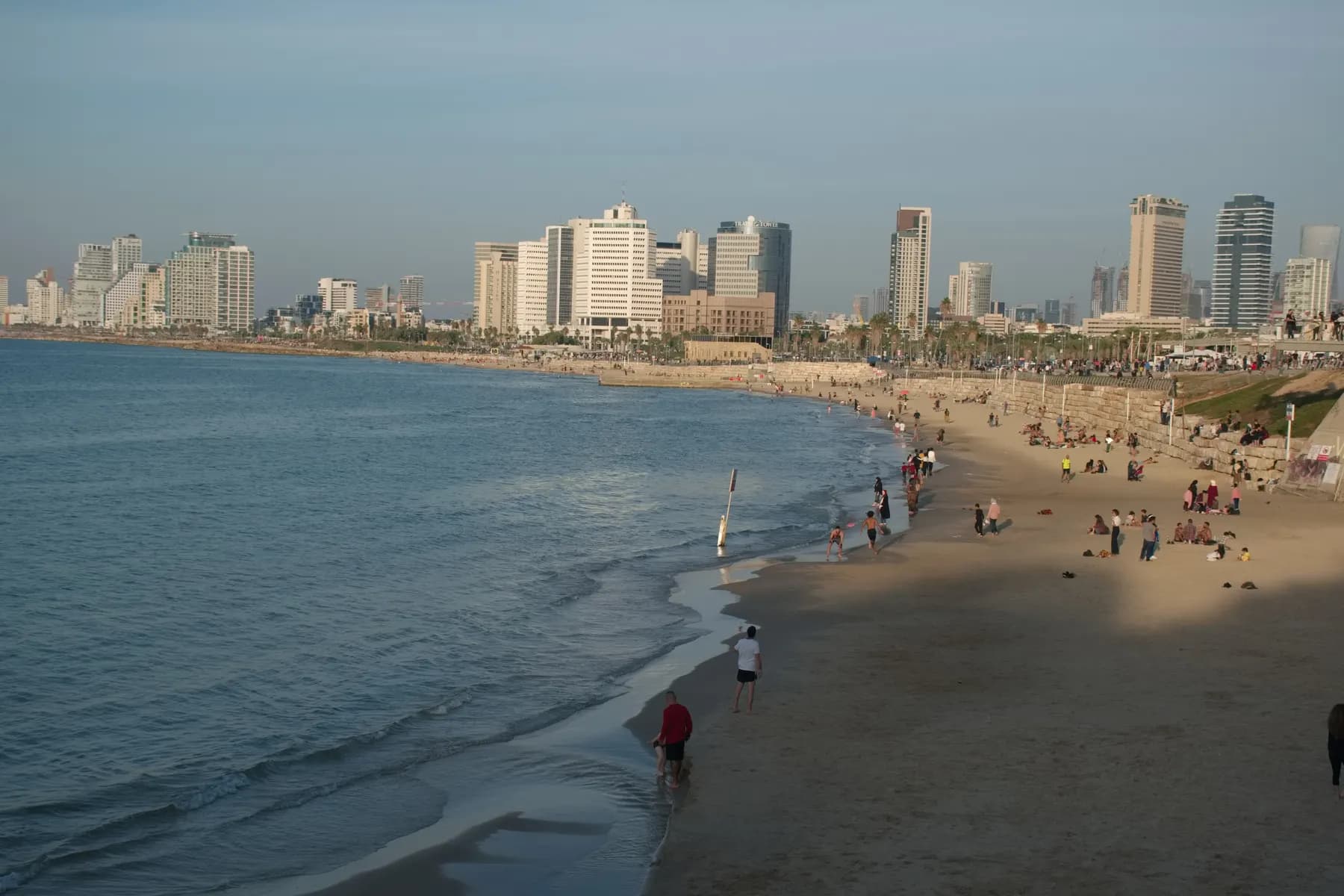
Beach · Tel Aviv
Tel Aviv Beaches and the Tayelet
Thirteen municipal beaches on one continuous promenade, opened for the 2026 season on 25 March, with the lifeguard stations due to close for the year on 10 October.
ענת פרנק גורלי / CC BY 2.5 · Wikimedia Commons
Municipal beaches
13
all thirteen were awarded the Blue Flag for 2026
2026 bathing season
25 March to 10 October
the dates the municipality publishes on its Hebrew beaches page
Entry
Free
a sunbed is ₪20 and an umbrella or deck chair ₪10 for a visitor
Lifeguards employed
about 50
and a first certification course in 40 years, run February to March 2026
In short
- How long to give it
- about 2 hours for a swim and a sit, or allow about 3 hours to walk the full seafront end to end
- 2026 bathing season
- 25 March to 10 October
- Entry to every beach and to the promenade
- Free
חופי תל אביב והטיילת
Tel Aviv's beaches are thirteen declared municipal bathing beaches strung along the city's whole western edge, from Tzuk in the north down to Givat Aliya in Jaffa, joined by a single walkable promenade the city calls the tayelet. Entry to every one of them is free, there is no gate anywhere on the strip, and the facts that actually change are the bathing-season dates, the lifeguard hours and the price of a sunbed. For 2026 the municipality gives the season as 25 March to 10 October, with lifeguard stations opening at 07:15 and closing between 16:45 and 18:45 depending on the month.
The English and Hebrew halves of the municipality's own site do not agree on those dates, and it is worth knowing which one to trust. The English beaches page still lists rescue cover as running 16 April to 8 October, with a June extension to 17:45 and nothing later. The Hebrew page carries the longer 2026 season and a July and August extension to 18:45. The Hebrew page is the one kept current. Where the two conflict, take the Hebrew dates and treat the English page as a translation that has fallen behind.
The other thing to understand before arriving is that the beach is not natural in the way it looks. Sand along this coast is held in place by structures built offshore, the ground under Charles Clore Park at the southern end is the rubble of a demolished neighbourhood, and the promenade itself has been built three separate times since the late 1930s. What a visitor walks on is a piece of civil engineering that has been argued over for ninety years.
The tayelet
Three promenades built one on top of the other
The first one was a decision of the city council in the late 1930s: a raised walkway to separate the people strolling from the people bathing, running only from Bograshov Beach to Jerusalem Beach. It did not last well. The British Mandate authorities prohibited beach bathing after the German invasion of Poland in 1939, sewage was going into the water off the city, and the evening crowd moved inland to Dizengoff Street instead. London Square went in at the northern end of the strip in 1942 and Independence Garden opened above Hilton Beach in 1953, but the seafront stayed the back door of the city rather than its front.
The second promenade is the one most people mean by the tayelet. It was designed by Yaacov Rechter and built in 1982, a redesign of that narrow 1939 walkway, and the Posen Library's entry on it singles out the paving: pebbles laid in a pattern that reads as waves, running the length of the city's beach. It is named for Shlomo Lahat, the mayor who drove the seafront's rehabilitation through the 1980s, and the signs still call it the Shlomo Lahat Promenade.
The third campaign rebuilt the central 2.5 kilometres of it. Mayslits Kassif Roytman Architects were commissioned by Atarim, the company that runs the beachfront for the municipality, and the work was finished in 2018. The architects describe the problem they were handed in unusually blunt terms for a project statement: the old raised boardwalk had worked as a barrier between the city and the sea rather than a connection to it. What replaced it is a run of seating terraces and ramps that let people move between street level and the sand without a step, and the roofs of the beach buildings, which had been disused, were turned into public terraces. That last move is the one visitors notice least and use most.
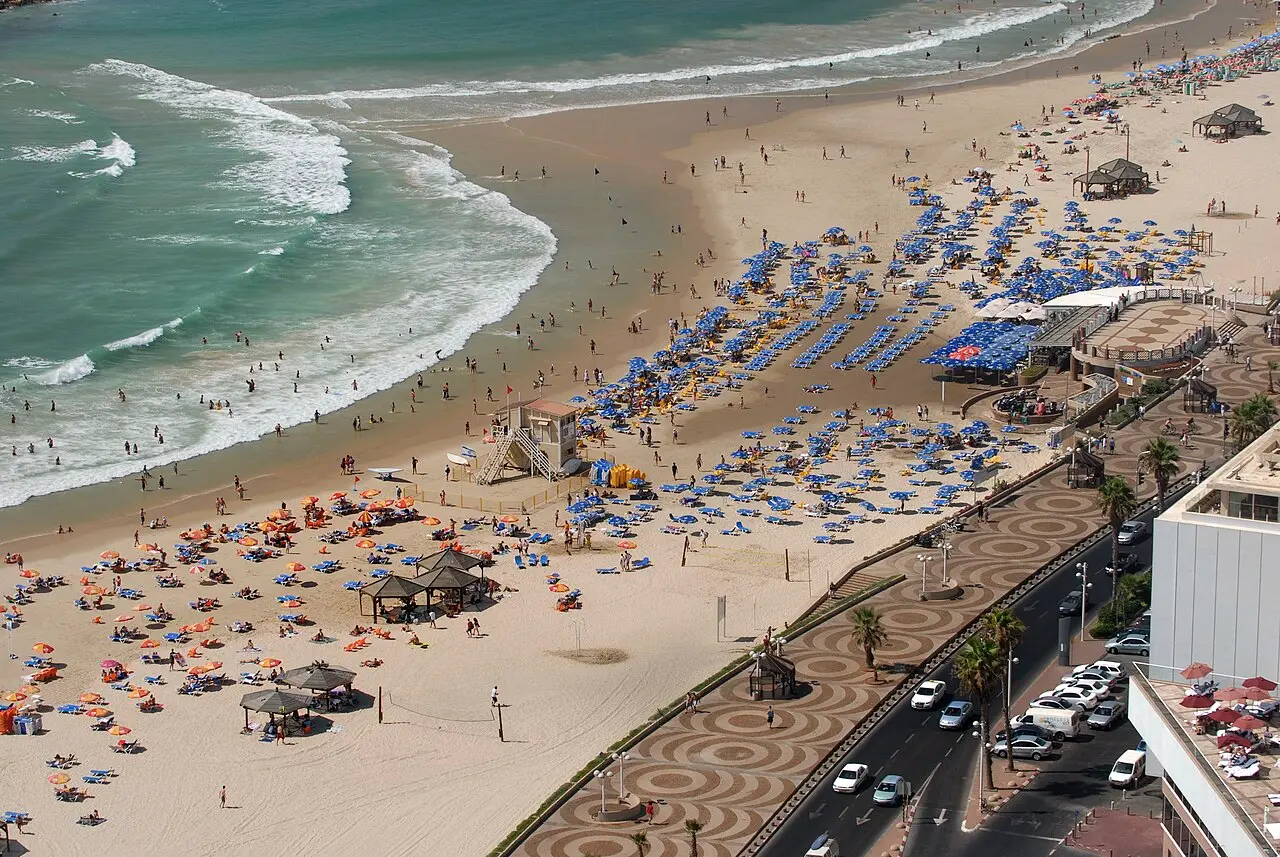
Simon Mannweiler / CC BY-SA 4.0 · Wikimedia Commons
The thirteen
Which beach is which, north to south
The thirteen run, from the Herzliya boundary southwards: Tzuk North, Tzuk South, Tel Baruch, Metzitzim, the Separate Beach (also called Nordau), Hilton, Gordon, Frishman, Bograshov, Jerusalem, Geula, Charles Clore and Givat Aliya. They are not interchangeable. The northern group is quiet, residential and takes some getting to. The middle group fronts the hotel strip and is where almost every visitor ends up. The southern two sit on made ground below Neve Tzedek and Jaffa.
The most striking stretch is the one where three incompatible constituencies sit side by side. The Separate Beach is walled off with a wooden partition and runs on a fixed rota: women and girls on Sunday, Tuesday and Thursday, men and boys on Monday, Wednesday and Friday, both on Saturday. Immediately north of it is Hilton, which the municipality's own page calls Tel Aviv's official gay beach and which is also the dog beach and the city's main surf beach. Those are not the same sand. The hotel association's guide splits Hilton into three: the dog beach at the north end, the gay beach in the middle, and the surf break at the southern end near the marina.
Gordon is the one with the outdoor gyms, the volleyball courts and the seawater swimming pool behind it, which is a separate municipal facility rather than part of the free beach. Frishman and Bograshov are the hotel-strip default, Jerusalem Beach has the kite surfing area, and Geula is named by the hotel association's guide as one of the city's matkot beaches. The municipality picks out Charles Clore for its waves and describes Givat Aliya, at the far southern end in Jaffa, as secluded; Givat Aliya is also the one built in an oriental idiom of arches, palms and limestone walls, and it is the least like the rest.
- Tzuk North, Tzuk South, Tel Baruch: northern, residential, and two of the four beaches equipped for bathers with disabilities
- Metzitzim: beside the old port, low-key, also equipped for disabled access
- The Separate Beach (Nordau): partitioned, with fixed days for men and for women
- Hilton: dogs at the north end, the official gay beach in the middle, surfers to the south
- Gordon, Frishman, Bograshov, Jerusalem: the hotel-strip beaches, with gyms, volleyball and kite surfing
- Geula: matkot
- Charles Clore and Givat Aliya: made ground, waves, and the quietest sand in the city
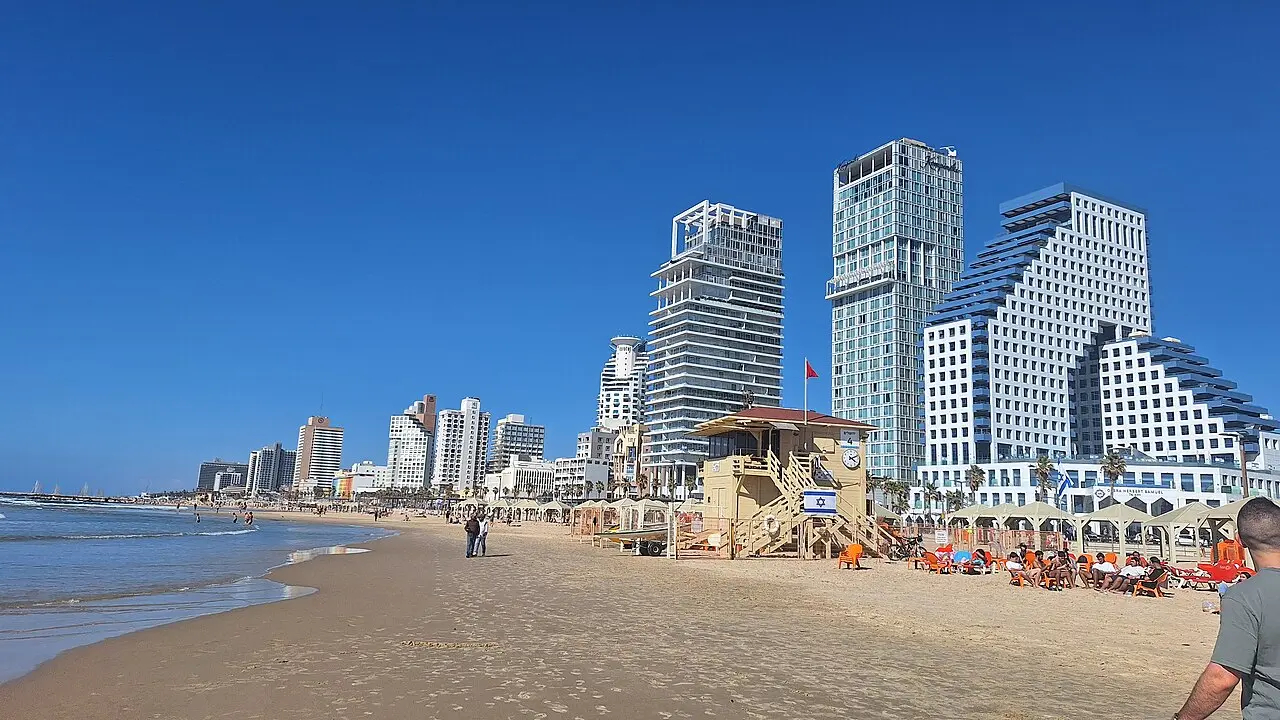
Rakoon / CC0 · Wikimedia Commons
Engineering
The sand is held in place, and some of the ground is rubble
Israel's first detached offshore breakwater went in off Tel Baruch, at the northern edge of the city, in 1965. I. Fried's paper to the International Conference on Coastal Engineering describes it: a rubble-mound structure 200 metres long, founded on rock three metres below sea level and tied to the shore by a groyne 100 metres long. Shortly after it was built, a sandy tombolo formed on both sides of the groyne and grew until it settled at equilibrium. That is the mechanism behind the wide beaches along much of this coast, and the sand that builds a tombolo is sand the longshore current was carrying past the site to somewhere else, which is why the technique is now argued over rather than simply repeated.
At the southern end the ground is artificial in a different sense. Charles Clore Park, about 29.6 acres of grass between the promenade and the Neve Tzedek side of the city, sits on the site of Manshiya, a seafront neighbourhood of Jaffa. It was fought over and largely destroyed in 1948, its remaining buildings were cleared in the 1960s for a central business district that was never built, and the rubble was embanked into the shore rather than carted away because carting it away was expensive. The park opened on top of it in 1974. Two structures from the neighbourhood are still standing, the most visible of them the Hassan Bek Mosque, just inland. How that destruction should be described remains sharply contested between Israeli and Palestinian accounts, and the park carries no explanation of what is underneath it.
The most recent thing to be taken off the seafront was the Dolphinarium. Nahum Zolotov's curved building opened in 1981, closed in 1985 when the dolphin shows proved unaffordable, and later housed the discotheque outside which a suicide bomber killed 21 people, most of them teenagers from the former Soviet Union, on 1 June 2001. It then stood derelict for seventeen years. Demolition began on 15 May 2018, to carry the promenade through the one stretch of coast it still blocked. The land swap that made the demolition possible, in which the owner received a site across the road near the Hassan Bek Mosque, was disputed in the courts and by campaigners who thought the city had paid far too much for it.
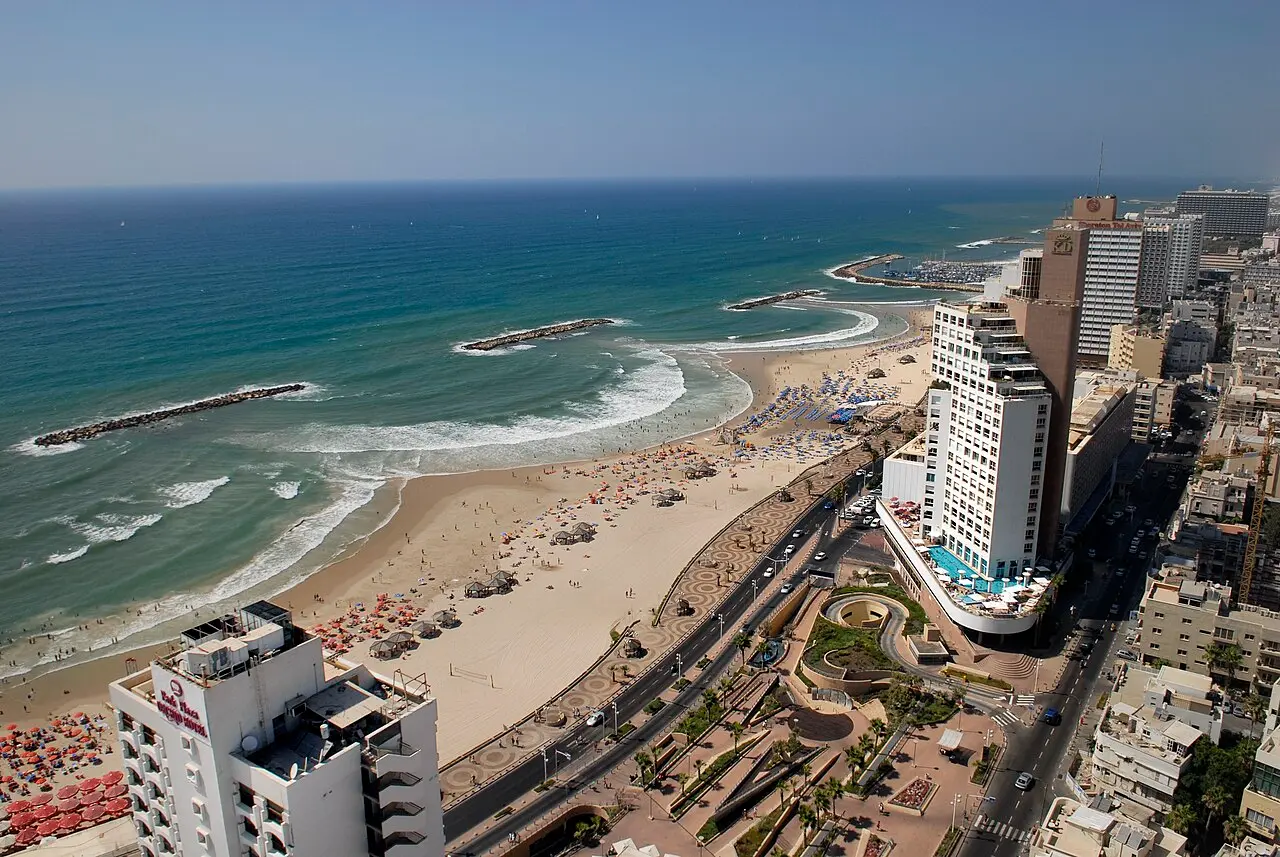
Simon Mannweiler / CC BY-SA 4.0 · Wikimedia Commons
In the water
Lifeguards, flags, and the hours when nobody is watching
The rule the municipality states most plainly is the one visitors break most often: swimming where no lifeguard is on duty is prohibited, not merely discouraged. That matters here because the stations keep short hours relative to the daylight. For 2026 they open at 07:15 every day of the season and close at 16:45 from 25 March to 31 May, 17:45 through June, 18:45 through July and August, and 16:45 again from September until the season ends on 10 October. Beach services and changing rooms run 07:00 to 19:30. In July the sun is still well up when the last lifeguard goes home, and the sand in front of the hotels stays full.
Outside the season the cover collapses. The city employs about 50 lifeguards in total, and in winter it runs three stations rather than thirteen. It is short of them: in January 2026 the municipality announced its first lifeguard certification course in four decades, free to participants and running from February to March, having taken on its first female lifeguard the previous summer.
Watch the flag on the station rather than the water. A black flag means bathing is forbidden, and it goes up often enough in spring and autumn that a calm-looking afternoon is no guide at all. All thirteen beaches held the Blue Flag for 2026, which is an award for water quality, safety provision and accessibility rather than a statement about the sea on any given day.
The other seasonal hazard is jellyfish. Swarms of Rhopilema nomadica, the nomad jellyfish, reach the Israeli coast in early summer, and in mid-June 2026 an orange swimming alert covered the shore from Ashkelon to Haifa Bay with stings reported without direct contact and sea temperatures at 26 degrees. Swarms shift over days rather than settling in for a season, which is why the municipality and the hotel association both point people at a jellyfish reporting app instead of publishing a calendar: there is not a reliable one to publish.
דוידי ורדי / CC BY 2.5 · Wikimedia Commons
Matkot
The sound the beach makes
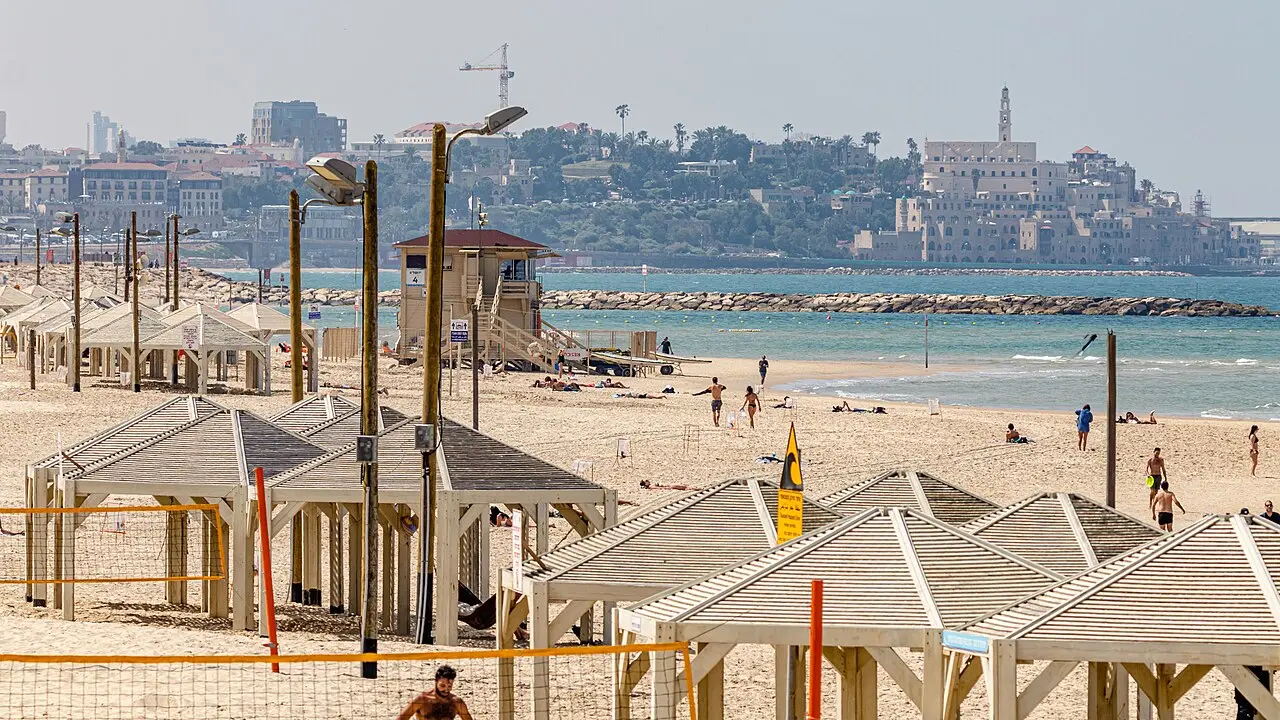
The noise along the waterline, a flat wooden crack repeating every second or so, is matkot: two players, two wooden paddles, one small rubber ball, and the object of keeping it in the air. There is no net, no court, no score and no winner. One player attacks and the other defends, they stand wherever they like (including directly across the path of everyone walking to the sea), and the game ends when somebody gets tired.
It has been played on these beaches since around the 1920s. The earliest well-known depiction is a 1932 painting by Nahum Gutman showing two young men with rounded paddles on a Tel Aviv beach. Where the paddles first came from is not settled, and one account has them arriving with immigrants from Turkey in the Ottoman period; nobody has established it. The same game turns up in Brazil as frescobol and in the United States as kadima. Israelis will tell you it is the national sport, which is a claim about temperament rather than about registration.
Two things follow for a visitor. The players have right of way in practice whatever the signs say, and walking through a rally is how most people get hit. And the paddles are sold along the strip, cheaply, which is how nearly everyone on the beach came to play badly.
What to look for
Things not to walk past at Tel Aviv Beaches and the Tayelet
The details that repay knowing about before you are standing in front of them.
The terraces on the beach building roofs
Along the central promenade the roofs of the beach buildings were rebuilt as public terraces in the 2018 renewal. They are free and they are the best sitting height on the strip, and most people walk underneath them without noticing the steps up.
The Separate Beach partition
A wooden wall runs down to the water at Nordau, with women admitted Sunday, Tuesday and Thursday and men Monday, Wednesday and Friday. Its immediate neighbour to the north is the city's official gay beach, with the dog beach in between.
The seawater pool at Gordon
A municipal swimming complex sitting on the beachfront itself, separate from the free beach and with its own admission. It is the fallback on a day the black flag is up and the sea is closed.
Charles Clore Park at the southern end
Roughly 30 acres of grass on the rubble of Manshiya, the Jaffa seafront neighbourhood destroyed in 1948 and cleared in the 1960s. The Hassan Bek Mosque, one of the two surviving buildings from it, stands just inland.
The gap where the Dolphinarium stood
Nahum Zolotov's 1981 curved building blocked the promenade for over thirty years, seventeen of them as a ruin after the 2001 attack outside the discotheque inside it. Demolition began on 15 May 2018 and the walkway now runs straight through.
A matkot rally at Geula
The hotel association's own guide names Geula as one of the city's matkot beaches. Paddles are sold along the strip, there is no scoring and no court, and there is no way to lose.
The long view
Tel Aviv Beaches and the Tayelet, in order
c. 1920s
Matkot begins to be played on the Tel Aviv sand. Nahum Gutman paints two players on the beach in 1932.
Late 1930s
The city council builds the first promenade, from Bograshov Beach to Jerusalem Beach, to separate walkers from bathers.
1939
The British Mandate authorities prohibit beach bathing after the German invasion of Poland. With sewage going into the water offshore, the seafront falls out of use.
1942 and 1953
London Square is laid out at the northern end of the strip, and Independence Garden opens above Hilton Beach.
1948 to the 1960s
Manshiya, the seafront neighbourhood of Jaffa, is destroyed in the 1948 war and its remains cleared in the 1960s. The rubble is embanked into the shore.
1965
Israel's first detached offshore breakwater is built off Tel Baruch, 200 metres long with a 100 metre groyne. A tombolo forms behind it.
1974
Charles Clore Park opens on the Manshiya rubble at the southern end of the beachfront.
1981 to 1985
The Dolphinarium, designed by Nahum Zolotov, opens and then closes when the dolphin shows prove unaffordable.
1982
Yaacov Rechter's promenade is built, with pebble paving in a wave pattern, under mayor Shlomo Lahat, whose name it still carries.
1 June 2001
A suicide bombing outside the discotheque in the disused Dolphinarium kills 21 people, most of them teenagers.
2018
Mayslits Kassif Roytman Architects complete the rebuilding of the central 2.5 km of promenade for Atarim, replacing the raised boardwalk with terraces and ramps to the sand.
15 May 2018
Demolition of the Dolphinarium begins, opening the last blocked stretch of the seafront.
January 2026
The municipality announces its first lifeguard certification course in 40 years, run free of charge from February to March.
25 March 2026
The 2026 bathing season opens across all thirteen beaches. It is due to close on 10 October.
29 May 2026
All thirteen Tel Aviv-Yafo beaches are named among 62 beaches nationally awarded the Blue Flag for the year.
Practical
Visiting Tel Aviv Beaches and the Tayelet
Where
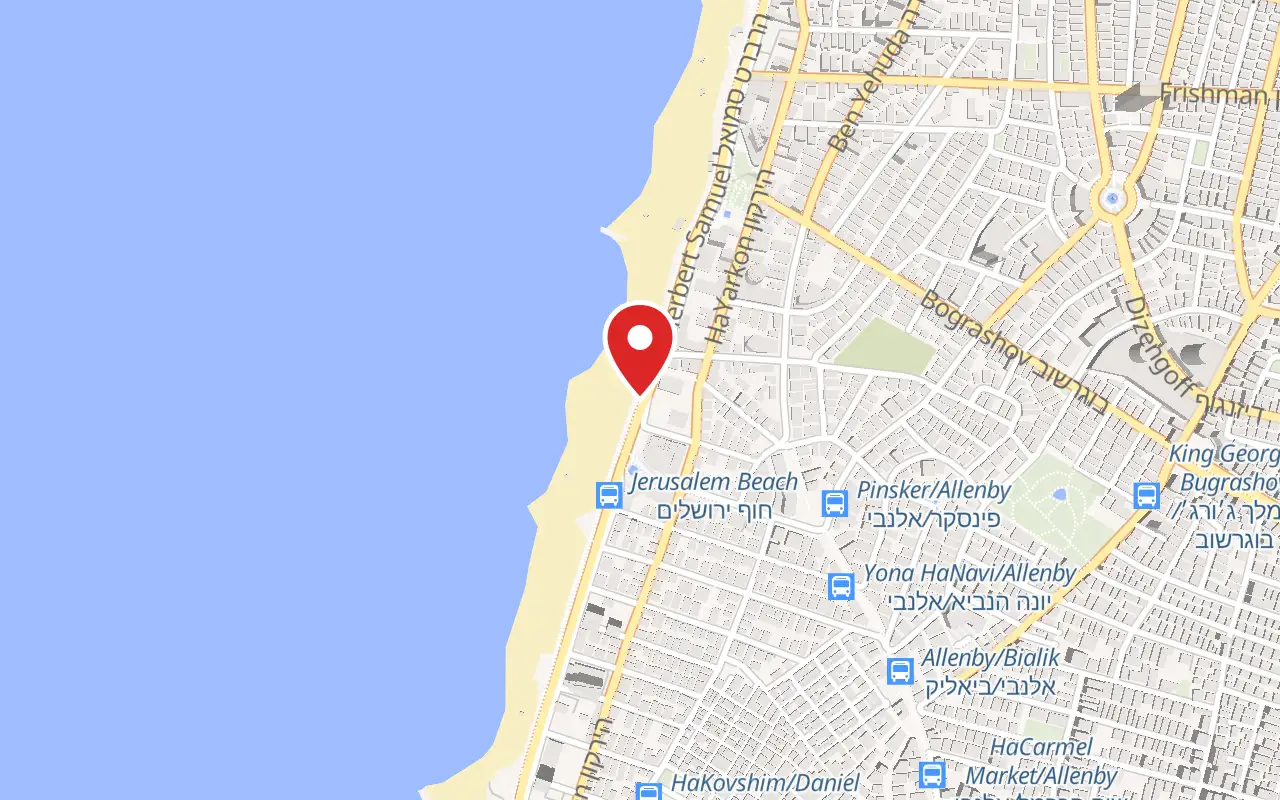
The Tel Aviv-Yafo seafront, from the Herzliya boundary in the north to the Bat Yam boundary in the south, along the Shlomo Lahat Promenade and its northern and southern continuations
Opening hours
- 2026 bathing season
- 25 March to 10 Octobersource
- Lifeguard stations, 25 March to 31 May
- 07:15 to 16:45source
- Lifeguard stations, June
- 07:15 to 17:45source
- Lifeguard stations, July and August
- 07:15 to 18:45source
- Lifeguard stations, September to 10 October
- 07:15 to 16:45source
- Beach services and changing rooms
- 07:00 to 19:30source
- Winter, outside the season
- Three lifeguard stations rather than thirteensource
- The promenade itself
- Open at all hours, with no gate anywhere along itsource
Admission
- Entry to every beach and to the promenade
- Freesource
- Umbrella or deck chair
- ₪10 for a visitor, ₪4 with a Digitel cardsource
- Sunbed
- ₪20 for a visitor, ₪8 with a Digitel cardsource
- Capped kiosk prices, as published for the previous season
- ₪6 coffee or tea, ₪6 small bottle of water, ₪12 pita with hummus and salads, ₪4 ice creamsource
- Changing rooms, showers and toilets
- Freesource
Access
Flat throughout: the promenade has no climb and no steps on its through route, and the rebuilding of the central 2.5 kilometres put ramps between street level and the sand precisely so that the descent to the beach is not a staircase. Four beaches are equipped for bathers with disabilities: Tzuk, Tzuk North, Metzitzim and Hilton. The municipality says every beach has an accessible trail to a shade shelter and at least one accessible chair, though that chair needs a companion to push it. All thirteen have adapted showers and taps, and the STEP HEAR audio guidance system is installed for blind and partially sighted visitors, usable through a free app or a free handset. Soft dry sand between the promenade and the waterline is still soft dry sand, and an unassisted wheelchair will not cross it away from the matting.
On site
- Lifeguard stations (in season)
- Free changing rooms, showers and toilets
- Kiosks and beach cafes with capped prices
- Sunbed, deck chair and umbrella hire
- Outdoor gyms
- Beach volleyball courts
- Playgrounds
- Seawater swimming pool at Gordon
- Surf and kayak hire at Hilton
- Dog beach at Hilton North
- Accessible matting and shade shelters
- STEP HEAR audio guidance
Booking
Nothing on the beaches is booked or ticketed. Sunbeds and umbrellas are hired on the spot from the concession on each beach, and the reduced rate needs a Digitel card, which is issued to residents rather than to visitors.
Hours and prices are given as the operator publishes them and change without much notice, particularly around Shabbat and the festivals. Check the operator's own page before you travel for this.
Official page at tel-aviv.gov.il →What people wish they had known
- Check the Hebrew beaches page, not the English one, for this year's dates. The English page was still showing a season of 16 April to 8 October when the Hebrew page had already published 25 March to 10 October for 2026.
- Work backwards from the lifeguard's closing time rather than from sunset. In July the stations shut at 18:45 with the sun still high, and swimming after that is prohibited rather than simply unsupervised.
- Do not assume Hilton is one beach. The dog stretch, the gay beach and the surf break are three different pieces of sand under a single name, and arriving at the wrong end is the commonest mistake on the northern strip.
- Check the day before setting out for the Separate Beach. Women are admitted Sunday, Tuesday and Thursday, men Monday, Wednesday and Friday, and both on Saturday, so half the week is wrong for any given visitor.
- Hire the sunbed from the beach concession rather than a cafe. The municipal rate is ₪20 for a sunbed and ₪10 for an umbrella or deck chair, and the kiosks on the same beaches work to capped prices too.
- Walk the promenade south rather than north in the late afternoon. It is flat the whole way, the light is behind you, and Old Jaffa on its headland is the thing in front of you for the last stretch.
The figures
Tel Aviv Beaches and the Tayelet by the numbers
Each figure carries the year it belongs to and links the source it came from.
| Measure | Figure | As of | Source |
|---|---|---|---|
| Municipal bathing beaches | 13 | 2026 | tel-aviv.gov.il |
| Length of the beachfront | about 14 km, given by the municipality as 8.7 miles | 2026 | tel-aviv.gov.il |
| Bathers a season | about 8.5 million | 2026 | israelhayom.com |
| Lifeguards employed by the municipality | about 50 | 2026 | israelhayom.com |
| Blue Flag beaches in Tel Aviv-Yafo | 13 of 13, out of 62 nationally | 2026 | jpost.com |
| Central promenade rebuilt for Atarim | 2.5 km | 2018 | mkarchitects.com |
| Tel Baruch offshore breakwater | 200 m long, with a 100 m groyne | 1965 | icce-ojs-tamu.tdl.org |
| Charles Clore Park | about 29.6 acres | 2026 | en.wikipedia.org |
While you are here
The rest of Tel Aviv
Everything else in this destination with a page of its own.
Romanhit / CC BY-SA 3.0 · Wikimedia Commons
Landmark
Tel Aviv Port
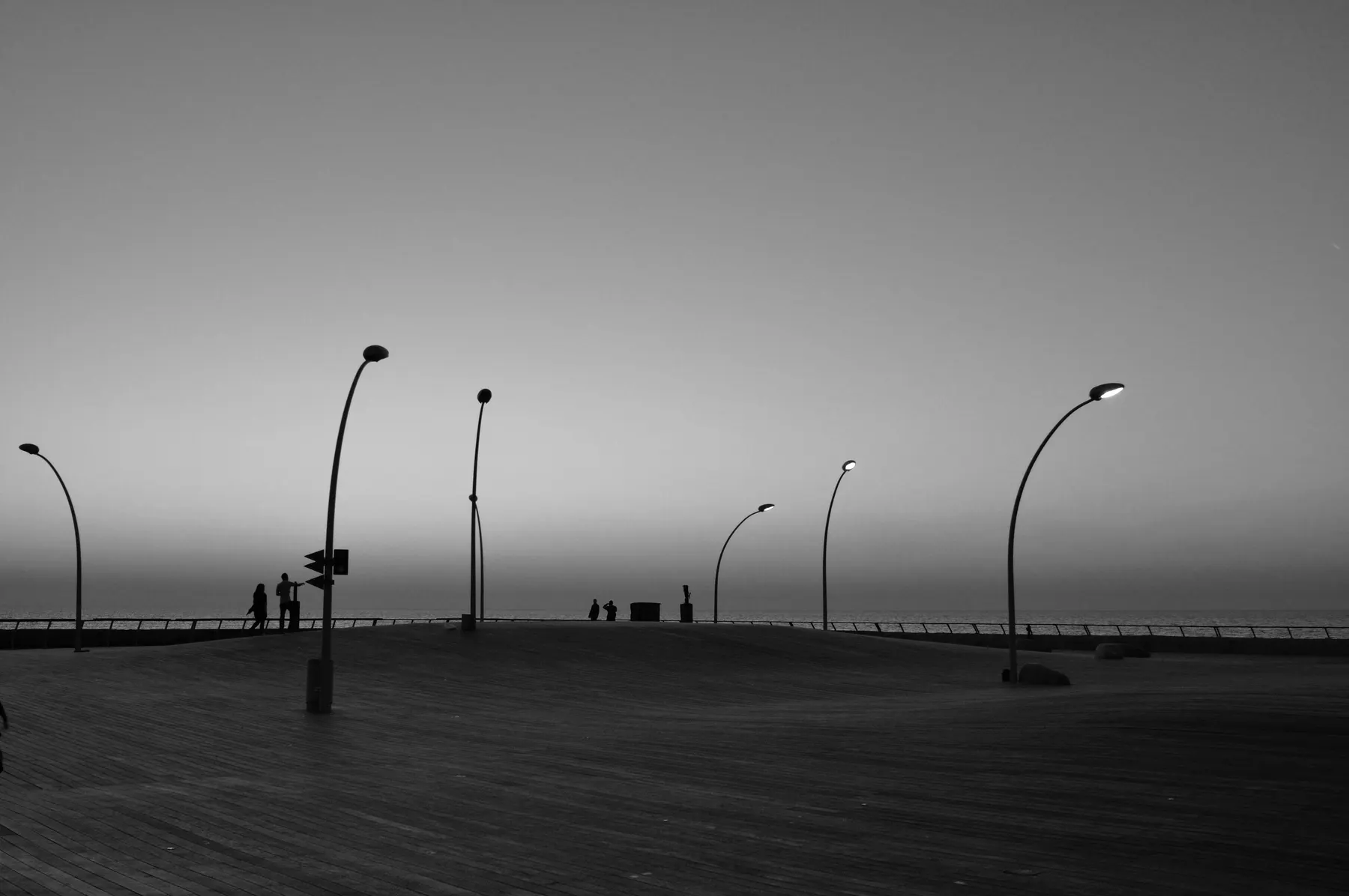
The first Jewish-run port on this coast landed its first cargo, a load of cement, on 19 May 1936, worked until 25 October 1965, and reopened as public space under a timber deck finished in 2008.
Rakoon / CC0 · Wikimedia Commons
Market
Carmel Market
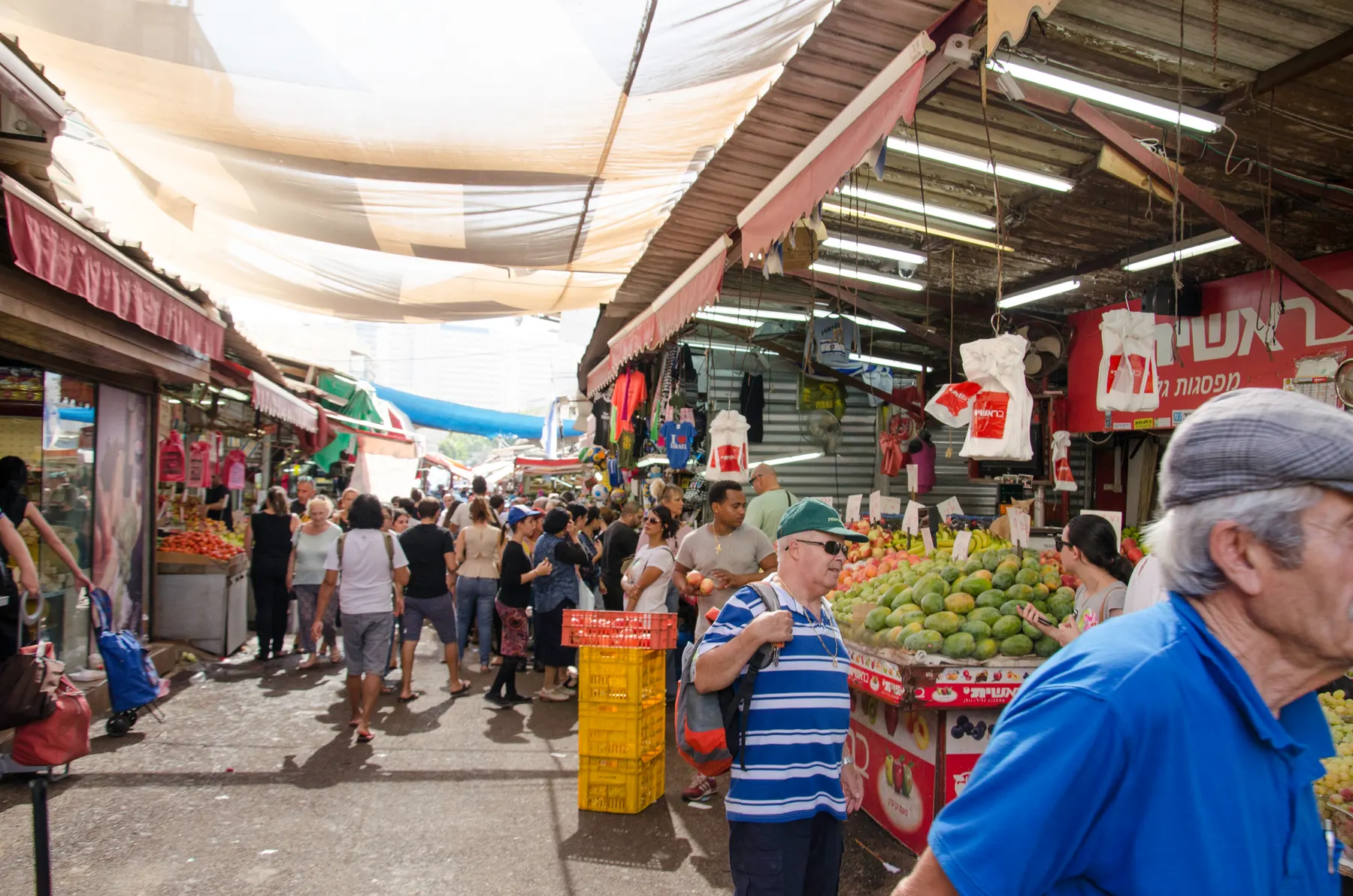
The market opened in 1920 on plots bought in Russia seven years earlier as a speculation, by investors who fled the revolution and arrived in Tel Aviv with nothing else left.
Deror Avi / CC BY-SA 3.0 · Wikimedia Commons
Neighbourhood
Neve Tzedek
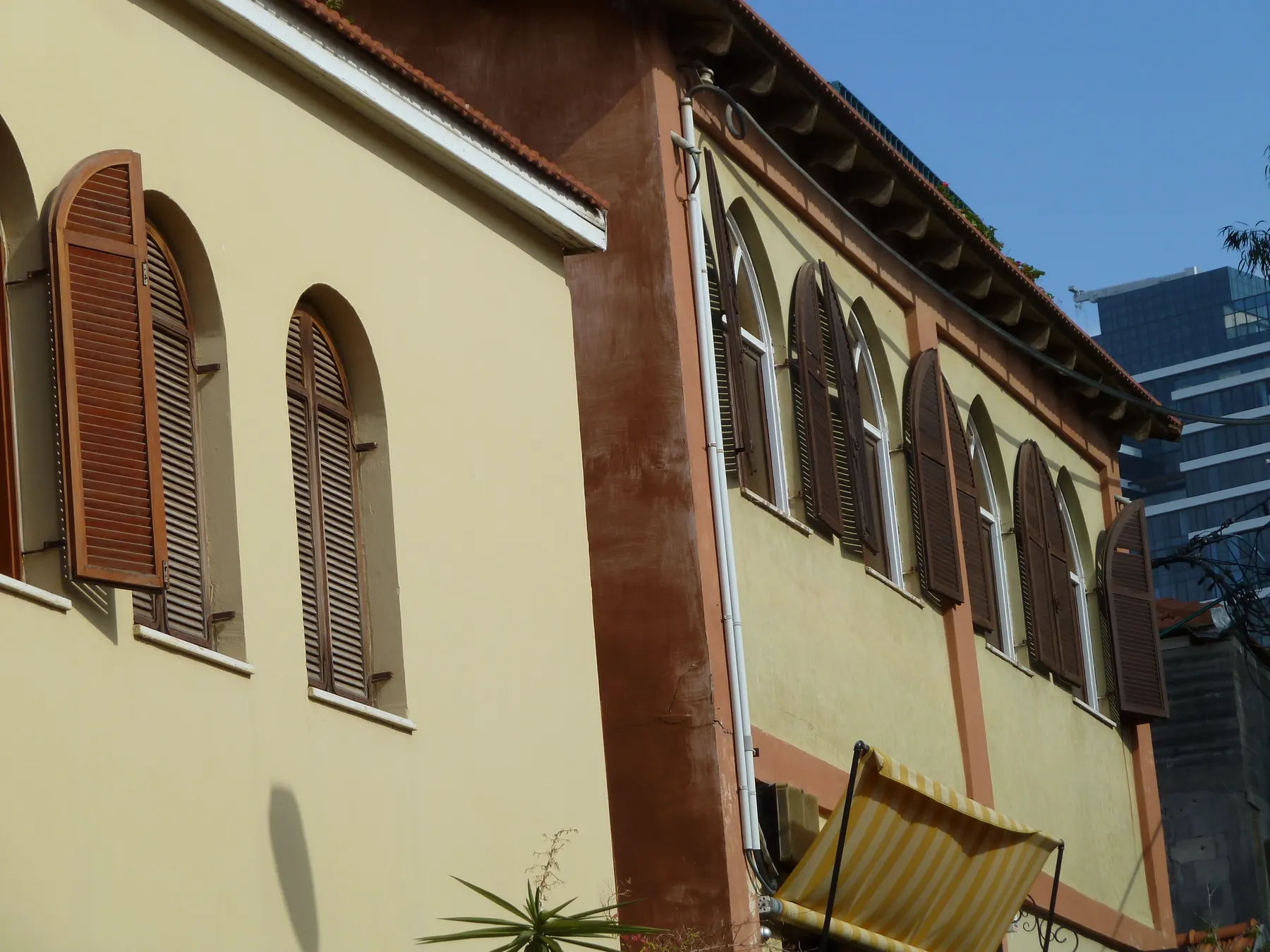
The quarter Jewish families built on the sand outside Jaffa in 1887, twenty two years before Tel Aviv existed, and the only one where the original houses were restored rather than cleared.
Sources and further reading
Every link below was opened and checked when this page was written. Official statements are marked as such: they are the subject's own account, not an independent one.
- OfficialTel Aviv-Yafo Municipalitytel-aviv.gov.ilBeaches
the operator's English page: the thirteen beaches and what each is known for, the religious beach rota, sunbed and umbrella prices, free showers and changing rooms, the four accessible beaches, the 8.7 mile figure, and the older 16 April to 8 October rescue window
- OfficialTel Aviv-Yafo Municipalitytel-aviv.gov.ilBathing beaches of Tel Aviv-Yafo
the operator's Hebrew page, which carries the current season: 25 March to 10 October 2026, lifeguard hours by period, beach services 07:00 to 19:30, the thirteen named beaches, the Blue Flag status and the beach by-laws including the dog rule
- OfficialMayslits Kassif Roytman Architectsmkarchitects.comTel Aviv's Central Beach Promenade
the architects' own account: Atarim as client for the municipality, 2.5 km, completion in 2018, and the continuous interface of terraces and ramps replacing the old barrier between city and sea
- ReportingIsrael Hayomisraelhayom.comTel Aviv opens first lifeguard training course in 40 years
January 2026: about 50 lifeguards employed, the free certification course running February to March, the first female lifeguard, three winter stations rather than thirteen, and about 8.5 million bathers a season
- ReportingIsrael Hayomisraelhayom.co.ilThe bathing season opens: what you may not bring to the beach, and what a small coffee costs
the municipality's capped kiosk prices as published for the previous season, the hire rates, the single-use plastic ban, the thirteen beaches in Hebrew and the STEP HEAR system
- ReportingIsrael Hayomisraelhayom.comOrange alert issued for Mediterranean beaches as jellyfish swarm Israeli coast
15 June 2026: the orange swimming alert from Ashkelon to Haifa Bay, stings without direct contact, and a sea temperature of 26 degrees
- ReportingThe Times of Israeltimesofisrael.comShow's over for Tel Aviv's Dolphinarium eyesore
Nahum Zolotov's design, the 1981 opening and 1985 closure, the 1 June 2001 bombing that killed 21 people, demolition from 15 May 2018, and the disputed land swap near the Hassan Bek Mosque
- ReportingThe Jerusalem Postjpost.comThese are the cleanest and safest beaches in Israel for 2026
29 May 2026: all thirteen Tel Aviv-Yafo beaches named among 62 beaches and three marinas awarded the Blue Flag by EcoOcean on behalf of the Foundation for Environmental Education
- ReferencePosen Library of Jewish Culture and Civilizationposenlibrary.comTel Aviv Promenade, Tel Aviv-Jaffa, Israel
Yaacov Rechter as designer, the 1982 date, the pebble paving laid in a wave pattern, and the promenade as a redesign of a narrower walkway built in 1939
- ReferenceWikipediaen.wikipedia.orgTel Aviv Promenade
the late-1930s council decision and the original Bograshov to Jerusalem Beach stretch, the 1939 bathing ban and the sewage discharge, London Square in 1942 and Independence Garden in 1953
- ReferenceWikipediaen.wikipedia.orgCharles Clore Park
Manshiya, the 1960s clearance and the rubble embanked into the shore, the park's opening and its 29.6 acres, and Charles Clore as the British financier it is named for
- ReferenceI. Fried, Proceedings of the 15th International Conference on Coastal Engineeringicce-ojs-tamu.tdl.orgProtection by means of offshore breakwaters
the Tel Baruch breakwater of 1965, 200 metres long on rock three metres down with a 100 metre groyne, and the tombolo that formed on both sides of it and grew to equilibrium
- ReferenceHadassah Magazinehadassahmagazine.orgMatkot, Israel's beachside ball game
play on the Tel Aviv beaches from the 1920s, the 1932 Nahum Gutman painting of two players, and the game's absence of rules, scoring and winners
- ReferenceTel Aviv Hotel Associationvisit-tel-aviv.comTel Aviv's beaches
Hilton split into the dog beach, the gay beach and the surf beach, Geula as a matkot beach, the separate beach rota, and the advice to watch a jellyfish app from May to October
Tel Aviv Beaches and the Tayelet: common questions
Are Tel Aviv beaches free?+
Yes. There is no admission charge on any of the thirteen municipal beaches, no gate anywhere on the promenade, and changing rooms, showers and toilets are free as well. The only things you pay for are hired furniture and food: ₪20 for a sunbed and ₪10 for an umbrella or deck chair at visitor rates, with lower rates for residents holding a Digitel card.
When is the Tel Aviv bathing season?+
For 2026 the municipality gives 25 March to 10 October on its Hebrew beaches page. Its English page still carries an older window of 16 April to 8 October, so the two disagree, and the Hebrew page is the one kept current. Outside the season the sand is open but only three lifeguard stations operate instead of thirteen.
What time do the lifeguards finish?+
At 16:45 from the start of the season to the end of May, 17:45 through June, 18:45 through July and August, and 16:45 again from September to the close of the season. They start at 07:15 every day. Beach services and changing rooms run 07:00 to 19:30, which is why the beach stays busy for an hour or two after the water is officially shut.
Which is the best Tel Aviv beach?+
It depends on what you want, because the thirteen are not variations on one thing. Gordon and Frishman are the hotel-strip default, with gyms, volleyball and the seawater pool behind them. Hilton is for surfers, dog owners and the city's gay beach. Metzitzim and the Tzuk beaches are quieter and are among the four equipped for disabled bathers. Givat Aliya in Jaffa is the one the municipality describes as secluded.
Can you take a dog to the beach in Tel Aviv?+
Only to the designated dog beach, which is the northern section of Hilton. The municipality's by-laws prohibit dogs on beaches other than those allocated for them. The dog stretch sits directly between the city's official gay beach and the partitioned religious beach, which is a piece of Tel Aviv geography that surprises most first-time visitors.
Is there a religious or separate beach, and how does it work?+
Yes. The Separate Beach, also called Nordau, is walled off with a wooden partition and runs on gender-separated days: women and girls on Sunday, Tuesday and Thursday, men and boys on Monday, Wednesday and Friday, and both on Saturday. It is one of the thirteen municipal beaches and carries the same free entry, lifeguard cover and Blue Flag status as the others.
Are the beaches accessible for a wheelchair?+
The promenade is, completely: it is flat, has no steps on its through route, and the central 2.5 kilometres was rebuilt with ramps down to the sand for exactly this reason. Four beaches are equipped for bathers with disabilities: Tzuk, Tzuk North, Metzitzim and Hilton. Every beach has an accessible trail to a shade shelter and at least one accessible chair, but that chair needs someone to push it, and dry sand away from the matting is not crossable unassisted.
Is it safe to swim, and what do the flags mean?+
Swim only where a lifeguard is on duty. The municipality prohibits bathing anywhere else and states that swimming without supervision is extremely dangerous, and the current off this coast pulls hard in a westerly. A black flag on the station means bathing is forbidden that day, and it goes up regularly in spring and autumn regardless of how the water looks from the promenade.
Are there jellyfish, and when?+
Yes, mostly in early summer. Swarms of Rhopilema nomadica reach the Israeli coast from around June, and in mid-June 2026 an orange swimming alert ran from Ashkelon to Haifa Bay with stings reported even without direct contact. The swarms move on over a few days rather than settling in for the season, so the practical answer is to check a jellyfish reporting app on the morning you plan to swim.
How long does it take to walk the whole promenade?+
Allow about three hours end to end without stopping, over the roughly 14 kilometres the municipality claims from the northern beaches down to Jaffa. Most people walk one section rather than the lot. It is flat the entire way, with no steps on the through route, and the natural direction in the afternoon is southwards with the sun behind you.