Landmark · Tel Aviv
Tel Aviv Port
The first Jewish-run port on this coast landed its first cargo, a load of cement, on 19 May 1936, worked until 25 October 1965, and reopened as public space under a timber deck finished in 2008.
Romanhit / CC BY-SA 3.0 · Wikimedia Commons
Founded
1936
the municipality calls it the first Hebrew port in Israel
Working life
1938-1965
inaugurated at full size on 23 February 1938, last ship 25 October 1965
Compound
220 dunams
22 hectares, with more than 140 businesses on the municipality's count
The deck
24,000 sq m
timber, on the municipality's figure; the architects give 55,000 sq m for the whole scheme
In short
- How long to give it
- about 90 minutes for the deck, the crane and the lighthouse; half a day with the market and a meal
- The compound
- Open every day, at all hours; the municipality lists it as active seven days a week, 365 days a year
- Entry to the port
- Free. There is no gate and no ticket desk
נמל תל אביב
Tel Aviv Port is a 220 dunam compound of former cargo hangars, quays and fair buildings at the northern end of the city's seafront, walked on today across an undulating timber deck. The municipality describes it as the first Hebrew port in Israel, dates its founding to 1936, counts more than 140 businesses inside it and says it is open seven days a week, 365 days a year. Nothing has been shipped through it since 1965.
It exists because of a strike. On 19 April 1936 the Arab general strike closed Jaffa, the coast's working harbour, to the Jewish community's traffic, and within weeks a landing stage was being improvised on the sand north of Tel Aviv. The historian Kobi Cohen-Hattab, in the account Matti Friedman summarised in the Jewish Review of Books, treats the opening of this port as the moment the Zionist movement began to see the Mediterranean as a continuation of the land rather than its edge. The same sentence describes a facility built to work around Arab dockworkers, and both halves of it are true at once.
What a visitor meets now is mostly not the port. The quay walls, the hangar shells, one crane and the lighthouse at the northern end are the surviving fabric; the deck, the lawns, the playground and the shopfronts date from a rebuilding that ran from 2001 and produced the wave-form boardwalk in 2008. The architects who designed it, Mayslits Kassif, put the annual figure at about four million visitors, which is their own estimate rather than a counted one.
1936
A port built because Jaffa's was closed
Jaffa had been the coast's port for centuries and the Yishuv had no share in running it. A Jewish port at Tel Aviv had been argued for since the end of the First World War, by Meir Dizengoff among others, and refused. The Arab general strike declared on 19 April 1936 changed the answer: with Jaffa shut, the British administration agreed to a landing stage on the sand north of the city, on condition that no Mandate money paid for it.
The money was raised instead by Otzar Mifalei Yam, a company floated for the purpose whose shares were sold to the Jewish public, and the work was done in part by Greek-speaking Jewish labourers from Salonika who had done this kind of work before. The Times of Israel's account has a Yugoslav freighter carrying a thousand tons of cement dropping anchor when construction had barely begun; the Hebrew record dates the first unloading to 19 May 1936, from the ship Četvrti, in sacks carried ashore by lighter. The first wooden pier collapsed the day after it was opened and a metal one replaced it inside a month.
The first man in charge of the place was Volodia Itzkovitz, who had been the only Jewish cadet at the naval academy in Odessa and by then went by the name Ze'ev Hayam, Wolf of the Sea. Dizengoff, mayor and by then gravely ill, is recorded at the opening saying that there would be a great port here. He died a few months later, in September 1936.
הרווי ספיר / CC BY 2.5 · Wikimedia Commons
1938-1965
Twenty-seven years of cargo, then Ashdod
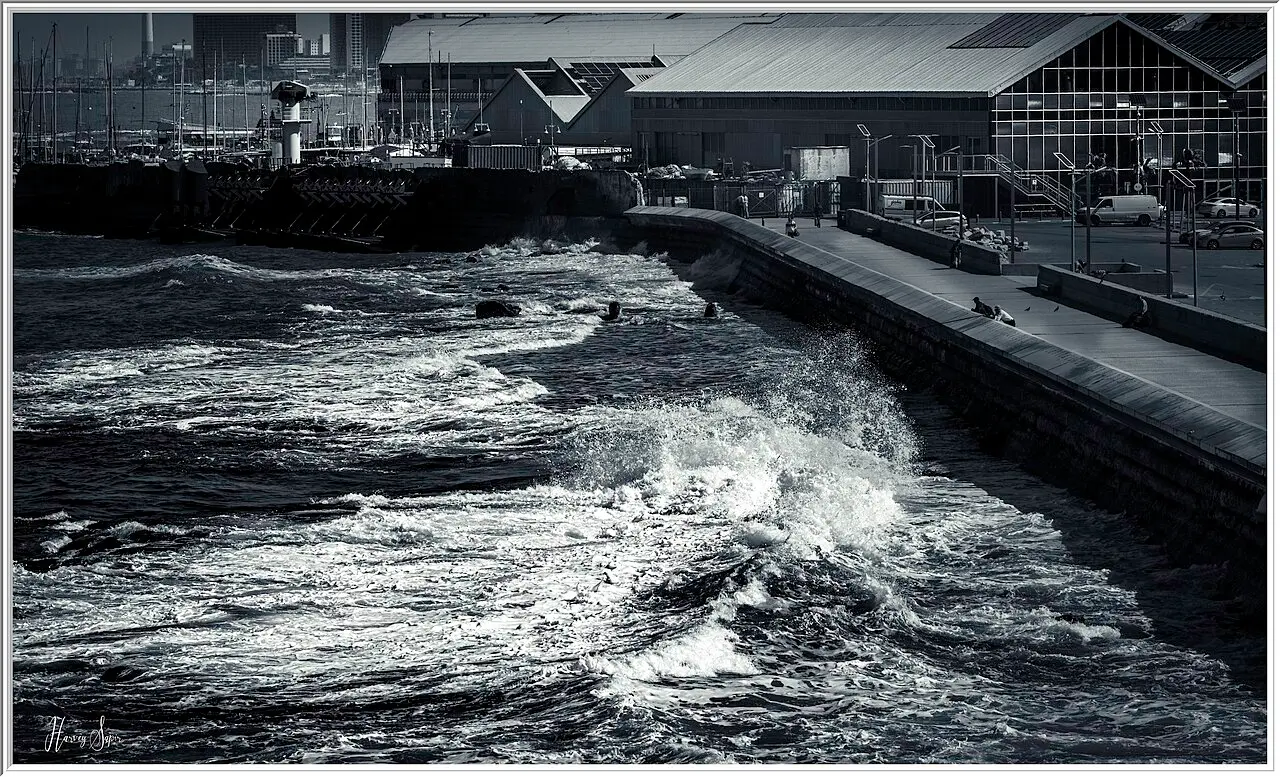
The improvised pier became a port proper on 23 February 1938, when the finished works were inaugurated at their full size. The basin was small by any commercial standard: the Hebrew account gives it as roughly 225 metres long and 63 metres wide, closed by a breakwater built parallel to the shore rather than thrown out to sea, which is why ships anchored off and cargo came in by lighter rather than alongside.
Its civilian working life was short. The British took the facilities as a military base for the Second World War, and the port's next significant moment was the 1948 war, when it was the only port wholly under Jewish control: supplies, weapons and the iron plates for the armoured convoys to besieged Jerusalem came through it. After the state was established the traffic moved to Haifa, and the shallow basin here had no answer to bigger ships.
Ashdod, deep-water and purpose-built, opened in 1965 and settled the question. The last ship left Tel Aviv on 25 October 1965. What followed was thirty-odd years of fishing boats, storage sheds and workshops, and the compound became the sort of place a city keeps its ugly functions in. The port's barges had one further outing: in the 1973 war they were taken to the Suez Canal for the crossing.
- Basin: about 225 m long and about 63 m wide
- Breakwater: built parallel to the shore, not out from it
- Cargo worked by lighter from ships anchored offshore
- 1939-1945: taken by the British as a military base
- 1948: the only port wholly under Jewish control during the war
Fabric
The crane, the lighthouse and the mound under it
The single most legible piece of the working port is the crane standing by the marina near the central deck. The municipality's own text dates its service from 1938 to 1965, calls it the only one of its kind operating in the country and says it lifted vessels during the Second World War. At its eighty-first year it was refurbished and lit as an installation by the designers Kochavi and Kimchi, which is a fair description of what has happened to the whole site: the machinery survives as sculpture.
At the northern edge stands the lighthouse, a 17 metre square concrete tower built by the British administration in 1934-35 and lit from 1935. It went dark in 1965 with the port it served, had a boardwalk built round it by the Israel Antiquities Authority in 2007, and in 2021 was fitted out as a cafe.
Under and around it is Tell Qudadi, an ancient mound on the north bank of the Yarkon mouth. P. L. O. Guy cut trial trenches there in October 1937 and a salvage dig by Eleazar Sukenik, Shmuel Yeivin and Nahman Avigad ran from November 1937 to March 1938, funded by Pinhas Rutenberg. No final report was ever published. When Alexander Fantalkin and Oren Tal went back to the material and published their reassessment, they moved the fortress from the tenth or ninth century BCE, where the excavators had put it, to the late eighth century under Assyrian rule, with abandonment around 650 BCE. The disagreement has not been settled, and the conserved remains sit beside the promenade with nothing on the ground to tell a walker which reading to believe.
The hangars themselves are the fourth survival, and the most misleading. The shells are original cargo sheds and 1930s fair buildings, restored; everything inside them is a fit-out of the last twenty years.
1934
The flying camel on the ground next door
The port did not arrive on empty sand. Two years earlier the same ground carried the Levant Fair, a trade exhibition of about ten hectares laid out at the northern edge of the city. The 1934 edition opened on 26 April, ran to 26 May, was inaugurated by the High Commissioner Arthur Wauchope and drew, on the usual account, 600,000 people from thirty countries in a month.
Its pavilions were designed by the architects who were then building the White City: Aryeh Elhanani, Richard Kauffmann, whose central pavilion was shaped like a ship, and Arieh Sharon. Elhanani also drew the fair's emblem, a winged camel that Tel Aviv has never quite let go of. One of the pavilions, built for Romania, was later used as a clandestine Haganah weapons workshop.
Most of the fair is gone. Elhanani's statue of the Hebrew Worker has been restored on the site, some of the halls stand as retail and event space with their numbers still on them, and the large playground occupies eight dunams of lawn where the Maccabiah stadium used to be. The municipality's own page about the port is filed under the fair's name, which is the tidiest indication of how thoroughly the two sites have merged.
2003-2008
The wave deck, and the argument it won
Otzar Mifalei Yam, still the owner, began putting the compound back together from 2001; the infrastructure was overhauled by 2002 and the leisure complex was substantially open by the end of 2004. The surface everyone now photographs came later. An open competition held in 2003 was won by Mayslits Kassif Architects, working with the landscape architect Galila Yavin, and the deck was completed in 2008.
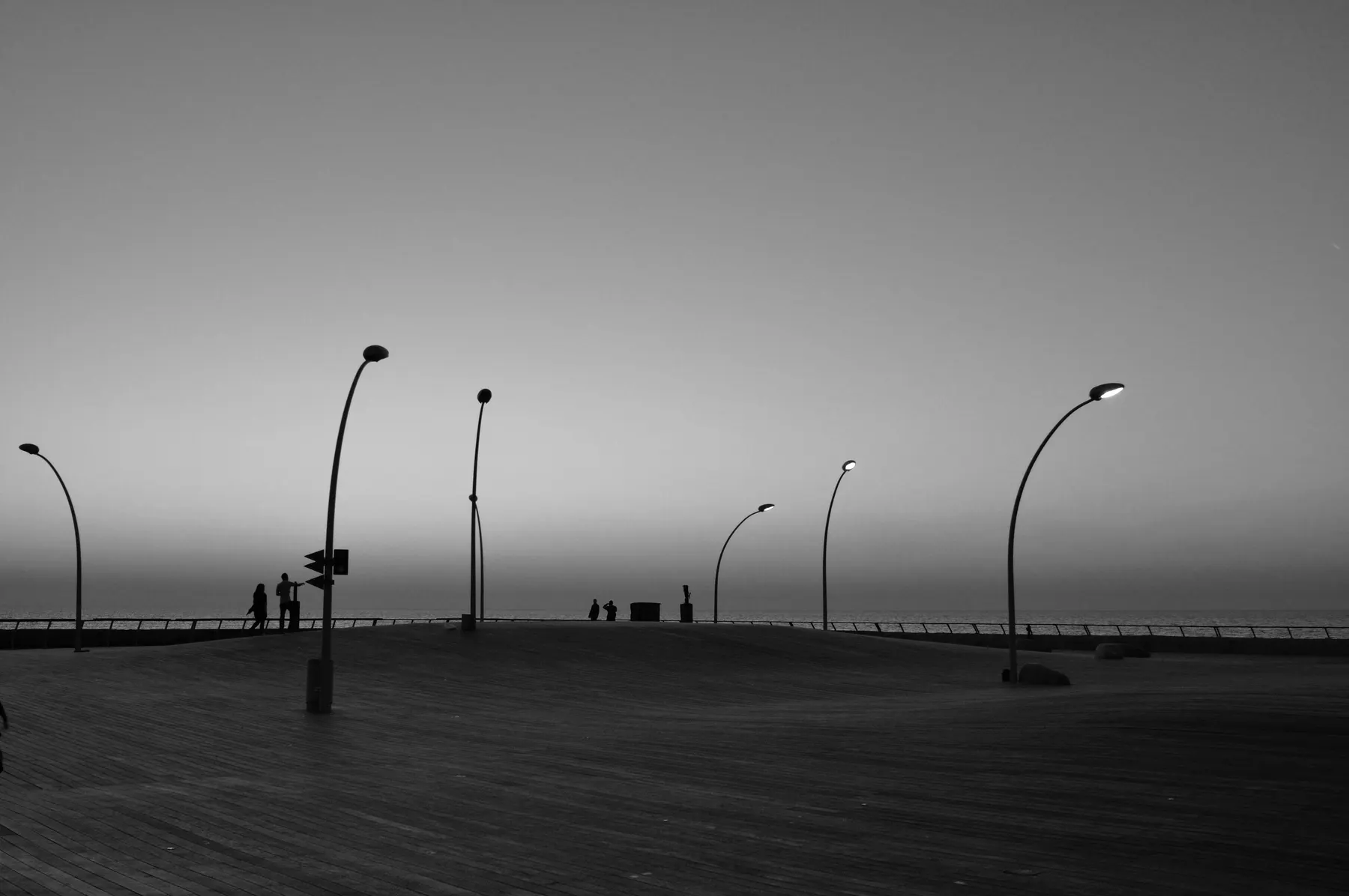
Their design is a single continuous timber surface that rises and falls in long waves, described by the practice as an undulating, non-hierarchical surface referring to the dunes the port was built on. Nothing on it is labelled as a route, a plaza or a lawn, which is the point: the deck is meant to be read as an open invitation rather than a plan. It has since carried everything from spontaneous rallies to art projects, on the architects' own account.
The published areas do not agree, because they measure different things. The municipality gives the deck as 24,000 square metres. The architects give 55,000 square metres for the whole scheme. The Hebrew account of the rebuilding says over 20,000 square metres of decking was laid. Read them as a deck of roughly two hectares inside a project of about five and a half.
In October 2010 the project won the Rosa Barba European Landscape Prize at the sixth landscape architecture biennial in Barcelona, from 427 entries and a shortlist of nine. The practice makes a larger claim for it: that a design strategy, rather than a grant of building rights, is what stopped the waterfront being developed commercially and turned it into the metropolitan area's most used open space. That is the designers' reading of their own work, and it is worth knowing whose it is.
Michal Zabag / CC BY-SA 3.0 · Wikimedia Commons
Today
What the port is on a Saturday
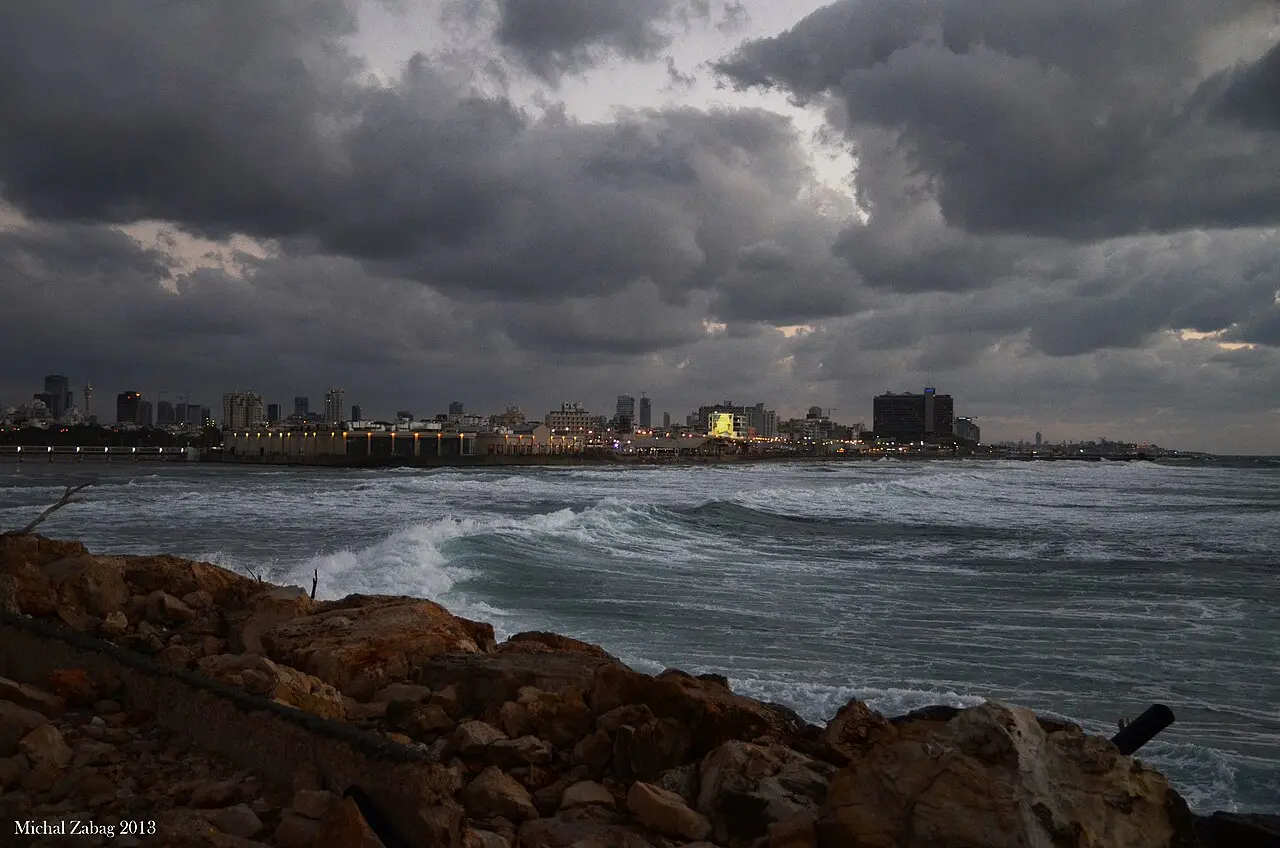
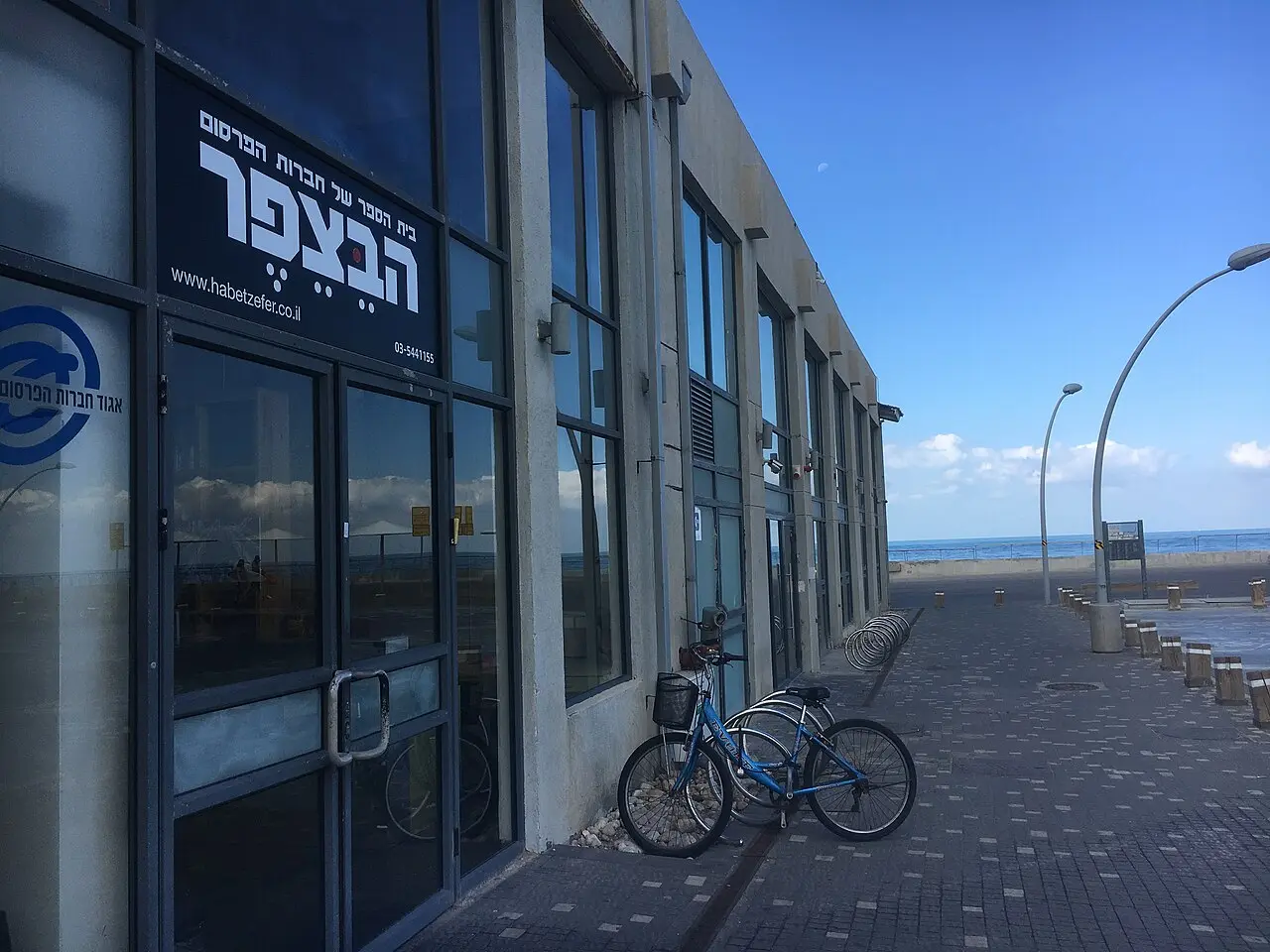
The compound runs as a shopping and eating district with a public promenade through it. The municipality counts more than 140 businesses and lists the fixtures a family will actually be looking for: the city's letter installation on the central deck beside a large sandbox, a 2.5 metre red heart frame between hangars 26 and 29, a carousel designed by Anat and Ilan Berman on 1950s and 1960s references, the eight dunam playground by the amphitheatre, and a three metre pair of angel's wings near the Yarkon bank, a copy of Jorge Marín's Alas de la Ciudad given to the city by the Jewish community of Mexico City.
The other fixture is the farmers market, Shuk HaNamal, which sells produce, cheese, fish, spices and prepared food out of a hangar. Its published hours are Sunday 09:00 to 14:00 on a reduced schedule, Monday to Thursday 09:00 to 20:00, Friday 07:00 to 17:00 and Saturday 09:00 to 18:00, and the market itself advises checking stall by stall.
Saturday is the busy day here precisely because so much of Israel is shut: the port is open every day of the year and most of the city's shops are not. That is also the day scheduled public transport does not run, so the journey home is the thing to think about before setting out. The setting either side is worth the extra hour: the Yarkon estuary and the Reading power station, built in 1938 around the country's first turbine, to the north, and the promenade running south past the beaches to the hotel strip and eventually to Jaffa.
The practical infrastructure is municipal and published. Three clusters of public toilets open daily from 06:30 to 22:00, at Hangar 3, at Hangar 25 and in a container by the playgrounds on the old fair ground; all three are accessible and two have baby-changing corners. A control room staffed around the clock covers this compound along with the marina, Jaffa port, Old Jaffa and HaTachana.
- More than 140 businesses, open every day of the year
- Farmers market in a hangar, with a reduced Sunday schedule
- Public toilets at Hangar 3, Hangar 25 and the fair ground, 06:30 to 22:00
- Playground of eight dunams, plus a sandbox on the deck itself
- The Yarkon estuary and Reading power station immediately north
Habetzefer / CC BY-SA 4.0 · Wikimedia Commons
What to look for
Things not to walk past at Tel Aviv Port
The details that repay knowing about before you are standing in front of them.
The 1938 crane
It worked cargo here from 1938 until the port closed in 1965 and the municipality calls it the only one of its kind that operated in the country. It stands by the marina near the central deck, refurbished and lit.
The lighthouse at the north end
A 17 metre concrete tower built by the British administration in 1934-35 and lit from 1935, dark since the port shut in 1965. A cafe was fitted inside it in 2021.
Tell Qudadi
The conserved remains of an ancient fortress beside the promenade at the Yarkon mouth, dug in 1937-38 and never fully published. Its date is contested: the excavators said tenth or ninth century BCE, a 2009 reassessment says late eighth.
The Hebrew Worker statue
One of the few surviving pieces of the 1934 Levant Fair, by Aryeh Elhanani, who also drew the fair's winged camel emblem. The fair's halls are the buildings the shops now occupy.
The deck itself
A single continuous timber surface rising and falling in waves, completed in 2008 and given the Rosa Barba European Landscape Prize in 2010. Walk the seaward edge rather than the shopfronts.
The farmers market
Produce, cheese, fish, spices and cooked food in a hangar, three deliveries a week from growers around the country. Friday morning from 07:00 is when it is fullest.
The long view
Tel Aviv Port, in order
26 April 1934
The Levant Fair opens on the ground next to the future port, inaugurated by the High Commissioner Arthur Wauchope; it draws 600,000 visitors from thirty countries before closing on 26 May.
1934-1935
The British administration builds the 17 metre concrete lighthouse at the Yarkon mouth. It is first lit in 1935.
19 April 1936
The Arab general strike closes Jaffa port. The British agree to a landing stage north of Tel Aviv on condition that Mandate funds pay nothing towards it.
19 May 1936
The first cargo is landed: cement, carried ashore by lighter from a Yugoslav ship, onto a pier that is still being built.
23 February 1938
The completed port is inaugurated at its full size, with a basin about 225 metres long behind a shore-parallel breakwater.
1939-1945
The British take the port as a military base for the duration of the Second World War.
1948
During the war of independence this is the only port wholly under Jewish control, landing supplies, weapons and the iron plating for the armoured convoys to Jerusalem.
25 October 1965
The last ship leaves. Operations move to the new deep-water port at Ashdod and the compound falls to fishing boats, storage and workshops.
2001-2004
Otzar Mifalei Yam rebuilds the compound as a leisure and commercial district; the infrastructure is overhauled by 2002 and the complex is substantially open by the end of 2004.
2003
An open competition for the public space is won by Mayslits Kassif Architects with the landscape architect Galila Yavin.
2007
The Israel Antiquities Authority conserves Tell Qudadi and builds the boardwalk around the lighthouse.
2008
The undulating timber deck is completed.
October 2010
The scheme wins the Rosa Barba European Landscape Prize at the sixth Barcelona biennial, from 427 entries and nine finalists.
2021
The lighthouse, dark for 56 years, reopens with a cafe inside it.
Practical
Visiting Tel Aviv Port
Where
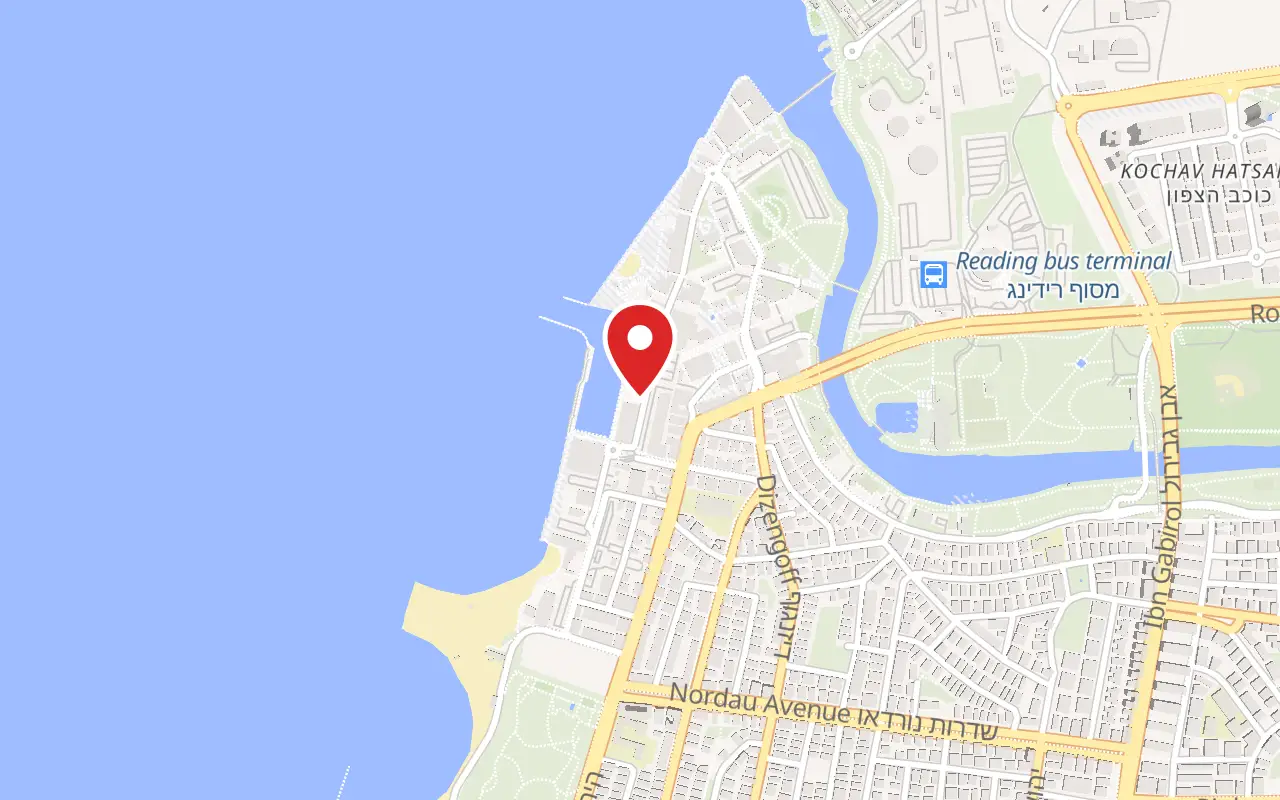
Nemal Tel Aviv Street, north Tel Aviv, between the Yarkon estuary and Hilton beach
What ticket you need
This is not inside a ticketed park and no ticket applies. The land is run by Otzar Mifalei Yam (Marine Trust Ltd), the same company floated in 1936 to build the port and named as the client of the 2000s redevelopment; the municipal company Atarim runs the control room that watches this compound along with the Tel Aviv marina, Jaffa port, Old Jaffa and HaTachana.
Opening hours
- The compound
- Open every day, at all hours; the municipality lists it as active seven days a week, 365 days a yearsource
- Public toilets
- 06:30 to 22:00 daily, at Hangar 3, Hangar 25 and the container by the playgroundssource
- Farmers market, Sunday
- 09:00 to 14:00, on a reduced schedulesource
- Farmers market, Monday to Thursday
- 09:00 to 20:00source
- Farmers market, Friday and Saturday
- Friday 07:00 to 17:00, Saturday 09:00 to 18:00source
- Shops and restaurants
- Each keeps its own hours; the market's own advice is to check stall by stallsource
Admission
- Entry to the port
- Free. There is no gate and no ticket desksource
- Events on the deck
- The municipality says free-entry public activities run through the yearsource
- Sheraton car park, HaNamal 1 (49 spaces)
- ₪24 an hour, 06:00 to 18:00 Sunday to Friday; ₪36 for a single entry 18:00 to 06:00; first 15 minutes free; 50% off for Tel Aviv-Yafo residentssource
- Reading West car park, Rokach 7 (485 spaces)
- ₪36 for a single entry valid 24 hours; first 15 minutes free; 75% off for Tel Aviv-Yafo residentssource
- The port's own car parks
- Charged, and operated by the port company rather than the municipal one; tariffs are posted at the barriersource
Access
Level throughout. The deck was designed as one continuous surface rather than a set of terraces, so there is no climb and no flight of steps anywhere on the site, and the walking between hangars is flat. The municipality publishes three clusters of public toilets, all of them accessible, open 06:30 to 22:00, two with baby-changing corners. The municipal car park at Reading West is listed as wheelchair accessible. The surface is timber and it is wet and slippery after rain, which is the one thing that catches wheels out here.
On site
- Public toilets, 06:30 to 22:00
- Accessible toilets
- Baby-changing (Hangars 3 and 25)
- Restaurants and cafes
- Farmers market
- Playground (8 dunams)
- Sandbox on the deck
- Amphitheatre
- Event halls and clubs
- Paid car parks
- 24-hour control room
Booking
Nothing here is ticketed or booked. Individual venues in the hangars, the concert halls in particular, sell their own tickets, and the market is busiest on Friday morning.
Hours and prices are given as the operator publishes them and change without much notice, particularly around Shabbat and the festivals. Check the operator's own page before you travel for this.
Official page at namal.co.il →What people wish they had known
- Do not come expecting an old harbour of stone quays and bollards. Almost everything underfoot is a timber deck laid in the 2000s; the port that is left is the crane by the marina, the hangar shells, the quay edge and the lighthouse at the north end.
- Check the market day before planning the visit round it. Shuk HaNamal runs a reduced Sunday, 09:00 to 14:00, and its long days are Monday to Thursday; Friday starts at 07:00 and stops at 17:00 for Shabbat.
- Work out the way home before Saturday. The port is open and at its busiest on Shabbat, when much of the city is closed, but scheduled buses and the light rail are not running.
- Park with the municipal company rather than at the barrier if the stay will be long. Reading West, at Rokach 7, charges ₪36 for a single entry valid 24 hours and is a walk across the Yarkon; the Sheraton car park at HaNamal 1 charges ₪24 an hour in the daytime.
- Walk the northern end, not just the shopfronts. The lighthouse, the conserved mound of Tell Qudadi and the Yarkon estuary are all past the last hangar, and most visitors turn back at the restaurants.
- Treat the deck as slippery after rain. It is timber, it is unbroken by kerbs or steps, and the same continuity that makes it easy for a pushchair makes it fast underfoot when wet.
The figures
Tel Aviv Port by the numbers
Each figure carries the year it belongs to and links the source it came from.
| Measure | Figure | As of | Source |
|---|---|---|---|
| Area of the compound | 220 dunams (22 hectares) | 2026 | tel-aviv.gov.il |
| Businesses inside it | more than 140 | 2026 | tel-aviv.gov.il |
| The deck, on the municipality's figure | 24,000 sq m | 2026 | tel-aviv.gov.il |
| The scheme, on the architects' figure | 55,000 sq m | 2008 | mkarchitects.com |
| Visitors a year, as the architects estimate it | about 4 million | 2026 | mkarchitects.com |
| Entries to the 2010 Rosa Barba prize | 427, with nine finalists | 2010 | designboom.com |
| The 1938 basin | about 225 m by 63 m | 1938 | he.wikipedia.org |
| Height of the lighthouse | 17 m | 1935 | en.wikipedia.org |
While you are here
The rest of Tel Aviv
Everything else in this destination with a page of its own.
ענת פרנק גורלי / CC BY 2.5 · Wikimedia Commons
Beach
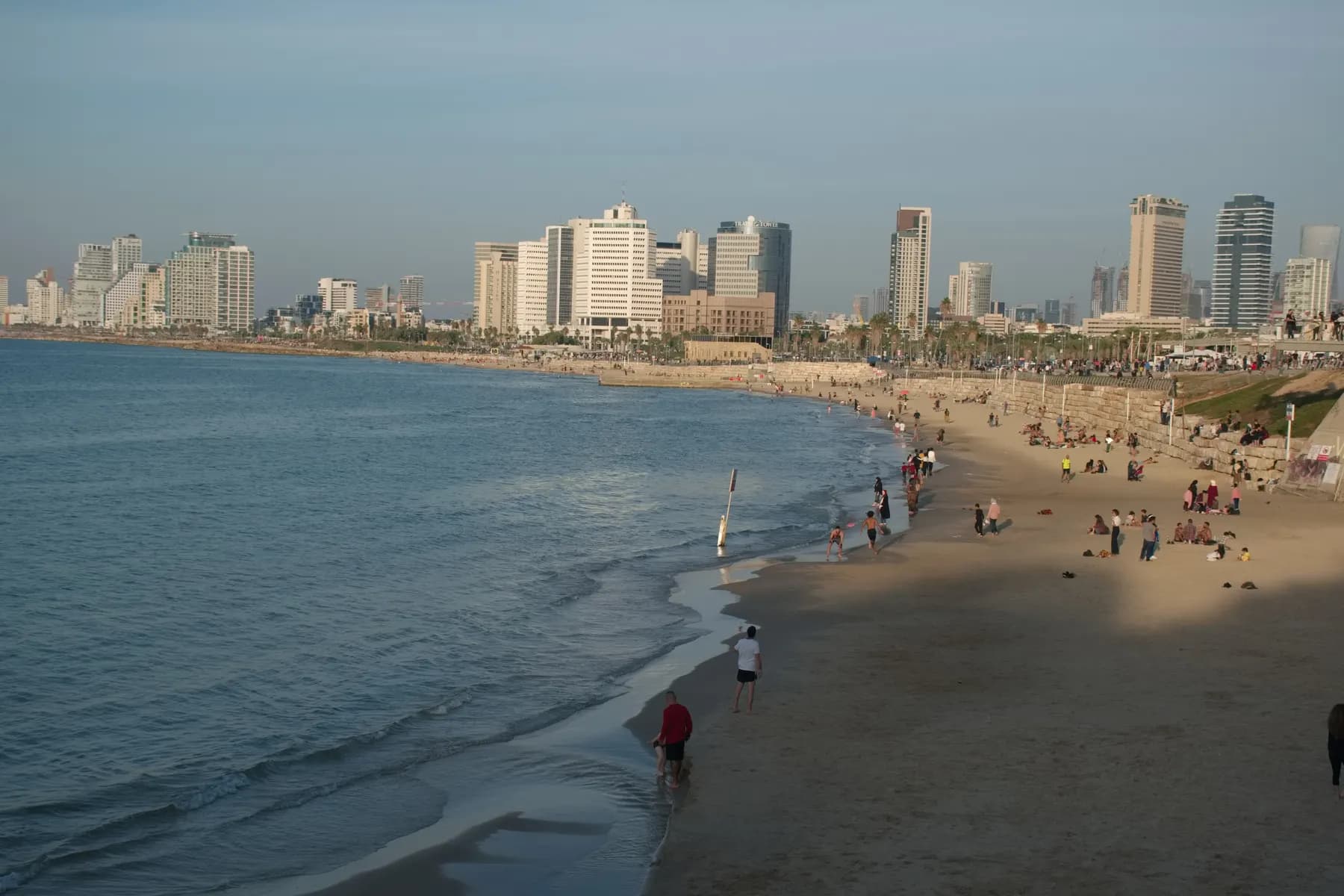
Tel Aviv Beaches and the Tayelet
Thirteen municipal beaches on one continuous promenade, opened for the 2026 season on 25 March, with the lifeguard stations due to close for the year on 10 October.
הרווי ספיר / CC BY 2.5 · Wikimedia Commons
Nature reserve
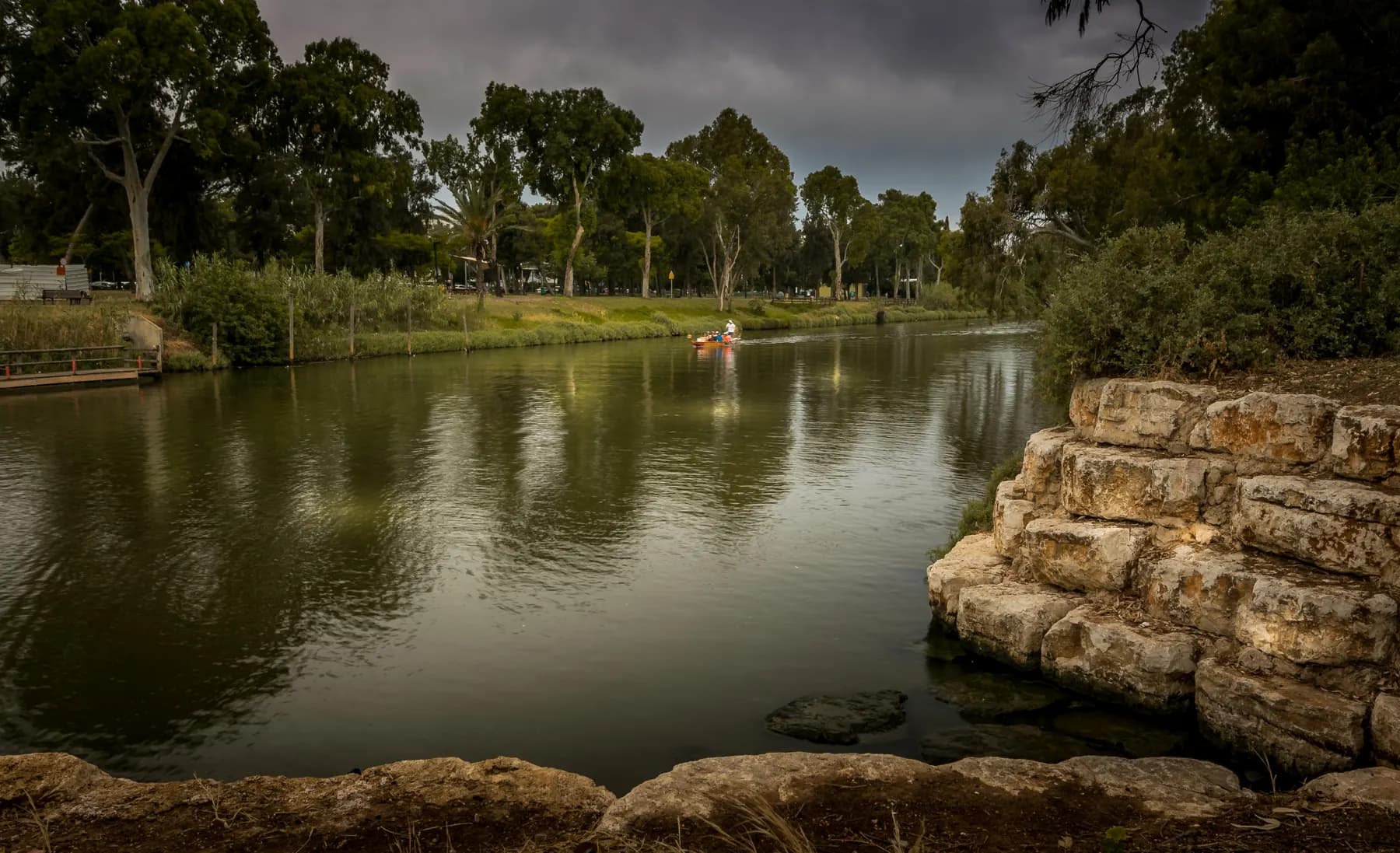
HaYarkon Park
The park runs about 3,800 dunams from the Geha road to the sea, and the river it is named for now carries roughly 5 per cent of the water it did before the Yarkon-Negev pipeline took the springs.
Deror_avi / CC BY-SA 4.0 · Wikimedia Commons
Museum
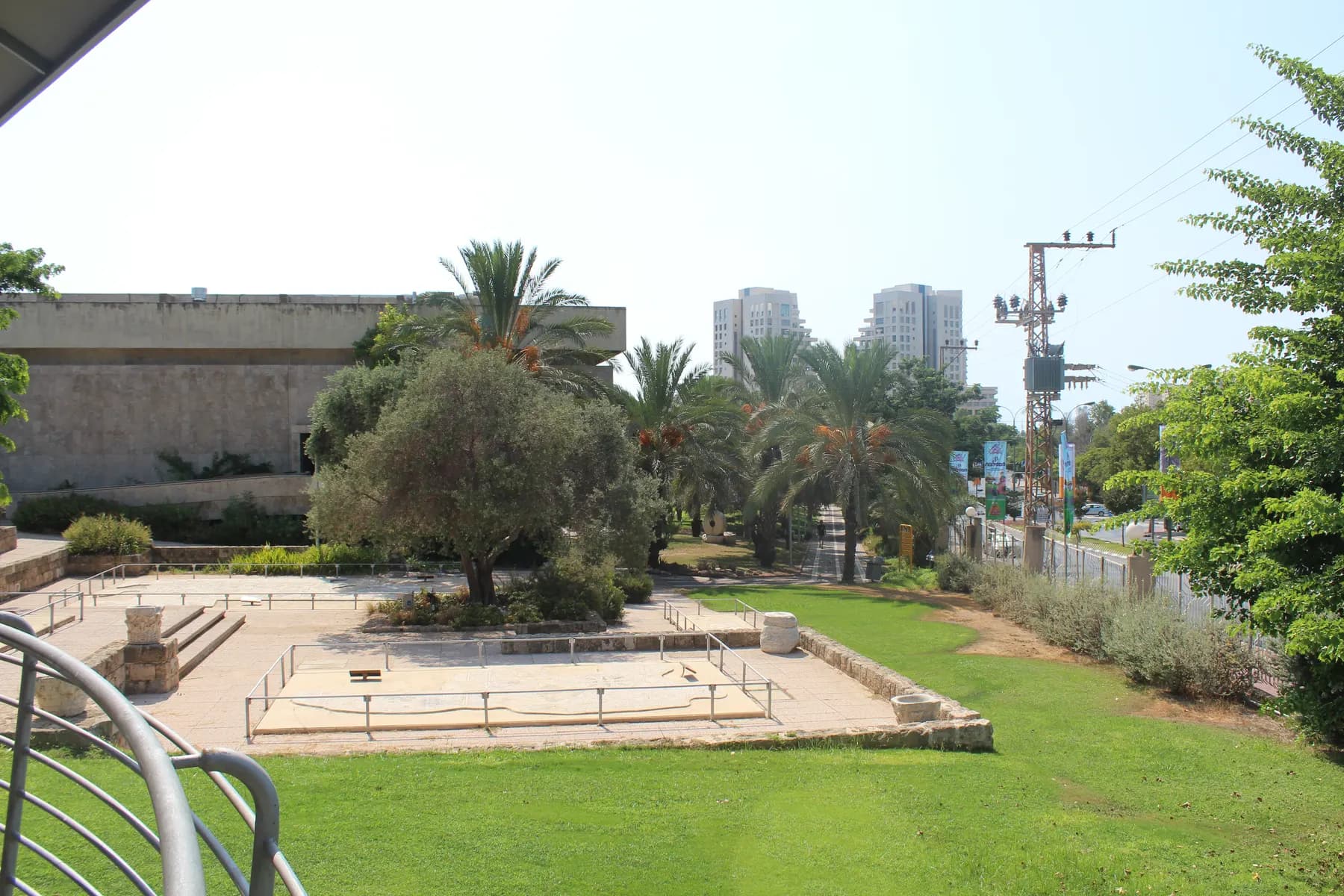
Eretz Israel Museum
The first excavation permit issued by the State of Israel, in 1948, was for the mound that still stands at the centre of this museum's grounds in Ramat Aviv.
Sources and further reading
Every link below was opened and checked when this page was written. Official statements are marked as such: they are the subject's own account, not an independent one.
- OfficialTel Aviv-Yafo Municipalitytel-aviv.gov.ilנמל תל אביב (Tel Aviv Port)
220 dunams, more than 140 businesses, the 24,000 sq m deck, the 1938-1965 crane, the installations and the public toilet hours
- OfficialMayslits Kassif Roytman Architectsmkarchitects.comTel Aviv Port
the designers' own project data: 55,000 sq m, competition 2003, completed 2008, client Marine Trust, about four million visitors a year
- OfficialTel Aviv Port Marketshukhanamal.co.ilשוק הנמל (Shuk HaNamal)
the market's published opening hours and its advice to check individual stalls
- OfficialAhuzot HaHof, Tel Aviv-Yafo municipal parking companyahuzot.co.ilחניון שרתון (Sheraton car park, HaNamal 1)
49 spaces, ₪24 an hour daytime, ₪36 single entry overnight, first 15 minutes free, 50% resident discount
- OfficialAhuzot HaHof, Tel Aviv-Yafo municipal parking companyahuzot.co.ilחניון רידינג מערב (Reading West car park)
485 spaces, ₪36 for a single entry valid 24 hours, 75% resident discount, listed as wheelchair accessible
- ReportingDesignboomdesignboom.comMayslits Kassif Architects: Tel Aviv port public space wins Rosa Barba European Landscape Prize
the 2010 prize at the sixth Barcelona biennial, 427 entries and nine finalists, and the collaboration with Galila Yavin
- ReportingThe Times of Israeltimesofisrael.comAt Tel Aviv Port, once the gateway into the Land of Israel
Aviva and Shmuel Bar-Am, 19 December 2015: the cement ship, Dizengoff at the opening, the 1938 inauguration, wartime and 1948 use
- ReferenceJewish Review of Booksjewishreviewofbooks.comIsrael's Sea Change
Matti Friedman on Kobi Cohen-Hattab's Zionism's Maritime Revolution: Jaffa's closure in 1936, Ze'ev Hayam as first port captain, and the port's working life to 1965
- ReferenceHebrew Wikipediahe.wikipedia.orgנמל תל אביב
Otzar Mifalei Yam's share issue, the Salonika labourers, the first unloading on 19 May 1936, the basin dimensions and the 2001-2004 rebuilding
- ReferenceEnglish Wikipediaen.wikipedia.orgTel Aviv Port
the 23 February 1938 inauguration, the 25 October 1965 closure and the 2002-2008 redevelopment sequence
- ReferenceEnglish Wikipediaen.wikipedia.orgReading Light
the lighthouse: built 1934-35, 17 metres, dark from 1965, boardwalk in 2007 and a cafe from 2021
- ReferenceEnglish Wikipediaen.wikipedia.orgTell Qudadi
the 1937-38 excavations, the unpublished report, and the contested redating of the fortress by Fantalkin and Tal
- ReferenceEnglish Wikipediaen.wikipedia.orgLevant Fair
the 1934 fair on the adjoining ground, its architects, the flying camel emblem and what survives
- ReferenceEnglish Wikipediaen.wikipedia.orgReading Power Station
the 1938 station at the Yarkon mouth immediately north of the port
Tel Aviv Port: common questions
Is there an entrance fee for Tel Aviv Port?+
No. The port is open public space with no gate and no ticket desk, and the municipality says free-entry activities run there through the year. The only things you pay for are food, shops, event tickets and parking.
What are the opening hours?+
The compound itself has none: the municipality lists it as active seven days a week, 365 days a year, and the deck is walkable at any hour. Individual businesses set their own times, the public toilets run 06:30 to 22:00, and the farmers market closes in the late afternoon or early evening depending on the day.
Is anything left of the actual 1936 port?+
Yes, but less than most visitors assume. The surviving fabric is the cargo crane that worked here from 1938 to 1965, the shells of the hangars and 1930s fair halls, the quay edge and breakwater line, and the 1934-35 lighthouse at the northern end. The deck, the lawns, the playground and every shopfront are new work from the 2000s.
How long does a visit take?+
About 90 minutes covers the deck end to end, the crane and the lighthouse at a walking pace. Add the farmers market and a meal and it becomes half a day, which is how most people actually use it.
Is it open on Shabbat?+
Yes, and Saturday is one of its busiest days, because the port keeps trading when much of the country is shut. The catch is transport: scheduled buses and the light rail do not run from Friday evening to Saturday night, so plan the return journey before setting out.
Where do you park and what does it cost?+
There are paid car parks inside the compound run by the port company, and two municipal ones nearby run by Ahuzot HaHof. The Sheraton car park at HaNamal 1 charges ₪24 an hour from 06:00 to 18:00 Sunday to Friday and ₪36 for a single entry overnight; Reading West at Rokach 7 charges ₪36 for a single entry valid 24 hours. Both give the first 15 minutes free and discount for Tel Aviv-Yafo residents.
Can you swim at Tel Aviv Port?+
Not in the port. The old basin is a moorage for small boats, not a bathing area, and there is no declared beach inside the compound; the nearest ones are immediately to the south, at Metzitzim and Hilton, where the municipality posts lifeguards in season. What the deck offers instead is a low seaward edge to sit on.
Is it accessible for wheelchairs and pushchairs?+
Yes, and unusually well. The deck was designed as one continuous surface, so there is no climb and no flight of steps anywhere on the site, and the municipality publishes three clusters of accessible public toilets open 06:30 to 22:00. The one caution is that timber decking is slippery when wet.
Is Tel Aviv Port worth it if you only have one day in the city?+
Only if the day already includes the northern seafront. The port is a pleasant, busy, largely commercial compound with a good market and one genuinely important piece of landscape architecture, but a first day in Tel Aviv is better spent on the White City, Carmel Market and Jaffa. It rewards a second visit, an evening, or a family with small children more than it rewards a rushed first one.
What is the wooden deck, and why is it famous?+
It is a single undulating timber surface completed in 2008 to a design by Mayslits Kassif Architects with Galila Yavin, who won an open competition for it in 2003. It won the Rosa Barba European Landscape Prize in Barcelona in 2010 from 427 entries, and it is cited internationally as an example of reclaiming a derelict waterfront through public space rather than through building rights.