2,000-year-old ritual bath lifted intact from the ground in Kiryat Gat
The Israel Antiquities Authority says the Second Temple-period mikveh, weighing about 25 tons, points to a previously unknown Jewish settlement in Israel's south.
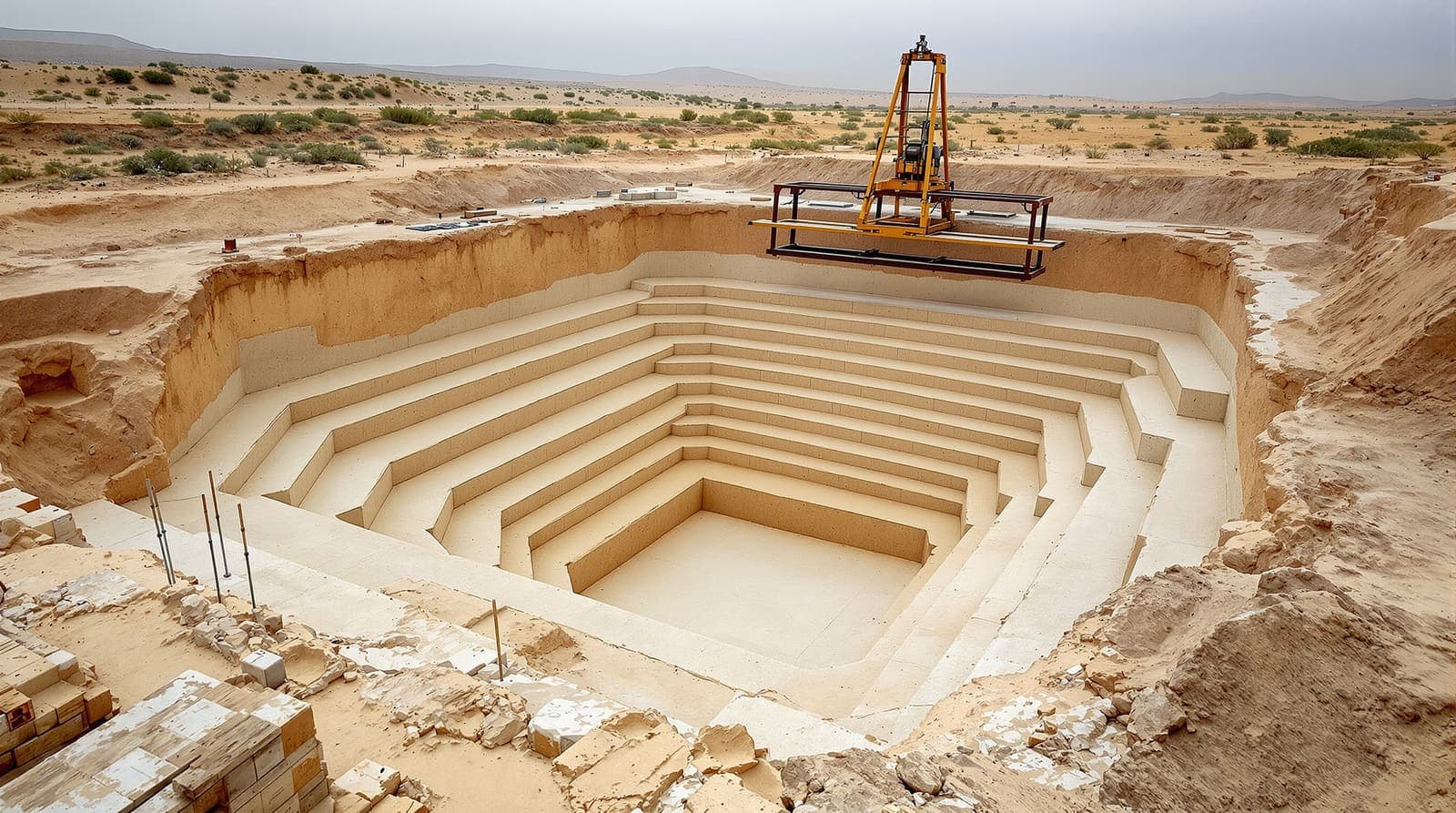
Illustration
A Jewish ritual bath dated to roughly 2,000 years ago was raised from the ground in one piece in the southern Israeli city of Kiryat Gat, according to an announcement by the Israel Antiquities Authority relayed by Israel's Ministry of Foreign Affairs. The bath, which the authority says weighs about 25 tons, was lifted over the summer.
The installation came to light during salvage excavations carried out ahead of construction work in Carmei Gat, a neighborhood of the city. The Israel Antiquities Authority said the find offers evidence of a Jewish settlement in the area that had not previously been documented, in the zone between the Judean Lowlands and the northern Negev. The announcement was made on Thursday.
What the sources posted
On the ground

A 2,000-year-old Jewish ritual bath weighing about 25 tons was lifted intact from the ground in the southern city of Kiryat Gat this summer, the Israel Antiquities Authority said on Thursday. The Second Temple-period mikveh was uncovered during salvage excavations before Show more
What a mikveh is
A mikveh (plural mikva'ot) is a pool built for ritual immersion in Jewish law, used for purification at defined moments in religious life. To be valid it must hold water gathered in a prescribed way rather than water that has been carried by hand, which is why ancient examples are typically cut into bedrock and reached by a flight of steps descending into the basin. Because the requirements are specific and recognisable, archaeologists treat a stepped immersion pool as one of the clearest physical markers that the people who built it were Jewish, in the same category as stone vessels or the absence of pig bones at a site.
The Second Temple period
The Second Temple period is the era of the rebuilt Temple in Jerusalem, running from the return from Babylonian exile to the Temple's destruction by Rome. It is the setting for the Hasmonean kingdom, Herodian building projects and the Jewish revolts against Roman rule, and it is the period in which ritual immersion pools became common across Judea. Mikva'ot from this era have been documented in Jerusalem, in the Judean hills and at desert sites, so the type of installation is well known; what the Israel Antiquities Authority presents as new here is the location.
Where Kiryat Gat is, and why the location matters
Kiryat Gat is a city in Israel's southern district, situated in the lowland country inland from the Mediterranean coastal plain. It sits between two distinct landscapes: the Judean Lowlands, the belt of low chalk hills that separates the coastal plain from the Judean Mountains, and the northern Negev, the semi-arid country that opens out towards the desert in the south. That belt was a frontier zone in antiquity, and the Israel Antiquities Authority's point is that a mikveh there implies a Jewish community living in a place where one was not previously recorded.
What a salvage excavation is
Under Israeli practice, land slated for development is examined by archaeologists before building begins, and where remains are found the dig is carried out as a rescue or salvage operation rather than as an open-ended research project. The Israel Antiquities Authority, the government body responsible for excavation, conservation and the country's antiquities collections, runs or licenses this work. The Kiryat Gat mikveh was uncovered in exactly that context, during excavations that preceded construction in Carmei Gat. Lifting an installation of this weight intact, rather than recording it and building over it, is a conservation decision that allows the object to be displayed or re-sited.
What the report does not say
The material available is brief, and a number of basic points are left open. It does not give the exact date on which the pool was lifted, the engineering method used, or where the mikveh has been taken. It does not name the excavation directors, describe the other finds from the site, or say how large the settlement the authority infers might have been, nor how it was dated beyond the general attribution to the Second Temple period. It also does not say what will happen to the rest of the excavation area or whether the planned construction in Carmei Gat is affected.
The account here rests on a single announcement by the Israel Antiquities Authority as published by the Israeli Foreign Ministry, which pointed readers to further coverage in The Times of Israel. No independent assessment of the dating or of the settlement interpretation is available in that material.
Sources and further reading
Every link below was opened and checked when this page was written. Official statements are marked as such: they are the subject's own account, not an independent one.
- Officialmfax.comIsrael Foreign Ministry on X
How we checked this
All details here come from a single Israel Antiquities Authority announcement as published by Israel's Foreign Ministry, which also pointed to coverage in The Times of Israel. The dating and the settlement interpretation remain attributed to the antiquities authority alone.
The account of the incident itself rests on the official statement and has not been independently confirmed by Israel.com. Where the statement is silent, this page says so rather than filling the gap.
Our sourcing and corrections policy →The week from Israel, in one email
The stories that mattered, sourced and checked by the Israel.com newsroom. Free, weekly, one-click unsubscribe.
One list, unsubscribe in a click. See our privacy policy.
More in Archaeology
All archaeology →

Latest
- Trump bars CNN, MS NOW and Politico from the White House
- Hadera teenager named as Amichai Atia; driver's remand extended
- Boy of seven killed on Route 264 near Rahat; police open investigation
- Ex-Palestinian minister says he carried Sinwar message to Israel before Oct. 7
- Police officer and his father held over Haifa stabbing that left man, 25, critical
- Man in his thirties dies in violent incident on Ashkelon street