After Nova, an Israeli Wristband That Works When Networks Fail
Founders who developed the system during reserve duty say a radio mesh network can keep crowds connected to security teams when cellular coverage collapses.
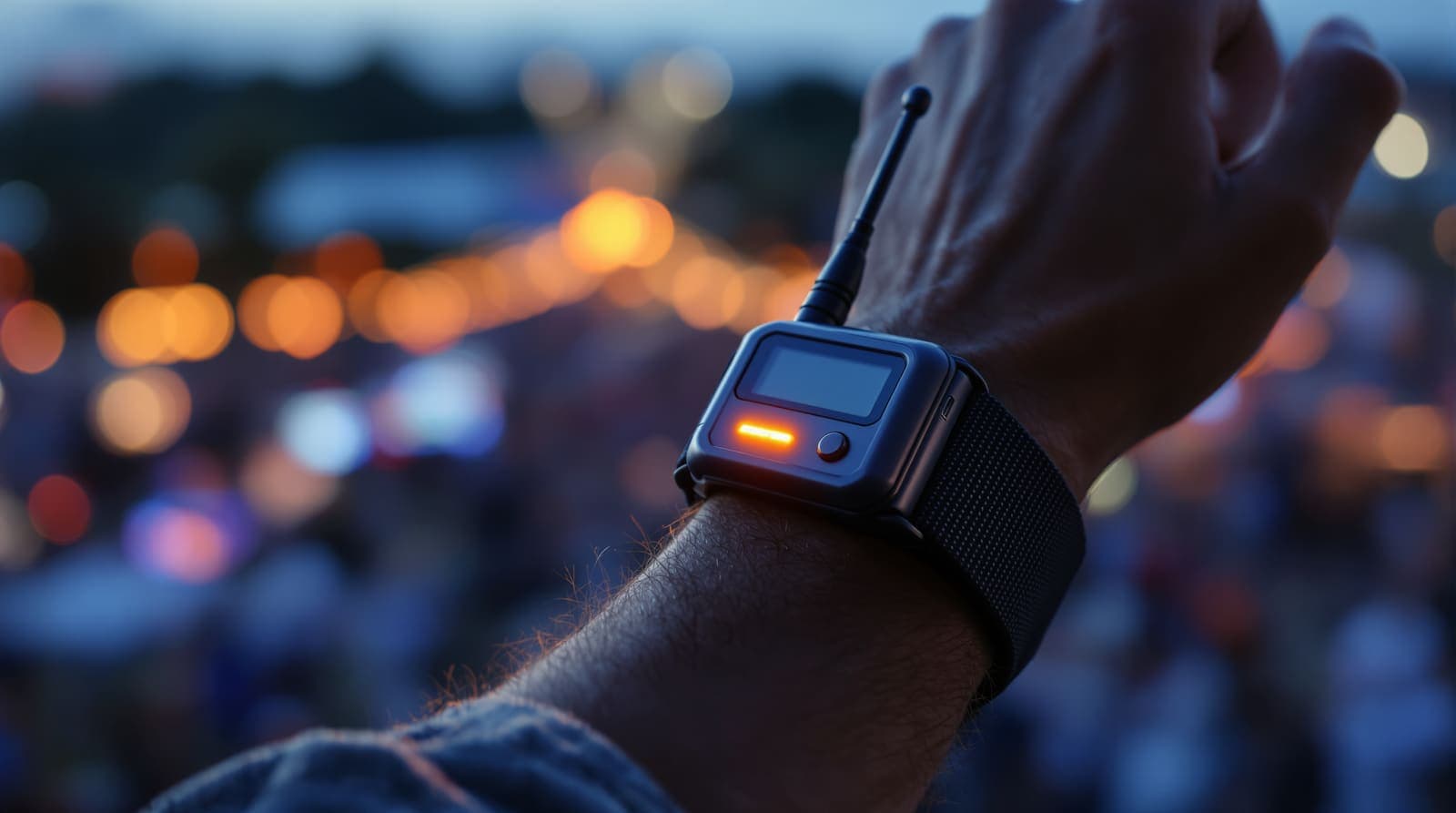
AI illustration, not a photo of the events.
When Israel's civilian communications failed on 7 October 2023, the collapse exposed something beyond an intelligence or military failure: in moments of mass panic, the basic safety systems that modern societies rely on stop working. That observation is the founding premise of dot SAGA, a Tel Aviv company built by founders who developed the technology while serving reserve duty during the war, and which was selected to represent Israel's innovation "Dream Team" at the Mind the Tech summit in Berlin.
The catalyst was the Nova music festival massacre. The all-night event, attended by 3,500 people near Kibbutz Re'im in southern Israel, became a killing field in which 364 people were massacred and 40 others taken hostage, the highest death toll of any location attacked by Hamas that day. As cellular networks failed, emergency services lost contact with the crowd and families could not locate relatives. The company's founders, veterans of elite military units, had been developing early versions of off-grid communication technology before the attack, and had been contacted by the Nova production team asking whether their device could be made available for the festival. It was not ready, founder and chief executive Noam Goldman told The Press Service of Israel. "I think about what would have happened if it was ready," he said.
How a mesh network works when the towers do not
Conventional emergency communication assumes public infrastructure holds: a phone reaches a cell tower, the tower reaches the network, the network reaches a dispatcher. Remove any link and the chain breaks. A mesh network removes the dependency by making every device a relay, so a message hops person to person until it reaches its destination.
dot SAGA replaces cell towers with a wearable-based mesh, in which each device acts as both user and relay, creating a closed, venue-owned network that relies not on cellular, Wi-Fi or satellite links but on radio. The Defense Circuit, in a January 2026 profile, describes the system as combining that wearable mesh with command-and-control software, with each device automatically re-routing messages when a path fails, and locating people through peer-to-peer signal relationships and fixed anchor points rather than GPS, which is what allows it to work indoors.
Reversing the logic of crowd security
Cameras, guards and control rooms are reactive: they observe after something has gone wrong, or wait for a call. dot SAGA is built the other way round, on personal agency. A single button press on a rugged, screen-free wristband sends an alert through the mesh, pinpoints the wearer indoors or outdoors, and routes the signal straight to responders on site.
Israel's week in five stories, every Friday
Sourced and checked by the Israel.com newsroom, with Shabbat times. Free, one-click unsubscribe.
One list, unsubscribe in a click. See our privacy policy.
"For the first time we are taking the existing, resilient technology of the radio and bringing the ability to have an end-user communicate and connect with the security system of a site," Goldman said. He drew the contrast with consumer trackers: if a child gets lost at a theme park, an AirTag or an emergency SOS call routes through the emergency number, and the minutes spent locating the caller are the critical ones. "We are connecting you to the closest team member, with whom the end-user currently has no direct communication."
Unlike its competitors, Goldman said, the company sells to venues rather than consumers: ski resorts, amusement parks and concert halls that hand a wristband to each visitor on arrival. Lab tests, he said, support 40,000 simultaneous users per venue. The Jerusalem Post, profiling the company in January 2026, described the same single-button, screenless design and the self-organising mesh, and said the three founders are veterans of elite Israeli military intelligence units. The company is listed on Startup Nation Central's startup register under aerospace, defence and homeland security, selling through business-to-government and business-to-business models from Tel Aviv.
Next story Society
Thousands rally in Tel Aviv for an October 7 state inquiry as polls near
Where the company is now
dot SAGA has finished prototype testing and is launching a pilot at Bulgaria's Bansko ski resort. It is in a pre-seed investment phase of $1 million, and Goldman said the company expects to be return-on-investment positive within two years.
Yagil Rimoni, a security specialist whose firm was responsible for safety at the Nova festival on 7 October, told The Press Service of Israel that such a device could have mattered. "The hardest challenge was communication," he said. "Getting information, transferring it, understanding what was happening in real time. A tool like this could have saved many lives and significantly changed the situation."
What is still unclear
The company did not disclose the range of a single device, the battery life of the wristband, or how the 40,000-user figure translates outside laboratory conditions. It did not name the investors behind the pre-seed round, give a price per venue, or say when the Bansko pilot would report results.
More on Tel Aviv-Yafo: Places and businesses in Tel Aviv-Yafo · Shabbat times in Tel Aviv-Yafo
Read next
All emergency →
Illustration
Transport
Austrian Airlines says no danger found on diverted Tel Aviv-Vienna flight

Illustration
Emergency
Man, 35, seriously injured in Route 1 crash near La Guardia interchange

Illustration
Emergency
Man, about 40, seriously hurt as two trucks collide on Route 6

Illustration
Courts & Crime
Man, 37, taken to Ichilov with penetrating injuries after Tel Aviv assault
Sources and further reading
Every link below was opened and checked when this page was written. Official statements are marked as such: they are the subject's own account, not an independent one.
- ReportingThe Defense Circuitthedefensecircuit.comBuilding safety infrastructure that works when everything else fails
How the mesh relays messages and locates users without GPS or cellular
- ReportingThe Jerusalem Postjpost.comIsraeli start-up reshapes safety and security technology
Independent description of the device, the mesh design and the founders' backgrounds
- DataStartup Nation Centralfinder.startupnationcentral.orgdot SAGA company profile
Company registration, sector classification and go-to-market model
How we checked this
The Nova festival figures, the founders' account, the product claims and all quotes are taken from the original Press Service of Israel report of 16 December 2025 and have not been altered or supplemented. The technical description of mesh networking was checked against Jerusalem Post and Defense Circuit profiles of the company published in January 2026, and the company's registration details against Startup Nation Central.
Our sourcing and corrections policy →The week from Israel, in one email
The stories that mattered, sourced and checked by the Israel.com newsroom. Free, weekly, one-click unsubscribe.
One list, unsubscribe in a click. See our privacy policy.
Latest
- Man of about 25 shot dead in Yafia, near Nazareth, during a taxi ride
- IDF says Gaza strikes killed two men who moved Iranian and Turkish money to Hamas
- Israeli and Greek navies practise sinking a hostile vessel in joint drill
- Kinneret Drops Another 4.0 cm to -213.715 m, Sitting 0.72 m Below the Lower Red Line
- IDF bars Palestinian workers from settlements and closes crossings for election day
- Man about 35 killed as truck and car collide on Route 465 near Aboud