Iran's Guards say tanker carrying 2 million barrels hit mine in Hormuz
Iran's Revolutionary Guards say a crude tanker blew up after striking a naval mine in the Strait of Hormuz, on what Tehran calls an unauthorised route.
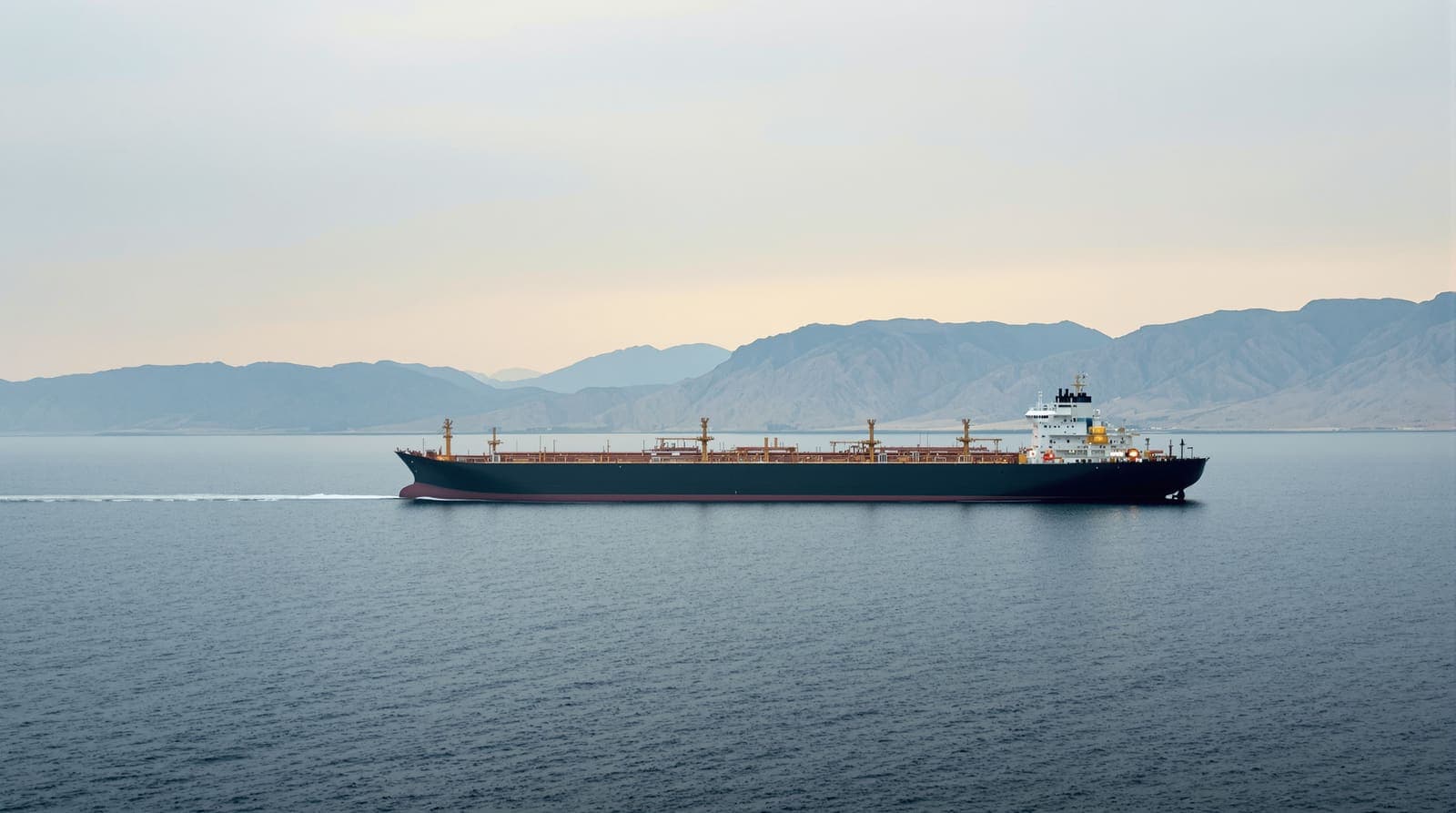
AI illustration, not a photo of the events.
An oil tanker blew up and burned after striking a naval mine in the Strait of Hormuz, according to a claim by Iran's Revolutionary Guards that was carried by Iranian media and picked up by Israeli outlets. The Times of Israel reported that, according to the Iranian account, the vessel was loaded with more than 2 million barrels of crude and was trying to pass through the waterway illegally, using a route Iran had not authorised.
The Israeli broadcaster N12, through its foreign news desk, said the Guards' statement placed the incident overnight. N12 described the Guards as saying the tanker exploded and then caught fire after making contact with a sea mine during its crossing, citing Iranian media as the source. Ynet, the news site of the Israeli daily Yedioth Ahronoth, ran a brief alert that attributed to Iran the report of a tanker exploding as it attempted to pass through Hormuz, quoting the Guards as saying it had "hit a mine".
Who the Revolutionary Guards are
The Islamic Revolutionary Guard Corps, often shortened to IRGC, is a branch of Iran's armed forces that operates alongside, and separately from, the country's regular military. It answers to Iran's political and clerical leadership and has its own naval arm, which is active in the Gulf waters around the strait. Statements from the Guards are official Iranian claims. In this case the account reached the outside world through Iranian media, and none of the three reports here describes any confirmation from a source outside Iran.
On the same day, The Times of Israel's live coverage also carried a separate item in which the top United States commander in the Middle East said Iran's regional proxies were sending money back to the IRGC because of a cash shortage. That item does not refer to the tanker incident.
Why the Strait of Hormuz matters
The Strait of Hormuz is the narrow sea passage that connects the Persian Gulf to the open ocean, with Iran on its northern shore. Tankers carrying oil from Gulf producers must pass through it to reach world markets, which is why The Times of Israel described it as a strategic waterway. Any disruption to traffic there is closely watched by governments, shipping companies and energy markets.
The Iranian claim that the tanker was on a route Tehran had not authorised is significant in itself. It suggests Iran regards some passages through the strait as permitted and others as off limits, and that it presents the vessel's choice of course as the reason for what happened. The reports do not explain which routes Iran considers authorised, how such rules were communicated to shipping, or whether other states accept them.
Regional backdrop
The incident was reported against a tense regional picture. The same Times of Israel live coverage noted that the United Kingdom had advised against all but essential travel to Saudi Arabia amid attacks by the Houthis, the Iran-aligned movement based in Yemen. None of the reports links that advisory to the tanker incident, and this article draws no connection between them.
How the reports differ
The three outlets agree on the core claim: the Revolutionary Guards say a tanker exploded after hitting a mine while crossing the Strait of Hormuz. They differ in detail and in how they frame the source.
- The Times of Israel and N12 both state explicitly that the information came via Iranian media reporting the Guards' statement. Ynet's alert attributes the report to Iran and quotes the Guards directly, without naming the media outlet.
- Only The Times of Israel gives the cargo figure of more than 2 million barrels of crude and the description of the transit as illegal and on an unauthorised route.
- The Times of Israel and N12 both say the tanker caught fire after the blast. N12 alone specifies that the incident happened overnight.
- Ynet describes the tanker as having tried to pass through Hormuz, a wording that leaves open whether it had entered the strait proper.
What the reports do not say
Much remains unknown. None of the reports names the tanker, its owner, its flag state or its destination. None says how many crew were aboard or whether anyone was hurt or killed. There is no precise location for the blast within the strait, and no information on whether the fire was brought under control or whether any oil has leaked into the sea.
The reports also do not say who laid the mine, when it was placed, or whether Iran acknowledges responsibility for mining the route. No response from the vessel's operator, from neighbouring states or from international maritime authorities appears in the material. Every substantive detail, including the cargo size and the description of the route as unauthorised, rests on the Revolutionary Guards' own account as relayed by Iranian media, and has not been independently confirmed in any of the reports.
Sources and further reading
Every link below was opened and checked when this page was written. Official statements are marked as such: they are the subject's own account, not an independent one.
- Reportingtoitimesofisrael.comThe Times of Israel
- Reportingyediotht.meYnet alerts
- Reportingkeshett.meN12
How we checked this
The Times of Israel, Ynet and N12 all reported the Revolutionary Guards' claim, each relaying Iranian sources rather than independent observation. The cargo figure and the unauthorised route detail appear only in The Times of Israel's report, and we have not independently verified any part of the account.
Our sourcing and corrections policy →The week from Israel, in one email
The stories that mattered, sourced and checked by the Israel.com newsroom. Free, weekly, one-click unsubscribe.
One list, unsubscribe in a click. See our privacy policy.
More in Security
All security →

Latest
- Met Police assess Sarah Helm post backing Palestine Action, a banned group
- Katie Zacharia out as White House press secretary after 5 days in the job
- US photojournalist Heidi Levine hurt as settlers hit olive harvest at Abu Falah
- Man, about 30, seriously hurt in electric scooter incident in Netivot
- Man, about 40, seriously hurt as two trucks collide on Route 6
- IDF says Gaza strikes killed Hamas weapons commander and Islamic Jihad member