Israeli Negotiators Fly to Delhi to Chase a Free Trade Deal
Israel's economy ministry sent a team to New Delhi to open the first practical round of free trade talks with India, a market it says is walled off by very high tariffs.
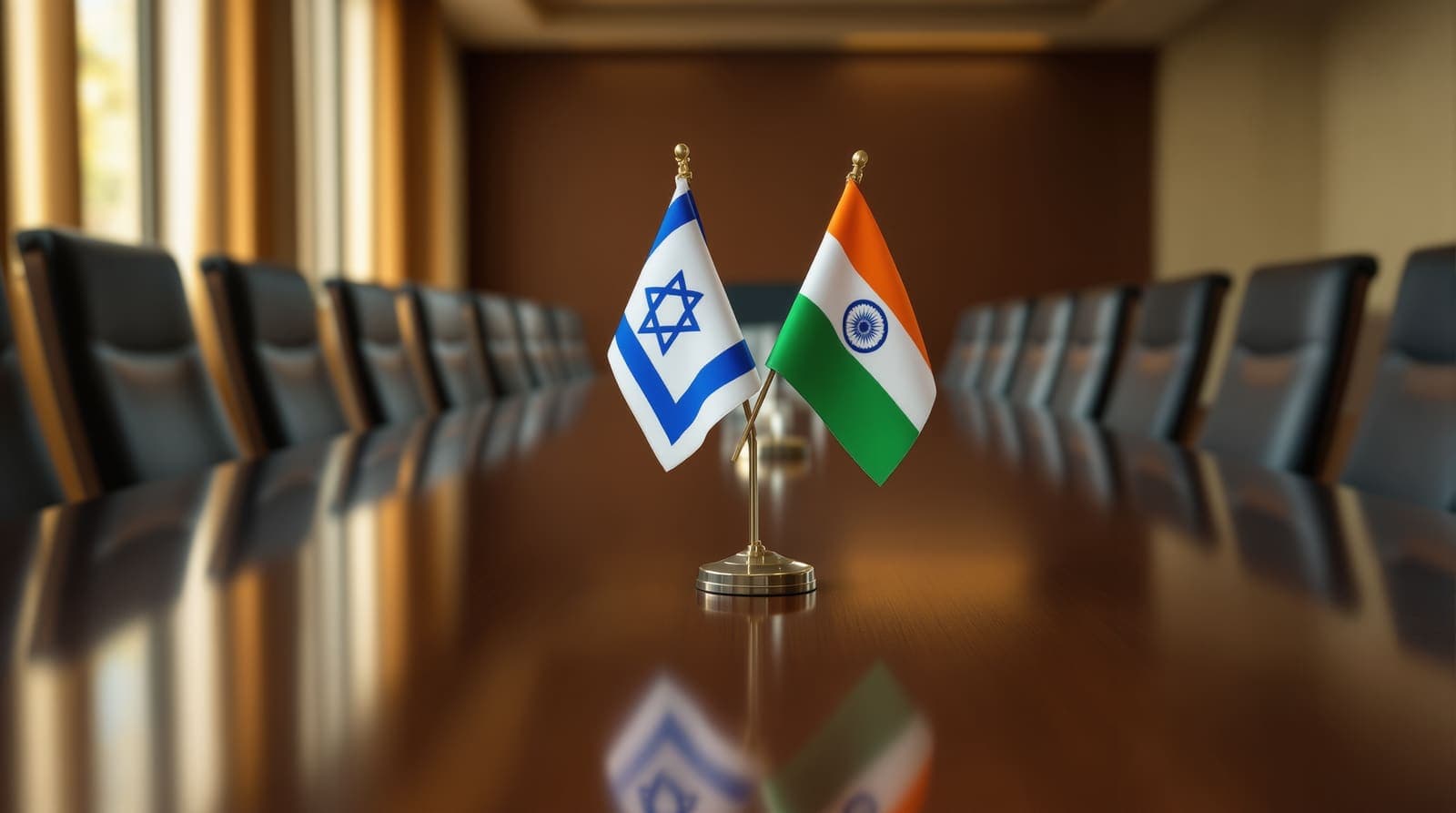
AI illustration, not a photo of the events.
An Israeli delegation was due to leave for New Delhi to begin the first round of practical negotiations on a free trade agreement with India, Israel's Ministry of Economy and Industry announced on Wednesday 18 February 2026. The talks follow a framework agreement signed the previous November by Israel's Minister of Economy and Industry, Nir Barkat, and India's Commerce and Industry Minister, Piyush Goyal, which formally opened the negotiating process.
The delegation is led by the ministry's Foreign Trade Administration and includes specialists in customs, regulation, services, intellectual property and government procurement, the ministry said. Its remit is to work with Indian counterparts towards a comprehensive agreement removing trade barriers. “The trade agreements with India are the next big thing for the Israeli economy,” Barkat said, calling the trip “a strategic step that will inject billions into the economy”. Roy Fisher, who heads the Foreign Trade Administration, said the team was travelling “with a structured work plan and a clear goal: to create a modern, balanced, and broad-ranging agreement”.
Fifteen years of stop-start talks
Israel and India have been circling a trade deal for a decade and a half. The Jerusalem Post reported that Barkat and Goyal signed their memorandum of understanding on 21 November 2025, with a delegation of more than 100 Indian representatives in attendance, and that the two sides had been working towards an agreement for fifteen years. The Post recorded the same trade figure the ministry cited: Israeli exports of goods and services to India of roughly $3.1 billion in 2024, up 56 per cent over four years.
The round the delegation flew out for went ahead. India's state broadcaster, All India Radio News, reported that the first round concluded in New Delhi on 26 February 2026 after four days, covering trade in goods and services, rules of origin, technical barriers to trade, customs procedures, intellectual property rights and digital trade, with the next in-person round set for Israel in May 2026.
The tariff wall Israeli exporters run into
Israeli officials describe Indian tariffs on technology products, chemicals, medical devices and advanced agricultural goods as among the highest in the world. Tariff schedules of this kind are catalogued in World Tariff Profiles, published jointly by the World Trade Organization, the International Trade Centre and UN Trade and Development, which sets out bound and applied tariffs for more than 170 economies. India runs a high applied-tariff regime by the standards of large economies, which is why market access rather than diplomacy is the substance of these negotiations.
Israel's week in five stories, every Friday
Sourced and checked by the Israel.com newsroom, with Shabbat times. Free, one-click unsubscribe.
One list, unsubscribe in a click. See our privacy policy.
What India already buys from Israel
One category of Israeli export to India needs no trade agreement at all. India is by a wide margin the largest customer for Israeli weapons: the Stockholm International Peace Research Institute found India took 56 per cent of Israeli arms exports in 2021–25, ahead of Germany at 21 per cent and the United States at 7.8 per cent, The Times of Israel reported in March 2026. SIPRI's own fact sheet for 2021–25 sets that against a market in which the United States alone supplied 42 per cent of major arms exports. A free trade agreement would matter mainly for the civilian half of the relationship: chemicals, medical devices, water technology and software.
Where Europe still sits
For all the attention on Asia, Israel's dominant goods partner remains the European Union, which accounted for 31.7 per cent of Israel's total trade in goods with the world in 2025, worth €43.3 billion, according to the European Commission. Israeli exports to India, at roughly $3.1 billion in 2024, are a fraction of that, which is the case Barkat is making for the deal, and also the measure of how far it would have to go.
What the announcement did not settle
The ministry gave no timetable for concluding an agreement, no list of the sectors Israel is prepared to open in return, and no indication of which Indian tariff lines it is targeting first. The statement describes India as the world's fifth-largest economy but does not source that ranking. The announcement also linked the trip to an imminent visit to Israel by the Indian prime minister without giving dates beyond "Sunday".
Read next
All economy →
File photo
Economy
Netanyahu stands by crypto sanctions idea after Bank of Israel rebuke

File photo
Economy
Regev rejects flydubai vetting blame as warnings and staffing gaps emerge

Illustration
Security
IDF says about 220,000 dunams of West Bank olives harvested so far

Illustration
Security
Troops detain Palestinian suspected of planning imminent attack in Binyamin area
Sources and further reading
Every link below was opened and checked when this page was written. Official statements are marked as such: they are the subject's own account, not an independent one.
- OfficialAll India Radio Newsnewsonair.gov.inFirst round of India-Israel FTA negotiations concludes successfully
Confirms the round took place, its dates, chapters covered and the next round
- OfficialEuropean Commissionpolicy.trade.ec.europa.euEU trade relations with Israel
EU's share of Israel's goods trade in 2025 for comparison with India
- ReportingThe Jerusalem Postjpost.comIsrael, India sign MOU renewing free trade agreement talks
Date and detail of the November 2025 framework agreement and the export figures
- ReportingThe Times of Israeltimesofisrael.comIsrael has surpassed UK as 7th-largest global arms exporter
India's share of Israeli arms exports in 2021–25 per SIPRI
- DataWorld Trade Organizationwto.orgWorld Tariff Profiles 2025
Reference source for bound and applied tariffs across more than 170 economies
- DataSIPRIsipri.orgTrends in International Arms Transfers, 2025
SIPRI data on major arms transfers and supplier shares, 2021–25
How we checked this
The delegation, its composition, the quotes and the trade figures are from the Israeli Ministry of Economy and Industry announcement of 18 February 2026 as supplied; the November framework agreement and the $3.1 billion export figure were confirmed against the Jerusalem Post, and the outcome of the negotiating round against All India Radio News.
Our sourcing and corrections policy →The week from Israel, in one email
The stories that mattered, sourced and checked by the Israel.com newsroom. Free, weekly, one-click unsubscribe.
One list, unsubscribe in a click. See our privacy policy.

Israel.com is free, and readers like you keep it that way.
The Israel.com newsroom checks every story against its sources and publishes it free. If this one helped, a contribution of any size keeps the next one free too.
One payment, nothing to sign up for. Another amount
Latest
- Soldiers killed near Hebron named and buried as army operation goes on
- Truck driver arrested after fatal crash on Route 465 near Aboud
- Man of about 25 shot dead in Yafia, near Nazareth, during a taxi ride
- IDF says Gaza strikes killed two men who moved Iranian and Turkish money to Hamas
- Israeli and Greek navies practise sinking a hostile vessel in joint drill
- Kinneret Drops Another 4.0 cm to -213.715 m, Sitting 0.72 m Below the Lower Red Line