Poland suspends constitutional court chief, prompting protests in Warsaw
The ousting of court president Bogdan Swieczkowski brought police to the court, right-wing protesters to its gates and the country's president home early from abroad.
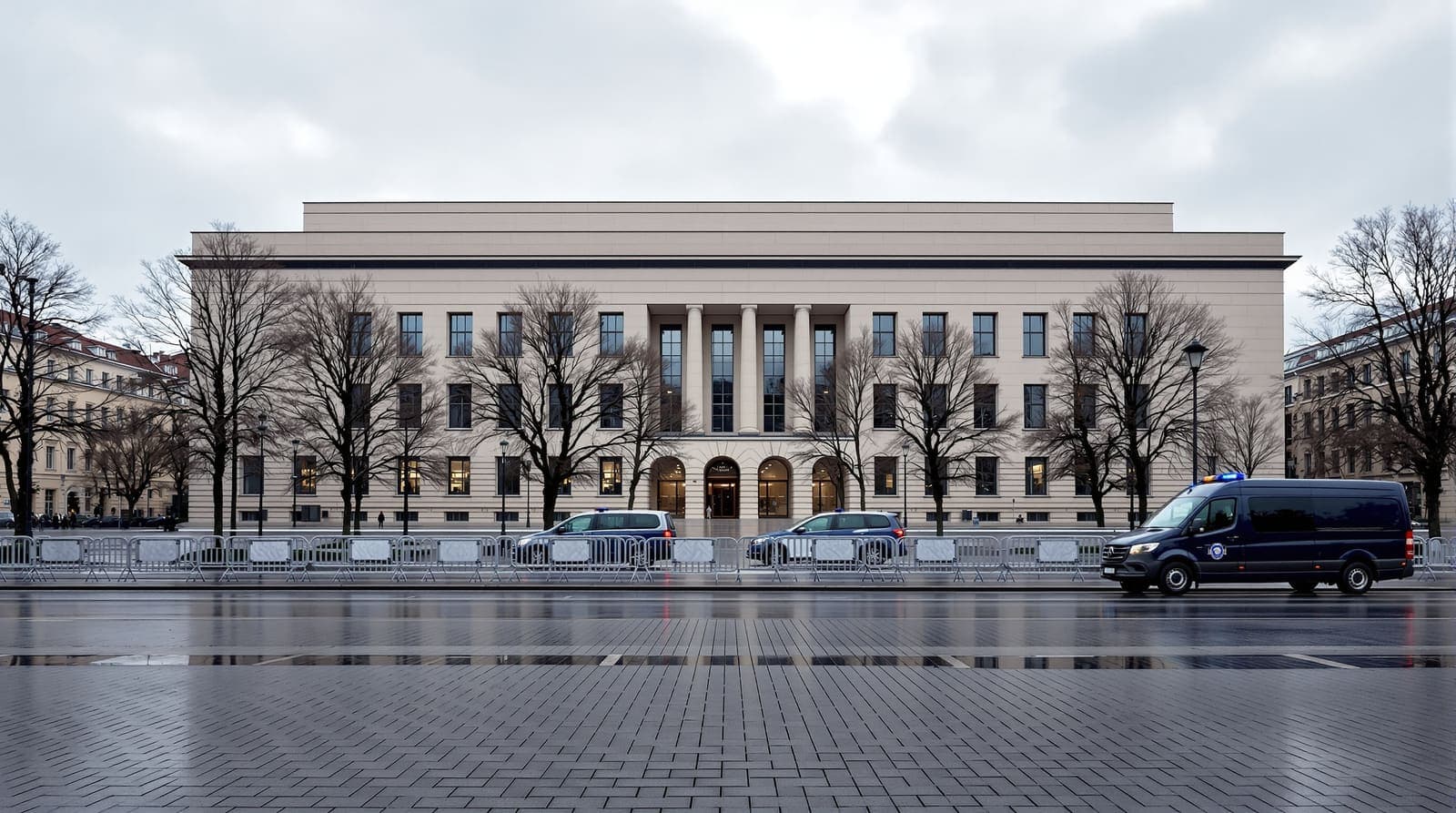
AI illustration, not a photo of the events.
Poland's constitutional court was surrounded by police in Warsaw after its president, Bogdan Swieczkowski, was suspended, setting off a confrontation between the centrist government of Prime Minister Donald Tusk and the nationalist right. The Times of Israel, citing AFP, reported that supporters of the opposition Law and Justice party (known by its Polish initials, PiS) gathered outside the building, that some tried to push past security barriers, and that police said three people who had tried to get into the court complex were arrested.
President Karol Nawrocki abandoned a planned trip to Africa while already in the air and flew back to the capital, according to the same report. The Israeli news site Ynet reported that once back, the president had a physical confrontation with judges at the court, and quoted judges as saying "he attacked us." A Ynet news alert carried the same account of a physical clash with judges.
On the ground

Supporters of Poland’s opposition Law and Justice party protest outside the Constitutional Tribunal in Warsaw as suspended court president Bogdan Swieczkowski attempts to enter the building. Police surround the court amid a standoff between the government and the nationalist Show more
What the dispute is about
A constitutional court rules on whether laws and government acts are compatible with a country's constitution, which makes control of its bench politically significant. According to Ynet, Poland has been in a constitutional crisis in which the court's president, who is identified with the right-wing camp that lost power, has refused to allow judges appointed by the liberal governing coalition to take up their posts.
Tusk has pledged to undo the judicial overhaul passed by the previous government, Ynet reported. The site quoted him as calling the current situation a painful process and saying there was no other way.
The reports do not say which body or official carried out the suspension, or on what legal basis. Ynet described the move as unexpected and put the word "suspended" in quotation marks in its headline, reflecting that the court president disputes it.
Israel's week in five stories, every Friday
Sourced and checked by the Israel.com newsroom, with Shabbat times. Free, one-click unsubscribe.
One list, unsubscribe in a click. See our privacy policy.
The scene outside the court
An earlier Ynet alert said dozens of people had come out to demonstrate in front of the court's gates once the suspension became known. The Times of Israel described dozens of police officers guarding the entrance and said access to the building had been blocked.
The court's official account on the social media platform X described events as a "coup d'etat," according to The Times of Israel. Some demonstrators chanted slogans calling Tusk a traitor. One protester, Tomasz Zaleski, told AFP that the prime minister was trampling on constitutional rights.
Next story Courts & Crime
Florida man, 31, charged over alleged threat to shoot at new Jewish community
Who the main figures are
- Bogdan Swieczkowski: president of the constitutional court, now suspended. Ynet links him to the right-wing camp that was voted out.
- Donald Tusk: prime minister, heading what The Times of Israel calls a centrist government and Ynet calls a liberal coalition.
- Karol Nawrocki: Poland's president, who cut short his Africa trip to return to Warsaw.
- Law and Justice (PiS): the right-wing opposition party whose supporters protested at the court.
Where the accounts differ
The two organisations describe the attempt to get into the court differently. Ynet reported that the court president himself claimed a coup and tried to force his way into the compound, which police had sealed off. The Times of Israel attributed the attempts to breach the barricades to protesters, and said the three arrests were of people trying to enter the complex. It did not say Swieczkowski tried to enter.
The physical confrontation between the president and judges appears only in Ynet's reporting. The Times of Israel report notes Nawrocki's return to Warsaw but does not mention any clash with judges.
What the reports do not say
None of the reports identifies who ordered the suspension or the legal mechanism used, and none says how long it is meant to last. They do not name the judges involved in the reported confrontation with the president, or describe what happened in detail, beyond the quoted complaint. There is no response in the material from Nawrocki to the judges' account, and no statement from Swieczkowski in his own words. The reports also do not say whether those arrested have been charged, or whether the judges appointed by the governing coalition have now been able to take their seats.
Read next
All courts & crime →
Illustration
Courts & Crime
Mor Shemali, widowed in the Alexandria shooting, dies three years on

Illustration
Courts & Crime
Binance says suspected security breach hit about $6.3 billion, bitcoin falls

Illustration
Courts & Crime
Herzog seeks full probe into alleged election interference, defends Arab voters

Illustration
Courts & Crime
Negev school principals among suspects held in Ra'am election bribery probe
Sources and further reading
Every link below was opened and checked when this page was written. Official statements are marked as such: they are the subject's own account, not an independent one.
- Reportingyediothynet.co.ilYnet
- Reportingyediotht.meYnet alerts
- Reportingyediotht.meYnet alerts
- Reportingtoitimesofisrael.comThe Times of Israel
How we checked this
The suspension and the protests were reported by both Ynet and The Times of Israel (citing AFP). The physical confrontation between President Nawrocki and judges, and the claim that the court president tried to force his way in, appear only in Ynet's reports; we have not independently verified any of it.
Our sourcing and corrections policy →The week from Israel, in one email
The stories that mattered, sourced and checked by the Israel.com newsroom. Free, weekly, one-click unsubscribe.
One list, unsubscribe in a click. See our privacy policy.
Latest
- Jordan says border guards repelled 14 armed men crossing from Syria
- Tanker hit near Hormuz as Trump says Iran wants to talk and the US has time
- Egypt's Abdelatty 'extremely worried' a new US-Iran round would be more destructive
- Qatari paper reports US delegation heading to Doha for direct Iran talks
- US tells Gulf allies new Iran strikes could come as early as November 4
- Qatari mediators spend 12 hours in Tehran pressing for a US-Iran deal