Religious site · The Dead Sea
Qasr al-Yahud Baptismal Site
The traditional site of Jesus's baptism stands inside a closed military zone: more than 6,500 landmines were lifted from the monasteries around it between 2018 and 2020, and the riverbank itself reopened in February 2026 after NIS 25 million of building work.
שלמה רודד / CC BY 2.5 · Wikimedia Commons
Entry
no charge
the site carries no fee on the operator's page and is absent from its 2025 entrance-fee table
Landmines lifted
more than 6,500
laid from the late 1960s, cleared between 2018 and April 2020
Rebuilt
NIS 25 million
the works finished for the reopening of 10 February 2026
Peak year
close to a million visitors
2019, on the Nature and Parks Authority's figure reported by Israel Travel News
In short
- How long to give it
- about 60 to 90 minutes for a look at the river and the terrace, and closer to two hours with an immersion, a change of clothes and a shower
- Summer, Sunday to Thursday and Saturday
- 08:00 to 17:00
- Entry to the site
- no charge. The operator publishes no fee on the site's own page, and the site does not appear in the Judea and Samaria section of its 2025 entrance-fee table, which lists Qumran, Einot Tzukim, Ein Prat, Herodion, Har Gerizim and the monasteries of Euthymius and Martyrius
אתר הטבילה קאסר אל יהוד
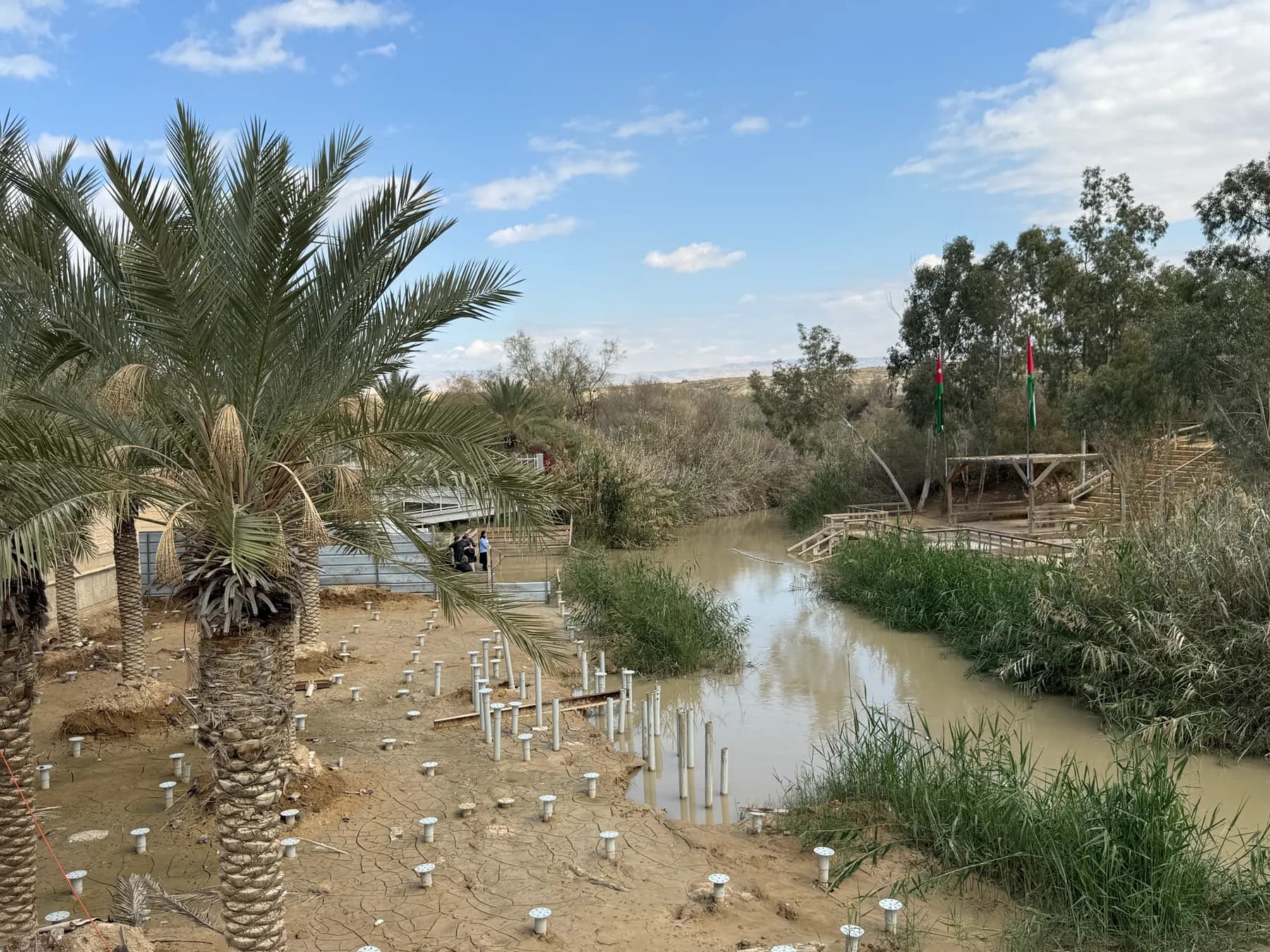
Qasr al-Yahud is the western bank of the Jordan River at the point where Christian tradition places the baptism of Jesus by John, run as a free site by the Israel Nature and Parks Authority and reached through a gate in a military fence. The river here is a few metres of slow brown water, and the far bank is Jordan, where a mirrored baptismal site operates as Al-Maghtas. A wide wooden deck and steps carry visitors down into it. The parks authority calls the place the third holiest site in the Christian world; the Times of Israel puts it more narrowly as the third most important Christian site in the area covering Israel and the West Bank, after the Church of the Holy Sepulchre and the Church of the Nativity.
The visit feels managed because almost none of it was accessible for two generations. After 1967 the Jordan became the front line, the area was declared a closed military zone, and the church compounds built here in the twentieth century were fenced, mined and abandoned where they stood. The Civil Administration began permitting visits after the 1994 peace treaty with Jordan, temporary structures went up in 2009, and the parks authority dates year-round opening with regular hours to 2011. Clearing the ground around the churches ran from March 2018 to April 2020.
The site reopened again on 10 February 2026 after NIS 25 million of work by the Government Tourism Company: a prayer pergola, an air-conditioned block with hot showers and changing cubicles, and the deck itself. What has not changed is the perimeter. The monasteries a few hundred metres away are still shut to independent visitors, the fences around them are minefield fences, and the parks authority warns that hours and access follow army instructions.
Orientation
Through the fence, down the steps, into the Jordan
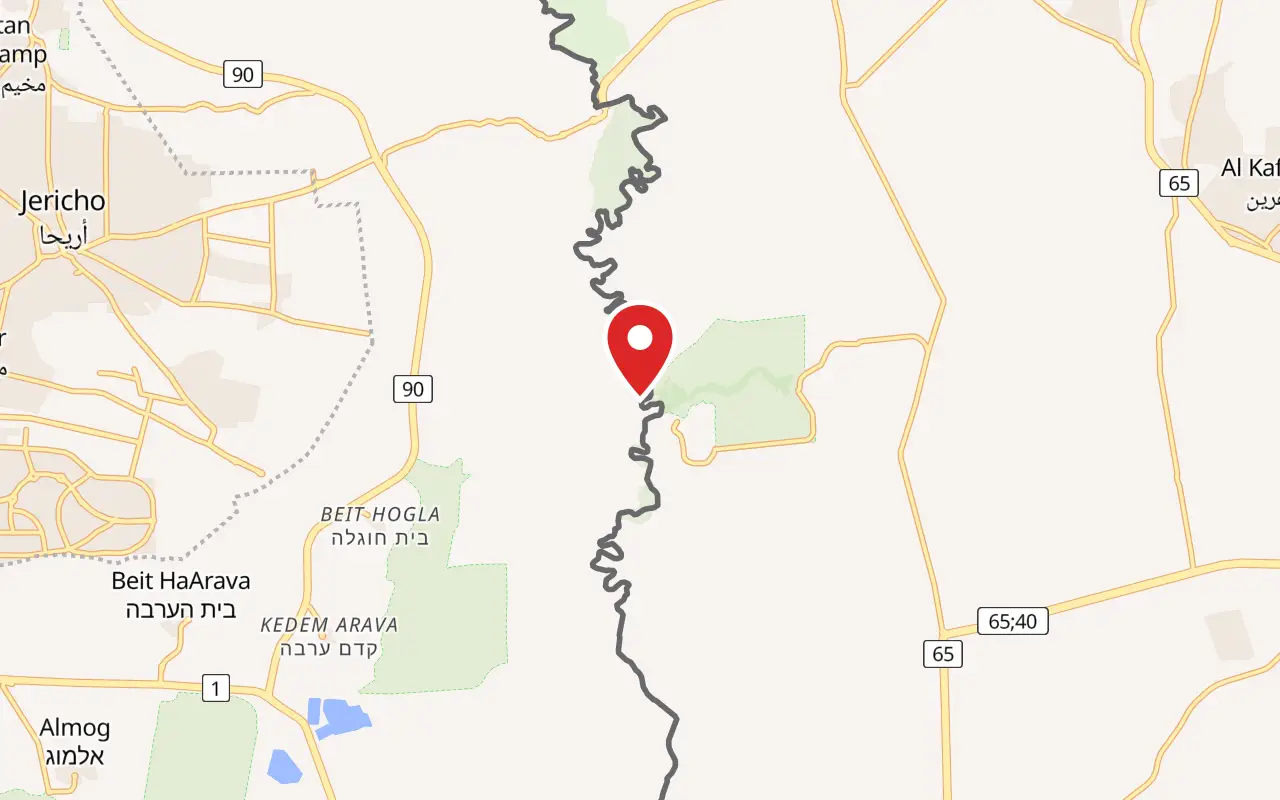
The approach is short and unmistakable. From Route 90, the Jericho bypass, a signposted turn runs east for about 1.5 kilometres to a gate in the military border fence, and the road continues east to the site. The operator locates that turn two ways: roughly 5 kilometres north of the Route 1 junction on its English page, about 2.5 kilometres north of the Deir Hijleh monastery entrance in its brochure. Look for the sign; the gate is manned.
Inside, the plan is compact: a car park, a visitor service centre, toilets and changing rooms, a shaded gathering plaza, a pergola for prayer and a terrace over the river and the eastern bank. From the terrace, steps and the wooden deck installed in 2026 run down to the water. Immersion is allowed only in that stretch. Crossing the river is prohibited, the water is not drinkable, and food is barred from the baptismal area.
The dress rule catches people out more than any other. The parks authority permits entry to the water in clothing that covers the shoulders and the knees, and not in a swimsuit; the service centre sells towels and white baptismal robes, along with drinks, snacks, souvenirs, books, hats and sunscreen. What the authority will not do is supply a priest: it states plainly that it cannot arrange clergy or a baptism ceremony, which groups have to bring with them.
Two dates fill the site: Easter, in April, and Epiphany in January, which the parks authority's Hebrew page gives as 18 and 19 January and its English brochure places anywhere between 12 and 24 January depending on the denomination. On those days the terrace becomes a viewing gallery for mass baptisms held by several churches at once, on both banks.
Why here
Four biblical scenes on one stretch of bank, and an argument about which side
The site carries more than one tradition, which is why it is sacred to Jews and Christians on different grounds. The parks authority's material sets out four. This is where Joshua 3 places the crossing of the Israelites into the land, the priests standing in the riverbed with the ark while the water heaped up at Adam. It is where 2 Kings 2 places Elijah's ascent in a chariot of fire after he handed his powers to Elisha. It is where Naaman, the Aramean commander, immersed himself seven times on Elisha's instruction and was cured of his leprosy in 2 Kings 5. And it is where the Gospels place John baptising, and baptising Jesus.
The Arabic name preserves the first of those. Qasr al-Yahud means the palace of the Jews, and it attaches to the fortress-like Greek Orthodox monastery above the bank rather than to the water. Al-Maghtas, the other Arabic name in use, simply means the place of the baptism, and it is used on both sides of the river.
Which bank was the bank is genuinely unresolved. The sixth-century Madaba mosaic map marks Bethabara, the house of the ford, on the western side. The excavated Byzantine remains, however, are on the eastern side: churches, baptism pools, hermitages and caves running up the Wadi al-Kharrar, dug between 1996 and 2002, and it is that eastern complex that UNESCO inscribed in 2015 as the Baptism Site "Bethany beyond the Jordan", in Jordan. Jodi Magness's caution, quoted by the Biblical Archaeology Society, applies to both banks: no site here has archaeological remains showing continuous veneration from the first century onwards.
The honest description of the western bank, then, is a place of long and documented pilgrimage rather than a place with a first-century layer under it. Byzantine pilgrims came in numbers from the fourth to the seventh centuries, traffic fell away under early Islamic rule and revived under the Crusaders, and Ottoman-era travellers came again in the nineteenth century. Pope John Paul II worshipped here in 2000.
שלמה רודד / CC BY 2.5 · Wikimedia Commons
The compounds
Eight monasteries along 1.5 kilometres, and none of them open
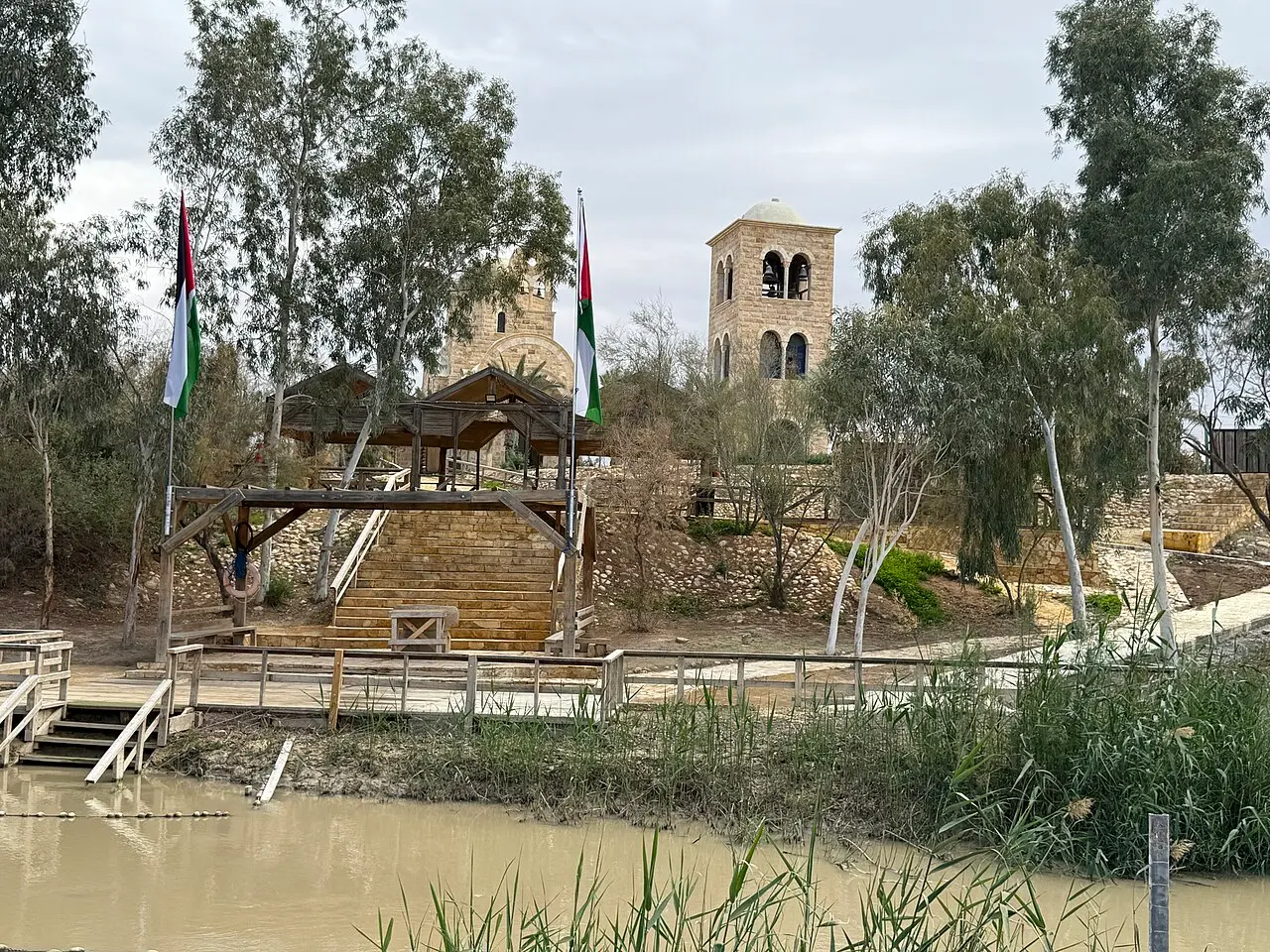
The buildings that make this landscape strange are strung along a paved road running roughly 1.5 kilometres behind the river. Nearest the junction, about 350 metres from the water, is the Greek Orthodox monastery of John the Baptist, the largest of them and the structure that gave the site its Arabic name. It stands on the foundations of the earliest Byzantine monastery here. Sixth-century evidence, on the parks authority's account, has it built under the emperor Anastasius I, who ruled from 491 to 518; an earthquake destroyed it in 1024; Manuel Komnenos rebuilt it in the twelfth century, and the Knights Templar gave it the fortified form it still has. Procopius records a cistern built at the site for Justinian around 560, which a visitor in 1883 found still standing in almost perfect condition.
Everything else on the road is modern, most of it built between the World Wars and the 1950s. The parks authority's inventory, walking south: the octagonal Franciscan chapel, which it dates to 1956; the Syriac Orthodox monastery of John the Baptist, partly destroyed by an earthquake the same year; the Coptic monastery of John the Baptist, built in the 1940s, with Coptic pilgrims' graves beside it; the hexagonal Russian chapel and the smaller bell chapel next to it; the Ethiopian monastery of the Holy Trinity, with a church and guest rooms; and the Romanian monastery, whose green-domed church the authority dates to 1934. The Custody of the Holy Land has held roughly 135 acres here since 1632, on the Franciscans' own account.
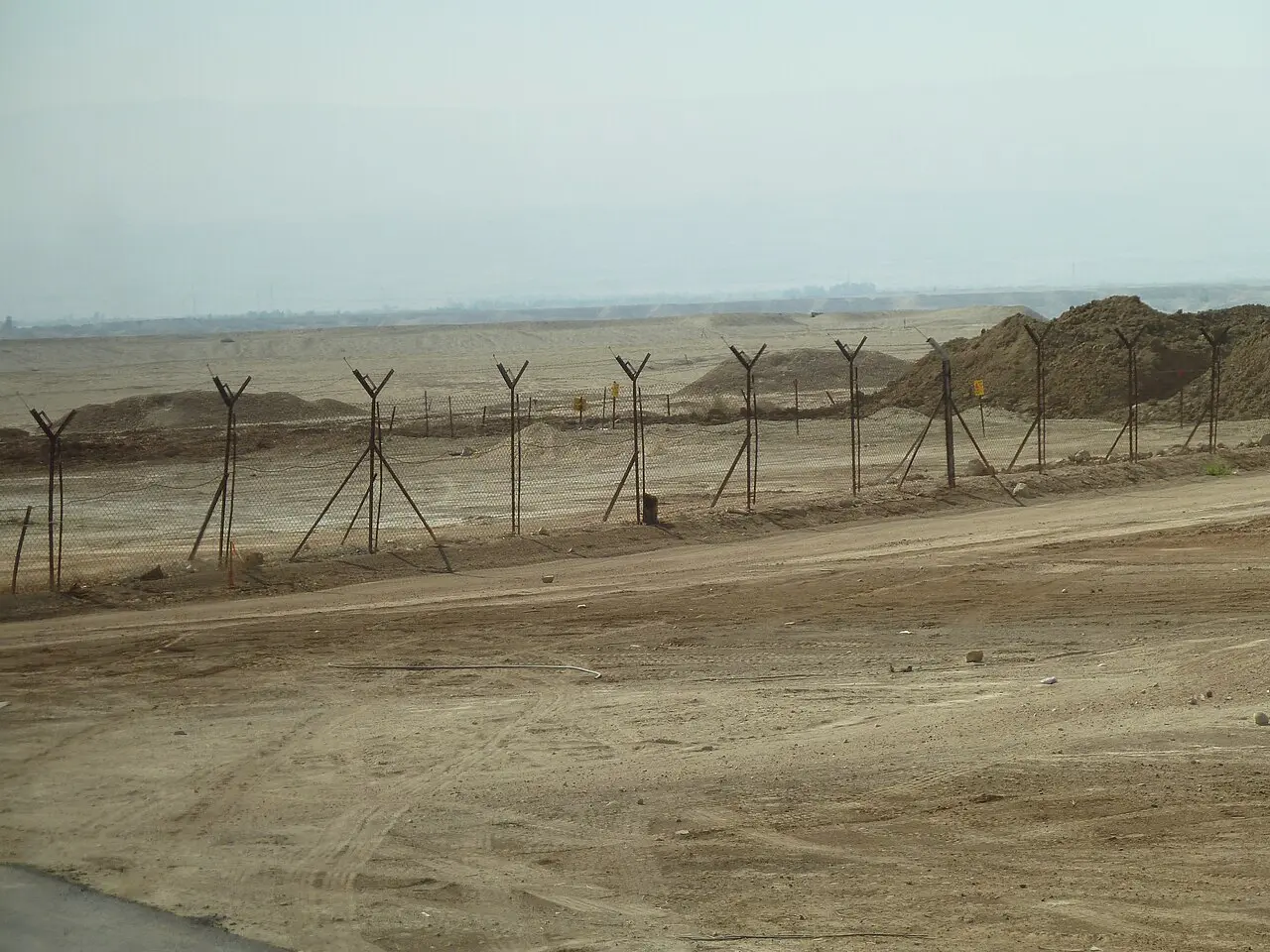
None of it can be entered on an ordinary visit. The parks authority's Hebrew page carries a standing warning that the monasteries and the road it calls the monastery axis are forbidden because of the danger of mines, and the English brochure says the remains are off limits for the same reason. The compounds are looked at from the road, and photographed from a distance.
The one legitimate way in is a guided walk the parks authority sells itself, about two hours, ₪55 a head, departing from the service centre. It runs on published dates rather than on demand, subject to weather and to Home Front Command instructions, and it fills. Anyone who wants to see the frescoes should book it rather than turn up hoping.
- Ancient and in place: the fortified Greek Orthodox monastery of John the Baptist, on Byzantine foundations, with twelfth-century rebuilding and Templar defences
- Recorded but not on the visitor route: the cistern Procopius attributes to Justinian, around 560
- Twentieth-century and abandoned in 1967: Franciscan, Syriac Orthodox, Coptic, Russian, Ethiopian and Romanian compounds along the monastery road
- Cleared of mines but still closed to independent visitors: all seven monastery compounds, fenced since the 1960s
- Built new for visitors in 2026: the wooden deck, the prayer pergola, the showers and changing block, the roads and the car parks
Demining
Six and a half thousand mines, seven monasteries, two years
The mines went in after the Six Day War, when the Jordan became the border and infiltration across it was constant. Israeli forces seeded the ground with more than 6,500 landmines from the late 1960s into the 1970s and booby-trapped the church buildings. A survey before clearance put the burden at roughly 2,600 anti-tank and 1,200 anti-personnel mines, plus improvised devices, over about a square kilometre.
Clearance began in the week of 20 March 2018, run by the Israel National Mine Action Authority, the Israel Defense Forces, the British demining charity the HALO Trust and the Israeli supervising contractor 4CI. The money was split: about NIS 10 million from the HALO Trust, raised largely from donations, and about NIS 7.5 million from the Israeli government, after the project sat two years waiting on funding. The Romanian monastery, the seventh and last, was declared clear in June 2019. Some 500 remaining mines were destroyed in one controlled explosion on 9 April 2020, and the last sappers left the same day, 53 years after the area was closed.
What the teams found inside had been sealed since January 1967. James Cowan, the HALO Trust's chief executive, described it as walking into a time capsule, with beer still on the shelf and the tables still laid for dinner. The Franciscans got their keys back in October 2020, and on 10 January 2021 Francesco Patton, the Custos of the Holy Land, celebrated the first Mass in their church in 54 years; the previous one had been said on 7 January 1967.
The clearance did not turn the area into open country. Fenced minefields remain in the wider valley, the brochure is unambiguous about not crossing a fence, and the instruction to keep to official roads covers the verges as well as the tarmac. Church plots are handed back to their denominations one at a time as restoration allows, which is why the monastery road stays closed while individual buildings come back into use.
deror_avi / CC BY-SA 3.0 · Wikimedia Commons
The river
What is actually in the water you are standing in
The Jordan at this point is a fraction of the river the biblical accounts describe, and that is measurable. EcoPeace Middle East, the cross-border environmental organisation that campaigns on the river, puts the fall in annual flow from more than 1.3 billion cubic metres to under 30 million, with about 96 per cent of the fresh water diverted upstream by Israel, Jordan and Syria for drinking and irrigation. What keeps the lower channel wet in places is saline water and treated and untreated sewage.
Water quality at the site has been tested and the results have not been steady. Sampling by the environment ministry, the health ministry, the parks authority and the water authority found a faecal coliform count of 2,300 per 100 millilitres in November 2013, against a bathing standard of 400; six months earlier the same measurement was 190. EcoPeace's Israeli director Gidon Bromberg described the water south of Alumot as a mixture of untreated and partly treated sewage, agricultural runoff, fish pond waste and saline water. The health ministry, through its spokeswoman Einav Shimron, replied that there is no raw sewage at Qasr al-Yahud and that the streams feeding the Jordan have improved considerably.
Campaigners and officials therefore disagree about how safe immersion is, and no daily reading is published at the gate. The rules the parks authority does publish are worth following on their own terms: enter only in the designated stretch, do not swallow the water, do not drink it, and rinse and change afterwards in the block built for the purpose. The bank is mud rather than sand, the current is real, and the authority states outright that because of the shape of the bank, the current and the mud, immersion in the river cannot be made accessible to wheelchair users.
The setting is worth a minute once the ceremonies stop. The river cuts through soft white rock that crumbles at a touch, and the tangle of trees and reeds along it is the one green line in the Jericho steppe, sheltering birds and animals with nowhere else to go. The area was proposed as a nature reserve under the British Mandate for that reason.
What to look for
Things not to walk past at Qasr al-Yahud Baptismal Site
The details that repay knowing about before you are standing in front of them.
The wooden deck and the steps into the river
Laid as part of the works finished in February 2026, the deck is the only place immersion is permitted and the only stable footing on a bank of mud. Robes and towels are sold at the service centre for people who did not bring them.
The Greek Orthodox monastery of John the Baptist
The fortress-like building about 350 metres from the water is the one the Arabic name Qasr al-Yahud, the palace of the Jews, actually refers to. It sits on Byzantine foundations dated by the parks authority to the reign of Anastasius I, and was given its defensive form by the Knights Templar.
The view across to Jordan
The eastern bank a few metres away is Al-Maghtas, inscribed by UNESCO in 2015 as the Baptism Site "Bethany beyond the Jordan". Ceremonies are held on both sides, often at the same hour, and each side is the other's view.
The green dome of the Romanian church
Visible from the monastery road, the church the parks authority dates to 1934 was the seventh and last compound to be cleared of mines, in June 2019. Its frescoes survived decades of abandonment largely intact.
The minefield fences
The fenced ground either side of the road is not decorative. More than 6,500 mines were lifted here between 2018 and 2020 and marked minefields remain in the wider valley.
Epiphany on the bank
In January, on dates the parks authority gives as 18 and 19 January in Hebrew and as a window between 12 and 24 January in its English brochure, several denominations hold mass baptisms in the river at once. Easter in April is the other peak.
The long view
Qasr al-Yahud Baptismal Site, in order
491-518 CE
Sixth-century evidence, on the parks authority's account, places the building of the monastery on this bank in the reign of the emperor Anastasius I.
about 560 CE
Procopius records a cistern built here for Justinian. A visitor in 1883 found it still standing in almost perfect condition.
6th century
The Madaba mosaic map marks Bethabara, the house of the ford, on the western bank of the Jordan.
1024
An earthquake destroys the monastery.
12th century
The Byzantine emperor Manuel Komnenos rebuilds it, and the Knights Templar give it its fortified form.
1632
The Custody of the Holy Land acquires roughly 135 acres at the site, on the Franciscans' own account.
1934
The green-domed church of the Romanian monastery is built. The Times of Israel reports that Romanian monks founded the community here in the 1920s.
1940s
The Coptic monastery of John the Baptist is built, with graves of Coptic pilgrims beside it.
1956
The octagonal Franciscan chapel is built. An earthquake the same year partly destroys the Syriac Orthodox monastery.
7 January 1967
The last Mass is said in the Franciscan church before the war, by Robert Carson and Silao Umah.
1967-1968
After the Six Day War the Jordan becomes the border. The area is declared a closed military zone, the monasteries are abandoned, and the ground around them is fenced and mined.
1980s
The Greek Orthodox patriarchate applies to the Civil Administration and resumes ceremonies at the site. Other denominations follow.
1994
After the peace treaty with Jordan, the Civil Administration of Judea and Samaria begins permitting visits, and the site is developed for large numbers.
2000
Pope John Paul II worships at the site.
2009
The site opens to visitors with temporary structures, on the Nature and Parks Authority's account reported by Israel Travel News.
2011
The parks authority's brochure dates year-round opening with regular hours to this year.
March 2018
Clearance begins, run by the Israel National Mine Action Authority, the IDF, the HALO Trust and the contractor 4CI, on ground holding roughly 2,600 anti-tank and 1,200 anti-personnel mines over about a square kilometre.
June 2019
The Romanian monastery, the seventh and last, is declared clear.
9 April 2020
Around 500 remaining mines are destroyed in one controlled explosion and the last sappers leave, 53 years after the area was closed.
October 2020
The keys of the Franciscan church are returned to the Custody of the Holy Land.
10 January 2021
Francesco Patton, Custos of the Holy Land, celebrates the first Mass in the Franciscan church in 54 years.
1 January 2026
Entry to the site becomes possible by advance registration only, according to the parks authority's Hebrew page.
10 February 2026
The site reopens after NIS 25 million of works by the Government Tourism Company: a wooden deck to the water, a prayer pergola, an air-conditioned block with hot showers and changing cubicles, new roads, parking and landscaping.
Practical
Visiting Qasr al-Yahud Baptismal Site
Where
Qasr al-Yahud Baptismal Site, east off Route 90 north of the Dead Sea, near Jericho
What ticket you need
This is not a site inside a larger ticketed park, and no Dead Sea beach, spa or national park ticket has any bearing on it. Entry is free, so a parks authority subscription or an Israel Pass buys nothing here. What does gate the visit is the perimeter: the site sits in Area C of the West Bank inside a closed military zone, reached through an army gate, and the operator warns that hours and access follow IDF instructions.
Opening hours
- Summer, Sunday to Thursday and Saturday
- 08:00 to 17:00source
- Summer, Friday and holiday eves
- 08:00 to 16:00source
- Winter, Sunday to Thursday and Saturday
- 08:00 to 16:00source
- Winter, Friday and holiday eves
- 08:00 to 15:00source
- Rosh Hashanah eve and Passover eve
- 08:00 to 13:00source
- Yom Kippur eve
- 08:00 to 13:00, and the site is closed on Yom Kippur itselfsource
- Sukkot and the intermediate days
- no change to normal hourssource
- Last entry
- one hour before the closing time listedsource
- Standing caveat
- the operator states that opening hours and access follow IDF instructions and may change with the security situation, and advises checking before setting outsource
Admission
- Entry to the site
- no charge. The operator publishes no fee on the site's own page, and the site does not appear in the Judea and Samaria section of its 2025 entrance-fee table, which lists Qumran, Einot Tzukim, Ein Prat, Herodion, Har Gerizim and the monasteries of Euthymius and Martyriussource
- Guided tour of the monastery road
- ₪55 a person, about two hours, departing from the service centre on published dates onlysource
- Priest or ceremony
- not available through the operator, which states it cannot arrange clergy or baptism ceremoniessource
Access
Good at the top, impossible at the bottom, and the operator says so itself. The parks authority lists the entrance area as accessible: the car park, the visitor service centre, the toilets and changing rooms, the shaded gathering plaza, the viewpoint over the Jordan, handrails on the steps and directional signage. It then states plainly that because of the shape of the river bank, the current and the mud, immersion in the river cannot be made accessible. Reaching the water means steps and a deck down a muddy bank. A fully accessible path to the water was announced in February 2026 as future work, alongside an air-conditioned auditorium, with no completion date published. An accessible visit coordination form is available, and adapted guiding should be requested at least 14 days ahead.
On site
- Car park
- Visitor service centre
- Toilets and changing rooms
- Hot showers, added in 2026
- Shaded gathering plaza
- Prayer pergola
- Wooden deck and steps to the water
- Terrace overlooking the river and the Jordanian bank
- Baptismal robes and towels for sale
- Cold and hot drinks, ice cream, snacks
- Souvenirs, books, hats and sunscreen
- Dogs allowed on the Hebrew page, leashed and muzzled; the English brochure says pets are not allowed
Booking
The parks authority states on both its Hebrew and English pages that from 1 January 2026 entry to the site is by advance registration only, and both carry the booking widget. Registration is free, and it is what guarantees a place on the date chosen. Groups wanting a service of any kind must bring their own clergy.
Hours and prices are given as the operator publishes them and change without much notice, particularly around Shabbat and the festivals. Check the operator's own page before you travel for this.
Official page at en.parks.org.il →What people wish they had known
- Register before travelling. The parks authority says entry has been by advance registration only since 1 January 2026, and the booking is free, so there is nothing to weigh up: reserve a slot and arrive with the confirmation.
- Bring clothes you can get wet in that cover shoulders and knees. Entering the water in a swimsuit is not permitted, and the alternative is buying a robe at the service centre at whatever it costs on the day.
- The parks authority cannot supply a priest. Groups wanting a service have to bring their own clergy; the site provides the water, the deck and the facilities and nothing liturgical.
- The monasteries are looked at, not entered. The only way onto the monastery road is the operator's own two-hour guided tour at ₪55, which runs on set dates and sells out. Everything else behind a fence is treated as mined ground.
- Do not confuse this with Yardenit, the baptism site on the Sea of Galilee outflow, or with Al-Maghtas on the Jordanian bank. All three are marketed as the baptism site and they are three different places under three different operators.
- Phone or check the site page the morning you go. Access here depends on army instructions in a way that no other Dead Sea site does, and the operator publishes that caveat itself rather than burying it.
The figures
Qasr al-Yahud Baptismal Site by the numbers
Each figure carries the year it belongs to and links the source it came from.
| Measure | Figure | As of | Source |
|---|---|---|---|
| Entrance fee | none published; the site is absent from the operator's 2025 entrance-fee table for the Judea and Samaria district | 2025 | parks.org.il |
| Landmines seeded in the area from the late 1960s | more than 6,500, plus booby traps inside the church buildings | 2019 | timesofisrael.com |
| Mines by type, and the size of the mined ground | about 2,600 anti-tank and 1,200 anti-personnel mines over roughly one square kilometre around seven churches | 2018 | timesofisrael.com |
| Cost of the clearance | about NIS 10 million from the HALO Trust and about NIS 7.5 million from the Israeli government | 2020 | timesofisrael.com |
| Cost of the works finished for the 2026 reopening | NIS 25 million, funded by the Tourism Ministry and the Civil Administration | 2026 | timesofisrael.com |
| Visitors in 2014 | 464,000 | 2014 | timesofisrael.com |
| Visitors at the peak | more than 800,000 a year by 2019, described as close to a million in 2019 itself | 2026 | itn.co.il |
| Faecal coliform in the river at the site | 2,300 per 100 ml in November 2013 against a bathing standard of 400, and 190 six months earlier | 2015 | timesofisrael.com |
While you are here
The rest of The Dead Sea
Everything else in this destination with a page of its own.
MotherForker / CC BY-SA 3.0 · Wikimedia Commons
Archaeological site
Qumran National Park
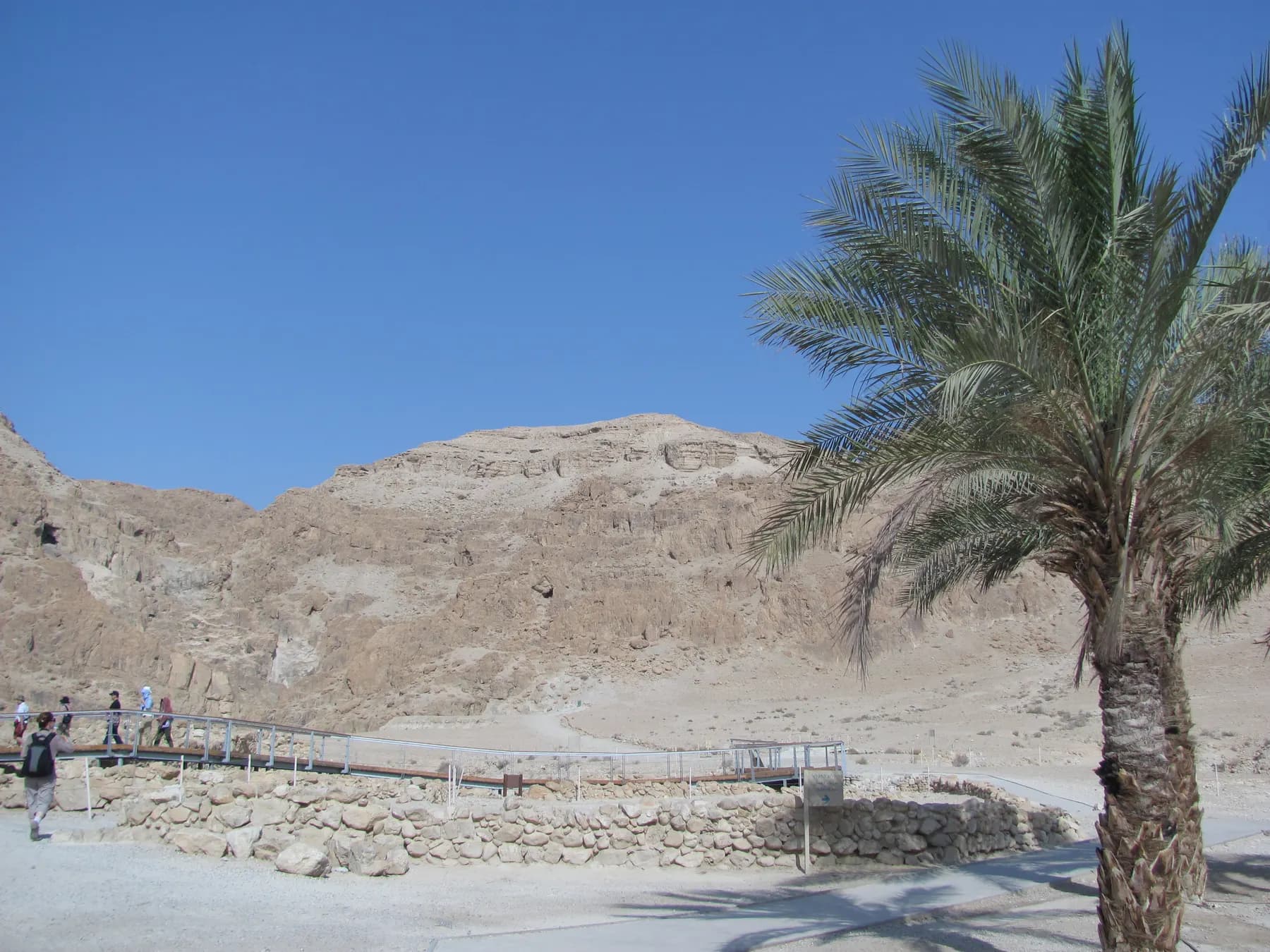
Eleven caves here gave up the Dead Sea Scrolls between 1947 and 1956, five of them found by Bedouin and six by archaeologists, and what the settlement beside them actually was is still argued over.
DinaKuzia / CC BY-SA 4.0 · Wikimedia Commons
Nature reserve
Einot Tzukim (Ein Feshkha) Nature Reserve
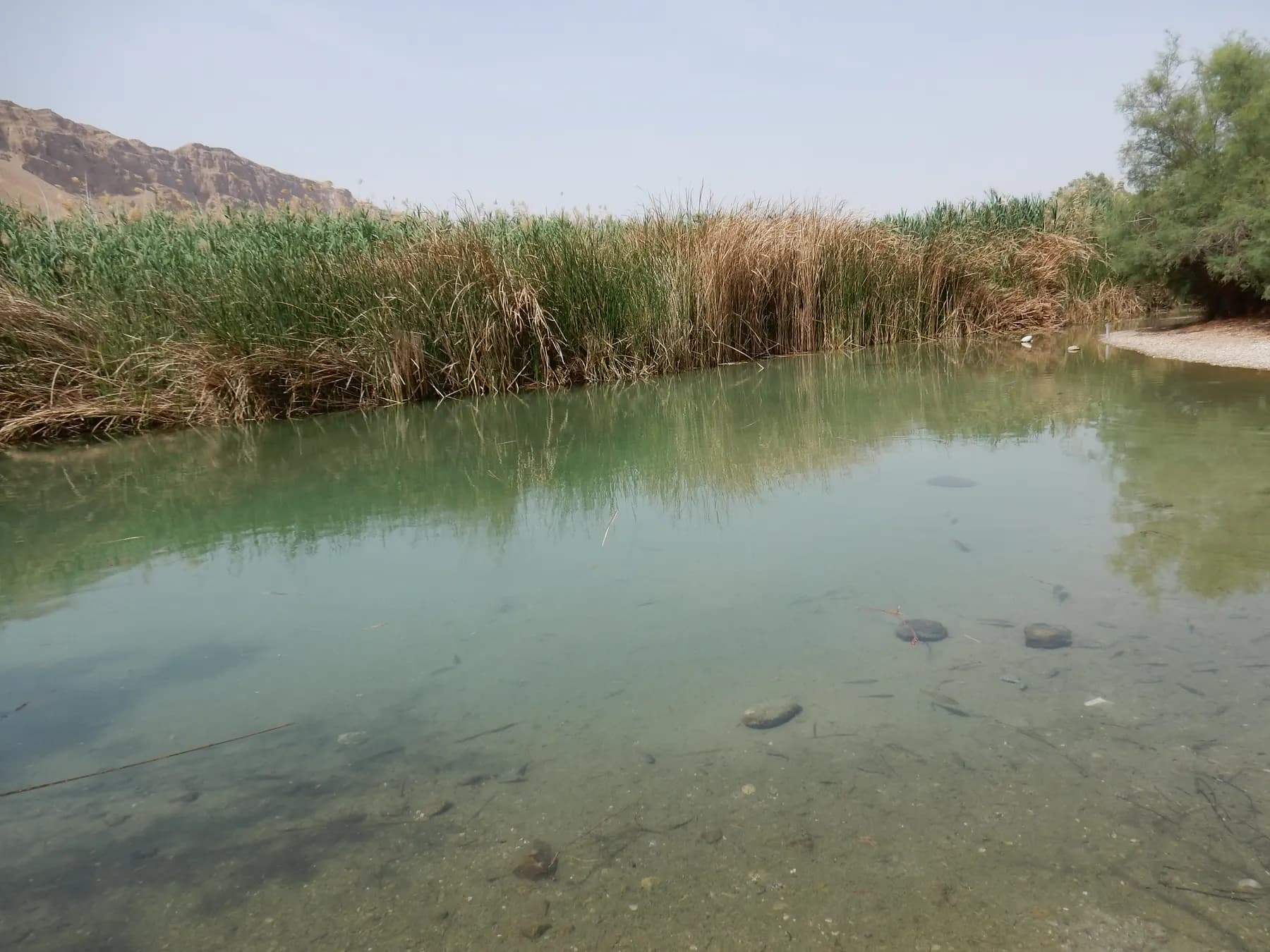
Brackish springs surface at the foot of the escarpment here and run into pools you can get into, and the Israel Nature and Parks Authority puts the point where they emerge at 390 metres below sea level.
Bahnfrend / CC BY-SA 4.0 · Wikimedia Commons
Beach
Kalia Beach
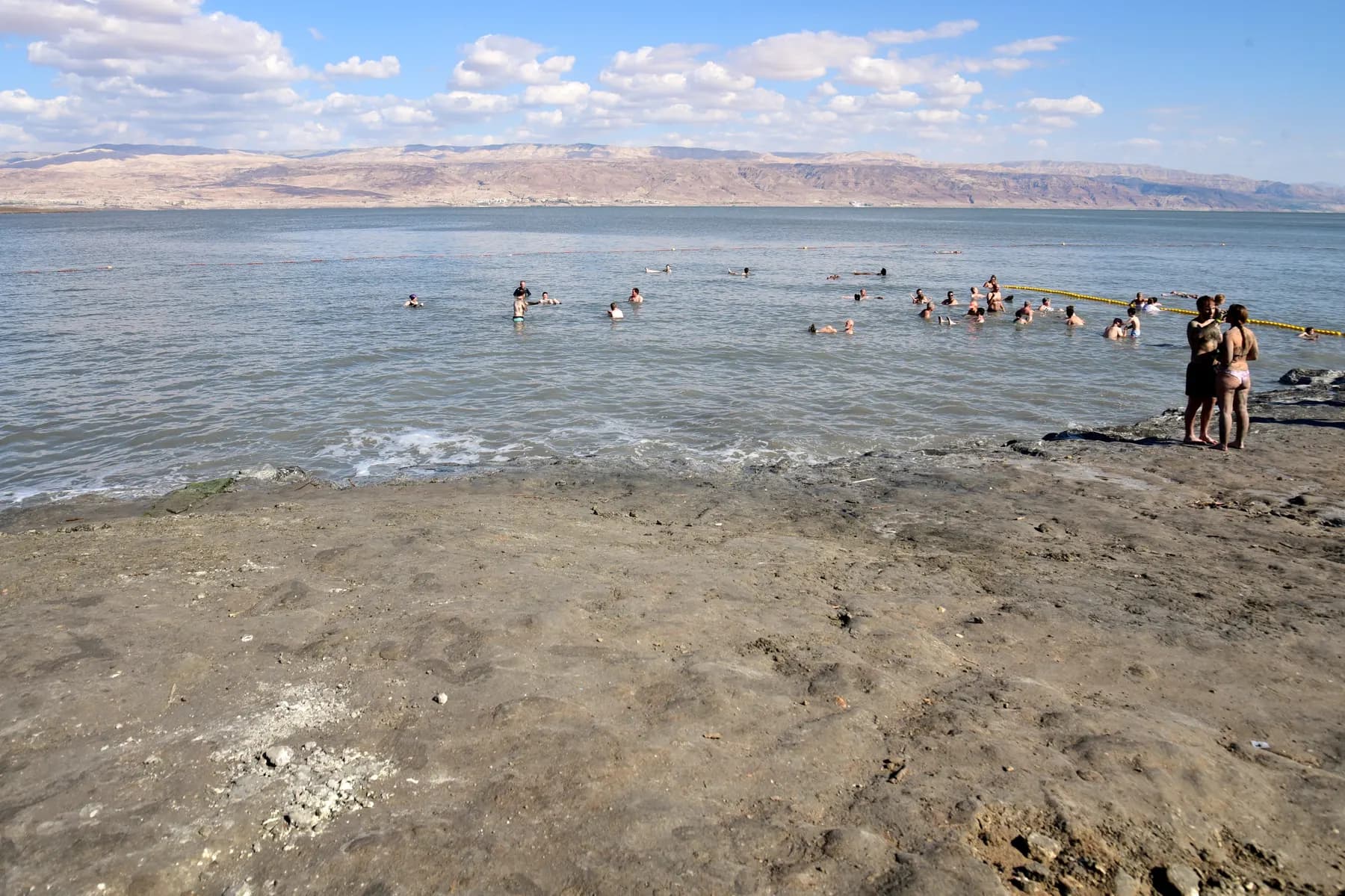
The northernmost managed beach on the Dead Sea, run by Kibbutz Kalia on the site of the potash works the Arab Legion destroyed in May 1948, with a paid gate and two quite different tickets.
Sources and further reading
Every link below was opened and checked when this page was written. Official statements are marked as such: they are the subject's own account, not an independent one.
- OfficialIsrael Nature and Parks Authorityen.parks.org.ilKasr el Yahud, The Baptismal Site, The Jordan Pass
Summer hours 08:00 to 17:00 and winter hours 08:00 to 16:00 for Sunday to Thursday and Saturday, last entry one hour before closing, the description of the site as the third holiest in the Christian world, the driving directions off Route 1 and Route 90, and the booking widget. No admission fee is published anywhere on the page.
- OfficialIsrael Nature and Parks Authorityparks.org.ilקצר אל יהוד, אתר הטבילה, מעברות הירדן (Qasr al-Yahud, Hebrew site page)
Friday and holiday-eve hours, the Rosh Hashanah, Passover and Yom Kippur eve hours, the advance-registration requirement from 1 January 2026, the warning that hours follow IDF instructions, the ban on entering the monasteries and the monastery road because of mines, the building-by-building description of the monasteries with their dates, the Jordanian rule until 1967 and the resumption of ceremonies in the 1980s, the dress rule for entering the water, the accessibility provision and its limits, the service centre stock, the dogs rule and the statement that the authority cannot arrange clergy.
- OfficialIsrael Nature and Parks Authoritystatic.parks.org.ilQaser al-Yahud Baptism Site, visitor brochure
The operator's own history: Joshua 3, Elijah and Elisha, Naaman, John the Baptist, Byzantine pilgrimage and its later revivals, the monastery of Anastasius I and its 1024 earthquake and twelfth-century rebuilding under Manuel Komnenos, the Templar fortification, the 1967 closure and mining, the 1994 peace treaty and the 2011 year-round opening, the Epiphany window of 12 to 24 January, the site rules, the landmine warning, and the drive times to Qumran, Einot Tzukim and the Good Samaritan Inn.
- OfficialIsrael Nature and Parks Authorityparks.org.ilמחירון 2025, דמי כניסה לשמורות טבע וגנים לאומיים (2025 entrance-fee table)
The operator's full price list, effective 1 January 2025. The Judea and Samaria section lists Har Gerizim, the Euthymius and Martyrius monasteries, the Good Samaritan Museum, Ein Prat, Qumran, Einot Tzukim and Herodion, and does not list the baptismal site, which is the basis for stating that entry is free.
- OfficialIsrael Nature and Parks Authorityparks.org.ilקצר אל יהוד, סיור אל ארץ המנזרים המסתורית (guided tour of the monastery road)
The operator's own guided walk onto the monastery road: ₪55 a person, about two hours, departing from the service centre, weather and Home Front Command dependent, with the note that adapted guiding must be requested 14 days ahead. Listed as ended or full at the time of reading.
- ReportingThe Times of Israeltimesofisrael.comQasr al-Yahud baptismal site reopens after NIS 25 million facelift
The reopening on 10 February 2026, the NIS 25 million cost funded by the Tourism Ministry and the Civil Administration, the works by the Government Tourism Company (prayer pergola, air-conditioned block with hot showers and changing cubicles, wooden deck, roads, parking, landscaping), the planned auditorium and accessible water path, and the ranking behind the Church of the Holy Sepulchre and the Church of the Nativity.
- ReportingIsrael Travel Newsitn.co.ilA Renewed Spiritual Journey: The Historic Qasr al-Yahud Baptism Site Unveils a Stunning Upgrade
Independent confirmation of the NIS 25 million upgrade, dated 17 February 2026, naming the Ministry of Tourism, the Nature and Parks Authority, the Civil Administration and the Ministry of Environmental Protection as funders, quoting tourism minister Haim Katz and parks authority director general Raya Shurqui, and giving the opening with temporary structures in 2009 and a peak of close to a million visitors in 2019.
- ReportingThe Times of Israeltimesofisrael.comIsrael begins clearing thousands of landmines from Jordan River baptism site
Dated 20 March 2018. About 2,600 anti-tank mines, 1,200 anti-personnel mines and improvised devices over roughly one square kilometre around seven churches, the start of work that week, the HALO Trust's fundraising of almost $1 million against a total cost near $4 million, and the defence ministry's statement that church plots would be returned to their denominations once clearance was verified.
- ReportingThe Times of Israeltimesofisrael.comStunning Romanian church is final monastery cleared of mines at Qasr al-Yahud
Dated 20 June 2019. More than 6,500 mines seeded from the late 1960s with booby traps inside the buildings, the Romanian monastery as the seventh and last cleared, the four bodies doing the work (the Israel National Mine Action Authority, the IDF, the HALO Trust and 4CI), the Romanian community's founding in the 1920s, Epiphany on 18 January, and more than 800,000 visitors a year.
- ReportingThe Times of Israeltimesofisrael.comJust in time for Easter: Jordan River baptismal site is mine-free after 53 years
Dated 12 April 2020. The controlled explosion of more than 500 mines on 9 April 2020 and the departure of the last sappers, the last monastery cleared in June 2019, funding of about NIS 10 million from the HALO Trust and NIS 7.5 million from the Israeli government, the two-year funding delay, and James Cowan's description of the churches as a time capsule with beer still on the shelf.
- ReportingThe Times of Israeltimesofisrael.comBaptism by mire? In lower Jordan River, sewage mucks up Christian rite
Dated 18 June 2015. The faecal coliform readings of 2,300 per 100 ml in November 2013 and 190 in May 2013 against a bathing standard of 400, the ministries and authorities that sampled, quotes from Gidon Bromberg and Nader Khateeb of EcoPeace and from health ministry spokeswoman Einav Shimron, 96 per cent diversion of the river's flow, and 464,000 visitors to the site in 2014.
- ReportingCatholic News Agency, republished by EWTN Newsewtnnews.comFranciscan friars return to site of Christ's baptism after 50 years
The Custody of the Holy Land's 135-acre holding here since 1632, the church of St John the Baptist dated to 1956, the last Mass on 7 January 1967 by Robert Carson and Silao Umah, demining from March to October 2018, the return of the keys in October 2020, and the first Mass in 54 years on 10 January 2021 celebrated by Custos Francesco Patton.
- ReferenceEcoPeace Middle Eastecopeaceme.orgJordan River
The cross-border environmental organisation's own briefing on the lower Jordan: annual flow down from more than 1.3 billion cubic metres to under 30 million, 96 per cent of the fresh water diverted, sewage and saline discharge keeping the channel wet, and the 400 million cubic metres it argues would be needed for ecological rehabilitation. An advocacy body rather than a neutral one, cited here for its published figures.
- ReferenceBiblical Archaeology Societybiblicalarchaeology.orgBaptismal Site "Bethany Beyond the Jordan" Added to UNESCO World Heritage List
The 2015 inscription of Al-Maghtas in Jordan, the 1996 to 2002 excavations of Byzantine churches, pools, hermitages and caves at Tell el-Kharrar, the rival western-bank tradition, and Jodi Magness's caution that no site here has archaeological remains showing continuous veneration from the first century.
Qasr al-Yahud Baptismal Site: common questions
How much does Qasr al-Yahud cost to visit?+
Nothing. The operator publishes no admission fee for the site, and the baptismal site does not appear in the Judea and Samaria section of the Israel Nature and Parks Authority's 2025 entrance-fee table, which does list Qumran, Einot Tzukim, Ein Prat and Herodion. The only priced items are extras: the ₪55 guided tour of the monastery road, and towels and baptismal robes at the service centre.
Do you need to book in advance?+
Yes. The parks authority states on both its Hebrew and English pages that from 1 January 2026 entry to the site is by advance registration only. Registration is free and takes a minute through the booking system on the operator's page. Turning up without it risks being turned away at a gate that is staffed by the army rather than by a ticket clerk.
Can you actually get into the Jordan River here?+
Yes, in one designated stretch, from a wooden deck and steps installed in the works completed in February 2026. Crossing the river is prohibited, food is not allowed in the baptismal area, and the water is not drinkable. The bank is mud rather than sand and the current is real, so the deck is not a formality.
What do you have to wear to be baptised at Qasr al-Yahud?+
Clothing that covers the shoulders and the knees, and not a swimsuit. That is the parks authority's published rule. White baptismal robes and towels are sold at the service centre for anyone who arrives without suitable clothes, and there are changing rooms and, since 2026, hot showers.
Is the water clean enough to be immersed in?+
That is genuinely disputed and no daily reading is published at the gate. Government sampling found a faecal coliform count of 2,300 per 100 millilitres at the site in November 2013 against a bathing standard of 400, though the same measurement had been 190 six months earlier. EcoPeace Middle East describes the lower Jordan as a mixture of sewage, agricultural runoff and saline water; the health ministry's response was that there is no raw sewage at Qasr al-Yahud and that the feeder streams have improved. Do not swallow the water, and rinse afterwards.
Are the monasteries and churches open to visitors?+
No, not on an ordinary visit. The parks authority's Hebrew page warns that entry to the monasteries and to the monastery road is forbidden because of the danger of mines, and the English brochure says the same. The compounds are viewed from the access road. The exception is the operator's own guided tour, about two hours at ₪55, which goes onto the monastery road on published dates.
Is it safe, given the landmines?+
The visitor area is cleared and has been open continuously since 2011. Between March 2018 and April 2020 the Israel National Mine Action Authority, the IDF, the HALO Trust and the contractor 4CI lifted more than 6,500 mines from the seven monastery compounds, finishing with a controlled explosion of some 500 remaining mines on 9 April 2020. Fenced minefields still exist in the wider valley, which is why the standing instruction is to keep to official roads and never cross a fence, not even onto the verge.
Is Qasr al-Yahud wheelchair accessible?+
The entrance area is, and the river is not. The parks authority lists accessible parking, service centre, toilets and changing rooms, shaded plaza, viewpoint over the Jordan, handrails and signage, and then states that because of the shape of the bank, the current and the mud, immersion in the river cannot be made accessible. An accessible path to the water was announced in February 2026 as future work, with no completion date given.
How long do you need, and can it be combined with the Dead Sea?+
An hour to ninety minutes covers the terrace, the river and the walk, and closer to two hours if you are going in and changing afterwards. It combines easily with the northern Dead Sea: the operator's own brochure gives about 15 minutes' drive to Qumran, about 20 to Einot Tzukim and about 30 to the Good Samaritan Inn, and Kalia Beach is on the same road.
Is this really where Jesus was baptised?+
It is one of two claimants on opposite banks of the same short stretch of river, and the evidence does not settle it. The sixth-century Madaba map marks the ford on the western side, where Qasr al-Yahud is; the excavated Byzantine churches, pools and hermitages are on the eastern side, and it is that Jordanian complex, Al-Maghtas, that UNESCO inscribed in 2015. The archaeologist Jodi Magness has pointed out that no site here has remains showing continuous veneration from the first century onwards.