Landmark · Tel Aviv
Sarona Colony and Sarona Market
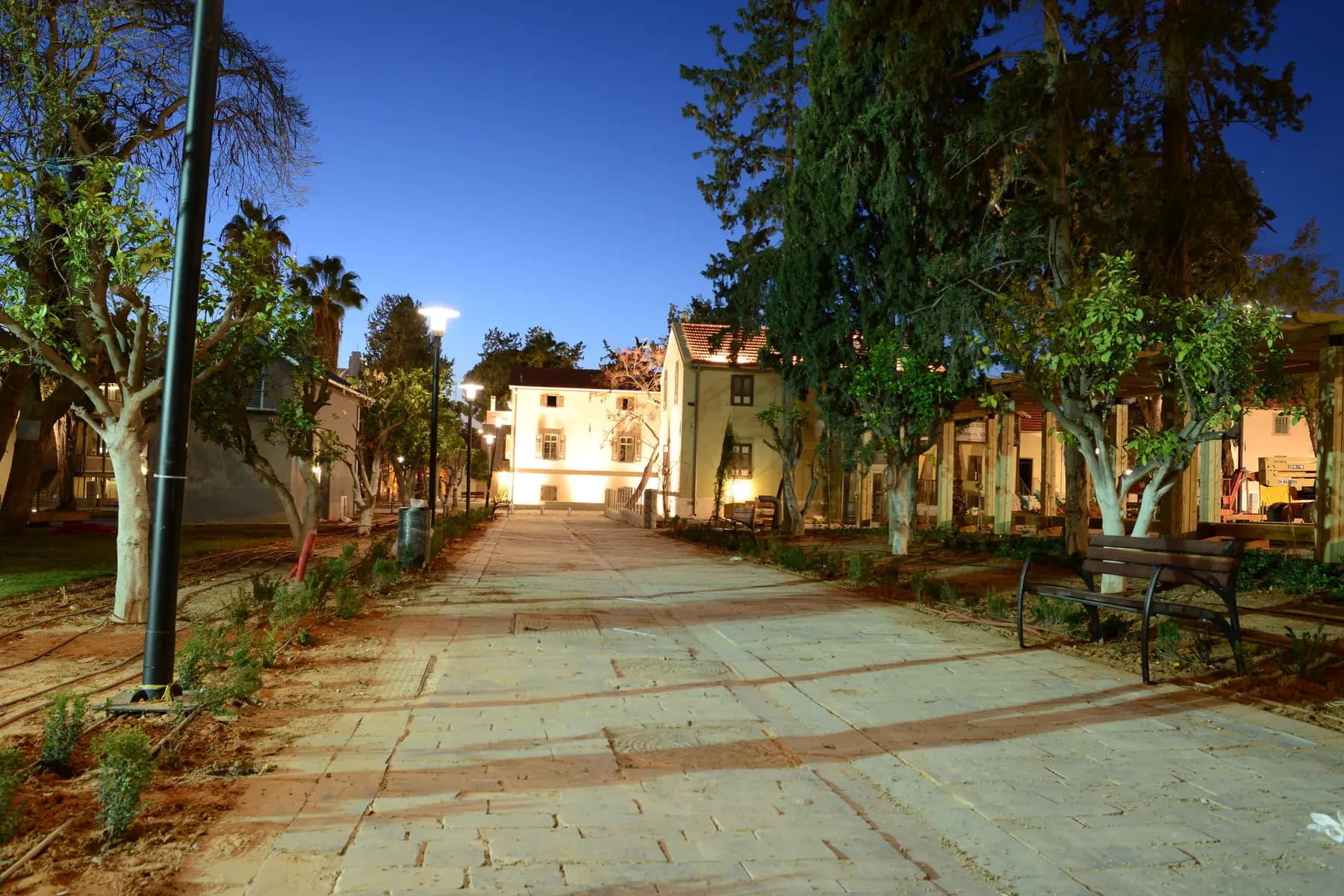
Five of Sarona's Templer houses no longer stand where they were built: in 2005 they were physically moved about thirty metres so that Kaplan Street could be widened.
Doraharon / CC BY-SA 3.0 · Wikimedia Commons
Colony founded
August 1871
about 600 dunams bought near Jaffa, cornerstone laid that October
Buildings listed for preservation
36
the figure the Tel Aviv-Yafo tourism administration gives for the 2006 plan
Houses physically relocated
5
moved about 30 metres in 2005 for the widening of Kaplan Street
Sarona Market
opened July 2015
89 businesses at opening, on the count Globes published that week
In short
- How long to give it
- about 90 minutes for the compound and the market, or around two hours with the visitor centre tour
- Sarona Market, Sunday to Wednesday
- 10:00-22:00
- Sarona Park, the colony streets and Sarona Market
- Free, no ticket
שרונה
Sarona is a German Templer farming colony of 1871 that ended up inside central Tel Aviv, was absorbed into the country's main military and government compound, and has been dug out again as a park of restored stone houses with a covered food market at its southern edge. The streets were laid out in the shape of a cross by a surveyor from the community, Theodor Sandel, and that plan is still legible: David Elazar Street and Kaplan Street cross where the colony's two public plots were.
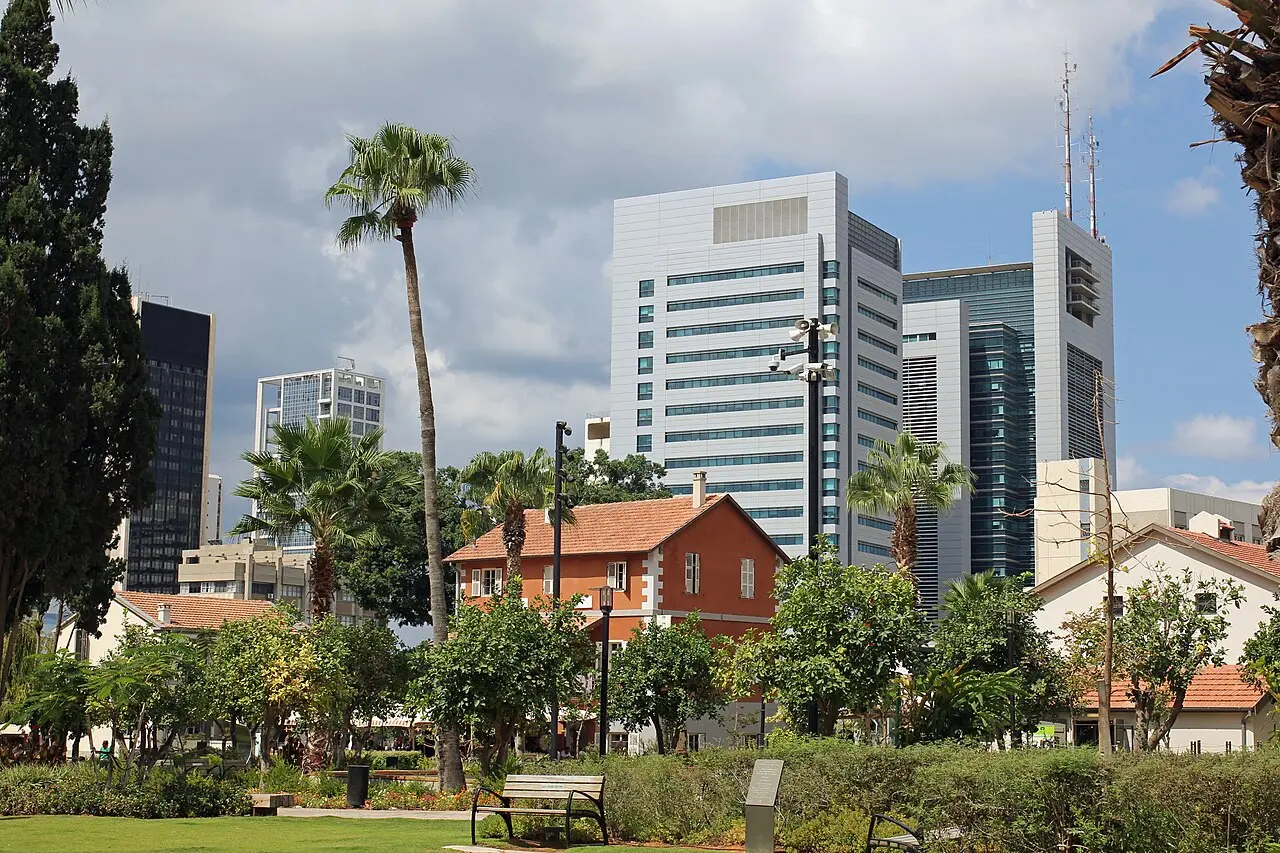
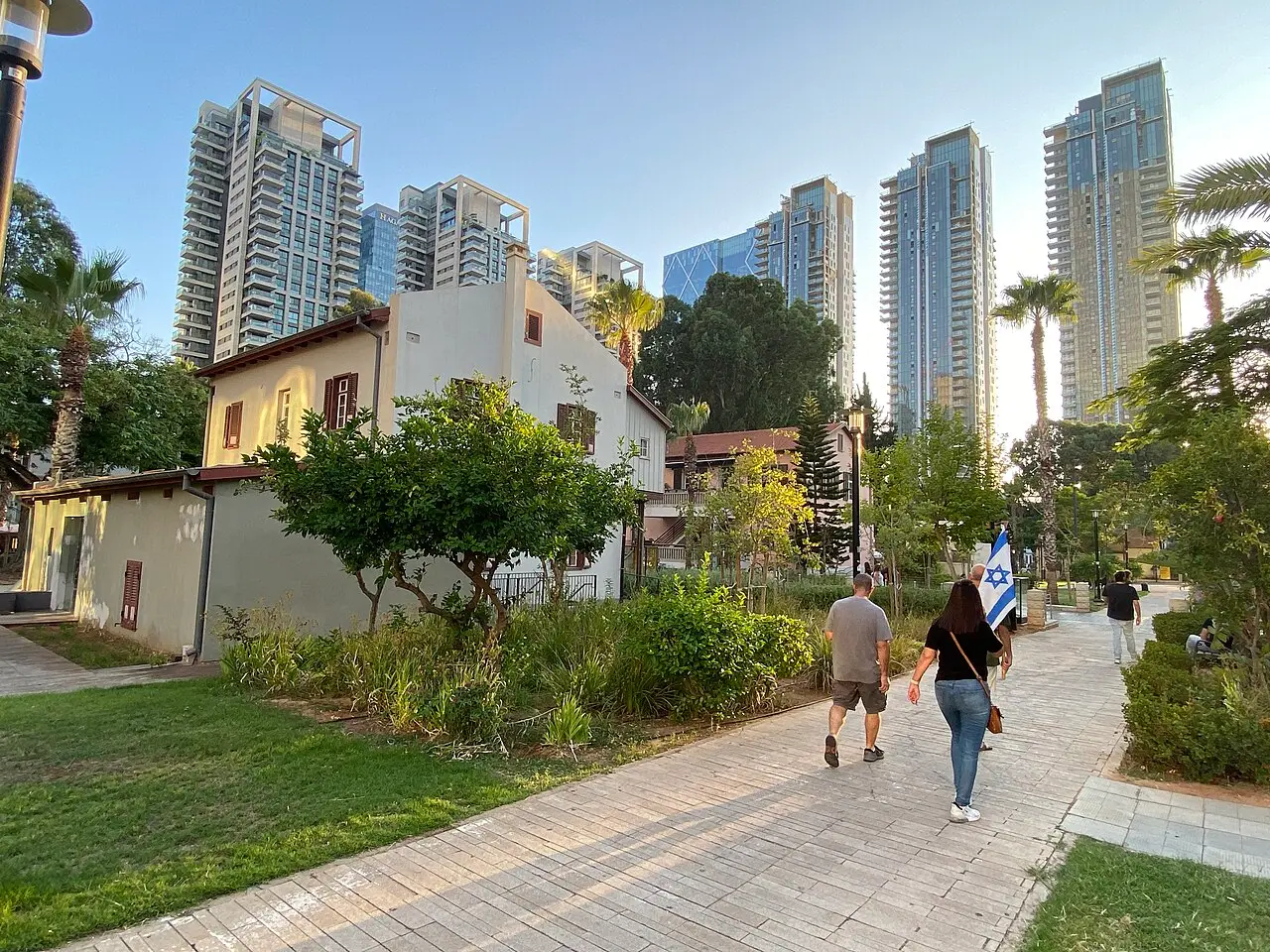
Nothing about the compound is a ruin. The houses hold shops, restaurants, offices and small museums, the ground between them is lawn, and Sarona Market, a hall of about ninety food counters under three residential towers, opened in July 2015. Only the northern part of the old colony is off limits, because the General Staff of the Israel Defense Forces has been there since 1955 and has not moved.
The unusual thing here is not that old buildings were saved. It is that some of them were driven up the road. Five Templer structures standing in the way of a road widening, including the community house whose cornerstone went down in 1871, were lifted and moved about thirty metres rather than demolished or recorded and lost. Knowing which parts of Sarona are original stone, which are repaired, and which are recent reconstruction changes what a visitor is looking at.
1871
Six hundred dunams bought from a monastery, laid out as a cross
Sarona was founded in August 1871, when members of the Temple Society bought about 600 dunams of land from a Greek monastery near Jaffa. The cornerstone went down that October. The founders were the second generation of the German colony in Jaffa, who wanted farming rather than town life, and they named the place for the plain of Sharon on whose southern edge it sat. One of their own, Theodor Sandel, surveyed and planned it in the cross shape used in several Templer settlements: the main street, then Christoph Hoffmann, is today David Elazar Street, and the sea road is today Kaplan Street.
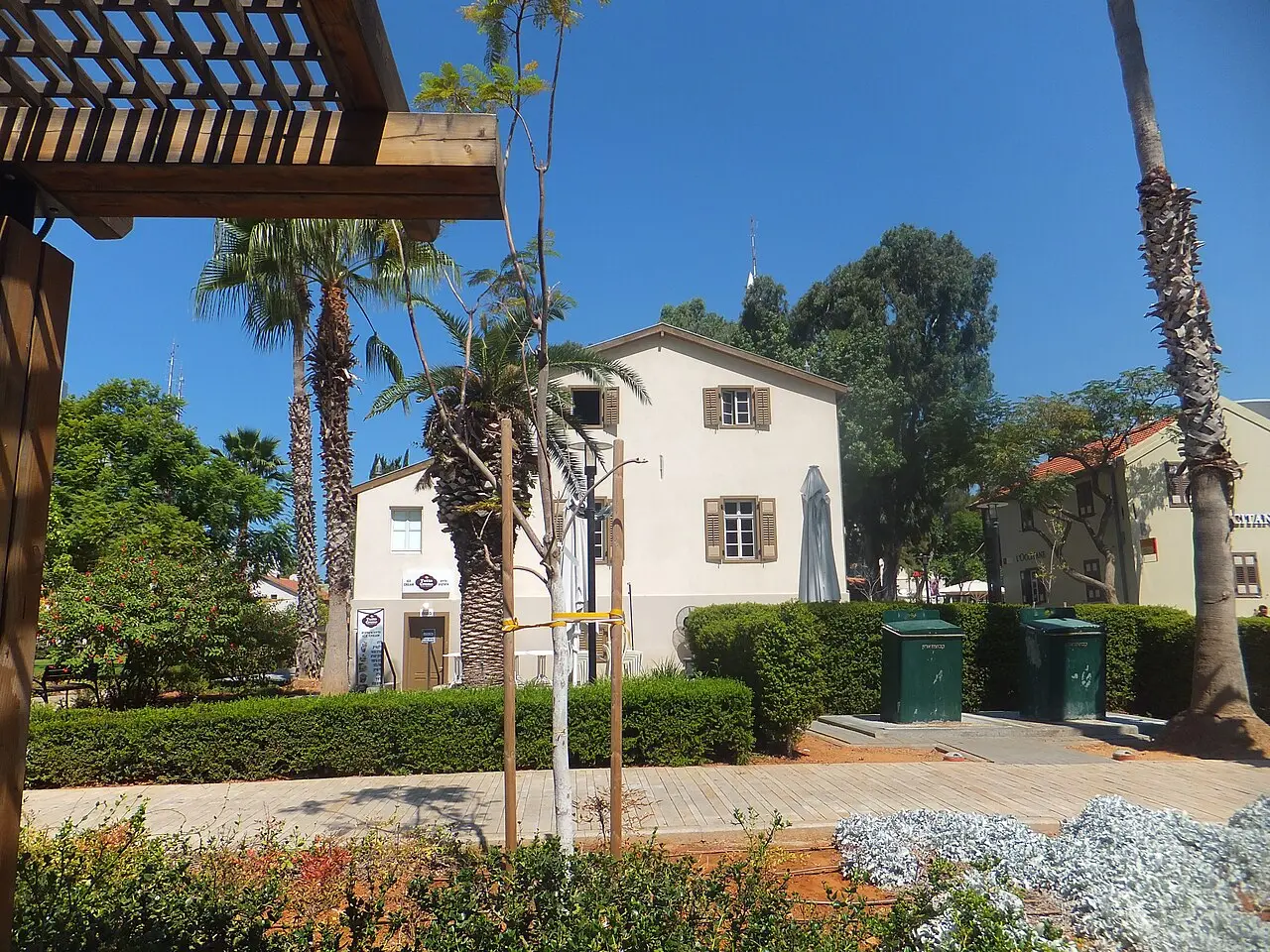
The houses went up in kurkar, the local coastal sandstone, mostly single storey with an attic above and a basement below, on the pattern of villages in southern Germany. The two plots at the northern crossroads were reserved for public buildings, a community house and a meeting hall, with an olive press and a large winery nearby and around thirty dwellings around them. Thousands of dunams of citrus, vines, olives and wheat lay outside the built village.
The first years were brutal. The English Wikipedia account records that malaria killed 28 of the 125 settlers in 1872 alone, and that the colonists planted 1,300 eucalyptus trees to dry out the marshy ground. By 1889 there were 269 people living in 41 houses, with a communal hall, a winery, workshops, barns and sheds. Templer growers shipped fruit to Germany under the Jaffa oranges name, and the grove planted by Christian Friedrich Lämmle, a gardener from one of the founding families, ran to sixty dunams and was reckoned among the best around Jaffa.
Under the British Mandate the colony did well. Its farmland was extended, businesses opened, the second and third generations built in the International Style alongside the old kurkar houses, and Sarona was declared a local council in 1925. On the eve of the Second World War it held 428 people.
- About 600 dunams bought in August 1871, cornerstone laid that October
- Planned by Theodor Sandel in a cross, on the southern German village model
- Built in kurkar: one storey, attic above, basement below
- 269 residents in 41 houses by 1889
- Declared a local council under the British Mandate in 1925
Sasha1506 / CC BY-SA 4.0 · Wikimedia Commons
1939
A Nazi party branch, an internment camp, then the Ministry of Defence
Relations with the Jewish community around the colony were workable at first, to the point that Sarona's dairymen employed Jewish milkers so that their cheese would be kosher and saleable in Jaffa. Politics ended that. In March 1933, weeks after Hitler took power in Germany, two branches of the Nazi party opened in Mandatory Palestine, one of them at Sarona and Jaffa, and the Jewish community answered with a boycott of Templer produce. The Tel Aviv-Yafo tourism administration states the point without hedging on its own page: from 1933 Sarona became a centre of the Nazi party in the country.
In September 1939 the British declared the German Templers enemy nationals and turned the colony into an internment camp. Some internees were shipped out: 188 residents left for Australia in July 1941 and were held at Tatura in Victoria until 1947, while others were exchanged for Jews from occupied Europe. The High Commissioner abolished the local council in November 1943. On 22 March 1946 Palmach men shot Gotthilf Wagner, the colony's mayor, on the edge of Tel Aviv.
The emptied camp became a British military base and then a target. The Haganah, the Irgun and Lehi all attacked it; a Palmach and Hish raid on 22 February 1946 failed and cost four fighters their lives, and HaArba'a Street is named for them. On 16 December 1947 the British handed the camp over to the Jewish community, which renamed it Camp Yehoshua after Yehoshua Globerman.
From May 1948 the Templer houses held the offices of the new Israeli government, and on David Ben-Gurion's instruction the name Sarona was replaced by HaKirya. Most ministries left for Jerusalem from the end of 1949, but the General Staff of the IDF moved down from Ramat Gan in 1955 and is still in the northern part of the compound. Israel compensated the dispossessed Templer owners under an agreement signed in 1962, at 54 million Deutsche Marks; the payments relating to Sarona itself went out from 1969.
Conservation
The five houses that were driven thirty metres up the road
Planning for the southern half of HaKirya began in September 1978, when a steering committee was appointed for roughly 190 dunams bounded by Kaplan, Begin, HaHashmona'im and HaArba'a, and Leonardo da Vinci. The scheme chosen in June 1980, by the architect Kalman Katz, put a large pedestrian space and a park at the centre and pushed vehicle movement and parking underground. Over the next quarter century the demand for offices and flats in central Tel Aviv grew, and so did the standing of conservation, which came to be treated as a lever for reviving a historic fabric rather than only as a cultural duty.
What was finally approved, as plan TA/3000 in September 2006, is a mixed-use ring of about 499,000 square metres of principal floor area wrapped around an urban park containing the listed buildings. The Tel Aviv-Yafo tourism administration says the plan followed a joint campaign by the Council for Conservation of Heritage Sites in Israel and the municipality, and that it covered 36 buildings for preservation. Hebrew Wikipedia describes the compound as made up of about 30 buildings. The two counts are not reconciled in anything published, and the difference probably turns on what is counted as a building.
Five of them are not where they were built. In 2005 five Templer structures standing along Kaplan Street were physically moved about thirty metres to allow the road to be widened, among them the old community house, whose cornerstone was laid in 1871 and which was dedicated in early 1873 as the colony's school. The library of Camp Rabin, on David Elazar Street, was demolished to clear a landing place for it. The widening was finished in 2008, and the ground to the south of the new road was renamed Ganei Sarona.
The heavy conservation work began in 2012, carried out by Bar Orian Architects with the architect Amnon Bar Or, at the same time as the park itself, designed by the landscape practice of Dan Zur and Lior Wolf. The compound reopened to the public in 2014. The management company puts the park at 48 dunams.
Original
Which of it is the 1870s, and which of it is 2013
Reading a facade here takes some care. The street plan is the original survey, the kurkar shells and roof lines of the Templer houses are genuine and were repaired rather than replaced, and the buildings that were moved were moved intact. Several of the things a visitor is most likely to photograph are new.
The visitor centre is the clearest case. It is not an old building at all: it is a new structure put up as a close reconstruction of the family butcher's shop that stood in the colony. Wikipedia's list of the site's explanatory signs, which covers 31 preserved buildings, marks the Knoll family barn as rebuilt and dates the reconstruction of the Grözinger farm building to 2013.
The community house clock shows the middle case, where something original survives inside something new. During the 2005 work the iron mechanism of the old carillon clock from the building's facade was found. It was shown at the Eretz Israel Museum in 2006, where a visiting descendant of the Templers recognised the maker's signature, the Perrot company of Calw in Germany. Perrot made a new clock for the building, and the repaired original is displayed in the visitor centre.
Underground, at the far end of David Elazar Street, a tunnel runs between the two Templer wineries, cut into the kurkar. It is now presented as the Templers' tunnel and forms part of the visitor centre route, along with the old olive press. The restored bowling lane the colonists played on, and drank beer beside, can be booked for a game.
Eduard Marmet / CC BY-SA 2.0 · Wikimedia Commons
2015
The food hall under three residential towers
Sarona Market opened in July 2015 on the ground floors of the three Sarona towers, at the southern edge of the restored colony. Globes reported at the opening that Gindi Holdings had spent more than 530 million shekels on it, that it held 89 businesses across 8,700 square metres, and that the mix was roughly 70 per cent retail to 30 per cent food service. The municipality's own English page gives the floor area as 7,800 square metres instead. The operator's current description of itself is looser again: more than 60 shops, food stalls and chef restaurants.
The claim the operator makes is that this is the largest covered food market in Israel, and Wikipedia's article calls it the first indoor market of its kind in the country, with enclosed markets built elsewhere afterwards. The design is by Kika Braz, Uri Ben Dror and Michael Ankawa of Studio Mo, and the plan is built around long shared tables rather than separate dining rooms, so a group can buy from four counters and sit together.
It is a market in the sense of a hall of specialist counters rather than a produce shuk. The operator lists cheeses, oils, spreads and pickles, fresh meat and fish, vegetables, wines, spices, coffee and tea alongside the street food, and names Eyal Shani, Israel Aharoni, Manal Ismail and Rachel Ben Alul among the chefs whose kitchens work here. Prices are not shuk prices, and the produce side is a delicatessen rather than a greengrocer.
On 8 June 2016 two gunmen opened fire on customers at the Max Brenner restaurant inside the market, killing four people. Reported counts of the wounded differ between contemporary accounts and later summaries. Bag checks at the entrances date from that attack.
שלמה רודד / CC BY 2.5 · Wikimedia Commons
What to look for
Things not to walk past at Sarona Colony and Sarona Market
The details that repay knowing about before you are standing in front of them.
The old community house
Cornerstone laid in 1871 and dedicated in early 1873 as the colony's school. It is one of the five buildings physically moved about thirty metres in 2005, and its carillon clock is a new one by the original German maker, Perrot of Calw.
The Templers' tunnel
A passage cut into the kurkar between the two Templer wineries at the far end of David Elazar Street. It is included in the visitor centre route and is the one part of that route that wheelchairs cannot do.
The olive press
The colony's press, kept as a small museum and shown on the guided route. The Templers were growing and processing their own oil here long before the compound became a military headquarters.
The restored bowling lane
The colonists' own lane, restored and bookable for a game. The municipality's tourism page mentions it in the same breath as the beer they drank beside it.
The shared tables at Sarona Market
The hall is laid out around long communal tables rather than individual restaurant rooms, which is the practical reason a group buying from four different counters can still eat together.
The lawns of Sarona Park
Forty-eight dunams on the management company's figure, and the part of the site locals actually use. Free, ungated, and the shaded benches fill first on a hot afternoon.
The long view
Sarona Colony and Sarona Market, in order
August 1871
Members of the Temple Society buy about 600 dunams from a Greek monastery near Jaffa; the cornerstone is laid in October.
1873
The community house is dedicated and takes in the colony's school.
1889
The colony counts 269 residents in 41 houses, with a communal hall, winery, workshops and barns.
1925
Sarona is declared a local council under the British Mandate.
March 1933
A branch of the Nazi party opens at Sarona and Jaffa; the Jewish community boycotts Templer produce.
September 1939
The British declare the German Templers enemy nationals and turn the colony into an internment camp.
July 1941
188 residents are deported to Australia and interned at Tatura in Victoria until 1947.
22 March 1946
Gotthilf Wagner, the colony's mayor, is shot dead by Palmach men on the edge of Tel Aviv.
16 December 1947
The British hand the camp to the Jewish community, which renames it Camp Yehoshua.
May 1948
Israeli government offices move into the Templer houses; Ben-Gurion has the name changed to HaKirya.
1955
The General Staff of the IDF moves from Ramat Gan into the northern part of the compound, where it remains.
1962
A compensation agreement is signed with the dispossessed Templer owners, at 54 million Deutsche Marks.
September 1978
A steering committee is appointed to plan the southern 190 dunams of HaKirya.
2005
Five Templer buildings on Kaplan Street are physically moved about thirty metres.
September 2006
Plan TA/3000 is approved: about 499,000 m² of mixed use around a park holding the listed buildings.
2008
The Kaplan Street widening is completed and the ground to its south is renamed Ganei Sarona.
2012
Conservation work begins under Bar Orian Architects with Amnon Bar Or, alongside the park by Dan Zur and Lior Wolf.
2014
The restored compound reopens to the public.
July 2015
Sarona Market opens on the ground floors of the three Sarona towers.
8 June 2016
Two gunmen open fire at the Max Brenner restaurant inside the market, killing four people.
Practical
Visiting Sarona Colony and Sarona Market
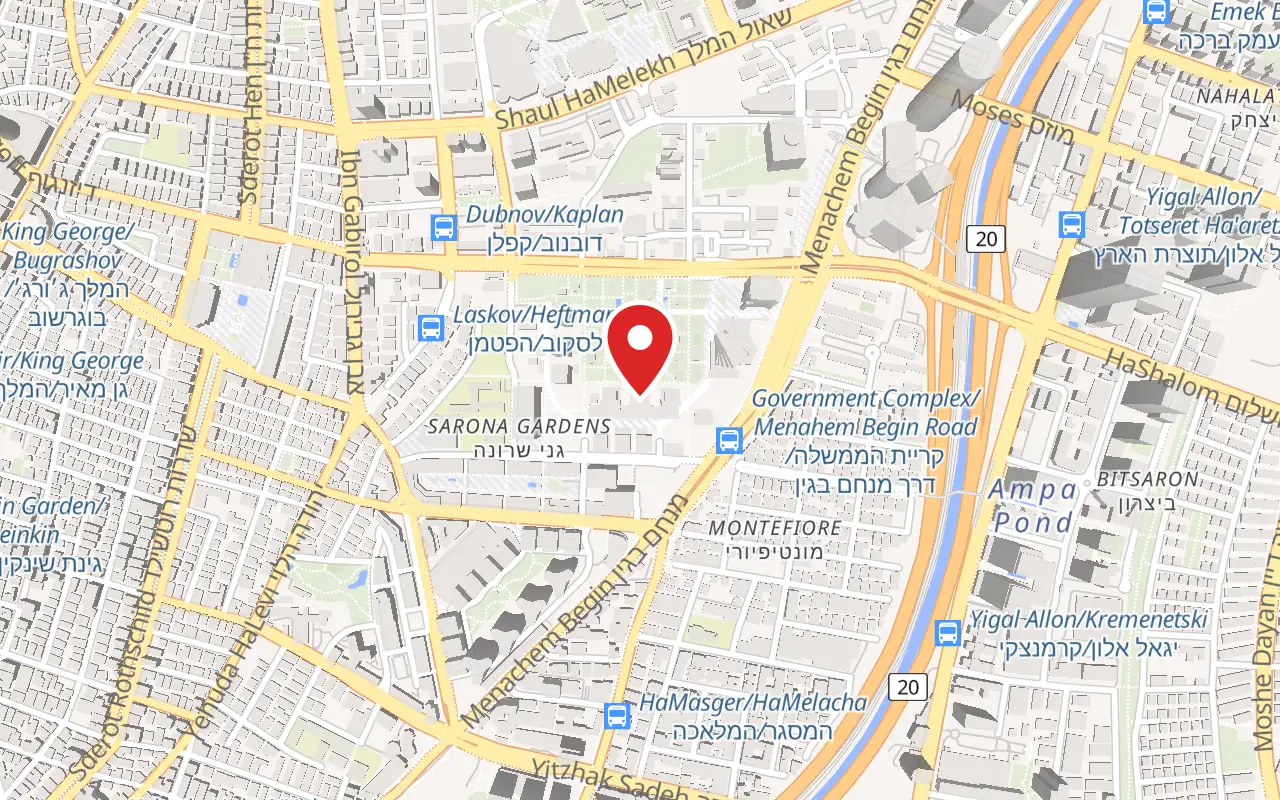
Where
Sarona Market, Kalman Magen 3, Tel Aviv-Yafo. Sarona Park offices, David Elazar 11. Tourist information and visitor centre, Albert Mandler 11.
What ticket you need
This is not inside a ticketed park. The colony streets, the lawns and Sarona Market are open ground with no gate. The only ticketed element is the guided route through the visitor centre, the olive press and the Templers' tunnel, run by the municipal tourism administration with the Ministry of Heritage and the Council for Conservation of Heritage Sites.
Opening hours
- Sarona Market, Sunday to Wednesday
- 10:00-22:00source
- Sarona Market, Thursday
- 10:00-23:00source
- Sarona Market, Friday
- 09:00-15:00source
- Sarona Market, Saturday
- 10:00-22:00source
- Retail counters inside the market
- close at 20:00, earlier than the hall itselfsource
- Visitor centre, Sunday to Thursday
- 09:00-17:30source
- Visitor centre, Friday
- 09:00-16:00source
- Visitor centre, Saturday
- 10:00-16:00source
- The park and the colony streets
- open ground, no gate and no closing timesource
Admission
Access
Flat and paved throughout. There is no climb anywhere on the site, and lifts run up from the underground car parks into the market and the park. The municipality states that the guided route is wheelchair accessible except for the Templers' tunnel, which is cut into rock, and lists an accessible lift, accessible passages, an audio system and human assistance on the same page.
On site
- Public toilets
- Covered food hall
- Restaurants, bars and cafes
- Delicatessen and produce counters
- Visitor centre and small museums
- Tourist information centre
- Underground car parks
- Lawns and shaded benches
- Step-free routes throughout
Booking
The visitor centre tour is not walk-up. It runs daily but has to be arranged in advance, on 03-604-9634 or by WhatsApp through the link on the park's visitor centre page. The market and the park need no booking.
Hours and prices are given as the operator publishes them and change without much notice, particularly around Shabbat and the festivals. Check the operator's own page before you travel for this.
Official page at saronamarket.co.il →What people wish they had known
- The retail counters shut at 20:00 while the hall itself stays open later, so a late evening visit is for eating and drinking, not for buying cheese, spices or wine to take away.
- Friday is the short day, 09:00 to 15:00. Unusually for this part of Tel Aviv, the operator does publish Saturday hours of 10:00 to 22:00, so Sarona is one of the few food halls in the city that is not shut for Shabbat.
- The guided route cannot be joined on the day. Book it ahead by phone or WhatsApp, and note that the two official pages disagree about how long it takes: the municipality says about 30 minutes, the park management company says about an hour and a quarter.
- Most first-time visitors arrive at the market from the car park and never cross Kaplan Street. The older half of the colony, with the community house, the wineries and the olive press, is north along David Elazar Street and is the part worth the walk.
- Do not expect to see the whole colony. The northern section is still an active army base and closed to the public; what is open is the restored ground south of Kaplan Street.
- Park underground. The operator names three car parks on Derech Aryeh Lova Eliav, at numbers 5, 22 and 14; kerbside parking around Kaplan is metered and taken by office workers on weekdays.
The figures
Sarona Colony and Sarona Market by the numbers
Each figure carries the year it belongs to and links the source it came from.
| Measure | Figure | As of | Source |
|---|---|---|---|
| Land bought for the colony | about 600 dunams | 1871 | he.wikipedia.org |
| Settlers lost to malaria in the first full year | 28 of 125 | 1872 | en.wikipedia.org |
| Buildings listed for preservation in the approved plan | 36 | 2006 | visit-tlv.co.il |
| Buildings physically relocated, and how far | 5, about 30 metres | 2005 | visit-tlv.co.il |
| Principal floor area in plan TA/3000 | about 499,000 m² | 2006 | he.wikipedia.org |
| Sarona Park, green area | 48 dunams | 2026 | parksarona.com |
| Sarona Market floor area | 8,700 m², though the municipality's English page says 7,800 m² | 2015 | globes.co.il |
| Businesses in Sarona Market at opening, and the investment | 89 businesses, over 530 million shekels | 2015 | globes.co.il |
While you are here
The rest of Tel Aviv
Everything else in this destination with a page of its own.
Talmoryair / CC BY-SA 4.0 · Wikimedia Commons
Museum
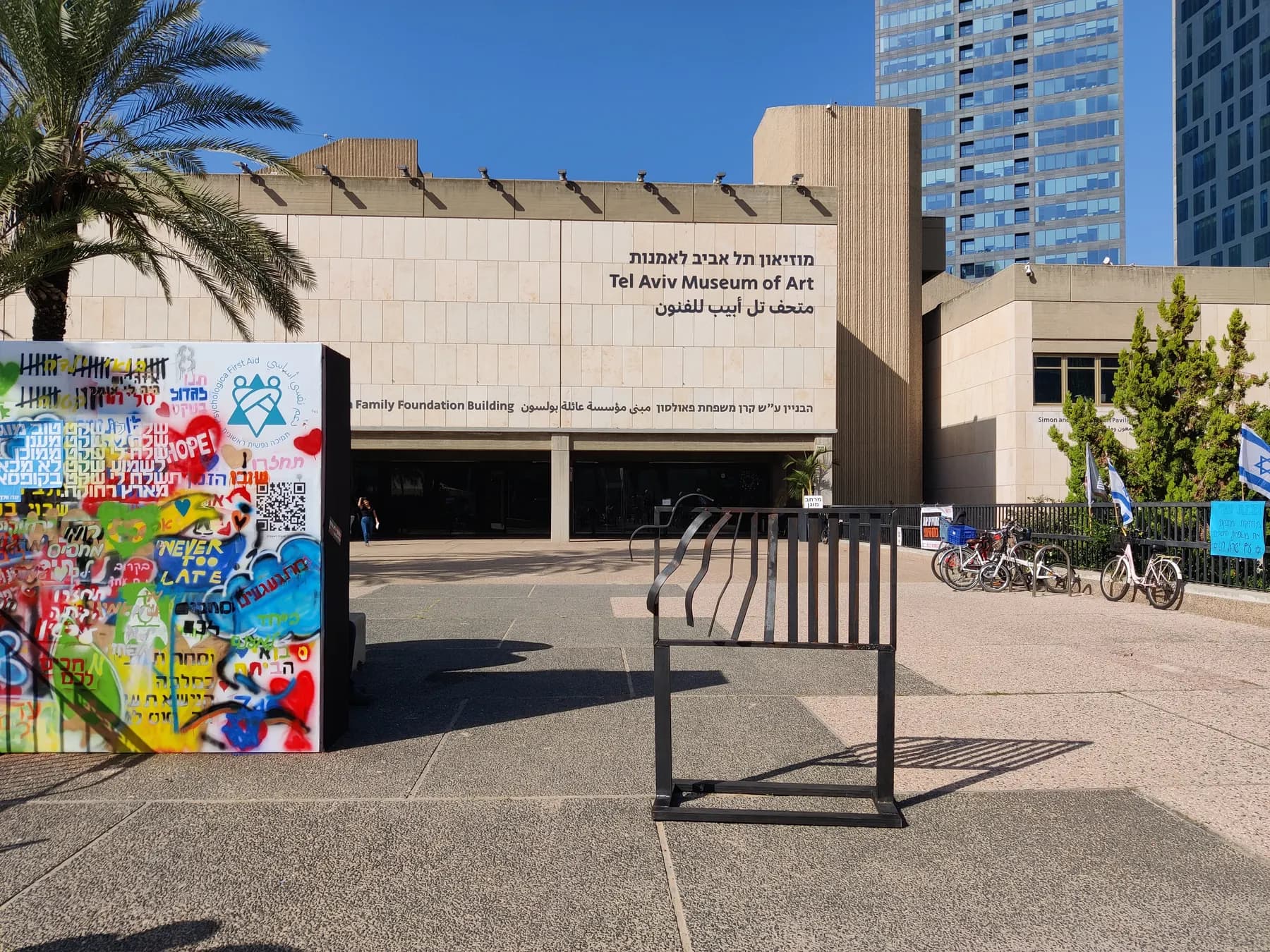
Tel Aviv Museum of Art
Israel's first art museum, opened in 1932 in the mayor's own house, now spread across three buildings on two addresses and built around a 26.5 metre concrete atrium called the Lightfall.
Marsupium / CC0 · Wikimedia Commons
Landmark
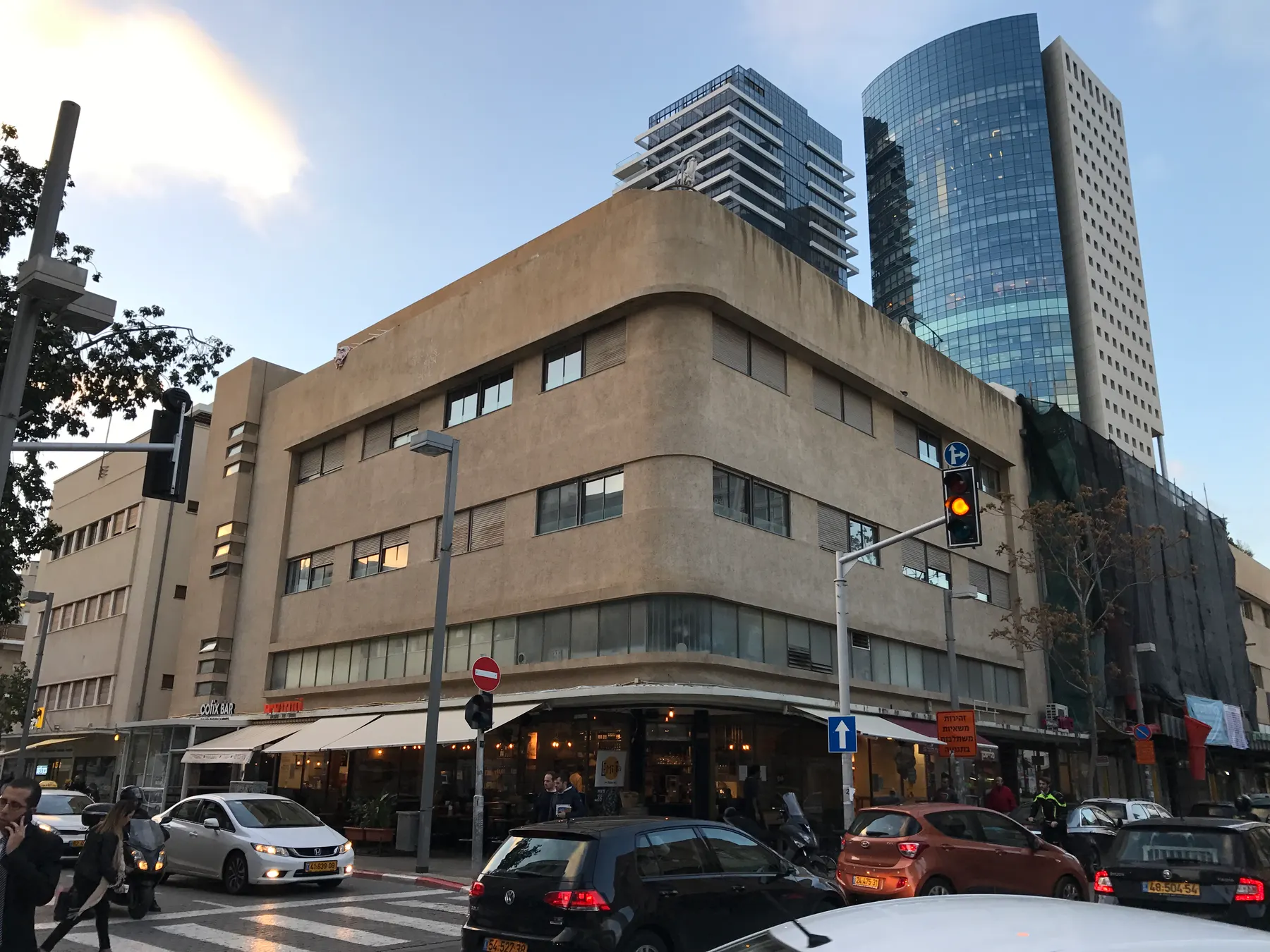
The White City and Bauhaus Tel Aviv
What UNESCO inscribed in 2003 is not one street but three separate zones covering 140.4 hectares, and roughly 90 per cent of the buildings inside them are privately owned flats.
Rakoon / CC0 · Wikimedia Commons
Market
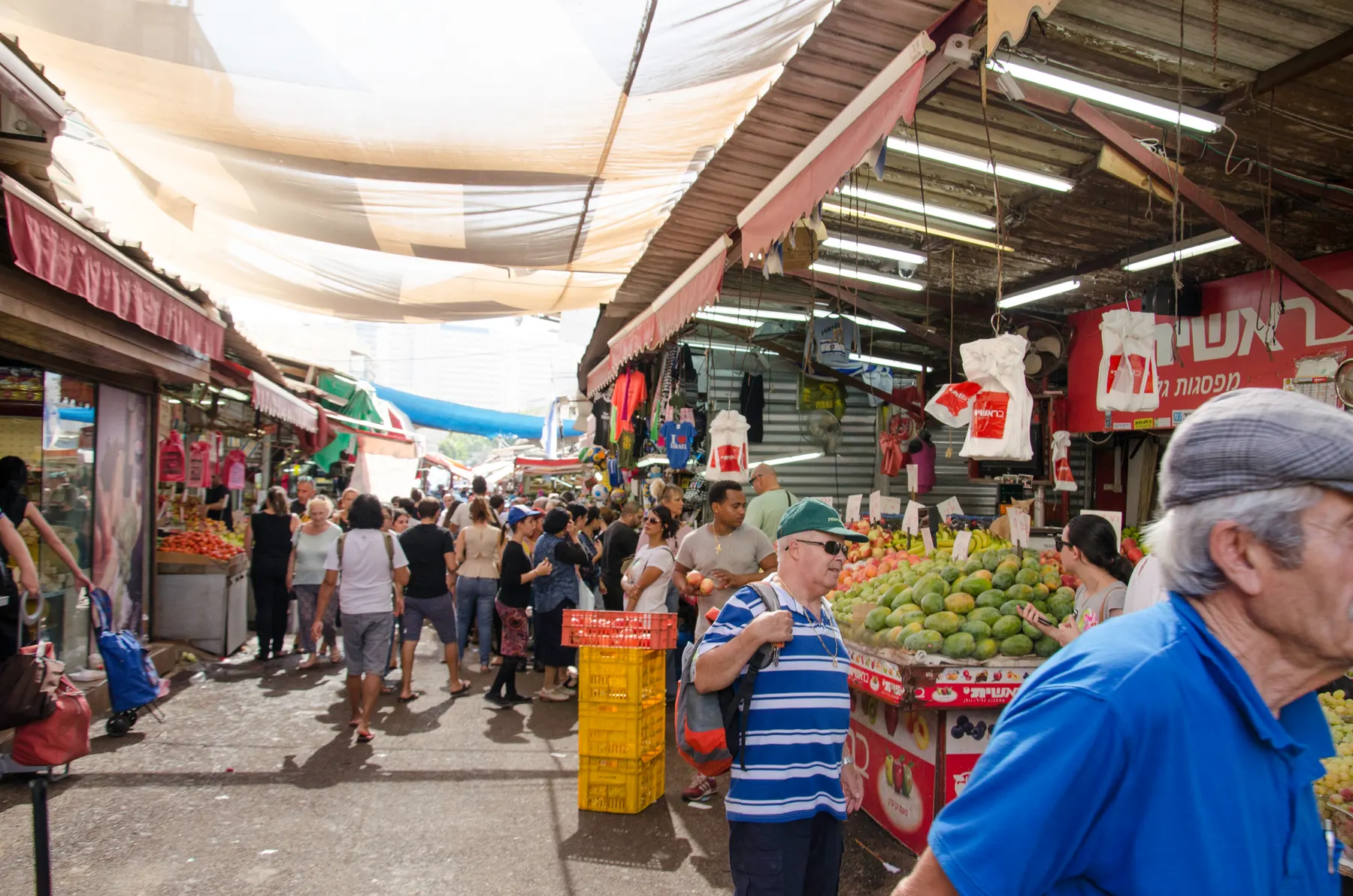
Carmel Market
The market opened in 1920 on plots bought in Russia seven years earlier as a speculation, by investors who fled the revolution and arrived in Tel Aviv with nothing else left.
Sources and further reading
Every link below was opened and checked when this page was written. Official statements are marked as such: they are the subject's own account, not an independent one.
- OfficialSarona Marketsaronamarket.co.ilבואו לבקר (Come and visit)
the operator's published opening hours, the 20:00 retail closing time, the address and the three named car parks
- OfficialSarona Marketsaronamarket.co.ilהסיפור שלנו (Our story)
the market's own account of itself: largest covered food market in Israel, more than 60 businesses, the named chefs and the shared tables
- OfficialSarona Park Management Companyparksarona.comאז והיום (Then and today)
the compound operator's history of the colony and HaKirya, and the 48 dunam figure for the park
- OfficialSarona Park Management Companyparksarona.comמרכז המבקרים (The visitor centre)
what the guided route covers, the booking requirement, and the operator's stated tour length of about an hour and a quarter
- OfficialTel Aviv-Yafo Municipality, tourism administrationvisit-tlv.co.ilשרונה
the 36 preserved buildings, the five that were moved, the 2014 reopening, tour prices in shekels, visitor centre hours and the accessibility statement
- OfficialTel Aviv-Yafo Municipality, English tourism sitevisit-tel-aviv.comSarona
independent English confirmation that five buildings fronting the main road were moved and repositioned
- OfficialTel Aviv-Yafo Municipality, English tourism sitevisit-tel-aviv.comSarona Market
the municipality's floor area figure of 7,800 m², against the 8,700 m² reported elsewhere
- ReportingGlobesglobes.co.ilגינדי פותחת את שרונה מרקט בהשקעה של 530 מיליון שקל
opening in July 2015, 89 businesses, 8,700 m², the 70:30 retail to food split and the investment figure
- ReportingThe Times of Israeltimesofisrael.comLiveblog, 8 June 2016
contemporary reporting of the Sarona Market shooting, including casualty figures that differ from later summaries
- ReferenceWikipediaen.wikipedia.orgSarona (colony)
the malaria deaths of 1872, the eucalyptus planting, the 1889 census, the Australian internment, the Perrot clock and the list of 31 signed preserved buildings
- ReferenceHebrew Wikipediahe.wikipedia.orgשרונה (מושבה)
Theodor Sandel's cross plan, the 600 dunam purchase, plan TA/3000, the 2005 relocation, the Bar Orian conservation work and the count of about 30 buildings
- ReferenceWikipediaen.wikipedia.orgSarona Market
the Studio Mo architects, the claim that it was the first indoor market of its kind in Israel, and the count of about 90 businesses
Sarona Colony and Sarona Market: common questions
Is Sarona free to visit?+
Yes. The colony streets, the lawns of Sarona Park and Sarona Market are open ground with no gate and no ticket. The only thing that costs money, apart from what you eat, is the guided route through the visitor centre, the olive press and the Templers' tunnel, published by the municipality at ₪20 standard, ₪12 for a child, a senior, a disability card holder, security forces or a reservist, and ₪10 a head for an organised group of ten or more.
Is Sarona Market open on Shabbat?+
The operator publishes Saturday hours of 10:00 to 22:00, so the hall does open on Shabbat. Friday is the short day, 09:00 to 15:00. Individual businesses inside the hall set their own practice, and the retail counters close at 20:00 on any day, so a Saturday evening visit is an eating and drinking one.
Were the buildings really moved, or is that a story?+
They were really moved. Five Templer structures standing along Kaplan Street were physically relocated about thirty metres in 2005 so that the road could be widened, and the widening finished in 2008. The Tel Aviv-Yafo tourism administration, the municipality's English tourism page and both Wikipedia articles all describe the same operation, and the English article specifies four houses plus the old community house.
How old are the buildings, really?+
The oldest go back to the colony's first years from 1871, and the kurkar shells of the Templer houses are original stone that was repaired rather than replaced. Not everything is. The visitor centre is a new building erected as a reconstruction of the colony's family butcher's shop, the Knoll family barn is marked as rebuilt on the site's own signage, and the Grözinger farm building was reconstructed in 2013.
How long do you need at Sarona?+
About 90 minutes covers the compound and a meal in the market, and around two hours if the visitor centre tour is added. The site is small and flat, so the time goes on eating and on walking the two crossing streets rather than on distance. Anyone interested in the conservation itself, and in picking out which walls moved, can spend longer.
Is it worth it if you have already done Carmel Market?+
They are different things and neither substitutes for the other. Carmel Market is an open street shuk selling produce to people cooking at home; Sarona Market is an enclosed hall of specialist counters and chef kitchens under residential towers, with prices to match. If the question is which one shows you a working Tel Aviv food market, that is Carmel. If it is which one lets a group of six eat six different things at one table, that is Sarona.
Can you go inside the historic buildings?+
Yes, but mostly as a customer. Almost all the restored Templer houses hold shops, restaurants, bars and offices, and you walk into them the way you would walk into any business. The buildings shown as heritage, meaning the visitor centre, the olive press and the underground Templer tunnel, are seen on the booked guided route rather than on your own.
Is Sarona wheelchair accessible?+
Almost entirely. The compound is flat and paved with no climb, and lifts run from the underground car parks into the market and the park. The municipality states that the guided route is wheelchair accessible with the single exception of the Templers' tunnel, which is cut into rock, and lists an accessible lift, accessible passages, an audio system and human assistance.
Is there shade, and where do you sit?+
Inside the market, seating is on long shared tables under a roof with air conditioning, which is the practical answer in July and August. Outside, the park has lawns and benches with tree cover that is still maturing, so the shaded benches fill first on a hot afternoon. There is no charge to sit in the park.
What happened at Sarona in 2016?+
On 8 June 2016 two gunmen opened fire on customers at the Max Brenner restaurant inside Sarona Market, killing four people. Reported numbers of wounded differ between the contemporary reporting and later summaries. Bag checks at the market entrances date from that attack, and they are why entering the hall takes a moment at busy times.