Museum · Tel Aviv
Tel Aviv Museum of Art
Israel's first art museum, opened in 1932 in the mayor's own house, now spread across three buildings on two addresses and built around a 26.5 metre concrete atrium called the Lightfall.
Talmoryair / CC BY-SA 4.0 · Wikimedia Commons
Opened
2 April 1932
in Meir Dizengoff's house at 16 Rothschild Boulevard
Buildings
Three
Eyal Ofer Pavilion 1959, main building 1971, Amir Building 2011
Adult admission
NIS 55
free under 18 and for soldiers, as published by the museum
The Lightfall
26.5 m
roof skylight to foundation, at the centre of the Amir Building
In short
- How long to give it
- About two hours for the two Shaul Hamelech buildings, three if a major temporary exhibition is on
- Sunday
- Closed
- Regular
- NIS 55
מוזיאון תל אביב לאמנות
The Tel Aviv Museum of Art is the country's leading museum of modern and contemporary art, and it is a campus rather than a building. Two structures stand together at 27 Shaul Hamelech Boulevard in the civic centre: the Paulson Family Foundation Building, the Brutalist main building of 1971, and the Herta and Paul Amir Building, opened in 2011 to a design by the American architect Preston Scott Cohen. A third, the Eyal Ofer Pavilion, sits about a kilometre away at 6 Tarsat Boulevard beside Habima Square, and its exhibitions are currently free to enter.
The collection is organised into seven departments: Israeli art, contemporary art, modern art, drawings and prints, photography, design and architecture, and European art of the sixteenth to nineteenth centuries. The museum states that it holds the world's largest collection of Israeli art, and over 30,000 drawings and prints. The modern holdings run from Manet and Pissarro through Klimt and Picasso to Rothko and Bacon, largely because the institution has been absorbing entire private collections since 1932.
It is not a place to walk into casually on the wrong day. The museum is shut on Sunday, and Monday appears on its published timetable only as an August entry. Last admission is one hour before closing, and the ticket buys a single entry, so leaving for lunch and coming back does not work.
Orientation
Three buildings, two addresses and one ticket
The museum divides its campus into three: the Paulson Family Foundation Building on Shaul Hamelech Boulevard; the Herta and Paul Amir Building beside it to the west; and the Eyal Ofer Pavilion, which is not beside it at all. Each was, in the museum's phrase, the new building of its moment, and each carries the architecture of its decade: late modernism in the 1950s, Brutalism in the 1970s, and the digital geometry of the 2000s.
The two Shaul Hamelech buildings are joined internally and share one ticket desk, so a visitor moves between them without noticing the seam except in the floors, which do not line up. The Amir Building carries the permanent display of Israeli art on its upper levels along with galleries for photography, drawing, design and contemporary art. The main building holds the rest of the permanent collections and the larger temporary exhibitions.
The Eyal Ofer Pavilion is a separate trip: 6 Tarsat Boulevard, in the cultural cluster next to Habima, roughly fifteen minutes on foot from the main gate. It runs its own exhibitions on its own hours, which differ from the main museum's on Thursdays, and at the time of writing admission to it is free, funded by the Azrieli Foundation. Two gardens fill the gap between the Shaul Hamelech buildings: the sunken, eucalyptus-shaded Lola Beer Ebner Sculpture Garden of 1999 and Nata's Garden of 2011.
- Paulson Family Foundation Building, 1971: the permanent collections and the big temporary shows
- Herta and Paul Amir Building, 2011: Israeli art, photography, drawing, design, contemporary art
- Eyal Ofer Pavilion, 6 Tarsat Boulevard: temporary exhibitions, currently free, a separate walk
- Lola Beer Ebner Sculpture Garden and Nata's Garden, in the gap between the two main buildings
רוני פומרנץ / CC BY 2.5 · Wikimedia Commons
1932
The museum that started in the mayor's living room
Meir Dizengoff, Tel Aviv's first mayor, wanted the new city to have an art museum and could not find it a home, so he gave it his own. His wife Zina died in 1930; in her memory he dedicated his plot and the two-storey house on it at 16 Rothschild Boulevard, and the building was remodelled around the gift. Bedrooms became galleries. By the end of the work the house held fifteen exhibition spaces and a concert and lecture hall, and Dizengoff kept the upper floor as his flat.
It opened on Saturday 2 April 1932, under the name Tel Aviv Museum, which it kept until 1989. The opening exhibition mixed its own holdings, among them Modigliani, Chagall and Chana Orloff, with loans from 34 local artists including Yosef Zaritsky, Anna Ticho and Reuven Rubin. Dizengoff had also wanted a Bible gallery of sculpture replicas and was talked out of it.
The museum ran its first year with no director and no chief curator. In 1933 Karl Schwarz, an art historian then heading the Jewish Museum in Berlin, came at Dizengoff's invitation to run it, and stayed until 1947, building the collection and founding an art library. Dizengoff died in September 1936 and left the house to the municipality, asking the residents of Tel Aviv in his will to take care of the museum.
The hall built for concerts and lectures is the one in which the state of Israel was declared on Friday 14 May 1948. The museum moved out in 1971 and the building became Independence Hall. What matters here is that the institution then went looking for a purpose-built home, and took two attempts to find one.
1971
A competition brief that asked for a work of art, and got a concrete spiral
The first attempt was the Helena Rubinstein Pavilion, inaugurated in 1959 and intended to replace Dizengoff House outright. It quickly became clear that its site could not carry a building large enough. So the museum's director Haim Gamzu and the mayor Chaim Levanon lobbied the government, which allocated ten dunams (2.5 acres) on Shaul Hamelech Boulevard, and a design competition was announced.
The judges wrote their priorities down, and the museum still quotes them: a museum is a repository of works of art and should be a work of art in its own right; the architecture should encourage philanthropists and collectors to donate or lend. Flexibility and simplicity came after that. The competition was won by Dan Eitan, who received the Israel Prize for architecture in 2019, and Itzhak Yashar, with a building in the Israeli Brutalist idiom that dominated public construction here between the 1950s and the 1970s.
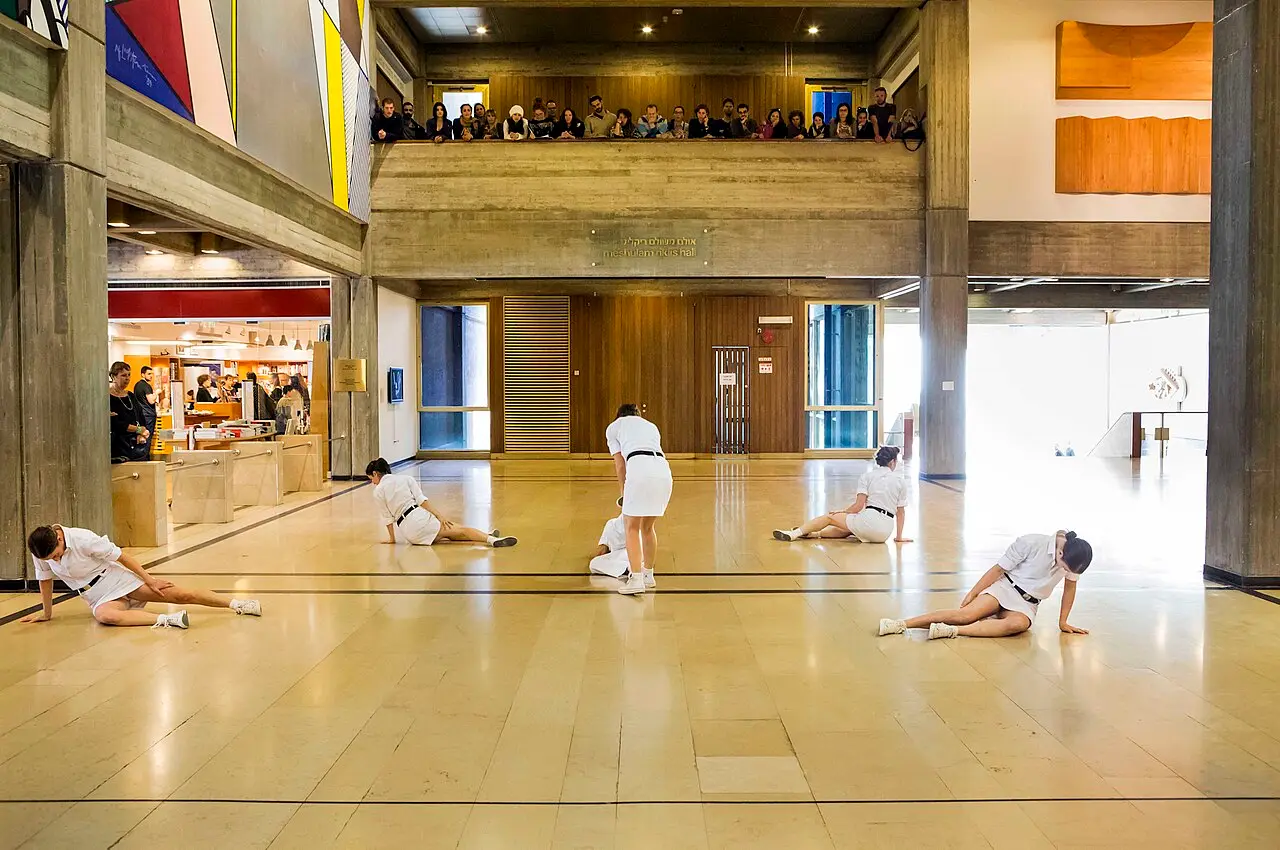
What they built is a spiral: four galleries wrapped around a tall central atrium, with a ramp climbing from the entrance hall so that a visitor always knows roughly where they are. The galleries are white cubes, unadorned and lit from above. It was inaugurated on 19 April 1971 with Prime Minister Golda Meir, Foreign Minister Abba Eban and Mayor Yehoshua Rabinowitz present. Dan Reisinger's logo followed and restated the plan as a graphic: four black rectangles around a white void, forming a stylised Hebrew letter mem.
The dating is not entirely consistent even in the museum's own telling. Its history page says the decision to build on Shaul Hamelech was taken in 1964 and that the building was inaugurated twelve years later, in 1971, which is seven years rather than twelve. Wikipedia's account has planning starting in 1963 and construction in 1966, halted for two years by a funding shortage. The opening date of 1971 is not in doubt; the run-up to it is told differently in different places.
Forty years of extensions and partitions had buried much of the original design by the time renovation began in 2018. The work stripped those accretions back towards Eitan and Yashar's building, added a cafe facing the sculpture garden, rebuilt the box office and created the Younes and Soraya Nazarian Family Experiential Center for the education programme. In 2021, on the museum's ninetieth anniversary, the main building was renamed the Paulson Family Foundation Building after its benefactors.
Kfir Bolotin / CC BY-SA 4.0 · Wikimedia Commons
2011
The Lightfall: a building folded around a 26.5 metre hole
By the 1990s the collection had outgrown the main building again, and the exhibition areas had barely changed since 1971. Mordechai Omer, director from 1995 to 2011, pushed the extension onto a lot an earlier director, Marc Scheps, had secured. An international competition and an international fundraising campaign followed, and the Herta and Paul Amir Building was inaugurated in 2011 to a design by Preston Scott Cohen with the Israeli project architect Amit Nemlich. The museum's own history says the new wing doubled its exhibition space.
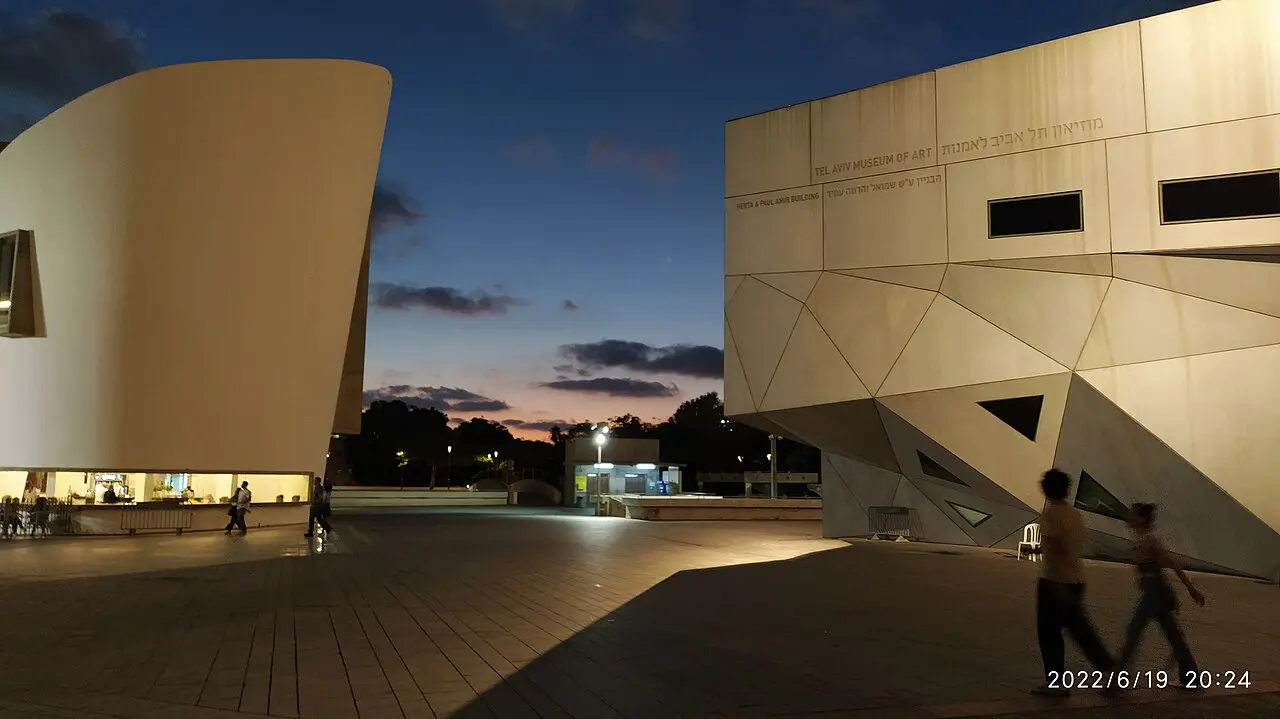
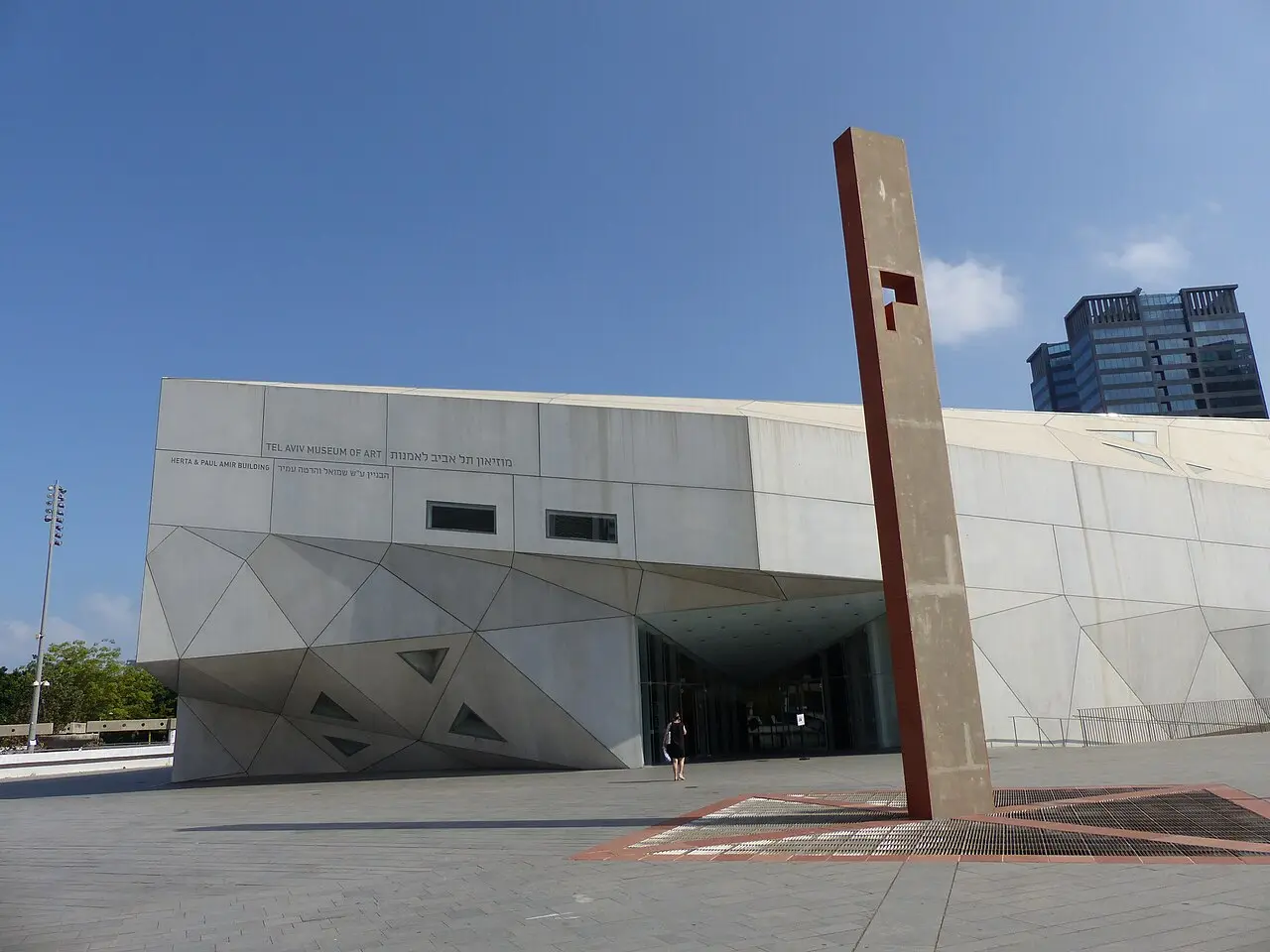
The site was awkward in two directions at once: a triangular plot with a height restriction on it, and a requirement for large, level, accessible galleries. Cohen's answer inverts the appearance. From the street the Amir Building reads as a low horizontal object; it is in fact a vertical one, with three levels below ground. The envelope is folded like origami into a geometry that changes angle continuously, and it is built from 465 panels of polished concrete, cast on site.
The interior is arranged around a single vertical void, the Lightfall, a 26.5 metre atrium running from a roof skylight down to foundation level. Its walls are concrete screens broken by openings, which throws daylight sideways into the circulation and lets a visitor read their position from inside the void. It is also used as a gallery in its own right, for installations made to its proportions.
The building also holds the Israeli Architecture Archive, a large auditorium, study workshops, the ticket offices and Pastel, the museum's fine-dining restaurant.
- 465 polished concrete panels, cast on site, folded into the outer envelope
- Three subterranean levels under a building that looks horizontal from the street
- The Lightfall: 26.5 m from roof skylight to foundation, used as a display space
- Upper levels: the permanent display of Israeli art, plus photography, drawing and design
Benjamín Núñez González / CC BY-SA 4.0 · Wikimedia Commons
The walls
What is actually hanging, and how it got here
The modern collection runs from the middle of the nineteenth century to the late 1980s and was built, in the museum's words, steadily since 1932 by private collectors and public figures who thought their pictures belonged in public. The Impressionist end names Manet, Renoir, Sisley, Cézanne, Gauguin, van Gogh and Pissarro. Beyond that sit Chagall, Klimt, Kandinsky, Jawlensky and Modigliani, Picasso across several periods, and the Surrealists Ernst, Dalí, Carrington and Tanguy. Postwar holdings include Dubuffet, Giacometti, Gerhard Richter and Günther Uecker.
Two of the best-known pictures came in one bequest: Klimt's Portrait of Friedericke Maria Beer of 1916 and Kandinsky's Untitled Improvisation V of 1914, both labelled as the Mizne-Blumental Collection, bequest of Annette Celine, 2018. Monet's Grainstack at Giverny of 1889 arrived as an anonymous gift in 1973.
American abstraction arrived early and by gift. Peggy Guggenheim gave 27 works, which the museum describes as the largest body from her collection anywhere outside the United States, taking in Rothko, Pollock and de Kooning. The dating deserves a note: the gift is often given as 1950, but the museum's own label for Pollock's Earth Worms of 1946 credits it to Peggy Guggenheim, Venice, through the America-Israel Cultural Foundation, in 1954. Later American and British additions include Georgia O'Keeffe, Roy Lichtenstein, Morris Louis, Alexander Calder, Ben Nicholson and Francis Bacon.
The strangest holding has the best story. In 1933 the German-Jewish collector Erich Goeritz lent the museum his early Alexander Archipenko works, from 1908 to 1921, and by doing so saved them: most of Archipenko's early output was destroyed in First World War bombing or later declared degenerate art by the Nazis. Archipenko himself did not learn until 1947 that Tel Aviv held them. After Goeritz died in 1955 his family donated 32 of the works, and the museum states that this is now the largest collection of early Archipenko anywhere.
Alongside all of that the museum holds what it calls the world's largest collection of Israeli art, running from the 1920s to the present: the Paris School influence of the 1930s and 1940s, the New Horizons group of the 1950s, the turn towards identity from the 1960s, and video and installation work since. Permanent displays rotate and works travel on loan, so no particular painting is guaranteed to be on the wall on a given day.
Talmoryair / CC BY-SA 3.0 · Wikimedia Commons
Outside
The plaza in front of the door, and what happened on it
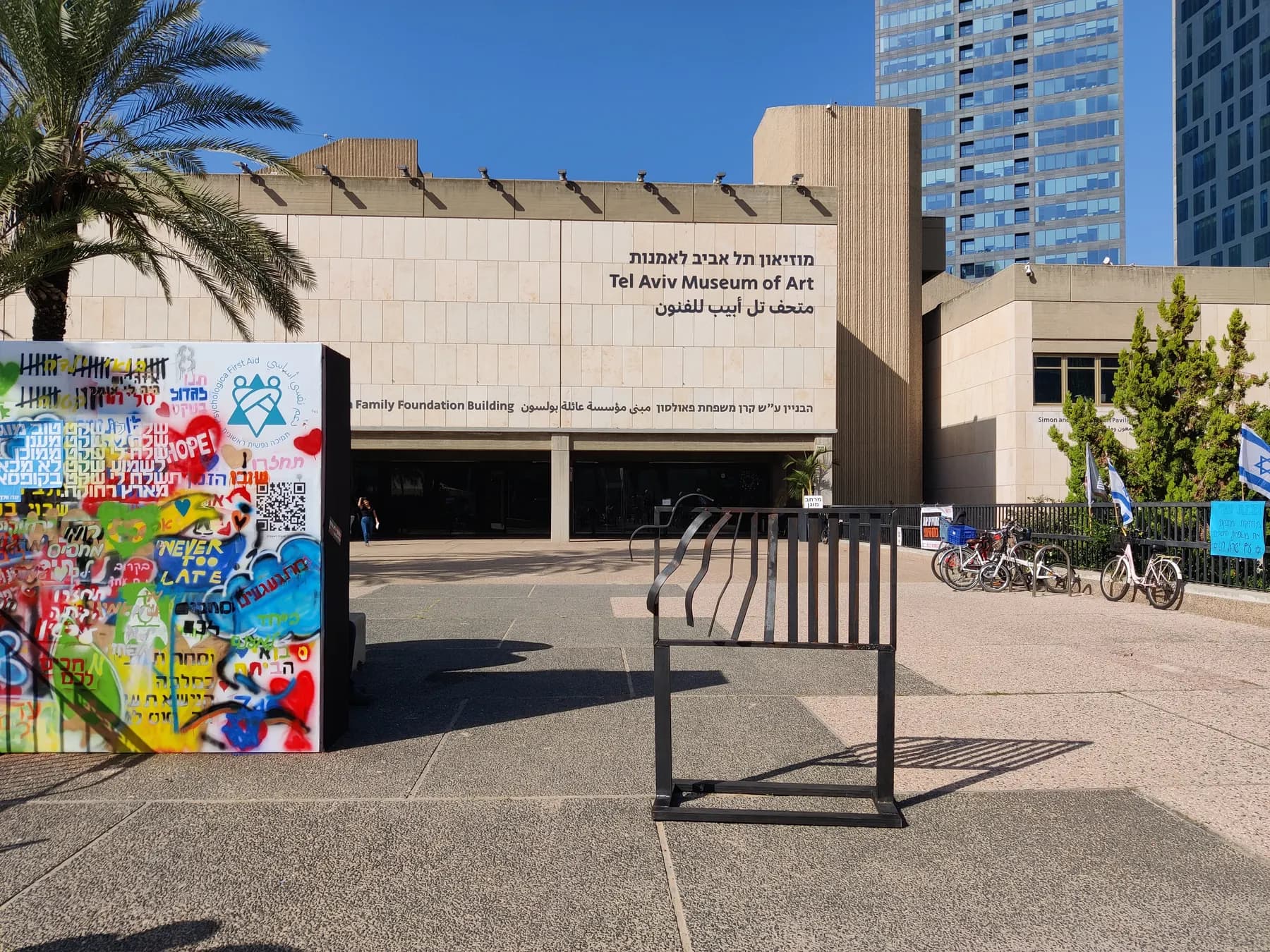
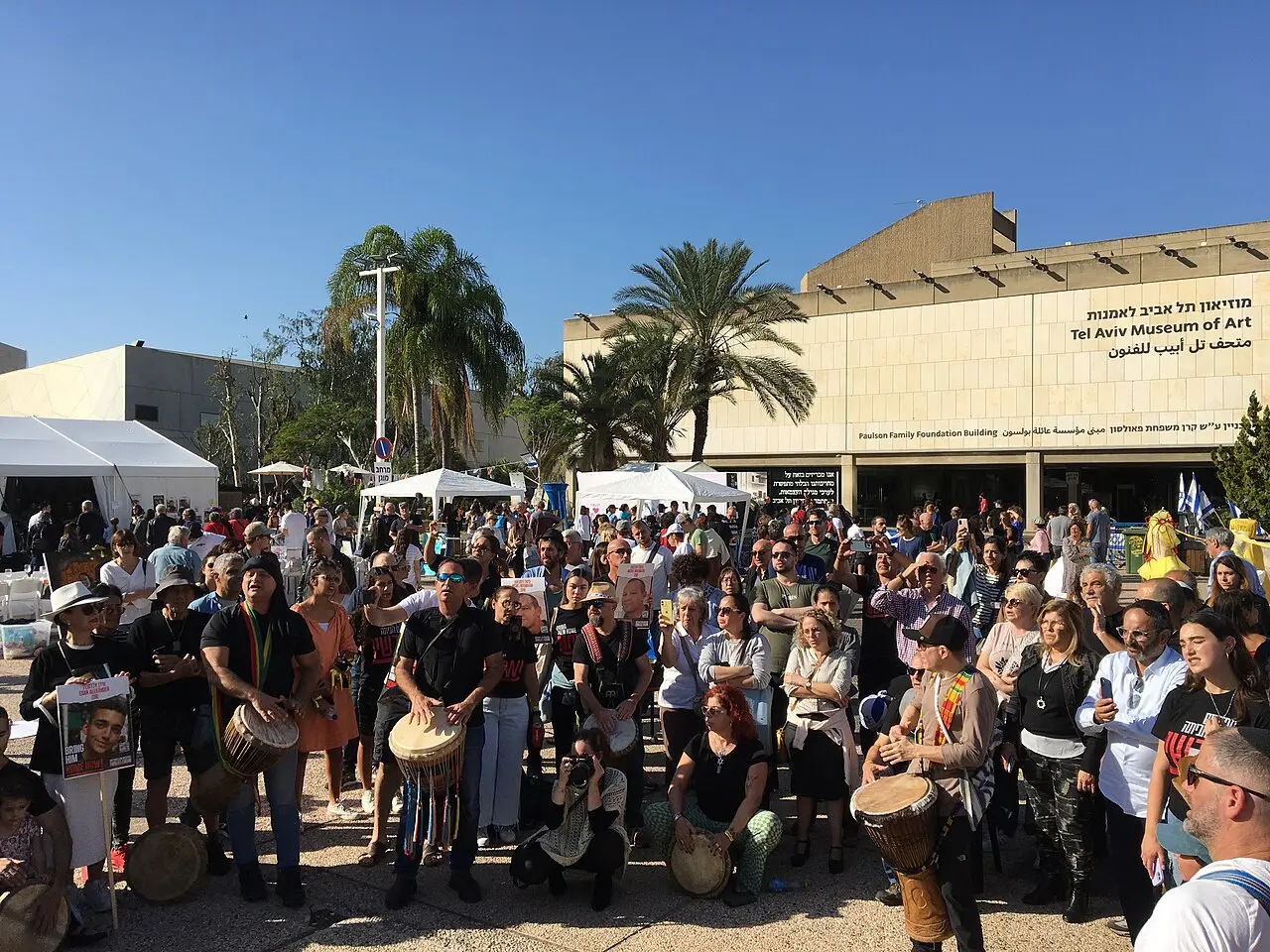
The paved plaza between Shaul Hamelech Boulevard and the museum entrance was Museum Square. After the attacks of 7 October 2023 it filled with families of the people taken to Gaza and with the installations they and others made, and within about two weeks it was being called Hostages Square. The Tel Aviv municipality made that the plaza's official name on 11 August 2026, saying the change was meant to keep the period between 7 October 2023 and the return of the last hostage, Ran Gvili, on 26 January 2026, in the city's memory.
What stood there is documented. A long Shabbat table was laid with a place for every hostage. Tents were staffed by people from the attacked kibbutzim, who talked to visitors and put up posters of their missing members. There were kiosks, small stages, and an electronic counter of the days elapsed, stopped after the last hostage's body was recovered. Rallies filled the square on Saturday nights.
The museum did not treat this as somebody else's business happening on its doorstep. It closed after 7 October and reopened at the end of November 2023 after roughly six weeks dark, during which staff ran lectures online and activities for evacuated children. It gave the square storage space, lavatories and shelter during rocket alerts, and later ran therapeutic tours for the bereaved, the injured and survivors of the Nova festival. Its director, Tania Coen-Uzzielli, has described the plaza as a spontaneous art space. It is quieter now, and the entrance is reached across it.
Yossipik / CC BY-SA 4.0 · Wikimedia Commons
What to look for
Things not to walk past at Tel Aviv Museum of Art
The details that repay knowing about before you are standing in front of them.
The Lightfall
The 26.5 metre atrium at the core of the Amir Building, its concrete screens throwing daylight sideways into the galleries. It is the single thing the building was designed around, and it doubles as an exhibition space.
The ramp in the 1971 building
Dan Eitan and Itzhak Yashar wound four galleries around a central atrium and hung a ramp through it. Walking up it, rather than taking the lift, is how the plan was meant to be read.
Klimt and Kandinsky from the Mizne-Blumental bequest
Portrait of Friedericke Maria Beer (1916) and Untitled Improvisation V (1914), both bequeathed by Annette Celine in 2018. They are the two pictures most visitors come specifically to see.
The early Archipenko works
Sculptures and sculptural paintings of 1908 to 1921, lent by Erich Goeritz in 1933 and donated by his family in 1956. The museum says it is the largest collection of the artist's early work anywhere, and it survived only because it left Germany.
The Lola Beer Ebner Sculpture Garden
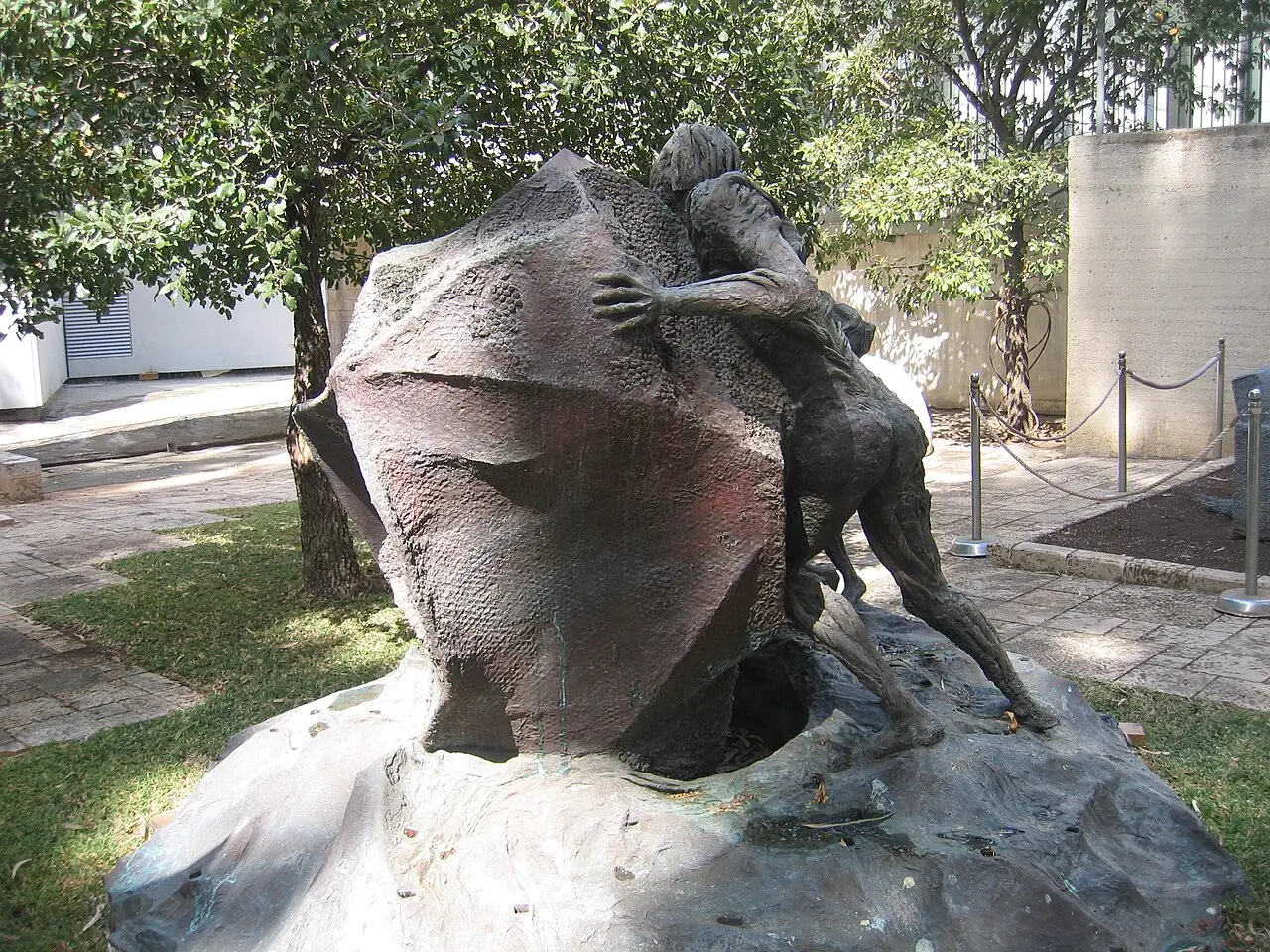
A sunken, eucalyptus-shaded courtyard between the two main buildings, with Yitzhak Danziger's Sheep of the Negev (1963), Menashe Kadishman's Scream (1998) and Enzo Cucchi's mosaic path of 1999. Free of charge to look at from the cafe.
The Eyal Ofer Pavilion
The 1959 building by Zeev Rechter, Yaakov Rechter and Dov Karmi, reworked by Amnon Rechter and reopened under its new name in 2023. Its exhibitions are currently free, and almost nobody makes the second trip.
The long view
Tel Aviv Museum of Art, in order
2 April 1932
The Tel Aviv Museum opens in Meir Dizengoff's remodelled house at 16 Rothschild Boulevard, with fifteen exhibition spaces and a lecture hall.
1933
Karl Schwarz, head of the Jewish Museum in Berlin, arrives to direct it, and stays until 1947.
14 May 1948
The state of Israel is declared in the museum's concert and lecture hall.
1959
The Helena Rubinstein Pavilion opens, designed by Zeev Rechter, Yaakov Rechter and Dov Karmi, intended to replace Dizengoff House.
1964
Ten dunams are allocated on Shaul Hamelech Boulevard and a design competition is announced, won by Dan Eitan and Itzhak Yashar.
19 April 1971
The Brutalist main building is inaugurated in the presence of Golda Meir and Abba Eban; the museum leaves Dizengoff House.
1989
The institution's name changes from Tel Aviv Museum to Tel Aviv Museum of Art.
1999
The Lola Beer Ebner Sculpture Garden opens between the main building and the future Amir site.
2011
The Herta and Paul Amir Building opens, doubling exhibition space, designed by Preston Scott Cohen with Amit Nemlich.
2018
Renovation of the main building begins, stripping later additions and adding the Nazarian Family Experiential Center.
2021
On its ninetieth anniversary the main building is renamed the Paulson Family Foundation Building.
2023
The Helena Rubinstein Pavilion reopens after renovation by Amnon Rechter as the Eyal Ofer Pavilion.
October 2023
The plaza in front of the museum becomes known as Hostages Square; the museum closes for about six weeks and reopens at the end of November.
11 August 2026
The Tel Aviv municipality adopts Hostages Square as the plaza's official name.
Practical
Visiting Tel Aviv Museum of Art
Where
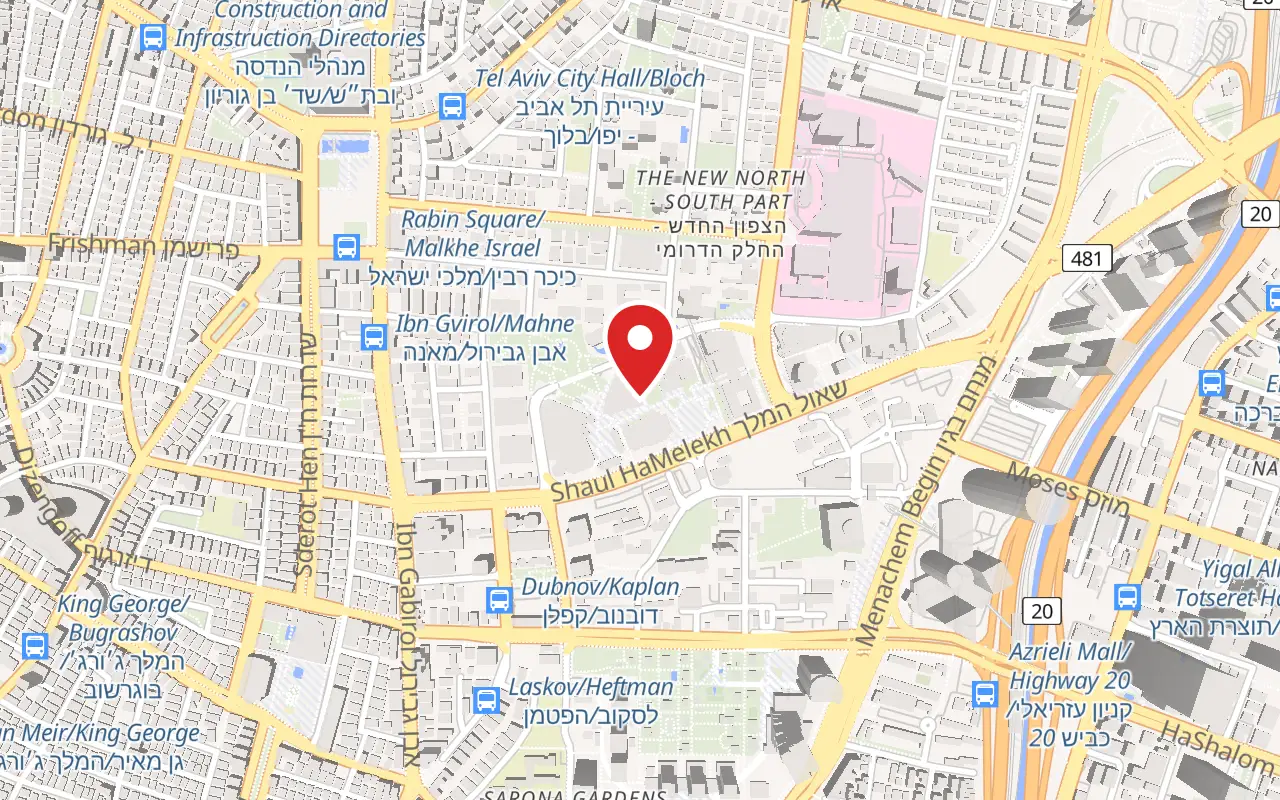
27 Shaul HaMelech Blvd, Tel Aviv-Yafo (Eyal Ofer Pavilion: 6 Tarsat Blvd)
Opening hours
- Sunday
- Closedsource
- Monday
- 10:00–18:00 during August only; the museum publishes no other Monday hourssource
- Tuesday
- 10:00–21:00source
- Wednesday
- 10:00–18:00source
- Thursday
- 10:00–21:00source
- Friday
- 10:00–14:00source
- Saturday
- 10:00–18:00source
- Last admission
- One hour before closingsource
- Art Library
- Monday to Thursday 10:00–16:00; closed Sunday, Friday and Saturdaysource
- Eyal Ofer Pavilion
- Same as the museum except Thursday, which is 10:00–18:00source
Admission
- Regular
- NIS 55source
- Students and DigiTel card holders
- NIS 45source
- Senior citizens and holders of a disability certificate
- NIS 27source
- Children and youth up to 18, soldiers, members
- Freesource
- Eyal Ofer Pavilion
- Free, supported by the Azrieli Foundationsource
- Validity
- One-time entry; discounts only against a valid certificate or cardsource
Access
Good, and unusually well documented. Step-free routes run from the disabled parking bay on Shaul Hamelech Boulevard to the entrances of both wings, and lifts serve every floor of the Paulson and Amir buildings. Wheelchairs and folding cane chairs are lent free against an ID deposit at the cloakrooms beside the ticket offices, and there are unisex accessible lavatories on several levels of both buildings. Service points carry induction loop hearing systems, and the museum runs the Bettear app for real-time audio in the galleries. Parking is free for holders of a Ministry of Transport disabled parking permit, on production of the certificate with the permit; the validation sticker is issued only at the museum and pavilion box offices. An accessibility coordinator is named and contactable on the museum's own page.
On site
- Free cloakroom
- Lockers
- Studio Cafe
- Pastel restaurant
- Helena wine bar (Eyal Ofer Pavilion)
- Museum store
- Art library
- Audio guide via Bloomberg Connects
- Two sculpture gardens
- Auditorium
- Accessible lavatories
- Wheelchair loan
Booking
Tickets are sold online through the museum's own ticketing site and at the box office, where they are available until one hour before closing. Nothing needs booking in advance for the permanent collection, but the big temporary exhibitions fill on Friday mornings and Saturdays.
Hours and prices are given as the operator publishes them and change without much notice, particularly around Shabbat and the festivals. Check the operator's own page before you travel for this.
Official page at tamuseum.org.il →What people wish they had known
- Check the day before travelling. The museum is closed every Sunday, and its published timetable lists Monday hours only for August, so a Monday visit outside that month is a wasted journey.
- Tuesday and Thursday run to 21:00 and are the quietest useful hours. Friday closes at 14:00 and Saturday is the busiest day of the week.
- Buy the ticket at least an hour before closing. Last admission is one hour before the doors shut, and the box office stops selling at the same point.
- The ticket is single entry. Eat at the Studio Cafe or Pastel inside rather than walking out to Sarona and expecting to be let back in.
- Anything larger than an A4 handbag goes into a locker or the cloakroom, which is free. Small backpacks have to be carried on the front of the body in the galleries.
- The Eyal Ofer Pavilion is a different building at 6 Tarsat Boulevard, about fifteen minutes' walk away, and is not covered by the museum ticket because entry to it is currently free.
The figures
Tel Aviv Museum of Art by the numbers
Each figure carries the year it belongs to and links the source it came from.
| Measure | Figure | As of | Source |
|---|---|---|---|
| Adult admission | NIS 55 | 2026 | tamuseum.org.il |
| Concession for seniors and disability certificate holders | NIS 27 | 2026 | tamuseum.org.il |
| Visitors in 2022 | 1,070,714 | 2022 | timesofisrael.com |
| Visitors to the Yayoi Kusama exhibition, November 2021 to May 2022 | About 670,000 | 2022 | timesofisrael.com |
| Height of the Lightfall atrium | 26.5 m | 2011 | tamuseum.org.il |
| Polished concrete panels in the Amir Building envelope | 465, cast on site | 2011 | tamuseum.org.il |
| Drawings and prints in the collection | Over 30,000 | 2026 | tamuseum.org.il |
| Works given by Peggy Guggenheim | 27 | 2026 | tamuseum.org.il |
While you are here
The rest of Tel Aviv
Everything else in this destination with a page of its own.
Doraharon / CC BY-SA 3.0 · Wikimedia Commons
Landmark
Sarona Colony and Sarona Market
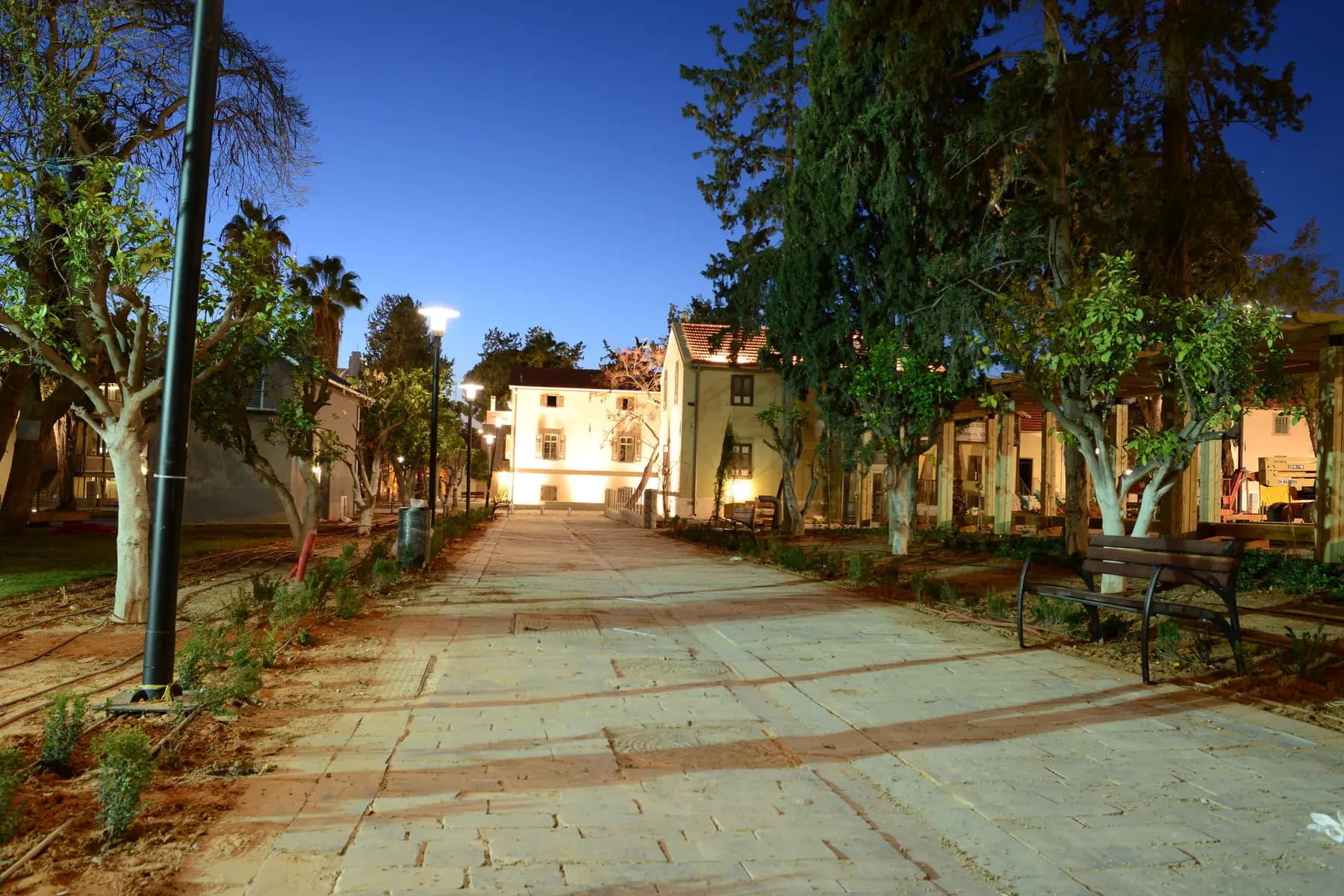
Five of Sarona's Templer houses no longer stand where they were built: in 2005 they were physically moved about thirty metres so that Kaplan Street could be widened.
Marsupium / CC0 · Wikimedia Commons
Landmark
The White City and Bauhaus Tel Aviv
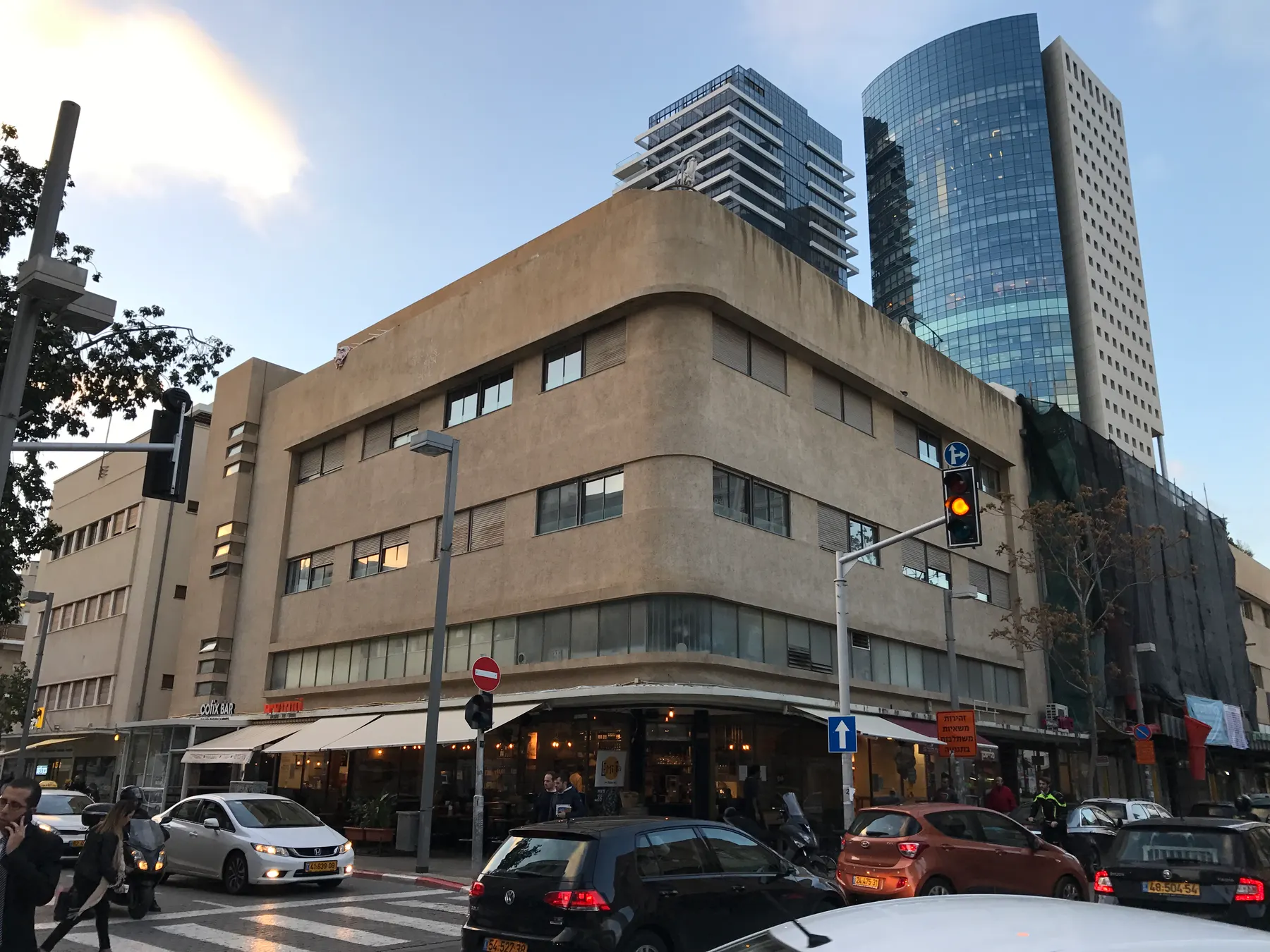
What UNESCO inscribed in 2003 is not one street but three separate zones covering 140.4 hectares, and roughly 90 per cent of the buildings inside them are privately owned flats.
Deror_avi / CC BY-SA 4.0 · Wikimedia Commons
Museum
Eretz Israel Museum
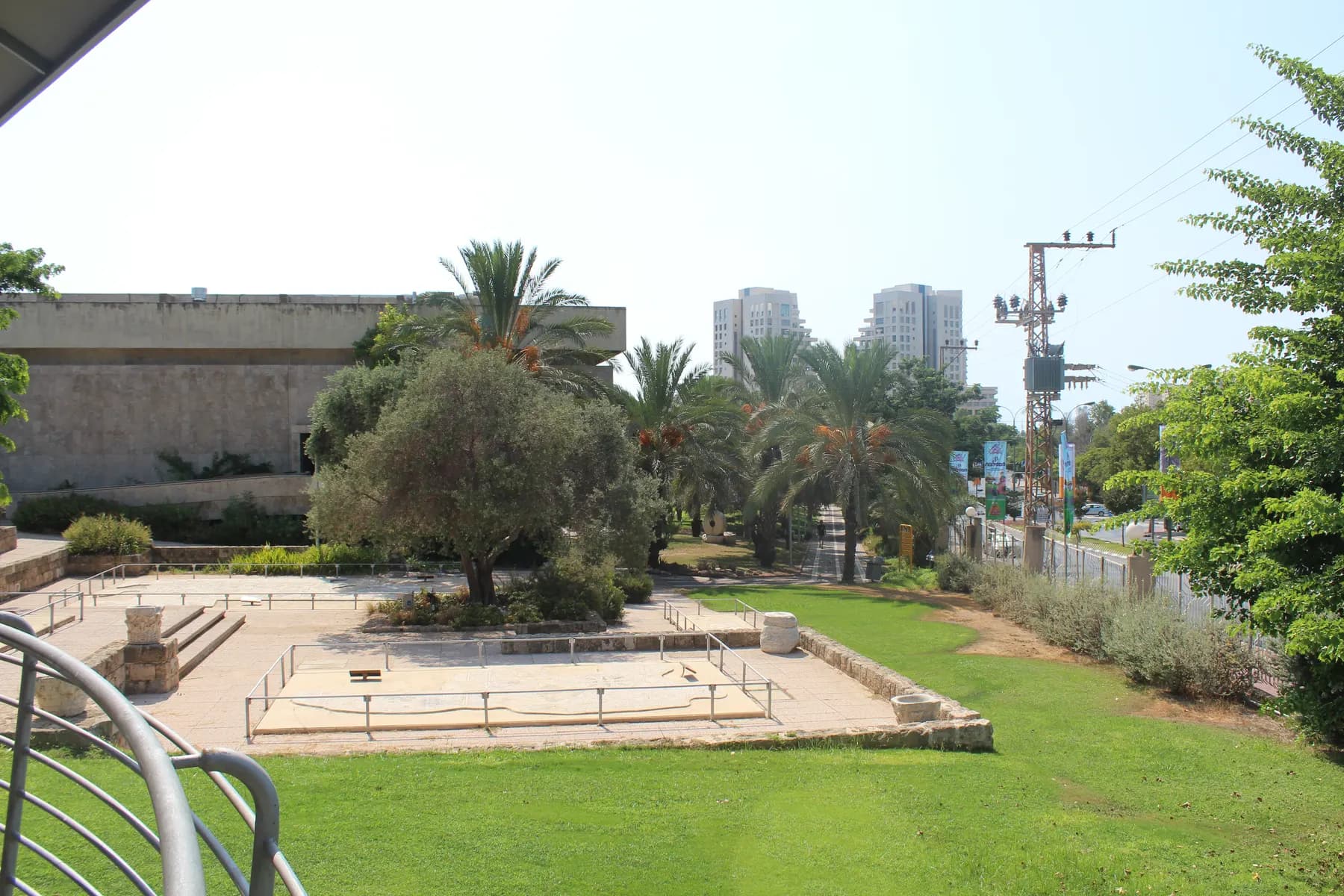
The first excavation permit issued by the State of Israel, in 1948, was for the mound that still stands at the centre of this museum's grounds in Ramat Aviv.
Sources and further reading
Every link below was opened and checked when this page was written. Official statements are marked as such: they are the subject's own account, not an independent one.
- OfficialTel Aviv Museum of Arttamuseum.org.ilVisit
opening hours by day, entrance fees in shekels, bag policy, cloakroom, cafes and the pavilion's separate address
- OfficialTel Aviv Museum of Arttamuseum.org.ilAccessibility
step-free routes, lifts, accessible lavatories, induction loops, wheelchair loan and disabled parking
- OfficialTel Aviv Museum of Arttamuseum.org.ilHistory
the 1932 founding, Dizengoff's dedication and will, Karl Schwarz, the 1964 decision and the succession of directors
- OfficialTel Aviv Museum of Arttamuseum.org.ilBuildings and Architecture
the three buildings and the periods they represent
- OfficialTel Aviv Museum of Arttamuseum.org.ilPaulson Family Foundation Building
the ten-dunam allocation, the competition brief, Dan Eitan and Itzhak Yashar, the 1971 opening and the 2018 renovation
- OfficialTel Aviv Museum of Arttamuseum.org.ilHerta and Paul Amir Building
Preston Scott Cohen and Amit Nemlich, the 465 concrete panels and the 26.5 metre Lightfall
- OfficialTel Aviv Museum of Arttamuseum.org.ilEyal Ofer Pavilion
the 1959 Rechter and Karmi building, the Ofer donation and the 2023 renaming
- OfficialTel Aviv Museum of Arttamuseum.org.ilSculpture Gardens
the Lola Beer Ebner garden of 1999, its 2014 reopening, Nata's Garden and the sculptures in both
- OfficialTel Aviv Museum of Arttamuseum.org.ilCollection
the seven departments and the figure of over 30,000 drawings and prints
- OfficialTel Aviv Museum of Arttamuseum.org.ilModern Art
the artists held, the Peggy Guggenheim gift of 27 works, the Mizne-Blumental bequest and the Goeritz Archipenko story
- OfficialTel Aviv Museum of Arttamuseum.org.ilIsraeli Art
the scope of the Israeli collection from the 1920s onwards
- ReportingThe Times of Israeltimesofisrael.comTel Aviv Museum of Art among 50 most popular museums worldwide
the 2022 attendance figure of 1,070,714 and the Kusama exhibition's 670,000
- ReportingThe Times of Israeltimesofisrael.comMaking hostages a centerpiece, a Tel Aviv museum becomes a showcase for wartime agility
the six-week closure after 7 October 2023, the November reopening and what the museum provided to the square
- ReportingThe Times of Israeltimesofisrael.comHostages Square becomes the official name of Tel Aviv plaza
the municipality's decision of 11 August 2026 and its stated reason
Tel Aviv Museum of Art: common questions
How much does the Tel Aviv Museum of Art cost?+
The museum publishes a regular price of NIS 55. Students and Tel Aviv DigiTel card holders pay NIS 45, senior citizens and holders of a disability certificate pay NIS 27, and children and young people up to 18, soldiers and museum members enter free. Discounts are only given against a valid certificate or card, and the ticket is good for one entry.
Is the museum open on Sunday or Monday?+
It is closed every Sunday. Monday appears on the museum's own timetable only as an August entry, at 10:00 to 18:00, and no Monday hours are published for the rest of the year. The reliable days are Tuesday to Saturday.
Is it open on Shabbat?+
Yes. Friday hours are 10:00 to 14:00 and Saturday hours are 10:00 to 18:00, so the museum is one of the few substantial things open in the city on a Saturday. Scheduled public transport does not run then, which is the harder half of the problem.
How long does a visit take?+
About two hours covers the two connected buildings on Shaul Hamelech Boulevard at a steady pace, and three is realistic when a large temporary exhibition is running. The Eyal Ofer Pavilion is a separate building fifteen minutes away and needs its own half hour plus the walk.
Is it wheelchair accessible?+
Yes, throughout. Step-free routes run from the disabled parking bay on Shaul Hamelech Boulevard to both entrances, lifts serve every floor of the Paulson and Amir buildings, and accessible lavatories are on several levels of each. Wheelchairs are lent free against an ID deposit at the cloakrooms, and free parking is available to holders of a Ministry of Transport disabled permit.
Can you take photographs inside?+
Non-flash photography is allowed, and use of the images is subject to copyright. Tripods, monopods, handheld microphones, lighting and props are not permitted, and staged or commercial shoots need authorisation.
Is the Tel Aviv Museum of Art worth it if you have already done the Israel Museum in Jerusalem?+
Yes, because the two barely overlap. The Israel Museum's centre of gravity is archaeology, Judaica and the Dead Sea Scrolls; this is a modern and contemporary art museum whose deepest holding is Israeli art of the last century, plus European and American modernism from Manet to Bacon. If your interest is antiquity rather than painting, skip it.
What is Hostages Square and is it still there?+
It is the plaza directly in front of the museum, previously called Museum Square, which became the gathering place for the families of those taken to Gaza on 7 October 2023 and for the installations put up in their names. The Tel Aviv municipality adopted Hostages Square as its official name on 11 August 2026. It is much quieter than it was, and the museum entrance is reached across it.
Where exactly is it and how do you get there?+
The main buildings are at 27 Shaul Hamelech Boulevard, in the civic centre next to the Performing Arts Centre that houses the Cameri Theatre and the Israeli Opera. Sarona and the Azrieli towers are each about ten minutes on foot, Rabin Square about the same, and Dubnov Garden is two minutes away.
Is there anywhere to eat inside?+
Three options, at three prices. The Studio Cafe in the main building does drinks, cakes, sandwiches and light meals overlooking the sculpture garden. Pastel, in the Amir Building at the other end of the same garden, is a fine-dining restaurant. Helena, at the Eyal Ofer Pavilion, is a wine bar with about a hundred seats built on Basque pintxos and Venetian cicchetti lines.