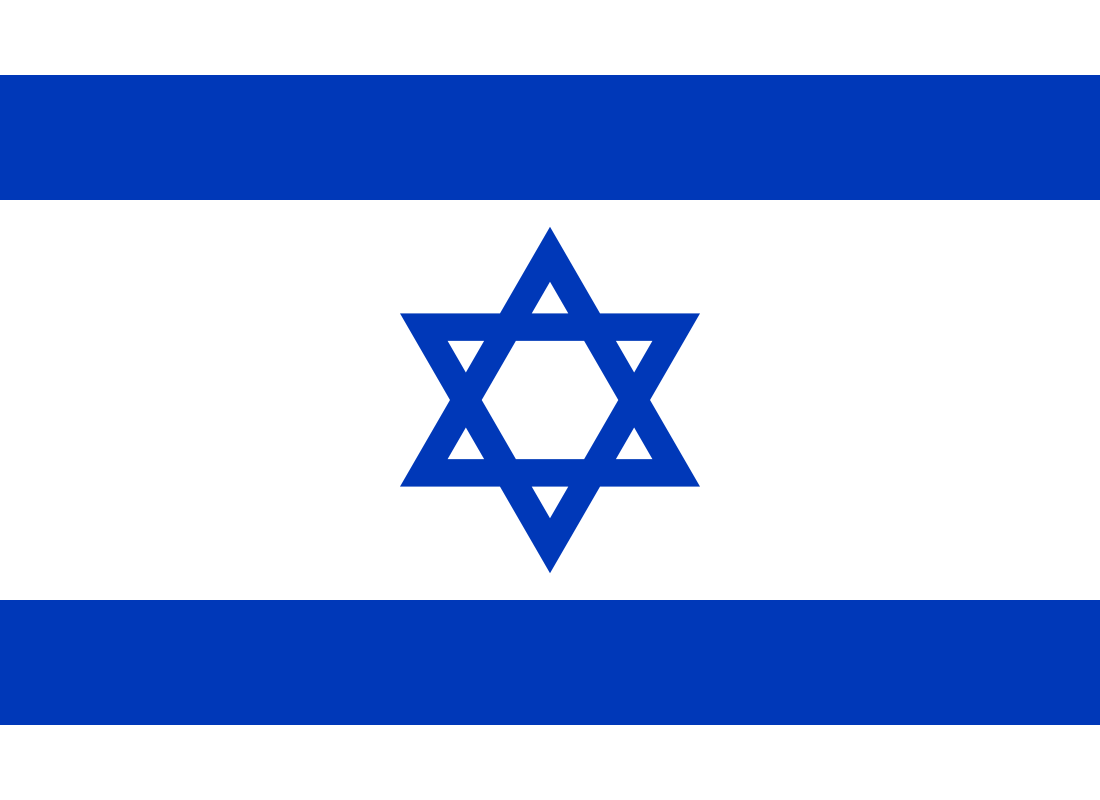
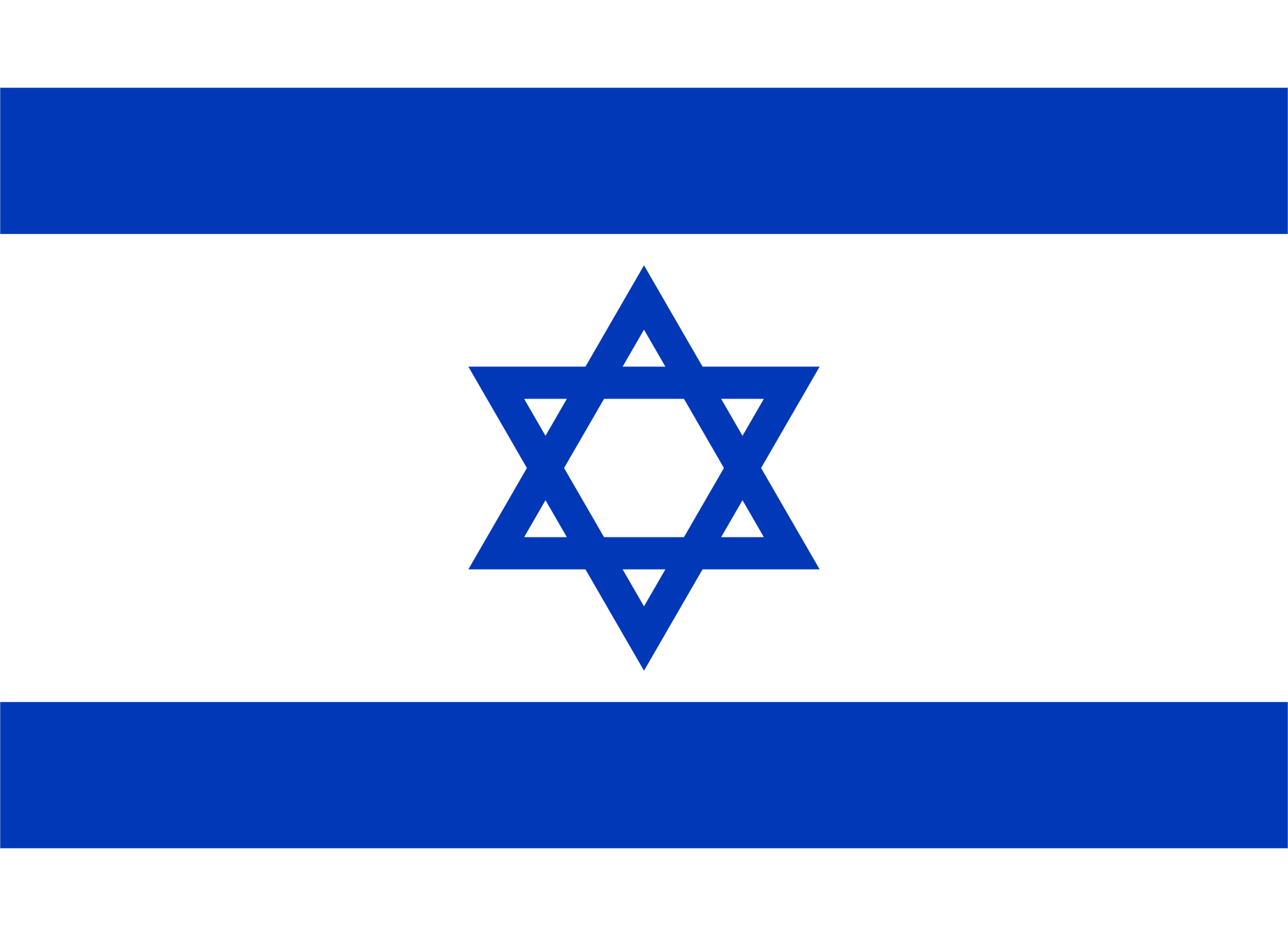
The flag of Israel is white with two blue stripes and a blue Star of David
The stripes run near its top and bottom edges and the star stands in the middle of the white. The Provisional Council of State proclaimed it on 28 October 1948, at 220 by 160 centimetres, a ratio of 11 to 8.1,2
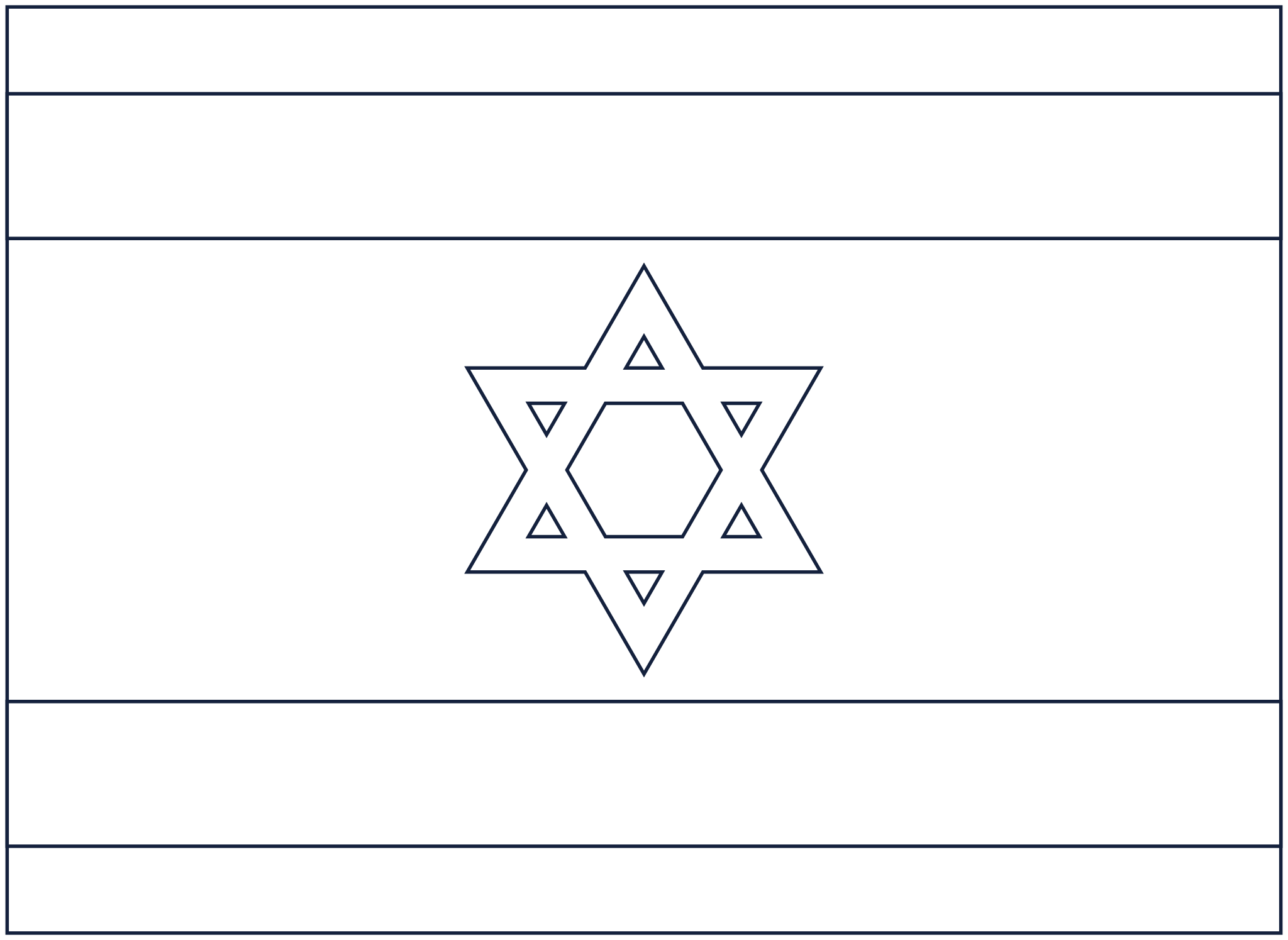
The flag can be downloaded as an SVG or a PNG, or printed to colour in
SVG, for any size
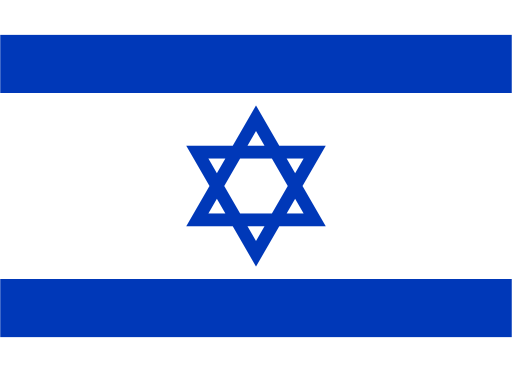
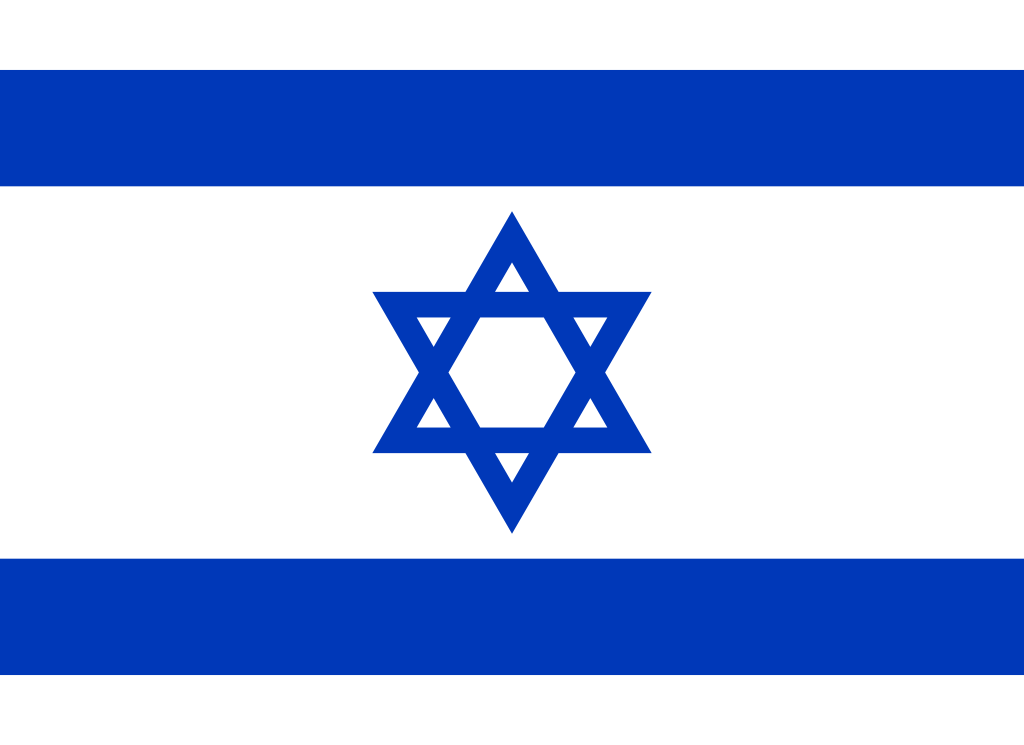
To print and colour in
The emoji
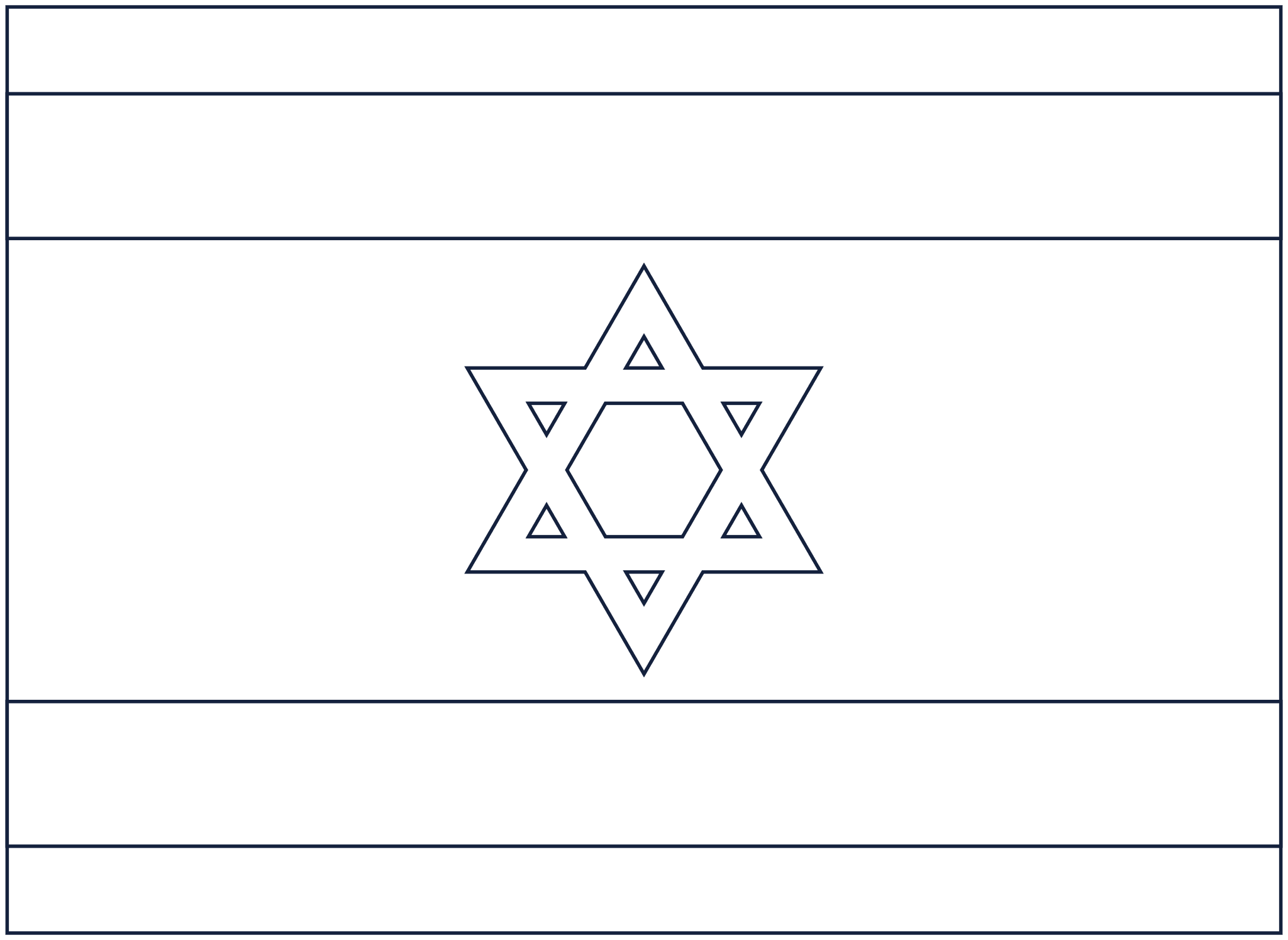
The drawing follows the proclamation’s measurements. The rules on using the flag are in the section on the law below.
The flag emoji is the two regional indicator letters I and L side by side (U+1F1EE U+1F1F1), named “flag: Israel” in the Unicode emoji list.3
One reading ties the stripes to a prayer shawl and the star to Jewish unity
The art historian Alec Mishory writes that the blue stripes were inspired by the stripes of the tallit, the prayer shawl, and that some say they recall the one blue strand of the ritual fringes. In his reading the Star of David expresses Jewish unity, and the stripes and the white ground stand for the precepts of the Torah that guide it. The proclamation describes the flag and does not state a meaning.1,4
Mishory notes that, judging by references in the Talmud, techelet was a shade between green and blue, and that white and techelet, with gold and purple, were the colours of the High Priest’s clothes.4
The proclamation sets the size, the stripes and the bars of the star
The flag is 220 centimetres long and 160 wide. Its background is white. Two stripes of dark techelet, a blue, 25 centimetres wide, run along the whole length, the upper one 15 centimetres from the upper long edge and the lower one 15 centimetres from the lower. That leaves 80 centimetres of white between them.1,2
In the middle of the white, between the stripes and the same distance from both, is a Star of David made of six bars of techelet, 5.5 centimetres wide each, which join into two equilateral triangles whose bases are parallel to the stripes.1,2
The proclamation gives no size for the star and no colour code. The star drawn here is 69.3 centimetres from tip to tip, as in the reference drawing of the flag on Wikimedia Commons, which leaves 5.35 centimetres of white between each tip and the stripe beside it.5
The law calls the blue techelet and gives no colour code
The proclamation of 1948 calls the colour of the stripes “dark techelet” (תכלת כהה) and the bars of the star techelet. Techelet is the blue of the thread that the Torah asks for in the fringes of a garment. The Basic Law of 2018 says the flag has two stripes of techelet and a Star of David in tachol, another Hebrew word for blue, and the Knesset’s English translation renders both as “light-blue”. Neither text gives a colour code.1,4,6
The blue used in the files on this page is #0038b8 (red 0, green 56, blue 184). It is the blue of the reference drawing on Wikimedia Commons, whose page says it is typical of flags used in Israel today, although individual flags vary. It is a common choice, not a colour fixed by law.5
The law sets how the flag is made, flown and treated
The Flag, Emblem and Anthem Law counts as the state flag the one proclaimed on 28 October 1948 and a flag of any size with the same image. The regulations of 1953 say a flag used in public must be made as proclaimed, in its size or another size that keeps the same proportions, must be fit for dignified use, and must not be used in a way that harms its dignity. A flag made as the law requires may cover the coffin at a funeral held by the state or by the IDF.7,8
On a pole, the regulations say, the flag is flown at the top, or halfway up as a sign of mourning, on a pole about three times as long as the flag is wide, which for the 160 centimetre flag is about 4.8 metres. It is not flown with another flag on one pole. Among other flags it flies on the right, as seen by someone facing out from the building, or in the middle, with no flag larger or higher and no pole longer, and it is raised first and lowered last. Beside the flags of other states every flag must be the same size.8
The law requires the flag on the main office of government ministries and of bodies set up by law, on the building of a local authority head’s office, on the administration building of institutions of higher education and on the main building of a recognised school. It is also placed in the offices of ministers and director-generals and in court halls.7
Using the flag for business, trade or a profession needs a licence or permit from the Interior Minister, but flying the flag and making or selling flags do not count as such use. Harming the dignity of the flag is an offence punishable by up to three years in prison, a fine or both.7
Blue and white were called the Jewish colours as early as 1864, and the state's flag came in 1948
1864
A poem calls blue and white the Jewish colours
The Austrian Jewish poet Ludwig August Frankl published “Judah’s Colors” in 1864, a poem about blue and white as the colours of the Jewish people. Mishory credits him with voicing that idea in modern times. A Hebrew translation appeared in the periodical Hahavatzelet in 1878.4
1885
Blue and white are raised in Rishon LeZion
A blue-and-white flag was raised over Rishon LeZion in 1885, on the third anniversary of its founding. Separately, the Bnai Zion Educational Society raised a blue-and-white flag with a Star of David in Boston in 1891 and showed it in public in 1892.4
1897
The Zionist Congress in Basel adopts a blue and white flag
The flag of the Zionist movement, white with blue stripes and a Star of David, was adopted by the First Zionist Congress in Basel in 1897, according to Mishory. Zionist tradition credits its design to David Wolffsohn. The well-known story that he answered Herzl’s question about a flag by showing his own prayer shawl is called a legend by Mishory. Wolffsohn’s own account says the tallit is the Jewish symbol and that he ordered a blue-and-white flag with the Shield of David painted on it.4
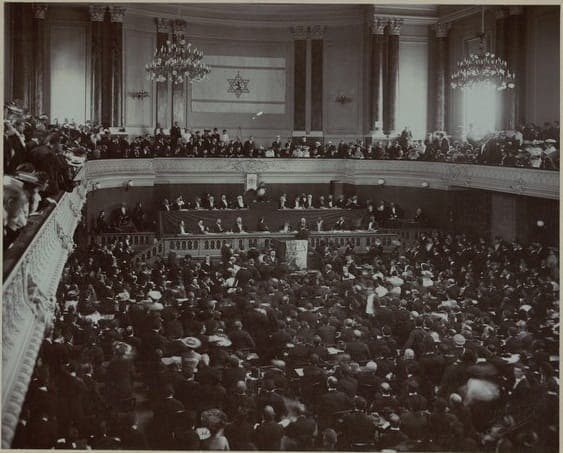
The hall of the Second Zionist Congress in Basel, 1898Robert Spreng · Public domain · Wikimedia Commons 14 May 1948
The Zionist flag stands beside Herzl at the Declaration of Independence
At the ceremony of the Declaration of the Establishment of the State, the dais carried a picture of Theodor Herzl flanked by the flag of the World Zionist Organization. Within days the question was raised whether that flag should be the flag of the state or be replaced.4
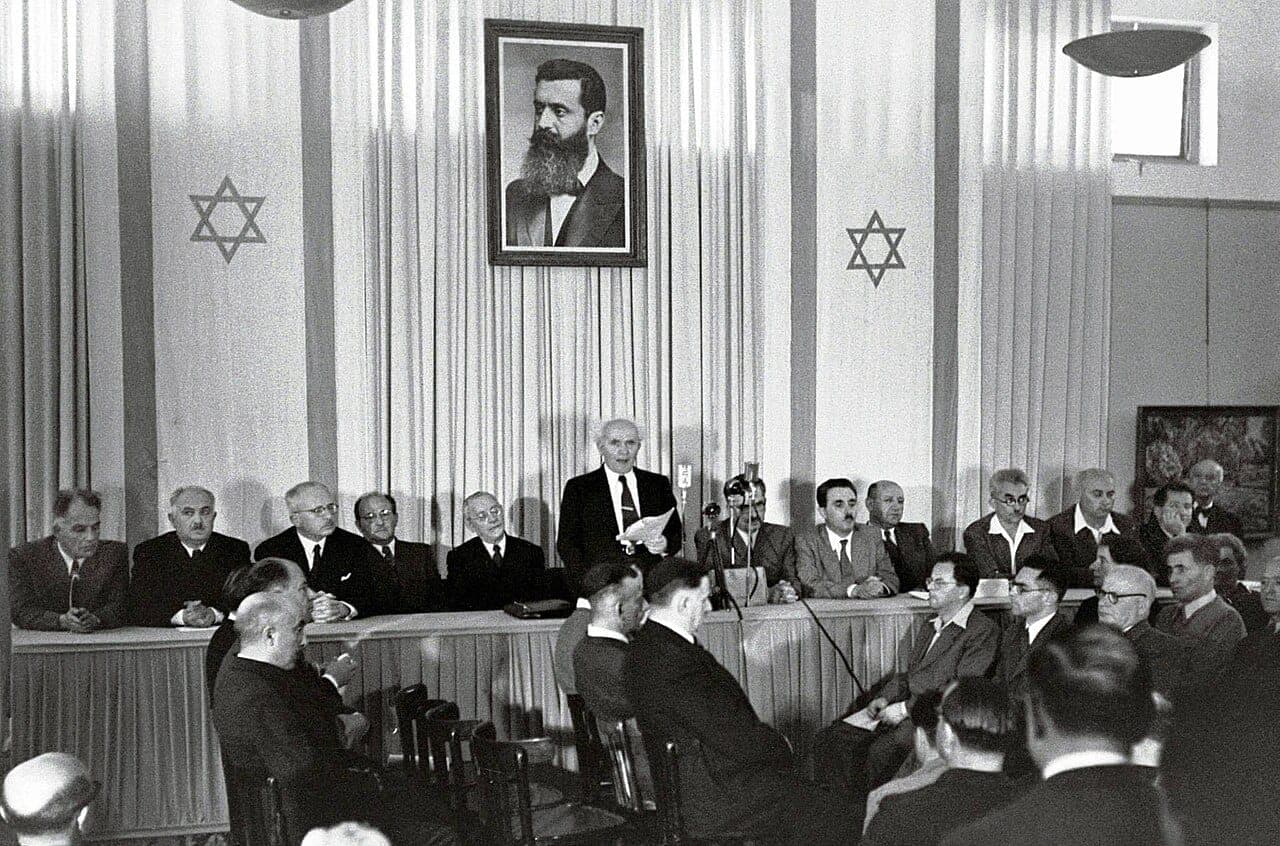
David Ben-Gurion reading the Declaration of Independence, 14 May 1948Rudi Weissenstein · Public domain · Wikimedia Commons 28 October 1948
The Provisional Council of State proclaims the flag
A committee of the Provisional Council of State wanted the state flag to look clearly different from the Zionist one, so that Jews abroad would not be taken to fly the flag of a state they were not citizens of, and a competition for designs was held. After Zionist leaders abroad answered that the fear was exaggerated, the Provisional Council voted unanimously on 28 October 1948 to adopt the Zionist flag. The proclamation took effect two weeks later, when it was published in the Official Gazette of 12 November 1948.1,4
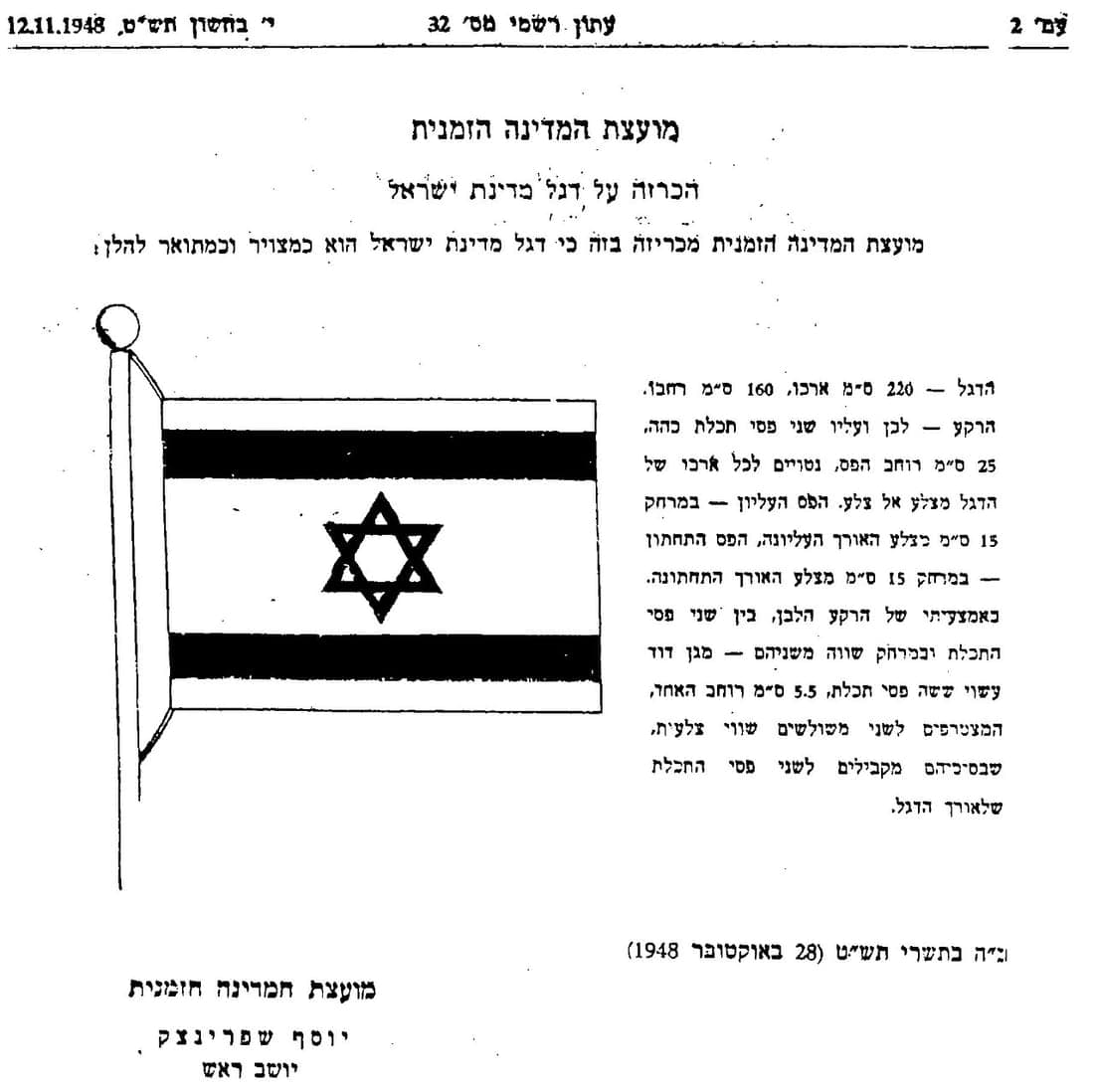
The Proclamation of the Flag in the Official Gazette, number 32, 12 November 1948מדינת ישראל · Public domain · Wikimedia Commons 10 March 1949
Soldiers draw the Ink Flag on a sheet at Umm Rashrash
On 10 March 1949, at the end of Operation Uvda, Israeli forces reached the shore of the Red Sea at Umm Rashrash, where Eilat stands today. The Negev Brigade had no flag with it, so on its commander Nahum Sarig’s order soldiers drew two stripes in ink on a sheet and sewed on a Star of David torn from a first-aid kit. Captain Avraham Adan raised it, and it was replaced by an official flag two hours later.9
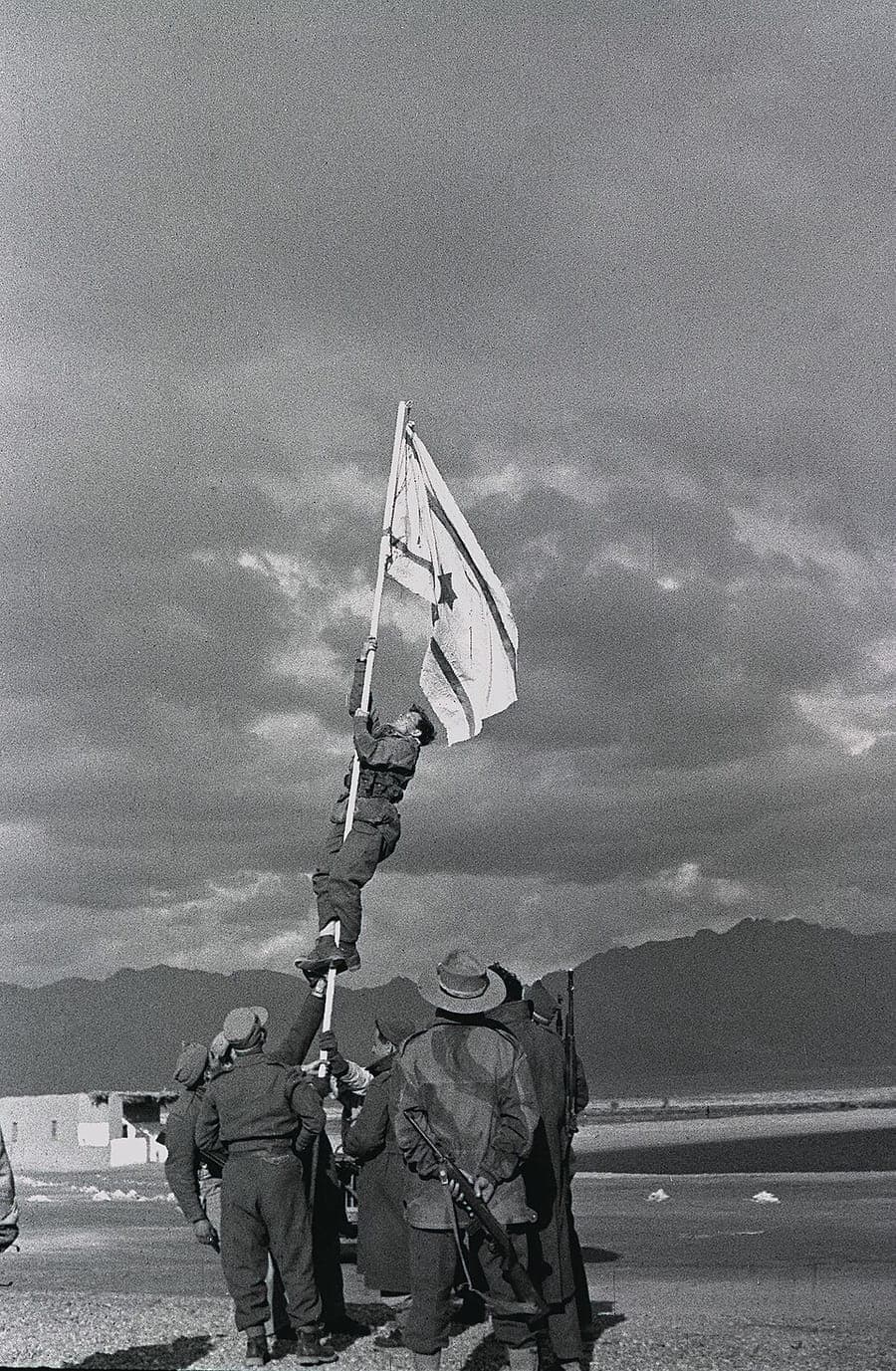
The Ink Flag at Umm Rashrash, now Eilat, 10 March 1949Micha Perry · CC BY-SA 3.0 · Wikimedia Commons 18 May 1949
The Knesset passes the Flag and Emblem Law
The Knesset passed the Flag and Emblem Law on 18 May 1949 (19 Iyar 5709). It defines the state flag as the one proclaimed on 28 October 1948 or a flag of any size with the same image. After the anthem was added to it in 2004 it is called the Flag, Emblem and Anthem Law.7,10,11
2018
The Basic Law describes the flag
Section 2 of the Basic Law: Israel as the Nation State of the Jewish People says the state flag is white, with two stripes close to the edges and a Star of David in the centre, in the colours quoted above.6
People ask these questions about the symbol
What does the Israeli flag look like, and how big is it?
It is white with two blue stripes close to the top and bottom edges and a blue Star of David in the middle, made of two triangles. In the proclamation it is 220 by 160 centimetres, a ratio of 11 to 8, with stripes 25 centimetres wide and 15 centimetres from the long edges.
What do the colours and the star of the Israeli flag mean?
The law describes the flag and does not state a meaning. One reading, by the art historian Alec Mishory, is that the blue stripes recall the stripes of a prayer shawl and the Star of David expresses Jewish unity.
When was the Israeli flag adopted?
The Provisional Council of State proclaimed it on 28 October 1948 (25 Tishrei 5709), and it took effect when the proclamation was published in the Official Gazette on 12 November 1948. It is the flag of the Zionist movement, adopted at the First Zionist Congress in 1897, which the Council chose as the flag of the state.
What is the Israel flag emoji and how is it typed?
It is the two regional indicator letters I and L together, U+1F1EE U+1F1F1, which Unicode names “flag: Israel”. The button at the top of this page copies it.
The flag, the star and the anthem each have a page of their own
The sentences on this page rest on these sources
- 1.Proclamation of the Flag of the State of Israel, Official Gazette no. 32, 12 November 1948read 2 November 2026
- 2.The text of the proclamation, Hebrew Wikisourceread 2 November 2026
- 3.Unicode emoji list (emoji-test.txt), Unicode Consortiumread 2 November 2026
- 4.Alec Mishory, Israel National Symbols: The Israeli Flag, Jewish Virtual Libraryread 2 November 2026
- 5.Flag of Israel, reference drawing, Wikimedia Commonsread 2 November 2026
- 6.Basic Law: Israel as the Nation State of the Jewish People, section 2, Knesset's English translationread 2 November 2026
- 7.Flag, Emblem and Anthem Law 5709-1949, as amended, Hebrew Wikisourceread 2 November 2026
- 8.Flag and Emblem Regulations (Use of the State Flag) 5713-1953, Hebrew Wikisourceread 2 November 2026
- 9.Ink Flag, English Wikipediaread 2 November 2026
- 10.Flag and Emblem Law 5709-1949, as passed, Knessetread 2 November 2026
- 11.Hatikvah, English Wikipediaread 2 November 2026