Ramat Gan Couple Killed by Cluster Munition Named as Yaron and Ilana Moshe
The two were killed while making their way to shelter during an overnight Iranian missile barrage; a cluster bomb fell through the roof of their home.
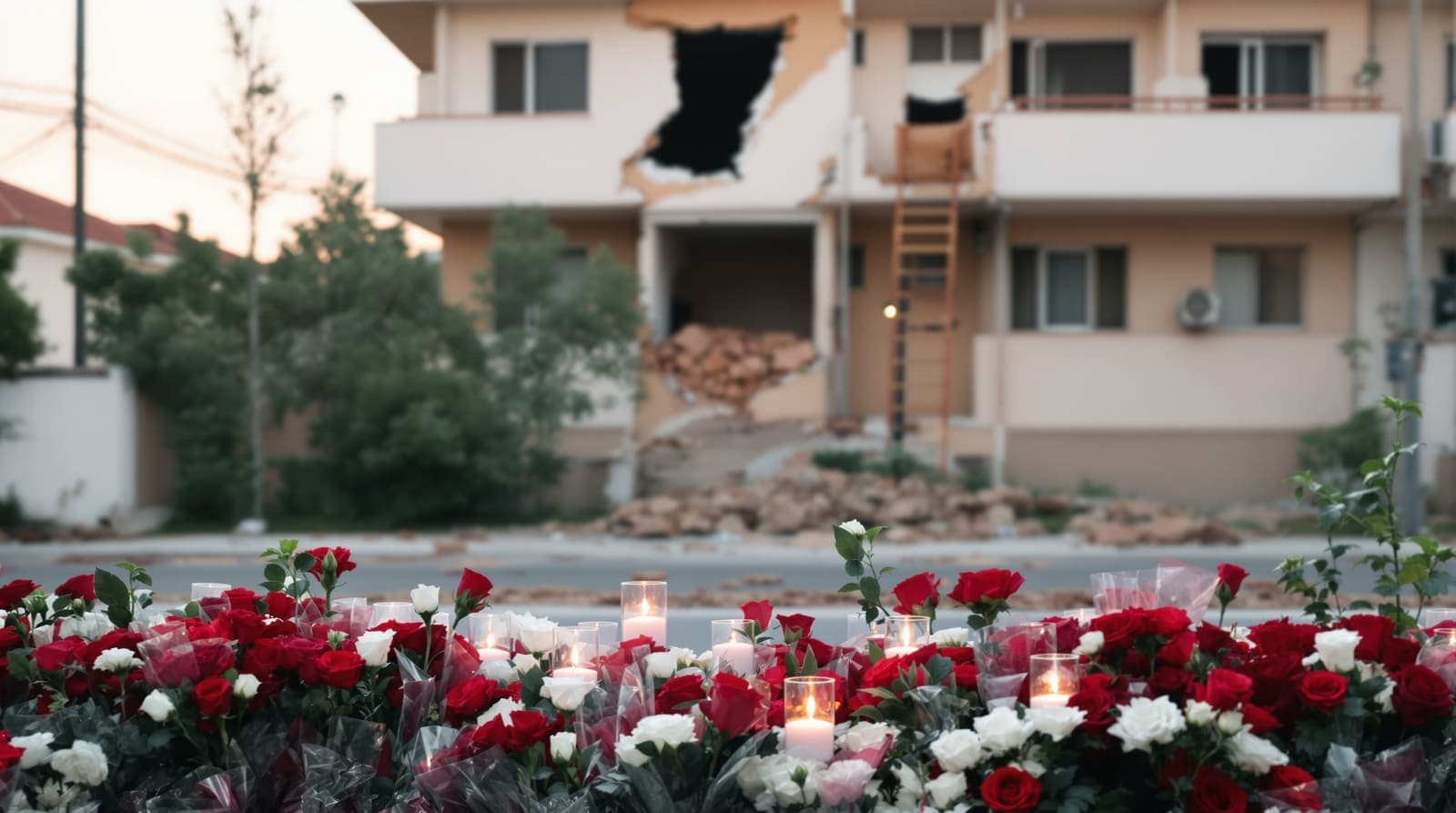
AI illustration, not a photo of the events.
The couple killed in Ramat Gan during an overnight Iranian missile barrage were named as Yaron and Ilana Moshe. According to the Tazpit Press Service report, they were killed while making their way to shelter, and a cluster bomb fell through the roof of their home.
Ramat Gan is a city of about 172,000 people immediately east of Tel Aviv, part of the Gush Dan metropolitan area that holds the largest concentration of Israel's population, according to a reference profile of the city. It is the kind of dense, mostly mid-rise urban area where the distance between a flat and a protected space is measured in seconds.
What a cluster munition is
A cluster munition is not a single bomb. It is a container or dispenser that opens in flight and scatters many smaller submunitions, sometimes numbering in the hundreds, over a wide area. Many submunitions are unreliable and fail to detonate on impact, leaving live explosives on the ground long after the attack, according to the United Nations Office for Disarmament Affairs. The Convention on Cluster Munitions, which prohibits their use, development, production, stockpiling and transfer, opened for signature in Oslo in December 2008 and entered into force on 1 August 2010; it binds only the states that have joined it.
Half the missiles, by Israel's own count
The barrage that killed the couple was part of a pattern the Israeli military had begun describing publicly. Times of Israel live coverage of 18 March 2026 reported that the IDF assessed roughly half of the Iranian missiles fired at Israel that night carried cluster warheads, that two people were killed by a direct strike in Ramat Gan, that a foreign worker was killed by shrapnel at Moshav Adanim, and that submunitions caused injuries across central Israel. The same coverage recorded at least four Palestinians killed by cluster submunitions at Beit Awwa, near Hebron in the West Bank. Impacts and sirens were reported that night across central Israel, Jerusalem, the south and the Gaza border area.
Next story Security
IDF says about 220,000 dunams of West Bank olives harvested so far
Why the walk to the shelter is the dangerous part
Israeli homes built since 1992 must contain a reinforced room, a mamad, introduced after Iraqi Scud missiles hit Israel during the 1991 Gulf War; residents of older buildings rely on communal or public shelters instead, which means leaving the flat. The Knesset passed legislation in July 2025 allowing residents of existing blocks to enlarge those rooms and requiring the Home Front Command to introduce lockable doors and shock-resistant windows, the Times of Israel reported. The alert system that tells people when to move is run by the Home Front Command, the IDF's civil defence command, created in February 1992 in the wake of that same Gulf War and responsible for public warnings, civil defence rules and search and rescue, according to a reference account of the command.
What is still unclear
The report gives no ages for Yaron and Ilana Moshe, no details of their family, and no address beyond the city. It does not say whether their building had a reinforced room or how far they had to go to reach shelter, and it does not say how many other people were hurt at the site. The military had not published its own findings on the strike at the time of the report.
More on Ramat Gan: Places and businesses in Ramat Gan · Shabbat times in Ramat Gan
Read next
All security →
Illustration
Security
Troops detain Palestinian suspected of planning imminent attack in Binyamin area
Illustration
Security
IDF says Gaza strikes killed two men who moved Iranian and Turkish money to Hamas

Illustration
Security
Israeli and Greek navies practise sinking a hostile vessel in joint drill
Illustration
Security
IDF bars Palestinian workers from settlements and closes crossings for election day
Sources and further reading
Every link below was opened and checked when this page was written. Official statements are marked as such: they are the subject's own account, not an independent one.
- OfficialUN Office for Disarmament Affairsdisarmament.unoda.orgConvention on Cluster Munitions
What cluster munitions are and what the convention prohibits
- ReportingTimes of Israeltimesofisrael.comLiveblog, 18 March 2026
The night's Iranian barrage, cluster warheads and casualties including Ramat Gan
- ReportingTimes of Israeltimesofisrael.comKnesset passes bill allowing Israelis to expand reinforced rooms, add bathrooms
Israel's reinforced-room rules and which homes have one
- ReferenceWikipediaen.wikipedia.orgRamat Gan
Location and population of the city
- ReferenceWikipediaen.wikipedia.orgHome Front Command
The command responsible for alerts, shelters and rescue
How we checked this
The identification of the couple and the circumstances of their deaths come only from the Tazpit Press Service report of 18 March 2026, which ran to two sentences; almost everything else on this page is researched context. The description of cluster munitions and the convention banning them is from the UN Office for Disarmament Affairs; the wider account of that night’s barrage is from Times of Israel live coverage. Israel.com has not independently verified the strike.
Our sourcing and corrections policy →The week from Israel, in one email
The stories that mattered, sourced and checked by the Israel.com newsroom. Free, weekly, one-click unsubscribe.
One list, unsubscribe in a click. See our privacy policy.
Latest
- Soldiers killed near Hebron named and buried as army operation goes on
- Truck driver arrested after fatal crash on Route 465 near Aboud
- Man of about 25 shot dead in Yafia, near Nazareth, during a taxi ride
- Kinneret Drops Another 4.0 cm to -213.715 m, Sitting 0.72 m Below the Lower Red Line
- Man and woman killed in two-car collision near Sde Eliyahu, three hurt
- More than 400,000 protest across France as Paris clashes continue