Netanyahu Orders Home Demolition and New Outposts After Attack
The Israeli prime minister set out five measures after a fatal attack in the West Bank, from demolishing the attacker's home to revoking work permits.
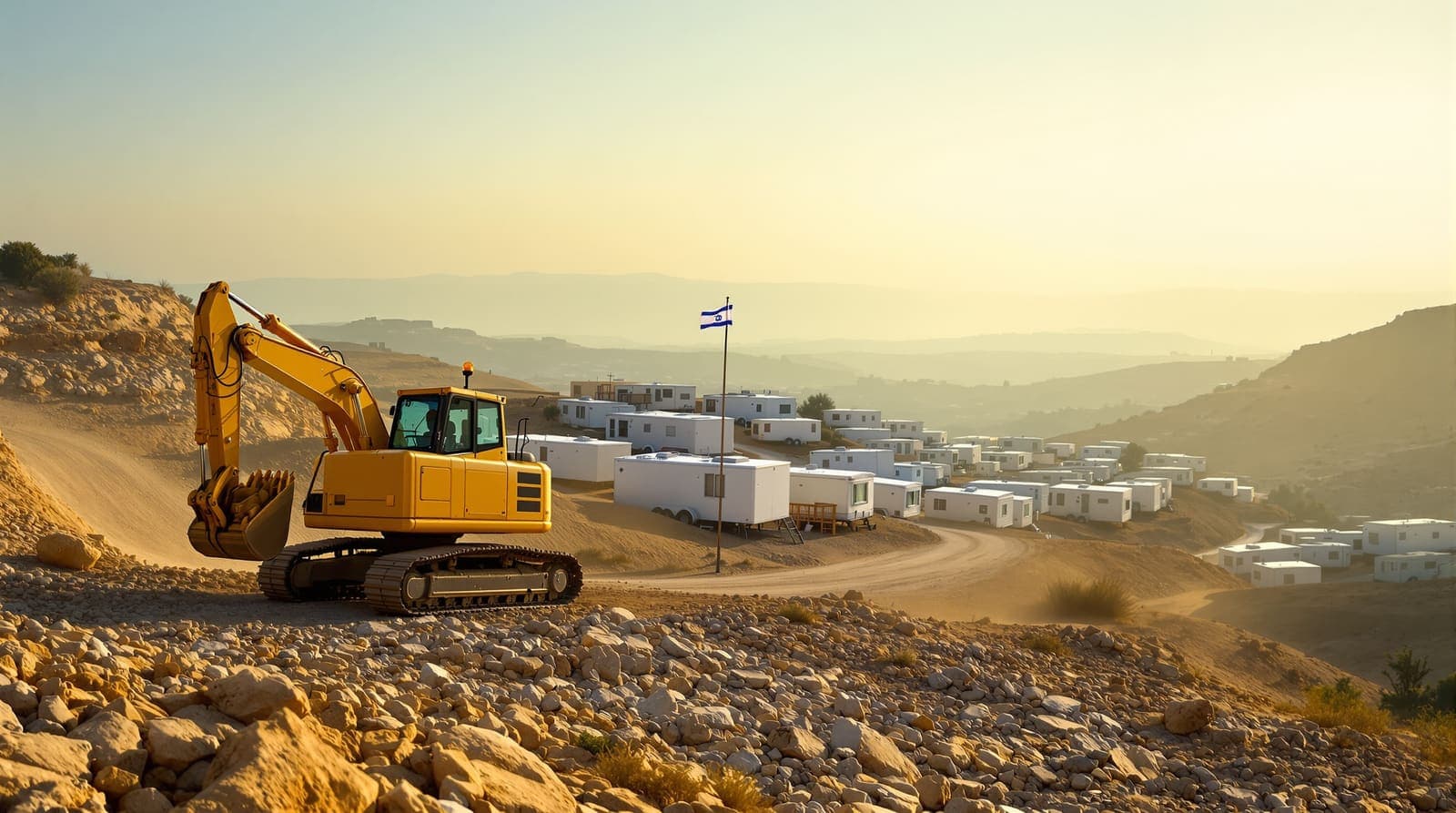
AI illustration, not a photo of the events.
Israel's Prime Minister Benjamin Netanyahu said he and Defence Minister Israel Katz had instructed the Israeli military to take a series of measures against attacks in the West Bank, in a statement issued on 24 July 2026 following what he described as the terror attacks of the previous 24 hours. The instructions were given after consultation with members of the Security Cabinet and the heads of the security establishment, the statement said.
Five measures were listed. The home of the attacker who carried out that morning's attack near the village the statement called Tal was to be demolished. Forces were to act with force in villages described as terror hotspots, including by collecting weapons and revoking work permits. Israeli forces throughout Judea and Samaria - the name Israel uses for the West Bank - were to be reinforced. Traffic routes were to be separated and checkpoints established according to security needs. And the regularisation of existing outposts and the establishment of new ones were to be accelerated. Netanyahu sent condolences to the Malt family, whose son Bneiahu was killed that morning, wished the wounded a full recovery, and called on people to refrain from any action that might interfere with the security forces' work.
What demolishing a home involves
Punitive demolition of an attacker's family home is a long-standing and contested Israeli practice, carried out under emergency regulations inherited from the British Mandate. Israeli courts have upheld it on the reasoning that it deters future attacks rather than punishes relatives. Reviewing the policy in June 2023, the Jerusalem Post cited figures from the monitoring group B'Tselem recording 17 homes demolished in 2022, displacing 63 people, and six punitive demolitions in the first half of 2023. Supporters argue that families sometimes alert the authorities to a planned attack to protect their homes; critics, including an Israeli law professor quoted in that report, say the available research shows only very local and temporary effects.
What revoking work permits would mean
Permits to work in Israel are already scarce. Roughly 100,000 Palestinians lost their permits after the Hamas attack of 7 October 2023 and fewer than 10,000 have been restored, the Times of Israel reported in February 2026, with West Bank unemployment climbing to nearly 30 per cent by the end of 2025 from around 12 per cent before the war. Palestinian labour in Israel had been worth about four billion dollars a year, equivalent to some two-thirds of the Palestinian Authority's budget. Enforcement of the ban has been uneven: an earlier Times of Israel report in March 2024 described some 2,400 Israeli businesses and institutions obtaining humanitarian exemptions that allowed tens of thousands of workers to keep entering.
Next story Security
IDF says about 220,000 dunams of West Bank olives harvested so far
Outposts and their regularisation
The final measure builds on a policy already moving quickly. In April 2026 the Times of Israel reported that Israel's security cabinet had approved 34 new West Bank settlements at a single sitting, which the monitoring group Peace Now called the largest number approved at once by any Israeli government. Peace Now counted 103 settlements approved by the current government since it took office in 2022, against six formally approved in the 30 years between the Oslo Accords and its formation.
What the statement did not say
The prime minister's statement gave no account of the attack itself beyond its timing and rough location, and did not say whether the attacker had been arrested or killed. It did not name the villages to be treated as hotspots, say how many work permits were involved, or set any timetable for the measures. It also did not say how many people were wounded, or give the age or circumstances of the man it named as killed.
Read next
All security →
Illustration
Security
Troops detain Palestinian suspected of planning imminent attack in Binyamin area
Illustration
Security
IDF says Gaza strikes killed two men who moved Iranian and Turkish money to Hamas

Illustration
Security
Israeli and Greek navies practise sinking a hostile vessel in joint drill
Illustration
Security
IDF bars Palestinian workers from settlements and closes crossings for election day
Sources and further reading
Every link below was opened and checked when this page was written. Official statements are marked as such: they are the subject's own account, not an independent one.
- ReportingJerusalem Postjpost.comIsrael's punitive home demolition policy: More harm than good?
Legal basis, demolition counts and the deterrence debate
- ReportingTimes of Israeltimesofisrael.comMisery deepens in West Bank amid dearth of permits to work in Israel
Scale of permit revocation since October 2023 and its economic effect
- ReportingTimes of Israeltimesofisrael.comDespite ostensible ban, tens of thousands of Palestinians working in Israel - report
How exemptions have kept workers entering despite the ban
- ReportingTimes of Israeltimesofisrael.comGovernment approves a record 34 new settlements, as it acts to deepen hold on West Bank
Recent pace of settlement approval and outpost regularisation
How we checked this
The list of measures, the attribution to the prime minister and defence minister and the reference to the family of the man killed come solely from the Israeli government statement of 24 July 2026. The demolition, work permit and settlement figures come from Jerusalem Post and Times of Israel reporting published between 2023 and 2026.
Our sourcing and corrections policy →The week from Israel, in one email
The stories that mattered, sourced and checked by the Israel.com newsroom. Free, weekly, one-click unsubscribe.
One list, unsubscribe in a click. See our privacy policy.
Latest
- Soldiers killed near Hebron named and buried as army operation goes on
- Truck driver arrested after fatal crash on Route 465 near Aboud
- Man of about 25 shot dead in Yafia, near Nazareth, during a taxi ride
- Kinneret Drops Another 4.0 cm to -213.715 m, Sitting 0.72 m Below the Lower Red Line
- Man and woman killed in two-car collision near Sde Eliyahu, three hurt
- More than 400,000 protest across France as Paris clashes continue