Beach · The Dead Sea
Ein Bokek Beach
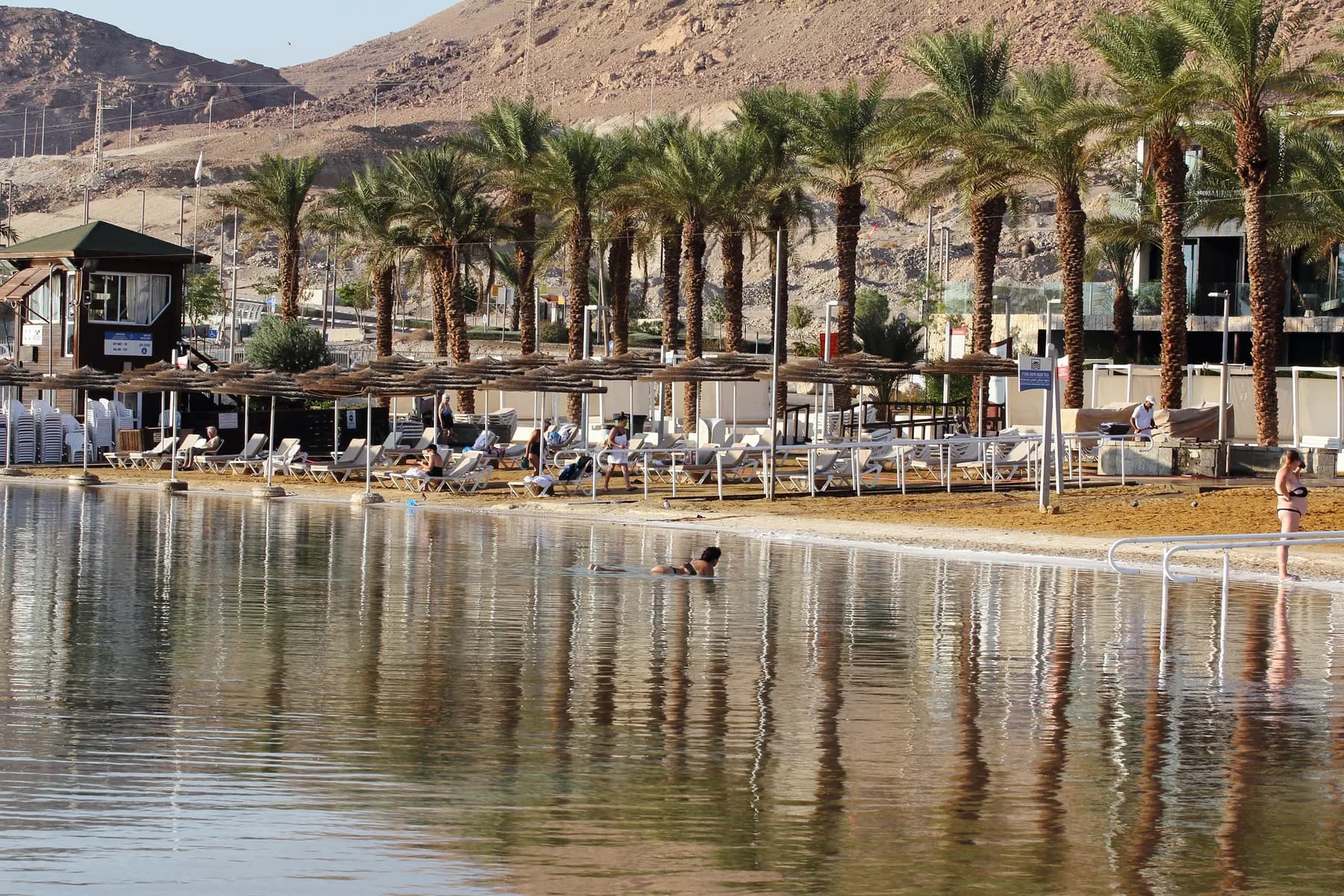
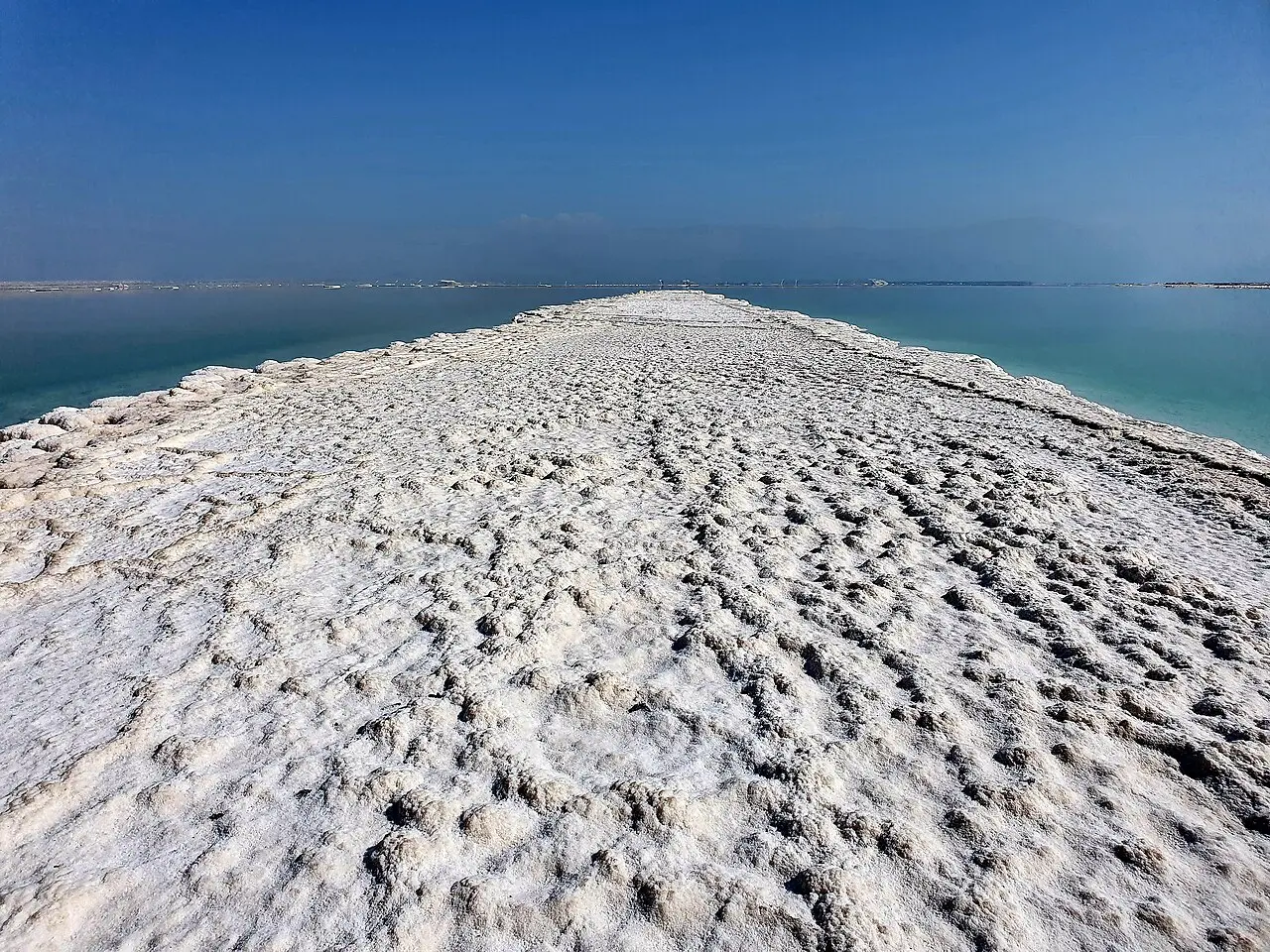
The free, lifeguarded public beach in front of the southern hotel strip, where the water is not the open Dead Sea but Pond 5, an evaporation pond of the mineral works, and the beach itself was raised two metres and rebuilt between 2012 and 2016.
ליזי שאנן / CC BY 2.5 · Wikimedia Commons
Admission
Free
the Tamar Regional Council charges nothing for the beach; parking is the one cost
Beach hours
07:00 to 18:00
summer; 07:00 to 16:00 in winter, on the regional tourism authority's own page
Beach level raised
two metres
in the works of 2012 to 2016, to stay above a pond whose floor keeps rising
Promenade opened
3 April 2017
first five kilometres, dedicated by the tourism minister; about 12 km planned
In short
- How long to give it
- about 90 minutes, of which no more than 20 should be spent in the water
- Summer
- 07:00 to 18:00
- Beach entry
- Free
חוף עין בוקק
Ein Bokek Beach is the free public bathing beach in front of the hotel strip at the southern end of the Dead Sea, operated by the Tamar Regional Council. Lifeguards, showers, changing rooms, public toilets, drinking fountains, shade structures and chairs and umbrellas all cost nothing; the only thing a visitor pays for is the car park. The regional tourism authority publishes the hours as 07:00 to 18:00 in summer and 07:00 to 16:00 in winter.
It is also, strictly speaking, not a beach on the Dead Sea. The lake's southern basin dried out decades ago, and the shallow water in front of the hotels is Pond 5, the first and largest of the solar evaporation ponds that the mineral works keeps filled by pumping brine south from the deep northern basin. Joshua Hammer put it plainly in Smithsonian in 2005: the water there is a reservoir maintained by Dead Sea Works, not the lake. ICL, the Israeli operator, describes the same pond as the shoreline of the hotels, and says it chose to protect that shoreline precisely because the pond's level is stable in a way the northern basin's is not.
That single engineering fact shapes everything a visitor meets here. The water does not retreat, there are no sinkholes on this frontage, the entry is shallow and even, and the pond floor is rising rather than falling, which is why the whole beach was dug up, raised two metres and rebuilt between 2012 and 2016. What looks like a resort beach is a piece of flood defence with sunloungers on it.
Orientation
One continuous frontage where there used to be a row of private ones
The beach runs along the foot of the hotel line at Ein Bokek and continues south toward Hamei Zohar. Before the rebuild the frontage was cut into hotel-controlled stretches with no continuous public access, even though beaches on this shore are public land; the Times of Israel reported that the new works joined them into an uninterrupted seafront. In 2017 the tourism ministry counted 16 new free and accessible beaches along the run between Ein Bokek and Hamei Zohar.
The order of things going inland is deliberate and was designed as a sequence: water, beach, promenade, a beach park planted with a grid of date palms, then the car parks, then the hotels and the road. The paved promenade carries cold drinking fountains, outdoor fitness equipment, ping pong tables and free solar charging points for phones. Behind it the Ein Bokek mall holds restaurants, a dining level and shops selling Dead Sea cosmetics.
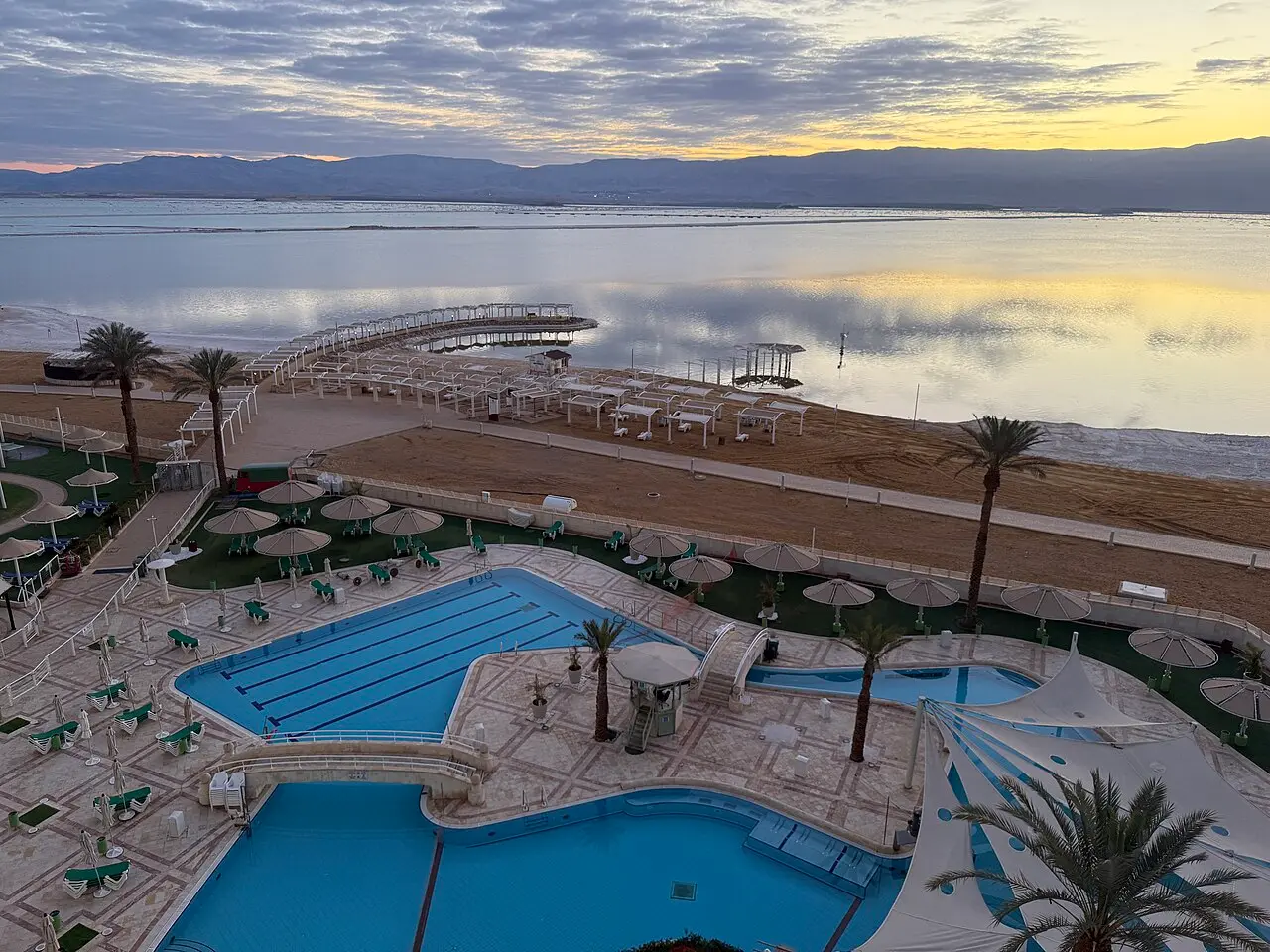
On the sand the operator provides shade sheets, sunbeds, and chairs and umbrellas marked with the Dead Sea Land brand, free to use. Showers, changing rooms, public toilets and a fresh drinking water fountain are on the beach itself. There is no admission gate and no ticket.
Parking is the catch. The beach lot is a regulated blue-and-white bay lot paid through the Pango app, and the operator's own page says it fills, listing the upper Palms car park and the upper Conference car park as the overflow. Both are a short walk down to the water.
Anagoria / CC BY-SA 4.0 · Wikimedia Commons
Pond 5
The water in front of the hotels is a pond, and its floor is rising
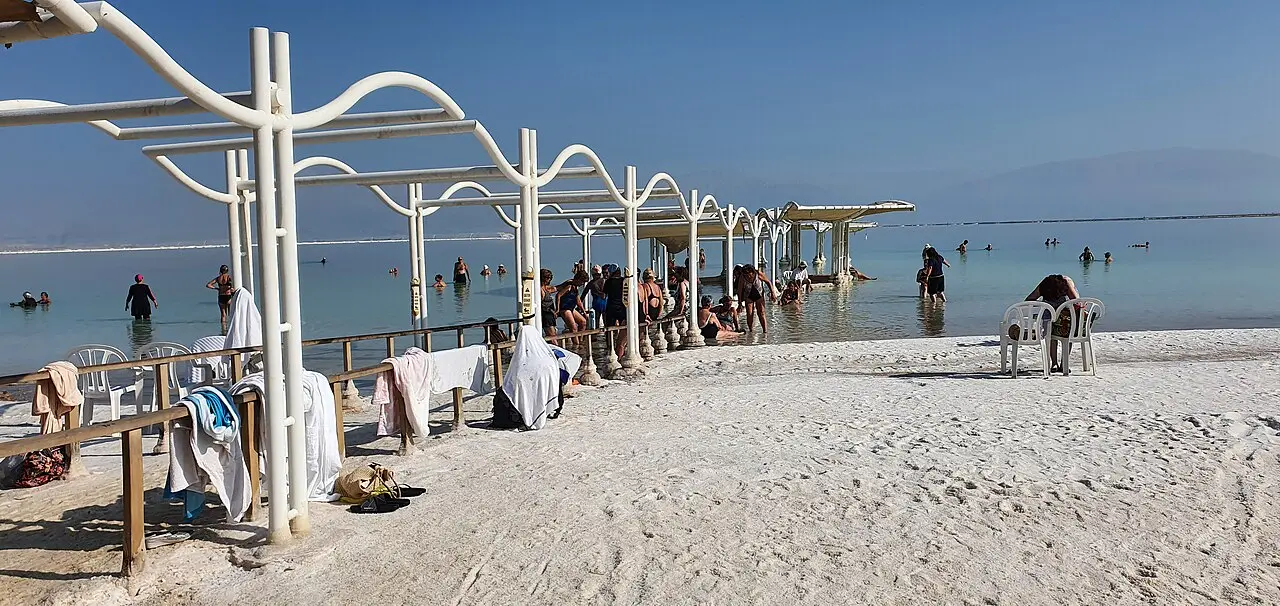
Pond 5 covers roughly 80 square kilometres and is the first and largest in the chain of evaporation ponds at the southern end of the lake. Brine is pumped from the northern basin, spread thin in the south and left to the sun, and the salts that come out of solution settle on the pond floor. ICL's own figure is about 20 million tonnes of salt precipitating in Pond 5 every year, which raises the bed by about 20 centimetres a year and pushes the water surface up with it.
That is the opposite of the problem the northern shore has. North of here the lake is falling by more than a metre a year and the beaches are stranded or lost to sinkholes; at Ein Bokek the danger has always been the water climbing into the hotel foundations. ICL states that if the level in Pond 5 rises above a certain point it may damage the foundations of the hotels standing near the water's edge and the other infrastructure on the western shoreline, and that this is why the beach and hotel protection project was begun at all.
The counter-measure is a dredger. Under an agreement signed in October 2017, ICL's board approved a budget of about $280 million to harvest salt from Pond 5, covering the company's 80 per cent share of the cost over twelve years against the Israeli government's 20 per cent. The vessel that does the work has been operating since November 2020: 141 metres long, 24 metres wide, with an electrical output of 10 MW, which ICL calls the largest electric dredger of its kind in the world. It lifts roughly 8 million tonnes a year, and two or three of them are needed to keep pace with the 20 million tonnes that settle.
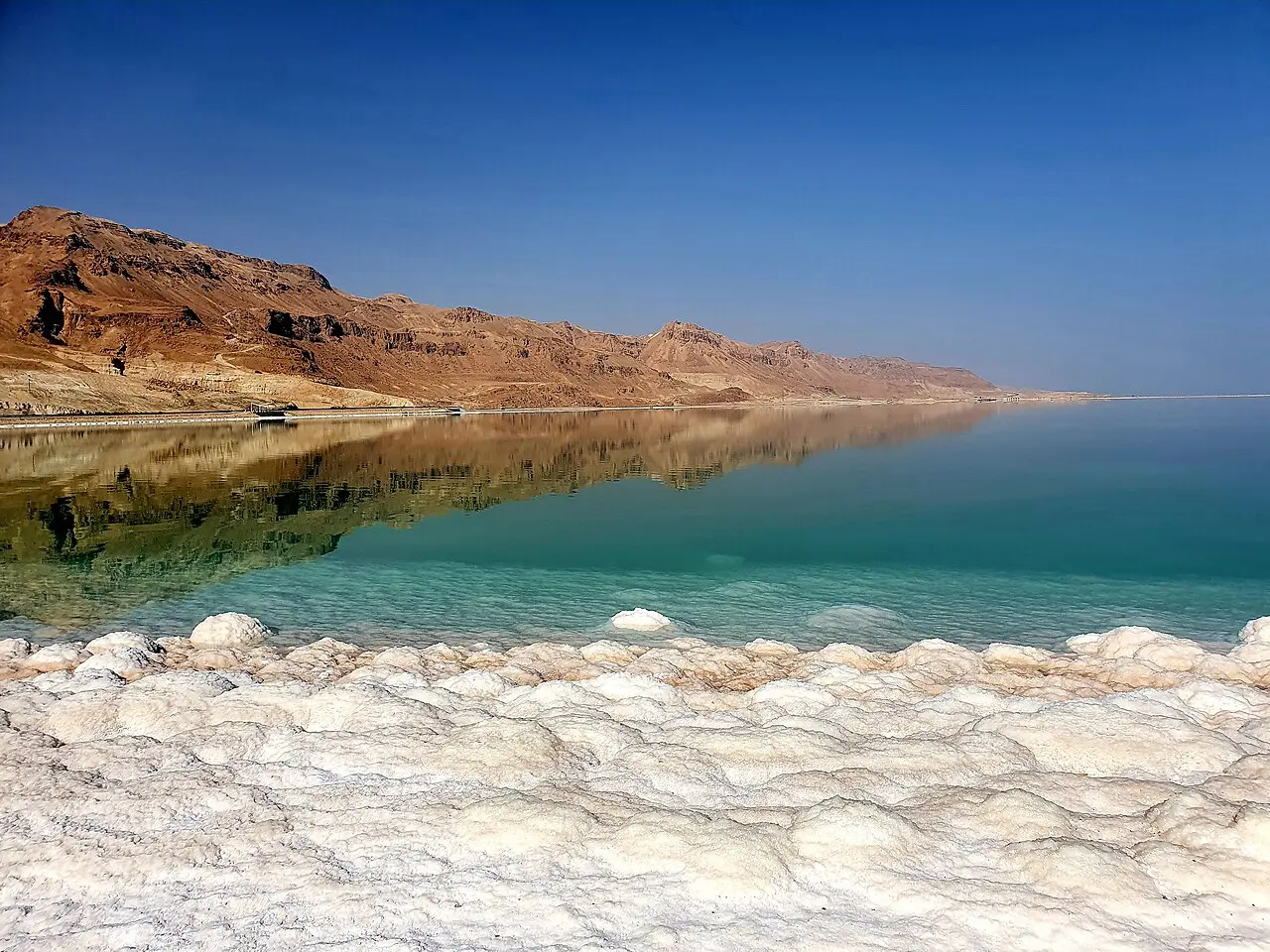
None of this is hidden from the visitor, and it is worth knowing before arriving with expectations formed by photographs of the northern shore. There are no cauliflower salt formations breaking the surface here and no retreating shoreline to walk out across. What there is instead is a level, maintained, industrially managed body of brine with a lifeguard watching it.
Anagoria / CC BY-SA 4.0 · Wikimedia Commons
2012 to 2016
What is original here, and what was built to hold the water off
Almost nothing on this frontage is older than the present decade and a half. Work began in late 2012 and finished at the end of 2016. Engineers raised the level of the beach by two metres and sank underground clay barriers, impermeable to brine, along the whole length of the hotel district. The Times of Israel gave the bill as 200 million shekels, split 60.5 per cent to the government and 39.5 per cent to Dead Sea Works. Since the beaches were being excavated anyway, a continuous seafront promenade was added on top of the flood works.
The landscape design is by Shlomo Aronson Architects, for the Dead Sea Preservation Government Company Ltd, with a team led by Barbara Aronson and including Ittai Aronson, Elia Shoshani, Svetlana Sirota, Daniel Shorer, Ayelet Ben David and Maayan Turgeman. The practice describes the brief as a response to rising water in the southern basin caused by the mining, and the built answer as accessible decks bringing bathers into the water, large shade structures on the beach, a beach park under a grid of date palms, and irrigation drawn from the hotels' treated wastewater. One decision shows at night: Barbara Aronson told the Times of Israel that the beach itself was deliberately left unlit so that walkers see the lights of Jordan across the water. The scheme took first prize from the Israeli Association of Landscape Architects in 2018, in the category of landscape restoration and infrastructure projects.
Tourism Minister Yariv Levin dedicated the first section on 3 April 2017. The published figures for what was opened do not agree, and it is worth saying so rather than picking one: the Times of Israel described a first phase of five kilometres, with about 12 kilometres eventually planned, while Israel National News reported that the government company had built a four-kilometre promenade and put its infrastructure and development spending at 500 million shekels. The two accounts may be measuring different things, and no source read for this page reconciles them.
The hotel strip behind the beach is older but not much. Wikipedia dates the first hotel at Ein Bokek to 1960 and counts fourteen by 2000. The Times of Israel put the strip at roughly 4,000 rooms in 2017; when the Israel Land Authority and the tourism ministry opened a new tender in March 2025, the Jerusalem Post reported the existing stock as 3,865 rooms across 33 hotels, of which fifteen were then operating, with a plan allowing for some 9,047 more.
- Rebuilt: the beach surface itself, raised two metres between late 2012 and the end of 2016
- New and buried: clay cut-off barriers along the length of the hotel district, put in to stop brine reaching the foundations
- New and visible: the seafront promenade, the shade structures, the accessible bathing decks, the date palm beach park, the lawns and the car parks
- Deliberately absent: lighting on the beach itself, so that the view east is the Jordanian shore rather than glare
- Not natural: the body of water in front of it all, which is a working evaporation pond kept at level by pumping and dredging
- Genuinely old, and inland: the Ein Bokek spring, the early Roman workshop on the shore and the fort above the wadi
שלמה רודד / CC BY 2.5 · Wikimedia Commons
Ein Bokek
A spring, a perfume works and a fort, all older than the hotels
The resort takes its name from a real spring in Nahal Bokek, the canyon-like gorge that comes down out of the cliffs immediately behind the strip, which carries water and its own flora and fauna. The spring has been recorded flowing at 40 to 50 cubic metres an hour, and an ancient aqueduct carried it toward the shore.
Two ancient sites sit beside it. On the shore itself is what the excavators called the officina: an early Roman building, published by Moshe Fischer, Mordechai Gichon and Oren Tal as En Boqeq II, The Officina (Mainz, 2000), read as a workshop making balsam perfume and medicines, and put out of use during the first Jewish revolt. It survives today as what Wikipedia describes as the partly reconstructed remains of an ancient perfume and medicine factory, which is to say the visitor is looking at a modern presentation of an excavated plan rather than at standing Roman walls.
Above the wadi is Metzad Bokek, a small fort commanding the road, excavated by Mordechai Gichon of Tel Aviv University between 1968 and 1970 as a teaching and research dig through which a generation of Israeli archaeologists passed. Gichon published it in 1993 as En Boqeq I, a report on the late Roman and Byzantine castellum, and it is still cited as one of the outstanding excavation reports for the Byzantine period in the country.
When the fort was built is not agreed. Gichon's reading places it with the tetrarchic and Constantinian frontier works of the fourth century; an Israel Antiquities Authority excavation report on the neighbouring fort of Mezad Tamar separates the Dead Sea forts into those built in the Roman period and those, naming 'En Boqeq and Rosh Zohar, built during the Byzantine period. The difference is a century or more, and nothing on the beach settles it.
In the water
What the floating is actually like here, and the parts people get wrong
The entry is the gentlest on the Israeli shore, which is the main reason first-time bathers are sent here. The water is a pond rather than an open lake: no waves, no swell, a shallow and even bed, and a level that does not move between visits. Accessible decks run out from the beach into the brine, and there is a narrow path leading directly into the water for people who cannot manage the surface underfoot.
That surface is salt. ICL's own account of Pond 5 is that the salts come out of solution and settle on the pond bed, about 20 centimetres of new crystal a year, and it is that crust rather than sand or mud that a bather stands on. Footwear that can be worn into the water is the single most useful thing to bring, and it is not sold on the beach.
The bathing rules are the same across the whole lake and they are not decorative: float on your back, keep your head out, do not shave beforehand, do not swallow the water, keep it out of your eyes, and rinse in fresh water afterwards. Twenty minutes at a time is enough. The freshwater showers on this beach are free and there are drinking fountains on the promenade, so the rinse is easy to do properly rather than in a hurry at a hotel.
Lifeguards are the reason to use this beach rather than an empty stretch of shoreline. Bathe when the lifeguard is on duty and inside the published hours, which end at 16:00 in the winter half of the year. Wheelchairs can be borrowed from the lifeguard's booth.
Anagoria / CC BY-SA 4.0 · Wikimedia Commons
What to look for
Things not to walk past at Ein Bokek Beach
The details that repay knowing about before you are standing in front of them.
The accessible bathing decks
Timber decks run from the beach out over the brine so that bathers can get in without crossing the salt crust. They were part of the Aronson practice's brief, not an afterthought bolted on later.
The shade structures and the date palm park
Large canopies give continuous shade on the beach, and behind them the beach park is planted as a grid of date palms watered with the hotels' treated wastewater. It is the only real shade for kilometres in either direction.
The unlit beach after dark
The promenade is lit and the beach deliberately is not, so that the eastern view at night is the lights of the Jordanian shore. The architect said in 2017 that this was the point of the lighting design.
The free showers and drinking fountains
Fresh water showers stand on the beach and cold drinking fountains along the promenade, all free. Rinsing properly after a float is the difference between a pleasant afternoon and an itchy one.
Metzad Bokek, above the wadi
The small fort commanding the old road sits up behind the hotels, excavated by Mordechai Gichon between 1968 and 1970 and published as a late Roman and Byzantine castellum. Whether it is fourth century or later is still argued.
The long view
Ein Bokek Beach, in order
Early Roman period
A workshop is built on the shore at En Boqeq, read by its excavators as an officina producing balsam perfume and medicines, and abandoned around the first Jewish revolt.
4th to 6th century CE
The fort of Metzad Bokek is built above the wadi. Gichon's report places it in the late Roman and Byzantine sequence; an Israel Antiquities Authority report on nearby Mezad Tamar lists 'En Boqeq among the forts founded in the Byzantine period.
1960
The first hotel opens at Ein Bokek.
1968-1970
Mordechai Gichon of Tel Aviv University excavates the fort and the oasis, in seasons used to train a generation of Israeli archaeologists.
1980s
The Dead Sea has dried out in its southern basin. The water in front of the hotels is from now on an evaporation pond fed by pumping from the north.
1993
Gichon publishes En Boqeq I, on the geography and history of the oasis and the late Roman and Byzantine fort.
2000
Fourteen hotels are operating at Ein Bokek. Fischer, Gichon and Tal publish En Boqeq II on the officina.
late 2012
Work starts on raising and rebuilding the beaches and burying clay barriers along the hotel district, at a cost of 200 million shekels split between the government and Dead Sea Works.
end of 2016
The beach and flood protection works are completed, with the beach surface two metres higher than before.
3 April 2017
Tourism Minister Yariv Levin dedicates the first section of the seafront promenade. The tourism ministry counts 16 new free accessible beaches between Ein Bokek and Hamei Zohar.
October 2017
ICL signs the salt harvesting agreement for Pond 5 and its board approves a budget of about $280 million, the company carrying 80 per cent of the cost over twelve years and the government 20.
2018
The Dead Sea promenade at Ein Bokek takes first prize from the Israeli Association of Landscape Architects for landscape restoration and infrastructure.
November 2020
The salt harvesting dredger begins work on Pond 5, lifting about 8 million tonnes a year against the roughly 20 million that settle.
March 2025
The Israel Land Authority and the tourism ministry open the first Dead Sea hotel tender in about twenty years, against an existing stock the Jerusalem Post reported as 3,865 rooms.
Practical
Visiting Ein Bokek Beach
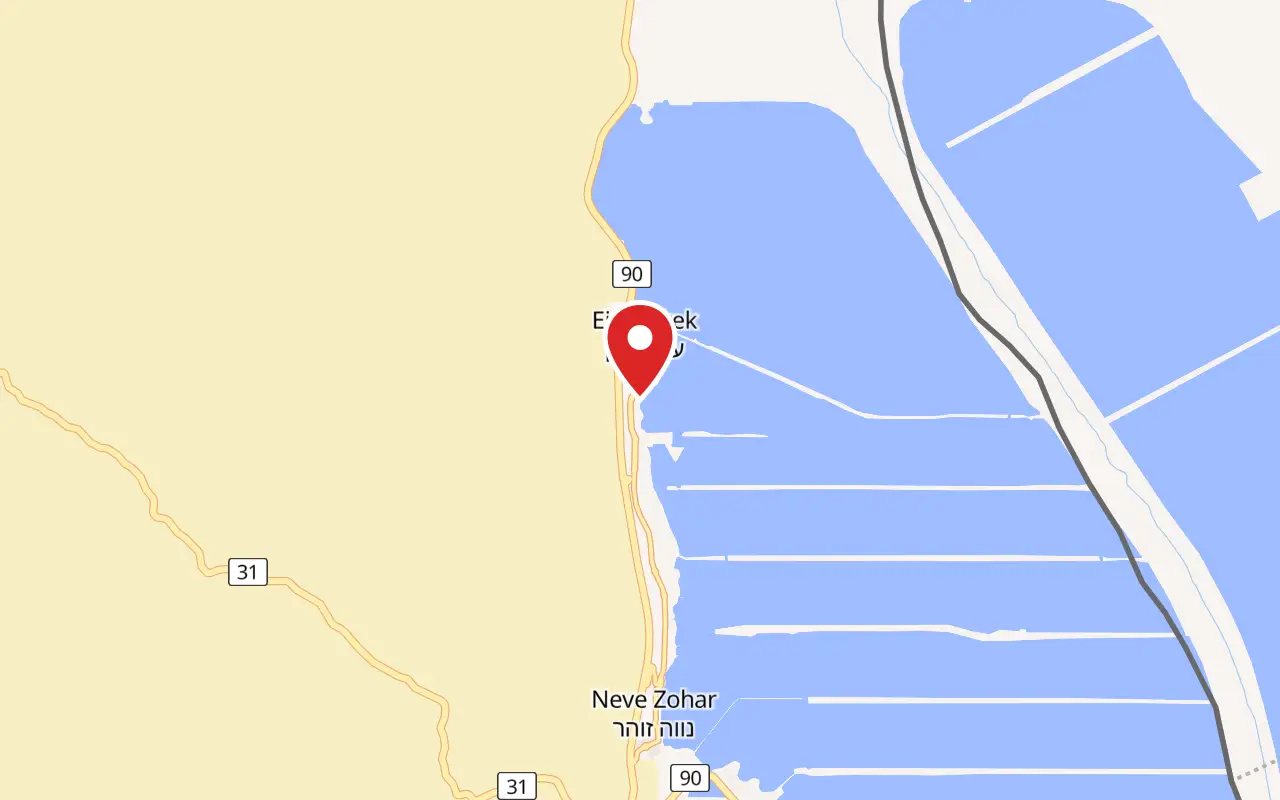
Where
Ein Bokek central beach, the hotel strip on Route 90, Tamar Regional Council, southern Dead Sea
What ticket you need
This is not inside a ticketed park and no other ticket covers or is needed for it. It sits in the middle of the Ein Bokek hotel strip, and the hotel frontages either side of it are public land too, joined into one continuous seafront by the works completed in 2016.
Opening hours
Admission
- Beach entry
- Freesource
- Chairs and umbrellas
- Free, marked with the Dead Sea Land brandsource
- Showers, changing rooms and toilets
- Freesource
- Drinking water and phone charging on the promenade
- Freesource
- Parking
- Charged. Regulated blue-and-white bays paid through the Pango app; no tariff is published on the operator's pagesource
Access
Among the most accessible bathing places in Israel, and level throughout. The operator states that the beach is wheelchair accessible, that wheelchairs can be borrowed from the lifeguard's booth, and that a narrow path leads directly into the water. The rebuild of 2012 to 2016 added paved paths from the promenade down to the waterline and decks that carry bathers out over the brine, and the promenade itself is flat and paved for its full length. The soft ground of the beach between the paths is the one part a wheelchair will struggle with, and the salt crust underfoot in the shallows is hard on bare feet.
On site
- Lifeguard station
- Fresh water showers
- Changing rooms
- Public toilets
- Drinking water fountain on the beach
- Free chairs, umbrellas, sunbeds and shade sheets
- Shade structures and lawns
- Accessible decks and a path into the water
- Wheelchair loan at the lifeguard's booth
- Paved seafront promenade with cold drinking fountains
- Outdoor fitness equipment and ping pong tables
- Free solar phone charging points
- Restaurants, snack bars and the Ein Bokek mall behind the beach
- Paid blue-and-white parking, Pango app
Booking
Nothing to book. There is no gate, no ticket and no reservation system; the beach is open to anyone within the published hours.
Hours and prices are given as the operator publishes them and change without much notice, particularly around Shabbat and the festivals. Check the operator's own page before you travel for this.
Official page at deadsea.co.il →What people wish they had known
- Do not come expecting the pictures. The salt sculptures, the crusted shoreline and the retreating waterline belong to the northern shore; the water here is a managed evaporation pond with a flat, even edge, and that is exactly why the bathing is easy.
- Bring shoes you can wear into the water. The bed is precipitated salt rather than sand, and nothing on the beach sells footwear.
- Budget for parking and nothing else. The beach lot is blue-and-white bays paid through Pango and it fills; the operator names the upper Palms and upper Conference car parks as the overflow, both a short walk away.
- Check which half of the year you are in before planning a late afternoon. The beach closes at 16:00 in winter and 18:00 in summer, and bathing at the Dead Sea without a lifeguard is a genuinely bad idea rather than a formality.
- Rinse properly, on the beach, not later. The freshwater showers are free and right there, and brine left on skin or in a swimsuit is what people remember unpleasantly.
- If mud is the point of the trip, buy it in the mall before going down. There is no natural mudflat on this frontage to scoop from.
The figures
Ein Bokek Beach by the numbers
Each figure carries the year it belongs to and links the source it came from.
| Measure | Figure | As of | Source |
|---|---|---|---|
| Admission | Free; only the car park is charged | 2026 | deadsea.co.il |
| Published beach hours | 07:00 to 18:00 in summer, 07:00 to 16:00 in winter | 2026 | deadsea.co.il |
| Cost of the beach and flood protection works | 200 million shekels, 60.5 per cent government and 39.5 per cent Dead Sea Works | 2017 | timesofisrael.com |
| Height the beach was raised | two metres, with buried clay barriers along the hotel district | 2016 | timesofisrael.com |
| Promenade opened in the first phase | five kilometres, of about 12 kilometres planned; Israel National News reported four kilometres built | 2017 | timesofisrael.com |
| Surface area of Pond 5, the water in front of the hotels | about 80 square kilometres | 2026 | icl-group-sustainability.com |
| Salt settling on the bed of Pond 5 | about 20 million tonnes a year, raising the floor by about 20 centimetres | 2026 | icl-group-sustainability.com |
| Salt harvesting dredger on Pond 5 | 141 metres by 24 metres, 10 MW, lifting about 8 million tonnes a year since November 2020 | 2026 | icl-group-sustainability.com |
| Hotel rooms on the strip behind the beach | 3,865 rooms in 33 hotels, fifteen of them operating, at the March 2025 land tender | 2025 | jpost.com |
While you are here
The rest of The Dead Sea
Everything else in this destination with a page of its own.
israel zeller ישראל זלר / CC BY 2.5 · Wikimedia Commons
Museum
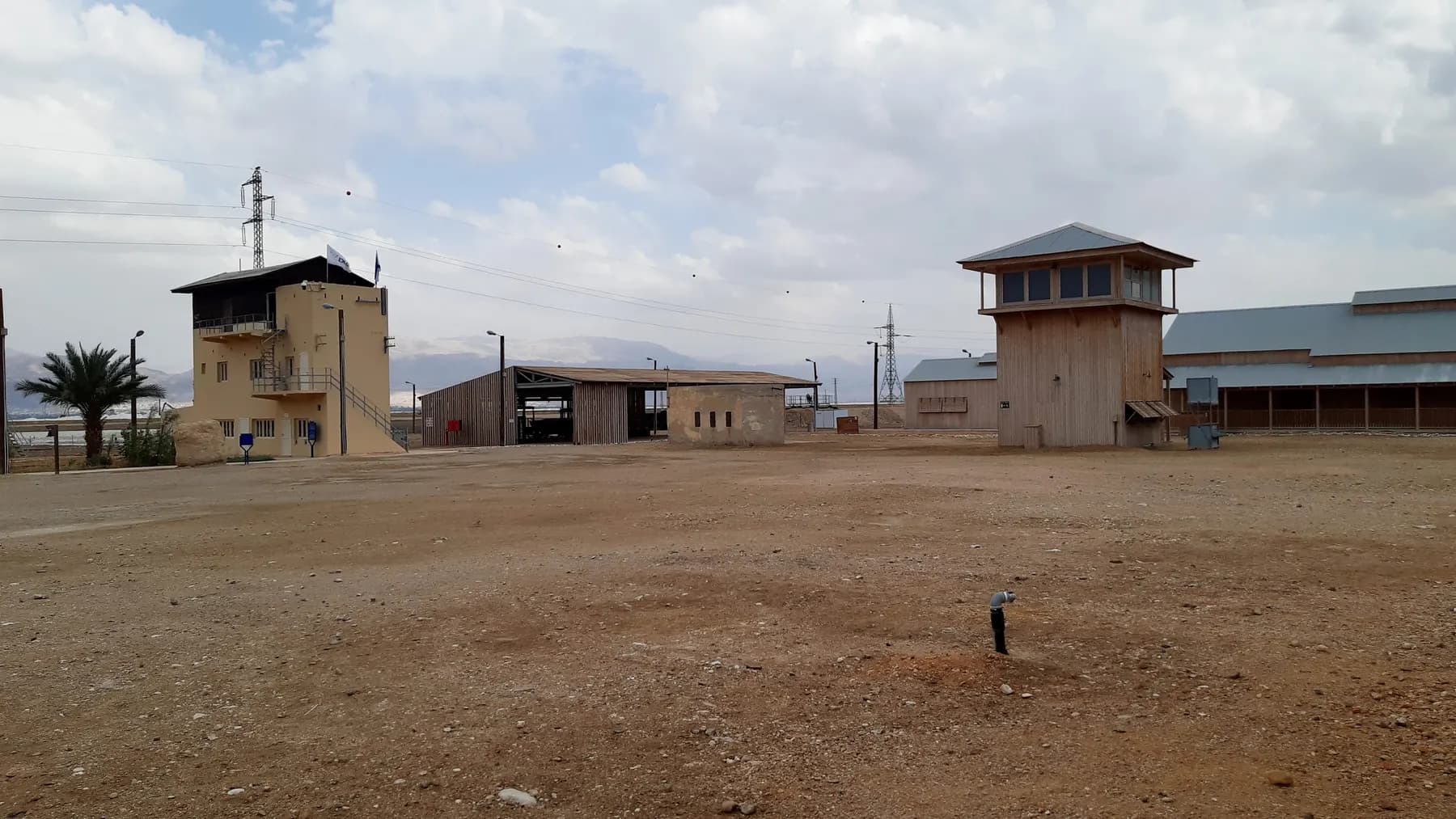
Moshe Novomeisky Visitor Center
The restored workers' camp of Palestine Potash at Sdom, lived in from 1934 until the early 1950s, open only on a guided tour of about ninety minutes.
Hoshvilim / CC BY-SA 4.0 · Wikimedia Commons
Landmark
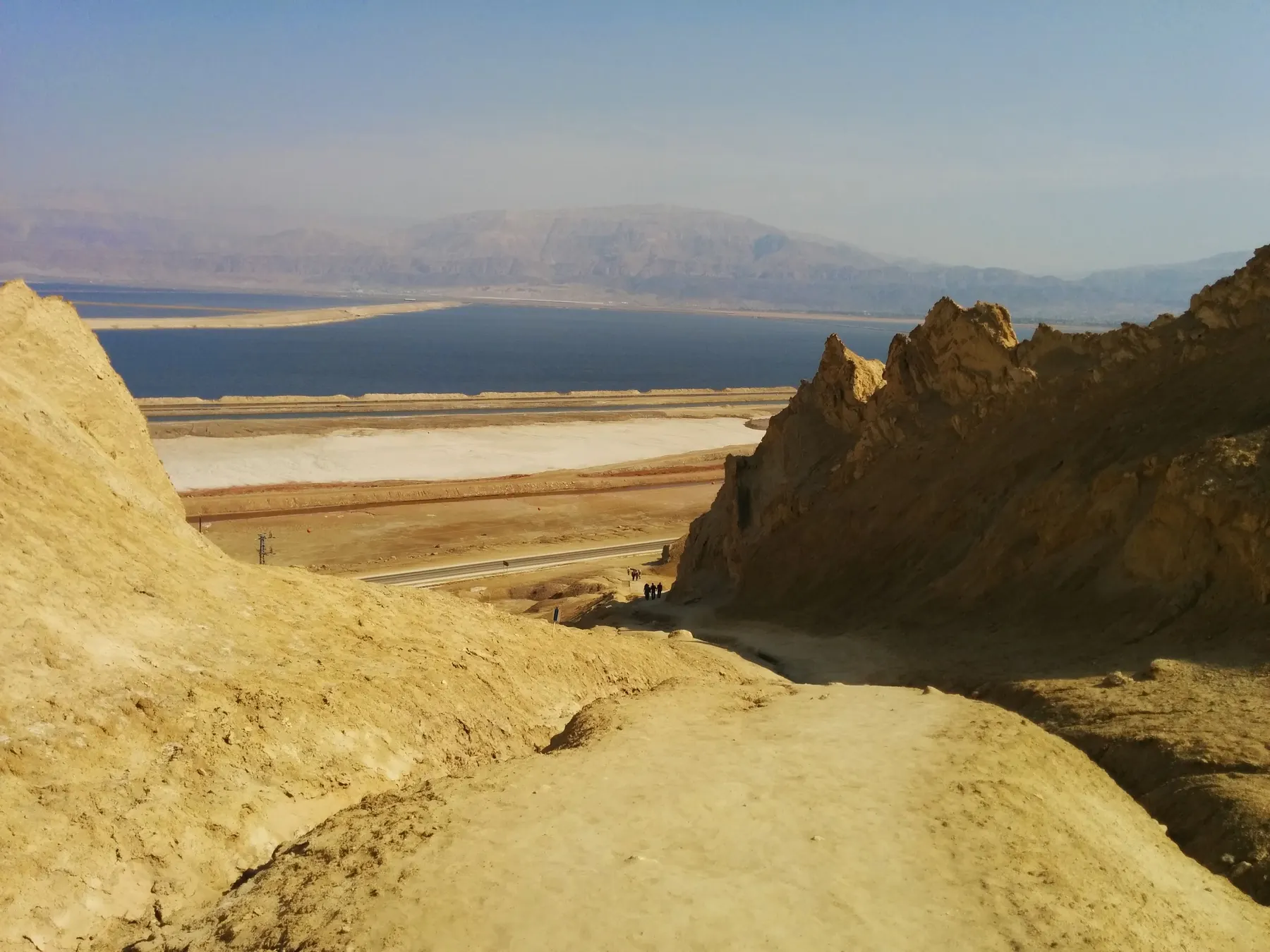
Mount Sodom and Lot's Wife
A wall of rock salt that radar measurements show is still rising by up to 8.3 millimetres a year, with the longest salt cave in the world running through the inside of it.
In-bar / CC BY-SA 4.0 · Wikimedia Commons
Nature reserve
Ein Gedi Nature Reserve
Four springs push about three million cubic metres of fresh water a year through two desert canyons here, and the parks authority has been rebuilding the trails between them since a flood tore through the reserve in May 2025.
Sources and further reading
Every link below was opened and checked when this page was written. Official statements are marked as such: they are the subject's own account, not an independent one.
- OfficialDead Sea Land, the regional tourism authority, for the Tamar Regional Councildeadsea.co.ilEin Bokek Central Beach
Summer hours 07:00 to 18:00 and winter hours 07:00 to 16:00, free entry, the operator and its phone number, showers, changing rooms, toilets, drinking fountain, free chairs and umbrellas, shade sheets and sunbeds, the wheelchair loan at the lifeguard's booth and the path into the water, the Pango blue-and-white parking and the upper Palms and upper Conference overflow lots, the promenade fountains, ping pong tables and solar charging points
- OfficialDead Sea Land, the regional tourism authoritydeadsea.co.ilחוף מרכזי עין בוקק (Ein Bokek central beach, Hebrew page)
The same summer and winter hours in Hebrew, free entry, the lawns, shade structures, fitness and play equipment, the lockers and showers, the accessibility provision and wheelchair loan, the Pango parking and the alternative lots, and the adjacent mall
- OfficialICL Groupicl-group-sustainability.comSalt Harvesting
Pond 5 at about 80 square kilometres as the first and largest pond and the shoreline of the hotels, about 20 million tonnes of salt precipitating a year and a 20 centimetre layer, the risk to hotel foundations if the level rises, the October 2017 agreement and the roughly $280 million budget at 80 per cent ICL to 20 per cent government over twelve years, and the dredger of 141 by 24 metres at 10 MW working since November 2020 and lifting about 8 million tonnes a year
- OfficialShlomo Aronson Architectss-aronson.co.ilDead Sea Promenade, Ein Bokek
The designers' own account: the client as the Dead Sea Preservation Government Company Ltd, the team of Barbara Aronson, Ittai Aronson, Elia Shoshani, Svetlana Sirota, Daniel Shorer, Ayelet Ben David and Maayan Turgeman, the brief as a response to rising water caused by the mining, and the built elements of accessible decks into the water, shade structures, the date palm beach park and irrigation from the hotels' treated wastewater
- OfficialShlomo Aronson Architectss-aronson.co.ilLandscape Architecture Award 2018
First prize for the Dead Sea Promenade at Ein Bokek from the Israeli Association of Landscape Architects in 2018, in the category of landscape restoration and infrastructure projects
- ReportingThe Times of Israeltimesofisrael.comTo shore up the Dead Sea, a NIS 200 million promenade
Work from late 2012 to the end of 2016, the beach raised two metres, the buried clay barriers along the hotel district, the 200 million shekel cost split 60.5 per cent government to 39.5 per cent Dead Sea Works, the first five kilometres dedicated by Tourism Minister Yariv Levin on 3 April 2017 and about 12 kilometres planned, the previously divided hotel frontages on public land, Barbara Aronson's quotation about leaving the beach unlit, and the roughly 4,000 rooms then on the strip
- ReportingSmithsonian Magazine, Joshua Hammersmithsonianmag.comThe Dying of the Dead Sea
The statement, published in October 2005, that the shallow water in front of the Ein Bokek hotels is not the Dead Sea, which dried up there in the 1980s, but a reservoir maintained by Dead Sea Works, which pumps water from the northern to the southern part of the lake to evaporate it for potash and bromide
- ReportingIsrael National Newsisraelnationalnews.comFor the first time in decades: New hotels at the Dead Sea
The tourism ministry's inauguration in 2017 of 16 new free and accessible beaches between Ein Bokek and Hamei Zohar, the Dead Sea Preservation Government Company's four-kilometre promenade and 500 million shekels of infrastructure and development work, and quotations from Yariv Levin, Eran Reuveni of the Israel Land Authority and the company's chief executive Shimon Daniel
- ReportingThe Jerusalem Postjpost.comIsraeli riviera: Hundreds of new hotel rooms planned at Dead Sea
The March 2025 Israel Land Authority and tourism ministry tender, the existing stock given as 3,865 rooms in 33 hotels with fifteen operating, the allowance for some 9,047 further rooms, and the ministry's claim of the highest occupancy rates in Israel
- ReferenceWikipediaen.wikipedia.orgEin Bokek
The first hotel in 1960 and fourteen hotels by 2000, the ruins of Metzad Bokek as a small Roman-era fortress commanding the main road, the partly reconstructed ancient perfume and medicine factory, and Nahal Bokek as a canyon-like gorge with springs and its own flora and fauna
- ReferenceRoman Roads and Milestones in Judaea/Palaestina, Kinneret Academic Collegemilestones.kinneret.ac.ilMordechai Gichon
Gichon's Tel Aviv University affiliation, the En Boqeq excavations of 1968 to 1970 as teaching and research seasons that trained a generation of scholars, the 1993 publication of En Boqeq I on the oasis and the late Roman and Byzantine castellum, and En Boqeq II on the early Roman period
- ReferenceAndrea Berlin, Journal of Roman Archaeology, volume 15 (2002), Cambridge University Presscambridge.orgBusiness at the bottom of the world: review of 'En Boqeq II, The Officina
The scholarly record of Fischer, Gichon and Tal, 'En Boqeq. Excavations in an Oasis on the Dead Sea, volume II, The Officina: An Early Roman Building on the Dead Sea Shore (Mainz, 2000). The review text itself is behind a paywall; the bibliographic detail and the description of the building as an early Roman structure on the Dead Sea shore are visible
- ReferenceDavida Eisenberg-Degen and Neer Lect Ben Ami, Hadashot Arkheologiyot 138, Israel Antiquities Authoritypublications.iaa.org.ilMeẓad Tamar (A-9674)
The division of the Dead Sea forts into those built in the Roman period, at the end of the third and beginning of the fourth century CE, and those such as Rosh Zohar and 'En Boqeq built during the Byzantine period, which is the dating that conflicts with Gichon's reading of Metzad Bokek
- ReferenceBibleWalksbiblewalks.comBokek
An independent site-documentation page used here only for the physical description of Metzad Bokek and the oasis: the square plan with corner towers, the surviving wall heights, the further excavation seasons to 1976, the spring flowing at 40 to 50 cubic metres an hour, the aqueduct, the Byzantine reservoir beside Route 90 and the footpath to the ruins from the northern hotels
Ein Bokek Beach: common questions
Is Ein Bokek Beach free?+
Yes. The Tamar Regional Council operates it at no charge, and that covers the lifeguards, the showers, the changing rooms, the toilets, the shade and the chairs and umbrellas. The only money a visitor spends is on parking, which is a regulated blue-and-white bay lot paid through the Pango app, and on food and shops behind the beach.
What are the opening hours at Ein Bokek Beach?+
07:00 to 18:00 in summer and 07:00 to 16:00 in winter, on the regional tourism authority's own page for the beach. Those are the hours the beach is staffed and supervised, so they are also the hours it is sensible to be in the water. The operator's phone number for confirming a change is 08-8000210, extension 106.
Is Ein Bokek Beach really the Dead Sea?+
Not in the strict sense. The lake's southern basin dried out in the 1980s, and the water in front of the hotels is Pond 5, an evaporation pond that the mineral works keeps filled with brine pumped south from the deep northern basin. Smithsonian reported this in 2005 and ICL, which runs the ponds, describes Pond 5 as the shoreline of the hotels. The brine is genuine Dead Sea brine and the floating works exactly as advertised; the body of water it sits in is engineered.
Is there a lifeguard at Ein Bokek Beach?+
Yes, and this is the main argument for using it rather than an unattended stretch of coast. The lifeguard station is on the beach, wheelchairs can be borrowed from the lifeguard's booth, and supervision runs through the published beach hours. Swallowing or inhaling Dead Sea water is a medical emergency rather than merely unpleasant, which is why unsupervised bathing on this lake is discouraged everywhere.
Is Ein Bokek Beach wheelchair accessible?+
Yes, and unusually well. The operator states the beach is wheelchair accessible, that wheelchairs can be borrowed at the lifeguard's booth, and that a narrow path leads directly into the water; the 2012 to 2016 rebuild added paved routes from the promenade to the waterline and decks that carry bathers out over the brine. The promenade itself is flat and paved. The soft ground between the paved paths is the part that will still be hard work.
How long should you spend at Ein Bokek Beach?+
About 90 minutes is a realistic visit and no more than 20 of those minutes should be spent in the water. The float itself is quick, the rinse and the sitting about afterwards take longer, and the promenade is worth a walk. People staying in the hotels often go in twice in a day rather than once for longer.
Is there mud at Ein Bokek Beach?+
Not lying on the shore to scoop up. The bed of Pond 5 is precipitated salt, roughly 20 centimetres of new crystal a year by the operator's own account, rather than the mudflat found on parts of the northern shore. Packaged Dead Sea mud is sold in the shops on the strip behind the beach, and the freshwater showers on the beach make washing it off straightforward.
Are there sinkholes at Ein Bokek?+
Not on this frontage. Sinkholes form where the lake retreats and fresh groundwater dissolves the salt layers left behind, which is the northern shore's problem and the reason beaches there have closed. At Ein Bokek the water level is held steady by pumping, and the engineering problem runs the other way: the pond floor rises about 20 centimetres a year, which is why the beach was raised two metres and clay barriers were buried along the hotel line.
Is there shade at Ein Bokek Beach, and how hot does it get?+
There is real shade, which is rare on this coast. Large canopies were built across the beach in the rebuild and there are lawns and a planted beach park behind them. It is still the Dead Sea in a rift valley below sea level, so summer afternoons are punishing; the sensible plan between May and September is early morning or the last two hours before closing.
What else is there at Ein Bokek besides the beach?+
The promenade, the mall and two archaeological sites most visitors walk past. Nahal Bokek, the gorge behind the hotels, carries the spring the place is named after; on the shore are the excavated remains of an early Roman workshop that made balsam perfume and medicines, partly reconstructed for display; and above the wadi is Metzad Bokek, the small fort Mordechai Gichon excavated between 1968 and 1970.