Route 90 Shut to Eilat as Flood Fears Close Four Desert Roads
Police closed Route 90 and three other southern highways from midday over flash-flood risk, severing the main artery between the Dead Sea and Eilat.
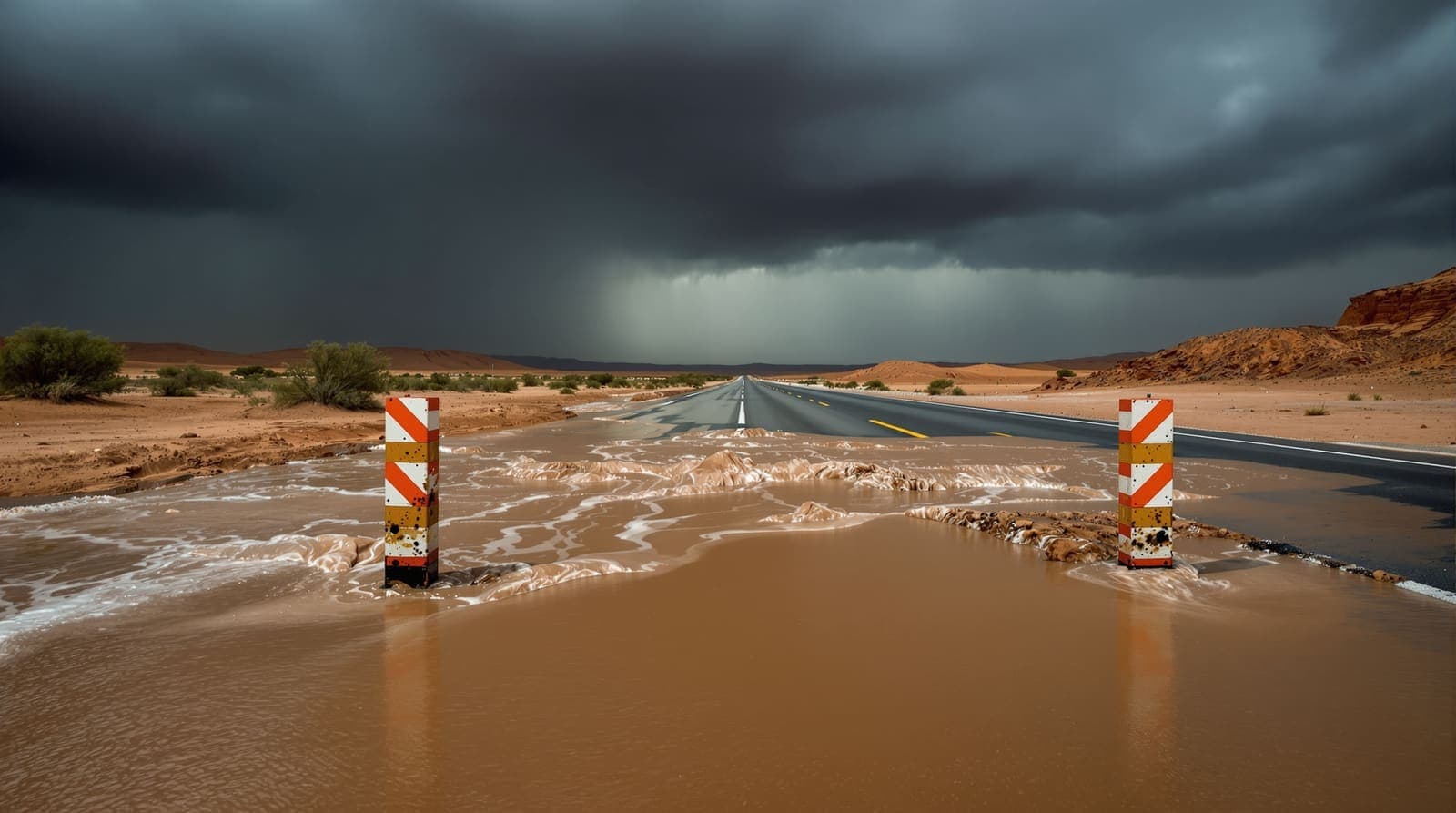
AI illustration, not a photo of the events.
Israeli police announced that from 12:00 on 25 March 2026 four roads across the south of the country would be closed to traffic in both directions because of the risk of flooding. The list covered Route 90 from Neve Zohar Junction, by the southern end of the Dead Sea, through Arava Junction and on to Eilat; Route 12 from Eilat to Neot Smadar Junction; Route 25 from Tzafit Junction to Arava Junction; and Route 40 from Ketura Junction to Tzichor Junction.
The public was asked to avoid non-essential travel to the southern region, to check conditions before setting out and to obey police instructions. The statement did not say how long the closures would last. It came while Israel was in the fourth week of the war with Iran that began on 28 February 2026, a period in which the Home Front Command had already been restricting movement and gatherings, as the Institute for the Study of War documented.
Why a desert floods faster than a wet country
The Negev and the Arava (the trough running from the Dead Sea south to Eilat) receive very little rain, and that is exactly the problem. Sun-baked ground absorbs almost nothing, so a storm falling on high ground can send a wall of water down a dry streambed many kilometres away, under a clear sky. The desert landscape is especially susceptible to severe weather and flash floods, The Times of Israel noted in December 2025, when flooding forced the closure of Routes 90, 12 and 40 and left Eilat effectively cut off, with hundreds of cars backed up as weekend visitors tried to get home.
The road with no alternative
Route 90 is the spine of eastern Israel, running the length of the country from the far north down the Jordan Valley, past the Dead Sea and through the Arava to Eilat. Where it crosses the desert there is essentially nothing to divert onto, which is why a single closed section between Neve Zohar and Arava Junction detaches the southern resort city from the rest of the country. Route 12, hugging the Egyptian border out of Eilat, and Route 40, the inland north–south road through the Negev, are the other two ways in and out; on 25 March all three were shut at once.
Next story Security
Israeli soldiers start voting at some 850 military polling stations
Why the police close roads before anything happens
Pre-emptive closures in this region carry the memory of a specific disaster. On 26 April 2018, ten teenagers (nine girls and a boy from a pre-military academy) were killed when a flash flood swept through the Tzafit riverbed south of the Dead Sea during a hike, despite weather warnings. In April 2025 the Beersheba District Court sentenced two educators to seven years in prison for negligent manslaughter over the deaths, The Times of Israel reported. Tzafit Junction, named for the same streambed, appears on the closure list.
What the police did not say
The notice gave no expected duration and no reopening criteria, did not attribute the flood risk to a named forecast, and did not say whether any roads were already impassable at the time it was issued. It made no mention of stranded travellers or of arrangements for residents of the Arava settlements on the closed stretches.
More on Eilat: Places and businesses in Eilat · Shabbat times in Eilat
Read next
All emergency →
File photo
Government
Netanyahu tours eastern barrier near Kibbutz Massada, tells enemies 'do not test us'

Illustration
Emergency
Man about 35 killed as truck and car collide on Route 465 near Aboud

Illustration
Emergency
Man and woman killed in two-car collision near Sde Eliyahu, three hurt

File photo
Emergency
Fire at Hitler's Eagle's Nest retreat in Bavaria, 200 firefighters called in
Sources and further reading
Every link below was opened and checked when this page was written. Official statements are marked as such: they are the subject's own account, not an independent one.
- ReportingTimes of Israeltimesofisrael.comPolice close all roads in and out of Eilat as flooding intensifies
How desert flooding cuts Eilat off, from the December 2025 closures
- ReportingTimes of Israeltimesofisrael.comEducators sentenced to 7 years over deaths of 10 students in flash flood disaster
The 2018 Nahal Tzafit disaster that shapes pre-emptive closures
- ReportingInstitute for the Study of Warunderstandingwar.orgIran Update Evening Special Report, February 28, 2026
Start date of the war that was under way when the closures were ordered
How we checked this
The roads, junctions and midday start time are taken directly from the Israel Police notice of 25 March 2026 and have not been altered. The flooding background, the 2018 Nahal Tzafit disaster and the December 2025 closure of Eilat's access roads come from Times of Israel reporting; the wartime context is dated to the Institute for the Study of War's 28 February 2026 report.
Our sourcing and corrections policy →The week from Israel, in one email
The stories that mattered, sourced and checked by the Israel.com newsroom. Free, weekly, one-click unsubscribe.
One list, unsubscribe in a click. See our privacy policy.
Latest
- Man of about 25 shot dead in Yafia, near Nazareth, during a taxi ride
- IDF says Gaza strikes killed two men who moved Iranian and Turkish money to Hamas
- Israeli and Greek navies practise sinking a hostile vessel in joint drill
- Kinneret Drops Another 4.0 cm to -213.715 m, Sitting 0.72 m Below the Lower Red Line
- IDF bars Palestinian workers from settlements and closes crossings for election day
- More than 400,000 protest across France as Paris clashes continue