Netanya Streets Closed as Thousands Mourn Rabbi Amos Guetta
Police shut two roads and the cemetery car park for a 13:30 burial expected to draw thousands, after arresting a suspect in the rabbi's killing.
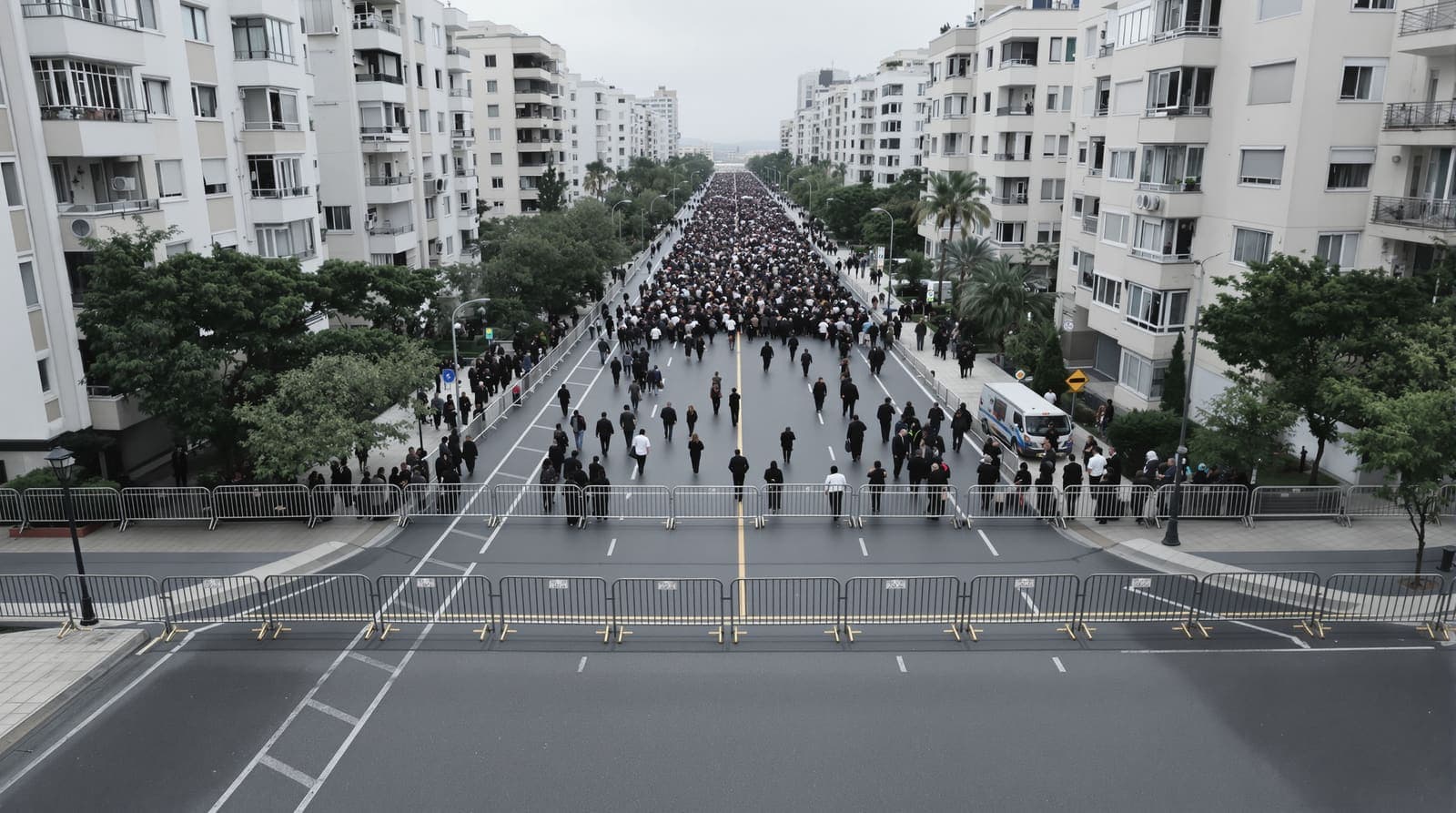
AI illustration, not a photo of the events.
Israel Police said it had completed its preparations for securing the funeral of Rabbi Amos Guetta in the coastal city of Netanya, warning that streets around the cemetery would be closed and that heavy traffic should be expected. The burial was set for 13:30 the same day at the cemetery in Shikun Vatikim, a Netanya neighbourhood, and the force said it anticipated thousands of mourners.
According to the police statement, Degania Street, Rabbi Neria Street and the cemetery car park would be closed to traffic during the funeral procession. The force asked the public to follow the instructions of officers and inspectors on the ground, to stay away from the area unless they needed to be there, and to plan journeys accordingly. The same statement restated the criminal case behind the funeral: the commander of the Central District, Superintendent Amir Cohen, had assigned the investigation to the Sharon District Detective Unit, and after a manhunt conducted with detectives from the Netanya station the suspect in the killing (described only as a Netanya resident in his twenties) had been arrested.
Why the burial came so quickly
To a reader outside Israel, a funeral held the same day the police announce their traffic plan can look startlingly fast. It is not unusual. Jewish law requires burial as soon as possible after death, with delays permitted mainly out of respect for the deceased (to allow distant relatives to travel, for example, or to arrange the service), and the ceremony itself centres on psalms, eulogies and a closing memorial prayer rather than a viewing, as summaries of Jewish mourning practice explain. The practical consequence for police is that a mass funeral has to be planned in hours, not days.
Crowd safety is the sentence Israeli police cannot skip
The insistence on obeying stewards, and the request that people who do not need to attend stay away, reflects an anxiety that has shaped Israeli policing of mass religious gatherings since 2021, when 45 men and boys were crushed to death at the Lag BaOmer pilgrimage on Mount Meron. A state commission of inquiry headed by retired judge Dvora Berliner later found that senior political and police figures bore responsibility for the disaster and described it as a tragedy whose end was known from the start, the Times of Israel reported in March 2024. Since then, releases about crowd events in Israel almost always lead with access control and stewarding rather than with the event itself.
Next story Society
Thousands rally in Tel Aviv for an October 7 state inquiry as polls near
Where this is happening
Netanya lies on the Mediterranean about 30 kilometres (20 miles) north of Tel Aviv and had around 235,000 residents as of 2024, making it Israel’s seventh-largest city, according to the city’s public profile. It sits inside the Israel Police’s Central District, one of the six regional commands of the national force, which employs roughly 35,000 people. Closing two named streets and a cemetery car park in a city that size, at short notice and in the middle of a working day, is a district-level operation rather than a station one.
What the police did not say
The statement gave no estimate of the crowd beyond “thousands”, no time at which the closures would be lifted, and no diversion routes. It did not say how many officers were deployed, nor whether the closures extended to the roads feeding the neighbourhood. It also added nothing to the criminal case: the suspect was not named, no motive was described, and no court appearance was announced.
More on Netanya: Places and businesses in Netanya · Shabbat times in Netanya
Read next
All in memoriam →
Illustration
Elections
Rabbi Abergil's Ahi party quits the Knesset race and backs Likud

Illustration
Religion
Haredi leader Rabbi Dov Lando, 96, faces backlash over recorded attack on Zionism
Courts & Crime
Thousands march in Jerusalem for jailed Haredi draft evaders, cash offered
Illustration
In Memoriam
Soldiers killed near Hebron named and buried as army operation goes on
Sources and further reading
Every link below was opened and checked when this page was written. Official statements are marked as such: they are the subject's own account, not an independent one.
- ReportingTimes of Israeltimesofisrael.comState inquiry blames Netanyahu for deadly 2021 Meron crush
The commission findings that reset Israeli policing of mass religious gatherings
- ReferenceWikipediaen.wikipedia.orgBereavement in Judaism
Jewish law on prompt burial and the shape of a funeral service
- ReferenceWikipediaen.wikipedia.orgNetanya
Location and size of the city
- ReferenceWikipediaen.wikipedia.orgIsrael Police
The national force and its six regional districts
How we checked this
The funeral arrangements, street closures and references to the arrest are taken solely from the Israel Police statement of 1 July 2026 in the original release. The 2021 Meron death toll and inquiry findings come from Times of Israel reporting of March 2024; the burial-timing and city details come from public reference sources.
Our sourcing and corrections policy →
The week from Israel, in one email
The stories that mattered, sourced and checked by the Israel.com newsroom. Free, weekly, one-click unsubscribe.
One list, unsubscribe in a click. See our privacy policy.
Latest
- Trump urges Israelis to 'vote for Bibi' in new post a day before the election
- IDF fires interceptor at suspected aerial target over southern Lebanon
- Truck driver arrested after fatal crash on Route 465 near Aboud
- IDF says about 220,000 dunams of West Bank olives harvested so far
- Troops detain Palestinian suspected of planning imminent attack in Binyamin area
- Man of about 25 shot dead in Yafia, near Nazareth, during a taxi ride