Archaeological site · The Galilee
Beit She'arim Necropolis
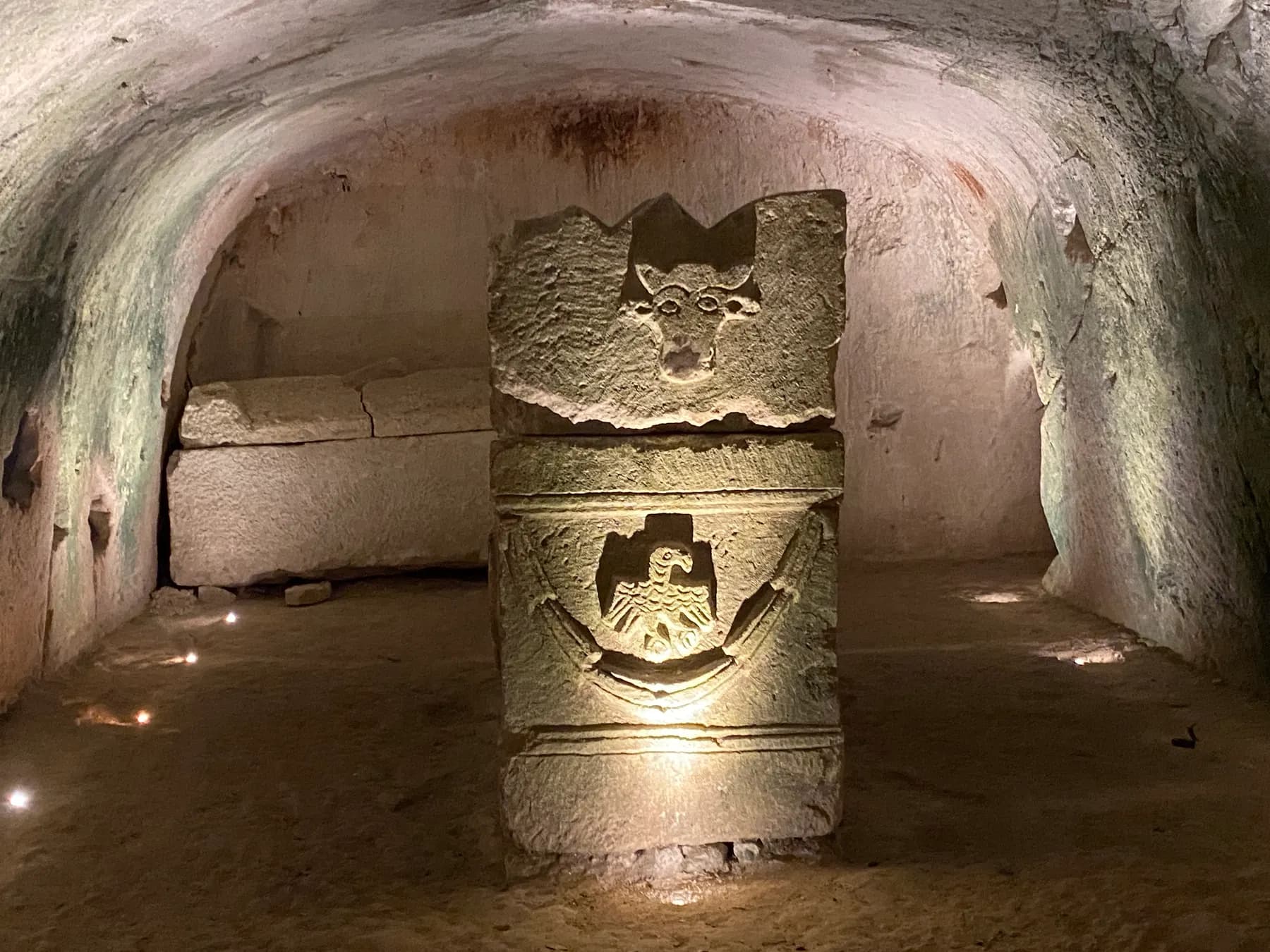
About thirty catacombs cut into the soft chalk of Sheikh Abreik hill, holding more than three hundred funerary inscriptions in Greek, Hebrew, Aramaic and Palmyrene, around the tomb attributed to Rabbi Judah ha-Nasi.
שלמה רודד / CC BY 2.5 · Wikimedia Commons
Adult admission
₪24
the Israel Nature and Parks Authority's published rate, with children at ₪10 and soldiers in compulsory service free
Catacombs cut into the hill
about 30
on the Parks Authority's count, inscribed by UNESCO as a World Heritage Site in July 2015
Funerary inscriptions recorded
more than 300
the majority in Greek, the rest in Hebrew, Aramaic and Palmyrene
Burial places in the largest cave
some 380
the Cave of the Horseman, in 16 chambers branching off one long corridor at several levels
In short
- How long to give it
- about 90 minutes for the upper and lower trails and the main caves, or nearer three hours if the Menorah Caves tour and the menorah presentation are added
- Summer, Sunday to Thursday and Saturday
- 08:00–17:00
- Adult
- ₪24
גן לאומי בית שערים
Beit She'arim National Park is a hillside of rock-cut Jewish burial caves in the western Jezreel Valley, about ten minutes from the centre of Kiryat Tivon, together with the excavated town that stood above them. The Israel Nature and Parks Authority runs it. Around thirty catacombs were cut into the soft chalk of Sheikh Abreik hill, the smaller ones holding dozens of graves and the largest close to four hundred, and more than three hundred funerary inscriptions have been recorded in them, most in Greek and the rest in Hebrew, Aramaic and Palmyrene.
The necropolis exists on this scale because of one man. Rabbi Judah ha-Nasi, head of the Sanhedrin, moved his study house and the Sanhedrin here from Shefar'am and was buried here in 220 CE, although he spent his last seventeen years at Zippori compiling the Mishnah. After that, with Jewish burial in Jerusalem prohibited by the Roman authorities, bodies were brought to this hill from Tyre and Antioch, from Palmyra in Syria and from Himyar in Yemen.
A visit is a chain of courtyards cut into the slope, each with a facade borrowed from classical architecture and a stone door hung on a rock hinge. Adult entry is ₪24, entry closes a full hour before the gate does, and the Menorah Caves on the western slope can be seen only with a Parks Authority guide, by arrangement.
The town
Besara, a hundred dunams of town on top of the graves
The Hebrew name means house of gates, and the Parks Authority offers two explanations without choosing between them: the gates in the town wall, or se'orah, barley, for the fields around it. In Aramaic the place is Beit Sh'arei; in Greek it is Besara, and Greek inscriptions carrying that name confirmed the identification. Josephus is the first writer to name it, as the centre of an estate belonging to Berenice, daughter of Agrippa I. The earliest building remains on the hill date from the second century BCE.
Its importance is second and third century. Judah ha-Nasi, known in the sources simply as Rabbi, moved his study house and the Sanhedrin from Shefar'am to Beit She'arim; the Roman authorities had granted him tenant status on several estates, one of them here, which the Parks Authority gives as the reason he chose the place for his grave. The excavated town covers about 100 dunams and has produced a synagogue, a basilica, a study house, dwellings, a wall, a gate and an olive press.
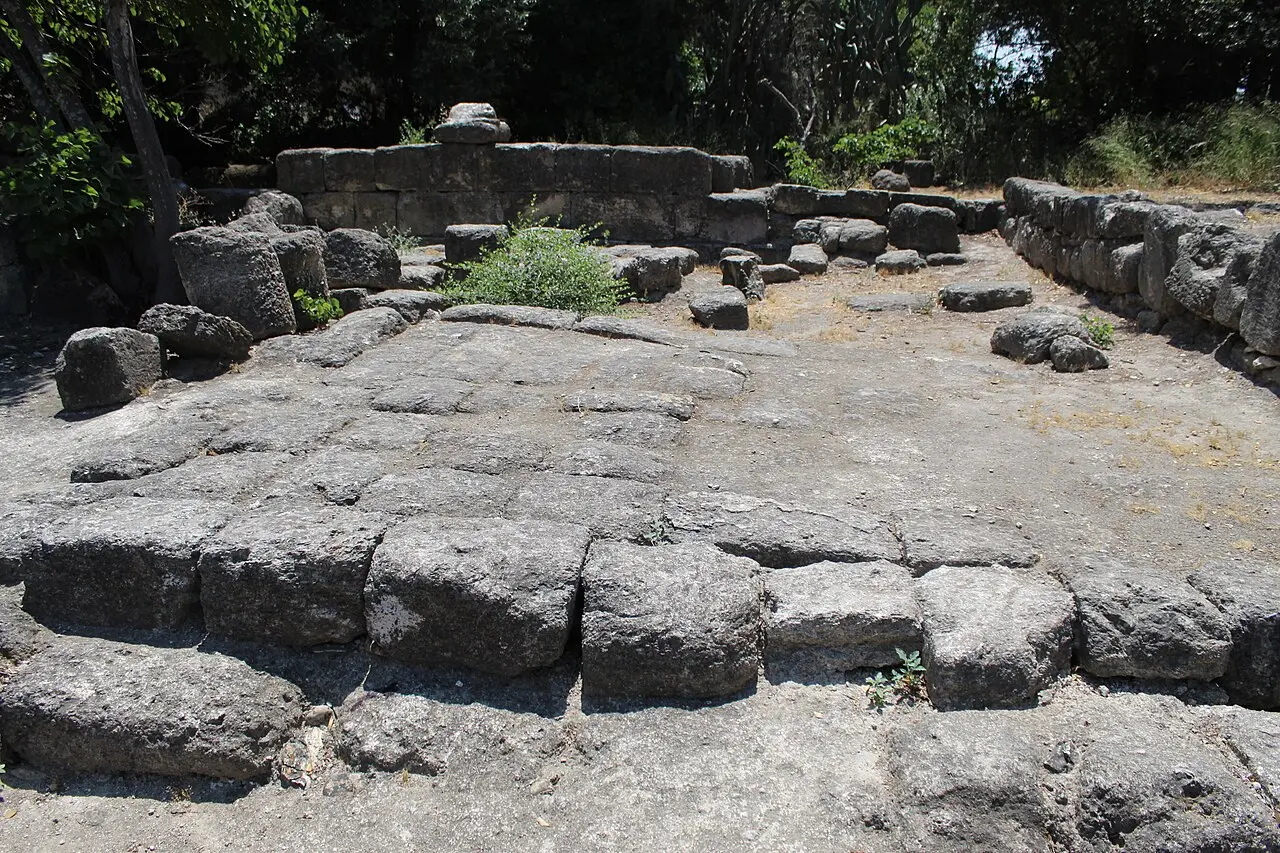
The synagogue is a hall of large dressed ashlars, 35 metres by 15, its facade turned towards Jerusalem; one of its two Greek inscriptions reads "Jacob of Caesarea, head of the synagogue of Pamphylia. Shalom", and shalom is the only word in it written in Hebrew. The decline was quick. Once the Sanhedrin moved on to Zippori the building work coarsened, though burials went on in plainer forms, and the town was destroyed and burned in the fourth century CE. Britannica dates the synagogue's destruction precisely, to 352; the Parks Authority gives only the century.
Davidbena / CC BY-SA 4.0 · Wikimedia Commons
The dead
Buried beside Rabbi, and carried in from Yemen
Judah ha-Nasi died at Zippori and was buried here in 220 CE, in a grave prepared while he was alive. The Talmud records the arrangement plainly: "Rabbi was lying [on his sickbed] at Sepphoris but a [burial] place was reserved for him at Bet She'arim" (Ketuboth 103b). Afterwards the cemetery acquired a sanctity of its own, and two things worked together: proximity to Rabbi, and the Roman prohibition on Jewish burial in Jerusalem.
The inscriptions then read like a shipping manifest of the eastern Roman world, recording origins, trades and family ties. In the Cave of the Syrian Jews a Greek text marks the tomb of "Edesios, head of the council of elders of Antioch". Sarah's Cave has "Burial place of Theodosia also called Sarah of Tyre" on a basalt lintel, and a marble tablet for "Caliope the elder, who is also the freedwoman of Procopius", which the Parks Authority reads as evidence both of slavery among Jews and of release from it.
The Textile Merchants Cave holds six inscriptions, among them "Sabirius son of Sabinus, the chief textile dyer", and a marble plaque reading "Daniel son of Ada of Tyre" in Greek with the single Hebrew word shalom below. Grave robbery is a theme rather than a footnote: the Cave of the Breach is named for the hole above its door, where robbers gave up on the stone slab and went through the weak point beside it, and the Cave of the Curses next door carries twelve texts including one promising an evil end to anyone who opens the graves.
The caves
Stone doors on rock hinges, and 135 coffins in one cave
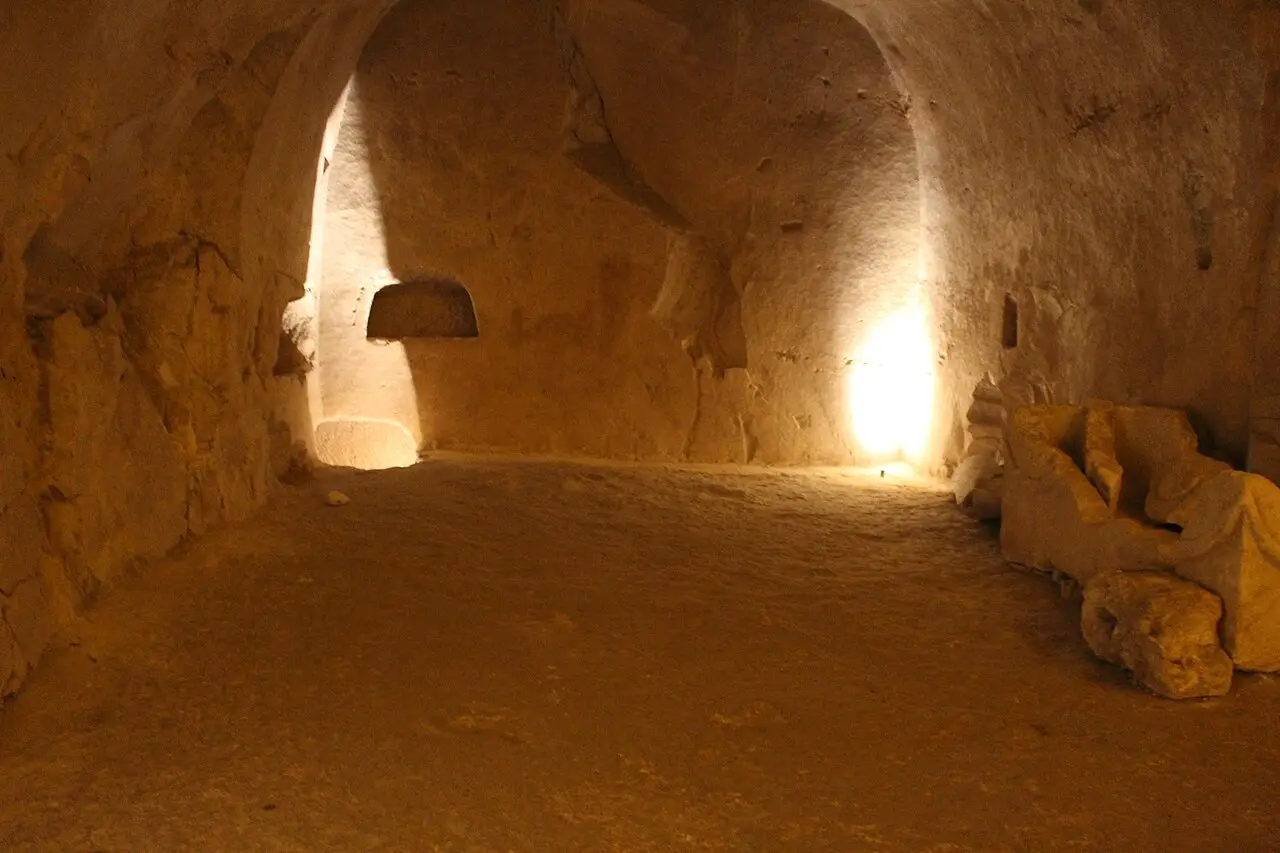
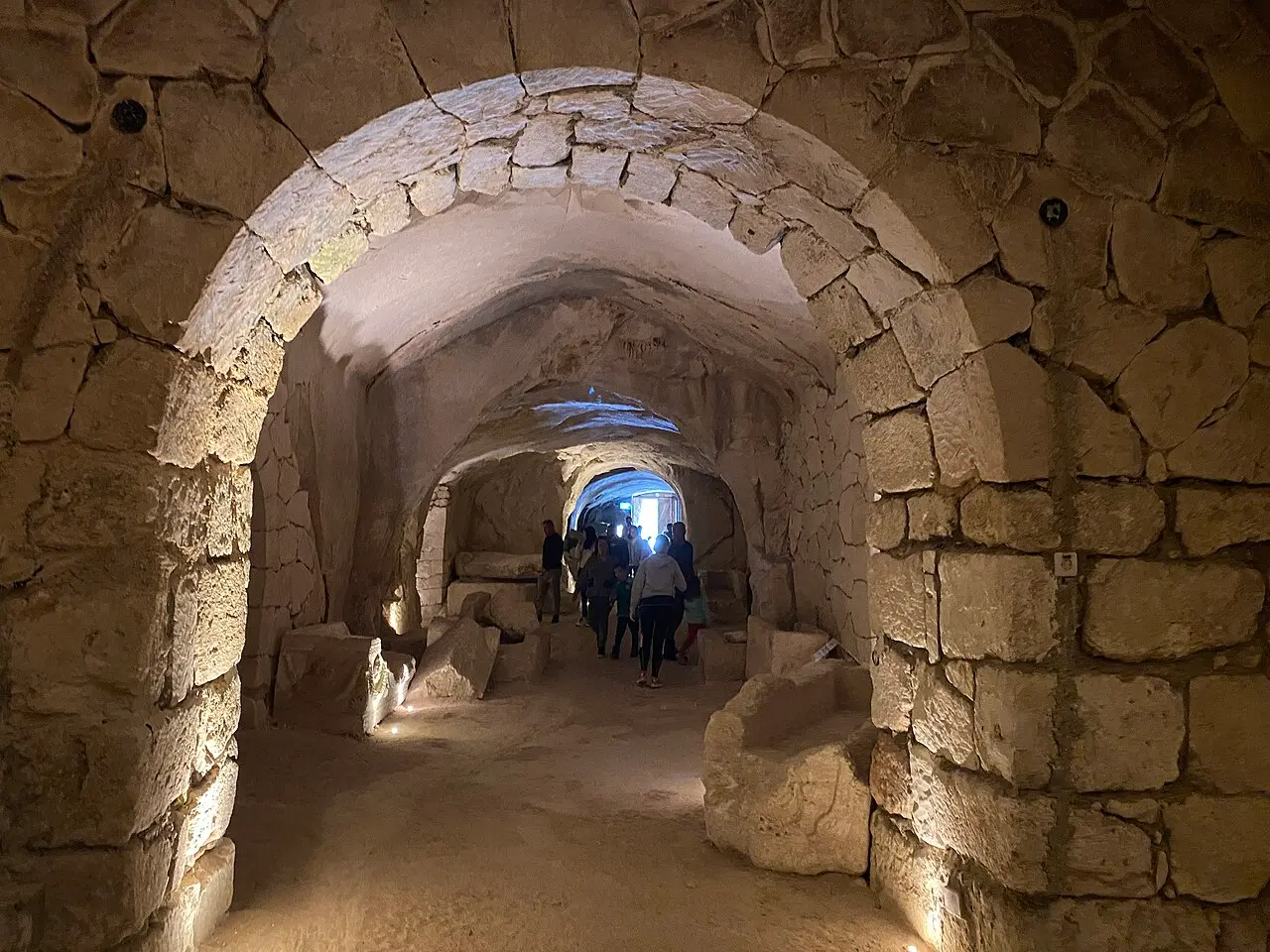
The pattern repeats down the slope. Steps drop into an open courtyard; the cave front behind it is dressed as classical architecture; in the middle is a door cut from a single slab, turning on a rock hinge, carved with bands and studs in imitation of the metal reinforcement used on wooden doors. Several keep the ring that was pulled to swing them. Behind the doors the burials take four forms: arcosolia, benches under an arched ceiling and the commonest type here, loculi driven into the wall, graves sunk into the floor, and free-standing stone coffins.
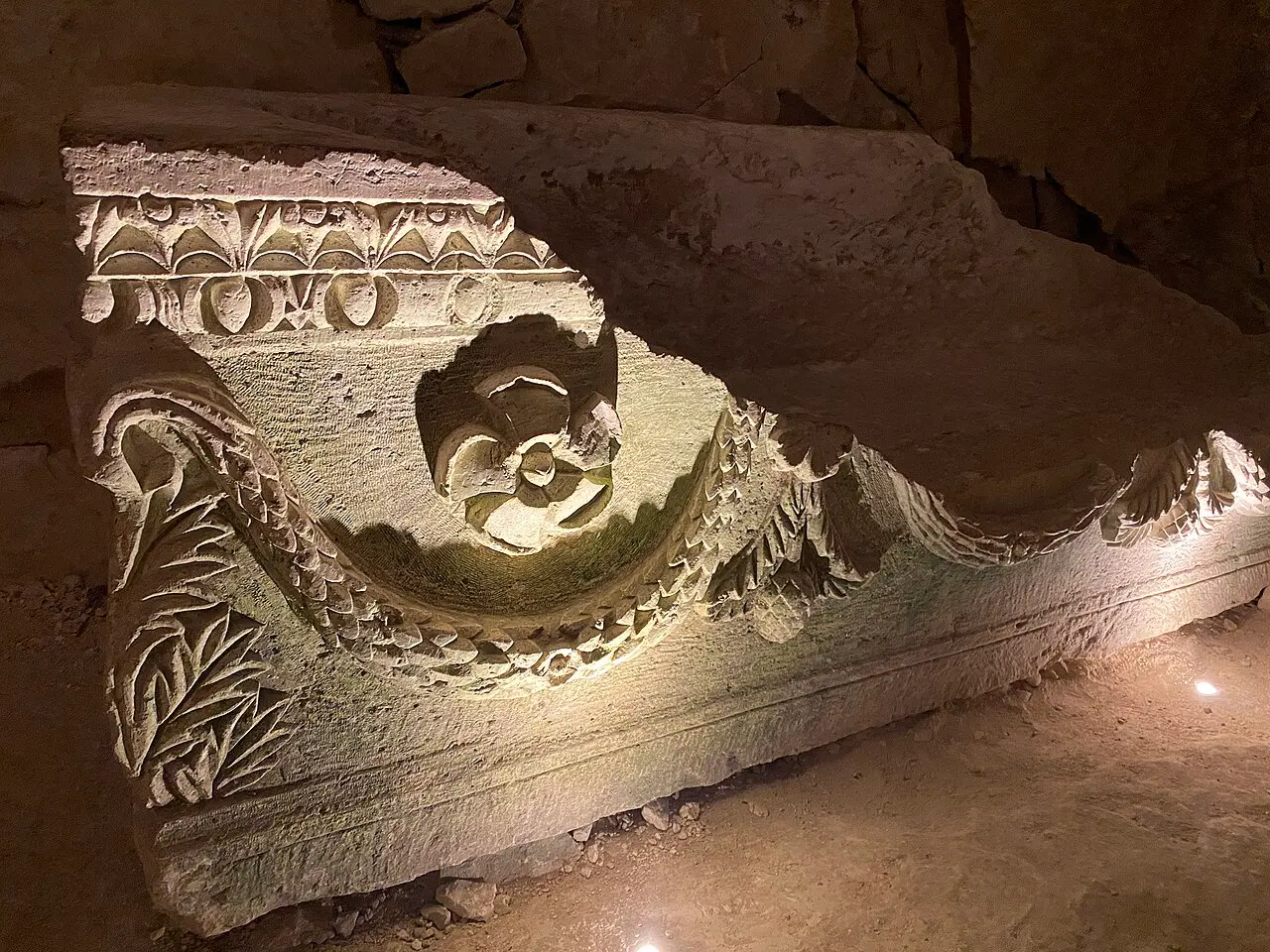
The Cave of the Coffins is the largest system found, 75 by 75 metres behind a three-arched facade. It held 135 sarcophagi, twenty finely carved, mostly with bulls, eagles, lions, birds and fish. On its wall is a menorah in relief 1.9 metres high and 1.25 metres wide, standing as much as 36 centimetres out from the rock, which the Parks Authority calls the mother of all menorahs. The Cave of the Horseman is the biggest by capacity: some 380 burial places in sixteen chambers off one corridor, with Palmyrene inscriptions in four of the halls.
The cave attributed to Judah ha-Nasi has three doorways under a triple arch eight metres high, and painted inscriptions naming Rabbi Shim'on, Anina the younger and Rabbi Gamaliel. In the back room are two rectangular graves cut side by side into the floor, unusual here, once covered by heavy slabs and carrying no inscription at all. The identification rests on the combination: those were the names of his two sons and of a rabbi he appointed head of the Sanhedrin, a bench structure for memorial gatherings sits directly above, and he had asked to be buried in the ground rather than in a coffin. The Parks Authority calls that reasonable evidence rather than proof.
- Cave of the Coffins (20): 75 by 75 metres, 135 sarcophagi, the 1.9-metre menorah relief
- Cave of the Horseman (1): some 380 burial places, Palmyrene inscriptions in four halls
- Cave of Rabbi Yehuda Hanasi (14): a triple arch 8 metres high and two unmarked floor graves
- Cave of the Steps (13): twelve chambers on two levels, 26 inscriptions in Greek and Hebrew
- Cave of the Curses (12): twelve Greek and Aramaic inscriptions, several of them threats
- Museum Cave (28): a cistern turned glass workshop, now the site's interpretation room
Davidbena / CC BY-SA 4.0 · Wikimedia Commons
What survives
Original rock, a restored relief and a 1940s concrete floor
Almost everything underground is original cutting. These are not reconstructed buildings but voids hewn from chalk, and what has been added is lighting, paths and safety work. The interventions are on the decorated surfaces: the relief of a warrior with a menorah above his head was badly damaged by vandals and has been restored, and the great menorah in the Cave of the Coffins was stabilised by the Parks Authority with the Israel Antiquities Authority to stop it deteriorating.
Two spaces were never tombs in their present form. The Museum Cave began as a cistern, became a glass workshop and is now the park's interpretation room; in the middle of it lies a slab of glass weighing 8.8 tonnes, made in the ninth century CE and apparently abandoned because of a flaw. Accounts differ in detail, with Wikipedia's article reporting that a bulldozer turned it up in 1956 and putting it at about nine tons. The other is the Slik Cave, a Roman reservoir 26 metres long holding more than 1,300 cubic metres, which the Haganah floored in concrete in the early 1940s and used as a firing range and weapons cache, and which was fully excavated in 2014.
The most consequential thing above ground is the planting. The park was laid out in the 1950s by the landscape architect Lipa Yahalom, who won the Israel Prize for the work, and those trees have matured and are now driving roots into the chalk, opening and widening cracks over the burial chambers. In May 2026 the Parks Authority announced that about a hundred trees, mostly cypress, would be felled over roughly three days to save caves 25, 26 and 27, which it says are already closed to visitors on safety grounds. It states that the risk of doing nothing includes collapse and transfer to the World Heritage list of properties in danger.
שלמה רודד / CC BY 2.5 · Wikimedia Commons
Rediscovery
A watchman climbed through a hole in a wall in 1936
The hill was surveyed in the nineteenth century but not understood. The Parks Authority credits Claude Conder with the first study of the caves in 1871 and says it revealed very little; Wikipedia's article gives his visit as 1872 and Britannica says the site stayed obscure until a rediscovery in 1875. The accounts agree that nothing much came of it.
The find that mattered was accidental. Alexander Zayid settled on Sheikh Abreik hill in 1926 as a guard for Jewish National Fund land. In 1936 he came upon an opening, entered what is now called the Cave of Hell, got through a hole in its wall into the neighbouring Cave of the Horseman and found ancient Jewish material. He summoned Benjamin Mazar and Yitzhak Ben-Zvi, later Israel's second president; Mazar proposed that the hill was ancient Beit She'arim, and digging began shortly afterwards.
Mazar excavated from 1936 to 1940 for the Jewish Palestine Exploration Society, and Nahman Avigad resumed the work from 1953 to 1958 for the Israel Exploration Society and the Hebrew University; those two campaigns exposed the town and about thirty catacombs. Work restarted in the last decade, on the reservoir in 2014 and on the town from 2014 to 2015 under Adi Erlich of the University of Haifa. Zayid did not see it finish: he was murdered in an ambush in 1938, and a bronze statue of him on horseback now stands on the hilltop beside the double-domed tomb of Sheikh Abreik.
Menorah Caves
Six caves the Knesset paid to open, and a guide you have to book
A second complex opened to visitors in 2009: six burial caves at the foot of the western slope, unusually rich in carving, with dozens of reliefs of the seven-branched menorah on their walls. Because that menorah became the emblem of the state, the Knesset put money into conserving them, which is what made opening part of the group to the public possible.
They are not on the free-roaming circuit. The Parks Authority takes visitors in with one of its own guides only and requires arrangement in advance, citing both the value of the carvings and visitor safety. Its English page gives departures on Fridays and Saturdays at 10:30 and 11:00; its Hebrew page routes bookings through the online reservation system and warns that the entry time to the menorah presentation is exact, so visitors should arrive at least fifteen minutes early.
What is inside is the reason to bother. The Torah Ark Cave has four chambers and about a hundred burial places, with an incised Torah Ark, lions, an altar and a menorah, the figure of a Jewish gladiator beside the Greek words "Germanos son of Isaac the Palmyrene", and a man shown diving, which the Parks Authority suggests may stand for the passage to the world of the dead. The Cave of Hell carries two merchant ships incised on its walls, read as evidence of Jewish seafaring. The tour ends in the reservoir with an audio-visual presentation tracing the menorah from the destruction of the Temple to the emblem of the state.
שלמה רודד / CC BY 2.5 · Wikimedia Commons
What to look for
Things not to walk past at Beit She'arim Necropolis
The details that repay knowing about before you are standing in front of them.
The double grave in Cave 14
Two rectangular graves cut side by side into the floor of the back room, covered once by heavy slabs and carrying no inscription. They fit Judah ha-Nasi's instruction to be buried in the earth rather than in a coffin, which is part of why the cave is attributed to him.
The mother of all menorahs
A seven-branched menorah carved in relief on the wall of the Cave of the Coffins, 1.9 metres high, 1.25 metres wide and projecting up to 36 centimetres from the rock. It has been conserved by the Parks Authority together with the Antiquities Authority.
A stone door still on its hinge
The cave of Yitzhak Ze'ira son of Shim'on keeps the original metal ring used to swing its door, and the bands and studs carved across the slab imitate the metal reinforcement of a wooden door. Several other doors around the site are still hanging where they were fitted.
The 8.8-tonne glass slab
A single block of glass made in the ninth century CE and left in what had been a cistern and then a glass workshop, now the Museum Cave. Blocks like it were broken up and shipped on to workshops; this one seems to have been abandoned because of a flaw.
The Slik Cave
A Roman reservoir 26 metres long that the Haganah fitted with a concrete floor and a door in the early 1940s and used as a firing range and weapons cache. It was fully excavated in 2014 and now houses the menorah presentation.
The Cave of the Curses
Four chambers with twelve inscriptions in Greek and Aramaic, several of them warnings to anyone thinking of opening the graves, including one promising an evil end. A robbers' breach in the wall shows the warning was ignored.
The long view
Beit She'arim Necropolis, in order
2nd century BCE
The earliest building remains on the hill, in the town later known in Greek as Besara.
1st century CE
Josephus is the first writer to name the place, as the centre of an estate belonging to Berenice, daughter of Agrippa I.
late 2nd century CE
Rabbi Judah ha-Nasi moves his study house and the Sanhedrin here from Shefar'am.
220 CE
Judah ha-Nasi, who spent his last seventeen years at Zippori, is buried at Beit She'arim in a grave prepared during his lifetime.
3rd century CE
The cemetery becomes a destination, with Jewish burial in Jerusalem prohibited; bodies are brought from Palmyra, Antioch, Tyre and Himyar.
end of the 3rd century CE
After the Sanhedrin moves to Zippori the quality of construction declines, though burials continue in simpler forms.
352 CE
Britannica dates the destruction of the town's synagogue to this year.
4th century CE
Beit She'arim is destroyed and burned. The caves are gradually covered by earth and vegetation.
9th century CE
A glass workshop operates in a former cistern on the site, leaving behind the 8.8-tonne slab now displayed in the Museum Cave.
c. 900 CE
An eleven-line Arabic funerary poem is painted in the Cave of Hell. It was recorded in excavation and has since disappeared.
1871
Claude Conder makes the first study of the caves, on the Parks Authority's dating, and finds very little. Other accounts give 1872 or 1875.
1926
Alexander Zayid settles on Sheikh Abreik hill as a guard for Jewish National Fund land.
1936
Zayid finds a cave opening and gets through a wall into the Cave of the Horseman. Benjamin Mazar and Yitzhak Ben-Zvi are summoned and Mazar identifies the site.
1936–1940
Mazar excavates for the Jewish Palestine Exploration Society.
1938
Zayid is murdered in an ambush. A bronze statue of him on horseback now stands on the hilltop.
early 1940s
The Haganah casts a concrete floor in the Roman reservoir and uses it as a firing range and a hidden weapons cache.
1950s
The national park is laid out by the landscape architect Lipa Yahalom, who won the Israel Prize for the work.
1953–1958
Nahman Avigad resumes excavation for the Israel Exploration Society and the Hebrew University, exposing the town and about thirty catacombs.
1997
The Parks Authority and the Kiryat Tivon Local Council start a community project training residents as volunteer guides in the park.
2009
The Menorah Caves, six burial caves on the western slope conserved with Knesset funding, open to guided visits.
2014
The Slik Cave reservoir is excavated by Tsvika Tsuk and Iossi Bordowitz under the auspices of the Antiquities Authority.
2014–2015
Adi Erlich renews excavation of the town itself for the University of Haifa's Institute of Archaeology.
July 2015
UNESCO inscribes the necropolis as a World Heritage Site, under the name Necropolis of Beit She'arim: A Landmark of Jewish Renewal.
May 2026
The Parks Authority announces the felling of about a hundred trees, mostly cypress, to stop roots splitting the rock above caves 25, 26 and 27.
Practical
Visiting Beit She'arim Necropolis
Where
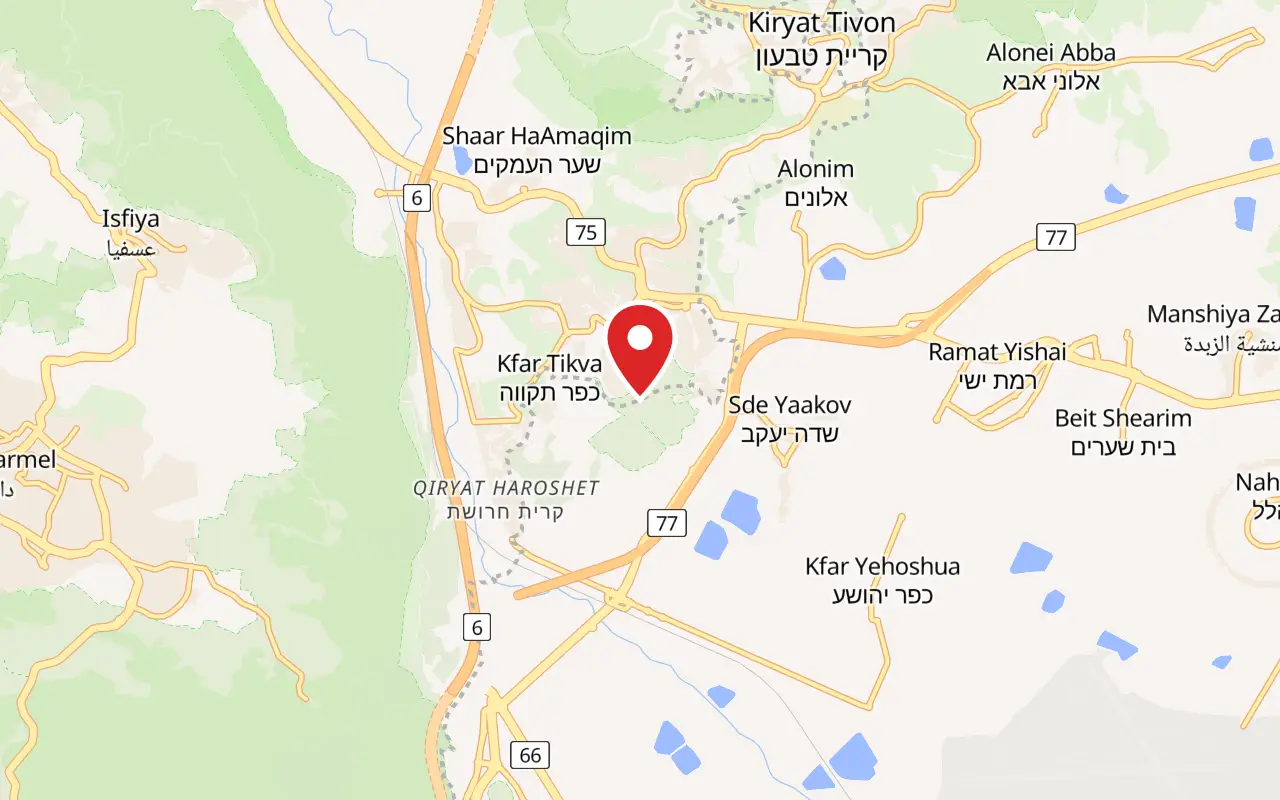
Bet She'arim National Park, near Kiryat Tivon, western Jezreel Valley. From Tel Aviv the Parks Authority routes drivers along Road 4 to Furedis Junction, east on Road 70 to Yokne'am Junction, then Road 722 to Hashomrim Junction and the first left. Its Hebrew page gives the Waze coordinates as 32.7027036, 35.1275862. Telephone 04-9831643.
What ticket you need
Beit She'arim is a national park in its own right, with one gate and one ticket, and nothing here sits inside a larger paid site. The Menorah Caves complex is inside the same park and inside the same admission, but it is reached separately and only with a guide. The Parks Authority's Israel Pass cards are valid at up to 70 national parks and nature reserves and run for two weeks from first entry, with the Matmon annual subscription valid for a year from purchase.
Opening hours
- Summer, Sunday to Thursday and Saturday
- 08:00–17:00source
- Summer, Friday and holiday eves
- 08:00–16:00source
- Winter, Sunday to Thursday and Saturday
- 08:00–16:00source
- Winter, Friday and holiday eves
- 08:00–15:00source
- Rosh Hashanah eve, Passover eve and Yom Kippur eve
- 08:00–13:00source
- Last entry
- One hour before the closing time listed, so 15:00 on a winter weekdaysource
- Menorah Caves, guided departures
- Fridays and Saturdays at 10:30 and 11:00, by arrangement and with a site guidesource
Admission
- Adult
- ₪24source
- Child
- ₪10source
- Student
- ₪20source
- Israeli senior citizen
- ₪12source
- Adult in a group
- ₪20, for groups of more than 30 on the Hebrew price listsource
- Child in a group
- ₪9source
- Soldier in compulsory, national or civilian service, on the Hebrew price list
- Free on production of a valid card, with reservists at ₪18 and school pupils at ₪8source
- Children up to five
- Exempt from entrance fees to national parks and nature reservessource
Access
Partly, and the Parks Authority is specific about which parts. Entry to the national park is by car, and there is parking beside the visitor service centre and, by prior arrangement, beside the Menorah Caves. In the heart of the park the operator lists as accessible: parking, concrete and paved paths, the service centre, lavatories, handrails on the built steps, shaded picnic corners, drinking fountains and directional signage. Beside the service centre there are models and explanatory panels that it presents as an alternative to going into the caves. Among the burial caves themselves it lists only three adaptations: the cave of Rabbi Yehuda Hanasi can be reached and viewed from outside the entrance, the Cave of the Coffins has a slightly raised threshold at the door but an accessible interior, and the entrance lobby of the Menorah Caves complex is accessible with the audio-visual presentation adapted for people with a hearing impairment. Nothing else underground is on the list. The park's own rules warn of open pits and of a slipping risk in autumn, winter and spring, and there is a separate accessible visit coordination form for visitors with disabilities.
On site
- Visitor service centre with hot and cold drinks, ice cream, fast food, snacks and souvenirs
- Books, sun cream and hats on sale
- Shaded picnic corners and picnic tables around the car park
- Lavatories
- Drinking fountains
- Information centre and site model at the start of the visitor trail
- Museum Cave interpretation room
- Car park, with vehicle access into the park
- Barbecues permitted, open campfires not
- Junior ranger activity booklet for children
Booking
The Menorah Caves cannot be visited alone. The Parks Authority takes visitors in with one of its own guides only, by prior arrangement, and its Hebrew page routes that through the online reservation system; the entry time to the menorah presentation inside the reservoir is exact, so it asks people to arrive at least fifteen minutes early. Booking a visit to the park generally is not compulsory, but a visitor who has registered and finds the site full may be asked to show the visit coordination confirmation at the gate. Organised groups wanting a guide go through the Carmel instruction centre rather than the gate.
Hours and prices are given as the operator publishes them and change without much notice, particularly around Shabbat and the festivals. Check the operator's own page before you travel for this.
Official page at en.parks.org.il →What people wish they had known
- Book the Menorah Caves before travelling, not at the gate. They are the richest carving on the site and the Parks Authority will not let anyone in without one of its guides. Its English page lists departures only on Fridays and Saturdays at 10:30 and 11:00, so a Tuesday visit that has not been arranged in advance will not include them.
- Check which caves are shut the morning of the visit. As of August 2026 caves 25, 26 and 27, the first three on the Parks Authority's own suggested route from the information plaza, are closed on safety grounds while roots are cleared from above them, and the Cave of the Engaged Columns is also listed as not open to the public.
- Work back from the closing time. Entry closes a full hour before the gate, and in winter the gate closes at 16:00, so arriving at 15:15 in January means being turned away with the ticket unbought.
- Do not bring candles into the caves. The park's rules ban them outright, along with taking animals underground, and warn about open pits and about slipping on the rock in autumn, winter and spring. Flat shoes with grip matter more here than at most excavated sites.
- The dog rule is published two ways and the caves are the constant. The English page states that entry for dogs is prohibited; the Hebrew page says dogs are permitted on a lead and muzzled but not inside the burial caves. Either way a dog cannot go where the visit actually happens, so leaving it at home is the safe reading.
- The town is a separate walk from the necropolis. The synagogue, the basilica, the Zayid statue and the sheikh's tomb are on the upper trail at the top of the hill, and visitors who spend all their time in the caves below usually miss the view over the Jezreel Valley entirely.
The figures
Beit She'arim Necropolis by the numbers
Each figure carries the year it belongs to and links the source it came from.
| Measure | Figure | As of | Source |
|---|---|---|---|
| Adult admission | ₪24 | 2026 | en.parks.org.il |
| Child admission | ₪10 | 2026 | en.parks.org.il |
| Catacombs discovered on the hill | about 30 | 2025 | static-en.parks.org.il |
| Funerary inscriptions recorded | more than 300, in Greek, Hebrew, Aramaic and Palmyrene | 2025 | static-en.parks.org.il |
| Burial places in the Cave of the Horseman | some 380, in 16 chambers | 2025 | static-en.parks.org.il |
| Sarcophagi found in the Cave of the Coffins | 135, twenty of them finely carved | 2025 | static-en.parks.org.il |
| Area of the excavated ancient town | about 100 dunams, 10 hectares | 2025 | static-en.parks.org.il |
| Capacity of the Roman reservoir known as the Slik Cave | more than 1,300 cubic metres, in a chamber 26 m long and 6 m deep | 2025 | static-en.parks.org.il |
While you are here
The rest of The Galilee
Everything else in this destination with a page of its own.
Yair Haklai / CC BY-SA 4.0 · Wikimedia Commons
Archaeological site
Zippori National Park
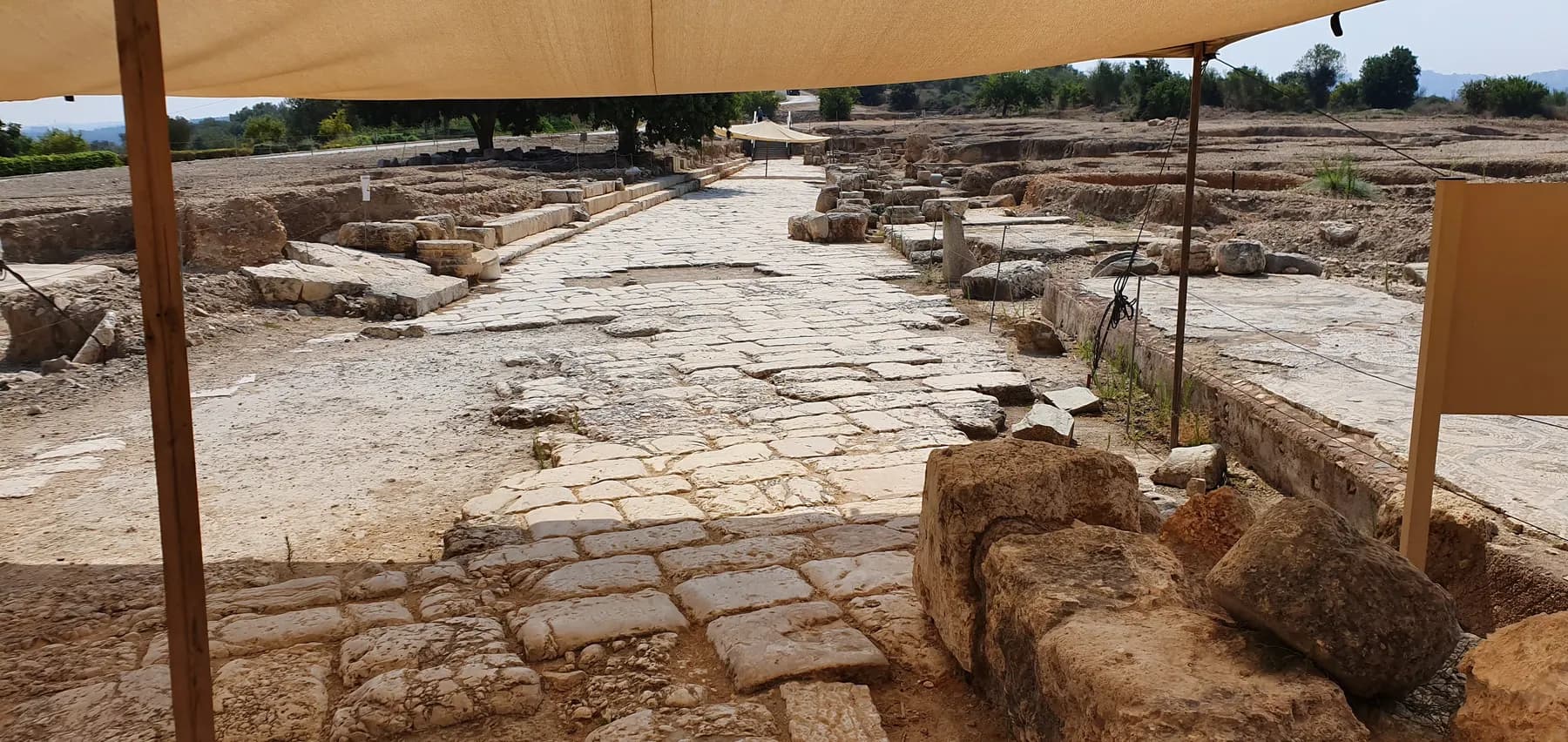
The Roman capital of the Galilee, where the dining room of a third-century mansion holds the face known as the Mona Lisa of the Galilee and a rock-cut reservoir 260 metres long runs under the hill to the east.
כובש המלפפונים / CC BY-SA 4.0 · Wikimedia Commons
Religious site
Basilica of the Annunciation
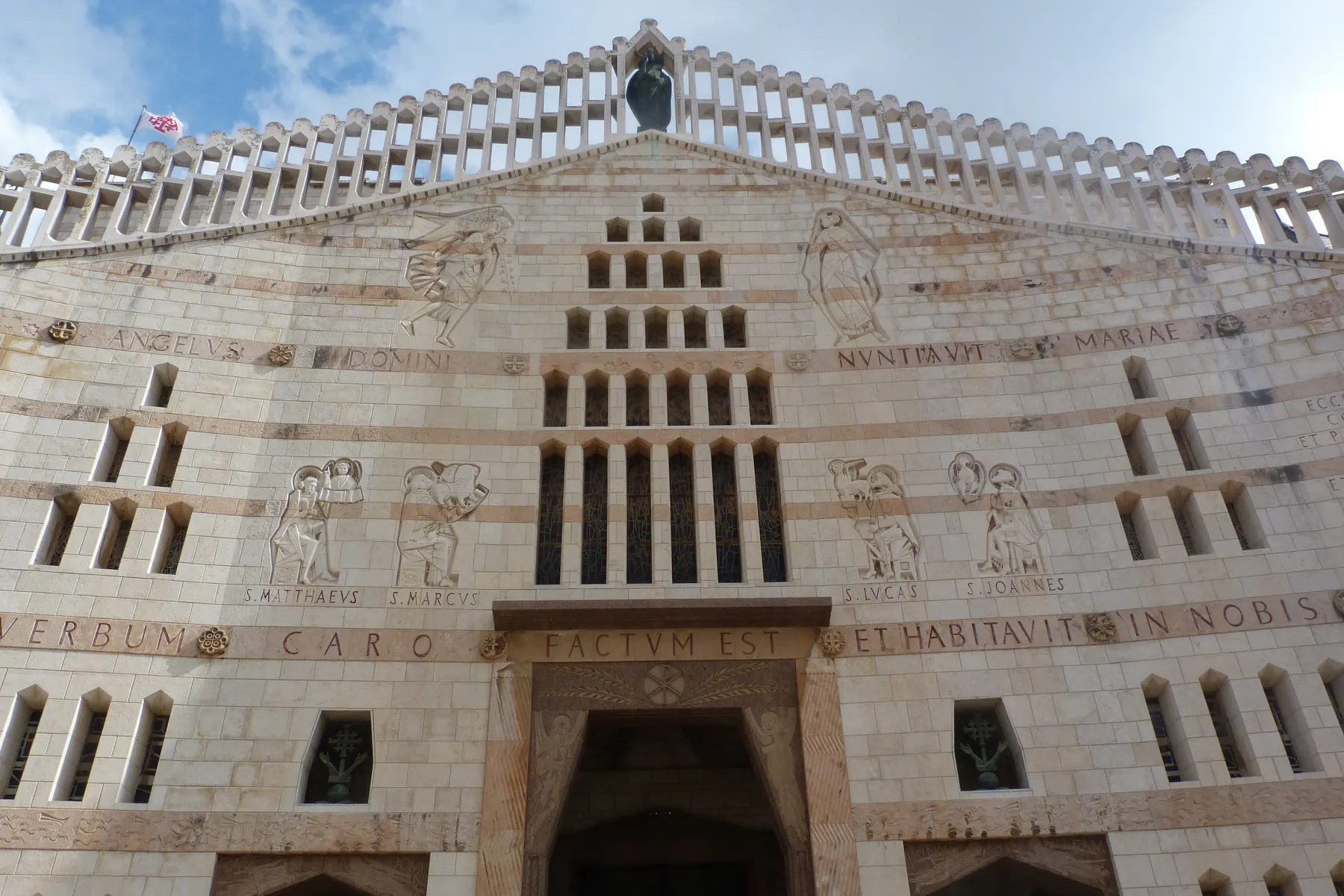
The Custody of the Holy Land dropped Antonio Barluzzi's design for this church and built Giovanni Muzio's instead: two churches stacked over one rock-cut cave, with the excavated village of Nazareth left open in the floor between them.
Museum
Nazareth Village
The hillside was quarried and farmed in the Late Hellenistic and Early Roman periods, and the wine press cut into its bedrock sits about 500 metres from the centre of the village Nazareth grew out of.
Sources and further reading
Every link below was opened and checked when this page was written. Official statements are marked as such: they are the subject's own account, not an independent one.
- OfficialIsrael Nature and Parks Authorityen.parks.org.ilBet Shearim National Park
Summer and winter opening hours, the one-hour last-entry rule, the entrance fees of ₪24 adult, ₪10 child, ₪20 student and group adult, ₪9 group child and ₪12 Israeli senior, the Menorah Caves departures on Fridays and Saturdays at 10:30 and 11:00, the visitor centre stock, the dogs notice, the telephone number and the driving route from Tel Aviv
- OfficialIsrael Nature and Parks Authorityparks.org.ilגן לאומי בית שערים
The fuller Hebrew price list with reservists at ₪18, pupils at ₪8 and free entry for soldiers in compulsory service; the accessibility list cave by cave; the dogs rule permitting them on a lead but not in the burial caves; the synagogue at 35 by 15 metres and its Pamphylia inscription; the Waze coordinates; the fifteen-minute rule for the menorah presentation; and the notice that the entrance pavilion is being renovated
- OfficialIsrael Nature and Parks Authoritystatic-en.parks.org.ilBet She'arim National Park, visitor brochure
The history of research from Conder in 1871 through Mazar, Avigad, Tsuk and Erlich; the town at about 100 dunams; the roughly 30 catacombs and more than 300 inscriptions; the cave-by-cave descriptions and quoted inscriptions; the Cave of the Coffins at 75 by 75 metres with 135 sarcophagi and the 1.9-metre menorah; the Cave of the Horseman at some 380 burial places; the Slik Cave dimensions and its Haganah use; the 8.8-tonne glass slab; Lipa Yahalom's 1950s design; and the rules for visitors
- OfficialIsrael Nature and Parks Authoritystatic.parks.org.ilדפדפת גן הלאומי בית שערים
The Hebrew edition of the same brochure, used to check the cave descriptions, the numbering and the quoted inscriptions against the English translation
- OfficialIsrael Nature and Parks Authorityparks.org.ilטיפול בנזקי שורשי עצים להצלת מערות הקבורה העתיקות בגן לאומי בית שערים
The notice of 6 May 2026 setting out the root damage to caves 25, 26 and 27, the felling of about a hundred trees over roughly three days, the backing of the Antiquities Authority, the closure of those caves on safety grounds and the stated risk of transfer to the World Heritage in-danger list
- OfficialIsrael Nature and Parks Authorityen.parks.org.ilWorld Heritage Sites
The Necropolis of Bet She'arim listed among Israel's inscribed World Heritage Sites with the year 2015
- OfficialIsrael Nature and Parks Authorityen.parks.org.ilIsrael Pass
The multi-site cards covering up to 70 national parks and nature reserves, valid two weeks from first entry, the Matmon card valid a year from purchase, and the exemption for children up to five
- ReferenceEncyclopaedia Britannicabritannica.comBet She'arim
Judah ha-Nasi's dates of about 135 to 220 CE, the town becoming the central necropolis of Jewry, the start of excavation in 1936, the destruction of the synagogue in 352, the destruction of the site in the fourth century and its rediscovery in 1875
- ReferenceWikipediaen.wikipedia.orgBeit She'arim necropolis
The UNESCO inscription of 2015 at the 39th session under criteria ii and iii and the official name Necropolis of Beit She'arim: A Landmark of Jewish Renewal; the count of close to 300 sepulchral inscriptions; Conder's visit given as 1872; and the glass slab reported as turned up by a bulldozer in 1956 at about nine tons
Beit She'arim Necropolis: common questions
What is Beit She'arim?+
It is a national park in the western Jezreel Valley built around a Jewish necropolis of about thirty rock-cut catacombs, together with the excavated remains of the ancient town of Besara on the hill above them. The Israel Nature and Parks Authority runs it. UNESCO inscribed the necropolis as a World Heritage Site in July 2015, under the name Necropolis of Beit She'arim: A Landmark of Jewish Renewal.
Is Rabbi Judah ha-Nasi really buried here?+
The Parks Authority presents it as a strong inference rather than a settled fact, and calls the evidence reasonable rather than conclusive. Cave 14 contains two unmarked graves cut side by side into the floor, which matches his instruction to be buried in the earth rather than a coffin, and inscriptions in the same cave name Rabbi Shim'on, Rabbi Gamaliel and Anina, who were his two sons and a rabbi he appointed head of the Sanhedrin. A bench structure for memorial gatherings sits directly above it. The Talmud independently records that a burial place was reserved for him here while he lay ill at Sepphoris.
How much does it cost to get in?+
The Parks Authority publishes ₪24 for an adult and ₪10 for a child, with students and adults in groups at ₪20, children in groups at ₪9 and Israeli senior citizens at ₪12. Its Hebrew price list adds ₪18 for reservists, ₪8 for school pupils and free entry for soldiers in compulsory, national or civilian service on production of a valid card. Children up to the age of five are exempt from entrance fees at national parks generally.
What are the opening hours?+
In summer the park opens 08:00 to 17:00 Sunday to Thursday and on Saturday, and 08:00 to 16:00 on Friday and holiday eves. In winter those become 08:00 to 16:00 and 08:00 to 15:00. On the eves of Rosh Hashanah, Passover and Yom Kippur it closes at 13:00. Entry to the park closes one hour before the stated closing time in every case.
How long do you need at Beit She'arim?+
About 90 minutes covers the lower trail through the main burial caves, the Museum Cave and the upper trail to the town and the Zayid statue. Adding the Menorah Caves tour and the menorah presentation inside the reservoir pushes it closer to three hours, and that part has to be booked. Reading the inscription texts on the interpretive signs properly will use the longer figure without any trouble.
Can you go inside the burial caves?+
Yes. The caves that have been prepared for visitors have lighting installed and are entered on foot from open courtyards, and the main circuit takes visitors through several of them, including the Cave of the Coffins with its 135 sarcophagi and the great menorah relief. Not all are open: the Cave of the Engaged Columns is listed as closed to the public, cave 2 is closed because its inscriptions faded away, and caves 25, 26 and 27 are shut on safety grounds while root damage above them is dealt with.
Is Beit She'arim wheelchair accessible?+
Partly, and the underground parts largely are not. The Parks Authority lists accessible parking, concrete and paved paths, the visitor service centre, lavatories, handrails on the built steps, shaded picnic corners and drinking fountains, and it points wheelchair users to the models and explanatory panels beside the service centre as an alternative to going in. Among the caves it lists only three adaptations: the cave of Rabbi Yehuda Hanasi can be reached and viewed from outside, the Cave of the Coffins has a slightly raised threshold but an accessible interior, and the Menorah Caves entrance lobby is accessible. There is a separate coordination form for visitors with disabilities.
Is there shade, and does the month matter?+
The caves themselves are cool and out of the sun, and there are shaded picnic corners and broad-crowned trees around the car park, but the upper trail across the hilltop is open ground. In July and August the sensible plan is an early start with the town and the viewpoint first, keeping the caves for the middle of the day. The Parks Authority warns that the rock is slippery in autumn, winter and spring, which is the trade-off for cooler walking.
Is it worth it if you have already been to Zippori?+
The two are complementary rather than duplicates, and doing both in a day is common. Zippori is where Judah ha-Nasi spent his last seventeen years and compiled the Mishnah; Beit She'arim is where he was buried, and where the Sanhedrin sat before it moved on. The material is different in kind: mosaics and a Roman street grid at one, rock-cut burial architecture and several hundred funerary inscriptions at the other. They are about fifteen kilometres apart.
Why is the Parks Authority cutting down trees at a World Heritage Site?+
Because the trees are destroying the caves. In a notice dated 6 May 2026 the Parks Authority explained that trees planted above the burial caves in the middle of the last century have matured and are driving roots into the soft chalk, opening and widening cracks and threatening partial or total collapse of caves 25, 26 and 27. It said about a hundred trees, mostly cypress, would be felled over roughly three days, that the work is backed by the Antiquities Authority and supervised by an engineer and a landscape architect, and that the alternative risk includes the site being transferred to the World Heritage list of properties in danger.