Museum · Masada
The Masada Museum in Memory of Yigael Yadin
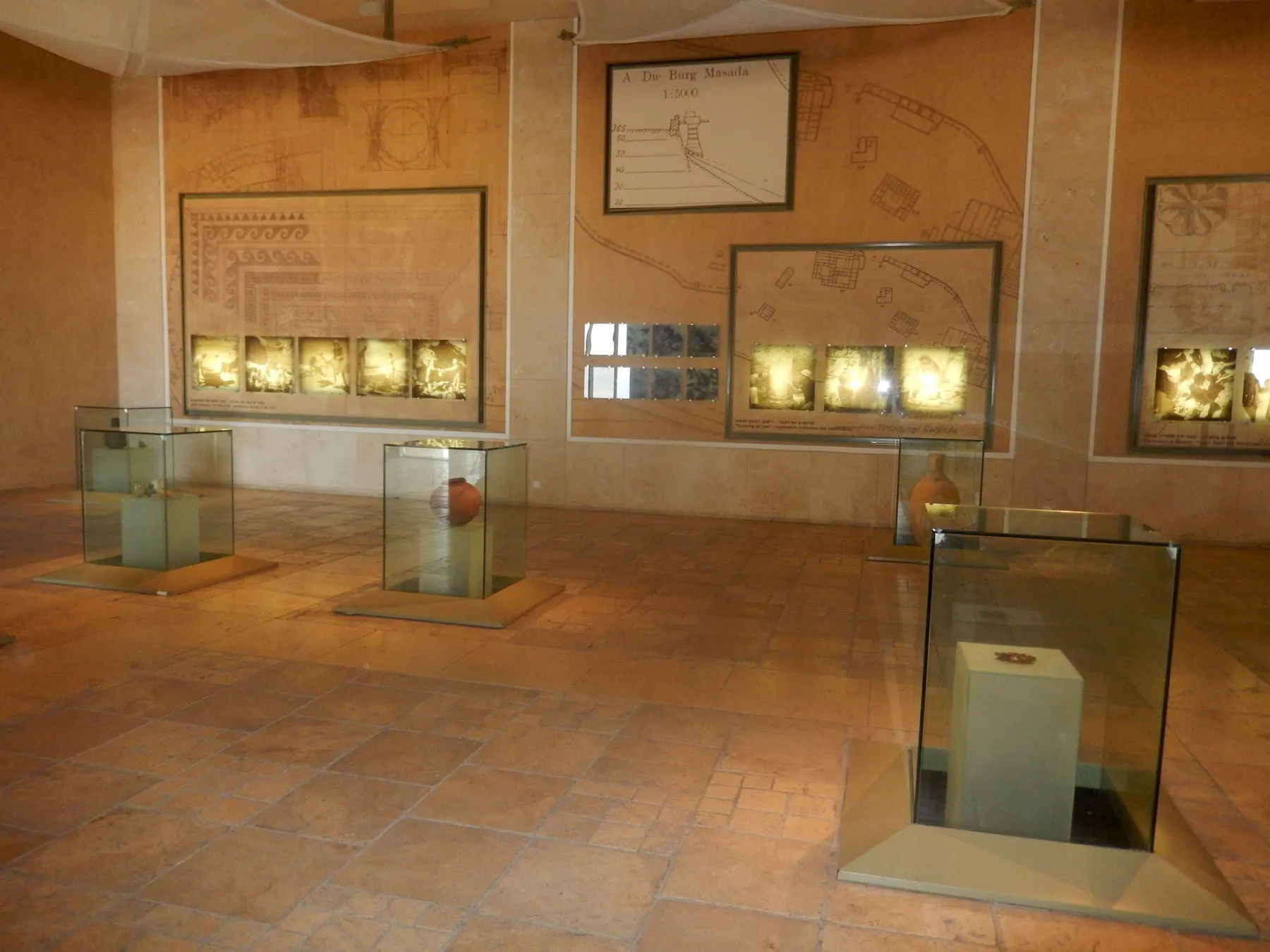
Nine rooms at the foot of the mountain, painted from dark grey to black so that the objects Yigael Yadin's expedition dug out of Masada between 1963 and 1965 are the only lit things in them.
Armineaghayan / CC BY-SA 4.0 · Wikimedia Commons
Rooms
9
divided by archaeological and historical content, per the parks authority
Audio guide
7 languages
Hebrew, English, French, German, Russian, Chinese and Spanish
Museum only
₪20
one price; included at no extra cost with entry to the national park
Excavation
1963–1965
Yadin's Hebrew University expedition, whose finds fill the cases
In short
- How long to give it
- The parks authority publishes no figure for the museum on its own. Its accessible itinerary allows two to four hours for the whole eastern visit, museum and plateau together, depending on how much detail the visitor wants.
- Sunday to Thursday and Saturday
- 08:30 to 15:30
- Museum with park entry
- no additional charge, but a reservation is still required
מוזיאון מצדה על שם יגאל ידין
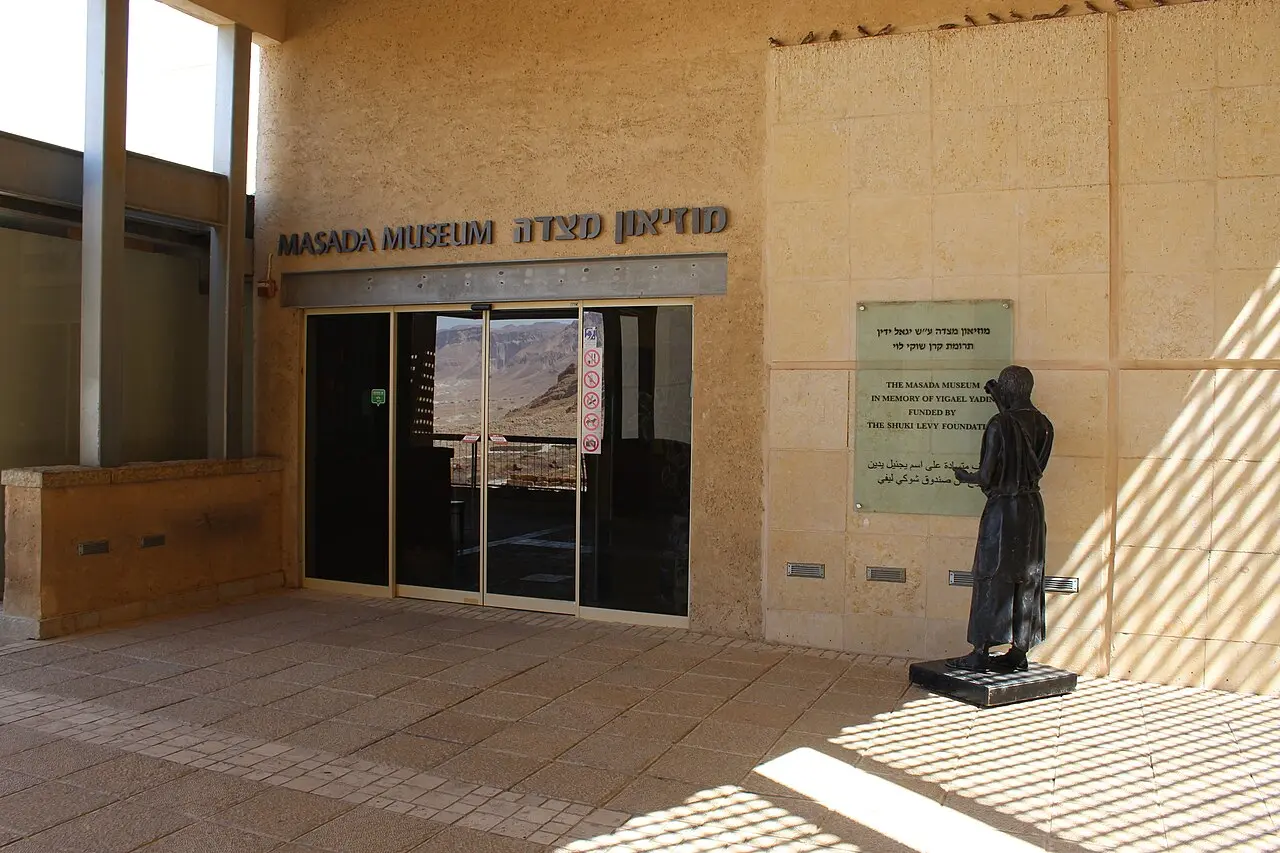
The Masada Museum in Memory of Yigael Yadin is an indoor, ticketed exhibition at the eastern entrance to Masada National Park, in the same complex as the covered car park, the shops, the film halls and the lower station of the cable car. The Israel Nature and Parks Authority, which runs it, describes it as holding the archaeological finds dug out of Masada by the Hebrew University of Jerusalem expedition headed by Professor Yigael Yadin. Its full title on the authority's own signage adds the donor: funded by the Shuki Levy Foundation.
It is not a conventional gallery. The authority divides it into nine spaces according to archaeological and historical content, and each one is a built set: sculpted figures, architectural details, floors and walls, made to match the material culture of the period as closely as possible but finished in dark colours running from dark grey to black. The lighting is kept minimal, so the sets recede and the excavated objects, individually lit and captioned, are what the eye finds. There is no live guide. A recorded track on headphones, offered in seven languages, carries the whole interpretation.
Practically, two things catch visitors out. Entry is by advance reservation only, because the number of people inside at any moment is capped. And the museum closes at 15:30 on most days, well before the national park above it does, so a plan that starts with the plateau and leaves the museum for afterwards often ends with a locked door.
The building
Nine dark rooms below the cable car station
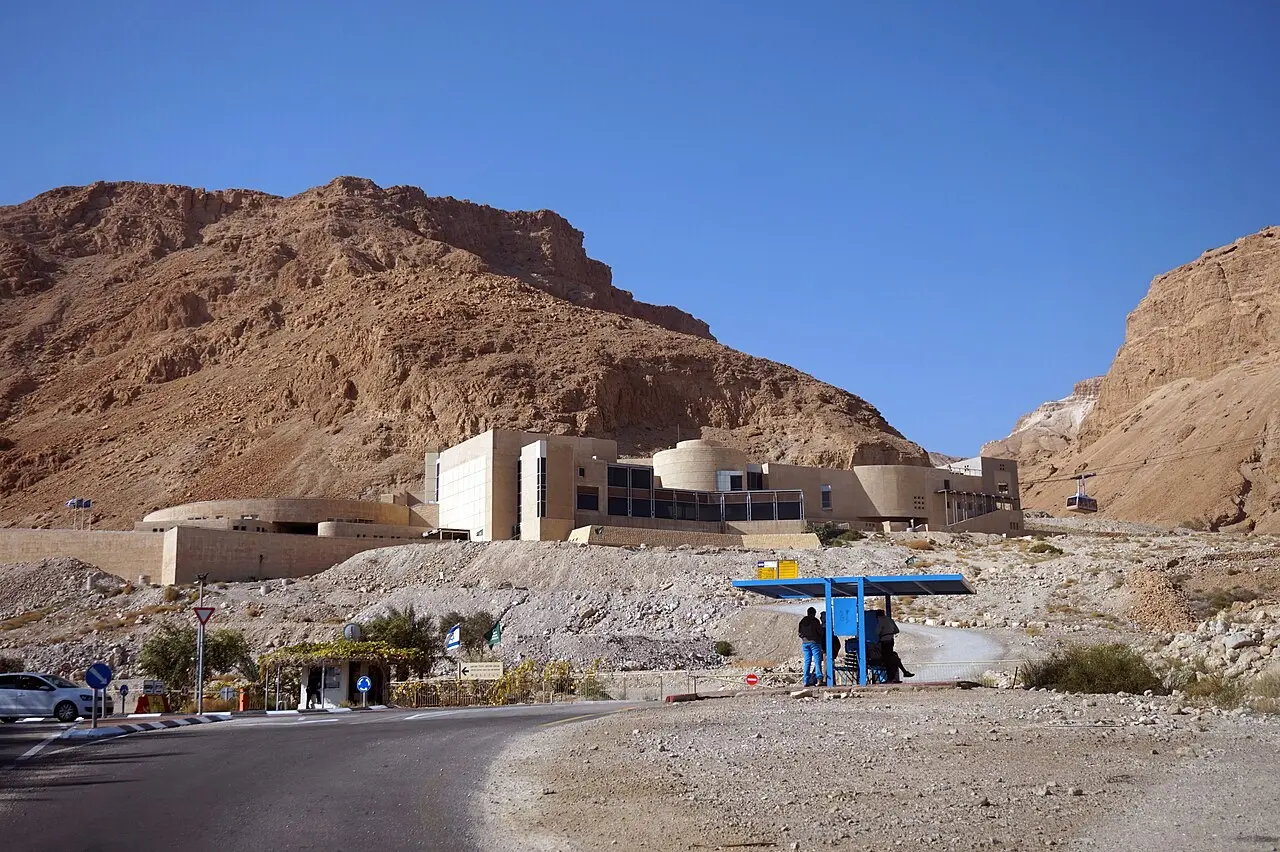
The museum sits in the eastern complex, the one reached from Route 90 on the Dead Sea side, roughly 18 km south of Ein Gedi and 12 km from Ein Bokek. The parks authority lists it alongside the covered parking, the shopping and public areas, the film halls and the lifts as the accessible features of that entrance, and English Wikipedia places the visitor centre and the museum together at the base of the cable car. Nothing about it involves the climb: it is at ground level, indoors and air-conditioned, and it is the last building most visitors pass before they queue for the cable car or start up the Snake Path.
What it does is the reverse of what the plateau does. On top of the mountain there is architecture with its contents removed: rooms, cisterns, a bathhouse floor on its hypocaust columns, a synagogue with two empty pits in the floor. In the museum there are the contents with the architecture removed, arranged around what the authority calls three central focuses, Herod, the rebels and the Roman army, and set in a sequence that begins with Flavius Josephus and ends with the excavator.
The authority's own advice is to do it first. Its accessible itinerary for Masada calls the museum an unmissable stop and a prologue to the visit on the mountain top, and puts the whole eastern circuit, museum and plateau together, at two to four hours depending on how interested you are.
- Eastern entrance, off Route 90, at the base of the cable car
- Nine spaces, grouped around Herod, the rebels and the Roman army
- Josephus at the start of the route, Yadin in the final room
- Reservation compulsory; the number of visitors inside is capped
Mohammad Shad Siddiqui / CC BY-SA 4.0 · Wikimedia Commons
The design
A set built to disappear into its own darkness
The exhibition was put together with Gila Horwitz, its curator, of the Institute of Archaeology at the Hebrew University of Jerusalem, and Eliav Nahlieli, designer and producer, of Programa 1 in Tel Aviv. The parks authority describes the method rather than selling it: finds from the excavations shown against a theatrical design background, with the explanation delivered through headphones.
The colour decision is the whole trick. The three-dimensional backdrops are built to period authenticity as far as the evidence allows, then finished in dark greys and blacks, and lit as little as possible. The authority's own phrase for the effect is a present absence: the scenery is there, and it vanishes into the dark, throwing dramatic angles into relief while the archaeological finds are the lit and labelled objects in the room. Each space pairs a set with the objects that belong in it, so that a stone table and its fine tableware stand in a banquet scene from Herod's day rather than on a shelf.
It is worth being clear about what that costs. A room lit this way is a designed argument about how the objects felt in use, not a neutral case with a label in it, and visitors who prefer to read an object against a plain background will find the staging does a lot of the interpreting for them. It is also genuinely dark, which matters for anyone with poor low-light vision and for anyone hoping to photograph the cases.
The recorded track is not an optional extra here: it is the guide. It runs in Hebrew, English, French, German, Russian, Chinese and Spanish, and the headphones are T-coil compatible, so visitors with a hearing aid carrying a T setting can take the soundtrack through the aid itself with equipment supplied by the staff on site.
The finds
Wine for Herod, straw baskets for the rebels
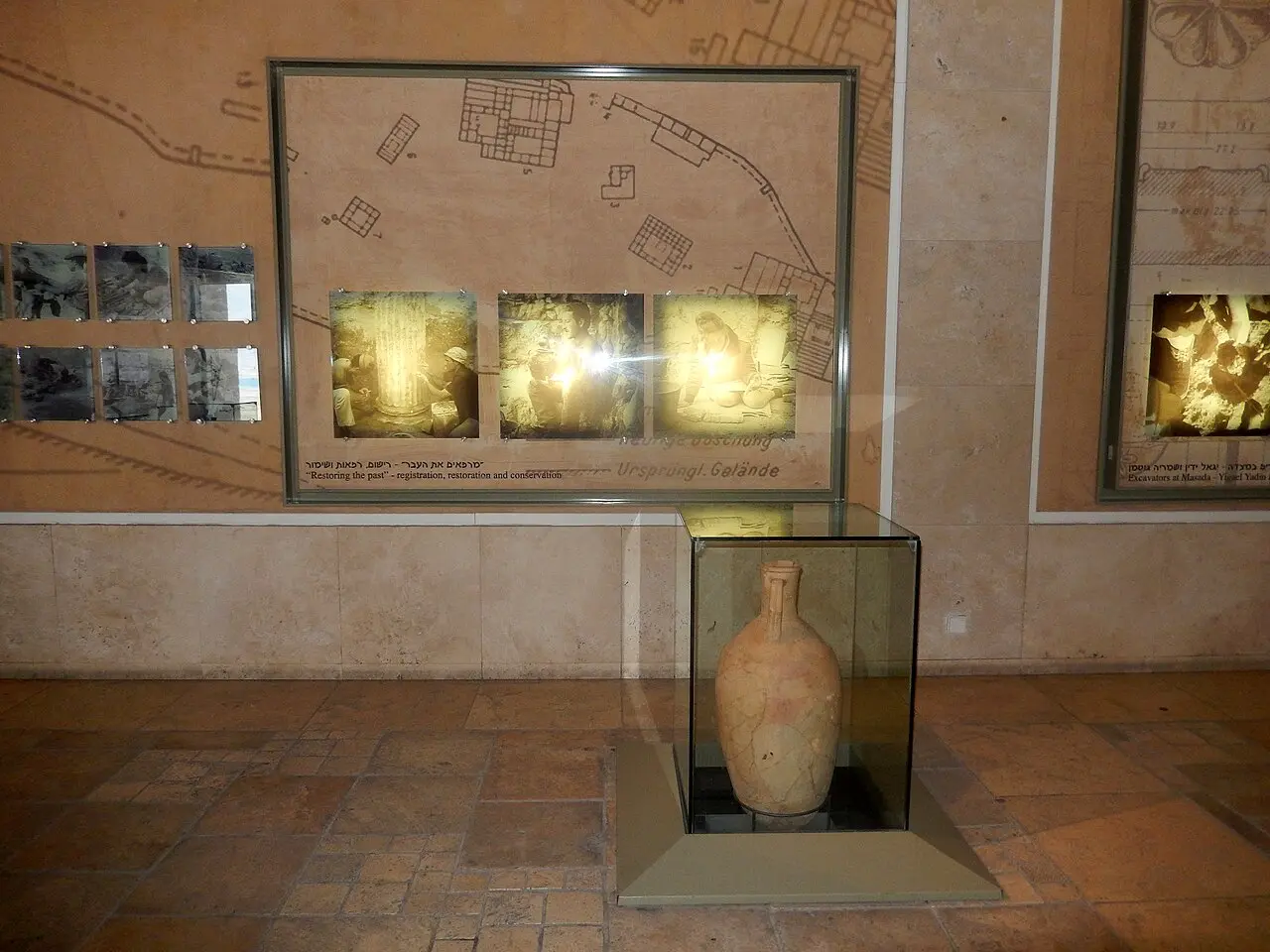
The parks authority names some of the contents directly. Imported amphorae that carried wine to King Herod are among the exhibits, along with inscriptions on amphorae setting out the types of wine and the special foods inside them, shown with a stone table and fine dining vessels against the banquet scene. Another space reconstructs the rebels' quarters in the casemate rooms of the wall, and holds plain cooking pots, remnants of clothing, straw baskets, brushes and Hebrew inscriptions about daily life. A third puts Latin inscriptions and objects belonging to the Roman army against a depiction of a camp of the Tenth Legion, the force that besieged the mountain.
The authority's own picture gallery for the museum adds more: remains of dried fruit recovered in the Masada excavations, finds from Herod's period, and a fresco lifted from the lower terrace of the Northern Palace. That last item is the sharpest illustration of what the museum actually is, because it is a piece of the mountain brought down off it, and it is looked after as such. In August 2025 the authority's southern conservation team reported the periodic cleaning of the wall paintings in the Northern Palace, the bathhouse, the commander's quarters, building 8 and in the museum, in the same round of work.
The line between original and reconstruction is unusually easy to draw here, and worth holding onto. Everything lit in a case is an excavated object. Everything unlit around it, the sculpted figures, the architectural details, the floors and the walls, was made for this room in the twenty-first century, to match what excavation showed of the period. The parks authority states that distinction itself rather than blurring it.
One honest limitation: the authority publishes descriptions and examples, not an object list. Its account does not name the inscribed potsherds from the Room of the Lots, the biblical scroll fragments from the pits in the synagogue floor, or the braided hair found in the bathhouse of the Northern Palace among the things on display, and this page does not claim they are here. What is verifiable is the class of material, which is the material Yadin's expedition took out of the mountain.
- Imported wine amphorae addressed to Herod, with inscriptions naming wines and foods
- A stone table and fine tableware, set in a banquet scene
- Rebel household goods from the casemate rooms: cooking pots, cloth, baskets, brushes
- Latin inscriptions and Roman army objects against a Tenth Legion camp
- Dried fruit from the excavations, and a fresco lifted from the Northern Palace
Armineaghayan / CC BY-SA 4.0 · Wikimedia Commons

Yadin
The dig that filled the cases, and the man in the last room
The collection exists because of one campaign. Britannica records that the entire mountaintop was excavated by Yigael Yadin in 1963 to 1965, assisted by thousands of volunteers from around the world; Hebrew Wikipedia gives the two seasons as October 1963 to April 1964 and December 1964 to March 1965. The aridity and the remoteness are why there was so much to lift: organic material that would have rotted almost anywhere else, cloth, basketry, fruit, came up intact.
Yadin himself was an odd figure to be running a dig, and the museum makes no attempt to hide it. Born in Jerusalem on 20 March 1917, he was Chief of the General Staff of the Israel Defense Forces from 9 November 1949 to 7 December 1952, took the Israel Prize in Jewish studies in 1956 for a doctoral thesis on the Dead Sea Scrolls, bought four of the original seven scrolls in New York in 1954 after his father had acquired the other three, served as Deputy Prime Minister from 1977 to 1981, and died on 28 June 1984. His popular account, Masada: Herod's Fortress and the Zealots' Last Stand, appeared in 1966, the year after the second season closed.
The final space is devoted to him, which is a deliberate editorial choice rather than a courtesy. The authority describes the route as framed between two poles, the ancient teller of the story and the modern excavator who uncovered it, so the visit closes on the making of the knowledge rather than on the fall of the fortress. That framing is also where the museum is most exposed to argument, because some of the readings Yadin gave his finds are contested. The inscribed potsherds he identified as the lots of Josephus's account are, on other readings, ordinary name tags, and English Wikipedia states only that the ten other names may be those of the men chosen by lot.
It is fair to say that the building carries a name and a claim at once. The name is a memorial to the archaeologist; the claim is that his excavation is what the mountain now means. Visitors who have read about the disputes will notice the room; visitors who have not will hear a clean story.
The visit
Reservation only, and it shuts before the mountain does
Entry is by advance booking, without exception. The parks authority states that because the number of visitors at any given moment is limited, a reservation must be made in advance, that entry is permitted only on presentation of the visit confirmation, and only at the date and time written on it. The confirmation arrives by email as soon as the booking is made and has to be shown at the site. This is a separate reservation from the one the authority asks visitors to make for the national park itself.
The published hours are 08:30 to 15:30 on Sundays to Thursdays and on Saturdays, and 08:30 to 14:30 on Fridays and holiday eves. Those do not change between summer and winter, while the park's do: in summer the park runs to 17:00 on the same days, so the museum shuts an hour and a half ahead of it.
There is a real discrepancy in the closing rule, and it is worth reading before booking a late slot. The English page says the museum closes half an hour before the site closes, which cannot be squared with a 15:30 close against a 17:00 summer park close. The Hebrew original of the same page says something different and more useful: entry to the museum closes half an hour before the hours listed, which puts the last admission at 15:00 on Sundays to Thursdays and Saturdays and 14:00 on Fridays. Treat the Hebrew version as the operative one and arrive with time in hand.
The ticket structure is simple once stated. A visit to the museum carries no charge beyond entry to the national park, so anyone already holding a park ticket does not pay again, although they still have to book a slot. For anyone who wants the museum alone, the price is ₪20 a person, listed on the authority's price table as one price with no concessions, and free to members of its Matmon club. Park entry itself is ₪37 for an adult, ₪21 for a child, ₪31 for a student or an adult in a group, ₪18 for a child in a group and ₪19 for an Israeli senior citizen.
- Sunday to Thursday and Saturday: 08:30 to 15:30
- Friday and holiday eves: 08:30 to 14:30
- Included with park entry, but still requires its own booking
- ₪20 for the museum on its own, one price, free for Matmon members
Tiia Monto / CC BY-SA 3.0 · Wikimedia Commons
What to look for
Things not to walk past at The Masada Museum in Memory of Yigael Yadin
The details that repay knowing about before you are standing in front of them.
The banquet space
A stone table laid with fine vessels against a reconstructed feast from Herod's reign, with imported amphorae beside it whose inscriptions record which wine and which delicacies came inside them.
The casemate room
The rebels' quarters in the rooms inside the wall, furnished with what was actually found there: plain cooking pots, scraps of cloth, straw baskets, brushes and Hebrew inscriptions about ordinary days.
The Tenth Legion space
Latin inscriptions and Roman military objects shown against a painted camp of Legio X Fretensis, the legion that ringed the mountain. It is the only room in the museum told from the besiegers' side.
The Northern Palace fresco
A wall painting cut from the lower terrace of Herod's cliff palace and brought down to the museum. The parks authority's conservators clean it on the same rota as the paintings still up on the mountain.
The dried fruit
Remains of dried fruit recovered in the excavations, preserved by an atmosphere so dry that almost nothing organic decayed. It is the exhibit that explains why the Masada finds are unusual rather than merely old.
The last room
The closing space belongs to Yigael Yadin, the excavator. The parks authority frames the whole route between Josephus at one end and Yadin at the other, so the exhibition finishes on how the story was recovered.
The long view
The Masada Museum in Memory of Yigael Yadin, in order
October 1963 – April 1964
The first season of Yigael Yadin's Hebrew University expedition works on the mountain.
December 1964 – March 1965
The second season completes the excavation of substantially the whole summit. Britannica records thousands of volunteers from around the world across the campaign.
1966
Yadin publishes Masada: Herod's Fortress and the Zealots' Last Stand with Random House, the popular account that fixed the site in the public mind. Masada is declared a national park the same year.
1984
Yadin dies on 28 June, having been Chief of the General Staff, an Israel Prize laureate and Deputy Prime Minister as well as the excavator of Masada.
2001
Masada is inscribed on the UNESCO World Heritage list, largely for the Roman siege works below the mountain.
2007
The Masada Museum in Memory of Yigael Yadin opens at the eastern entrance, funded by the Shuki Levy Foundation, showing the finds in a theatrical setting.
August 2025
The parks authority's southern conservation team reports cleaning the wall paintings in the Northern Palace, the bathhouse, the commander's quarters, building 8 and the museum in a single round of routine work.
Practical
Visiting The Masada Museum in Memory of Yigael Yadin
Where
Masada National Park, eastern entrance off Route 90 on the Dead Sea side, about 18 km south of Ein Gedi and 12 km from Ein Bokek
What ticket you need
The museum stands inside Masada National Park, at the eastern entrance, and the park entrance fee covers it: there is no second charge for a visitor who has already paid to enter the site. The ₪20 museum ticket exists for people who want the museum and not the mountain. Either way a timed reservation is required, and the museum's own closing time of 15:30 is earlier than the park's.
Opening hours
- Sunday to Thursday and Saturday
- 08:30 to 15:30source
- Friday and holiday eves
- 08:30 to 14:30source
- Last admission
- half an hour before the times listed, so 15:00 and 14:00 respectively, on the Hebrew version of the pagesource
- The English page's wording
- 'The museum closes a half hour before the site closes', which does not reconcile with the 17:00 summer close of the parksource
- National park, summer
- 08:00 to 17:00; Friday and holiday eves 08:00 to 16:00source
- National park, winter
- 08:00 to 16:00; Friday and holiday eves 08:00 to 15:00source
Admission
- Museum with park entry
- no additional charge, but a reservation is still requiredsource
- Museum alone
- ₪20 per person, listed as one pricesource
- Matmon club members
- freesource
- Park entry, adult
- ₪37source
- Park entry, child
- ₪21source
- Park entry, student or adult in a group
- ₪31source
- Park entry, child in a group
- ₪18source
- Park entry, Israeli senior citizen
- ₪19source
Access
The parks authority states that the museum is accessible to visitors with mobility impairments, and lists it among the accessible features of the eastern entrance along with the covered parking, the shopping and public areas, the film halls and the lifts. The cable car and the bridge at the top are wheelchair accessible, so a visitor using a wheelchair can do the museum and then reach the plateau without using a path. The recorded tour's headphones are T-coil compatible and staff on site supply the aid needed to take the soundtrack through a hearing aid. Two cautions the authority does not print: the rooms are deliberately very dark, which is hard for low-vision visitors, and the museum is nowhere near the Roman ramp entrance on the Arad side.
On site
- Recorded audio tour on headphones, seven languages
- T-coil compatible headphones for hearing aid users
- Covered parking at the eastern entrance
- Shops and public areas
- Film halls and lifts
- Cable car lower station in the same complex
- Toilets at the visitor centre
- No dogs anywhere in Masada National Park
Booking
Booking is compulsory and is made through the parks authority's own reservation widget on the museum page: choose a date, a time and a number of visitors, fill in personal details, and the confirmation appears immediately and is emailed. Entry is allowed only on presentation of that confirmation and only in the time slot printed on it. This is a separate booking from the reservation the authority asks visitors to make for the national park.
Hours and prices are given as the operator publishes them and change without much notice, particularly around Shabbat and the festivals. Check the operator's own page before you travel for this.
Official page at en.parks.org.il →What people wish they had known
- Book the museum separately. A reservation for Masada National Park does not carry you into the museum: the parks authority runs a second booking for it, and entry is refused without the confirmation and outside the slot printed on it.
- Do the museum before the mountain, not after. It closes at 15:30 while the park runs to 17:00 in summer, and the authority's own itinerary treats it as the prologue to the climb rather than the reward for it.
- Do not buy the ₪20 ticket if you already hold a park ticket. Museum entry is included in the entrance fee; the standalone price exists for visitors who want the exhibition without the site.
- Take the headphones seriously. There are no live guides and the wall text is short, so a visitor who skips the recorded track gets lit objects with almost no argument attached to them.
- It is on the eastern side only. Anyone driving in from Arad on road 3199 for the Roman ramp path arrives on the opposite side of the mountain, with no way through to the museum except by crossing the summit.
- Anyone with a hearing aid should say so at the desk. The headphones carry a T-coil, and the staff supply the piece needed to route the soundtrack through the aid itself.
The figures
The Masada Museum in Memory of Yigael Yadin by the numbers
Each figure carries the year it belongs to and links the source it came from.
| Measure | Figure | As of | Source |
|---|---|---|---|
| Rooms in the exhibition | 9, divided by archaeological and historical content | 2026 | en.parks.org.il |
| Audio guide languages | 7: Hebrew, English, French, German, Russian, Chinese and Spanish | 2026 | en.parks.org.il |
| Museum-only admission | ₪20 per person, one price, free for Matmon members | 2026 | en.parks.org.il |
| Park entry, which already includes the museum | ₪37 adult, ₪21 child, ₪31 student or adult in a group, ₪19 Israeli senior citizen | 2026 | en.parks.org.il |
| Closing time | 15:30 Sunday to Thursday and Saturday, 14:30 Friday and holiday eves | 2026 | en.parks.org.il |
| Excavation seasons that produced the collection | October 1963 to April 1964, and December 1964 to March 1965 | 1965 | he.wikipedia.org |
| Volunteers on the Yadin expedition | thousands, from around the world | 1965 | britannica.com |
| Year the museum opened | 2007, funded by the Shuki Levy Foundation | 2007 | en.wikipedia.org |
While you are here
The rest of Masada
Everything else in this destination with a page of its own.
Godot13 / CC BY-SA 4.0 · Wikimedia Commons
Activity
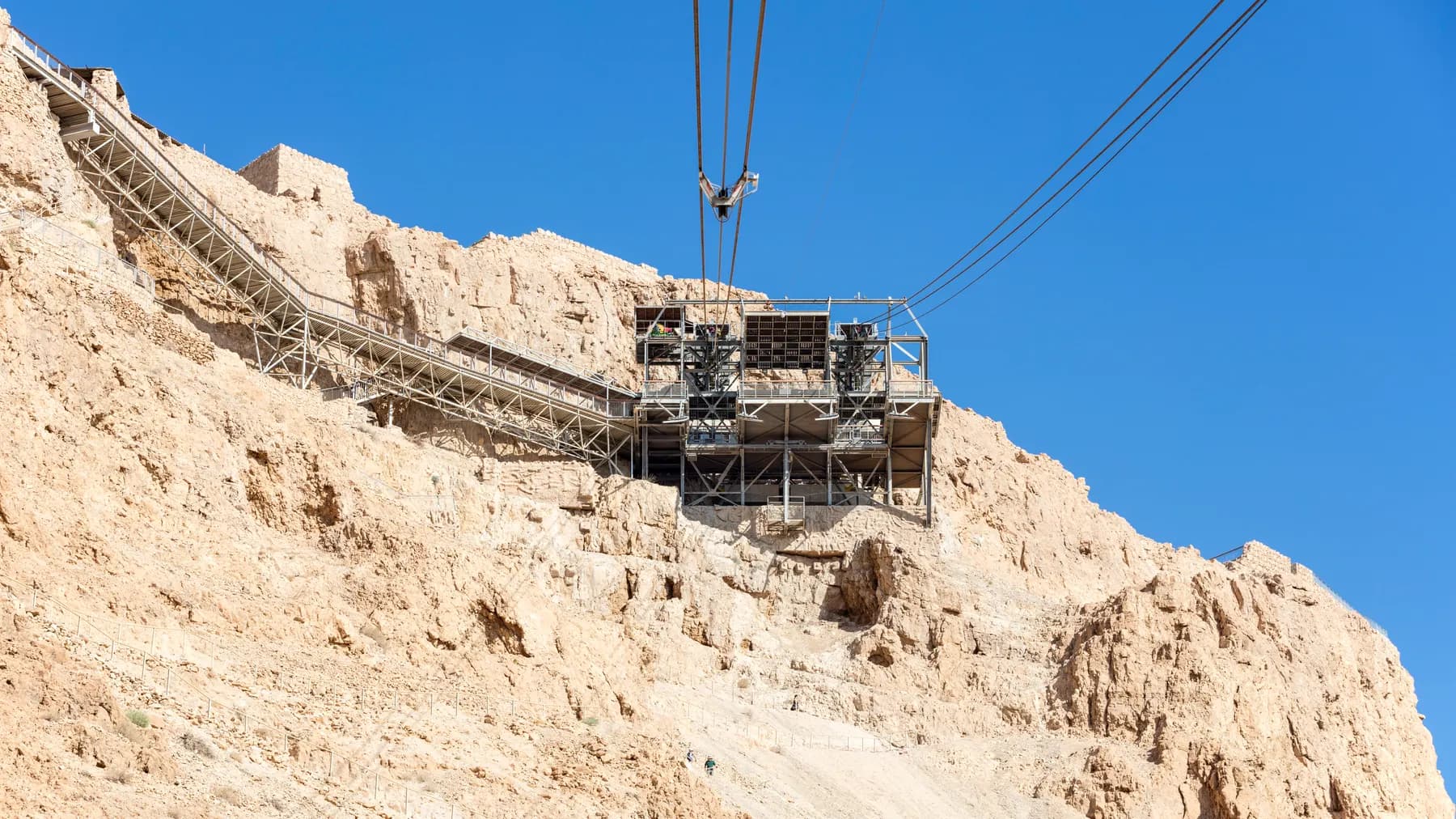
The Masada Cable Car
Its lower station stands 257 metres below sea level and its upper station 33 metres above, which is why ropeway databases file it as the lowest aerial tramway in the world.
Jan Helebrant / CC0 · Wikimedia Commons
Activity
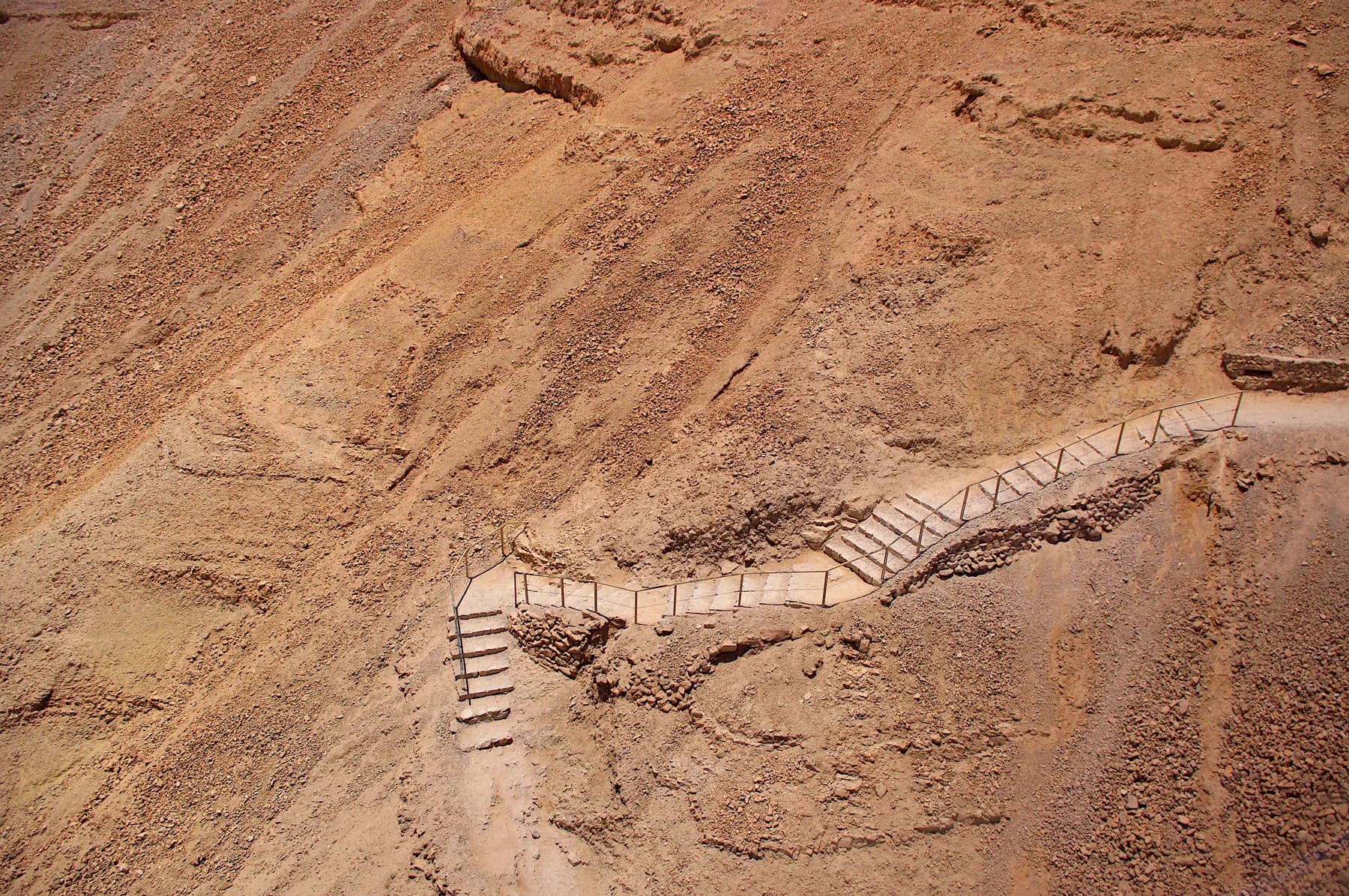
The Snake Path
The parks authority measures the climb at 350 metres over about two kilometres and roughly 900 steps, on a line up the east face that Josephus already knew as the serpent.
Godot13 / CC BY-SA 4.0 · Wikimedia Commons
Archaeological site
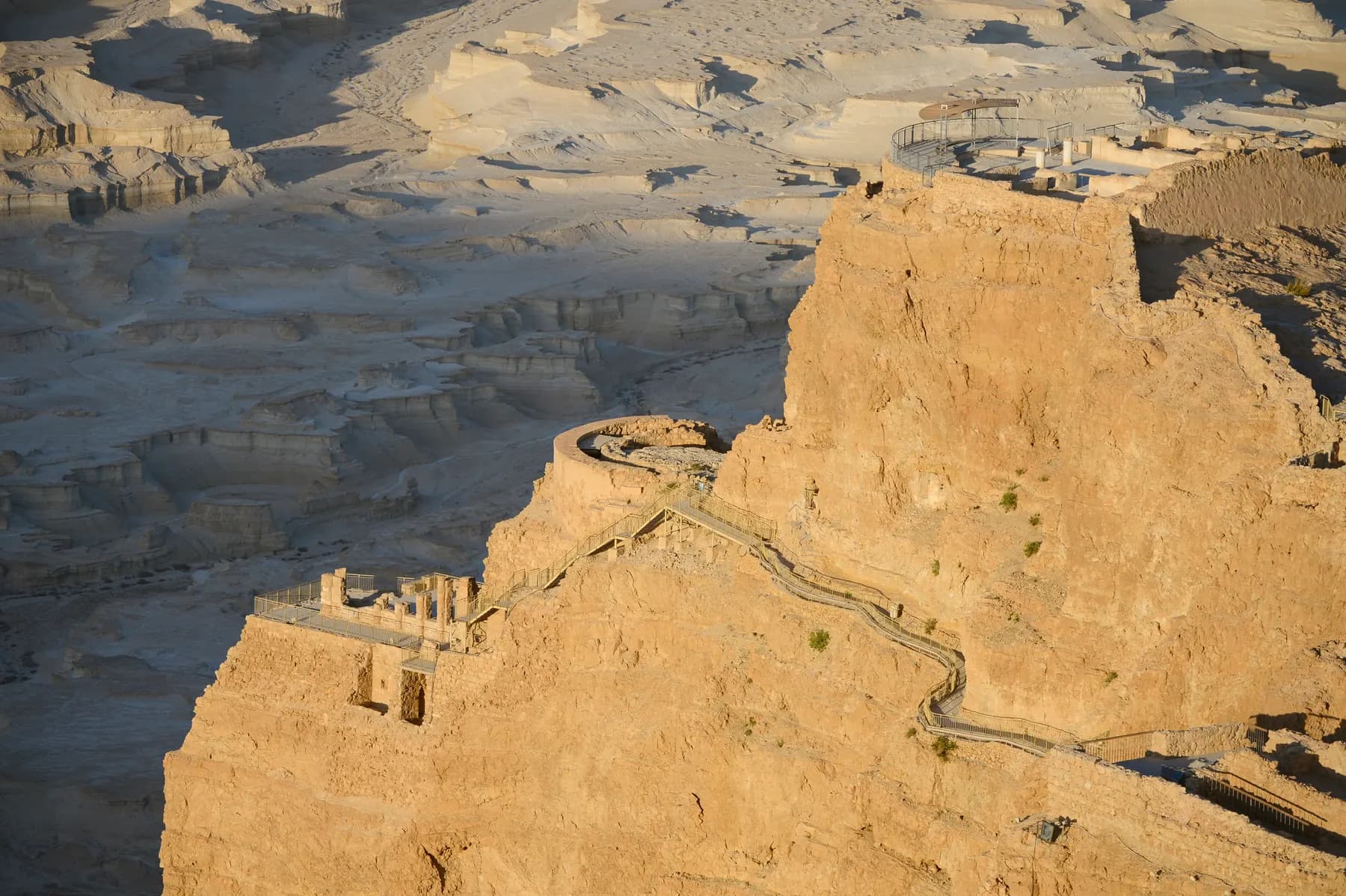
Herod's Northern Palace
Herod's architects hung a private house on three rock terraces at the northern tip of Masada, with about 30 metres of height between the top terrace and the bottom one and retaining walls holding the lower two onto the cliff.
Sources and further reading
Every link below was opened and checked when this page was written. Official statements are marked as such: they are the subject's own account, not an independent one.
- OfficialIsrael Nature and Parks Authorityen.parks.org.ilThe Masada Museum in Memory of Yigael Yadin, funded by the Shuki Levy Foundation
The operator's own page for this site: the finds as those of the Hebrew University expedition under Yadin, the nine spaces, the three focuses of Herod, the rebels and the Roman army, the dark grey to black sets and the 'present absence' effect, the curator Gila Horwitz and the designer Eliav Nahlieli of Programa 1, the banquet, casemate and Tenth Legion rooms, Josephus at the start and Yadin at the end, the seven audio languages, the T-coil headphones, the mobility accessibility, the ₪20 museum-only price, the free entry with a site ticket, the compulsory reservation and the 08:30 to 15:30 and 08:30 to 14:30 hours
- OfficialIsrael Nature and Parks Authorityparks.org.ilמוזיאון מצדה על שם יגאל ידין תרומת קרן שוקי לוי (the same page in Hebrew)
The Hebrew original, which states the closing rule differently: entry to the museum closes half an hour before the listed hours. It also carries the gallery captions for the imported amphorae that held wine for King Herod, the remains of dried fruit from the excavations, the fresco transferred from the lower terrace of the Northern Palace, and the artisans laying the mosaic of the set
- OfficialIsrael Nature and Parks Authorityen.parks.org.ilMasada National Park
The price table (₪37 adult, ₪21 child, ₪31 adult in a group or student, ₪18 child in a group, ₪19 Israeli senior citizen, ₪20 museum marked 'one price'), the summer and winter park hours, the note that entry to the museum is by reservation only, the accessible features of the eastern entrance including the museum, the description of the site as the Yigal Yadin Masada Museum donated by the Shuki Levy Foundation, the ban on dogs, and the distances from Ein Gedi and Ein Bokek
- OfficialIsrael Nature and Parks Authorityparks.org.ilמצדה בגרסה נגישה: היסטוריה, מדבר וחדוות גילוי (Masada in an accessible version)
The authority's own itinerary, dated 23 September 2024: two to four hours for the eastern circuit depending on interest, the museum listed first among the points of interest, and the recommendation to treat it as the prologue before going up to the mountain top
- OfficialIsrael Nature and Parks Authorityparks.org.ilפעילות שוטפת של תחזוקה ושימור במצדה (Routine maintenance and conservation at Masada)
Reported by Ruby Miel, head of the southern conservation team, on 31 August 2025: the periodic cleaning of the wall paintings in the Northern Palace, the bathhouse, the commander's quarters, building 8 and in the museum, which confirms that original frescoes are displayed and conserved inside the museum
- ReferenceEncyclopaedia Britannicabritannica.comMasada
That the entire mountaintop was excavated by Yigael Yadin in 1963 to 1965 with thousands of volunteers from around the world, and the character of the finds, including the group of inscribed potsherds bearing Hebrew personal names
- ReferenceWikipediaen.wikipedia.orgMasada
That the Masada Museum in Memory of Yigael Yadin opened in 2007, displaying finds in a theatrical setting and funded by the Shuki Levy Foundation, citing the parks authority's former page and the Hebrew University Institute of Archaeology; also that the visitor centre and the museum stand at the base of the cable car, and that the eleven ostraca in front of the Northern Palace may or may not be the lots of Josephus's account
- ReferenceWikipediahe.wikipedia.orgמצדה (Masada, Hebrew Wikipedia)
The two excavation seasons dated precisely: October 1963 to April 1964, and December 1964 to March 1965
- ReferenceWikipediaen.wikipedia.orgYigael Yadin
Born 20 March 1917 in Jerusalem, died 28 June 1984; Chief of the General Staff from 9 November 1949 to 7 December 1952; Israel Prize in Jewish studies 1956 for his thesis on the Dead Sea Scrolls; his purchase of four of the original seven scrolls in New York in 1954; Deputy Prime Minister 1977 to 1981; and the 1966 Random House book Masada: Herod's Fortress and the Zealots' Last Stand
The Masada Museum in Memory of Yigael Yadin: common questions
What is the Masada Museum?+
It is the Israel Nature and Parks Authority's exhibition of the archaeological finds excavated at Masada by the Hebrew University of Jerusalem expedition under Professor Yigael Yadin, housed at the eastern entrance to the national park. Its full name is The Masada Museum in Memory of Yigael Yadin, funded by the Shuki Levy Foundation. The authority divides it into nine spaces grouped around Herod, the rebels and the Roman army, each one a darkened built set with the excavated objects lit inside it.
How much does the Masada Museum cost?+
Nothing beyond the national park entrance fee, if you are already paying that. The parks authority states that the museum visit is included with entry to the site, and prices the museum on its own at ₪20 a person, listed as one price with no concessions and free to members of its Matmon club. Park entry is ₪37 for an adult, ₪21 for a child, ₪31 for a student or an adult in a group and ₪19 for an Israeli senior citizen.
Do I need to book the Masada Museum in advance?+
Yes, always. The parks authority caps the number of people inside at any moment, so it requires a reservation, and says entry is permitted only on presentation of the visit confirmation and only at the date and time written on it. The booking is made through the widget on the museum's own page and the confirmation is emailed immediately. It is a separate booking from the one for the national park.
What are the Masada Museum opening hours?+
08:30 to 15:30 on Sundays to Thursdays and on Saturdays, and 08:30 to 14:30 on Fridays and holiday eves. Unlike the national park, those hours do not switch between summer and winter. Note that the Hebrew and English versions of the parks authority's page state the closing rule differently: the Hebrew says entry closes half an hour before the listed times, which makes the last admission 15:00 and 14:00, while the English says the museum closes half an hour before the site does, which does not fit a 17:00 summer park close. The Hebrew reading is the safer one to plan around.
Where is the Masada Museum?+
At the eastern entrance to Masada National Park, off Route 90 on the Dead Sea side, in the complex at the base of the cable car with the covered parking, the shops, the film halls and the lifts. It is about 18 km south of Ein Gedi and 12 km from Ein Bokek. It is not reachable from the western, Arad side, where the Roman ramp path and the campsite are.
How long does the Masada Museum take?+
The parks authority publishes no figure for the museum alone, so any number quoted elsewhere is somebody's estimate rather than the operator's. What it does publish is a total of two to four hours for the whole eastern visit, museum and plateau together, depending on how much detail the visitor wants. The pace inside is set by the recorded track, since there is one for each of the nine spaces.
Is the Masada Museum wheelchair accessible?+
Yes. The parks authority states that the museum is accessible to visitors with mobility impairments, and lists it among the accessible features of the eastern entrance together with the covered parking, the shopping and public areas, the film halls and the lifts. Because the cable car and the bridge at the top are also wheelchair accessible, the museum and the plateau can both be done without using a path. The one thing the authority does not flag is how dark the rooms are, which is a real obstacle for visitors with poor low-light vision.
Is the Masada Museum in English?+
Yes. The recorded tour on the headphones runs in seven languages: Hebrew, English, French, German, Russian, Chinese and Spanish. The headphones are handed out as part of the visit rather than hired separately, and they are T-coil compatible for visitors with hearing aids, with staff on site providing the adapter. The explanatory texts beside the lit finds accompany the objects; the recorded track carries most of the interpretation.
Are the objects real, or reconstructions?+
The objects are real and the rooms around them are not. The parks authority describes the exhibits as the archaeological finds excavated at the site by Yadin's expedition, and separately describes the backdrops as sculpted figures, architectural details, floors and walls made for the museum to match the material culture of the period. One item blurs the line usefully: a fresco physically lifted from the lower terrace of the Northern Palace, which is an original wall painting removed from the mountain and conserved down here on the same schedule as the paintings left in place.
Is the Masada Museum worth it if I only have half a day?+
It depends on which half of the site you came for. If the object is the mountain, the light and the siege works, the plateau is the visit and the museum is a bonus that has to be booked and fitted in before 15:30. If the object is understanding what was found here, the museum is the only place at Masada where the finds themselves are on show, and the authority itself recommends it as the opening move rather than the closing one. Doing both in half a day is possible on the cable car and awkward on foot.