Activity · Masada
The Masada Cable Car
Its lower station stands 257 metres below sea level and its upper station 33 metres above, which is why ropeway databases file it as the lowest aerial tramway in the world.
Godot13 / CC BY-SA 4.0 · Wikimedia Commons
Ride time
about 3 minutes
each way, the figure the parks authority publishes
Lower station
257 m below sea level
upper station 33 m above, a rise of 290 m
Cabin
up to 80 passengers
the authority limits each trip to 65
Current line
built 1997–1998
replacing the cable car opened on 11 February 1971
In short
- How long to give it
- about 3 minutes in the cabin, and about 15 to 20 minutes each way once queueing and the walk through the stations are counted. Allow two to four hours for the plateau itself.
- Summer, Sunday to Thursday and Saturday
- 08:00 to 17:00
- Cable car, return, adult
- ₪54, not including park entry
רכבל מצדה
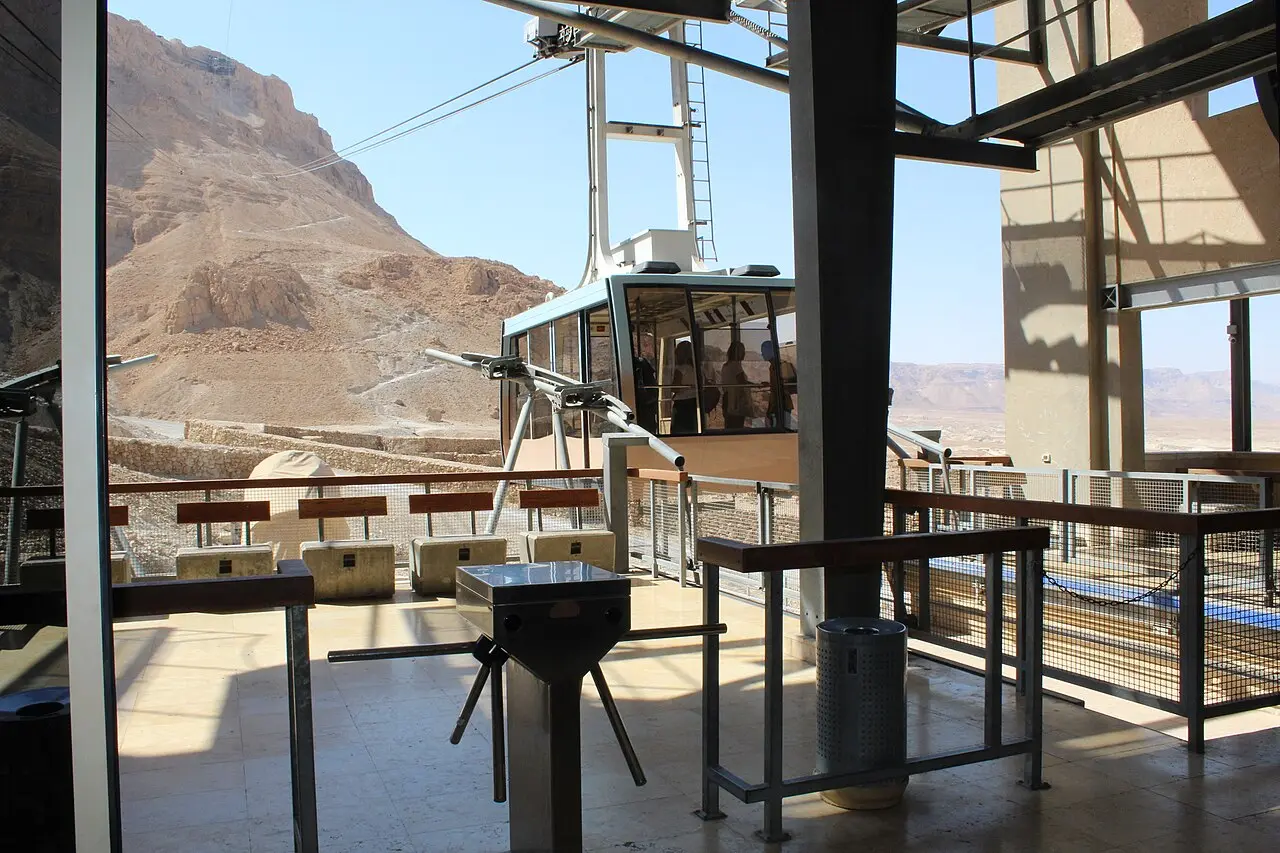
The Masada cable car is an aerial tramway on the eastern, Dead Sea side of Masada National Park, running from the visitor centre at the foot of the mountain to a station hung on the cliff just below the plateau. The Israel Nature and Parks Authority, which owns and operates it, gives the ride as about three minutes each way and the cabins as holding up to 80 passengers, with each trip limited in practice to 65. It is the alternative to walking the Snake Path, it lands at the Snake Path Gate, and it is charged for separately from the park entrance fee.
The line running today is not the original. The first Masada cable car opened on 11 February 1971. Hebrew Wikipedia, working from the newspapers of the time, gives it as 840 metres long, climbing from 250 metres below sea level to 18 metres above, taking three and a half minutes and carrying 40 people to a car. Its upper station stopped short of the plateau, so passengers finished the climb on a staircase. A bigger machine, its mechanical systems bought from the Swiss company Von Roll, went up on the same alignment in 1997 and 1998; ynet reported in March 2001 that the new tramway had completed its running-in and Swiss technicians were about to spend three weeks dismantling the old one.
The number attached to it in every list is neither the length nor the height but the altitude. The lower station is 257 metres below sea level and the upper station 33 metres above, and on that basis Hebrew Wikipedia, English Wikipedia and the French ropeway database Remontées Mécaniques all describe it as the lowest aerial tramway in the world. The parks authority's own page about the cable car, last updated on 30 December 2025, does not make the claim.
The ride
From a car park below sea level to a bridge on the cliff
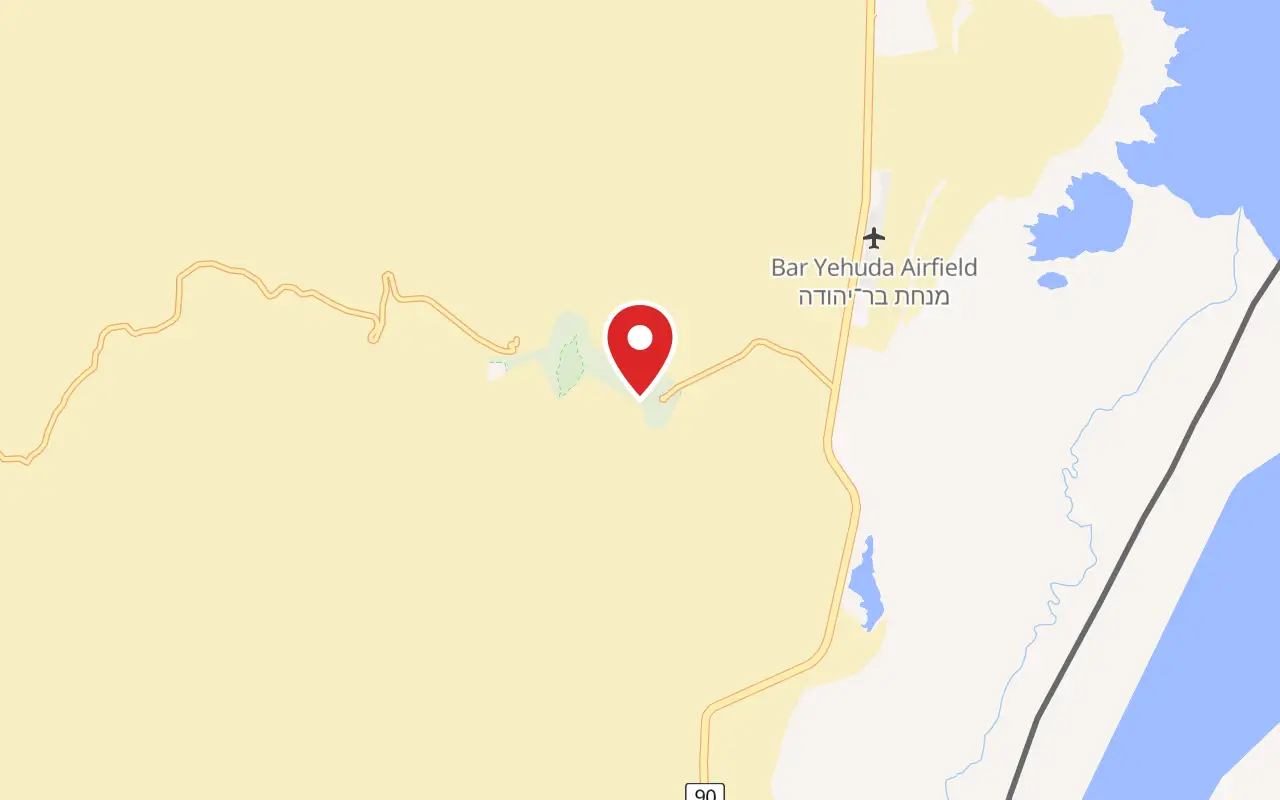
Boarding is at the eastern complex, reached from Route 90 along the Dead Sea shore, which the parks authority puts about 18 km south of Ein Gedi or 12 km from Ein Bokek. The lower station is not a shed at the end of a car park: it was built into the visitor centre, and the same building holds the ticket office, the Yigael Yadin Masada Museum, the film halls, shops and covered parking.
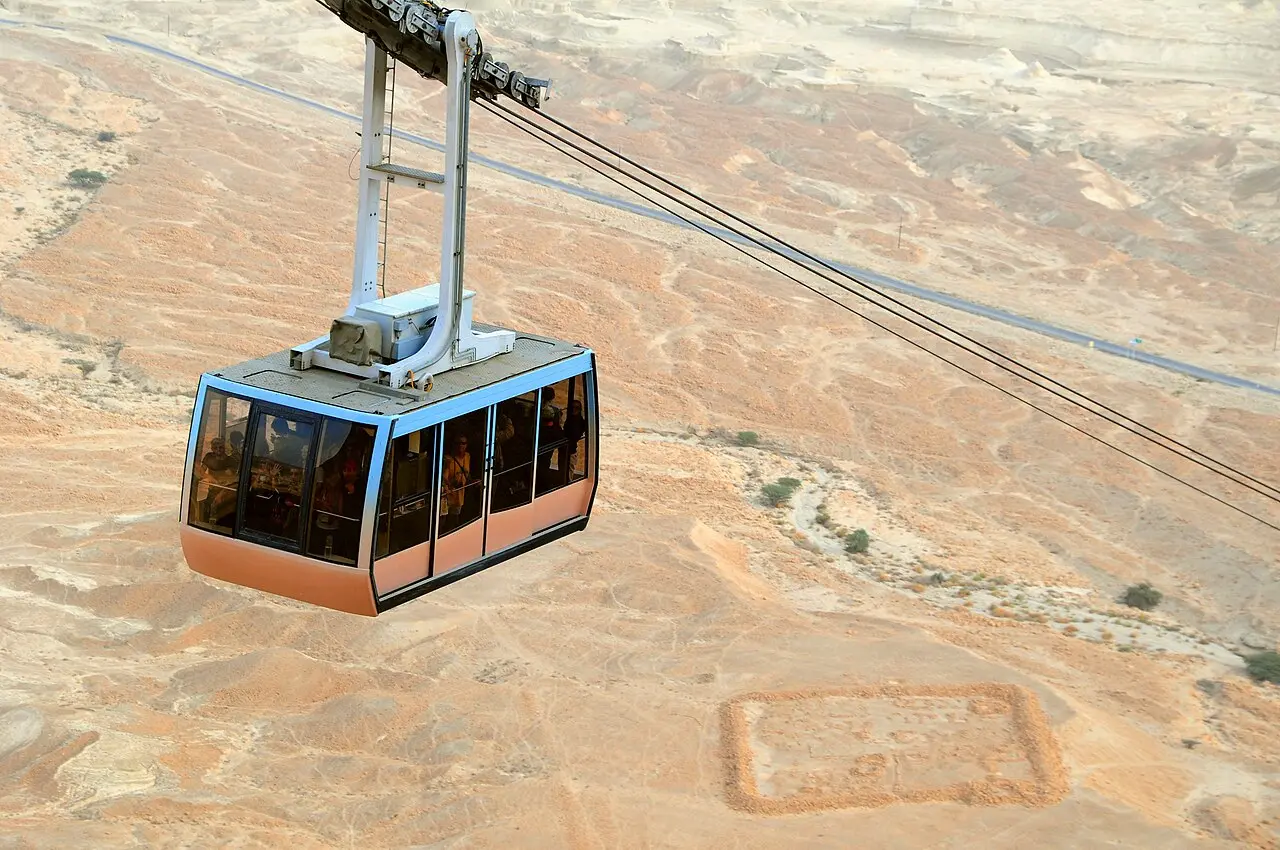
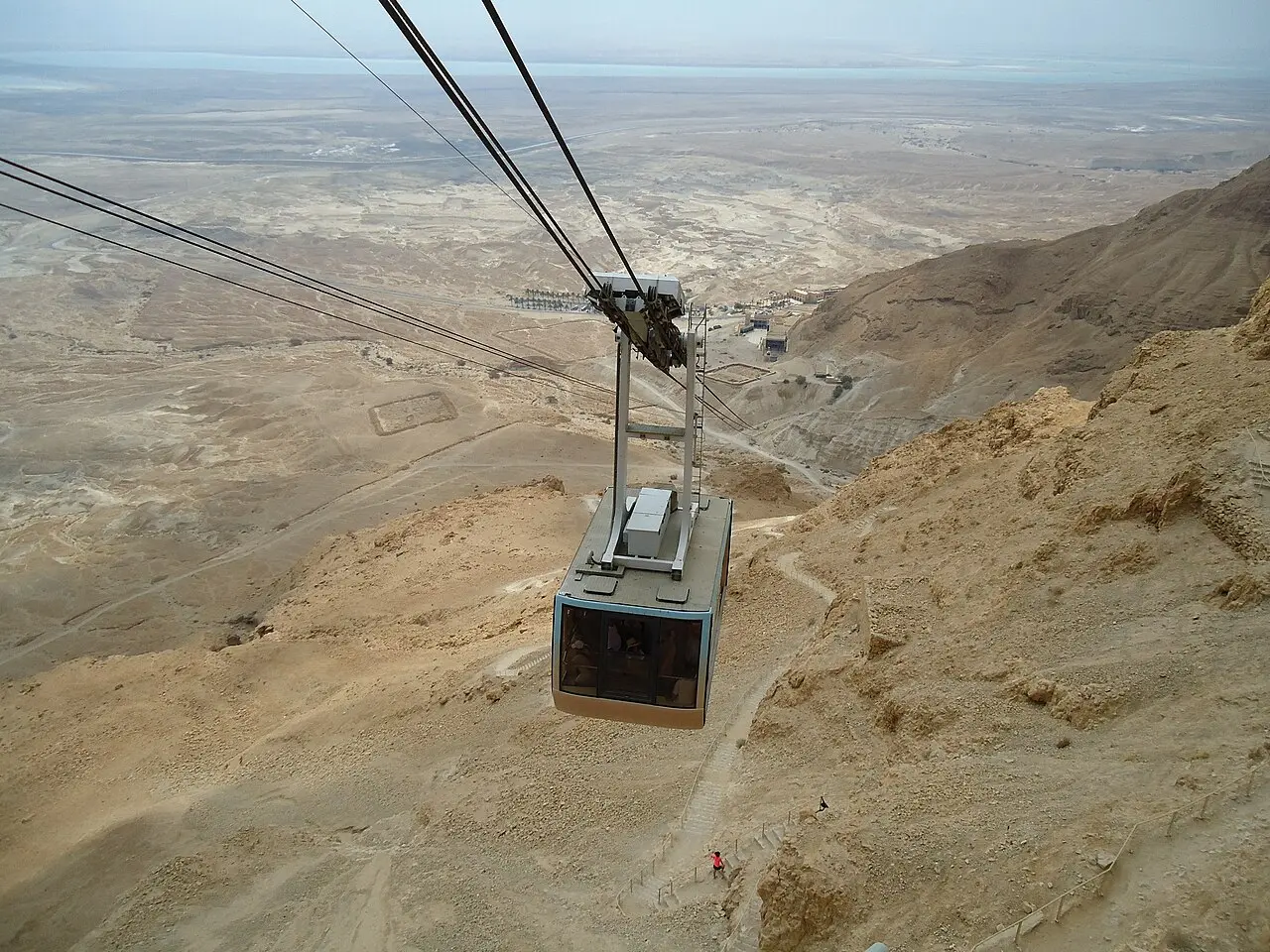
The line itself is short and unusually bare. Hebrew Wikipedia gives 900 metres of cable, a height difference of 290 metres, a top speed of up to eight metres per second and a throughput of 1,200 passengers an hour, with the two station buildings covering roughly 3,000 square metres between them. English Wikipedia records the cars leaving every fifteen minutes. There is no support pylon anywhere on the span: the two cars pass each other in mid-air over open desert, with nothing between the stations.
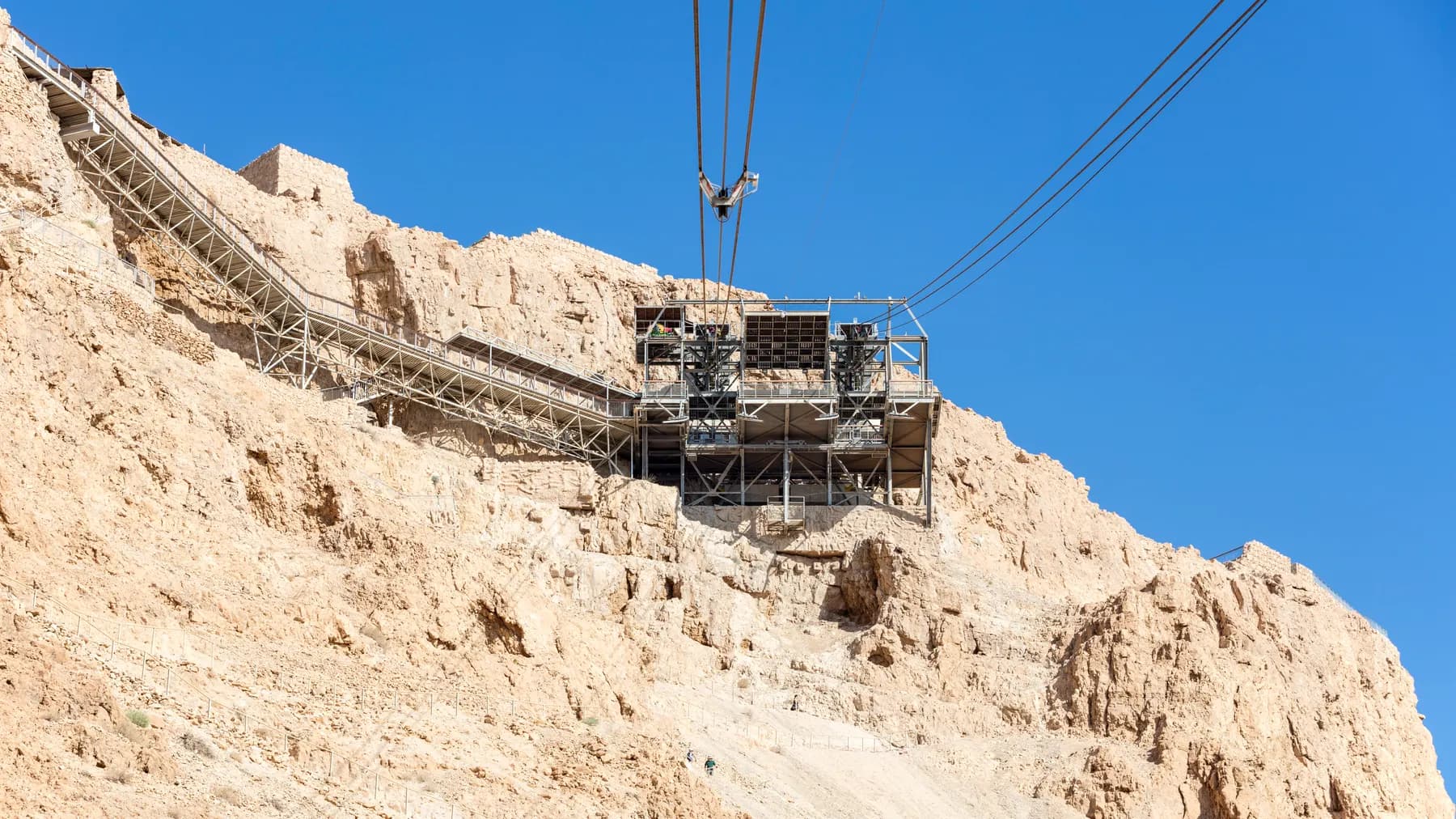
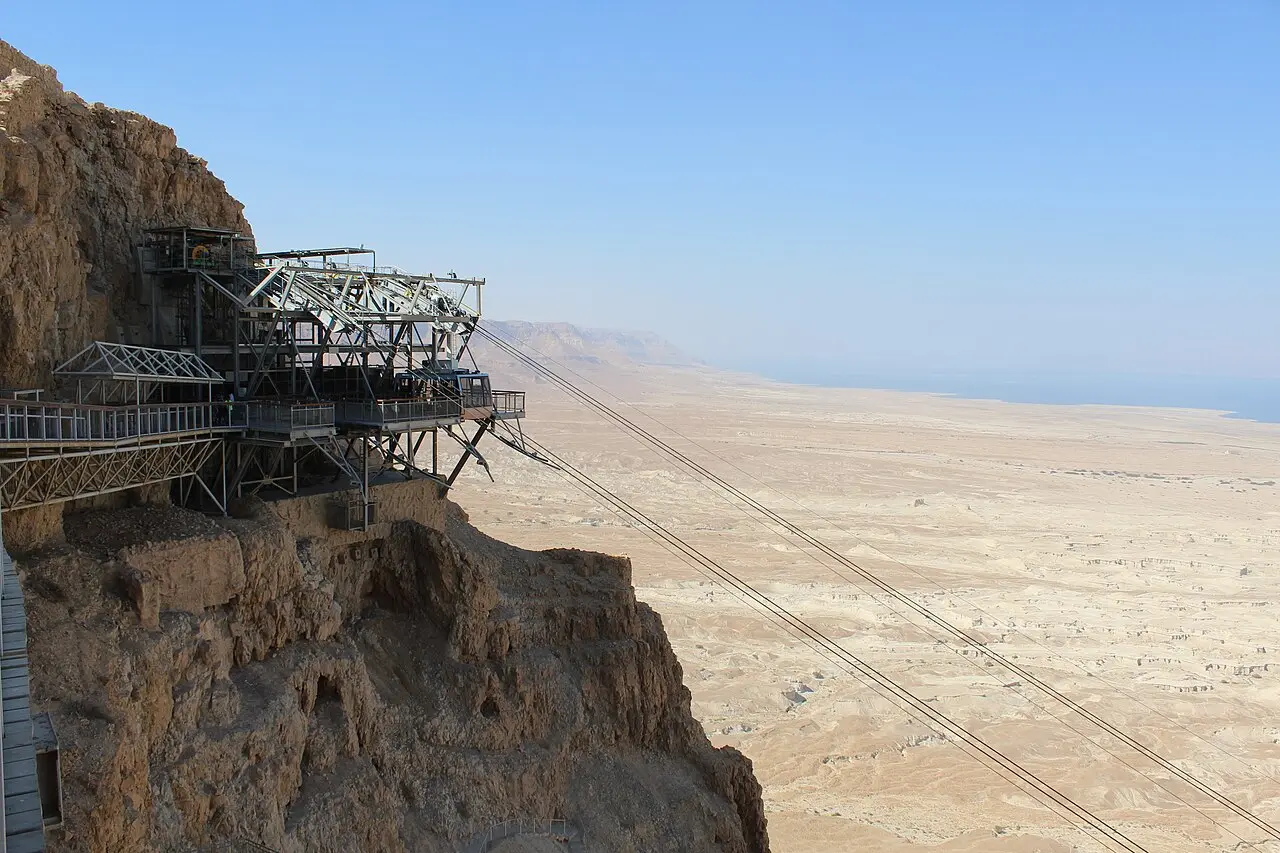
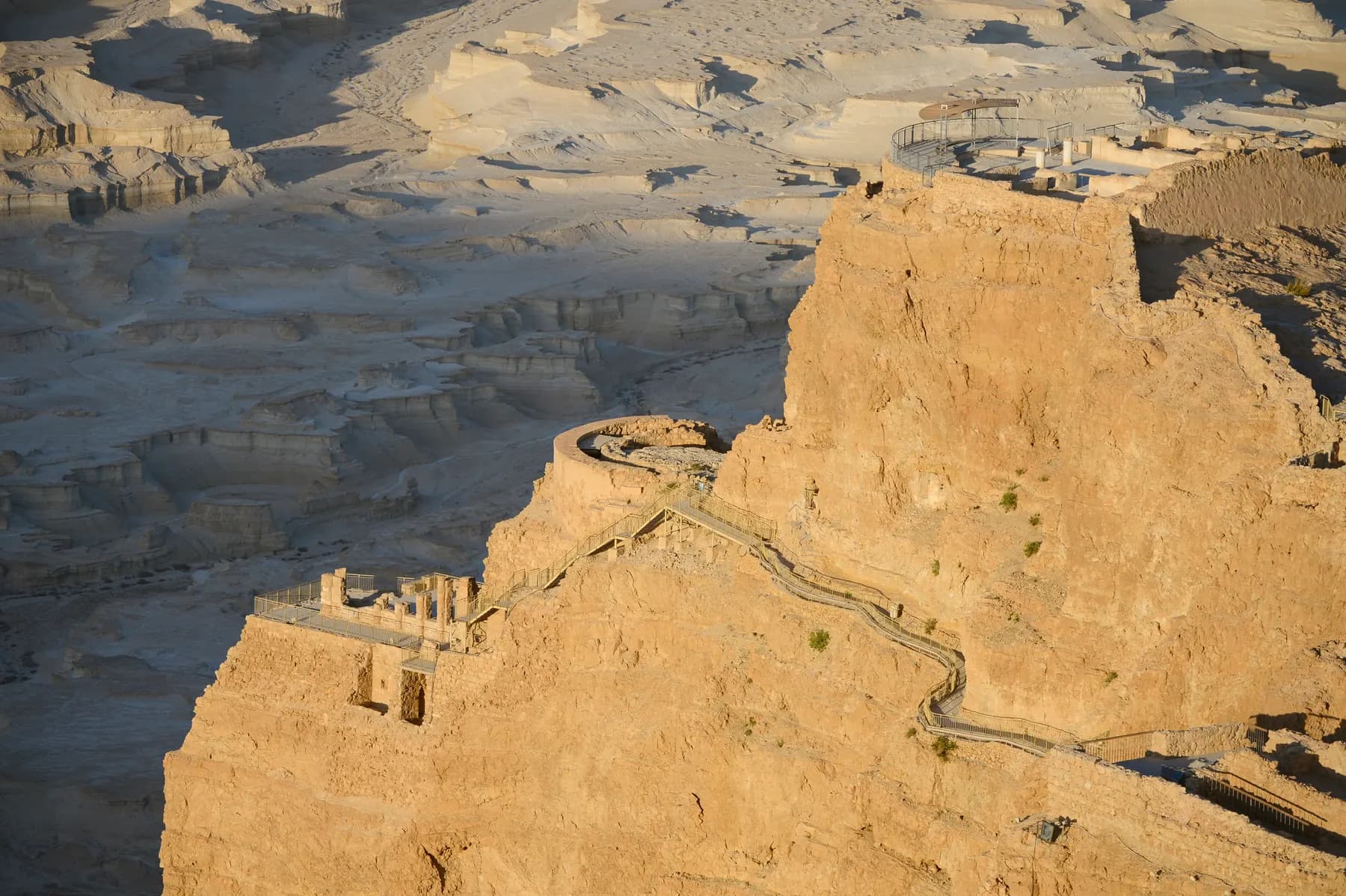
The upper station is the piece most people misread from below. It does not stand on the summit. The Remontées Mécaniques report on the tramway notes that it sits a few metres under the plateau, cantilevered out over the rock face, so that it interrupts the skyline as little as possible. Passengers leave across a suspension bridge to the Snake Path Gate, and because that bridge replaced the old staircase there are no steps at the top.
- 900 m of cable, 290 m of height difference, no intermediate tower
- Up to 8 metres per second, and about 3 minutes station to station
- Cars every 15 minutes during opening hours
- Exit at the top by suspension bridge, not by steps
Sarah Murray from South Bend, IN, USA / CC BY-SA 2.0 · Wikimedia Commons
The claim
What 'the lowest cable car in the world' actually means
The claim is about altitude, not about depth or drop. Masada stands roughly 450 metres above the Dead Sea shore on the parks authority's own figure, and yet its summit is only tens of metres above sea level, because the shore it rises from is one of the lowest points of dry land on earth. So the tramway climbs 290 metres and still finishes barely above the datum: 257 metres below sea level at the bottom, 33 metres above it at the top.
Who says it matters more than the number. Hebrew Wikipedia states it flatly, and cites the elevations. English Wikipedia repeats it. Remontées Mécaniques, a specialist ropeway site, puts it more carefully, describing the machine as the one with the lowest bottom station in the world rather than as the lowest ropeway outright. No body certifies records of this kind, and the parks authority, which would have every commercial reason to print it, does not.
The technical figures need the same handling. English Wikipedia's account rests on a single travel aggregator, and it attaches the 900 metre length and the 290 metre rise to the 1971 line. Hebrew Wikipedia, citing contemporary press reports, gives the 1971 line as 840 metres, running from 250 metres below sea level to 18 metres above. Read the two sets as the new machine and the old one, which fits the parks authority's statement that the upper station was moved when the tramway was replaced.
Meg Stewart from Poughkeepsie, NY, U.S.A. / CC BY-SA 2.0 · Wikimedia Commons
History
Sixteen years of argument before anything was built
The idea surfaced in 1955, alongside the first plans for a hotel at Ein Bokek, as a cable railway that would carry guests north to the rock. In 1963 the management of the Egged bus co-operative proposed a cable car up the eastern face, and the Ministry of Tourism turned it down: the point of Masada, at that date, was held to be the climb. During Yigael Yadin's excavations the Engineering Corps did run an electric cable railway up the western side from the diggers' camp, but that was for hauling equipment, not people.
In October 1966 a committee of the parks authority, the Tamar Regional Council and the transport and tourism ministries settled on a compromise that now sounds absurd: a cable car from the eastern side to a plaza on the west, from which visitors would walk up the Roman ramp. Driving vehicles onto the mountain had been ruled out as damaging, and a road linking the two sides was beyond the budget. The design called for 20 small cabins carrying four people each. The tender that went out at the end of 1966 attracted no bids at all, and the job was retendered for construction only, with operation left to the parks authority.
Then the Six Day War reordered the queue, and a cable car on Mount Hermon took priority. In February 1968 Yadin complained in print that everything his expedition had uncovered was going to waste for want of a lift up the mountain. A backer was found that July, the American Jewish businessman Arnold Kagan, and by then the plan had changed again: the line would go straight to the top. The opponents were not quiet about it. Yehuda Almog asked whether people did not understand that Masada had to be taken on foot, that the cliffs, the chasms, the rock-cut cisterns and the Roman camps ringing the mountain had to be seen with one's own eyes, and how anyone would see all that from inside a cable car cabin.
Building started in February 1970. The Swiss firm Brändle did the work with an Israeli contractor named Fogtsh, and the design and construction were in the hands of the Hungarian engineer Georg Sashegy, who had also built the cable car at Rosh Hanikra. The line opened on 11 February 1971 at a cost of more than a million lira, with a fare of four lira for an adult and three for a child. The Minister of Religious Affairs, Zerach Warhaftig, asked that it be kept still on Shabbat out of respect for the dead of Masada. The request was refused, and the cable car has run on Saturdays ever since.
Rebuilt
What changed in 1998, and what stayed where it was
The alignment stayed. Almost everything else went. Hebrew Wikipedia records that the mechanical systems were bought from Von Roll Holding of Switzerland and the cars were replaced, and that the upper station was moved and a suspension bridge built so that visitors with limited mobility could enter the site without climbing steps. The parks authority describes the old machine as one that carried a limited number of people to a point below the summit, from which they had to walk up a staircase, and says the replacement was driven by growing visitor numbers.
The pylon went too, and that is the engineering change a passenger can see. Because the new tramway has no tower to pass, the carriage and hanger can close completely around the two track ropes and the haul rope, which removes the possibility of a cabin falling through a derailment. The Remontées Mécaniques report adds the details the operator does not publish: the cabins are by Gangloff of Bern, the drive is at the lower station and the tension is taken by counterweight at the upper one, and one of the cabins from the 1971 line was kept at the bottom station as a memento.
The changeover was not a single day. Ynet reported on 12 March 2001 that the new tramway had already been built and run in, that specialists brought from Switzerland would take three weeks to dismantle the old one, and that the new machine could move about 1,200 people an hour in groups of 80, against 40 to a cabin and 600 an hour before. The same report put the number of Israelis and tourists who had visited Masada by then at more than 10 million.
The most recent work is electronic rather than mechanical. The parks authority says the cable car's electronic system was replaced in 2020, and that inspections run continuously to the European ropeway standard required by the manufacturers, with an annual test before a licence is issued. Its page records the last annual test as January 2021, by a Technion-certified inspector, with a permit issued by the Ministry of Transport. The page was updated at the end of December 2025 and still gives that date, so read it as the most recent inspection the authority has published rather than as this year's.
- Kept: the route, and the eastern approach from Route 90
- Replaced: the mechanical systems (Von Roll), the cabins (Gangloff of Bern), the upper station
- Removed: the support pylon and the staircase at the top
- Added: the suspension bridge into the Snake Path Gate, and in 2020 a new electronic system
Mohammad Shad Siddiqui / CC BY-SA 4.0 · Wikimedia Commons
Practicalities
The fare is separate, and the last car is an hour before closing
The cable car is not covered by the park ticket, and the English version of the parks authority's site is unhelpful about what it costs: its price table is headed 'Entrance fee No cable car' and lists ₪37 for an adult, ₪21 for a child, ₪31 for a student or an adult in a group, ₪18 for a child in a group and ₪19 for an Israeli senior citizen, with no cable car row anywhere. The Hebrew price table on the same site carries two more tabs. A one-way ride, stated as not including entry, is ₪32 for an adult and ₪16 for a child. A return ride is ₪54 and ₪32. That makes an adult who wants to ride up and down ₪91 all in, which is exactly the figure the authority quotes for its sunrise cable car package.
Hours are the park's hours, minus an hour. In summer the site opens 08:00 to 17:00 Sunday to Thursday and on Saturday, and to 16:00 on Fridays and holiday eves; in winter those become 16:00 and 15:00. Entry to the cable car closes one hour before the time printed, so the useful number on a summer Friday is 15:00. The two parks authority pages disagree about Yom Kippur eve: the English site gives 08:00 to 12:00 and the Hebrew site 08:00 to 13:00.
The sunrise everybody photographs is not this service. Regular operation begins at 08:00, long after the sun is up. What the authority sells separately is a booked ascent called 'Sunrise for everyone', running on set Friday mornings at 05:30, 06:30 and 07:30, paid for in advance, at ₪91 for an adult, ₪53 for a child up to 18 and ₪46 for an Israeli senior citizen, all inclusive of entry and a return ride. It boards only from Masada East on Route 90; guests at the Masada West campsite on the Arad side cannot reach it.
The combination most walkers want is a climb up and a ride down, and the authority allows for it: people who come up the Snake Path can buy a descent ticket at the top without booking ahead. That matters, because the path shuts for ascent by mid-morning in hot weather, and at 07:00 in extreme summer heat, while the cable car keeps running to the published closing time.
Mohammad Shad Siddiqui / CC BY-SA 4.0 · Wikimedia Commons
What to look for
Things not to walk past at The Masada Cable Car
The details that repay knowing about before you are standing in front of them.
The suspension bridge at the top
The upper station opens onto a bridge that runs into the Snake Path Gate rather than onto a staircase. It is the reason the summit is reachable in a wheelchair at all, and it dates from the 1998 rebuild.
The station hung under the summit
The upper station is not on the plateau. It is cantilevered out over the rock a few metres below the top, deliberately, so that the building interrupts the profile of the mountain as little as possible.
An empty span
There is no tower between the two stations, so the cabins never lurch over a pylon. The carriage instead closes right around both track ropes and the haul rope, which is what makes a derailment fall impossible.
The old cabin at the bottom
One of the cars from the 1971 line was kept at the lower station as a memento of the machine that carried 40 people at a time and stopped short of the summit.
The museum in the same building
The lower station is part of the visitor centre, and the Yigael Yadin Masada Museum is in it, charged separately at ₪20. Entry to the museum is by reservation only.
The long view
The Masada Cable Car, in order
1955
A cable railway up Masada is floated in the press alongside the first plans for a hotel at Ein Bokek, 15 km to the south.
1963
Egged's management proposes a cable car up the eastern face. The Ministry of Tourism rejects it: the interest in Masada at that date is the climb itself.
October 1966
A committee of the parks authority, the Tamar Regional Council and the transport and tourism ministries agrees on a line from the east to a plaza on the west, with 20 cabins of four people, from which visitors would walk up the Roman ramp.
1966–1967
The construction and operation tender attracts no bids. It is reissued for construction alone, with the parks authority to run the line. The Six Day War then puts a cable car on Mount Hermon ahead of it.
February 1968
Yigael Yadin protests publicly that what his expedition uncovered on Masada is going unused for want of a way up the mountain.
July 1968
A backer is found, the American Jewish businessman Arnold Kagan. The plan is changed from a line ending on the western plaza to one running straight to the summit.
February 1970
Construction starts. The Swiss firm Brändle builds with an Israeli contractor named Fogtsh, to a design by the Hungarian engineer Georg Sashegy, who also built the Rosh Hanikra cable car.
11 February 1971
The cable car opens: 840 m long, from 250 m below sea level to 18 m above, three and a half minutes, two cars of 40, one departure every half hour. Cost over one million lira. Fares four lira for an adult, three for a child.
1971
The Minister of Religious Affairs, Zerach Warhaftig, asks that the cable car not run on Shabbat, out of respect for the dead of Masada. The request is refused.
1973
Capacity on the original line is raised from 500 to 650 passengers an hour.
1997–1998
The site is rebuilt. Mechanical systems are bought from Von Roll of Switzerland, the cabins are replaced, the upper station is moved and the suspension bridge is built.
March 2001
Ynet reports that the new tramway has finished running in and that Swiss specialists will spend three weeks taking the 1971 machine down.
2020
The cable car's electronic system is replaced.
Practical
Visiting The Masada Cable Car
Where
Masada National Park, eastern (Dead Sea) entrance off Route 90, about 18 km south of Ein Gedi
What ticket you need
The cable car sits inside Masada National Park and is charged on top of the entrance fee, not instead of it. The parks authority's English price table is headed 'Entrance fee No cable car' and prints no cable car row at all; the fares are published on the Hebrew version of the same page.
Opening hours
- Summer, Sunday to Thursday and Saturday
- 08:00 to 17:00source
- Summer, Friday and holiday eves
- 08:00 to 16:00source
- Winter, Sunday to Thursday and Saturday
- 08:00 to 16:00source
- Winter, Friday and holiday eves
- 08:00 to 15:00source
- Holiday eves
- 08:00 to 13:00source
- Yom Kippur eve
- 08:00 to 12:00 on the English site, 08:00 to 13:00 on the Hebrew sitesource
- Last entry to the cable car
- one hour before the closing time listedsource
- Departures
- every 15 minutes during operating hourssource
Admission
- Cable car, return, adult
- ₪54, not including park entrysource
- Cable car, return, child
- ₪32, not including park entrysource
- Cable car, one way, adult
- ₪32, not including park entrysource
- Cable car, one way, child
- ₪16, not including park entrysource
- Park entry, adult
- ₪37source
- Park entry, child
- ₪21source
- Park entry, student or adult in a group
- ₪31source
- Park entry, Israeli senior citizen
- ₪19source
- Masada Museum, separate ticket
- ₪20, one price, reservation onlysource
Access
This is the accessible route up Masada, and the only one. The cable car and the suspension bridge at the top are both wheelchair accessible, and the staircase that the old upper station required was removed in the 1998 rebuild. At the eastern complex the covered parking, museum, shops, public areas, film halls and lifts are all accessible. On the plateau there are concrete paths, accessible toilets, railings on steps, benches and shaded gathering places, with reach to most of the main complexes and lookouts, and models and relief maps for visually impaired visitors. The exception is the Northern Palace, whose descent is many steps with railings on both sides; the models and lookouts are offered in its place. The Snake Path is a steep earthen path of built steps and is not an accessible route by any measure.
On site
- Ticket office at the lower station
- Covered parking
- Yigael Yadin Masada Museum
- Film halls and lifts
- Shops and public areas
- Toilets, including accessible toilets on the plateau
- Shaded gathering places on the plateau
- Accessible suspension bridge at the upper station
- No dogs anywhere in the national park
Booking
The parks authority runs an online reservation system for the national park and says a booking guarantees entry at the chosen time. Tickets themselves are bought at the site's ticket office on arrival. Walkers who come up the Snake Path can buy a one-way descent ticket at the top without booking ahead. The sunrise cable car ascents are a separate booked activity, paid in advance, with free cancellation up to five days before and no refund inside 48 hours.
Hours and prices are given as the operator publishes them and change without much notice, particularly around Shabbat and the festivals. Check the operator's own page before you travel for this.
Official page at en.parks.org.il →What people wish they had known
- Entry to the cable car closes an hour before the closing time the parks authority prints, so on a summer Friday the last useful moment is 15:00 rather than 16:00.
- The park ticket does not include the ride. Budget ₪37 plus ₪54 for an adult return, and expect the English price table to show only the first of those two figures.
- Book a one-way ticket if the plan is to walk one leg. Walkers coming up the Snake Path can buy a descent ticket at the top on the spot, with nothing arranged in advance.
- The regular service starts at 08:00, which is well after sunrise. The dawn ascents are a separate booked activity on set Friday mornings, and they board only from the eastern side on Route 90.
- Anyone sleeping at the Masada West campsite is on the Arad side and cannot reach the cable car from there. That side has the Roman ramp path and nothing else.
- Dogs are forbidden throughout Masada National Park, cable car included, which catches out visitors who have driven down the Dead Sea road with one in the car.
The figures
The Masada Cable Car by the numbers
Each figure carries the year it belongs to and links the source it came from.
| Measure | Figure | As of | Source |
|---|---|---|---|
| Cable car return fare, adult | ₪54 (child ₪32), not including park entry | 2026 | parks.org.il |
| Cable car one-way fare, adult | ₪32 (child ₪16), not including park entry | 2026 | parks.org.il |
| Park entrance without the cable car, adult | ₪37 (child ₪21, student ₪31, Israeli senior ₪19) | 2026 | en.parks.org.il |
| Ride time | about 3 minutes each way | 2026 | en.parks.org.il |
| Cabin capacity | up to 80 passengers, limited by the operator to 65 | 2026 | en.parks.org.il |
| Station elevations | 257 m below sea level at the bottom, 33 m above at the top | 2026 | he.wikipedia.org |
| Cable length and height difference | 900 m of cable, 290 m of rise | 2026 | he.wikipedia.org |
| Throughput, new line against old | about 1,200 passengers an hour in groups of 80, against 40 to a cabin and 600 an hour on the 1971 line | 2001 | ynet.co.il |
While you are here
The rest of Masada
Everything else in this destination with a page of its own.
Jan Helebrant / CC0 · Wikimedia Commons
Activity
The Snake Path
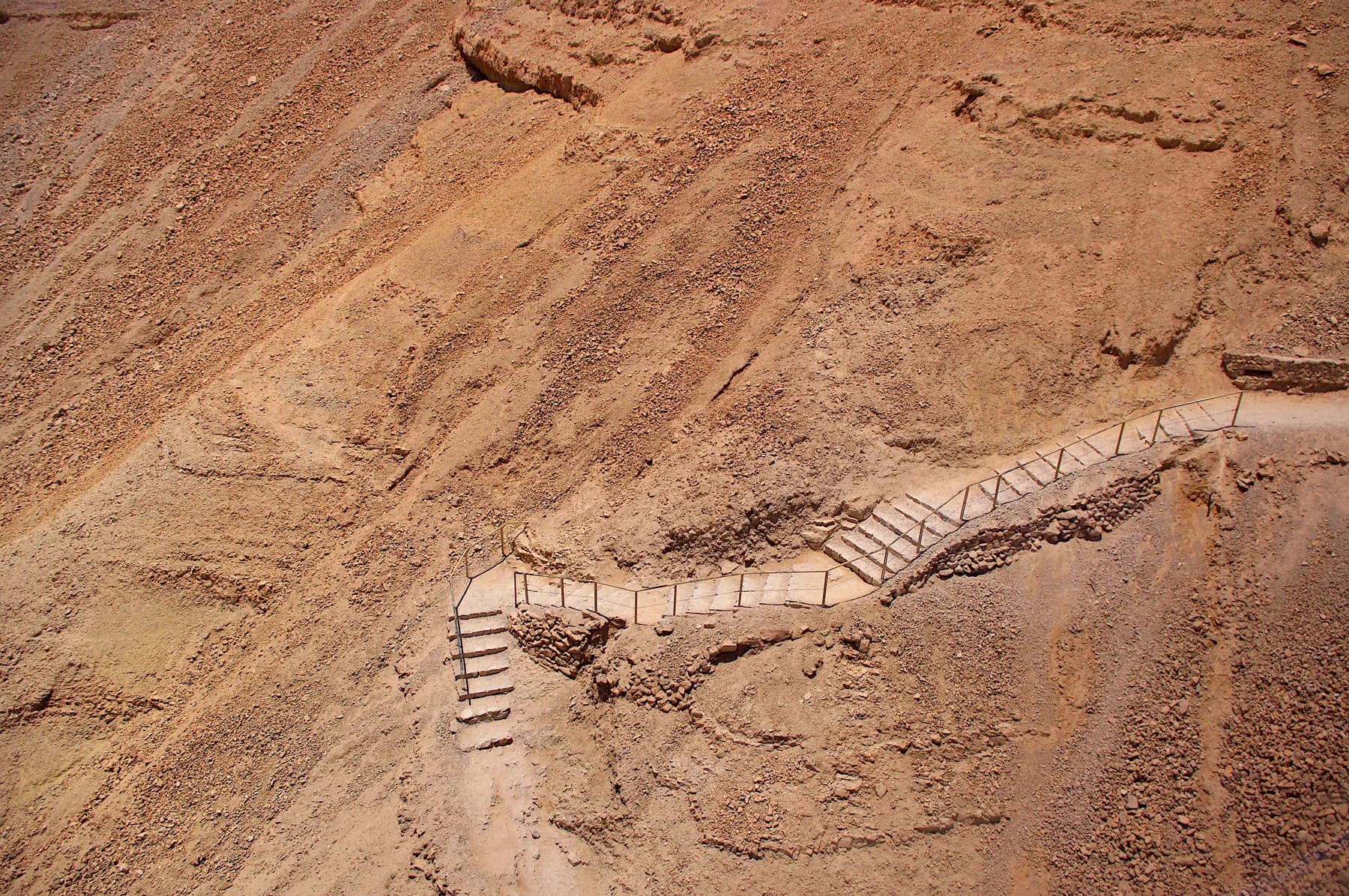
The parks authority measures the climb at 350 metres over about two kilometres and roughly 900 steps, on a line up the east face that Josephus already knew as the serpent.
Armineaghayan / CC BY-SA 4.0 · Wikimedia Commons
Museum
The Masada Museum in Memory of Yigael Yadin
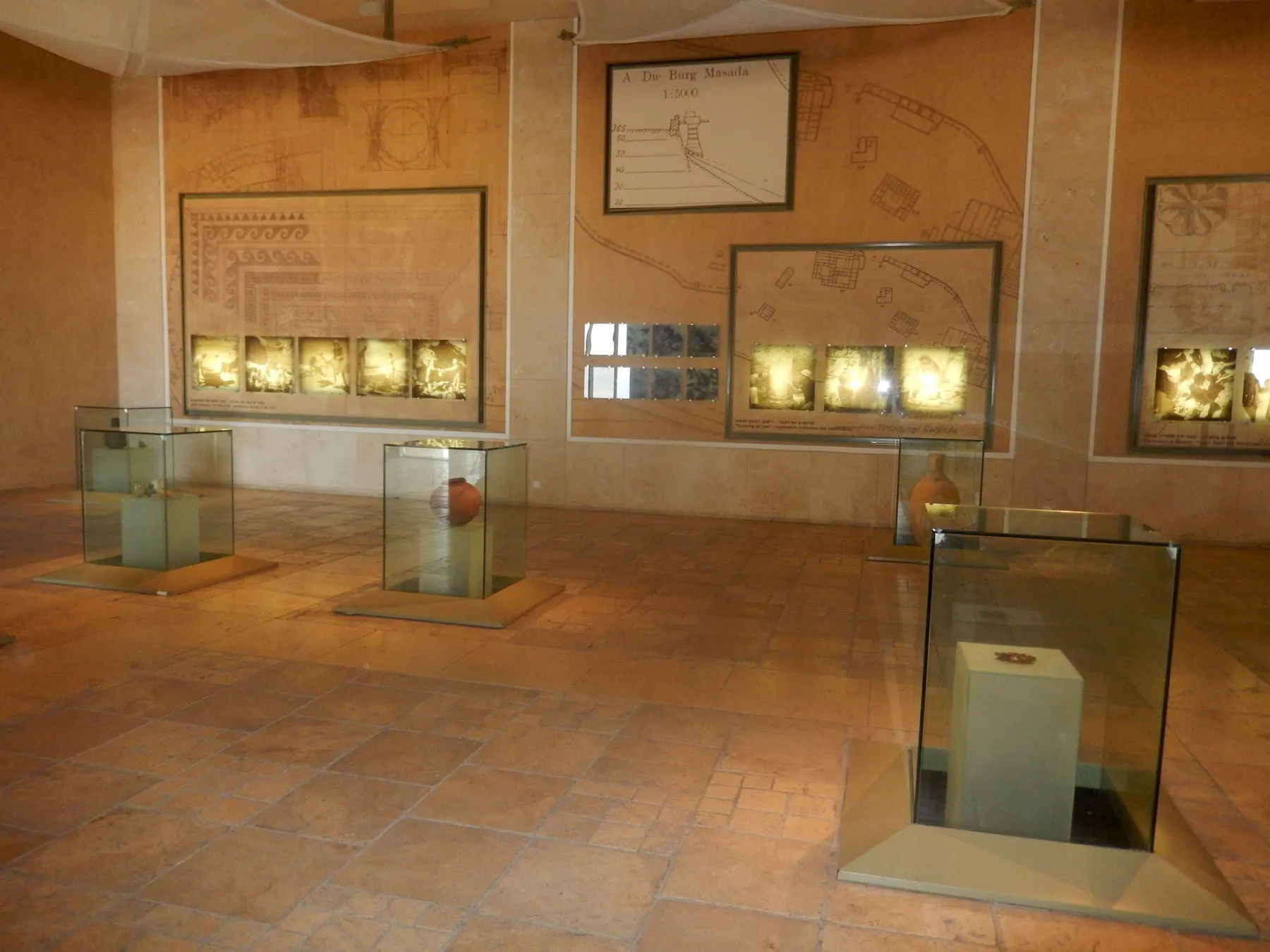
Nine rooms at the foot of the mountain, painted from dark grey to black so that the objects Yigael Yadin's expedition dug out of Masada between 1963 and 1965 are the only lit things in them.
Godot13 / CC BY-SA 4.0 · Wikimedia Commons
Archaeological site
Herod's Northern Palace
Herod's architects hung a private house on three rock terraces at the northern tip of Masada, with about 30 metres of height between the top terrace and the bottom one and retaining walls holding the lower two onto the cliff.
Sources and further reading
Every link below was opened and checked when this page was written. Official statements are marked as such: they are the subject's own account, not an independent one.
- OfficialIsrael Nature and Parks Authorityen.parks.org.ilThe Masada Cable Car
The operator's own page for this site, dated 30 December 2025: the 1971 line and its staircase, the 1998 replacement for growing visitor numbers, the lower station as part of the visitor centre, the suspension bridge, the 2020 electronic upgrade, the 80-passenger cabin limited to 65, the three-minute ride, wheelchair accessibility, the safety and inspection regime with the January 2021 annual test, and the opening hours with entry closing one hour before
- OfficialIsrael Nature and Parks Authorityparks.org.ilרכבל מצדה (The Masada cable car, Hebrew site)
The Hebrew original of the same page, which gives Yom Kippur eve as 08:00 to 13:00 where the English page gives 12:00, and states that the cable car ascends to the Snake Path Gate
- OfficialIsrael Nature and Parks Authorityen.parks.org.ilMasada National Park
Summer and winter hours, the note that the last cable car ascends one hour before closing, the entrance fee table headed 'Entrance fee No cable car' (₪37/₪21/₪31/₪18/₪19 and ₪20 for the museum), the accessible features at the eastern entrance and on the plateau, the Snake Path heat rules, the ban on dogs, and the distances from Ein Gedi and Ein Bokek
- OfficialIsrael Nature and Parks Authorityparks.org.ilגן לאומי מצדה (Masada National Park, Hebrew site)
The two cable car price tabs missing from the English site: one-way ₪32 adult and ₪16 child, return ₪54 and ₪32, both marked as not including the entrance fee
- OfficialIsrael Nature and Parks Authorityparks.org.ilמצדה מציגה: זריחה לכו-לם (Masada presents: sunrise for everyone)
The booked sunrise cable car: Friday departures at 05:30, 06:30 and 07:30, ₪91 adult, ₪53 child to 18 and ₪46 Israeli senior including entry and a return ride, boarding from Masada East only, the note that Snake Path climbers can buy a descent ticket on the spot, and the cancellation terms
- OfficialIsrael Nature and Parks Authorityparks.org.ilמצדה בגרסה נגישה (Masada, the accessible version)
The accessible route as the authority sets it out: covered parking, museum, shops, public areas, film halls and lifts at the eastern complex, the accessible cable car and bridge, the concrete paths on the plateau, and a suggested visit of two to four hours
- ReportingYnet, Shimon Iferganynet.co.ilאחרי 30 שנה יוחלף הרכבל במצדה (After 30 years the Masada cable car will be replaced)
Contemporary reporting from 12 March 2001: the new tramway already built and run in, Swiss specialists about to spend three weeks dismantling the old one, capacity of about 1,200 an hour in groups of 80 against 40 a cabin and 600 an hour before, and more than 10 million visitors to Masada up to that date
- ReferenceHebrew Wikipediahe.wikipedia.orgרכבל מצדה (Masada cable car)
The detailed history, footnoted throughout to the Israeli press of the period: the 1955 proposal, Egged's 1963 plan and its rejection, the October 1966 committee decision and the 20 four-person cabins, the failed tender, the Six Day War delay, Yadin's 1968 complaint, Arnold Kagan, construction from February 1970 by Brändle with the contractor Fogtsh and the engineer Georg Sashegy, the opening on 11 February 1971 with its 840 m line and four-lira fare, Warhaftig's Shabbat request, the 1973 capacity increase, the 1997 to 1998 Von Roll rebuild, and the current figures of 900 m, 290 m, 8 m per second, 1,200 an hour and stations at minus 257 m and plus 33 m
- ReferenceWikipediaen.wikipedia.orgMasada cableway
The English summary: Karl Brändle of Switzerland in 1971, the Von Roll replacement in 1998 with no support pillar so the hanger encloses both track ropes and the haul rope, cars every fifteen minutes, a line length of 0.9 km and a speed of 28.8 km/h, and the claim to be the lowest aerial tramway in the world. Its technical account rests on a single travel aggregator and attaches the 900 m and 290 m figures to the 1971 line
- ReferenceRemontées Mécaniquesremontees-mecaniques.netTPH80 Massada
A specialist ropeway survey of the tramway: described as the machine with the lowest bottom station in the world, built 1998 by Von Roll after 27 years of the Brändle line, bicable with a single haul rope, drive at the lower station and counterweight tension at the upper, cabins by Gangloff of Bern, the upper station cantilevered below the summit for visual reasons, and one old cabin preserved at the bottom station
The Masada Cable Car: common questions
How much does the Masada cable car cost?+
A return ride is ₪54 for an adult and ₪32 for a child, and a one-way ride is ₪32 and ₪16, all stated by the parks authority as not including entry to the national park. Park entry is a further ₪37 for an adult and ₪21 for a child. These fares appear on the Hebrew version of the parks authority's Masada page; the English version prints a table headed 'Entrance fee No cable car' and omits them.
Is the cable car included in the Masada ticket?+
No. It is charged on top of the entrance fee, and the parks authority says so on its own cable car page. There is no combined ticket on the standard price list, although the authority's booked sunrise ascent is sold as a package at ₪91 for an adult, which is the entrance fee and a return ride added together.
How long does the Masada cable car take?+
About three minutes each way, on the parks authority's own figure. Cars leave every fifteen minutes during operating hours, so the realistic door-to-door time including the queue and the walk through both stations is fifteen to twenty minutes in each direction. The plateau itself takes two to four hours depending on how much of it you want.
Is the Masada cable car wheelchair accessible?+
Yes, and it is the only accessible way onto the mountain. The parks authority lists the cable car and the bridge at the top as wheelchair accessible, and the staircase that the old upper station required was removed when the line was rebuilt in 1998. On the plateau there are concrete paths, accessible toilets, railings and shaded gathering places, with access to most of the main complexes. The Northern Palace is the exception: its descent is many steps, and models and lookouts are offered instead.
Can you take the cable car up and walk down the Snake Path?+
You can, but the heat rules bite harder than the ticket does. The parks authority closes the Snake Path for descent by mid-morning in hot weather, at 09:00 when it is very hot and 08:00 in extreme summer heat, while the cable car runs on to the published closing time. The reverse combination, walking up before dawn and buying a descent ticket at the top, is the one the authority explicitly allows without a prior booking.
Does the cable car run on Shabbat?+
Yes. It runs on Saturdays on the same 08:00 timetable as the rest of the week, closing at 17:00 in summer and 16:00 in winter. This was contested when the line opened: the Minister of Religious Affairs, Zerach Warhaftig, asked in 1971 that it be kept still on Shabbat out of respect for the dead of Masada, and the request was refused.
Can you ride the cable car for sunrise?+
Only on the authority's booked 'Sunrise for everyone' mornings, not as part of the ordinary service, which begins at 08:00. Those ascents run on set Fridays at 05:30, 06:30 and 07:30, must be paid for in advance, and cost ₪91 for an adult, ₪53 for a child up to 18 and ₪46 for an Israeli senior citizen, inclusive of entry and a return ride. They board from Masada East on Route 90 only.
Is it really the lowest cable car in the world?+
That is what the reference sources say, and the arithmetic behind it is straightforward: the lower station stands 257 metres below sea level and the upper station 33 metres above. Hebrew and English Wikipedia both state the claim outright, and the ropeway site Remontées Mécaniques phrases it as the machine with the lowest bottom station in the world. No organisation certifies records of this sort, and the parks authority does not print the claim on its own pages.
Do I need to book the cable car in advance?+
Not for the ride itself, but the parks authority asks visitors to reserve a time slot for the national park, and says a reservation guarantees entry at the time chosen. Tickets are then bought at the site's ticket office on arrival. Booking matters most in the two hours after opening, when tour coaches from Jerusalem and the Dead Sea hotels arrive together.
Is the Masada cable car safe?+
The parks authority publishes its regime rather than asking to be taken on trust: continuous inspections to the European ropeway standard set by the manufacturers, plus an annual test before a licence is issued. Its page records the most recent annual test as January 2021, by a Technion-certified inspector, with the permit granted by the Ministry of Transport. The span has no support tower, and the carriage encloses both track ropes and the haul rope, which removes the derailment case that a pylon introduces.