Archaeological site · Masada
Herod's Northern Palace
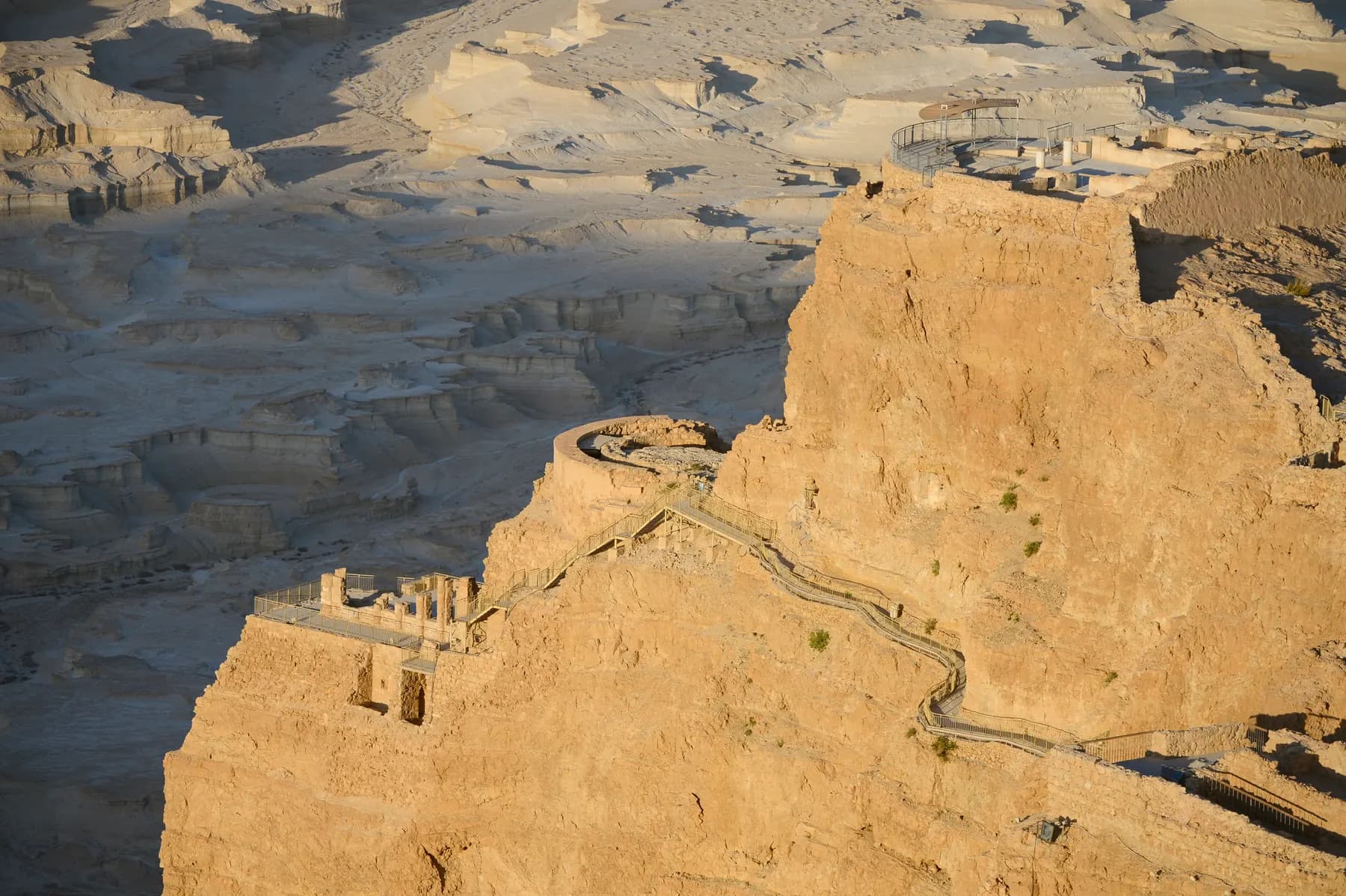
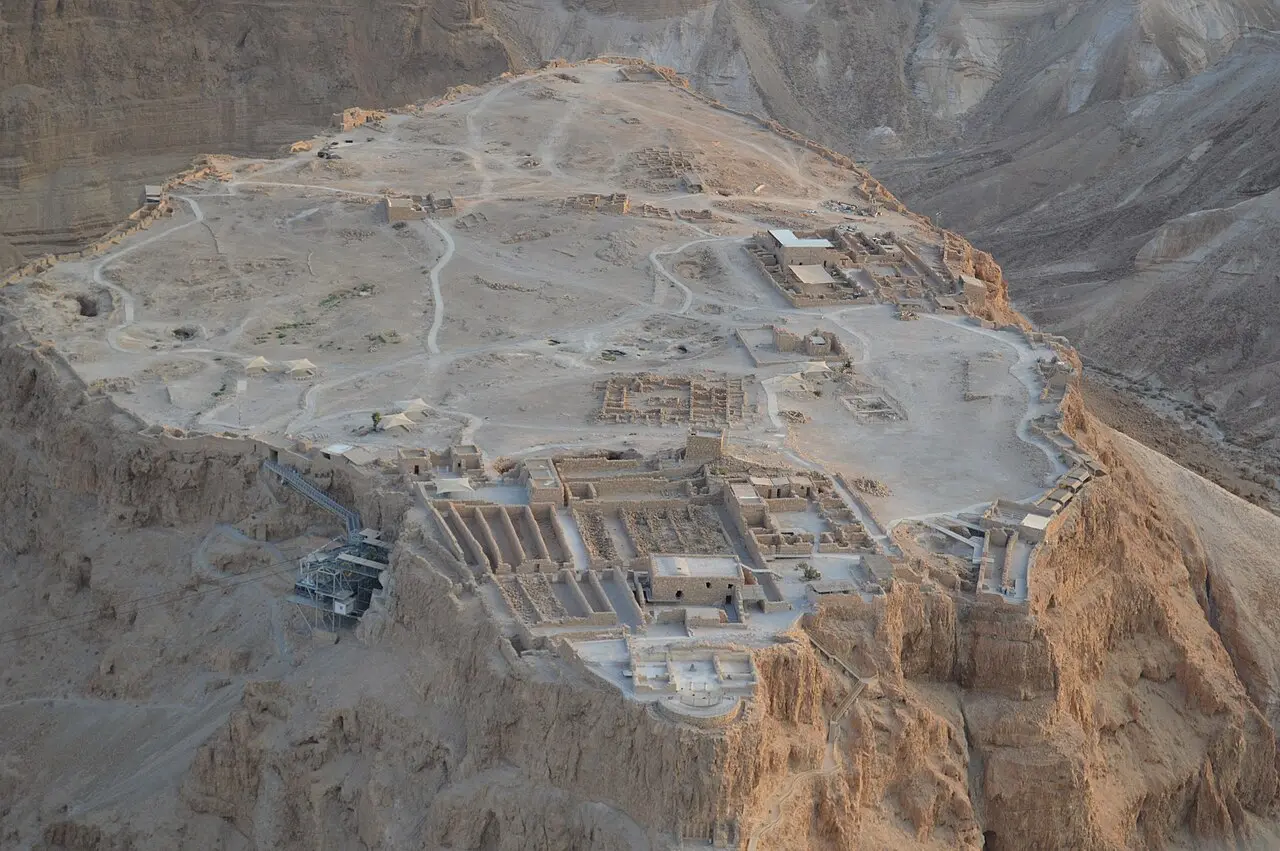
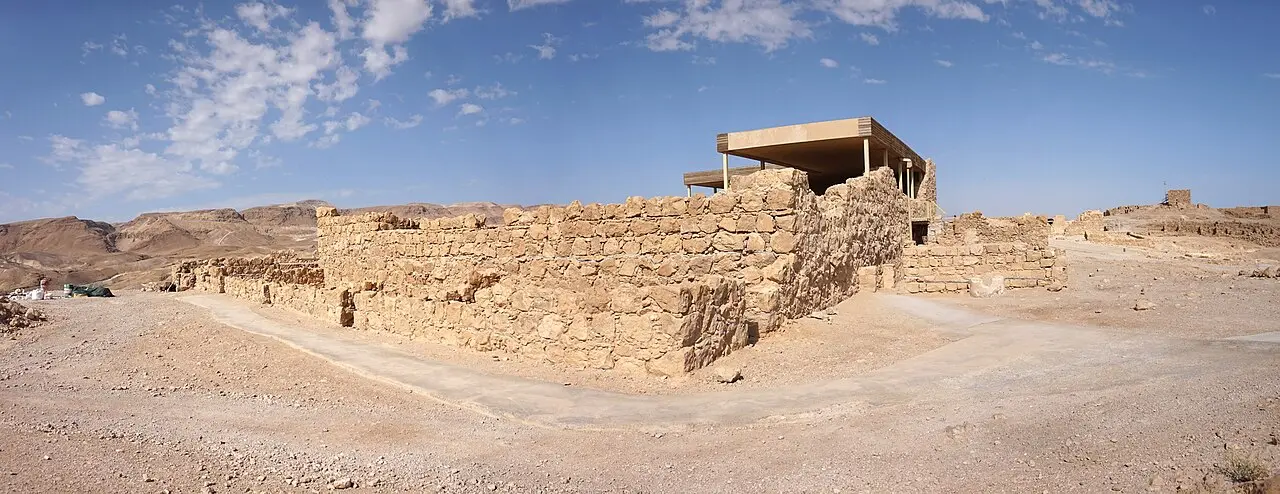
Herod's architects hung a private house on three rock terraces at the northern tip of Masada, with about 30 metres of height between the top terrace and the bottom one and retaining walls holding the lower two onto the cliff.
Godot13 / CC BY-SA 4.0 · Wikimedia Commons
Terraces
3
about 30 m of height between the top and the bottom, per the parks authority
Drop to the middle terrace
about 20 m
and roughly 15 m more to the lower one, per Encyclopaedia Judaica
Rooms on the top terrace
4
around a central hall, mosaic floors and painted walls, Herod's own quarters
Skeletons on the lower terrace
3
found in the small bathhouse in November 1963, and still argued over
In short
- How long to give it
- about 45 minutes for the palace and its terraces, inside the two to three hours most visitors give the whole plateau
- The palace itself
- No separate hours: it opens and closes with the national park, and there is no gate or ticket at the top of the steps
- Adult, park entry, cable car excluded
- ₪37
הארמון הצפוני
The Northern Palace is a private residence Herod's builders hung onto the northern tip of the Masada plateau, on three rock terraces linked by staircases. It is not the biggest building on the mountain: the Western Palace is far larger. It is the one that took the most nerve, because two of its three levels sit below the summit on ledges that had to be enlarged with retaining walls before anything could stand on them.
The Israel Nature and Parks Authority, which runs the mountain, gives the height difference between the top terrace and the bottom one as about 30 metres. Encyclopaedia Judaica's entry on Masada, written by the archaeologist Guy D. Stiebel, breaks that into roughly 20 metres from the upper terrace down to the middle one and roughly 15 metres more to the lower. The top terrace held four rooms and a central hall with mosaic floors and painted walls, and a semicircular balcony built out from the rock on a double wall. The two below were for pleasure: a round columned pavilion, and beneath it a colonnaded hall with a small Roman bathhouse in one corner.
It is also the piece of Masada that UNESCO named. The parks authority records that the 2001 World Heritage inscription singled out two things: the Roman siege works below, and the Northern Palace, described as an outstanding example of a luxurious villa of the early Roman period.
The building
A private house pinned to the north face of the rock
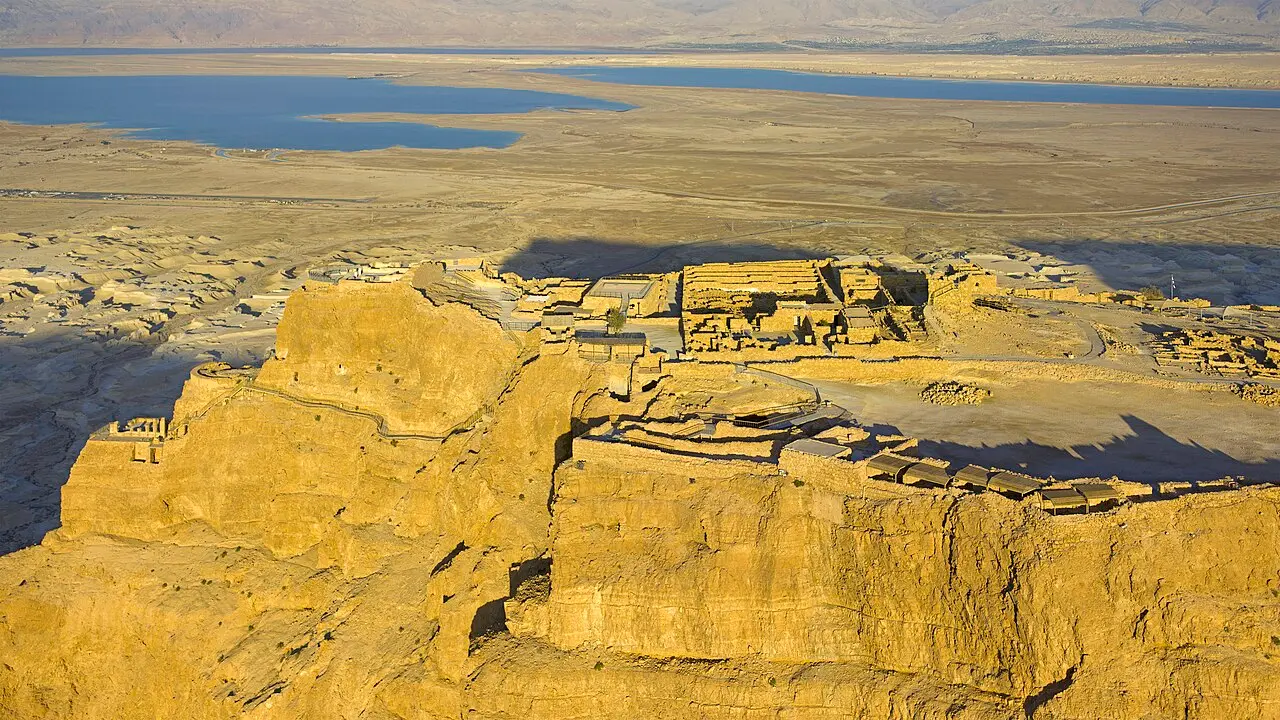
Herod's engineers had a flat summit roughly 650 metres long to build on, and they put the king's own quarters on the one part of it that runs out of ground. The plateau narrows to a point at its northern end and then falls away; the palace begins on that point and continues down the face, on ledges squared off and walled up to make three usable platforms. The parks authority calls it a daring structure built at the edge of a deep ravine, with strong retaining walls doing work that is invisible from the top and obvious from below.
There is a plain reason for choosing the north end. It is the shaded side, out of the worst of the sun, and it faces the escarpment and the Dead Sea rather than the desert. Josephus says the palace enjoyed better conditions and a view running as far as Ein Gedi: the site was picked for climate and outlook, not for defence.
The palace was also cut off from the rest of the mountain. A high white plastered wall ran across the neck of the summit south of it, leaving only a narrow passage at the eastern end for the staircase down: anyone on the plateau, garrison included, was on the far side. Josephus places Herod's palace "at the western ascent" while adding that it was "within, and beneath the walls of the citadel: but inclined to its north side", a description that has sent readers looking in two directions ever since.
It went up in stages. Ehud Netzer identified three construction phases at Masada; on Stiebel's summary a building on the upper terrace belongs to the first, and the palace as a complex, with the large bathhouse and public storerooms south of it, to the second.
Godot13 / CC BY-SA 4.0 · Wikimedia Commons
Level by level
Bedrooms on top, a round pavilion below, a banqueting floor at the bottom
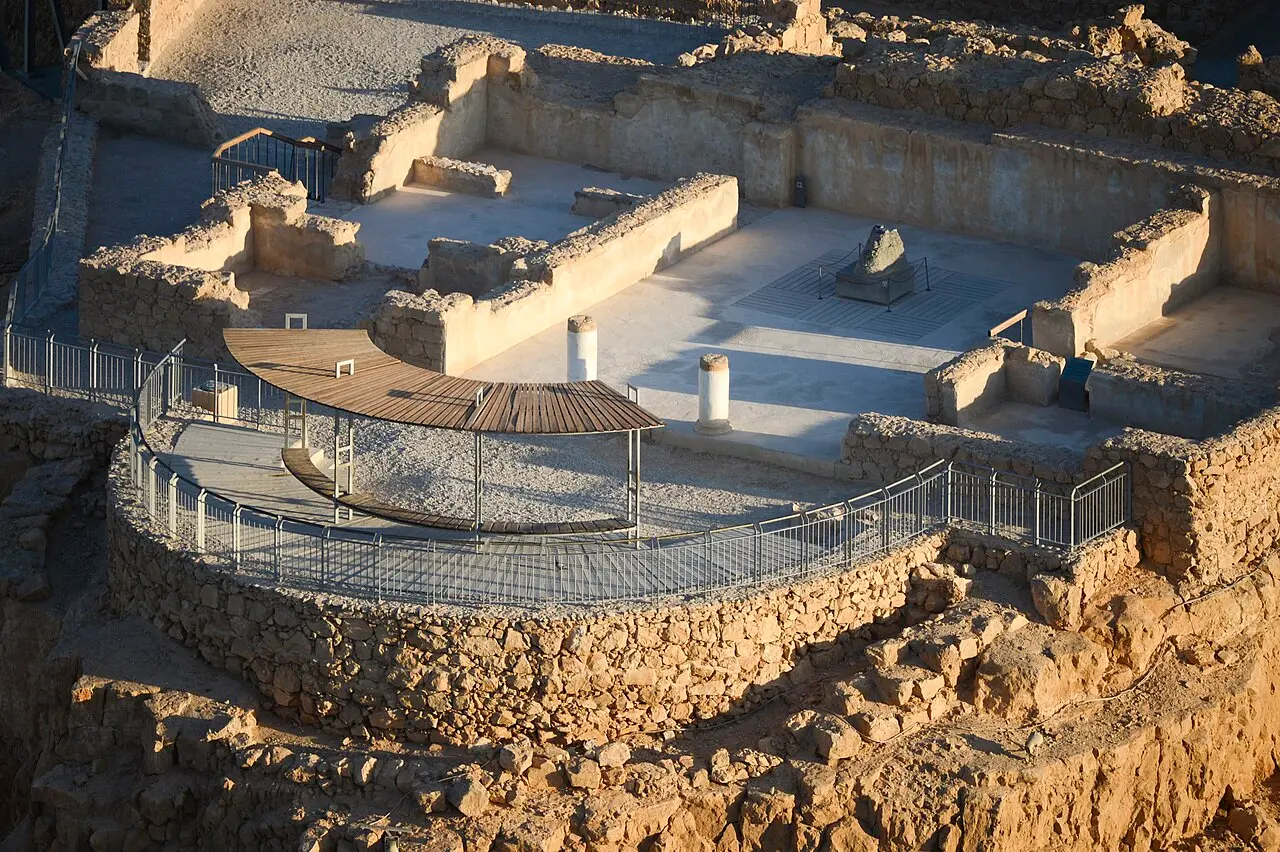
The upper terrace is the residence. Four rooms and a central hall sit south of a semicircular balcony that was once ringed with columns and is carried on a double wall built out from the terrace edge. The rooms were paved with geometric mosaic and the walls and ceilings painted. In the southwestern room the parks authority records a black and white mosaic of hexagons, a pattern it calls typical of Rome and its surroundings and reads as a clue to where the craftsmen took their ideas from. The balcony looks out over the Ha-'Etekim escarpment, the Dead Sea and the Roman siege system.
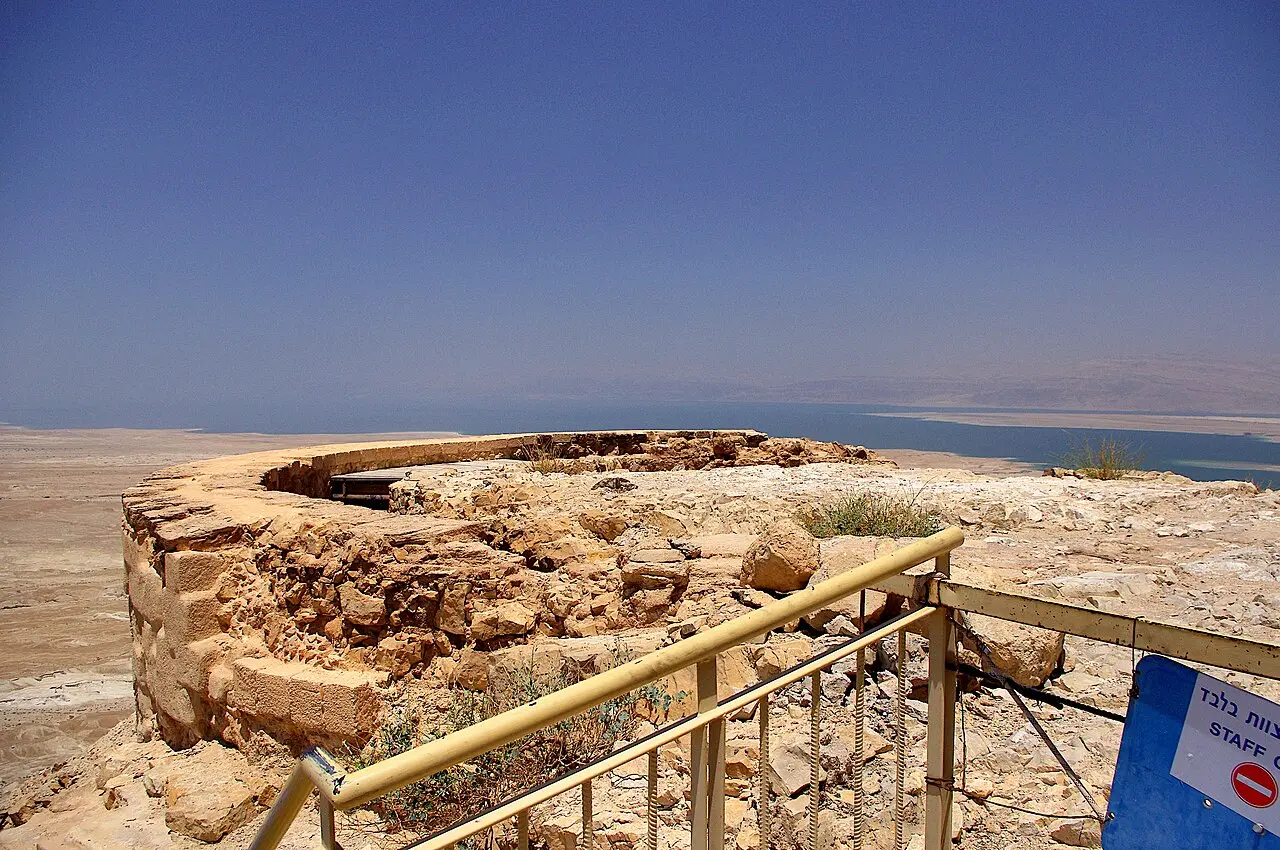
The middle terrace, about 20 metres down, is the hardest to read on the ground because almost nothing of the superstructure is left. What survives is two concentric circular walls, which served as the platform for a round columned building; the parks authority is blunt that only the foundations remain. Stiebel's entry describes a staircase on the west, a large room with traces of frescoes on the east, and a roofed colonnade between them which he suggests may have been a library. It is the one part of the palace whose architecture he calls completely Hellenistic rather than Roman.
The lower terrace, roughly 15 metres below that again, is the best preserved of the three. Great supporting walls raise a nearly square platform on a spur that tapers to a point; low walls around it formed porticoes on all sides. The outer walls carried stucco, and the inner walls frescoes painted to imitate slabs of coloured marble and geometric panels. In the eastern corner is a small bathhouse in the Roman manner, and it was here that Yigael Yadin's expedition found three human skeletons.
Stepped ritual immersion pools were cut into the lower terrace and beside the middle one during the revolt, not in Herod's time: the rebels were living in the king's private rooms a lifetime after he died.
- Upper terrace: four rooms and a central hall, mosaics, painted walls, a semicircular colonnaded balcony on a double wall
- Middle terrace: two concentric circular walls carrying a round columned building, foundations only
- Lower terrace: a colonnaded hall on a raised platform, frescoes imitating marble, a small Roman bathhouse
- Ritual immersion pools added in both lower levels during the revolt
Godot13 / CC BY-SA 4.0 · Wikimedia Commons
The design
Rome on the top terrace, Greece on the one below, and columns made of plaster
The palace is not stylistically consistent, and that is the interesting thing about it. Stiebel's Encyclopaedia Judaica entry treats it as a case study in the moment when Roman taste displaced Hellenistic taste in the eastern Mediterranean: the upper terrace was built in Roman style, the middle terrace is Hellenistic throughout, and the lower terrace was fitted with a Roman-style bathhouse. One building, two architectural worlds.
The Roman connection may be closer than a matter of fashion. Gideon Foerster argued that the plan of the upper terrace was directly influenced by the villa in the grounds of the Farnesina in Rome, a house attributed to Marcus Agrippa, who was Herod's patron and personal friend. If that holds, the drawing on the desk at Masada came from the circle of architects who built for Augustus's closest colleague.
The columns are the detail most visitors walk straight past. On the lower terrace they look like tall monolithic shafts of fluted stone. They are not. They are drums of soft sandstone stacked up, then plastered and fluted so the join disappears and the whole thing reads as one piece. The trick is ancient, not modern: this is what Herod's masons did in a place with no marble and no way of hauling it up a cliff. Josephus, who says the buildings were supported by "pillars of single stones", appears to have been taken in by it.
The same stone carries a signature of sorts. Stiebel notes that mason's marks in Hebrew letters are visible on all the pillar drums at Masada, indicating where the stone cutters came from, while the softer stone used for drums and capitals was brought in rather than quarried on the summit.
What the palace was for is still disputed. Yadin read the Western Palace as Herod's ceremonial building; Netzer rejected that and gave the ceremonial role to the Northern Palace. Nothing found so far settles it, and the two readings put the king in different rooms.
What survives
What is Herod's here, and what has been put back
The parks authority's own description of the palace lists "mosaic floors and restored wall paintings", and the word restored is carrying weight. The paintings on the lower terrace survived because the building fell in on them: buried under its own collapse, plaster keeps its colour in a way that exposed plaster in the Judaean Desert does not. Conservation here has been continuous since the excavations, and the parks authority describes decades of investment in conserving the site alongside the interpretive panels and the access works.
How far that conservation goes is easiest to see next door. Frescoes lifted from the commander's residence, the building at the southern entrance to the Northern Palace complex, spent roughly two decades in storage after Yadin's dig because they were deteriorating outdoors. They were restored by the Italian conservator Maurizio Tagliapietra and put back in 2014, in positions worked out from photographs taken during the excavation. Nothing on Masada that looks finished should be assumed to have stayed that way since 1965.
On the terraces themselves the split between ancient and modern is uneven. The lower terrace keeps its frescoed walls and the footprint of its porticoes. The middle terrace has lost effectively everything above its two foundation rings, which is why it reads as a pair of circles in the ground rather than as a building. On the upper terrace the balcony survives as the double wall that carried it; the columns that stood around it are gone. The steps you walk down are not the Herodian staircase, though parts of the original survive on the middle and lower levels.
- Original: the frescoed lower-terrace walls, the mosaic in the southwestern room upstairs, the retaining and foundation walls
- Gone: the columns of the upper terrace balcony and almost everything above the middle terrace foundations
- Restored: wall paintings, described as such by the parks authority
- Modern: the visitor staircase and its railings, and the interpretive models on the plateau
Jan Helebrant / CC0 · Wikimedia Commons
The find
Three skeletons, a woman's braids, and an argument that has not ended
In late November 1963, in the small bathhouse on the lower terrace, Yadin's expedition uncovered the remains of three people, along with a woman's scalp with the braids still in it and a pair of leather sandals. Yadin announced them at a press conference as the bones of Masada's Jewish defenders, and no other single find did as much to fix Josephus's account in the public mind. The braids are displayed at the Yigael Yadin museum at the foot of the mountain.
The identification has never been secure. Stiebel's encyclopaedia entry sets out the problem plainly: Yadin claimed the three as a rebel family, but the condition of the skeletons and the absence of many protein-rich bones may instead indicate that the bodies were dragged there by hyenas. That is a different story about how three people ended up in a bathhouse, and it is not a story about a last stand.
A separate group of 25 skeletons had been found a month earlier in a cave on the southern cliff, and those are more contested still. Pig bones were found among them, which led the anthropologist Joe Zias to argue they were Roman rather than Jewish dead; Zias has published a recollection of Yadin telling him, of the cave remains, "I never said that all the remains found there were Jewish."
The remains were nonetheless given a state funeral. On 7 July 1969, 27 skeletons, three from the Northern Palace and 24 from the southern cave, were buried near the foot of the Roman ramp with full military honours, the army's chief chaplain Shlomo Goren officiating and Yadin reading from Josephus. What was excavated as an open question was reburied as a settled one.
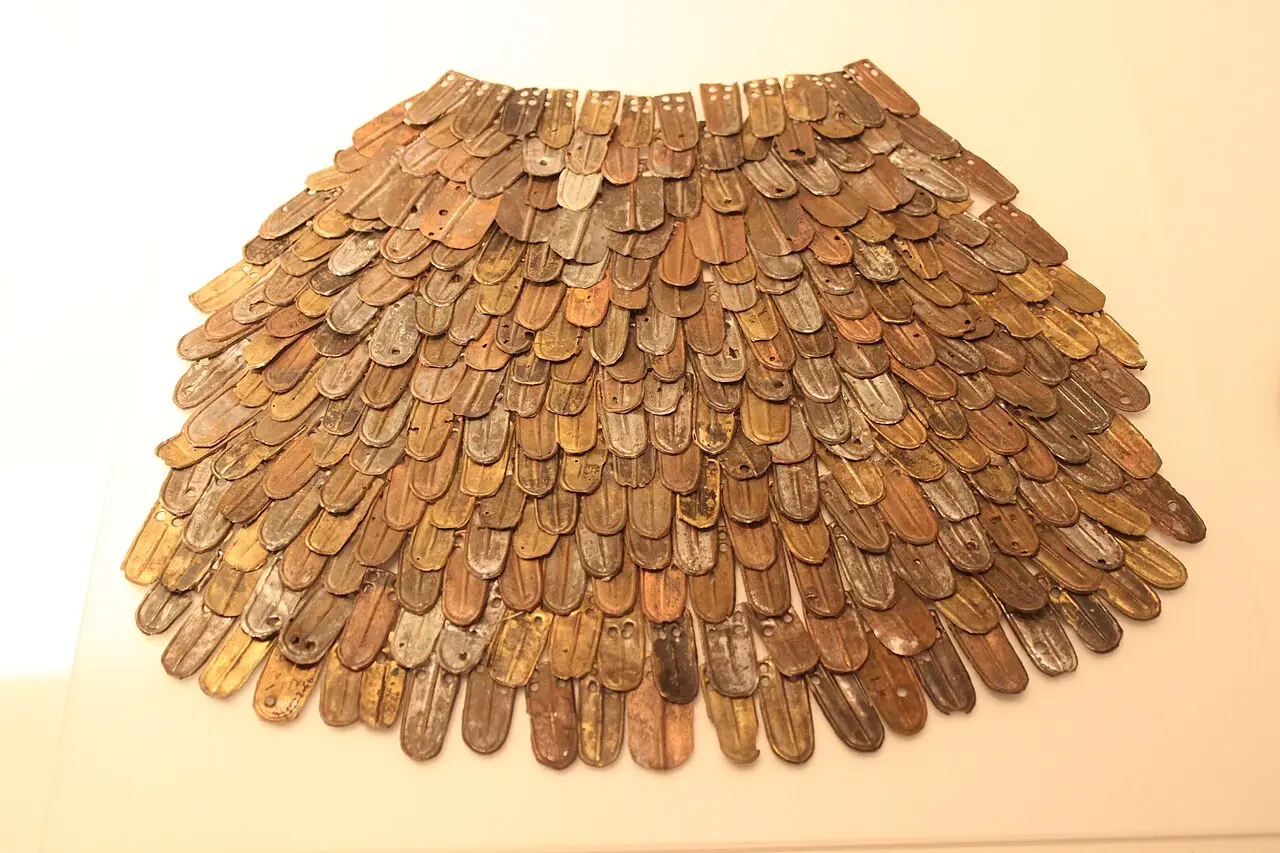
Superikonoskop / CC BY-SA 3.0 · Wikimedia Commons
On the ground
The descent, and why a lot of people skip it
The palace is not on the way to anywhere. The top terrace is at the northern end of the plateau, and everything below it is a descent and a re-ascent by the same steps. The parks authority describes that route as many steps with railings on both sides, and offers the models and lookouts on the plateau as the alternative for anyone who would rather not. That is an official acknowledgement that the two lower terraces are optional.
Nothing about the palace is separately ticketed or separately timed. It opens and closes with Masada National Park, which the parks authority lists as 08:00 to 17:00 in summer and an hour earlier through the winter, closing an hour earlier again on Fridays and holiday eves. The last cable car goes up an hour before closing, so the last sensible moment to start down is well before the gate shuts.
The order of the day matters more here than at most of the plateau complexes. The steps are exposed, the return leg is uphill, and Masada's paths run on a heat schedule rather than a timetable: in extreme summer conditions the parks authority puts the last ascent on the Snake Path at 07:00. Doing the palace first, straight off the cable car or the top of the path, buys shade on the north face and an empty staircase.
The view is the other argument for going down. From the balcony and the terraces below it the escarpment, the Dead Sea and the outlines of the Roman camps on the marl plain line up in one frame, which is true from nowhere on the summit.
BACbKA / CC BY-SA 4.0 · Wikimedia Commons
What to look for
Things not to walk past at Herod's Northern Palace
The details that repay knowing about before you are standing in front of them.
The semicircular balcony
Built out from the upper terrace on a double wall and once ringed with columns, it looks straight down the escarpment to the Dead Sea and out over the Roman siege works. The wall survives; the columns do not.
The hexagonal mosaic
In the southwestern room of the top terrace, a black and white floor of hexagons that the parks authority describes as a pattern typical of Rome and its surroundings, and reads as a clue to where the craftsmen learned their trade.
The two circles on the middle terrace
Concentric foundation rings that carried a round columned building for entertaining. Only the foundations survive, so this is the one level where the plan is easier to read than the architecture.
The columns that are not columns
The shafts on the lower terrace are sandstone drums stacked, plastered and fluted to pass as single pieces of stone. Josephus described Masada's buildings as supported by pillars of single stones, which suggests the illusion worked.
The frescoed walls of the lower terrace
Painted to imitate panels of coloured marble and geometric designs, and preserved because the building collapsed on top of them. This is the best-preserved decorated interior on the mountain.
The small bathhouse in the eastern corner
A complete Roman bath in miniature at the bottom of the palace, and the room where the three skeletons and the braided hair were found in November 1963.
The long view
Herod's Northern Palace, in order
40 BCE
Herod flees Jerusalem and leaves his family at Masada during the Parthian invasion, an episode Josephus records and which is usually taken as the reason he later fortified the rock as a personal refuge.
37–4 BCE
Herod's reign. Netzer identified three building phases at Masada: a structure on the upper terrace of the Northern Palace belongs to the first, and the palace as a complex, with the large bathhouse and the public storerooms, to the second.
1st c. CE
Rebels of the First Jewish Revolt occupy the mountain and cut stepped immersion pools into the lower terrace and beside the middle one, using the king's private terraces as living space.
1838
Edward Robinson and Eli Smith pick out the shape of the northern cliff through a telescope from Ein Gedi and identify it as Herod's palace, without setting foot on the mountain.
1932
Adolf Schulten spends about a month at Masada and misreads the Northern Palace as a fortification built at the upper end of the Snake Path.
1953
The first Israeli excavation, driven by Shmarya Guttman, correctly identifies the Northern Palace as Herod's palace.
November 1963
Yadin's expedition finds three skeletons, a woman's scalp and braids and leather sandals in the small bathhouse on the lower terrace, and announces them as the remains of the defenders.
7 July 1969
Twenty-seven skeletons, three from the Northern Palace and 24 from the cave on the southern cliff, are reburied near the foot of the Roman ramp with full military honours.
1995–2000
Further excavation seasons under Ehud Netzer and Guy Stiebel concentrate on the Northern Palace complex and its entrance buildings.
2001
UNESCO inscribes Masada, singling out the Northern Palace as an outstanding example of a luxurious villa of the early Roman period.
2014
Frescoes from the commander's residence, at the southern entrance to the Northern Palace complex, are restored by the conservator Maurizio Tagliapietra and returned to the positions recorded in Yadin's excavation photographs.
Practical
Visiting Herod's Northern Palace
Where
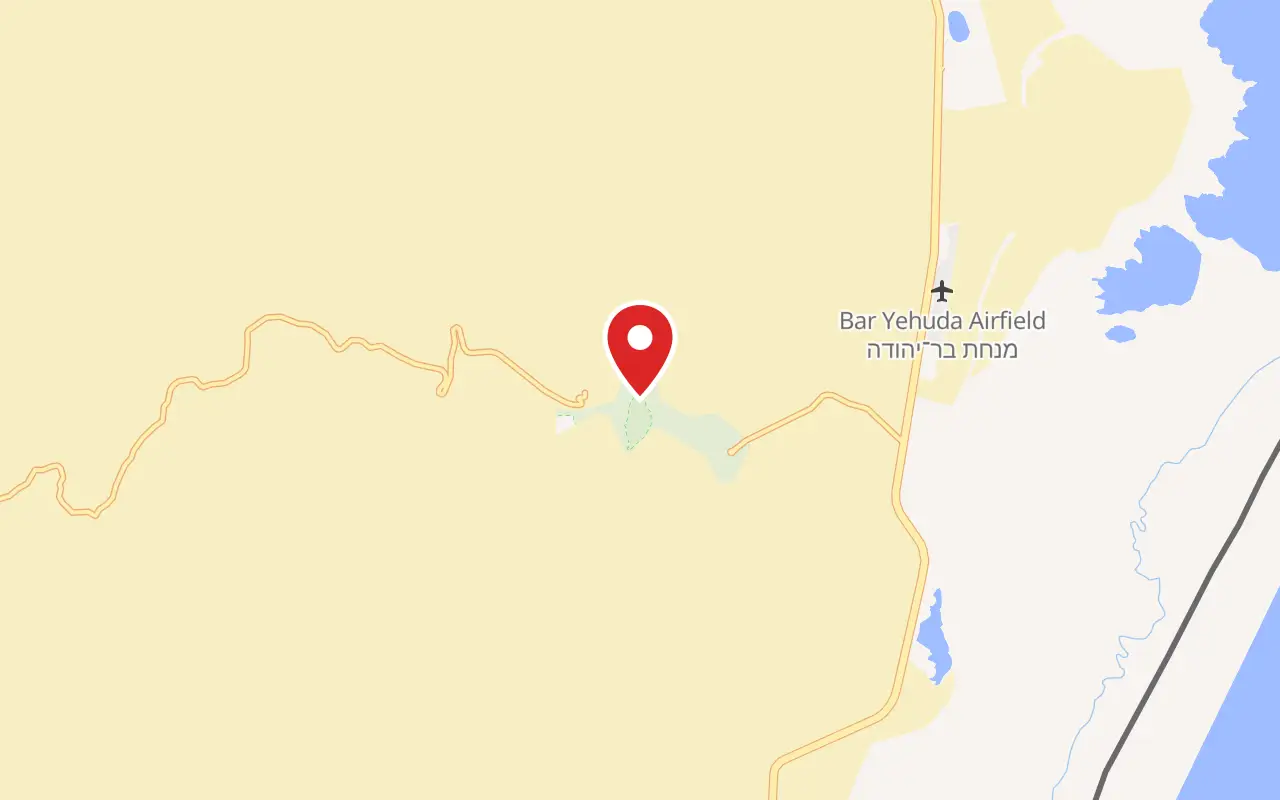
Northern end of the Masada plateau, Masada National Park, Judaean Desert, above the western shore of the Dead Sea
What ticket you need
The Northern Palace sits inside Masada National Park, at the far northern end of the summit. The park entrance fee covers it; there is no separate ticket, no separate gate and no separate opening time. Getting to the top is the part that costs extra or costs effort: the cable car is charged on top of the entrance fee, and the Snake Path and the Roman ramp trail are free to walk but close on a heat schedule.
Opening hours
- The palace itself
- No separate hours: it opens and closes with the national park, and there is no gate or ticket at the top of the stepssource
- Park, summer, Sunday to Thursday and Saturday
- 08:00 to 17:00source
- Park, summer, Friday and holiday eves
- 08:00 to 16:00source
- Park, winter, Sunday to Thursday and Saturday
- 08:00 to 16:00source
- Park, winter, Friday and holiday eves
- 08:00 to 15:00source
- Last entry and last cable car
- Entry to the park closes one hour before the stated time; the last cable car ascends one hour before closingsource
- Getting up in summer heat
- In extreme heat the last ascent on the Snake Path is 07:00 and on the Roman ramp trail 11:00, set against the Israel Meteorological Service forecastsource
Admission
- Adult, park entry, cable car excluded
- ₪37source
- Child
- ₪21source
- Student, or adult in a group
- ₪31source
- Child in a group
- ₪18source
- Israeli senior citizen
- ₪19source
- Northern Palace
- No separate charge: it is inside the park boundary and covered by the park ticketsource
- Yigael Yadin museum, where the braids are displayed
- ₪20, by reservation onlysource
Access
Not accessible below the top terrace. Getting to Masada can be done without steps: the cable car is wheelchair accessible and lands on a suspension bridge with no stairs at the upper station, and the plateau has concrete paths, railings, benches, accessible toilets and shaded gathering places. The palace is the exception. The parks authority states that the descent through the Northern Palace is via many steps with railings on both sides, and offers the models and the lookouts on the plateau as the alternative, which is the clearest way of saying that wheelchairs, and most people with a knee or a heart problem, are not going down. There is no lift, no ramp and no second route. The parks authority runs a coordination form for accessible visits, and its models and relief maps on the plateau are adapted for visually impaired visitors.
On site
- Handrails on both sides of the descent
- Interpretive models and lookouts on the plateau above
- Concrete paths and benches on the plateau
- Accessible toilets on the plateau
- Shaded gathering places
- No shade, water or toilets on the terraces themselves
Booking
There is nothing to book for the palace, but the parks authority asks visitors to reserve a time slot for Masada National Park online, and says that if the slot is full on arrival you will be asked to show the reservation confirmation to get in. The Yigael Yadin museum at the foot, which holds finds from the palace including the braided hair, is entered by reservation only and charged separately.
Hours and prices are given as the operator publishes them and change without much notice, particularly around Shabbat and the festivals. Check the operator's own page before you travel for this.
Official page at en.parks.org.il →What people wish they had known
- Do the palace first, before anything else on the plateau. It is at the far northern end, the steps are exposed, and the leg that hurts is the one back up. People who leave it until last tend to look over the railing and turn round.
- Understand what the descent is before starting it. The parks authority describes many steps with railings on both sides and openly offers the plateau models and lookouts as the alternative; there is no ramp, no lift and no easier way down.
- Do not go looking for the palace above the Snake Path gate. Adolf Schulten made exactly that mistake in 1932 and read the ruins as a fortification at the head of the path; the palace is at the northern tip, past the storerooms and the large bathhouse.
- Look at the columns on the lower terrace from close up. They are stacked sandstone drums finished in plaster and fluted to pass as single shafts, which is the most Herodian thing on the mountain and invisible from ten metres away.
- The braided hair is not on the mountain. It is displayed in the Yigael Yadin museum at the foot, which is charged separately and entered by reservation only, so book it with the park ticket rather than deciding on the way out.
The figures
Herod's Northern Palace by the numbers
Each figure carries the year it belongs to and links the source it came from.
| Measure | Figure | As of | Source |
|---|---|---|---|
| Height difference across the three terraces | about 30 m | 2026 | en.parks.org.il |
| Drop from the upper terrace to the middle | about 20 m, with roughly 15 m more to the lower terrace | 2007 | encyclopedia.com |
| Rooms on the upper terrace | 4, arranged around a central hall, two on each side of a court | 2026 | en.parks.org.il |
| Human remains found in the lower terrace bathhouse | 3, with a woman's scalp and braids and leather sandals | 1963 | jamestabor.com |
| Skeletons reburied at Masada with military honours | 27, of which 3 came from the Northern Palace, on 7 July 1969 | 1969 | jamestabor.com |
| Adult park entry, which covers the palace | ₪37, cable car excluded | 2026 | en.parks.org.il |
| Yigael Yadin museum, holding finds from the palace | ₪20, by reservation only | 2026 | en.parks.org.il |
| Cable car ride to the summit gate | about 3 minutes each way, up to 80 passengers per trip, limited by the operator to 65 | 2026 | en.parks.org.il |
While you are here
The rest of Masada
Everything else in this destination with a page of its own.
Carole Raddato from FRANKFURT, Germany / CC BY-SA 2.0 · Wikimedia Commons
Archaeological site
Herod's Large Bathhouse
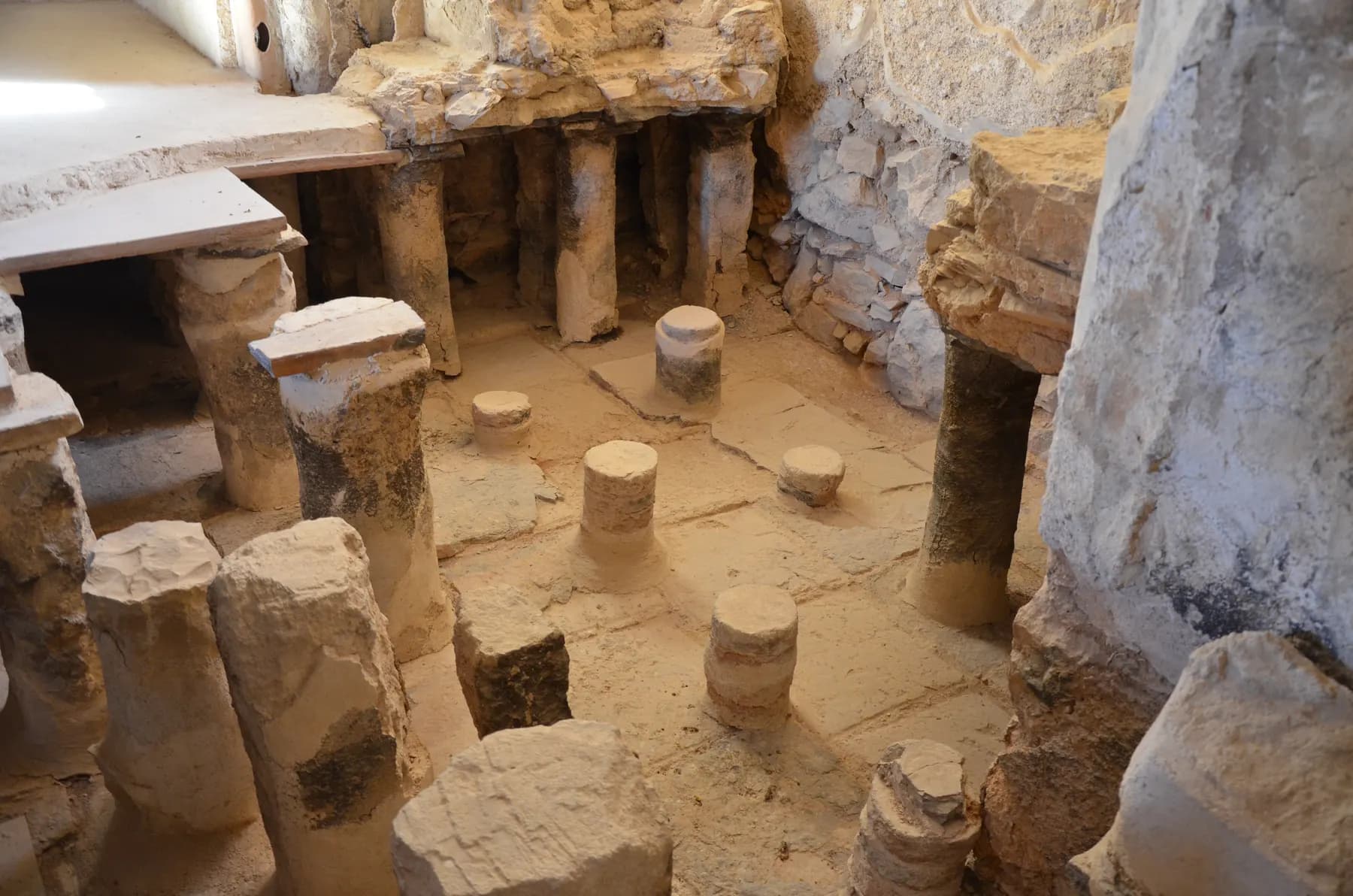
The floor of the hot room still stands on roughly 200 small columns, most of them brick, with the furnace stokehole, the wall flues and the stepped cold pool all in place around it.
Tiia Monto / CC BY-SA 3.0 · Wikimedia Commons
Archaeological site
The Western Palace
The Israel Nature and Parks Authority puts this building at 3,700 square metres, which makes it the largest on the Masada plateau, and its four wings held Herod's reception rooms, his storerooms, his workshops and his administration.
Armineaghayan / CC BY-SA 4.0 · Wikimedia Commons
Museum
The Masada Museum in Memory of Yigael Yadin
Nine rooms at the foot of the mountain, painted from dark grey to black so that the objects Yigael Yadin's expedition dug out of Masada between 1963 and 1965 are the only lit things in them.
Sources and further reading
Every link below was opened and checked when this page was written. Official statements are marked as such: they are the subject's own account, not an independent one.
- OfficialIsrael Nature and Parks Authorityen.parks.org.ilMasada National Park – The Plateau
The operator's own account of the Northern Palace: three rock terraces with a height differential of about 30 m and strong retaining walls, four rooms and a central hall on the top terrace, the black and white hexagonal mosaic in the southwestern room described as a pattern typical of Rome, the semicircular columned balcony over the escarpment, Dead Sea and Roman siege system, the middle terrace circular chamber of which only the foundations survive, the lower terrace chamber surrounded by stoae with stucco outside and frescoes imitating marble inside, the small bathhouse with three human skeletons and a woman's preserved braids, Schulten's 1932 misidentification and Guttman's correction in 1953
- OfficialIsrael Nature and Parks Authorityen.parks.org.ilMasada National Park
Summer and winter opening hours, entry closing an hour before the stated time and the last cable car an hour before closing, entrance fees of ₪37 adult, ₪21 child, ₪31 student and adult in group, ₪18 child in group, ₪19 Israeli senior and ₪20 for the museum, the heat schedule for the Snake Path and Roman ramp trail, the reservation system, and the accessibility statement including the line that descent in the Northern Palace is via many steps with railings on both sides and that the models and lookouts are an alternative
- OfficialIsrael Nature and Parks Authorityen.parks.org.ilWorld Heritage Sites
The parks authority's record of the 2001 UNESCO inscription, which named the Northern Palace built by Herod as an outstanding example of a luxurious villa from the Early Roman period alongside the siege works described as the finest and most complete Roman siege works to have survived
- OfficialIsrael Nature and Parks Authorityen.parks.org.ilThe Masada Cable Car
The three-minute ride to the Snake Path gate, capacity of 80 limited to 65 per trip, the step-free suspension bridge at the upper station, wheelchair access, and the fact that the cable car is charged on top of the park entrance fee
- ReportingBiblical Archaeology Societybiblicalarchaeology.orgMasada Frescoes Restored and Returned
Herodian frescoes from the commander's residence near the Northern Palace, kept in storage for nearly two decades after Yadin's excavations because they were deteriorating outdoors, restored by Maurizio Tagliapietra of the University of Verona and returned in 2014, with their positions determined from photographs taken during Yadin's dig
- ReportingThe Times of Israeltimesofisrael.comHerodian frescoes restored, returned to Masada
Independent account of the same conservation project: geometric frescoes from a room in a Herodian palace on Masada, discovered in the 1960s, held in storage for roughly twenty years to prevent deterioration, restored over a month of work by the Italian conservator Maurizio Tagliapietra with the Israel Nature and Parks Authority, and returned to their original location in May 2014
- ReferenceEncyclopaedia Judaica, entry by Guy D. Stiebel, via Encyclopedia.comencyclopedia.comMasada, in Encyclopaedia Judaica (2nd edition)
Drops of about 20 m from the upper terrace to the middle and about 15 m from middle to lower; the semicircular balcony bounded by a double wall and the four-room building with two rooms on each side of a court; the great white plastered wall separating the palace from the rest of Masada; Foerster's argument that the upper terrace plan was influenced by the Villa Farnesina in Rome attributed to Marcus Agrippa; the middle terrace concentric circular walls, the room with traces of frescoes and the roofed colonnade read as a possible library; the lower terrace platform, porticoes, sandstone drums plastered and fluted to resemble monolithic columns and frescoes imitating stone and marble panelling; Netzer's three building phases; Hebrew mason's marks on the pillar drums and the imported softer stone; Yadin's and Netzer's opposed readings of which palace was ceremonial; and the three skeletons with the woman's scalp, braids and sandals together with the suggestion that hyenas dragged the bodies there
- ReferencePenelope, University of Chicagopenelope.uchicago.eduThe Wars of the Jews, Book VII (Whiston translation)
Josephus on the palace built at the western ascent, within and beneath the walls of the citadel but inclined to its north side; the buildings supported by pillars of single stones; floors and walls paved with stones of several colours; and the road dug from the palace to the top of the mountain that could not be seen from outside
- ReferenceEncyclopaedia Britannicabritannica.comMasada
Herod's reign of 37 to 4 BCE and his constructions on the rock, given as two ornate palaces, one of them on three levels, together with heavy walls, defensive towers and aqueducts feeding cisterns holding nearly 750,000 litres
- ReferenceJames D. Tabor, University of North Carolina at Charlottejamestabor.comMasada Mysteries: What Do We Know About the Bones?
The three skeletons of a man, woman and child found in the Northern Palace in late November 1963 and announced by Yadin at a press conference; the woman's braided hair displayed at the Masada museum; the contrast with the 25 skeletons from the southern cave found a month earlier and never publicised; the pig bones among the cave remains; and the reburial of 27 skeletons, three from the Northern Palace and 24 from the cave, on 7 July 1969 with military honours
- ReferenceBible and Interpretation, University of Arizona (article by Joe Zias)bibleinterp.arizona.eduMasada: Who Is a Jew, Secular Fundamentalism, and the Second Coming
The anthropologist's account of the remains excavated in the 1960s and reburied with full military honours in 1969 as the last of the defenders, his doubts about their religious identity given the pig remains, and his report of Yadin telling him "I never said that all the remains found there were Jewish"
Herod's Northern Palace: common questions
What is the Northern Palace at Masada?+
It is Herod's private residence, built on three rock terraces at the northern tip of the Masada plateau. The top terrace held his living quarters and a semicircular colonnaded balcony; the two below it, reached by staircases and separated by about 30 metres of height in total, were built for entertaining and for the view. It is a separate building from the Western Palace, which is larger and sits on the other side of the summit.
Is it hard to get down to the lower terraces?+
Yes, for many people. The parks authority describes the descent through the Northern Palace as many steps with railings on both sides, and names the models and lookouts on the plateau as the alternative. There is no lift, no ramp and no second route, and the return is entirely uphill in the open. Anyone with a wheelchair, a bad knee or a heart condition should treat the top terrace as the end of the visit.
Do I need a separate ticket for the Northern Palace?+
No. It is inside Masada National Park and covered by the park entrance fee, which the parks authority listed in 2026 at ₪37 for an adult and ₪21 for a child with the cable car excluded. The cable car is charged on top of the entrance fee, and the Yigael Yadin museum at the foot is ₪20 and entered by reservation only. Check the operator's own page before travelling, because prices drift.
How much of the palace is original and how much is reconstruction?+
It varies sharply by terrace. The lower terrace keeps its frescoed walls, preserved because the building collapsed on top of them, and the upper terrace keeps a mosaic floor and the double wall that carried the balcony. The middle terrace has lost effectively everything above its two foundation rings. The parks authority's own description says "restored wall paintings", and conservation at Masada is ongoing: frescoes from the neighbouring commander's residence spent about two decades in storage before being restored and returned in 2014.
Whose skeletons were found in the palace?+
Nobody knows for certain. Yigael Yadin's expedition found three sets of human remains in the small bathhouse on the lower terrace in November 1963, together with a woman's scalp with the braids intact and leather sandals, and presented them as a family of the Jewish defenders. Encyclopaedia Judaica's entry notes that the condition of the skeletons, and the absence of many protein-rich bones, may instead mean the bodies were dragged there by hyenas. The remains were reburied with military honours in 1969, so the question cannot easily be reopened.
How long should I allow for it?+
About 45 minutes covers the top terrace, the descent, the two lower levels and the climb back, at a pace that leaves time to look at the frescoes. That sits inside the two to three hours most visitors give the whole plateau. Add the walk from the cable car station or the top of the Snake Path, which is the length of the summit.
Why did Herod build on the cliff face rather than on the flat summit?+
For the climate and the view rather than for defence. The northern end is the shaded side of the mountain, and it faces the Judaean Desert escarpment and the Dead Sea. Josephus notes that the palace had better conditions and a view running as far as Ein Gedi. The cost of the choice was structural: two of the three terraces sit below the summit on ledges that had to be enlarged with heavy retaining walls.
Is there any shade or water on the terraces?+
No. There is no shade, no water point and no toilet below the plateau, and the staircase is open on the exposed face. The shaded gathering places, benches, toilets and drinking water are all on the summit above. In summer this is the single strongest argument for going down early: Masada's paths run on a heat schedule that puts the last Snake Path ascent at 07:00 in extreme conditions.
Is the Northern Palace what UNESCO listed Masada for?+
It is half of it. The parks authority records that the 2001 inscription singled out two elements: the Roman siege works below the mountain, which UNESCO called the finest and most complete to have survived, and the Northern Palace, described as an outstanding example of a luxurious villa of the early Roman period. The listing also rests on the site's symbolic weight, which is a separate argument from the architecture.
Did Josephus describe this building?+
He described a palace, but where he put it has caused trouble. Josephus writes that Herod "built a palace therein, at the western ascent", then adds that it was "within, and beneath the walls of the citadel: but inclined to its north side". The identification of the three-terraced structure at the northern tip as Herod's palace was made by telescope from Ein Gedi in 1838, rejected by Adolf Schulten in 1932, and settled by the first Israeli excavation in 1953.