A Swimmer Drove Off Divers, Then Found a Crusader Sword
A metre-long 12th-century blade recovered off Dor Beach was CT-scanned inside its crust of marine deposits at a Haifa hospital rather than cleaned.
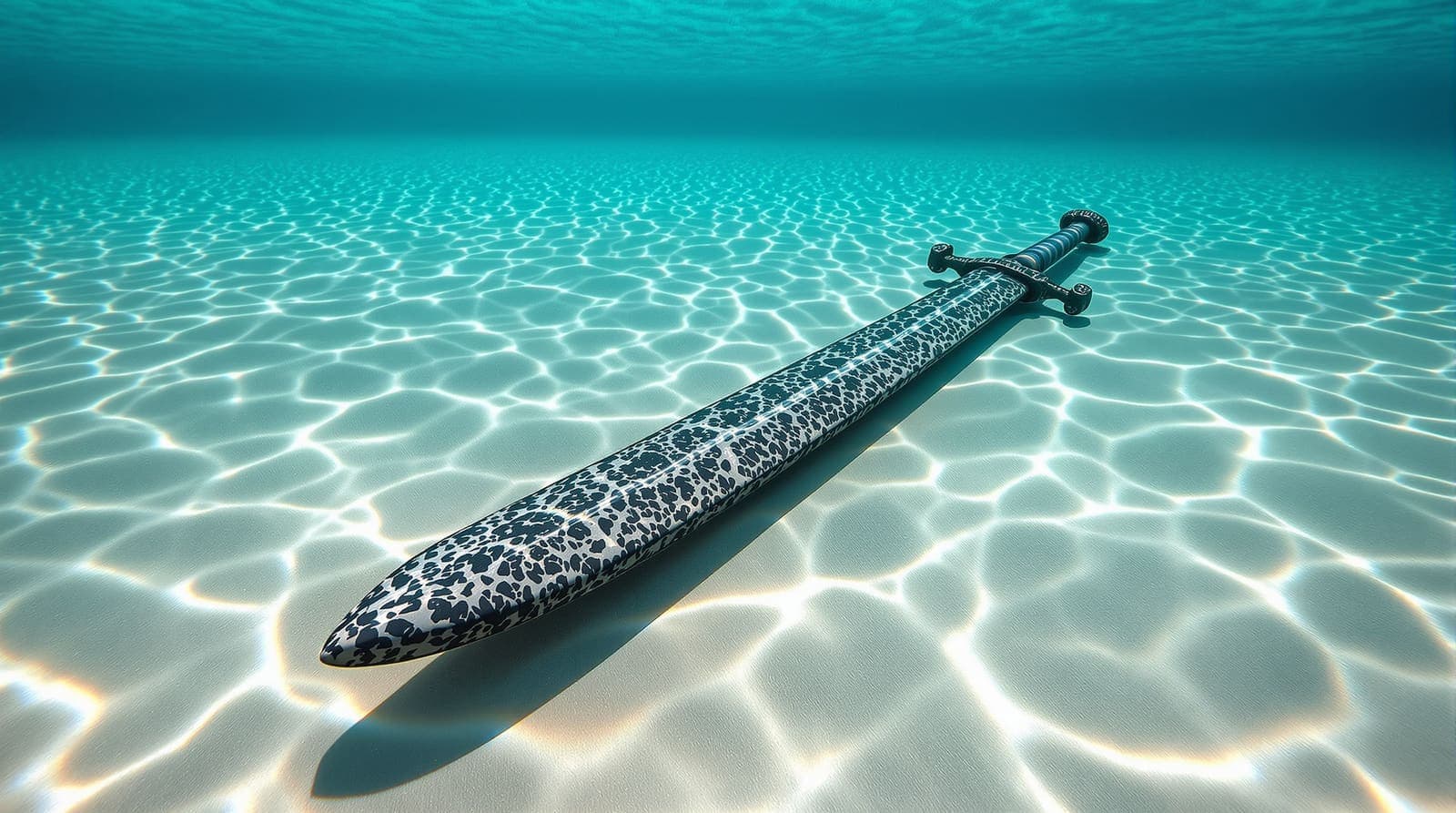
AI illustration, not a photo of the events.
A medieval sword that may once have hung at the side of a Crusader knight has come back off the floor of the Mediterranean after some eight centuries, found by chance off the northern Israeli coast. The account was given to the Press Service of Israel by Dr Sara Lantos of the Department of Maritime Civilizations at the University of Haifa.
"These artifacts are very rare and hard to find, because swords were not usually left behind," Lantos said. "Swords were very precious, symbolic personal objects of Crusader knights. They were also very expensive." She added: "This is definitely a European-type sword of a Frankish knight. It may have fallen off a ship or been lost during a battle."
How it came out of the sand
The one-metre sword was spotted the previous year protruding from the seabed near Dor Beach, on the coast south of Haifa, by Shlomi Katzin, a student of Maritime Civilizations who had been swimming there. According to the university, he noticed divers using metal detectors, suspected possible antiquities theft, drove them away and carried on scanning the seafloor himself, which is when he saw the weapon emerging from the sand.
Katzin alerted the university, which contacted the Israel Antiquities Authority. With special permission the sword was lifted carefully to prevent further damage and taken to a conservation laboratory. The Times of Israel reported in February 2026 that this was Katzin's second such find in five years, after a similar sword recovered in the same stretch of coast in 2021.
Why a hospital scanner and not a chisel
Centuries on the seabed had wrapped the blade in a thick crust of marine deposits, so its condition could not be judged from the outside. Rather than strip the concretion away, researchers took the sword for computed tomography imaging at Haifa's Medica Elisha Hospital.
Israel's week in five stories, every Friday
Sourced and checked by the Israel.com newsroom, with Shabbat times. Free, one-click unsubscribe.
One list, unsubscribe in a click. See our privacy policy.
"The CT is a non-invasive, non-destructive method to examine the sword, which was covered with shells and rocks, so it was hard to see the actual shape and condition of the iron underneath," Lantos said, "but the CT gives us a chance to look inside and see the shape and design." The crust cannot simply be removed: any exposure to air would accelerate the decay of the iron beneath it.
The scans placed the weapon in the 12th century and showed it was made for one-handed use, consistent with the swords carried by Crusader knights. Researchers concluded it was not forged locally but brought from Europe by Crusaders who established strongholds along the Levantine coast. The imaging also revealed a fracture in the blade, and showed that only a small portion of the original iron had survived salt water and shifting sand, which is why the sword's original weight cannot be estimated. The Jerusalem Post gave the same reading of the scan in its report of the find.
Next story Education
Kisch halts northern school trips for two days after Hezbollah submunition blast
Why Crusader swords almost never turn up
Only a handful of comparable swords from the Crusader period have been documented in Israel. That scarcity is the point: a sword was an expensive, personal object that its owner did not discard, so the ones that survive tend to be the ones that were lost by accident: overboard, or in the water during a fight. The Crusader presence on this coast ran for roughly two centuries from 1099, according to the Times of Israel's account, and left a chain of fortified harbours along the Levantine shore.
Lantos said the find adds to what is known about maritime anchorages along the coast and about the daily lives of the fighters who used them. "We would like this sword to be exhibited at the University of Haifa's Hecht Museum along with several others that were found," she said. "It can show the lives and the tools used by the knights who were here."
What is still unclear
The account did not give an exact date for the discovery beyond the previous year, and did not say whether the divers Katzin encountered were ever identified or investigated. It did not explain how the sword came to be on the seabed: shipwreck, battle or something else remains open. And because so little of the original iron survives, no maker, workshop or region of manufacture in Europe has been proposed.
More on Haifa: Places and businesses in Haifa · Shabbat times in Haifa
Read next
All archaeology →
Illustration
Security
IDF captain, 21, killed as Humvee overturns near Lebanon's Litani River

Illustration
Emergency
Girl, 16, moderately hurt in farmland near Mount Avital, Golan Heights

Illustration
Emergency
Light plane crash near Kafr Qara in Wadi Ara kills one man, injures another

Illustration
Security
IDF says about 220,000 dunams of West Bank olives harvested so far
Sources and further reading
Every link below was opened and checked when this page was written. Official statements are marked as such: they are the subject's own account, not an independent one.
- ReportingThe Times of Israeltimesofisrael.comDiver finds his second Crusader sword in 5 years off Israel's coast
Independent account of the find, the CT scan and Katzin's 2021 discovery
- ReportingThe Jerusalem Postjpost.comUniversity of Haifa student discovers 12th century Crusader sword off Israel's northern coast
Second account of the imaging results and the rarity of such swords
- ReportingYnetnewsynetnews.com12th-century Crusader sword found off northern Israel beach in rare seabed discovery
Third account of the recovery, the hospital CT imaging and the European origin of the blade
How we checked this
The description of the discovery, the CT imaging and all quotations are from the University of Haifa material of 23 February 2026 carried in the original statement. That Katzin had found a comparable sword in 2021, and the roughly two-century span of the Crusader presence on this coast, come from Times of Israel and Jerusalem Post reports that were checked.
Our sourcing and corrections policy →The week from Israel, in one email
The stories that mattered, sourced and checked by the Israel.com newsroom. Free, weekly, one-click unsubscribe.
One list, unsubscribe in a click. See our privacy policy.

Israel.com is free, and readers like you keep it that way.
The Israel.com newsroom checks every story against its sources and publishes it free. If this one helped, a contribution of any size keeps the next one free too.
One payment, nothing to sign up for. Another amount
Latest
- Soldiers killed near Hebron named and buried as army operation goes on
- Truck driver arrested after fatal crash on Route 465 near Aboud
- Troops detain Palestinian suspected of planning imminent attack in Binyamin area
- Man of about 25 shot dead in Yafia, near Nazareth, during a taxi ride
- IDF says Gaza strikes killed two men who moved Iranian and Turkish money to Hamas
- Israeli and Greek navies practise sinking a hostile vessel in joint drill