Twenty Years of Jerusalem's Rubbish Ringing the Dead Sea
A University of Haifa study found plastic terraces at the Dead Sea's retreating shore that record two decades of waste washed down from Jerusalem by flash floods.
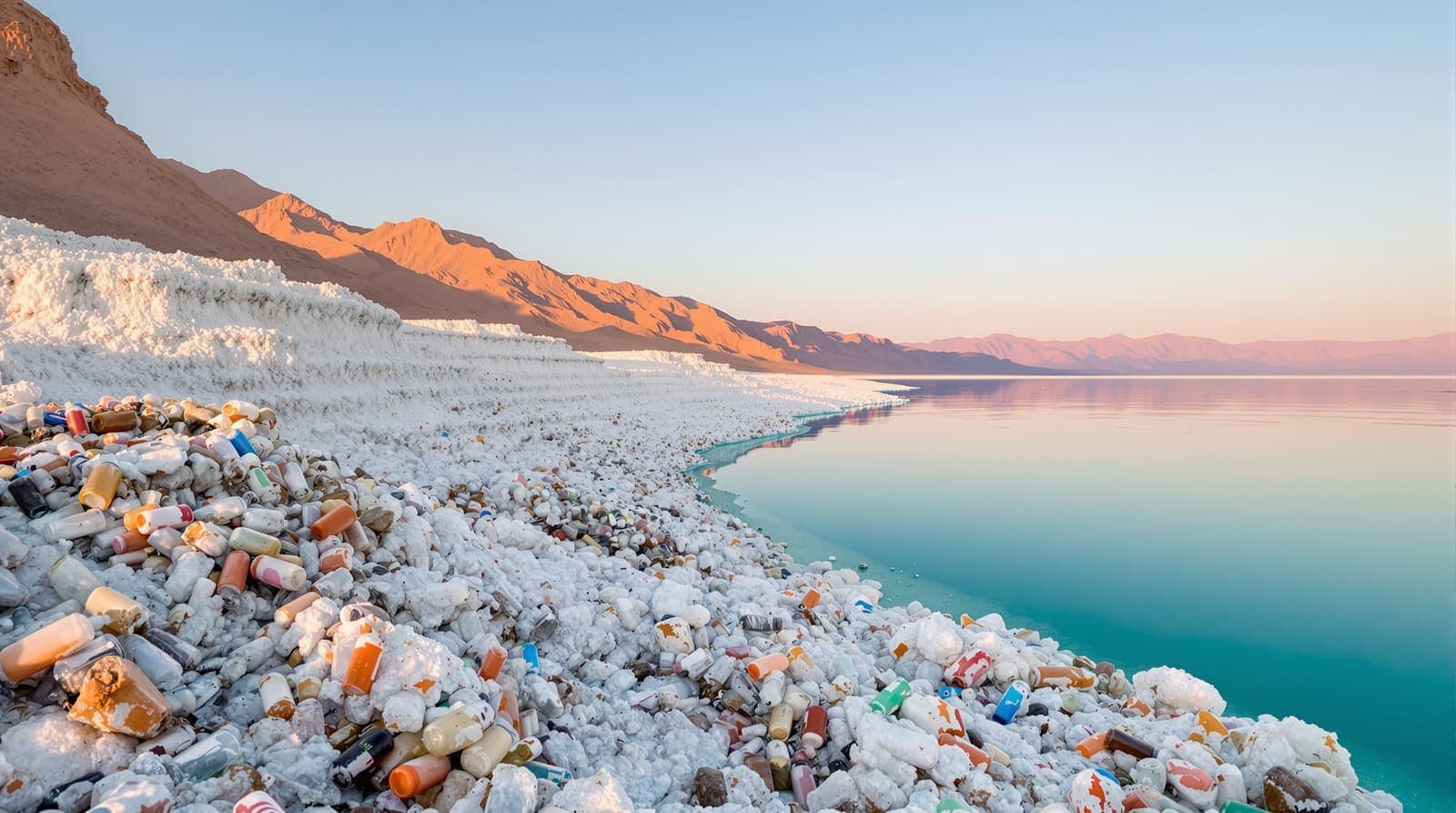
AI illustration, not a photo of the events.
Plastic waste carried out of urban areas has been piling up along the Dead Sea’s retreating shoreline for more than twenty years, and a study released by the University of Haifa with Italian collaborators argues that the accumulation has produced something unusual: a readable record. Flash floods, extreme salinity and falling water levels combine, the researchers said, to trap debris (bags, toys, bottles, even military equipment) in bands that stay put year after year at the lowest point on the Earth’s land surface.
“The Dead Sea is not only a geoheritage site under threat, but it also functions as an accelerated natural laboratory for the rest of the world,” Dr Akos Kalman, Professor Beverly Goodman Tchernov and Professor Michael Lazar told The Press Service of Israel. “Because it is a closed basin, everything that enters stays, which lets us follow the entire pathway of plastic pollution: from large pieces to fragments and finally to microplastics that become part of the geological record.”
The Kidron: Jerusalem’s drain to the lowest place on Earth
The mechanism is a single watercourse. In winter, the Kidron Stream, which drains a wide swathe of urban Jerusalem, carries sediment, debris and plastic to the lake in short, violent flash floods. Because Dead Sea water is dense enough to float almost anything, most of the plastic does not sink; it collects along the shore. As the water level drops, each year’s deposit is left stranded slightly higher and further back than the last, producing a stepped series of coastal terraces the researchers describe as “plastic rings”.
That only works because the shoreline keeps moving. The Dead Sea has been shrinking for decades, largely because the fresh water that once fed it is diverted upstream and because of extraction from the lake itself. The Israel Marine Data Centre puts the resulting drop at about a metre a year. Israel’s State Comptroller found the northern basin falling roughly 1.15 metres annually and, as Ynetnews reported, concluded that more than two decades after the problem was recognised the country still has no policy for stabilising it, with the retreat also opening sinkholes that damage roads along the shore.
What the study measured
The work, published in the peer-reviewed Journal of Hazardous Materials, examined terraces formed between 2000 and 2021 where the Kidron meets the lake. The team collected every visible plastic item on each terrace and logged weights, types, abrasion and distribution; sediment samples were sieved, filtered, photographed under a microscope and chemically analysed to identify polymers and the effects of long exposure to sun, heat and erosion. Historical aerial photographs and satellite imagery were used to track how the coast and the stream’s course changed.
Israel's week in five stories, every Friday
Sourced and checked by the Israel.com newsroom, with Shabbat times. Free, one-click unsubscribe.
One list, unsubscribe in a click. See our privacy policy.
The finding was a sharp rise in plastic input after 2000, with younger terraces holding hundreds of kilograms of waste, and a projection that a single terrace could exceed a tonne by 2030. Sunlight and heat break the material down fast: the researchers estimate that one kilogram of large visible plastic generates roughly four thousand microplastic particles a year, much of which stays in the sediment. The university’s own account of the study names the wider team at the Charney School of Marine Sciences and confirms the terrace period and the microplastic estimate. Some waste ends up wedged in sinkholes and cracks along the retreating coast, embedding it in sediment layers.
“Distinct plastic rings started forming around the Kidron outlet only about 25 years ago, after being completely absent before,” the scientists said. “What also surprised us is the sheer volume now accumulating and the fact that, despite growing public awareness, the problem continues to intensify rather than improve.” Their recommended response is prevention rather than clean-up: identify the exact entry points, monitor upstream, improve municipal collection and recycling, and enforce existing waste disposal law.
What is still unclear
The study covers terraces at one location (the Kidron outlet) and the researchers do not say how much plastic enters the basin through other channels, though they say other outlets show the same pattern. The account gives no total figure for plastic in the lake, no measurement of microplastics in the water itself as opposed to the sediment, and no assessment of whether any of it has reached the mineral and cosmetic products drawn from the Dead Sea, a risk the scientists raise only as a worst case.
More on Haifa: Places and businesses in Haifa · Shabbat times in Haifa
Read next
All environment →
File photo
Education
Kisch halts northern school trips for two days after Hezbollah submunition blast
Illustration
Security
IDF captain, 21, killed as Humvee overturns near Lebanon's Litani River
Illustration
Emergency
Girl, 16, moderately hurt in farmland near Mount Avital, Golan Heights

Illustration
Emergency
Light plane crash near Kafr Qara in Wadi Ara kills one man, injures another
Sources and further reading
Every link below was opened and checked when this page was written. Official statements are marked as such: they are the subject's own account, not an independent one.
- OfficialIsrael Marine Data Centre, IOLRisramar.ocean.org.ilDead Sea Monitoring
Rate of Dead Sea level decline and its causes
- ReportingIsrael Science Infoisraelscienceinfo.comPlastic waste from Jerusalem's runoff has accumulated in the Dead Sea since 2000
University of Haifa account of the study, research team and microplastic estimate
- ReportingYnetnewsynetnews.comDead Sea level keeps falling, but Israel still has no rescue plan
State Comptroller findings on the rate of decline and the absence of policy
How we checked this
The study's findings and the researchers' quotes are as given to The Press Service of Israel on 8 December 2025 and were checked against the University of Haifa's own account of the paper. The rate of Dead Sea level decline was verified with the Israel Marine Data Centre and Ynetnews reporting on the State Comptroller's findings.
Our sourcing and corrections policy →The week from Israel, in one email
The stories that mattered, sourced and checked by the Israel.com newsroom. Free, weekly, one-click unsubscribe.
One list, unsubscribe in a click. See our privacy policy.

Israel.com is free, and readers like you keep it that way.
The Israel.com newsroom checks every story against its sources and publishes it free. If this one helped, a contribution of any size keeps the next one free too.
One payment, nothing to sign up for. Another amount
Latest
- Soldiers killed near Hebron named and buried as army operation goes on
- Truck driver arrested after fatal crash on Route 465 near Aboud
- IDF says about 220,000 dunams of West Bank olives harvested so far
- Troops detain Palestinian suspected of planning imminent attack in Binyamin area
- Man of about 25 shot dead in Yafia, near Nazareth, during a taxi ride
- IDF says Gaza strikes killed two men who moved Iranian and Turkish money to Hamas