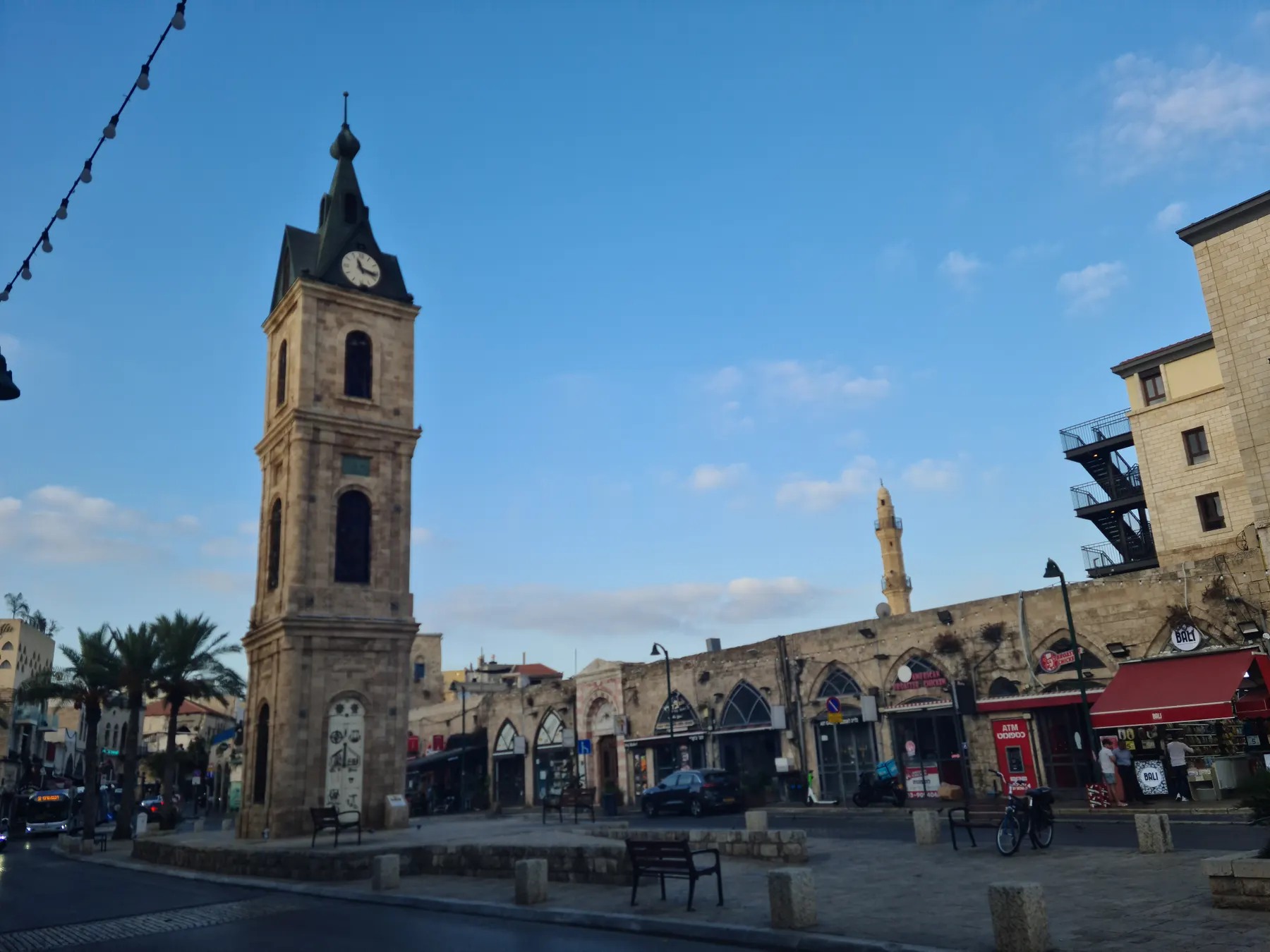
Landmark · Jaffa
Jaffa Clock Tower
Built for the silver jubilee of Sultan Abdul Hamid II with money raised from Jaffa's Muslim, Jewish, Christian and Armenian residents, it was the first public clock in a town where until then only churches and mosques rang the hours.
Sasha1506 / CC BY-SA 4.0 · Wikimedia Commons
Completed
1903
the year Britannica and both Wikipedias give; the municipality's own tourism page says 1902
Cornerstone
1 September 1900
laid before the Ottoman district governor, government officials and representatives of the religious communities
Height
27.8 m
base to the tip of the antenna, in the Hebrew reference account's measured schedule
Original sultan's seals surviving
one of four
the marble tughra on the south face, conserved by the Israel Antiquities Authority in 2016
In short
- How long to give it
- about 10 minutes for the tower itself, and about 20 if the Kishle gate and the sabil are included
- Outside, at any hour
- The tower stands on an island in a public street junction. There is no gate and no ticket desk, and the municipality's tourism service publishes no opening hours for it.
- Entry
- Free. Nothing here is ticketed and the municipality's tourism service lists no admission charge.
מגדל השעון ביפו · برج الساعة في يافا
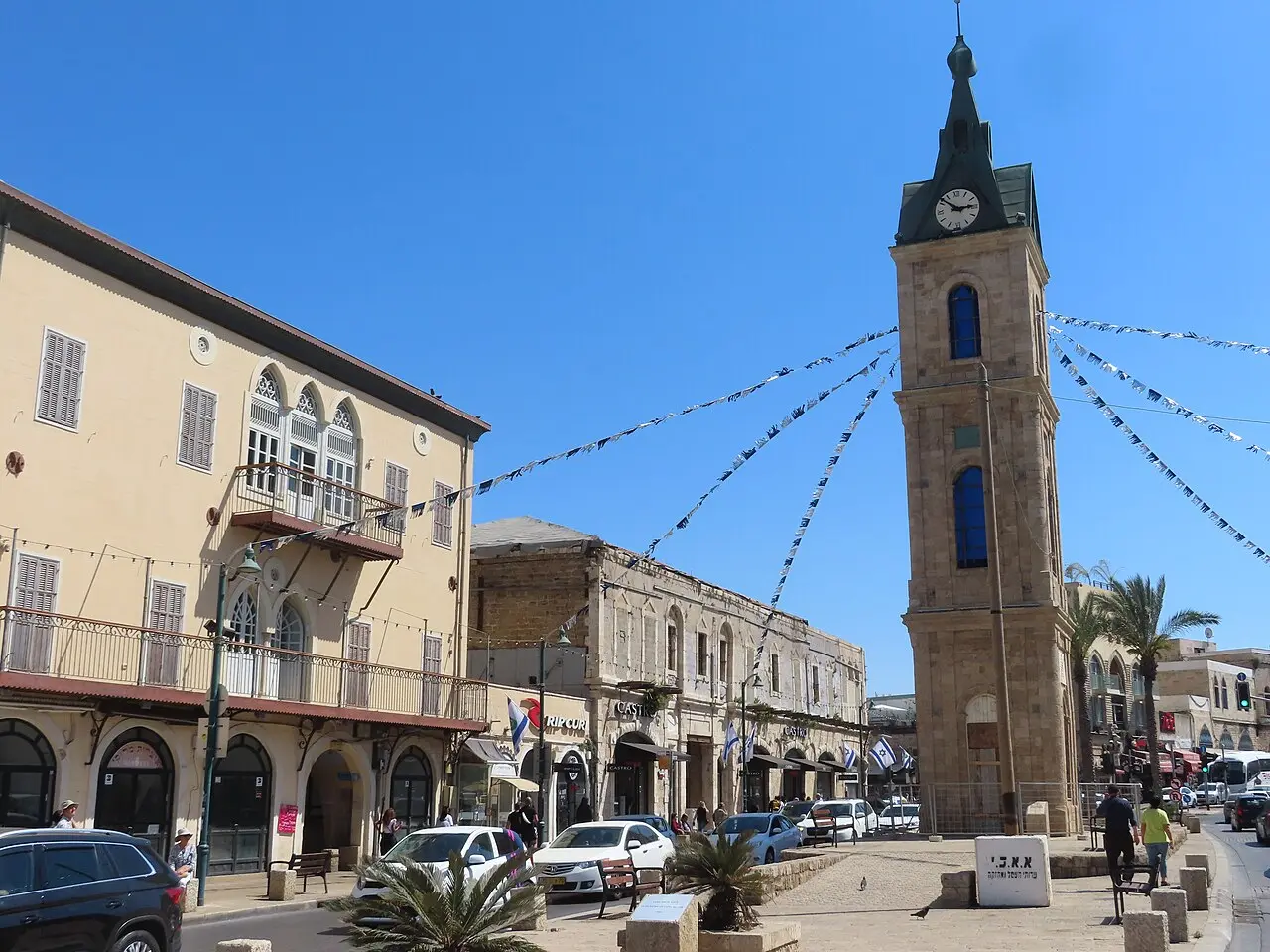
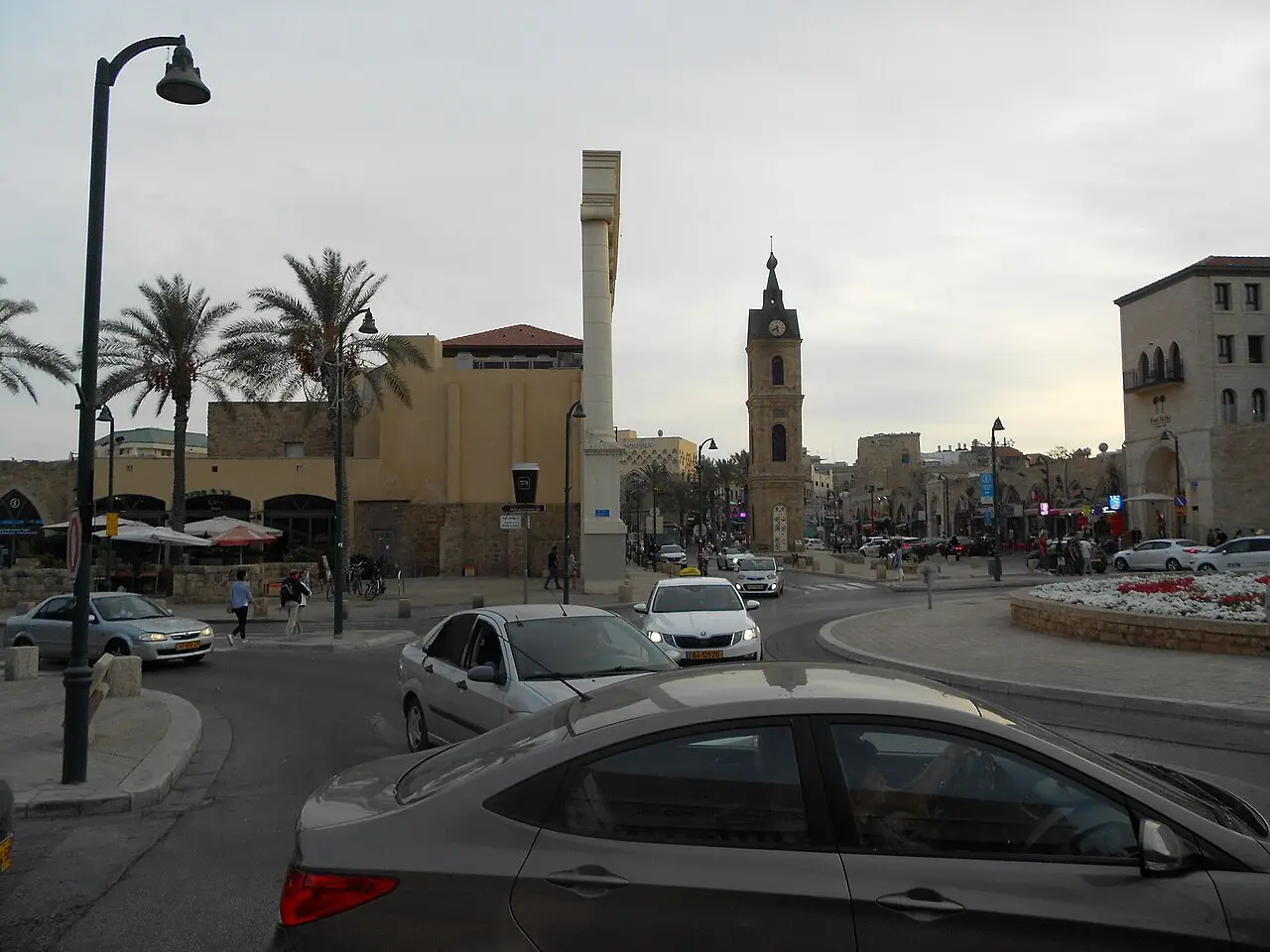
The Jaffa Clock Tower is a three-storey Ottoman clock tower on an island at the head of Yefet Street, where the roads down from Tel Aviv meet the top of the old town. It was raised for the silver jubilee of Sultan Abdul Hamid II, one of more than a hundred clock towers built across the Ottoman Empire for that anniversary and one of a small group of them in this country. The cornerstone went down on 1 September 1900 and the building was finished in 1903.
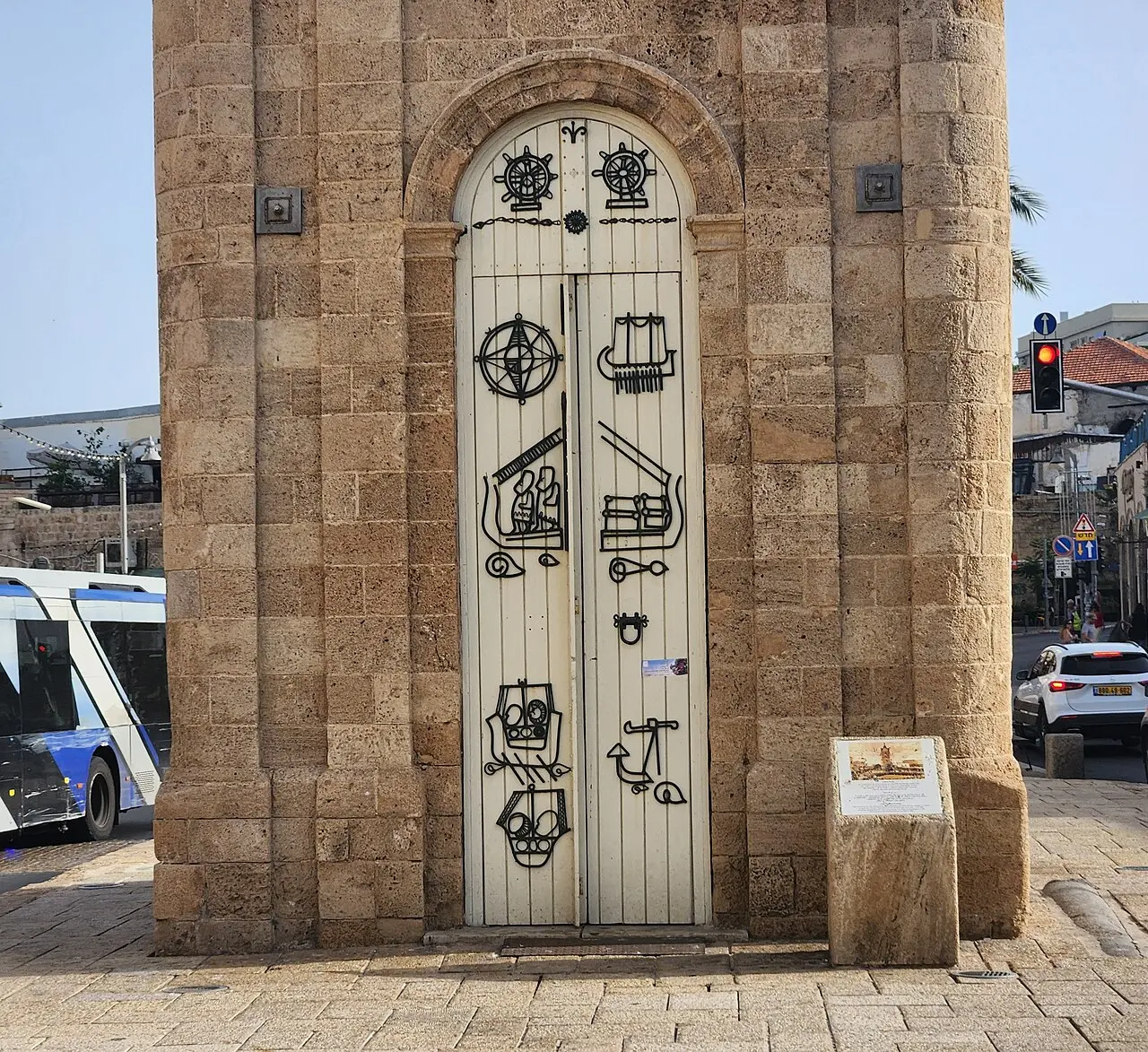
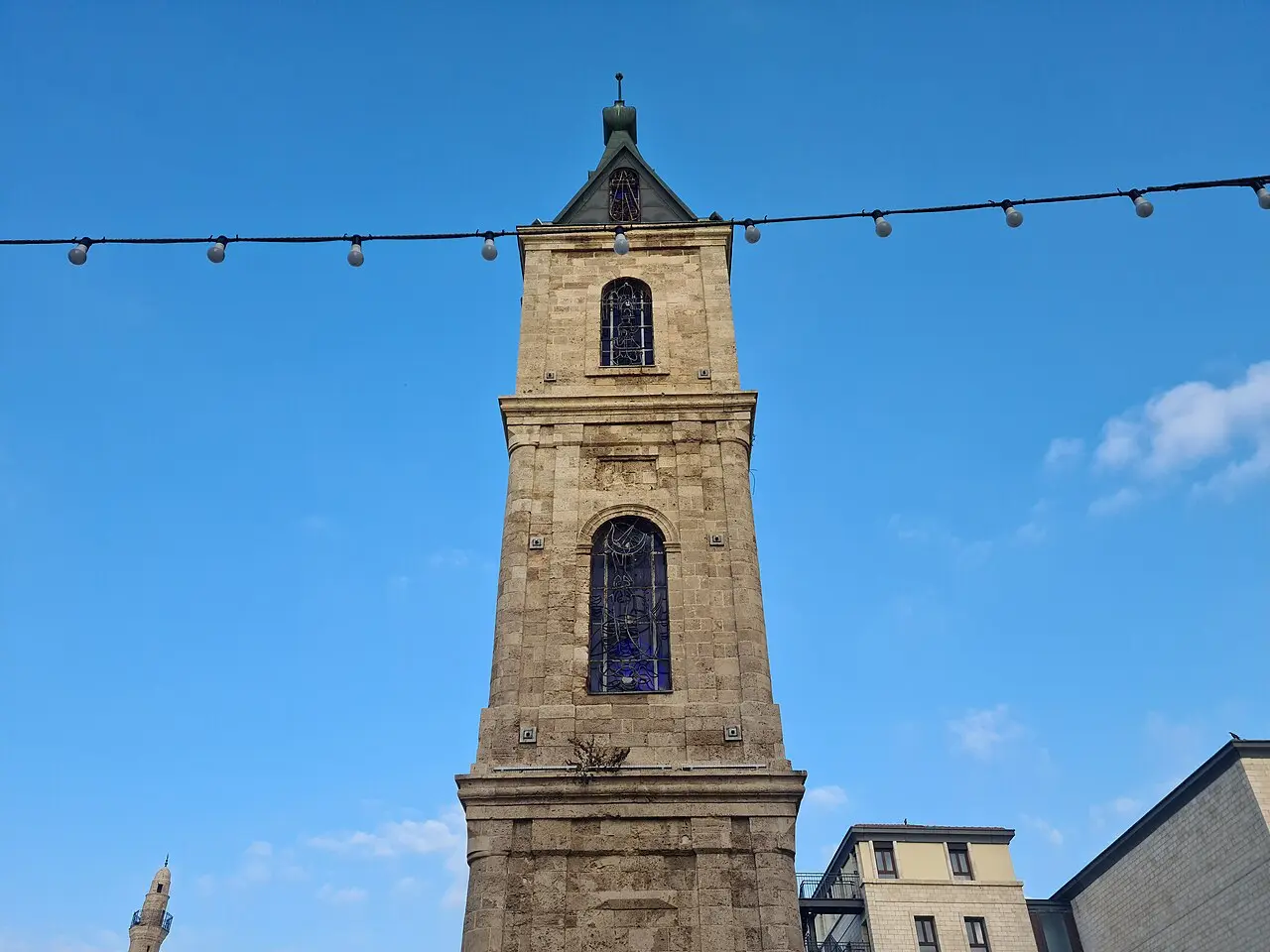
What a visitor gets is a monument to stand under rather than a site to go into. There is no gate and no ticket desk: the tower sits in the middle of a working road junction, and most people give it three minutes on the way to somewhere else. That is a fair allocation, so long as the three minutes go on the right things, because much of what catches the eye is not Ottoman. The coloured glass and the ornamental ironwork in the openings are Israeli work of the early 1960s, designed by the artist Arie Koren. Three of the four marble panels carrying the sultan's seal are glass replicas fitted in 2001.
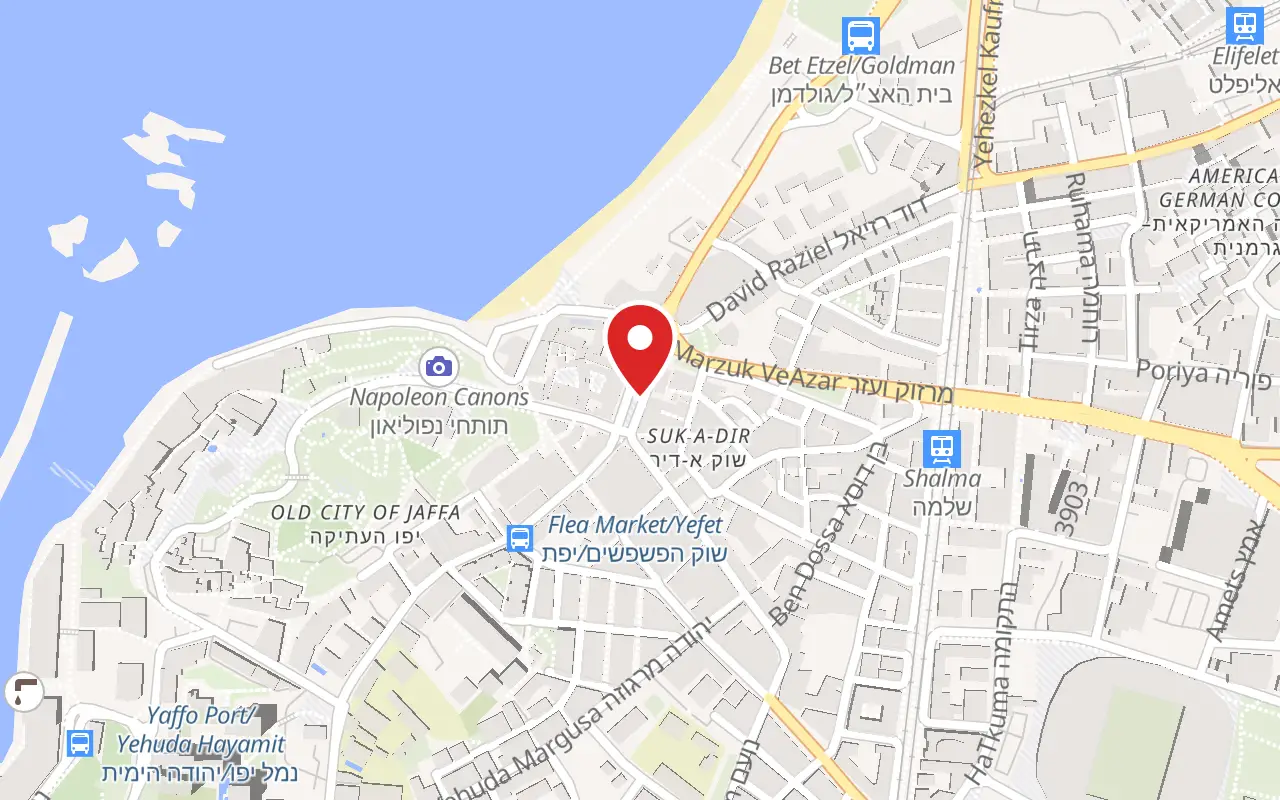
The tower is also why this junction is called Clock Square, and the square is the practical hinge of a visit to Jaffa. The flea market lanes open behind it to the southeast, and the municipality's tourism service directs walkers arriving from Tel Aviv to turn right just after the tower into Ruslan Street for Kedumim Square and the old town.
The tower
Twenty-eight metres of local stone at a road junction
The tower is built of kurkar, the wind-cemented sandstone the whole Jaffa headland sits on, in three storeys with a copper cap. English-language descriptions usually call the stone limestone; the Hebrew reference account calls it kurkar. Kurkar is a calcareous sandstone, so the two are closer than they sound, but the local name ties the building to the ground it stands on.
The published measurements are specific. The Hebrew account gives 27.8 metres from the base to the tip of the antenna, on a square base 3.8 metres each way, with a clock dial 1.3 metres across. The bell in the copper cap weighs 130 kilograms and strikes on the half hour.
How many clock faces the tower has, and has had, is genuinely muddled in the literature. The Hebrew account says two clocks went in when the building was finished in 1903 and describes two in the copper cap today. The municipality's tourism page says four separate clocks grace the top. English Wikipedia says the tower incorporates two and, in the same paragraph, repeats a claim that the watchmaker installed four, which its editors have flagged as unverified. Counting from the pavement settles the present-day question in about ten seconds, which is more than any of the sources manage.
Who designed it is thinly documented. The Hebrew account, citing a 1979 newspaper piece, says the planner was an Austrian engineer who combined European and eastern elements. English Wikipedia calls the style German with Ottoman influence. No source names the man.
- Height to the tip of the antenna: 27.8 m
- Base: 3.8 m square
- Clock dial: 1.3 m across
- Bell: 130 kg, 60 cm across, 110 cm high, striking every half hour
- Sultan's seal panels: 100 cm by 70 cm
Fallaner / CC BY-SA 4.0 · Wikimedia Commons
1900
A sultan's anniversary, and an order sent to the provinces
Abdul Hamid II took the Ottoman throne on 31 August 1876. In 1900 an imperial decree instructed provincial governors to build clock towers for the twenty-fifth year of his reign, and they went up in the centres of important cities across the empire as an expression of central authority and of a single official time. Faina Milstein, the Israel Antiquities Authority's conservation architect for Old Jaffa, puts the empire-wide total at more than a hundred and says six are known in this country: Jaffa, Acre, Jerusalem, Haifa, Safed and Nablus, with a seventh at Nazareth about which there is doubt whether it is a clock tower at all. English Wikipedia counts seven in Ottoman Palestine and includes Nazareth without the qualification.
Jaffa's cornerstone was laid on 1 September 1900 before the kaymakam, the Ottoman district governor, along with government officials and representatives of the religious communities. By 1901 the second storey was finished and the third started. The building was completed in 1903 and the clocks installed. The sultan's tughra, his calligraphic seal, was carved into the second storey.
The money came from the city, not from Istanbul. Contributions were raised across Jaffa's communities, and the largest share came from Yosef Bek Moyal, a Jewish businessman whose house stood on nearby HaHalfanim Street and who was also involved in the Jaffa to Jerusalem railway, whose first passenger train had run on 27 August 1892. The Christian merchants Najib Bustros and Iskandar Awad gave alongside him, and the streets beside the square carried their names before the road became Raziel Street.
There is a competing origin story, and it is worth knowing that it is competing. Moritz Schoenberg, a Jewish watchmaker, jeweller and property developer in Jaffa, wrote in his diary that at a meeting at the government house in 1902 he proposed the tower himself, against suggestions such as digging a public well, and specified a clock reading European time on two faces and Arab time on the other two. The Hebrew account reproduces the passage and then notes that the initiative was the central government's jubilee decree, not his.
The date in print is not settled either. Britannica dates the Ottoman clock tower here to 1903 and both Wikipedias agree. The municipality's own tourism service says 1902 and attaches it to the thirtieth anniversary of the sultan's accession rather than the twenty-fifth. A thirtieth anniversary of an 1876 accession falls in 1906, which fits neither a cornerstone laid in 1900 nor a jubilee decree, so the municipal version is the outlier.
Original and replica
One marble seal in four, and a great deal of later repair
The shell is Ottoman and most of the detail is not. By 2016 only one of the four original marble tughra panels was still on the building, on the south face about 12 metres up. Three glass replicas carved with the sultan's seal had gone up in 2001 in place of the marble panels that did not survive.
That last original nearly went too. During a year of conservation and structural strengthening carried out for the municipality by its company Ezra U'Bitzaron, the marble was found cracked, partly detached from the wall and crumbling, with the relief so faded that it was no longer possible to see there was a carving on it. Israel Antiquities Authority conservators cut it free with chisels and took it to the laboratory in Jerusalem, where the conservator Mark Avrahami built it a new support and brought the relief back up with pigments. It went back on the tower in late 2016.
Dr Yoav Arbel of the Antiquities Authority explains what the panel is. The tughra first appeared as the seal of Orhan, the second Ottoman sultan, and afterwards stood for the sultans and for the empire itself: a device combining the ruler's name, his titles, his father's name and a blessing with the empire's symbols, used on documents, public buildings and coinage. The same seal turns up nearby above the gate of the Kishle, the Ottoman police station, and above the sabil facing the old city gate known as Sabil Suleiman, both also conserved by the Authority in recent years.
The building has its own repair history. Newspapers reported in April 1950 that the tower was cracked and in danger of collapse, possibly from the explosion that destroyed the neighbouring Saraya. A municipal budget was approved in 1952, but work did not begin until the end of 1962 and finished in January 1964. A second restoration in 2001, on the initiative of the Government Tourism Company and the municipality, turned up the clock's original mechanism and its bell, and Clock Square was redesigned by the architects Eyal Ziv, Eitan Ido and Rali Parto. When the clock broke down again in 2021 it was repaired by Susanna Kaufmann, a watchmaker who came to Israel from Denmark in the early 1990s.
- 1962 to January 1964: the long-delayed post-1950 restoration
- 2001: second restoration; three glass tughra replicas; the square redesigned
- 2016: the last original marble tughra conserved and reinstalled
- 2021: the clock mechanism repaired again
ברוך ניב / CC BY 2.5 · Wikimedia Commons
Arie Koren
The coloured glass is a 1960s reading of Jaffa's past
The most photographed feature of the tower is the youngest thing on it. The ornamental metalwork and the coloured glass in the window openings were made by the artist Arie Koren for the restoration that ran from late 1962 to January 1964. He was chosen after a subcommittee for the improvement of the city assessed proposals from several artists and architects, sitting under Haim Gamzu as chair with the painter Nahum Gutman and the architect Arieh Elhanani. English-language sources date the glass to 1965 or 1966 instead; the Hebrew account works from the contemporary newspaper reports and gives the earlier dates.
The scenes are a list of the stories Jaffa was telling about itself in 1964. The fish delivering Jonah onto dry land. Merchants carrying goods landed at the port on donkeys and camels. The sabil built by Abu Nabbut. Jaffa oranges. The cedars of Lebanon coming through this harbour to the Temple in Jerusalem. And the capture of Jaffa in the 1948 war. The municipality's tourism service describes a similar set, adding ships sunk in the revolt against Rome and Simon the Maccabee, who took the port for the Hasmoneans.
It is a selection, and the seam in it is visible. Five scenes reach for the biblical and Ottoman past the city shares; the sixth is a military event from sixteen years before the glass was made, in a town where most of the pre-1948 population had gone. A plaque on the tower, according to the English Wikipedia article, commemorates the Israelis killed in the battle for it. Read as a document of the decade that made it, the glass is more interesting than as decoration.
Sasha1506 / CC BY-SA 4.0 · Wikimedia Commons
Clock Square
What the tower was put in the middle of
The square existed before the tower did. Jaffa's walls came down in the nineteenth century and the ground outside the old gate filled with the machinery of a growing port city: the Saraya, the Ottoman seat of government; the Kishle, the police station; the Greek Market; banks, offices and shops; and a stand for carriages and carts on what is now Beit Eshel Street, from which public transport ran across the country. Britannica describes the city that paid for all this as one of the most active ports on the eastern Mediterranean and the second largest in Palestine, exporting olive-oil soap, sesame, barley, wine and above all oranges.
The clock tower was the civic piece of that ensemble, and it changed what the town listened to. Until it was built, the only bells that rang in Jaffa were on church steeples and minarets. A public clock striking the half hour for everyone, paid for by subscription across the communities and stamped with the sultan's seal, put timekeeping in the hands of the state rather than the religions.
What that actually meant is a live argument among historians, not a settled point. Mehmet Bengu Uluengin, writing in the International Journal of Middle East Studies in 2010, reads the Ottoman clock towers as instruments of modernisation and secularisation and as assertions of state authority over public life. Avner Wishnitzer, in a comment published in the same journal later that year, accepts the layered and contradictory meanings Uluengin identifies but disputes the secularisation framing, pointing out that if neither the Ottoman authorities nor the early republican ones understood the towers that way, it is not obvious why they should still be presented that way. Anyone told confidently here what the tower meant is hearing one side of that.
The square kept reshaping the town after 1903. The municipality's tourism service records that the older marketplace was dispossessed by the Ottoman government from the ground where the tower now stands and moved to part of the site the flea market occupies today. The Saraya was destroyed by an explosion during the 1948 fighting, and the cracks reported in the tower two years later were blamed on it. It has been a busy junction for a century and a quarter and it still is: the tower is on a traffic island, with Jaffa's road traffic running past it on three sides.
Benoit Soubeyran from Jerusalem, Israel / CC BY 2.0 · Wikimedia Commons
What to look for
Things not to walk past at Jaffa Clock Tower
The details that repay knowing about before you are standing in front of them.
The marble seal on the south face
Twelve metres up on the southern side is the only one of the four original marble tughra panels still on the building. It was chiselled off, conserved in the Antiquities Authority's Jerusalem laboratory and put back in 2016.
The three glass replicas
The other three seals are glass, carved with the sultan's device and installed in 2001 where the lost marble panels had been. Comparing them with the marble one is the quickest lesson in what conservation actually involves.
Arie Koren's grilles and glass
The ironwork and coloured glass in the openings are Israeli, made for the restoration finished in January 1964. Jonah's fish, merchants with camels, Abu Nabbut's sabil, Jaffa oranges, the cedars of Lebanon and the 1948 capture of the town.
The bell in the copper cap
A 130-kilogram bell, 60 centimetres across, that strikes on the half hour. Before it was hung, the only bells sounding in Jaffa belonged to churches and mosques.
The Kishle gate, a minute away
The same sultan's seal appears above the gate of the Ottoman police station beside the square, and above Sabil Suleiman by the old city gate. Both were conserved by the Antiquities Authority in recent years.
The turning into Ruslan Street
The municipality's tourism service tells walkers arriving from Tel Aviv to turn right just past the tower: Ruslan Street runs west from the square to Kedumim Square and the old town.
The long view
Jaffa Clock Tower, in order
31 August 1876
Abdul Hamid II accedes to the Ottoman throne, starting the clock that the jubilee towers were built to mark.
1900
An imperial decree instructs provincial governors to build clock towers for the twenty-fifth year of the sultan's reign. More than a hundred go up across the empire.
1 September 1900
The cornerstone is laid at Jaffa before the kaymakam, government officials and representatives of the religious communities.
1901
The second storey is completed and work begins on the third. The sultan's tughra is carved into the second storey.
1903
The tower is finished and the clocks installed. Britannica and both Wikipedias give this year; the municipality's tourism page says 1902.
1917
During the Ottoman expulsion of the Jews of Jaffa and Tel Aviv, the watchmaker Netanel Markovitch obtains special permission from the Turkish governor to stay in the city and keep the clock running.
April 1950
Newspapers report that the tower is cracked and at risk of collapse, possibly from the explosion that destroyed the neighbouring Saraya.
1952
Tel Aviv municipality approves a budget for the repairs. Work does not start for another decade.
Late 1962 to January 1964
The tower is restored and Arie Koren's ornamental grilles and coloured glass are installed, after a selection panel chaired by Haim Gamzu with Nahum Gutman and Arieh Elhanani.
1968
Shlomo Cohen-Tzidon and Avraham Haim Elhanani propose renaming the building Moyal Tower, after the businessman who funded most of it. The name does not stick.
2001
A second restoration by the Government Tourism Company and the municipality uncovers the clock's original mechanism and bell, installs three glass replicas of the sultan's seal and redesigns Clock Square.
2016
The last surviving marble tughra, cracked and in danger of falling, is removed, conserved by Mark Avrahami at the Antiquities Authority laboratory in Jerusalem and reinstalled on the south face.
2021
The clock mechanism breaks down and is repaired by Susanna Kaufmann, a Danish-born watchmaker working in Israel.
Practical
Visiting Jaffa Clock Tower
Where
Yefet Street 14, Clock Square, Jaffa, Tel Aviv-Yafo
What ticket you need
The tower is not inside a ticketed park and needs no ticket from anywhere else. It sits at the junction between Old Jaffa, which is managed by the Old Jaffa Development Company, and the ordinary municipal streets of Yefet Street and the flea market, and it is free to approach from either side.
Opening hours
- Outside, at any hour
- The tower stands on an island in a public street junction. There is no gate and no ticket desk, and the municipality's tourism service publishes no opening hours for it.source
- Inside the tower
- Not part of a normal visit. The municipality's tourism service describes the building from the outside only and publishes no visiting arrangement for the interior.source
- The flea market behind it
- Weekday and Friday mornings for the stalls. Much of the retail closes for Shabbat from Friday afternoon, though the restaurants do not.source
Admission
- Entry
- Free. Nothing here is ticketed and the municipality's tourism service lists no admission charge.source
Access
Step-free at street level: the tower is looked at from the surrounding pavements, which are flat, and there is no climb and no interior to negotiate. The difficulty is traffic rather than terrain. The building sits on an island with roads on three sides, so reaching the pavement immediately beneath it means crossing live traffic at the junction, and the pavements around the square are narrow and busy. Wheelchair users and anyone unsteady on their feet can see the whole building, including the marble seal on the south face and the glass in the openings, from the surrounding footways without crossing at all. The flea market lanes behind the square are cobbled and uneven.
On site
- Public street junction, no gate
- Cafes and bakeries on Yefet Street
- Flea market lanes and toilets in the cafes behind the square
- Bus stops on Yefet Street and Jerusalem Boulevard
- Taxi rank on the square
- No car park of its own
Booking
Nothing to book. Guided walks of Jaffa commonly use Clock Square as their assembly point, and those are sold by the operators running them rather than by anyone at the tower.
Hours and prices are given as the operator publishes them and change without much notice, particularly around Shabbat and the festivals. Check the operator's own page before you travel for this.
Official page at oldjaffa.co.il →What people wish they had known
- Do not trust a single build date. Britannica and both Wikipedias say 1903, the municipality's own tourism page says 1902, and the cornerstone went down on 1 September 1900. A guide who states one year without qualification is picking a side in a live disagreement.
- The coloured glass is not Ottoman. It was designed by Arie Koren for a restoration completed in January 1964, which is why one of its six scenes is the 1948 capture of the town.
- Only one of the four sultan's seals is original marble, and it is on the south face about 12 metres up. Look at that one and then at the glass replicas from 2001, which are on the other three sides.
- Allow minutes, not an hour. There is no interior on a normal visit, no exhibition and no viewing platform, so the tower is a stop rather than a destination.
- It is a traffic island. The best views are from the surrounding pavements, and crossing to the base means crossing live roads at a busy junction with no particular reason to be there.
- Walk on rather than back. The municipality's tourism service directs walkers coming from Tel Aviv to turn right just past the tower into Ruslan Street for Kedumim Square, with the flea market lanes opening the other way to the southeast.
The figures
Jaffa Clock Tower by the numbers
Each figure carries the year it belongs to and links the source it came from.
| Measure | Figure | As of | Source |
|---|---|---|---|
| Height, base to the tip of the antenna | 27.8 m | 2026 | he.wikipedia.org |
| Base of the tower | 3.8 m square | 2026 | he.wikipedia.org |
| Diameter of the clock dial | 1.3 m, with a long hand of 65 cm | 2026 | he.wikipedia.org |
| Weight of the bell | 130 kg, 60 cm across and 110 cm high | 2026 | he.wikipedia.org |
| Height of the marble sultan's seal above the pavement | 12 m, on the south face | 2016 | davar1.co.il |
| Original marble seals still on the building | one of four; the other three are glass replicas fitted in 2001 | 2016 | ynet.co.il |
| Jubilee clock towers built across the Ottoman Empire | more than 100, of which six are known in this country | 2016 | davar1.co.il |
| First passenger train on the Jaffa to Jerusalem line | 27 August 1892, over 53 miles, cutting a two-day journey to about four hours | 2026 | israeled.org |
While you are here
The rest of Jaffa
Everything else in this destination with a page of its own.
Rakoon / CC0 · Wikimedia Commons
Market
Jaffa Flea Market
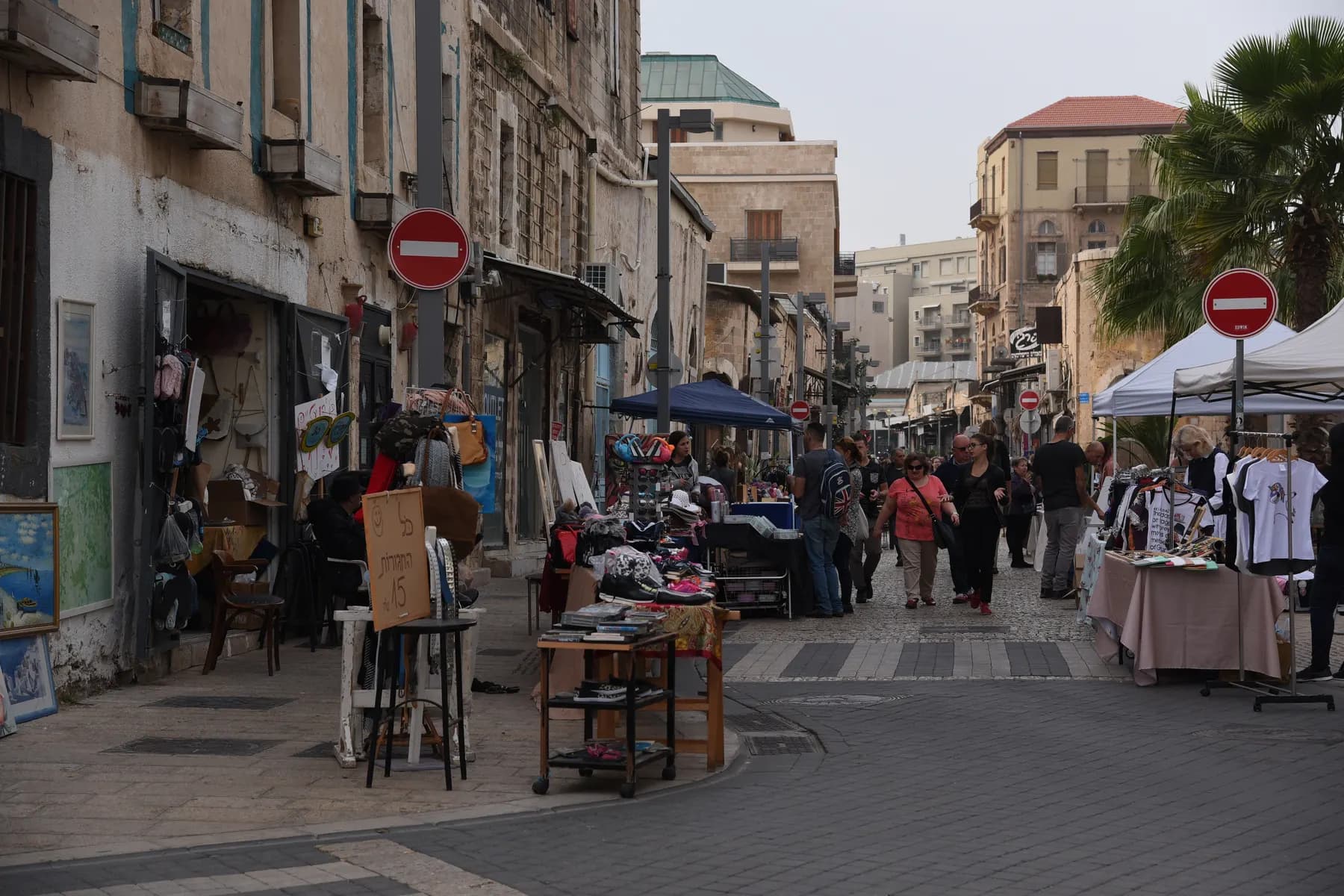
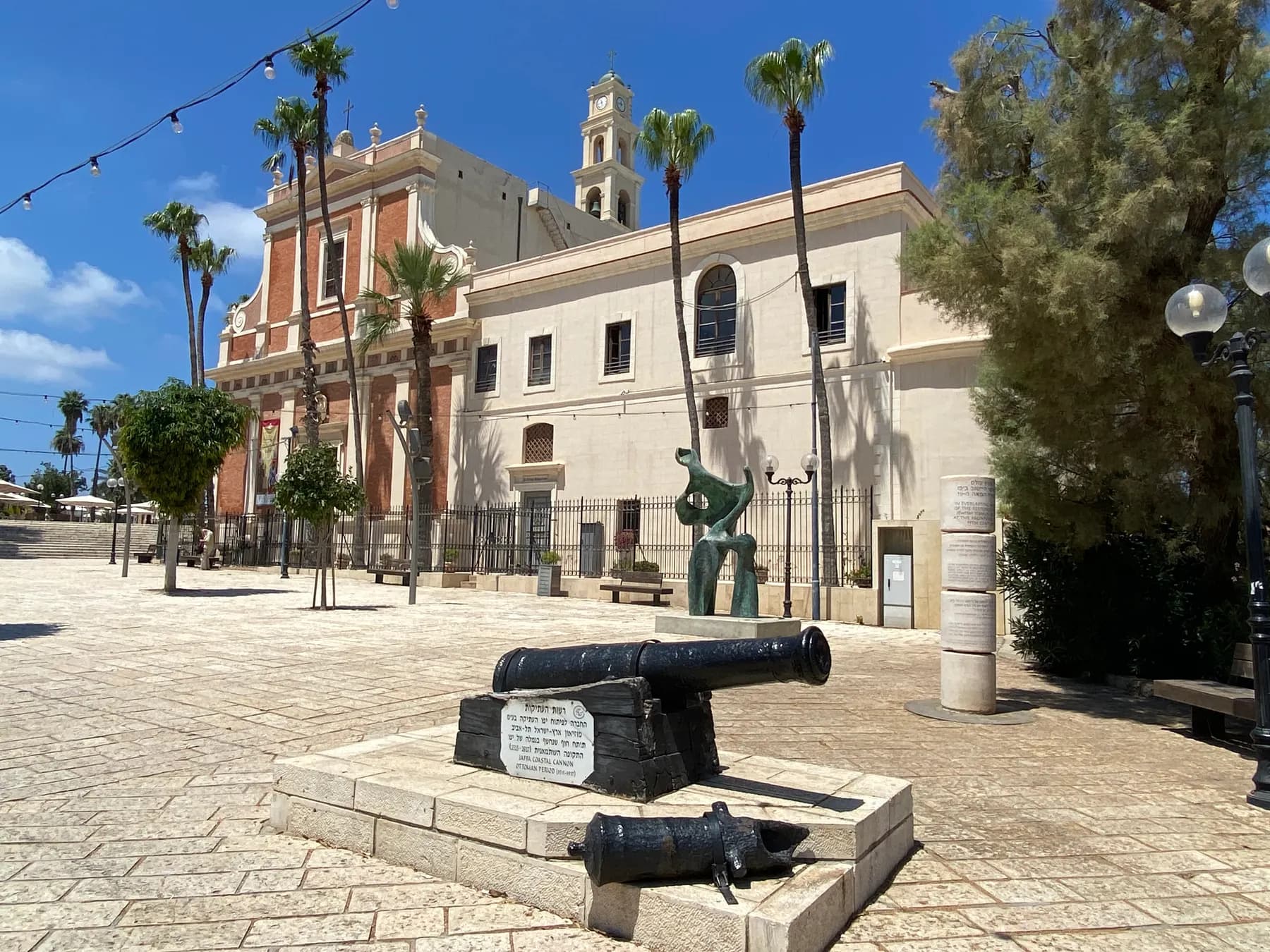
The market was pushed onto these streets in the late nineteenth century, when the Ottoman government cleared the ground where the clock tower now stands for its own administrative compound.
Fallaner / CC BY-SA 4.0 · Wikimedia Commons
Landmark
Kedumim Square
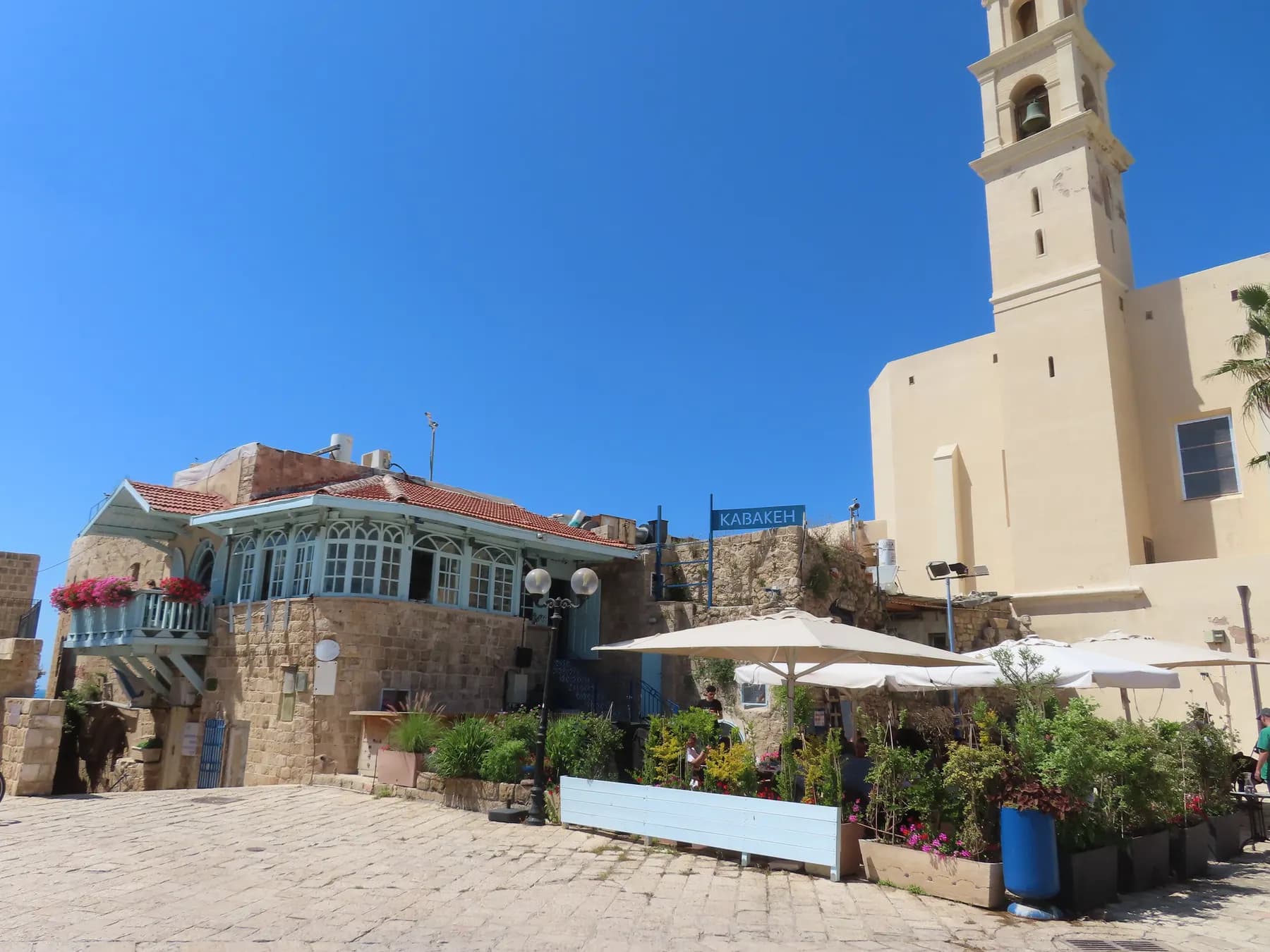
The flagged main square of Old Jaffa is a space the British made by demolition in June 1936, and the Israel Antiquities Authority excavation under its fountain found the drains of one of the houses that came down.
שלמה רודד / CC BY 2.5 · Wikimedia Commons
Religious site
St Peter's Church
The Custody of the Holy Land runs this as a shrine rather than a parish: a Spanish-funded church of 1888 to 1894 standing on the citadel Louis IX rebuilt, with an altar that faces west instead of east.
Sources and further reading
Every link below was opened and checked when this page was written. Official statements are marked as such: they are the subject's own account, not an independent one.
- OfficialVisit Tel Aviv, Tel Aviv-Yafo Municipalityvisit-tel-aviv.comJaffa Tel Aviv: Past and Future (the old city of Jaffa)
the municipality's own account: a clock tower 'from 1902' for the thirtieth anniversary of Abdul Hamid II's accession, four clocks at the top, and the scenes in its windows including the Lebanese cedars, camels at the port, ships sunk in the revolt against Rome and Simon the Maccabee; no hours and no admission are published for it
- OfficialVisit Tel Aviv, Tel Aviv-Yafo Municipalityvisit-tel-aviv.comOld Jaffa: meet the old city
the walking direction from the clock tower square west along Ruslan Street to Kedumim Square, and the absence of any published hours or admission for the tower
- OfficialVisit Tel Aviv, Tel Aviv-Yafo Municipalityvisit-tel-aviv.comThe Jaffa Flea Market
the older marketplace dispossessed by the Ottoman government from the ground where the tower now stands, and the market's present-day trading pattern behind the square
- ReportingDavar (13 December 2016)davar1.co.ilחותם הסולטאן שבנה את מגדל השעון ביפו שוב מתנוסס עליו
the Israel Antiquities Authority's account of the 2016 conservation: the marble tughra 12 metres above the pavement on the south face, cracked and partly detached; removal, treatment by the conservator Mark Avrahami in Jerusalem and reinstallation; the engineering strengthening by Ezra U'Bitzaron; Faina Milstein on the Kishle and the Saraya and on more than a hundred jubilee towers with six known here and a doubtful seventh at Nazareth; and Yoav Arbel on what a tughra is and where else it appears in Jaffa
- Reportingynet (Itay Blumental, 13 December 2016)ynet.co.ilשופץ חותם הסולטן שבנה את מגדל השעון ביפו
independent confirmation that four marble seals were installed originally, that only one survived, and that three glass replicas were fitted in 2001 in place of the lost panels
- ReportingThe Jerusalem Post (Rossella Tercatin, 15 October 2021)jpost.comThe iconic Jaffa clock broke. An olah watchmaker is getting it fixed
the 2021 breakdown and the repair by Susanna Kaufmann, who came from Denmark in the early 1990s with about forty years in watchmaking, plus the local story that Moyal funded the tower to stop passers-by asking him the time on the way to the railway station
- ReferenceWikipedia (Hebrew), citing contemporary newspaper reports, Haaretz, ynet and Davarhe.wikipedia.orgמגדל השעון (יפו)
the 1900 imperial decree, the cornerstone of 1 September 1900 before the kaymakam, the 1901 and 1903 building stages, kurkar construction and the copper cap with two clocks and a half-hourly bell, the measured schedule of dimensions, Yosef Bek Moyal with Najib Bustros and Iskandar Awad, Moritz Schoenberg's diary and the editorial caveat on it, Netanel Markovitch and the First World War expulsion, the cracks reported in April 1950, the 1952 budget, the 1962 to January 1964 restoration with Arie Koren's grilles and glass and the Gamzu selection panel, the 1968 renaming proposal, and the 2001 restoration and square redesign
- ReferenceWikipedia (English)en.wikipedia.orgJaffa Clock Tower
construction from 1900 to 1903, German and Ottoman-influenced style over three storeys, Joseph Bey Moyal's initiative and his role in the Jaffa to Jerusalem railway, Moritz Schoenberg's mechanism, the seven-tower count for Ottoman Palestine, the unresolved two-or-four clocks question, the 1965 or 1966 dating of the glass, the mechanism and bell found in 2001, the 1948 memorial plaque and the 2004 stamp
- ReferenceInternational Journal of Middle East Studies (Mehmet Bengu Uluengin, vol. 42 no. 1, 2010, pp. 17-36)cambridge.orgSecularizing Anatolia Tick by Tick: Clock Towers in the Ottoman Empire and the Turkish Republic
the scholarly reading of Ottoman clock towers as instruments of modernisation and secularisation and as assertions of state authority over public time
- ReferenceInternational Journal of Middle East Studies (Avner Wishnitzer, vol. 42 no. 3, 2010, pp. 537-540)cambridge.orgA Comment on Mehmet Bengu Uluengin, 'Secularizing Anatolia Tick by Tick'
the published objection to the secularisation framing, accepting the layered meanings but asking why the towers are presented as secularising agents when neither Ottoman nor early republican authorities saw them that way
- ReferenceEncyclopaedia Britannicabritannica.comJaffa
the Ottoman clock tower dated to 1903, and the nineteenth-century city that paid for it: rapid growth, Western merchants and pilgrims, exports of olive-oil soap, sesame, barley, watermelons, wine and oranges, and Jaffa as one of the most active eastern Mediterranean ports and the second largest city in Palestine
- ReferenceCenter for Israel Educationisraeled.orgJaffa-Jerusalem railway line debuts
the first passenger train on 27 August 1892, the 53-mile route, the fall from a two-day journey to about four hours, and the line as the first railway project in the Levant
Jaffa Clock Tower: common questions
What is the Jaffa Clock Tower?+
It is a three-storey Ottoman clock tower at the head of Yefet Street, built for the silver jubilee of Sultan Abdul Hamid II. It was one of more than a hundred clock towers raised across the Ottoman Empire for that anniversary, and one of a small group of them in this country. The Israel Antiquities Authority counts six here, at Jaffa, Acre, Jerusalem, Haifa, Safed and Nablus, with a disputed seventh at Nazareth.
When was it built?+
The cornerstone was laid on 1 September 1900 and the tower was finished in 1903. That is the date Britannica and both the English and Hebrew Wikipedia articles give. The Tel Aviv-Yafo municipality's own tourism page says 1902 and links it to the thirtieth anniversary of the sultan's accession rather than the twenty-fifth, which does not square with an 1876 accession or a jubilee decree issued in 1900.
Can you go inside or climb it?+
No, not on an ordinary visit. There is no visitor entrance, no stair open to the public and no viewing platform, and the municipality's tourism service describes the building only from the outside. Everything worth seeing, including the sultan's seal and Arie Koren's glass and ironwork, reads from the pavement.
Is there an entrance fee?+
No. The tower stands on an island in a public street junction with no gate and no ticket desk, and no operator publishes an admission charge for it. Guided walking tours of Jaffa often assemble in Clock Square, and those are priced by whoever runs them, not by the tower.
How long does it take to see?+
About ten minutes for the tower, or twenty if the Kishle gate and Sabil Suleiman nearby are included, since both carry the same sultan's seal. It is a stop on the way into Old Jaffa or the flea market rather than a visit in its own right, and treating it as more than that leads to disappointment.
What do the stained glass windows show?+
Six scenes from Jaffa's history and legends, chosen and designed by the artist Arie Koren in the early 1960s: the fish delivering Jonah onto dry land, Jaffa merchants carrying port goods on donkeys and camels, the sabil built by Abu Nabbut, Jaffa oranges, the cedars of Lebanon travelling through the harbour to the Temple, and the capture of Jaffa in the 1948 war. The municipality's tourism service describes a similar set and adds ships sunk in the revolt against Rome and Simon the Maccabee taking the port.
Is any of it original?+
The stone shell is, and one of the four marble panels bearing the sultan's seal. Almost every visible detail is later: the ornamental ironwork and coloured glass date from the restoration finished in January 1964, three of the four seals are glass replicas installed in 2001, and the clock mechanism has been repaired repeatedly, most recently in 2021.
Does the clock still work?+
Yes. The mechanism broke down in 2021 and was repaired by Susanna Kaufmann, a watchmaker who moved to Israel from Denmark in the early 1990s with roughly forty years in the trade. The building has a long record of stopping and being fixed, including a repair budget approved in 1952 for work that did not start until the end of 1962.
Is it worth going out of the way for?+
Not on its own, and it does not need to be. The tower sits exactly where anyone walking into Jaffa from Tel Aviv arrives, with the flea market behind it and Kedumim Square a few minutes west along Ruslan Street, so it costs nothing to include. Coming across the city specifically to look at it would be a thin afternoon.
Why is the square so busy?+
Because it has been the working centre of Jaffa since the city walls came down in the nineteenth century. The Ottoman government house, the police station, the Greek Market, the banks and the carriage stand for services across the country all clustered here, and the tower was put up in the middle of that. Today it is still a road junction with traffic on three sides, and the tower is a standard meeting point.