Religious site · Jaffa
St Peter's Church
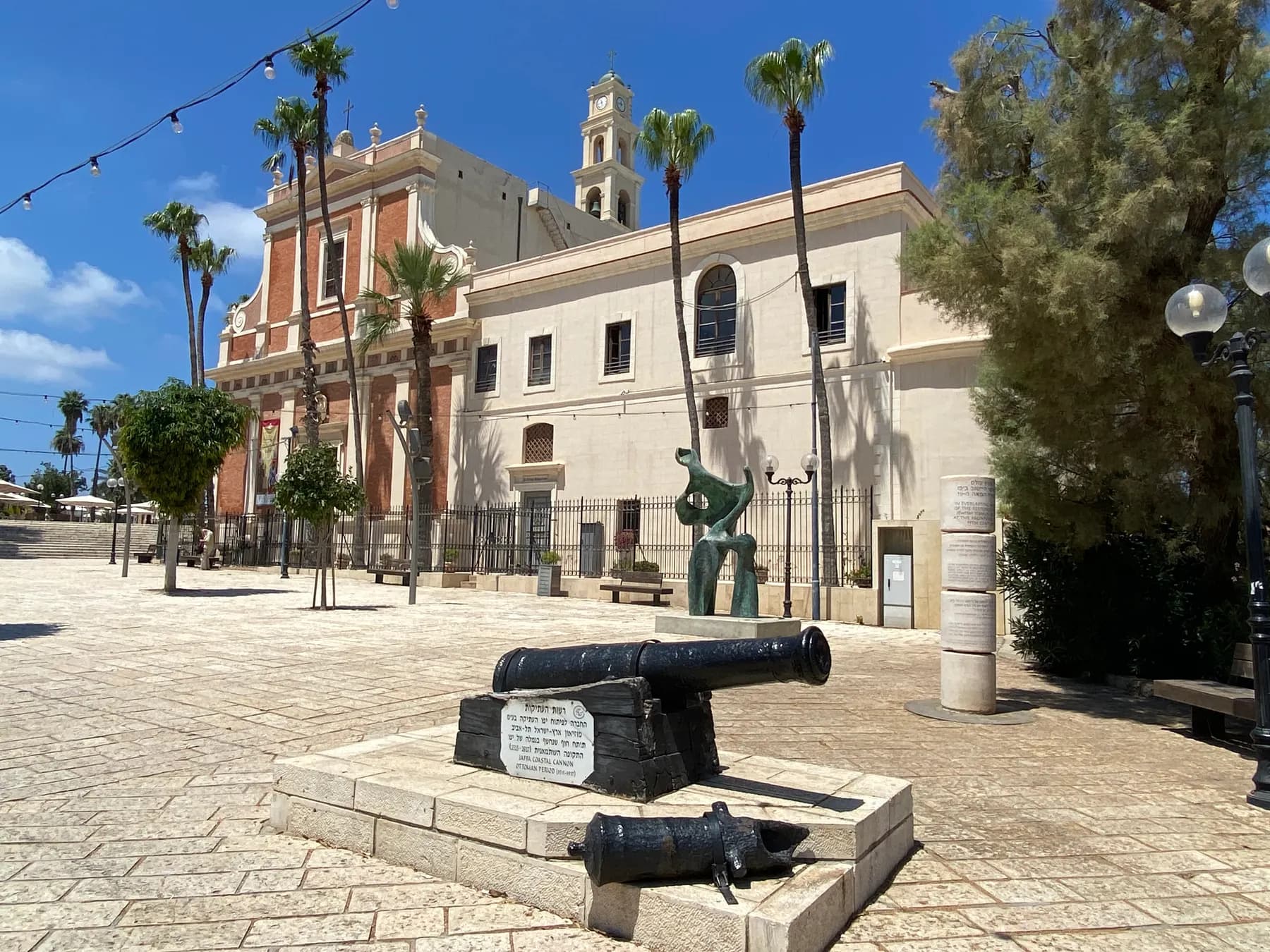
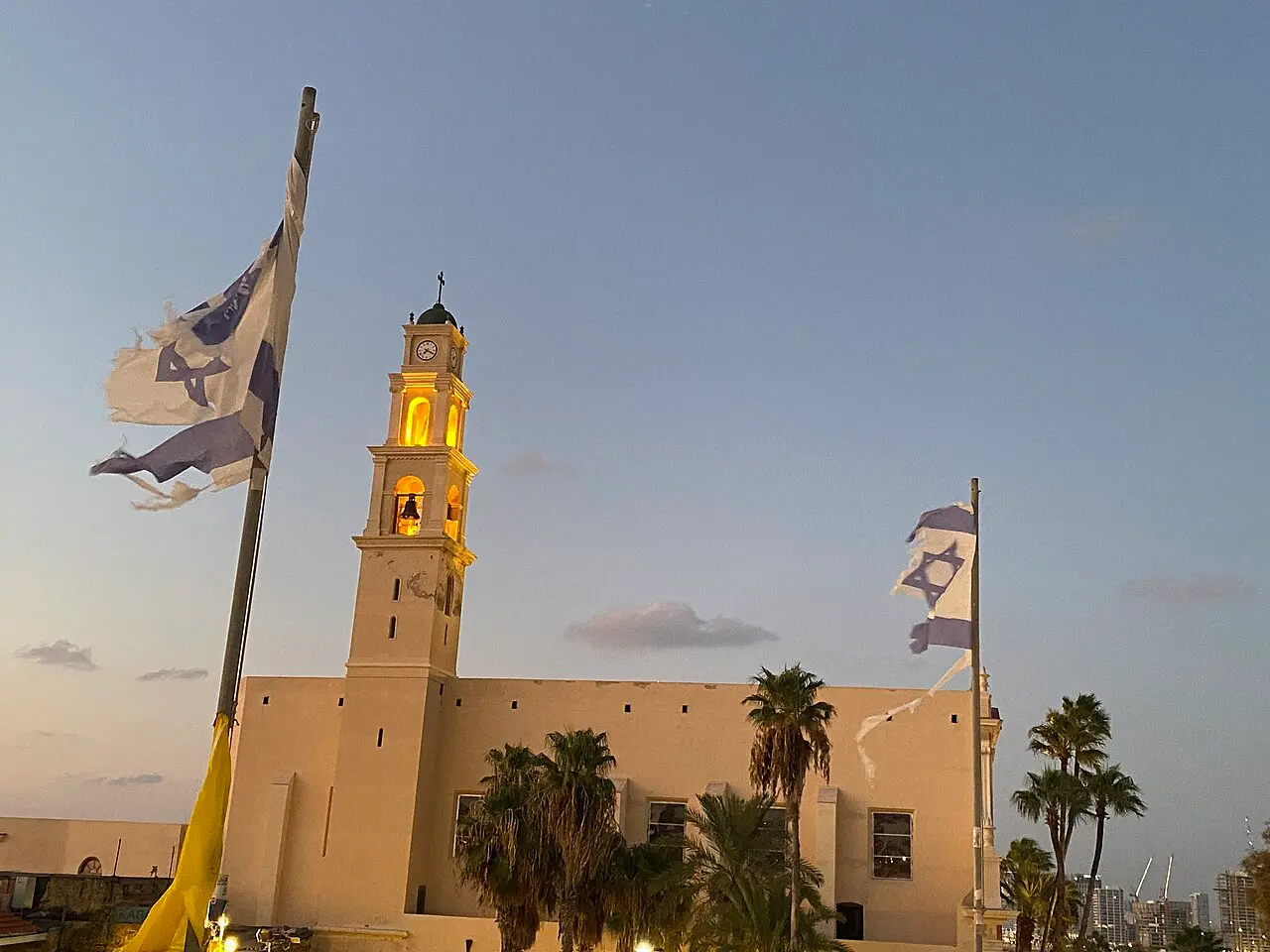
The Custody of the Holy Land runs this as a shrine rather than a parish: a Spanish-funded church of 1888 to 1894 standing on the citadel Louis IX rebuilt, with an altar that faces west instead of east.
שלמה רודד / CC BY 2.5 · Wikimedia Commons
Present church
1888 to 1894
built by the Spanish on the site of Louis IX's fortress, on the Custody of the Holy Land's own account
Open
08:00 to 11:45, 15:00 to 17:00
the Custody's published visiting hours, with more than three hours shut in the middle of the day
Admission
Free
the Custody publishes visiting hours for the church and no ticket price of any kind
Citadel demolished
7 March 1268
when Baybars took Jaffa and had the fortress pulled down, its timber and marble shipped to Cairo
In short
- How long to give it
- about 30 minutes for the church, the glass and the citadel rooms by the sacristy, or an hour if you sit through part of a mass or wait for the organ
- Morning, daily
- 08:00 to 11:45
- Church
- No charge. The Custody publishes visiting hours for this sanctuary and no ticket price of any kind, and it does publish a 10 shekel entrance fee for its site at Capernaum, so the omission is a position rather than a gap
כנסיית פטרוס הקדוש
St Peter's Church is the Franciscan sanctuary on the seaward side of Kedumim Square in Old Jaffa, and the largest building on the headland. The Custody of the Holy Land, which owns and runs it, lists it as a sanctuary and as a succursal of the Latin parish of St Anthony rather than as a parish church in its own right: the congregation that fills it on a Sunday evening is not, for the most part, the local Arab Catholic community, and the friary attached to it is small.
What the church commemorates is a chapter rather than a relic. The Acts of the Apostles puts three episodes at Jaffa: Peter raising Tabitha, his lodging at the house of Simon the Tanner, and the vision of a sheet lowered from heaven full of clean and unclean creatures, after which he went up the coast to Caesarea and received the Roman centurion Cornelius and his household into the Church. The Custody's page for the sanctuary is built around one line from that vision, Acts 10:15, and the painting over the high altar shows it. There is no claim that any of it happened on this spot. The traditional house of Simon the Tanner is a separate building a few minutes south, near the lighthouse.
The practical shape of a visit is short and awkwardly timed. Entry is free and the doors are open in two blocks with a long afternoon gap; almost nothing standing above ground is older than 1888; and the genuinely medieval part of the site, two low circular rooms with embrasures for firing through, sits outside the church beside the sacristy rather than in the nave where visitors look for it.
Acts 10
The vision that opened the Church to gentiles
Jaffa appears in Acts as a port town with an established community of Jewish believers. Peter comes down from Lydda, raises a woman named Tabitha, and stays on in the house of a tanner called Simon by the sea. It is on that roof, in the account the Custody of the Holy Land reproduces on its Jaffa page, that he sees a sheet let down from heaven holding creatures both pure and impure and is told not to call impure what God has made clean. He then travels to Caesarea at the invitation of the centurion Cornelius, whose household becomes the first group of pagan converts received into the Church.
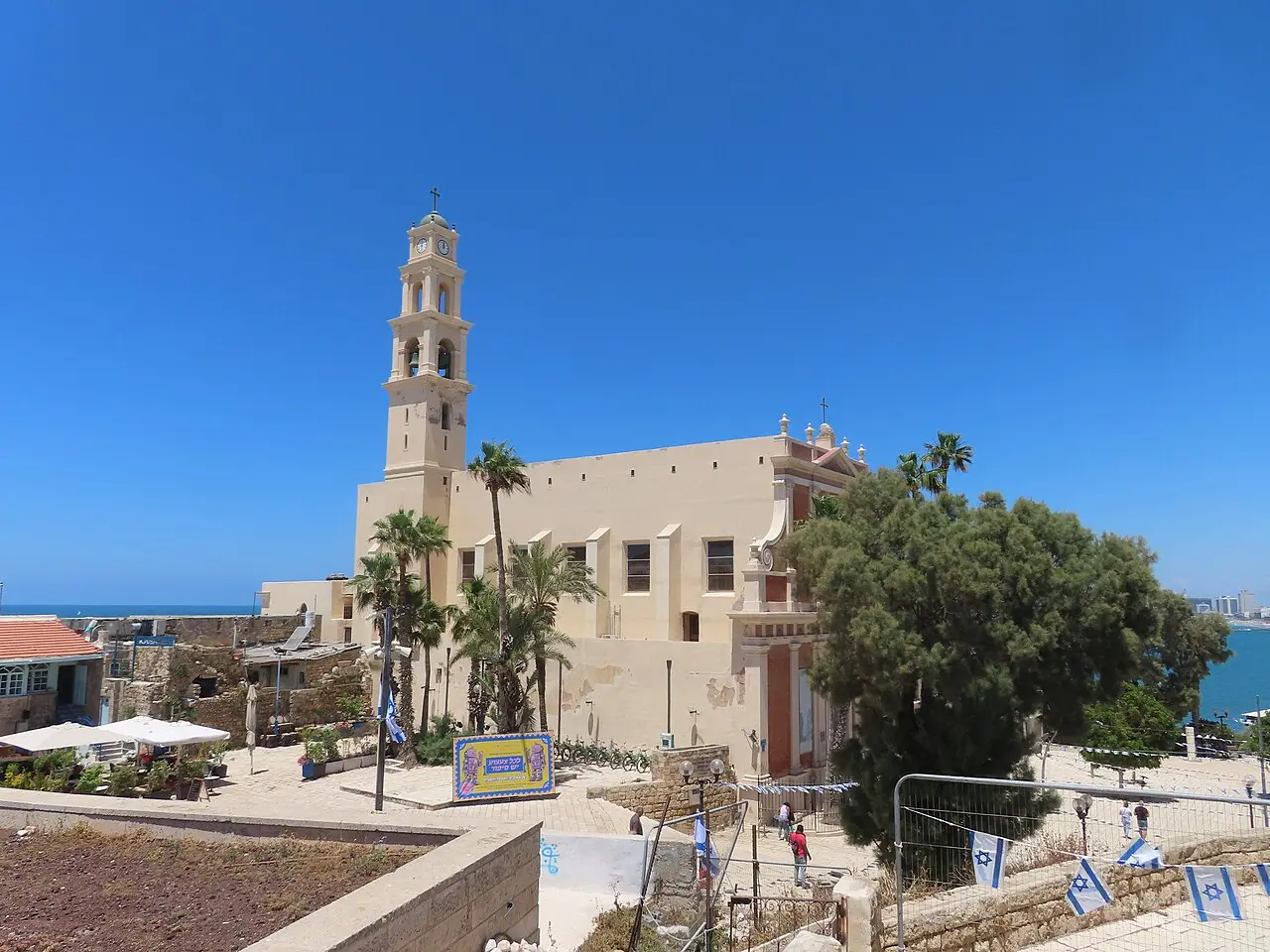
That is the reason there is a Catholic sanctuary on this headland at all, and it explains the one architectural oddity a visitor is likely to notice. Churches are conventionally oriented east. This one is not: BibleWalks records the main altar facing west, and reads the arrangement as turning the church towards the sea and towards the reputed house of Simon the Tanner. Wikipedia's infobox, working from the street rather than the axis, gives the facade direction as southeast. No survey of the building is published.
The tanner's house is not part of the church and is not run by the Custody. See The Holy Land places it at 8 Simon the Tanner Street, a few minutes away towards the lighthouse, and describes it as an inconspicuous nineteenth-century building. Visitors who go looking for a first-century roof will not find one, here or anywhere else in Jaffa.
Fallaner / CC BY-SA 4.0 · Wikimedia Commons
Crusader
Louis IX's fortress, and the muddle over which crusade built it
The plot was a castle before it was a church. The Custody says the present building stands where the fortress of Louis IX of France had stood, and that the king who built it was the same king who brought the Franciscans to Jaffa; his statue is in the friary cloister. The chronology behind that sentence is well documented even where the church's own signage is loose. Britannica records Louis IX embarking from Aigues-Mortes on 25 August 1248 with roughly 35,000 men, losing his army at al-Mansurah in February 1250, being captured that April, and then staying on in the Holy Land for four years, turning a military defeat into a diplomatic one and fortifying the Christian cities.
Which crusade that was depends entirely on who is counting, and the sources a visitor is most likely to read do not agree. The Custody calls it the sixth crusade and dates the fortress to about 1251. See The Holy Land calls it the ninth. Britannica, following the standard numbering, calls Louis IX's expedition of 1248 to 1254 the Seventh Crusade. The disagreement is over labels, not events, but it is worth knowing before a guide asserts one of them with confidence.
There is a second attribution problem. Wikipedia's article on the church, citing Kliot, Mansfeld and Sagi's study of Christian tourism to the Holy Land, says the citadel was erected by Frederick I and restored by Louis IX. Frederick I is Barbarossa, and Britannica records him drowning in the Göksu on 10 June 1190 while on the Third Crusade, well short of the coast of Palestine. The emperor whose crusade of 1228 to 1229 returned territory in the Holy Land to Latin rule was Frederick II.
The fortress did not last long after Louis IX left. On 7 March 1268 the Mamluk sultan Baybars took Jaffa, the citadel was demolished, and its timber and marble were sent to Cairo for a mosque he was building. That was the end of the Crusader presence in the south of the country, and it is the reason the medieval remains on this site amount to two rooms and a tower stump rather than a castle.
- 1228 to 1229: Frederick II's crusade returns Latin rule to part of the coast
- 1248 to 1254: Louis IX's expedition, which Britannica numbers the Seventh Crusade
- c. 1251: the Custody's date for the fortress on this site
- 7 March 1268: Baybars takes Jaffa and has the citadel pulled down
Dennis G. Jarvis / CC BY-SA 2.0 · Wikimedia Commons
Rebuilt
Four churches on one plot, and what actually survives
The Franciscans came back to the ruined castle as hosts rather than as builders. The Custody dates their guesthouse in Jaffa to 1650, opened to receive the growing number of pilgrims landing at the port on their way inland. A church followed in 1654, dedicated to St Peter and raised over the Crusader remains, and that is the consecration date Wikipedia's infobox still carries.
It did not survive the eighteenth century. Wikipedia states flatly that the church was twice destroyed and twice rebuilt in the late 1700s, without saying by whom on either occasion, and See The Holy Land repeats the same bare formula. What is attached to the period instead is a story about the surviving citadel rooms: both sources record that Napoleon is believed to have lodged in them after he took Jaffa in 1799. The verb in every account is a hedge, and this page keeps it.
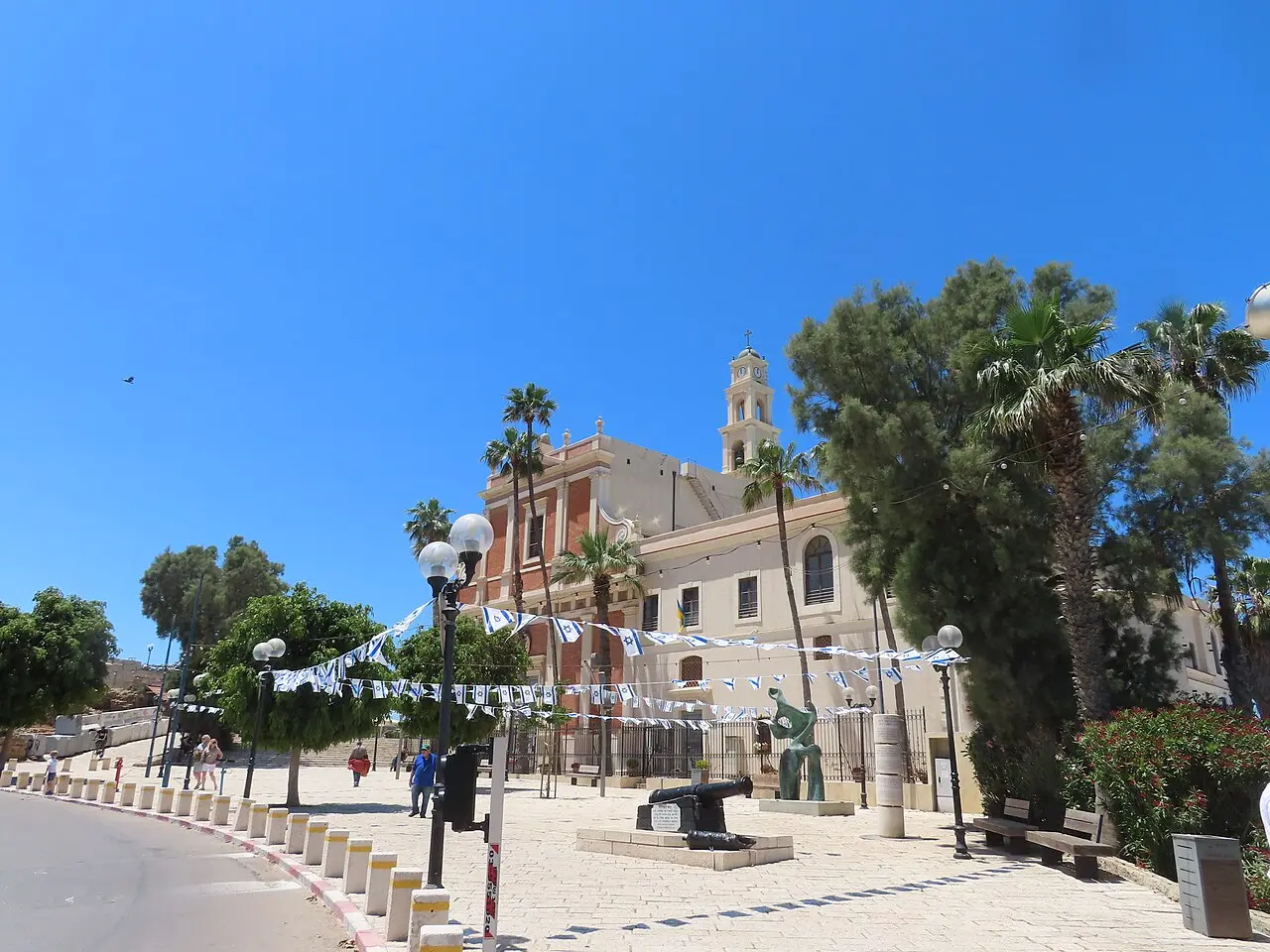
The building a visitor walks into now is the fourth on the site and was paid for from Spain. The Custody says plainly that it was built by the Spanish between 1888 and 1894, and Wikipedia classes the result as New Spanish Baroque, with one spire, a tall brick facade and the tallest bell tower in Old Jaffa. A renovation in 1903 is the last major work recorded on the church itself; the friary behind it was overhauled in the 2000s.
So the honest inventory is short. Nothing in the nave is medieval. The thirteenth-century material is outside and to the right of the sacristy, two circular rooms with low ceilings and embrasures cut for firearms, plus a large round tower in the north-western corner of the friary courtyard with a stone chapel in its basement. Everything else, including the whole silhouette that has served as a landmark for ships approaching Jaffa, is late Victorian.
- 1650: Franciscan guesthouse for pilgrims landing at Jaffa
- 1654: first church, over the Crusader ruins
- Late 18th century: destroyed twice, rebuilt twice
- 1799: Napoleon said to have lodged in the citadel rooms
- 1888 to 1894: the present church, funded from Spain
- 1903: the last major renovation of the church
Fallaner / CC BY-SA 4.0 · Wikimedia Commons
Inside
Munich glass, a pulpit shaped like a tree, and the oldest working organ in the country
The interior is a European nineteenth-century church transplanted whole: a high vaulted ceiling, marble on the walls, and coloured glass doing most of the work. The windows came from the Munich studio of Franz Xaver Zettler, who lived from 1841 to 1916 and set up his own stained glass firm in 1870, having married into the Mayer family whose Munich workshop remains the better-known name in the trade.
The four main panels run through the life of Peter: the miraculous catch of fish, the giving of the keys, the Transfiguration on Mount Tabor and the washing of the feet at the Last Supper. Almost every other window in the church shows a Spanish saint, which follows directly from who paid for the building; the exceptions are Tabitha, whom Peter raised in this town, Francis of Assisi, and the Immaculate Conception. Above the high altar hangs a painting of Peter's vision by the Catalan artist Talarn, named by the Custody and by very little else in print.
Two objects are worth going in for on their own. The pulpit is carved in wood in the shape of a fruiting tree, described in the Custody's own text and in See The Holy Land's account as lifelike rather than stylised. And since 15 June 2014 the church has held a small pipe organ built in 1847 by Agati Nicomede e Fratelli of Pistoia, in Tuscany: it was rebuilt by the Spanish Franciscan organ builder Delfino Fernandez Taboada, stood for years in the Christian Information Centre in Jerusalem, and was dismantled and reassembled here by the Israeli organ builder Gideon Shamir. The Terra Sancta Organ Festival, which is run out of the Custody, describes it as the oldest organ in use in Israel and Palestine. It has a fifty-note keyboard and a short stop list including Principale 8', Ottava 4', Decimaquinta 2' and Voce Angelica 8'.
The friary behind the church is not on the visitor route, and the description of it that circulates comes from Wikipedia rather than from the Custody. It has the eastern range built around the courtyard with the statue of Louis IX at its centre, an arcade on two sides, a library up a narrow stair from the tower basement holding a collection heavy in Polish, and the friars' own quarters in the higher western range, with views from the top floor over the Mediterranean and Andromeda's rock. The same account puts four friars in residence, two Poles, an Englishman and a Chilean; the Custody does not publish a number.
Congregations
The church Israel's migrant Catholics actually fill
The most interesting thing about St Peter's is not its architecture but its timetable. The Custody keeps two churches in Jaffa: St Anthony, up the hill, which is the parish with the schools serving Arabic-speaking Israeli citizens, and St Peter's, which is a shrine on the promontory. Between them the friars run services for Christian migrant and asylum-seeking communities whose combined number, on the Custody's own statement, exceeds that of the local Christian population: Filipinos, Indians in several languages, Eritreans, Ethiopians, Nigerians, Ghanaians, Sri Lankans, Latin Americans, Italians, Poles and others.
The mass list published by the Christian Information Centre in Jerusalem, which is also a Custody body, shows what that looks like in a week. Sunday has English at 09:00, Polish at 18:00 and Hebrew at 19:15. Saturday carries the anticipated Sunday masses, Spanish at 18:00 and Hebrew at 19:15. Monday and Friday open with morning prayer at 06:45 and an English mass at 07:00, with adoration of the Blessed Sacrament from 06:15 on Fridays. Wikipedia notes that Polish workers come to pray here on Saturdays, their day off.
The Hebrew line is the unusual one. Israel's Hebrew-speaking Catholic community was founded in the mid-1950s by immigrants who belonged to the Jewish people by birth or by family and wanted to practise as Catholics; the Vatican approved it on an experimental basis in 1955, and it was celebrating mass in Hebrew that same year, long before the Second Vatican Council permitted the vernacular elsewhere. Catholics and Cultures, the research project at the College of the Holy Cross, counts about a thousand members across seven cities and reports that 650 gathered for the sixtieth anniversary in 2015. It also states that St Peter's in Jaffa is home to the largest of those congregations, which is why a visitor who turns up at a quarter past seven on a Sunday evening hears this church praying in Hebrew.
None of that is on a sign outside. Visiting hours end at 17:00 and the congregations arrive afterwards, so the church most tourists see and the church that is actually used barely overlap.
שלמה רודד / CC BY 2.5 · Wikimedia Commons
What to look for
Things not to walk past at St Peter's Church
The details that repay knowing about before you are standing in front of them.
The two circular Crusader rooms
Outside and to the right of the sacristy, low-ceilinged and cut with embrasures for firing through, they are the only thirteenth-century fabric left from the citadel Louis IX rebuilt. Napoleon is believed, on several accounts and asserted by none of them firmly, to have lodged in them in 1799.
The round tower in the friary courtyard
A stump of the old fortress in the north-western corner, with a stone chapel in its basement and a narrow stair running up to the friary library. The courtyard it stands in also holds the statue of Louis IX that the Custody mentions on its own page.
Zettler's windows
Four panels on the life of Peter, the catch of fish, the keys, the Transfiguration and the washing of the feet, from the Munich studio of Franz Xaver Zettler. Nearly all the other windows show Spanish saints, the exceptions being Tabitha, Francis of Assisi and the Immaculate Conception.
Talarn's painting of the vision
The canvas above the high altar shows the sheet lowered from heaven in Acts 10, the episode the whole sanctuary exists to mark. The Custody names the Catalan painter Talarn, and there is very little else about him in print.
The pulpit carved as a fruiting tree
Wood worked into a tree in fruit rather than the usual panelled box, and singled out by the Custody and by See The Holy Land alike. It is the one piece of nineteenth-century furniture here that nobody walks past.
The 1847 Agati organ
Built in Pistoia, rebuilt by a Spanish Franciscan, kept for years at the Christian Information Centre in Jerusalem and reassembled in this church on 15 June 2014. The Terra Sancta Organ Festival calls it the oldest organ still in use in Israel and Palestine.
The long view
St Peter's Church, in order
1st century AD
Acts places Peter at Jaffa: the raising of Tabitha, his stay with Simon the Tanner, and the vision of the sheet that sends him to Cornelius at Caesarea.
1190
Frederick I Barbarossa, credited by one study with erecting the Jaffa citadel, drowns in the Göksu on 10 June while on the Third Crusade, without reaching the coast of Palestine.
1228 to 1229
Frederick II's crusade returns territory in the Holy Land to Latin rule and he crowns himself king of Jerusalem.
1248 to 1254
Louis IX's crusade: defeat at al-Mansurah, capture in April 1250, then four years spent fortifying the Christian cities of the coast.
c. 1251
The Custody's date for the fortress of Louis IX on this headland, the building the church now stands on.
7 March 1268
Baybars takes Jaffa. The Mamluks demolish the citadel and ship its timber and marble to Cairo for a mosque of his own.
1650
The Franciscans open a guesthouse at Jaffa for pilgrims arriving through the port.
1654
A church dedicated to St Peter is built over the Crusader ruins. It is the consecration date the building still carries.
Late 18th century
The church is destroyed twice and rebuilt twice. No source consulted here names who did the destroying on either occasion.
1799
Napoleon takes Jaffa and is believed to have lodged in the two circular citadel rooms beside the sacristy.
1888 to 1894
The present church is built, funded from Spain, in what Wikipedia classifies as New Spanish Baroque.
1903
The last major renovation recorded on the church itself.
1955
The Vatican approves Israel's Hebrew-speaking Catholic community on an experimental basis, and mass is celebrated in Hebrew that year. St Peter's now holds its largest congregation.
2000s
The friary behind the church is renovated.
15 June 2014
The 1847 Agati organ is dismantled at the Christian Information Centre in Jerusalem and reassembled in this church.
Practical
Visiting St Peter's Church
Where
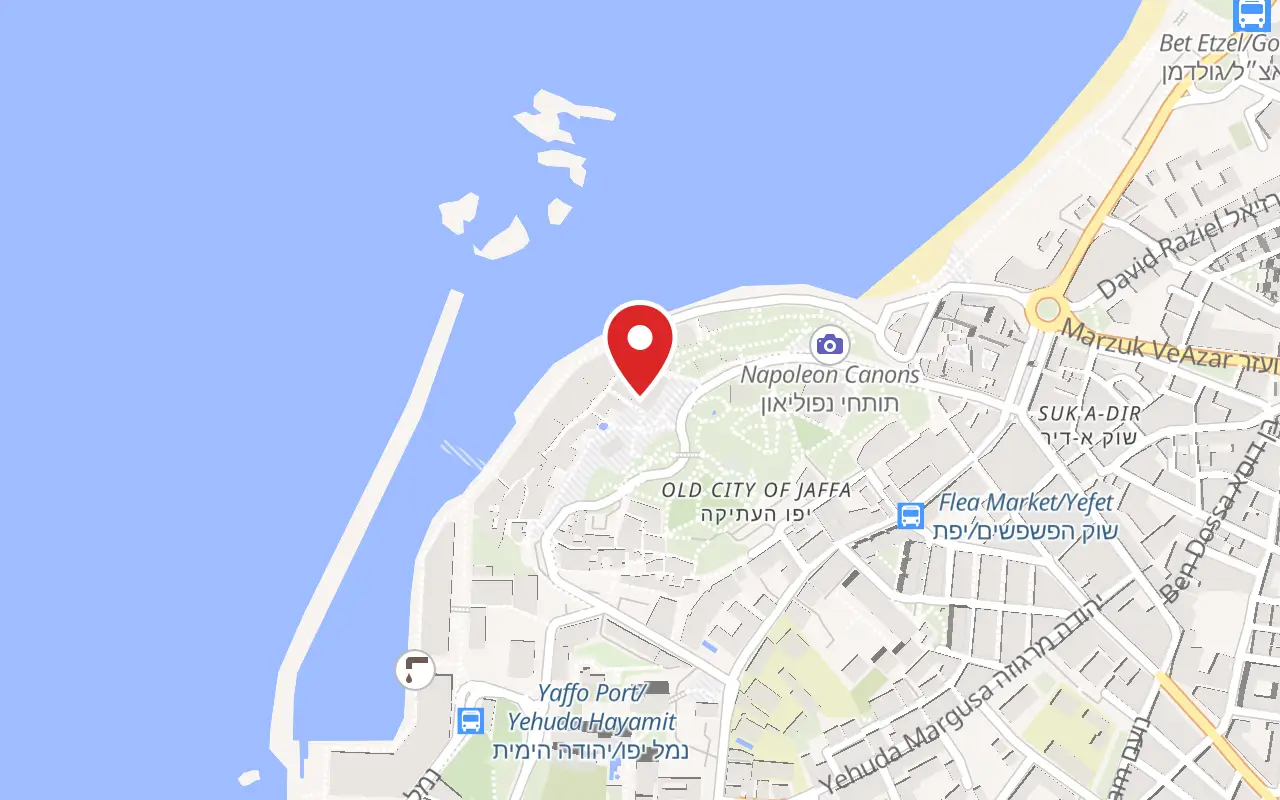
Kedumim Square, Old Jaffa, Tel Aviv-Yafo. The Custody's postal address is St Peter's Church, Terra Sancta, P.O.B. 8467, 61083 Jaffa
What ticket you need
This does not sit inside a ticketed park. It stands on Kedumim Square, which is open ground and free to walk through at any hour. The underground archaeological visitor centre beneath the same square is a separate operation with its own hours and its own ticket, and nothing on this page covers it.
Opening hours
- Morning, daily
- 08:00 to 11:45source
- Afternoon, daily
- 15:00 to 17:00. The Terra Sancta Organ Festival, another Custody body, publishes the same two blockssource
- Closed to visitors
- 11:45 to 15:00 every day, which catches most people arriving after a late morning in the flea marketsource
- Sunday masses
- 09:00 in English, 18:00 in Polish, 19:15 in Hebrew, all outside the published visiting hourssource
- Saturday anticipated masses
- 18:00 in Spanish and 19:15 in Hebrewsource
- Weekday masses
- Monday and Friday, morning prayer at 06:45 and mass in English at 07:00, with adoration of the Blessed Sacrament from 06:15 on Fridayssource
Admission
- Church
- No charge. The Custody publishes visiting hours for this sanctuary and no ticket price of any kind, and it does publish a 10 shekel entrance fee for its site at Capernaum, so the omission is a position rather than a gapsource
- Friary and cloister
- Not on the visitor route and no price is published. The statue of Louis IX, the round tower and the library are inside the friary, which is a working religious housesource
Access
The Custody publishes no accessibility information for this church, so anything stated here would be invention. What is checkable is the ground: the church stands on the crown of the Old Jaffa headland, every approach from the harbour or the port climbs, and the entrance is reached from Kedumim Square rather than at street level from the sea. Wheelchair users and anyone unsteady on slopes should ring the friary on +972 3 682 2871 before making the trip rather than rely on a guidebook.
On site
- Free entry
- Daily mass
- Masses in English, Spanish, Polish and Hebrew
- 1847 pipe organ
- Franciscan friary
- On Kedumim Square
Booking
Nothing is booked to visit and there is no ticket office. Groups wanting to celebrate mass, or anyone needing the church outside the two published blocks, contact the friary on +972 3 682 2871. The Custody lists this church as a succursal of the Latin parish of St Anthony, so parish business is handled there rather than here.
Hours and prices are given as the operator publishes them and change without much notice, particularly around Shabbat and the festivals. Check the operator's own page before you travel for this.
Official page at custodia.org →What people wish they had known
- The midday closure catches almost everybody. The Custody publishes 08:00 to 11:45 and 15:00 to 17:00, so the church is shut for more than three hours in the middle of the day, which is exactly when a walk from the clock tower and the flea market tends to reach Kedumim Square.
- The Crusader remains are not in the church. The two circular rooms with fire embrasures are outside and to the right of the sacristy, and the round tower with the chapel in its basement is in the friary courtyard, which is not part of a visit. Looking for medieval masonry in the nave is looking in a building finished in 1894.
- The house of Simon the Tanner is a different place. See The Holy Land puts it at 8 Simon the Tanner Street, a few minutes south towards the lighthouse, in an unremarkable nineteenth-century building. It is not the church, it is not run by the Custody, and it is not a visitor attraction.
- The church a visitor sees and the church that is used barely overlap. Every mass on the published list falls outside visiting hours, from 07:00 on Monday and Friday mornings to 19:15 in Hebrew on Saturday and Sunday evenings. Anyone who wants to see the building in use has to come for a service, not for the sightseeing window.
- Dress as for a working shrine: shoulders and knees covered. This is a Franciscan sanctuary with friars in residence and a full weekly liturgy, not a museum with a nave in it.
- Do not take the crusade numbering from the signage. The Custody calls Louis IX's expedition the sixth crusade and See The Holy Land calls it the ninth, while Britannica, following the standard scheme, calls it the Seventh. The dates, 1248 to 1254, are what everyone agrees on.
The figures
St Peter's Church by the numbers
Each figure carries the year it belongs to and links the source it came from.
| Measure | Figure | As of | Source |
|---|---|---|---|
| Present church built | 1888 to 1894 | 1894 | custodia.org |
| Franciscan guesthouse at Jaffa from | 1650 | 1650 | custodia.org |
| Citadel demolished by Baybars | 7 March 1268 | 1268 | en.wikipedia.org |
| Louis IX's force on embarking | about 35,000 men | 1248 | britannica.com |
| Organ built by Agati of Pistoia | 1847 | 1847 | tsorganfestival.org |
| Organ reassembled in this church | 15 June 2014 | 2014 | tsorganfestival.org |
| Hebrew-speaking Catholics in Israel | about 1,000, across seven cities | 2026 | catholicsandcultures.org |
| At the community's 60th anniversary | 650 members | 2015 | catholicsandcultures.org |
While you are here
The rest of Jaffa
Everything else in this destination with a page of its own.
Fallaner / CC BY-SA 4.0 · Wikimedia Commons
Landmark
Kedumim Square
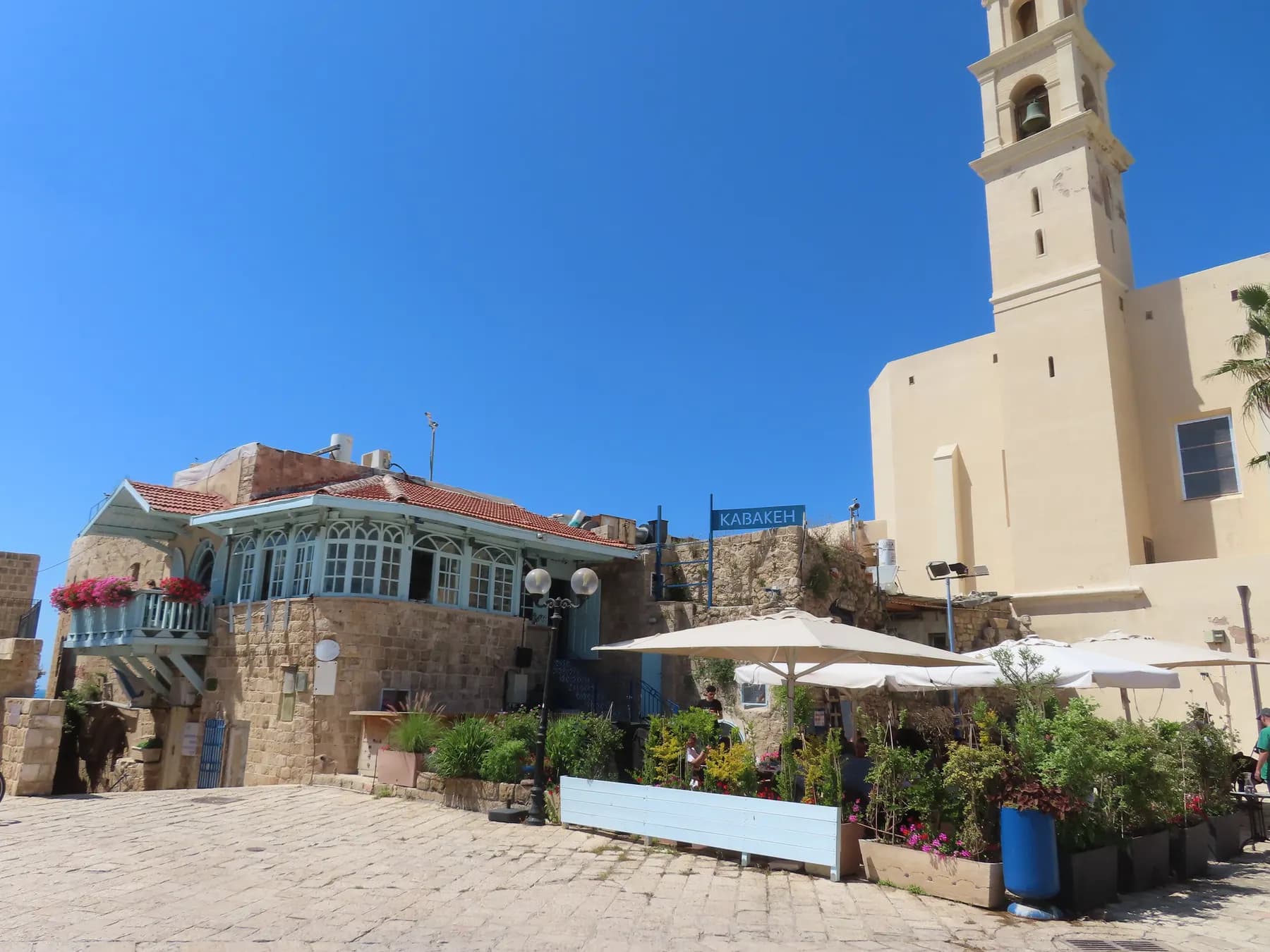
The flagged main square of Old Jaffa is a space the British made by demolition in June 1936, and the Israel Antiquities Authority excavation under its fountain found the drains of one of the houses that came down.
שלמה רודד / CC BY 2.5 · Wikimedia Commons
Landmark
Jaffa Port
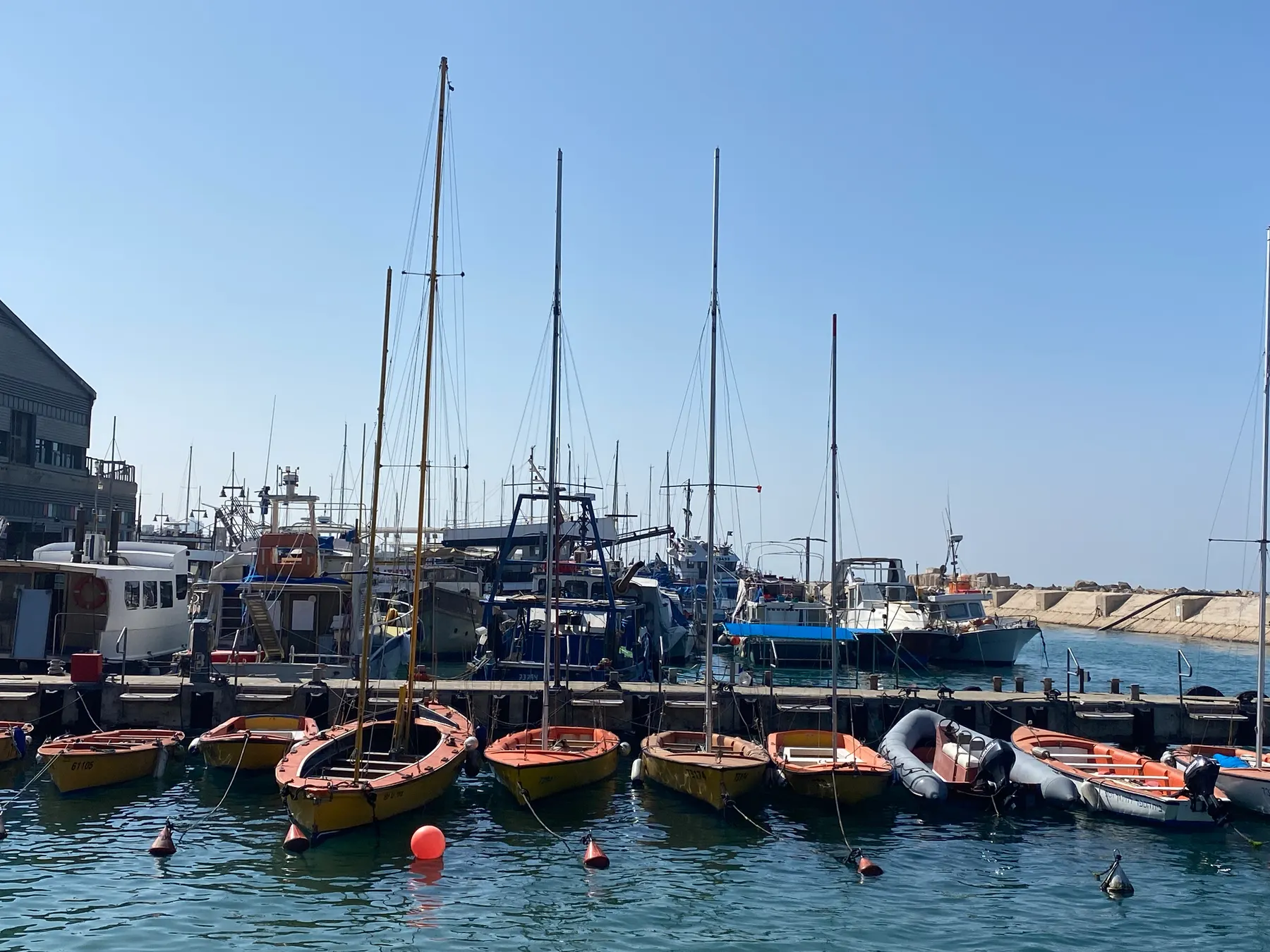
The quay, the breakwater and the three long sheds along it are British work of the mid-1930s, built for the orange trade on ground reclaimed from the sea, and two of those sheds were taken down and built again between 2019 and 2023.
Anagoria / CC BY 3.0 · Wikimedia Commons
Viewpoint
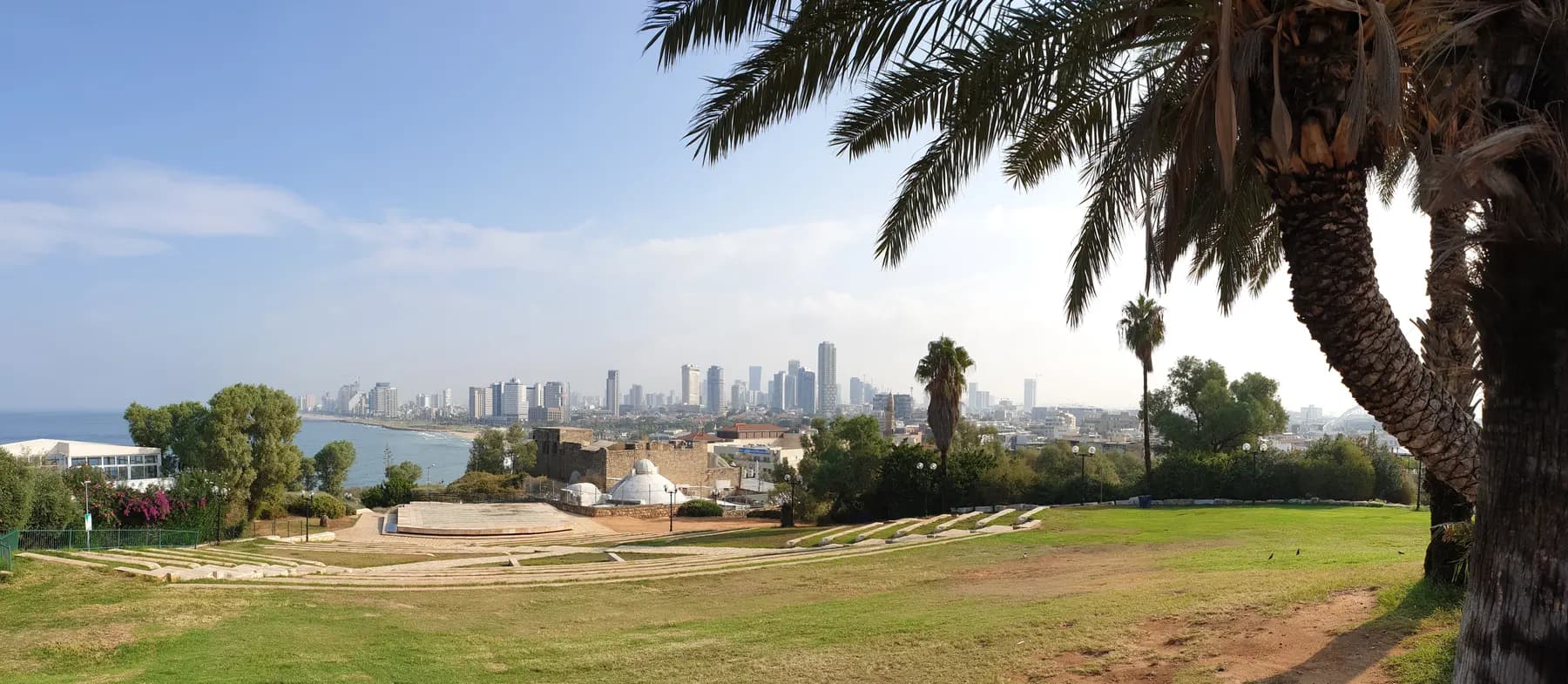
HaPisga Garden (Abrasha Park)
The lawns on top of Old Jaffa are not old: they are the ground left empty after the British blew a quarter of the town apart in June 1936, laid out as a public garden under a 1956 plan and planted by Tel Aviv's city gardener Avraham Karavan, whose nickname Abrasha the park still carries.
Sources and further reading
Every link below was opened and checked when this page was written. Official statements are marked as such: they are the subject's own account, not an independent one.
- OfficialCustody of the Holy Landcustodia.orgJaffa
The operator's own sanctuary page: visiting hours of 08:00 to 11:45 and 15:00 to 17:00, no admission price, the Spanish building of 1888 to 1894 on the fortress of Louis IX, the friars' guesthouse from 1650, the Zettler glass, the tree pulpit, Talarn's painting, the statue of Louis IX in the cloister, and the postal address and telephone number
- OfficialCustody of the Holy Landcustodia.orgJaffa: St. Peter's Church
The friary's entry in the Custody's list of convents, which classes the site as a sanctuary and as a succursal of the Latin parish of St Anthony rather than a parish of its own
- OfficialTerra Sancta Organ Festival, Custody of the Holy Landtsorganfestival.orgOrgans: Jaffa
The same opening hours; the 1847 Agati Nicomede e Fratelli organ, its rebuilding by Delfino Fernandez Taboada and its transfer into this church on 15 June 2014; and the Custody's statement that the migrant Christian communities served in Jaffa outnumber the local Christian population
- OfficialChristian Information Centre, Custody of the Holy Landcicts.orgCatholic masses outside Jerusalem
The published mass timetable for St Peter's, Jaffa: Sunday in English, Polish and Hebrew, Saturday anticipated masses in Spanish and Hebrew, and the Monday and Friday morning services
- ReferenceWikipediaen.wikipedia.orgSt. Peter's Church, Jaffa
The 1654 consecration, the two late eighteenth-century destructions, the 1903 renovation, the New Spanish Baroque classification, the subjects of the Zettler windows, the two circular citadel rooms and the Napoleon tradition, and the description of the friary with its courtyard, tower, library and four resident friars
- ReferenceBibleWalksbiblewalks.comJaffa: St. Peter's
The 1654 church over the ruins of a Crusader church, and the record of the main altar facing west with the reading that it is turned towards the house of Simon the Tanner
- ReferenceSee the Holy Landseetheholyland.netJaffa
The church twice destroyed and twice reconstructed, the citadel remnants outside the sacristy attributed to Louis IX, Napoleon believed to have lived in the two circular rooms after 1799, the fruiting-tree pulpit, and the reputed house of Simon the Tanner at 8 Simon the Tanner Street
- ReferenceEncyclopaedia Britannicabritannica.comLouis IX
The Seventh Crusade of 1248 to 1254, the embarkation from Aigues-Mortes on 25 August 1248 with about 35,000 men, the defeat at al-Mansurah and capture in April 1250, and the four subsequent years spent fortifying the Christian cities
- ReferenceWikipediaen.wikipedia.orgFall of Jaffa (1268)
Baybars' capture of Jaffa on 7 March 1268, the demolition of the citadel, and the shipping of its timber and marble to Cairo for a mosque of his own
- ReferenceEncyclopaedia Britannicabritannica.comFrederick I, Holy Roman emperor
Barbarossa's drowning in the Göksu on 10 June 1190 while on the Third Crusade, which bears directly on the attribution of the Jaffa citadel to a Frederick I
- ReferenceEncyclopaedia Britannicabritannica.comFrederick II, Holy Roman emperor
The crusade of 1228 to 1229 and Frederick II's coronation as king of Jerusalem, the episode that actually returned Latin rule to this stretch of coast
- ReferenceCatholics and Cultures, College of the Holy Crosscatholicsandcultures.orgHebrew-speaking Catholics find fellowship in Israel
St Peter's, Jaffa as home to the largest of the Hebrew-speaking kehillot, the community's foundation in the mid-1950s with Vatican approval on an experimental basis in 1955, mass in Hebrew from that year, about 1,000 members across seven cities, and 650 present at the sixtieth anniversary in 2015
- ReferenceWikipediaen.wikipedia.orgFranz Xaver Zettler
Zettler's dates of 1841 to 1916, the founding of his Munich stained glass firm in 1870, and his marriage into the Mayer family of Munich glassmakers
St Peter's Church: common questions
What are the opening hours?+
The Custody of the Holy Land publishes 08:00 to 11:45 and 15:00 to 17:00 for St Peter's, and the Terra Sancta Organ Festival, which is also a Custody body, gives the same two blocks. That means the church is closed to visitors from a quarter to twelve until three in the afternoon every day. Masses fall outside those hours entirely, from 07:00 on Monday and Friday mornings to 19:15 on Saturday and Sunday evenings.
Is there an entrance fee?+
No. The Custody publishes visiting hours for this sanctuary and no admission price at all, and on the same list of its sites it does publish a 10 shekel fee for Capernaum, so the absence of a figure here is deliberate. There is no ticket office. Donations are not solicited at the door.
How old is the building?+
The church a visitor walks into was built between 1888 and 1894 and last substantially renovated in 1903. It is the fourth church on the plot: a Franciscan guesthouse arrived in 1650, the first church was raised over the Crusader ruins in 1654, and Wikipedia records that it was destroyed twice and rebuilt twice in the late eighteenth century. Only the citadel rooms outside the sacristy and the round tower in the friary courtyard are medieval.
Is any of the Crusader castle still there?+
Two rooms and a tower. Outside and to the right of the sacristy are two circular rooms with low ceilings and embrasures cut for firing through, dated to the thirteenth century, and there is a large round tower in the north-western corner of the friary courtyard with a stone chapel in its basement. The rest went in 1268, when Baybars took Jaffa, had the citadel demolished, and sent its timber and marble to Cairo.
Did Napoleon really stay here?+
Every account hedges it, and this page does too. Wikipedia and See The Holy Land both say Napoleon is said, or is believed, to have lived in the two circular citadel rooms after he took Jaffa in 1799. Neither cites a contemporary source for it. He was demonstrably in Jaffa that year, the rooms were standing, and beyond that the claim rests on tradition.
Why does the altar face west?+
Because of what is out to sea. Churches are usually oriented east; BibleWalks records this main altar facing west and reads the arrangement as turning the building towards the Mediterranean and the reputed house of Simon the Tanner, where Peter had the vision the church commemorates. Wikipedia's infobox describes the facade as facing southeast, which is a statement about the entrance rather than the axis. No survey of the building is published.
Can you attend mass, and in what languages?+
Yes, and the language list is the point of the place. The Christian Information Centre publishes English at 09:00, Polish at 18:00 and Hebrew at 19:15 on Sundays, Spanish at 18:00 and Hebrew at 19:15 on Saturdays as anticipated masses, and English at 07:00 on Monday and Friday mornings after morning prayer at 06:45. Fridays open with adoration of the Blessed Sacrament at 06:15.
Is it wheelchair accessible?+
The Custody publishes nothing on accessibility for this church, so no honest answer is available in print. The church sits on the crown of the Old Jaffa headland and is entered from Kedumim Square, so every approach from the port or the seafront climbs. Anyone who needs a definite answer should telephone the friary on +972 3 682 2871 before travelling.
How long do you need?+
About half an hour is enough for the interior, the Zettler windows, Talarn's painting of the vision and the citadel rooms by the sacristy. An hour is right if you want to hear the 1847 organ or sit through part of a service. The building is large but there is not much of it to work through, and the friary is not open to visitors.
Is it worth going in if you are not religious?+
It depends what you came to Jaffa for. As architecture it is a competent late nineteenth-century church of a kind that is common in Europe and rare on this coast, with good Munich glass and a pulpit carved as a fruiting tree. As history it is the only place in Old Jaffa where thirteenth-century fortification survives at all. As a living institution it is where Israel's largest Hebrew-speaking Catholic congregation meets, alongside Polish, Filipino and other migrant communities, which is the least predictable thing on the headland.