
Jaffa
Things to do in Jaffa
Every site here that is worth building time around, each one with a page of its own covering what it is, what survives, when it opens and what it costs.
Sites covered
10
each with its own page
Ticketed
10
0 free to walk into
Sourced figures
80
each with its year and source
Citations
115
opened and checked
Jaffa is not one attraction. It is 10 of them, and they do not reward the same amount of time or the same time of day. This page is the index: what each one is in a sentence, how long it takes, and what it costs, so that the choosing happens here and the reading happens on the page for whichever you pick.
Every site below has been checked against its operator's own published information. Where a site charges admission, the price on its page is the operator's published price with the year it was taken. Where it sits inside a larger park, its page says which ticket covers it.
1 site
The ruins and excavations
leighklotz / CC BY 2.0 · Wikimedia Commons
Archaeological site
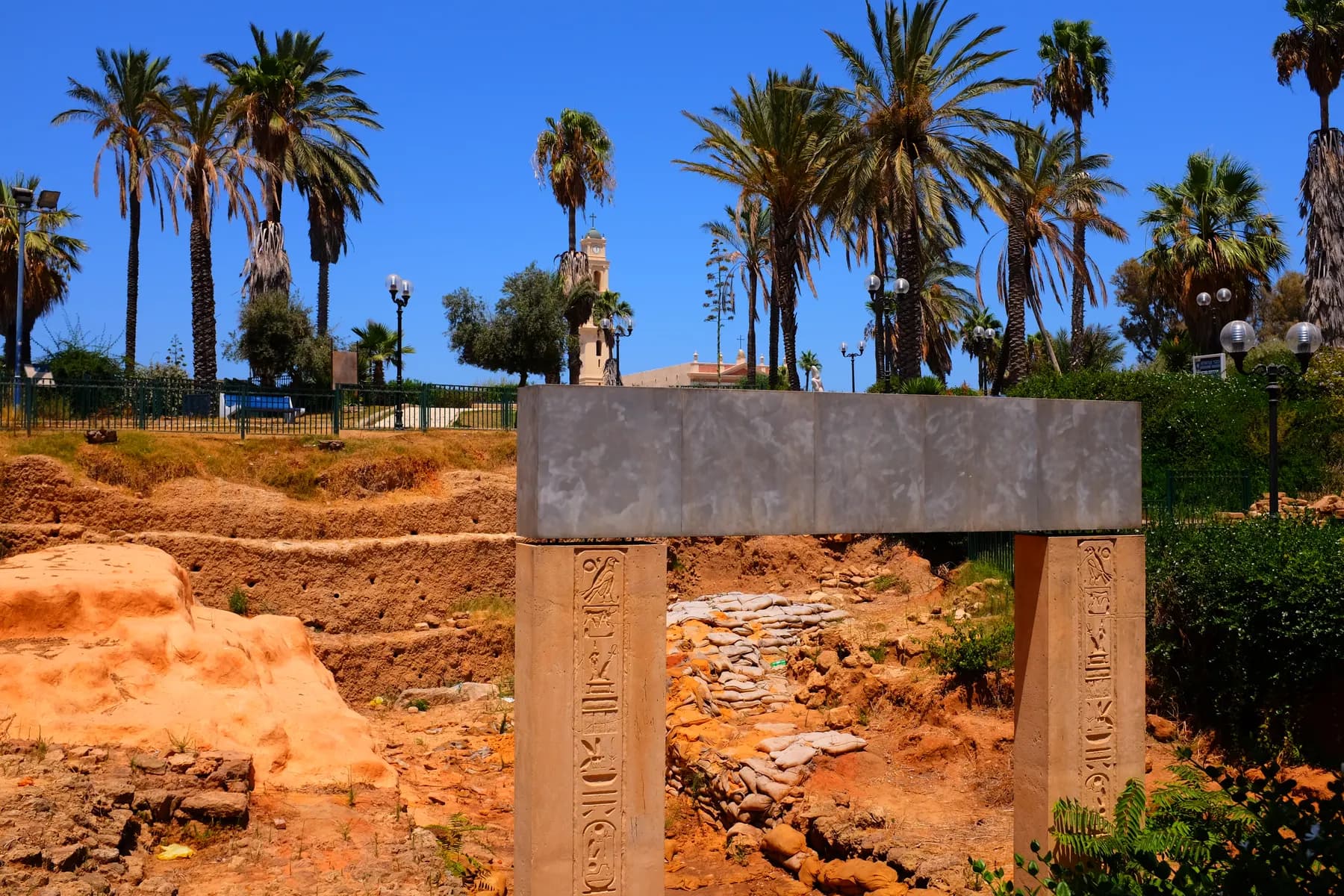
Ramses II Gate Garden
The inscribed portal standing in this excavation is a concrete reconstruction the Israel Antiquities Authority raised in the 1990s; the kurkar blocks that carried the titles of Ramesses II are in the Jaffa Museum of Antiquities.
- Time:
- about 20 minutes for the excavation itself, or about an hour taking in HaPisga Garden, the Statue of Faith and the view from the summit
- Entry:
- No charge. There is no ticket desk and no perimeter anywhere on this part of the hill; the site is listed among Old Jaffa's free attractions and sits inside a municipal park.
1 site
Churches, synagogues and holy places
שלמה רודד / CC BY 2.5 · Wikimedia Commons
Religious site
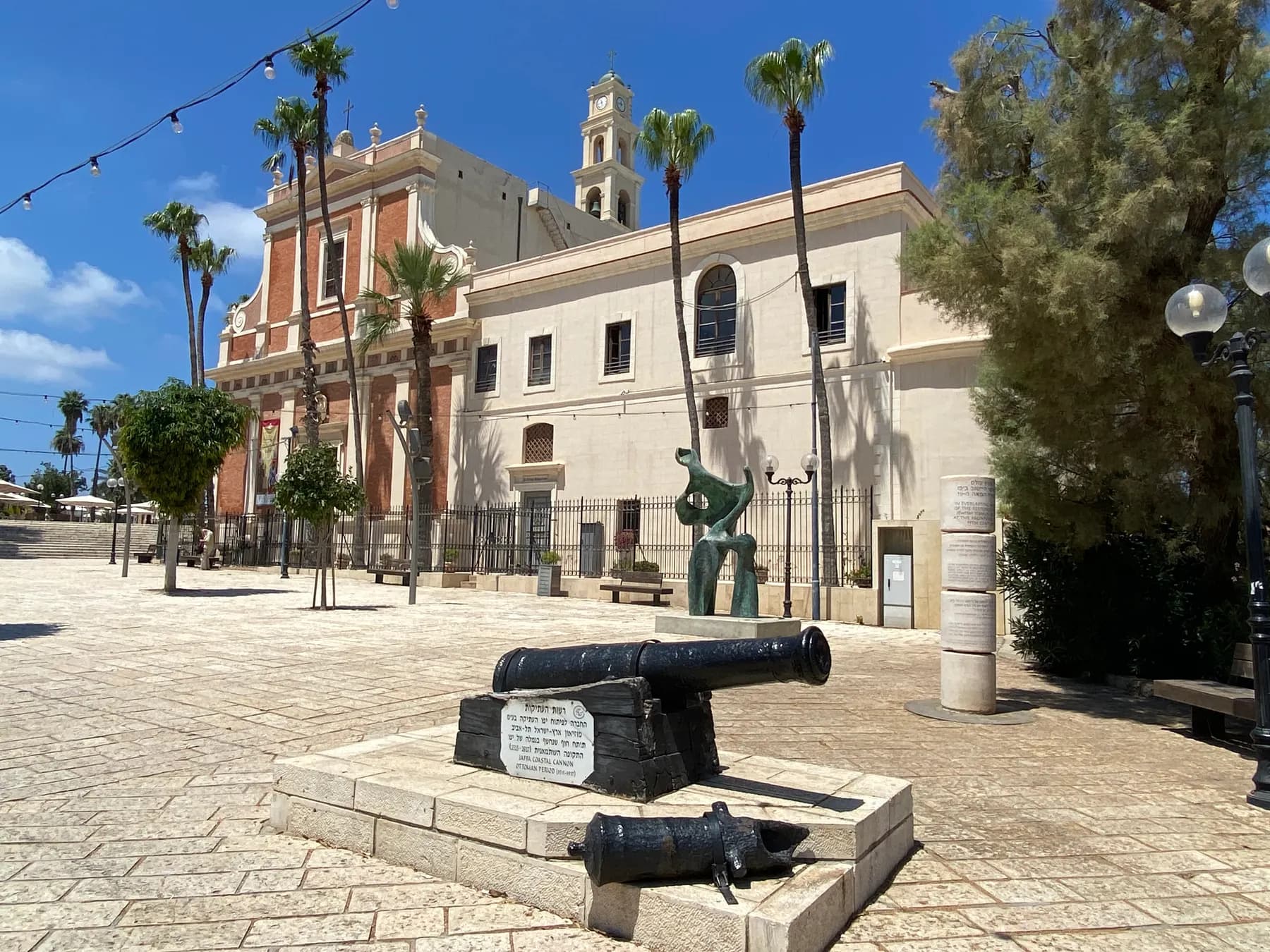
St Peter's Church
The Custody of the Holy Land runs this as a shrine rather than a parish: a Spanish-funded church of 1888 to 1894 standing on the citadel Louis IX rebuilt, with an altar that faces west instead of east.
- Time:
- about 30 minutes for the church, the glass and the citadel rooms by the sacristy, or an hour if you sit through part of a mass or wait for the organ
- Entry:
- No charge. The Custody publishes visiting hours for this sanctuary and no ticket price of any kind, and it does publish a 10 shekel entrance fee for its site at Capernaum, so the omission is a position rather than a gap
2 sites
Museums and collections
Deror_avi / CC BY-SA 3.0 · Wikimedia Commons
Museum
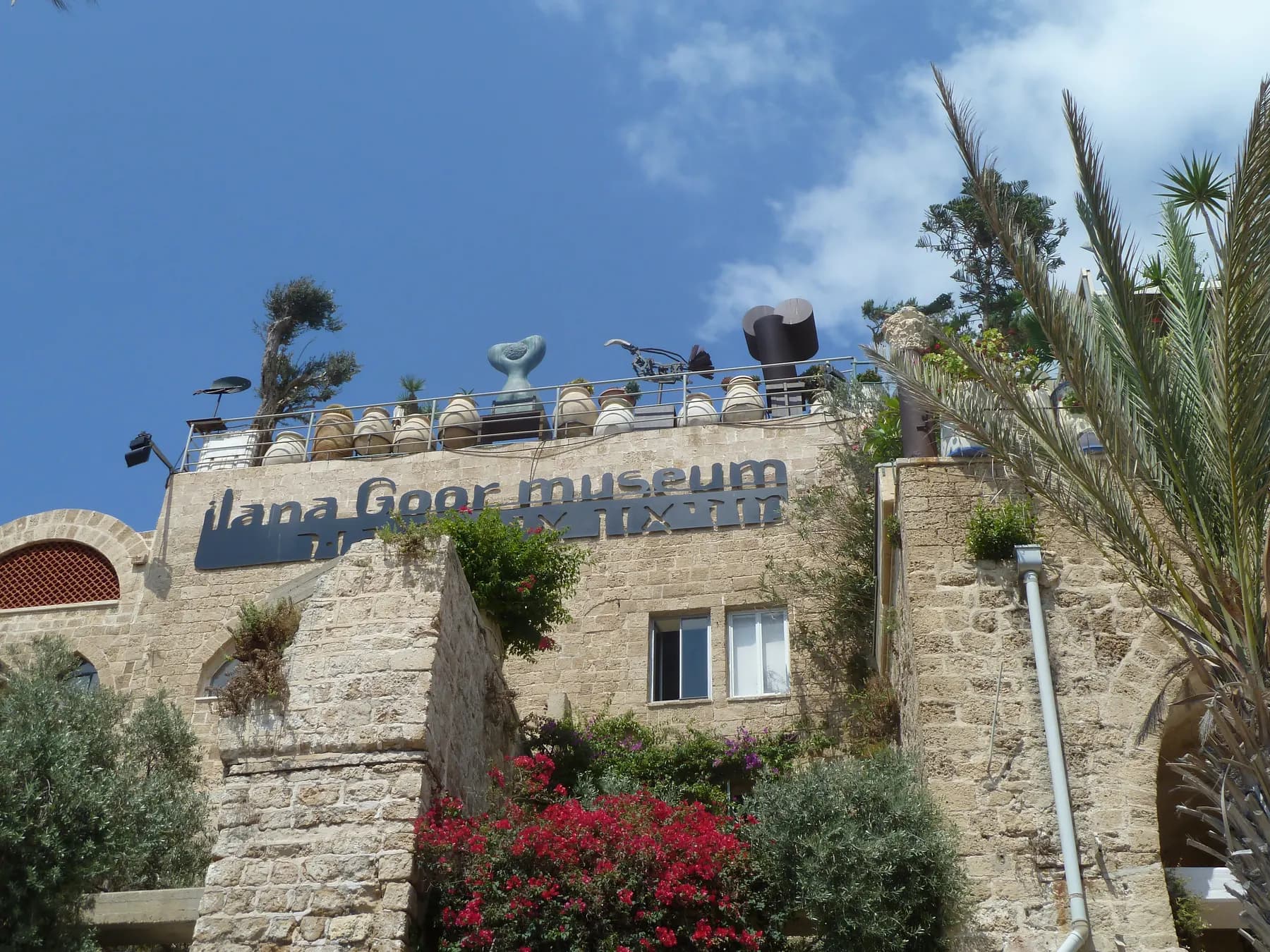
Ilana Goor Museum
A stone building of 1742, put up as an inn for Jewish pilgrims landing at Jaffa, which the sculptor Ilana Goor bought in two stages and opened as a museum of her own work and her collection in September 1995.
- Time:
- about 60 to 90 minutes
- Entry:
- 45 NIS
4.7 on Google, 1,166 ratings
שלמה רודד / CC BY 2.5 · Wikimedia Commons
Museum
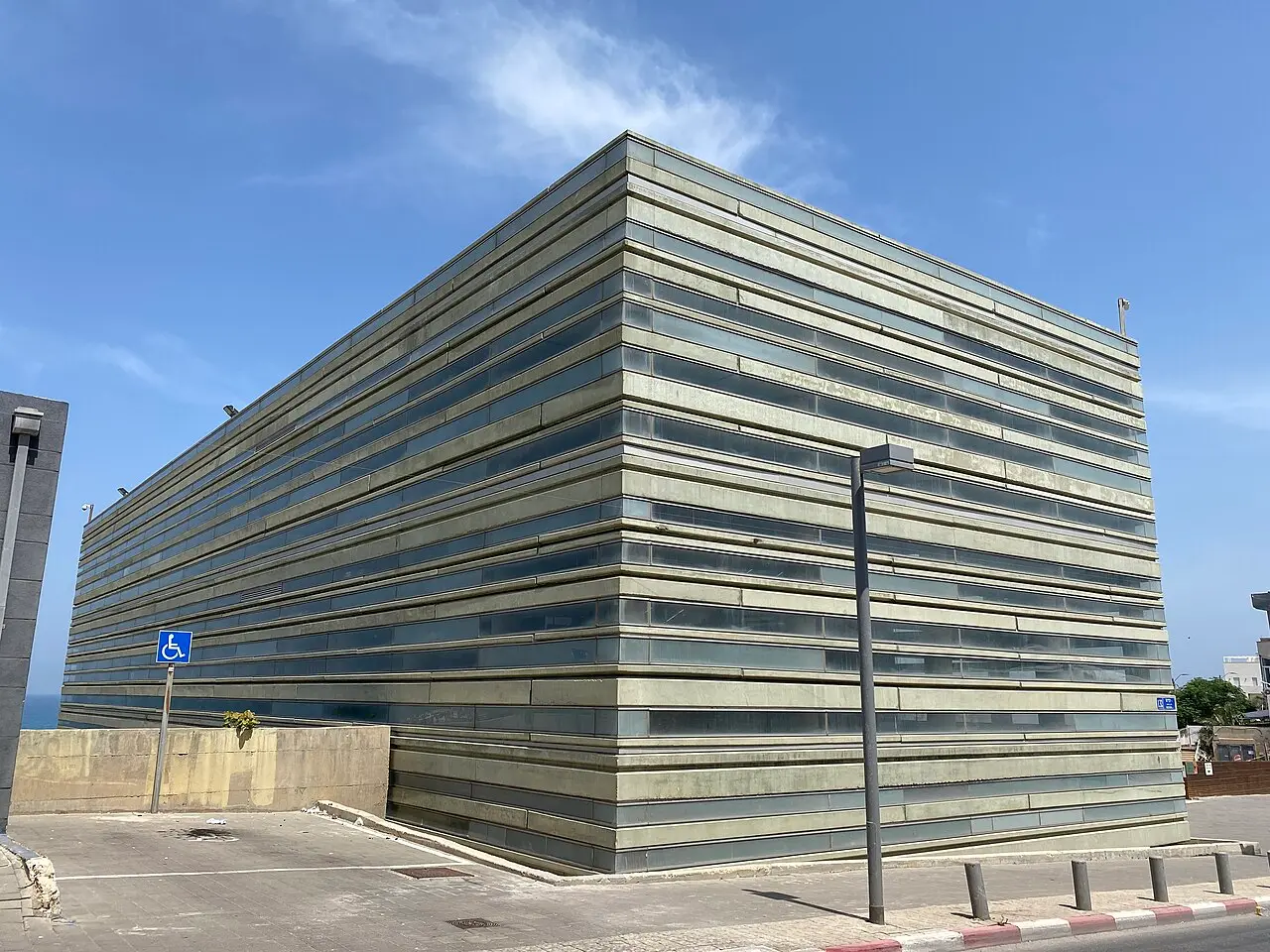
Peres Center for Peace and Innovation
The Israeli Innovation Center occupies four levels of the Peres Peace House, the building of alternating concrete and translucent glass that Massimiliano and Doriana Fuksas put on the Jaffa shore between 1999 and 2009.
- Time:
- about 1 hour 45 minutes for the standard guided tour, and 1 to 3 hours for group and delegation programmes
- Entry:
- 69 NIS
1 site
Quarters and streets worth walking
שלמה רודד / CC BY 2.5 · Wikimedia Commons
Neighbourhood
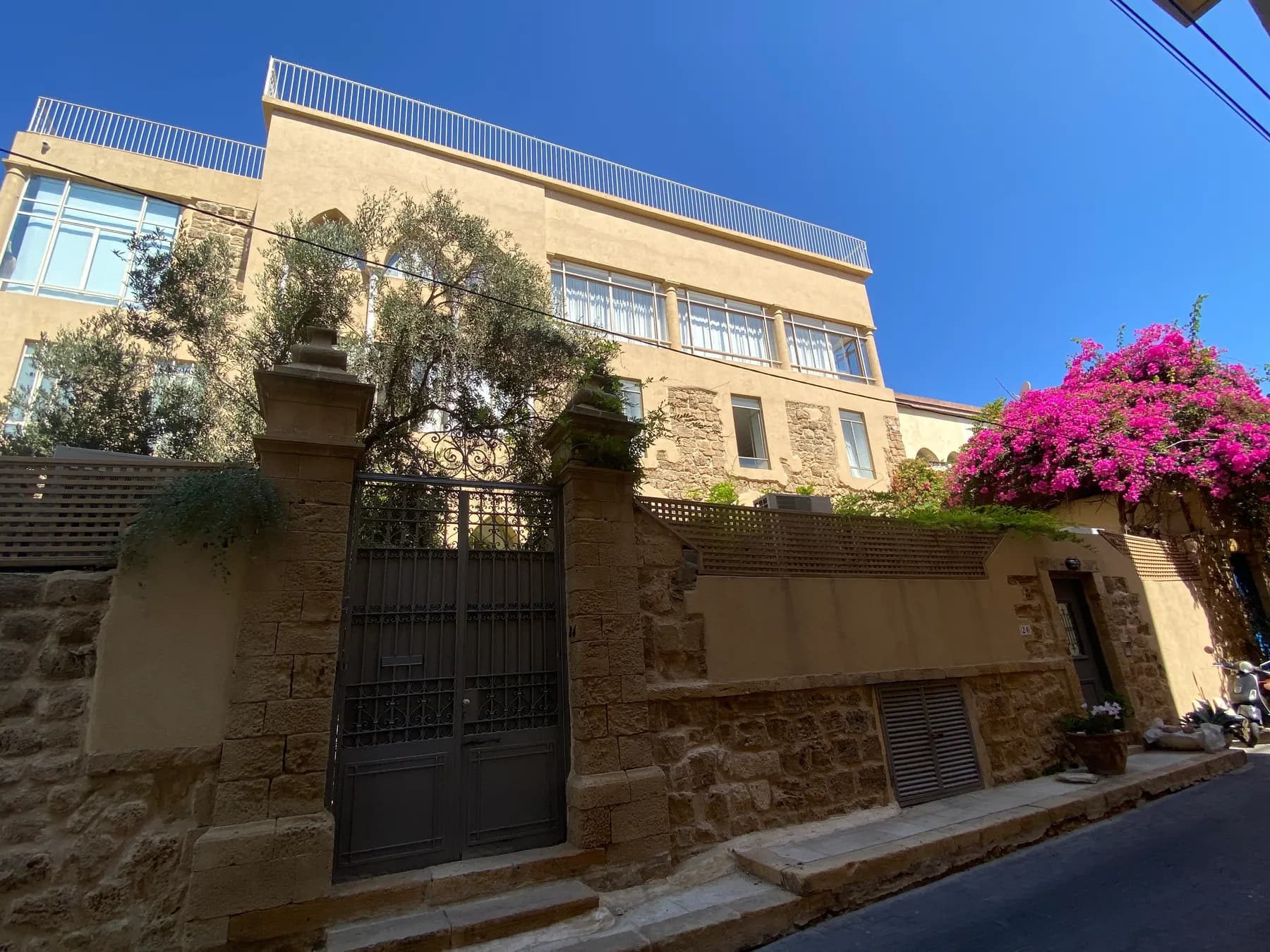
Ajami
The quarter south of Old Jaffa where the Arabs who stayed after 1948 were concentrated behind a fence, now a grid of kurkar villas above a coastal park built on forty years of construction rubble.
- Time:
- About two hours to walk Yefet Street, the villa streets below it and the park; half a day with lunch and time on the shore
- Entry:
- Free
1 site
Markets
Rakoon / CC0 · Wikimedia Commons
Market
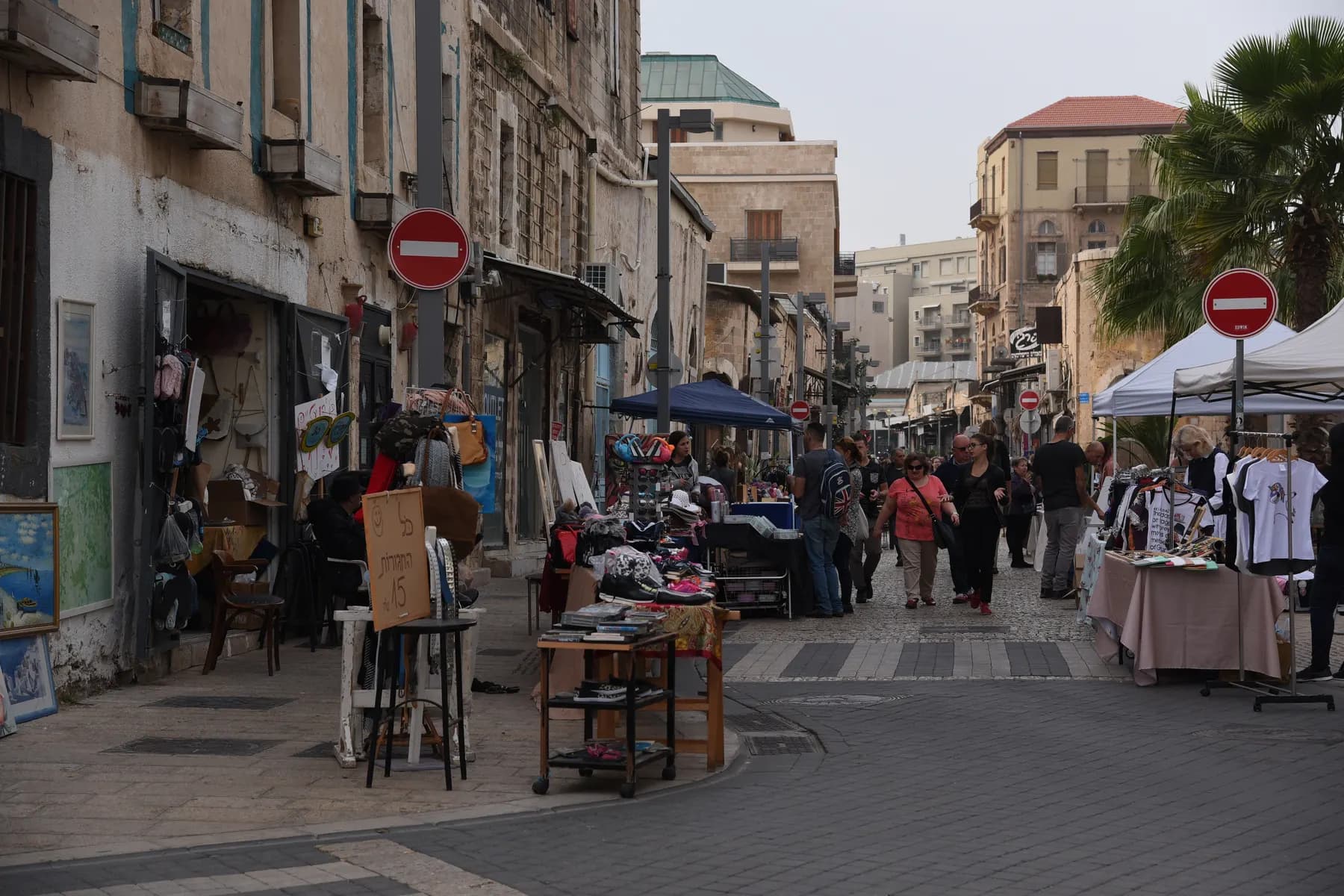
Jaffa Flea Market
The market was pushed onto these streets in the late nineteenth century, when the Ottoman government cleared the ground where the clock tower now stands for its own administrative compound.
- Time:
- about 90 minutes for the stalls, or two to three hours with lunch
- Entry:
- Free. The market trades on public streets: there is no gate, no ticket office and no admission charge published by the municipality or by the market's own information site.
3 sites
Landmarks
Sasha1506 / CC BY-SA 4.0 · Wikimedia Commons
Landmark
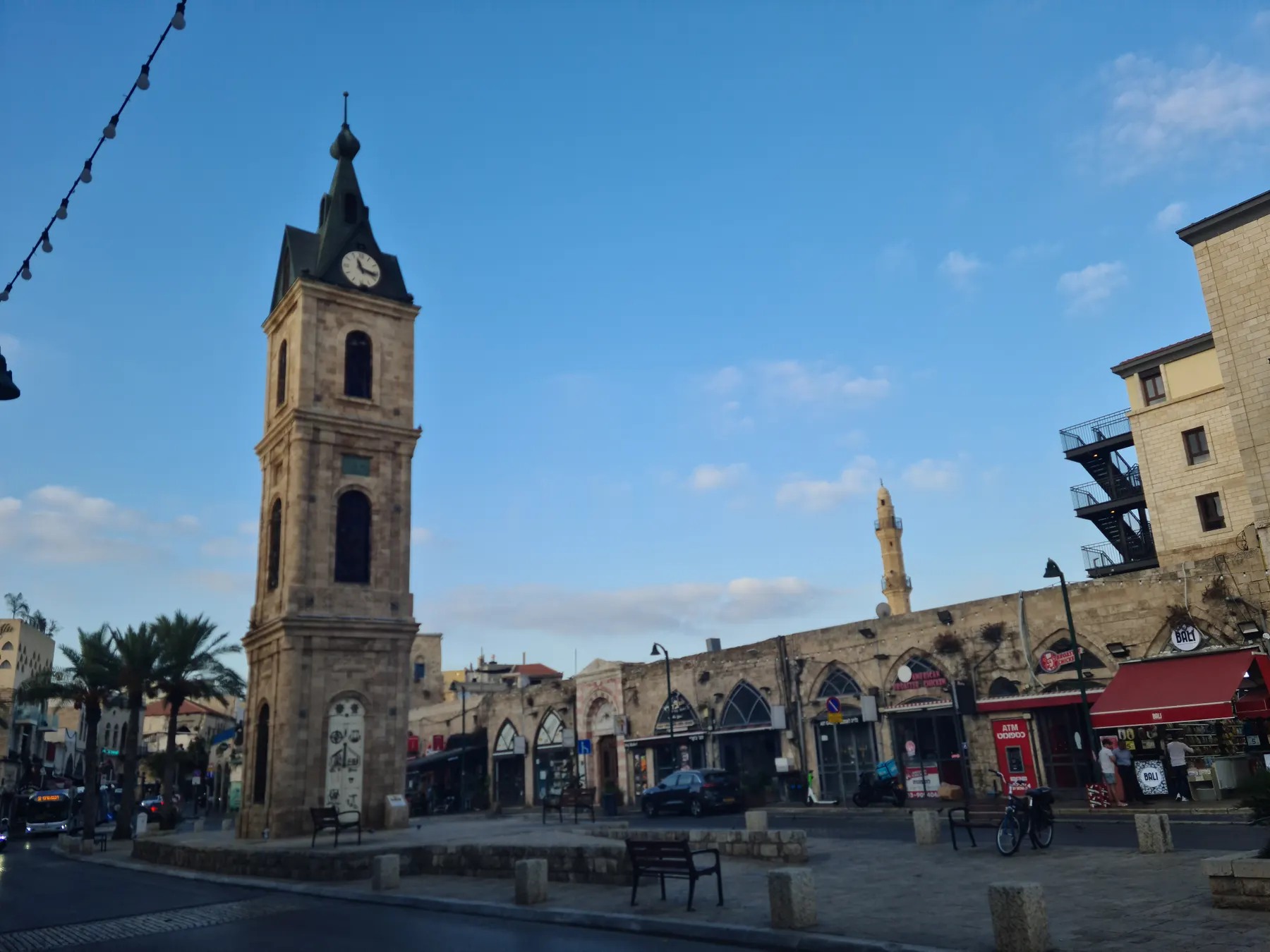
Jaffa Clock Tower
Built for the silver jubilee of Sultan Abdul Hamid II with money raised from Jaffa's Muslim, Jewish, Christian and Armenian residents, it was the first public clock in a town where until then only churches and mosques rang the hours.
- Time:
- about 10 minutes for the tower itself, and about 20 if the Kishle gate and the sabil are included
- Entry:
- Free. Nothing here is ticketed and the municipality's tourism service lists no admission charge.
4.5 on Google, 15,365 ratings
שלמה רודד / CC BY 2.5 · Wikimedia Commons
Landmark
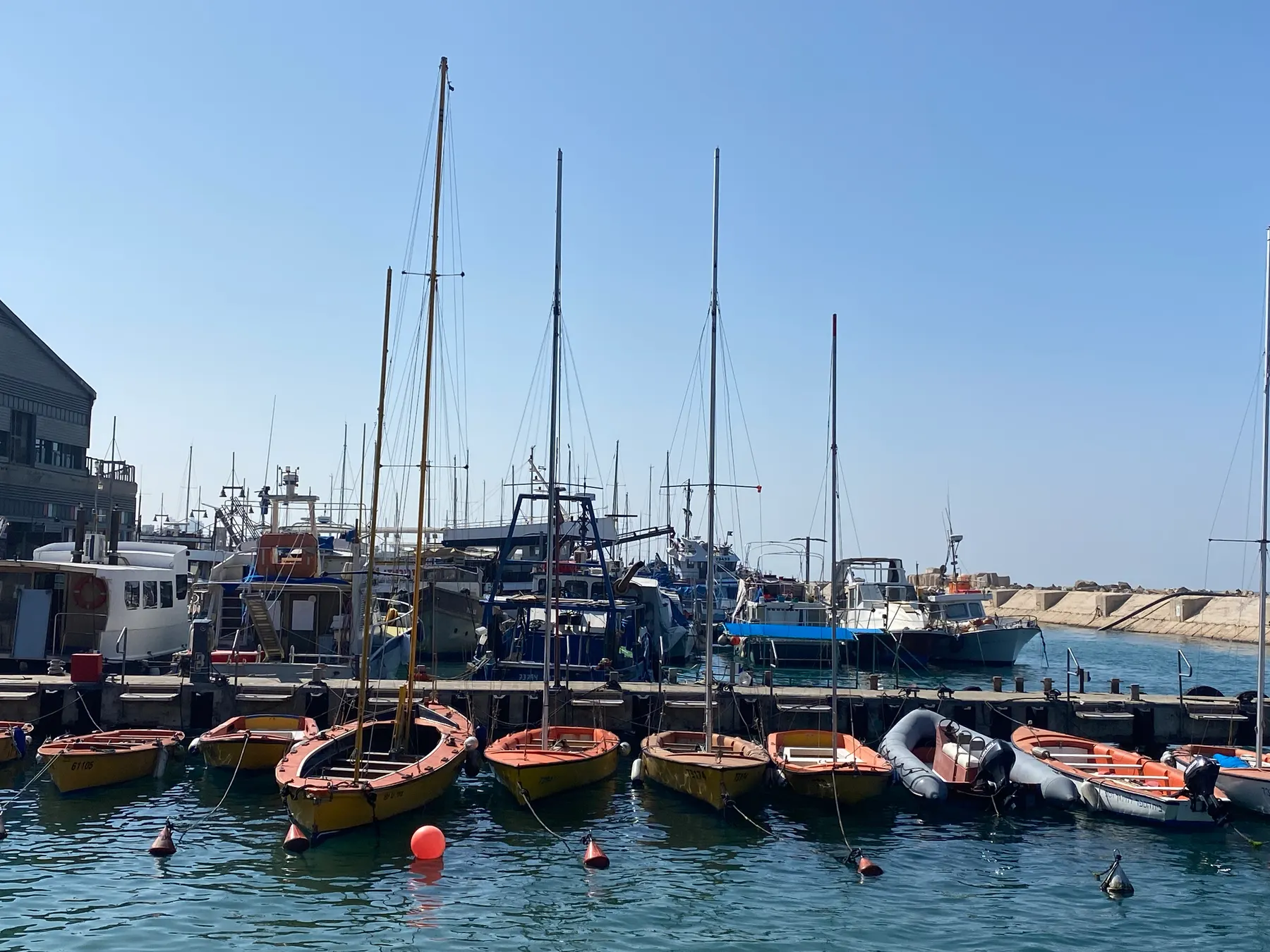
Jaffa Port
The quay, the breakwater and the three long sheds along it are British work of the mid-1930s, built for the orange trade on ground reclaimed from the sea, and two of those sheds were taken down and built again between 2019 and 2023.
- Time:
- about 60 to 90 minutes for the quay, the two rebuilt warehouses and the view along the breakwater, or half a day with a meal and a boat trip
- Entry:
- No charge. There is no ticket office and no gate; the quay, the warehouse square and the harbour front are public space.
4.5 on Google, 8,559 ratings
Fallaner / CC BY-SA 4.0 · Wikimedia Commons
Landmark
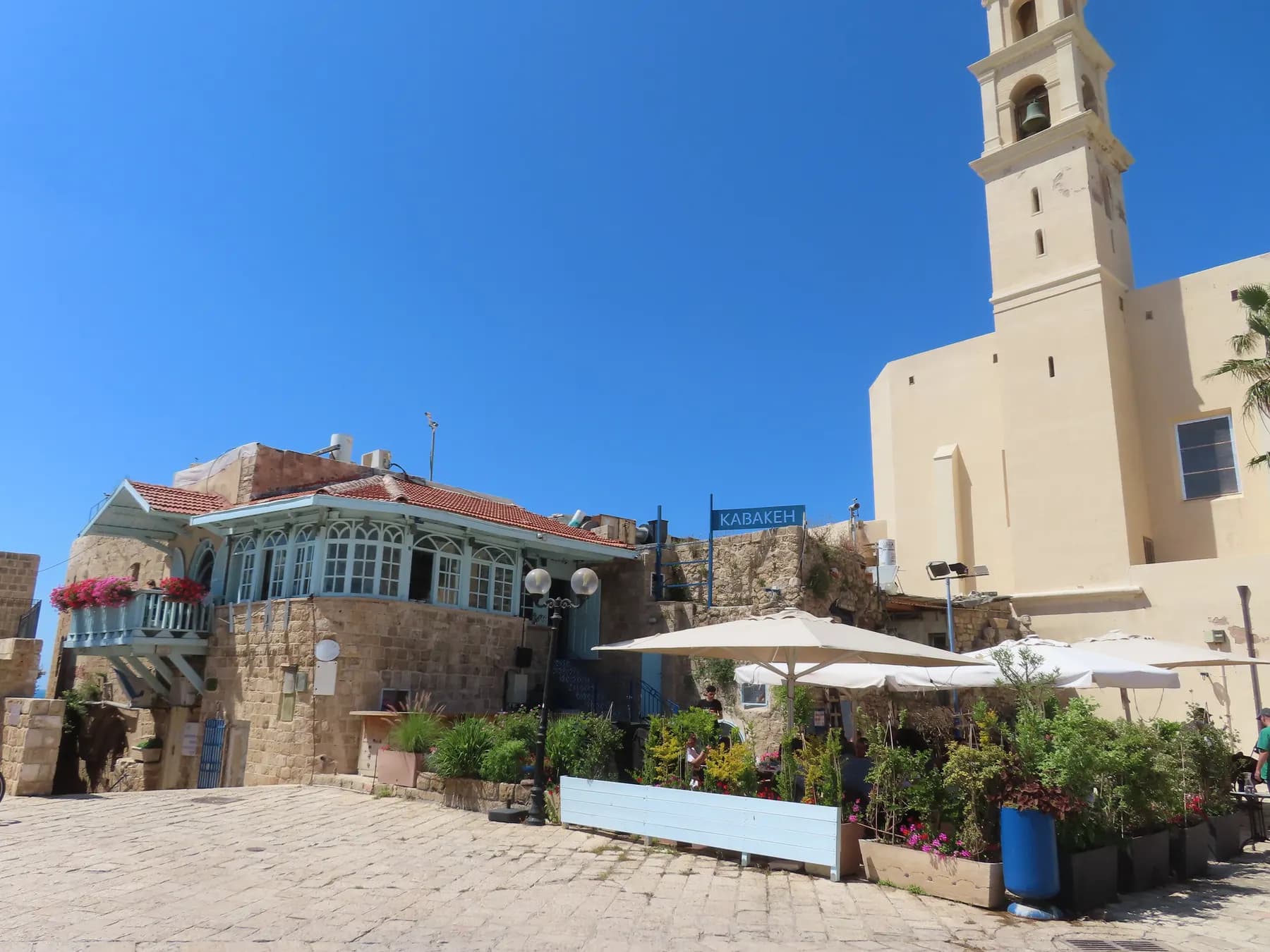
Kedumim Square
The flagged main square of Old Jaffa is a space the British made by demolition in June 1936, and the Israel Antiquities Authority excavation under its fountain found the drains of one of the houses that came down.
- Time:
- about 30 minutes for the square, the fountain and the church front, or about 90 minutes with the visitor centre and the walk down the zodiac alleys to the port
- Entry:
- No charge. There is no ticket desk, no perimeter and no gate anywhere in Old Jaffa's street network.
4.5 on Google, 25 ratings
1 site
Viewpoints
Anagoria / CC BY 3.0 · Wikimedia Commons
Viewpoint
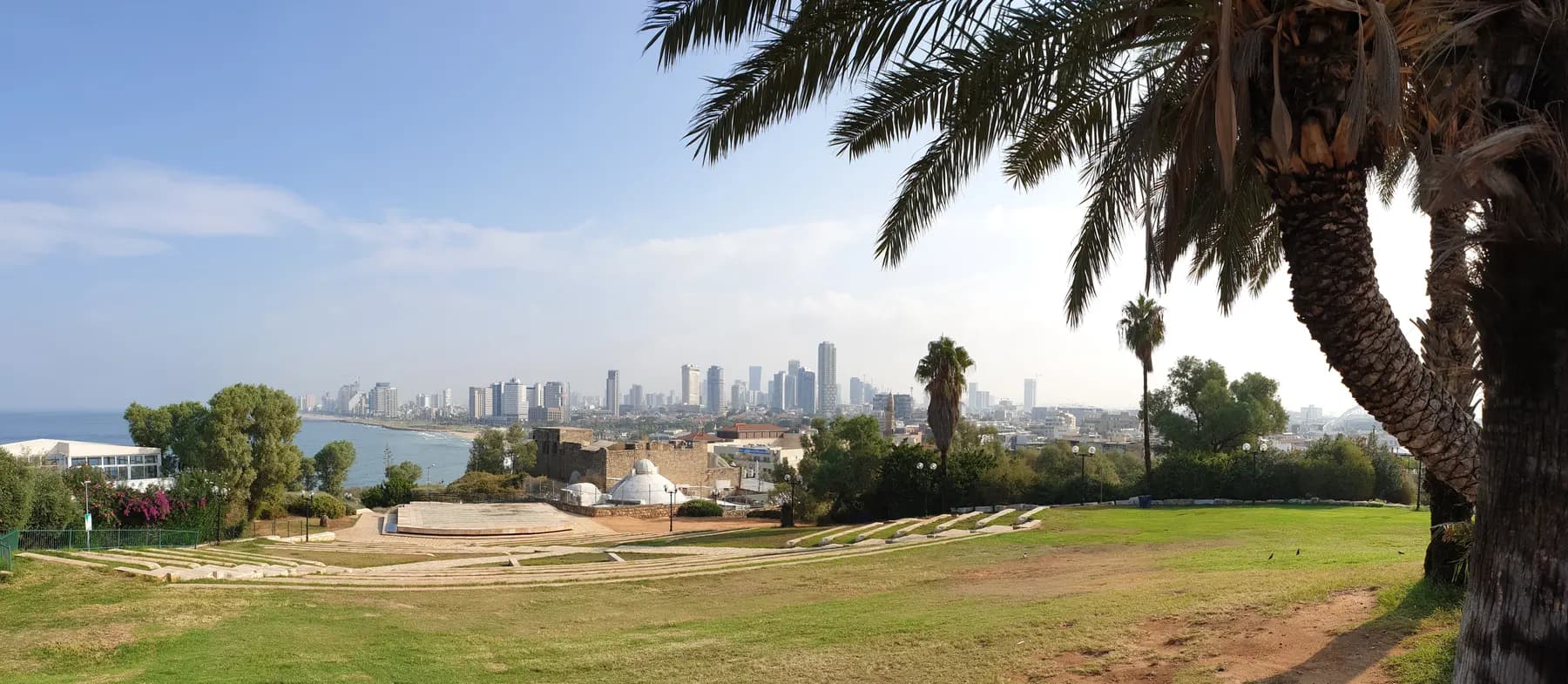
HaPisga Garden (Abrasha Park)
The lawns on top of Old Jaffa are not old: they are the ground left empty after the British blew a quarter of the town apart in June 1936, laid out as a public garden under a 1956 plan and planted by Tel Aviv's city gardener Avraham Karavan, whose nickname Abrasha the park still carries.
- Time:
- about 45 minutes for the garden, the sculpture, the bridge and the excavation, or about 90 minutes taken slowly with the sea walls promenade and a stop in the amphitheatre
- Entry:
- No charge in shekels or otherwise. There is no ticket, no barrier and no perimeter anywhere in Old Jaffa's street network, and the municipality lists all three as stops on a free public walking route.
4.7 on Google, 1,324 ratings
Planning the rest of it
Seeing the sites is one part of a day here. These cover the others.
Sources and further reading
Every link below was opened and checked when this page was written. Official statements are marked as such: they are the subject's own account, not an independent one.
- OfficialVisit Tel Aviv, Tel Aviv-Yafo Municipalityvisit-tel-aviv.comOld Jaffa: meet the old city
The municipal tourism service's own page on Old Jaffa, used for what lies immediately north of Ajami: Kedumim Square and the visitor centre, the Mahmoudiya Mosque and Abu Nabbut, the antiquities building and HaPisga park. It publishes no hours, prices or Ajami-specific detail, which is why this page carries none from it.
- OfficialVisit Tel Aviv, Tel Aviv-Yafo Municipalityvisit-tel-aviv.comThe Jaffa Flea Market
The market southeast of the clock tower, its seven decades of operation and the summer Thursday-night events, used here only to place the nearest concentration of shops and bars relative to Ajami.
- OfficialPeres Center for Peace and Innovationperes-center.orgPeres Center for Peace and Innovation
The centre's own site, for the innovation visitor centre on the Ajami shore, its guided visits in groups of 20 lasting one hour and 45 minutes, and the fact that visits are arranged through the centre in advance.
- OfficialTel Aviv-Yafo Municipalitytel-aviv.gov.ilOld Jaffa and Jaffa Port walking route, stations 8, 9 and 10: Abrasha Park, the Wishing Bridge, and the Jaffa excavations and Ramesses Gate
The operator of the public realm here. Source for the garden being the highest point in Old Jaffa, for the view by compass point, for the Gate of Faith attribution, for the Wishing Bridge custom and its zodiac plaques, and for the Canaanite wall and reconstructed Ramesses Gate in the excavation.
- OfficialThe Old Jaffa Development Company Ltdoldjaffa.co.ilThe Old Jaffa Development Company
The company that manages the Old Jaffa complex and established this garden. No hours or prices on this page are quoted from its site.
- ReportingAssociated Press, via The Times of Israel (Ilan Ben Zion, 28 April 2021)timesofisrael.comAs tensions boil, Jaffa's Arab Israelis say gentrification is pushing them out
The 1950 absentee property law and the transfer of thousands of confiscated properties to state-run housing companies, the push from 2011 to sell them, Amidar's statement that it has no intention of expelling people and offers homes to tenants first at a significant discount, residents' account of rents of 5,000 to 6,000 shekels against a 6,000 shekel salary, and about 20,000 Arab residents in Jaffa.
- ReportingZman Yisrael, the Hebrew edition of The Times of Israel (Aviva and Shmuel Bar-Am, 8 April 2020)zman.co.ilטיול וירטואלי לחג: מסע מצולם בעקבות פסלים בהשראת סיפורי התנך (A virtual holiday tour: sculptures inspired by biblical stories)
Independent source for the Gate of Faith: Kafri as sculptor, 1977, four metres, the three biblical scenes, the gate form chosen because Jaffa was regarded as the gateway to the Land of Israel, and the thirteenth century BCE gate excavated south of it.
- ReferenceEncyclopaedia Britannicabritannica.comJaffa
The 26 April 1948 Irgun attack, the displacement of nearly all of the city's 70,000 Arab Muslims and Christians, the fall of the city on 13 May, and the 4,000 who remained 'concentrated in the Ajami neighborhood, south of the old city'.
- ReferenceWikipediaen.wikipedia.orgAjami, Jaffa
Origin of the name in Ibrahim al-Ajami's maqam and the 1895 mosque built by Haj Yousef al-Manawi, the Maronite foundation of 1895 on 1,600 sq m and its replacement of 1901 to 1920 with the first stone on 28 February 1904, roughly 950 houses by 1924, the confinement of the remaining Palestinians behind a barbed-wire separation after 13 May 1948, the annulment of the mosque's waqf status, the some 497 Amidar eviction and demolition orders, and the Peres Center.
- ReferenceWikipediahe.wikipedia.orgAjami (Hebrew Wikipedia)
Boundaries against Old Jaffa, Givat Aliya and Tzahlon, the mid-nineteenth-century Maronite laying out of streets parallel to the shore, kurkar houses with courtyards, the 1950s demolition-and-reconstruction policy, the halt to renovation from the 1970s with each vacated house demolished, the construction waste tipped on the shore from 1975 to a mound about 15 metres high, and the conservation plan of the 1980s.
- ReferenceWikipediahe.wikipedia.orgMidron Yafo (Hebrew Wikipedia)
The park's 200 dunams from Jaffa Port to Givat Aliya beach, the waste tipping dated from late 1969, the Braudo-Maoz design at Ron Huldai's initiative, work from December 2005, completion in 2008, inauguration on 30 April 2010 after drought-related delays, the cost of about 60 million shekels, and the paths, promenade, three viewpoints, amphitheatre, sports area and car park.
- ReferenceWikipediaen.wikipedia.orgJaffa
The 3,800 Arabs who remained after the exodus, concentrated in the Ajami district under strict martial law, and the military administration continuing until 1 June 1949; also the description of Jaffa today as a mixed city.
- ReferenceWikipediaen.wikipedia.orgAjami (film)
The 2009 film by Scandar Copti and Yaron Shani set and shot in the neighbourhood, its cast of non-professional actors, and its status as the first predominantly Arabic-language film submitted by Israel for the Academy Award for Best Foreign Language Film, for which it was nominated.
- ReferenceWikipediaen.wikipedia.orgAbu Hassan (restaurant)
The HaDolphin Street original, Ali Karawan's handcart, the unsuccessful 1959 attempt and the opening in the early 1970s, the short menu of hummus, masabacha, ful medames and labaneh with the mixed plate, and the midday queue.
- ReferenceWikipediaen.wikipedia.orgTabeetha School
Founded 1863, run by the Church of Scotland at 21 Yefet Street, and open to children regardless of race, nationality, gender or religion.
- ReferenceWikipediaen.wikipedia.orgPeres Center for Peace
The building's location in Ajami on the Jaffa coast, Massimiliano Fuksas as architect, the opening in December 2009, and the floor area of 2,500 square metres.
- ReferenceWikipediaen.wikipedia.orgGiv'at Aliyah
The neighbourhood immediately south of Ajami, its shift from Arab fishing and merchant families to European immigrants after 1948, and the southernmost beach of Tel Aviv-Yafo within the Givat Aliya nature reserve.
- ReferenceAmerican Journal of Archaeology (Aaron A. Burke, Martin Peilstöcker and thirteen colleagues, vol. 121 no. 1, 2017, pp. 85-133)ajaonline.orgExcavations of the New Kingdom Fortress in Jaffa, 2011-2014: Traces of Resistance to Egyptian Rule in Canaan
The scholarly account of the fortress and gate beside the garden: operation from roughly 1460 to 1125 BCE, the only Egyptian fortress excavated in Canaan, and radiocarbon dates from two twelfth century destructions.
- ReferenceWikipedia (Hebrew)he.wikipedia.orgיפו העתיקה (Old Jaffa)
Source for Karavan designing the summit and slope gardens, the amphitheatre, the salt and wind tolerant planting with fig and date trees, the zodiac mosaic, the 237 buildings lost in Operation Anchor, the roughly 300 dunam complex and the 2022 population of 1,010.
- ReferenceWikipedia (Hebrew)he.wikipedia.orgשער האמונה (Gate of Faith)
Source for the 1977 dedication, the Galilee stone, the four metre pillars, and the specific scenes and inscriptions on each of the three faces.
- ReferenceWikipedia (Hebrew)he.wikipedia.orgדניאל כפרי (Daniel Kafri)
Source for Kafri's birth in Czechoslovakia in 1945, arrival in 1949, training at Bezalel, the 1971 Monaco prize, the 1976 Jerusalem Prize for sculpture, more than seven hundred works, and his death on 20 March 2024.
- ReferenceWikipedia (Hebrew)he.wikipedia.orgאברהם קרוון (Avraham Karavan)
Source for Karavan's dates, 1902 in Lviv to 23 March 1968, his roughly four decades as Tel Aviv's city gardener, and the Summit Garden among the gardens he designed.
- ReferenceWikipedia (Hebrew)he.wikipedia.orgהשטח הגדול (HaShetach HaGadol, the Great Open Space)
Source for the quarter that stood where the garden now is, the June 1936 evacuation notices and two week demolition, the post-1948 decay, the clearances from 1950, Moshe Aikhilov and Kaplan in 1953, and the 1956 plan designating HaPisga as a public garden.
- ReferenceWikipedia (Hebrew)he.wikipedia.orgהחברה לפיתוח יפו העתיקה (The Old Jaffa Development Company)
Source for the company's founding in 1961 by the government and the municipality, its establishment of HaPisga Garden and the Midron Garden, and the transfer of full ownership to the municipality in 2015.
Things to do in Jaffa: common questions
How many days do you need in Jaffa?+
There are 10 sites here with a page of their own, and giving each the time its own page suggests comes to more than one day. Most visitors pick three or four and treat the rest as a return trip. The per-site pages each carry a "how long to give it" figure, which is the number to add up.
What does it cost to see Jaffa?+
10 of the 10 sites listed here charge admission and 0 do not. Every ticketed one has its published price on its own page, with the operator's page linked beside it. Israel's national parks also sell a multi-site pass, which pays for itself at roughly the third park.
Are these sites open on Shabbat and holidays?+
Most national parks and museums keep shortened Friday hours and either close on Saturday or open late. Each page carries the hours as the operator publishes them, and the operator's own page is linked, which is the only version that will be current on the day you go.
Where do the opening hours and prices on these pages come from?+
From the operator: the Israel Nature and Parks Authority, the museum, the municipality or the site's own management, whichever publishes them. Each figure links the page it was taken from. Ratings and review counts, where a page shows them, come from a dated snapshot of Google Maps and are labelled as such rather than presented as current.
Which one is worth it if you only see one thing in Jaffa?+
Ajami is the one this guide would keep. The quarter south of Old Jaffa where the Arabs who stayed after 1948 were concentrated behind a fence, now a grid of kurkar villas above a coastal park built on forty years of construction rubble.
Is there anything worth seeing that is not on this list?+
Plenty, and that is deliberate. A site earns a page here when a visitor could reasonably spend half an hour there, when there is enough documented substance to write a real page about it, and when the operator publishes something a visitor can plan against. Things that fail those tests are covered on the Jaffa overview instead of padded out into pages of their own.