Viewpoint · Jaffa
HaPisga Garden (Abrasha Park)
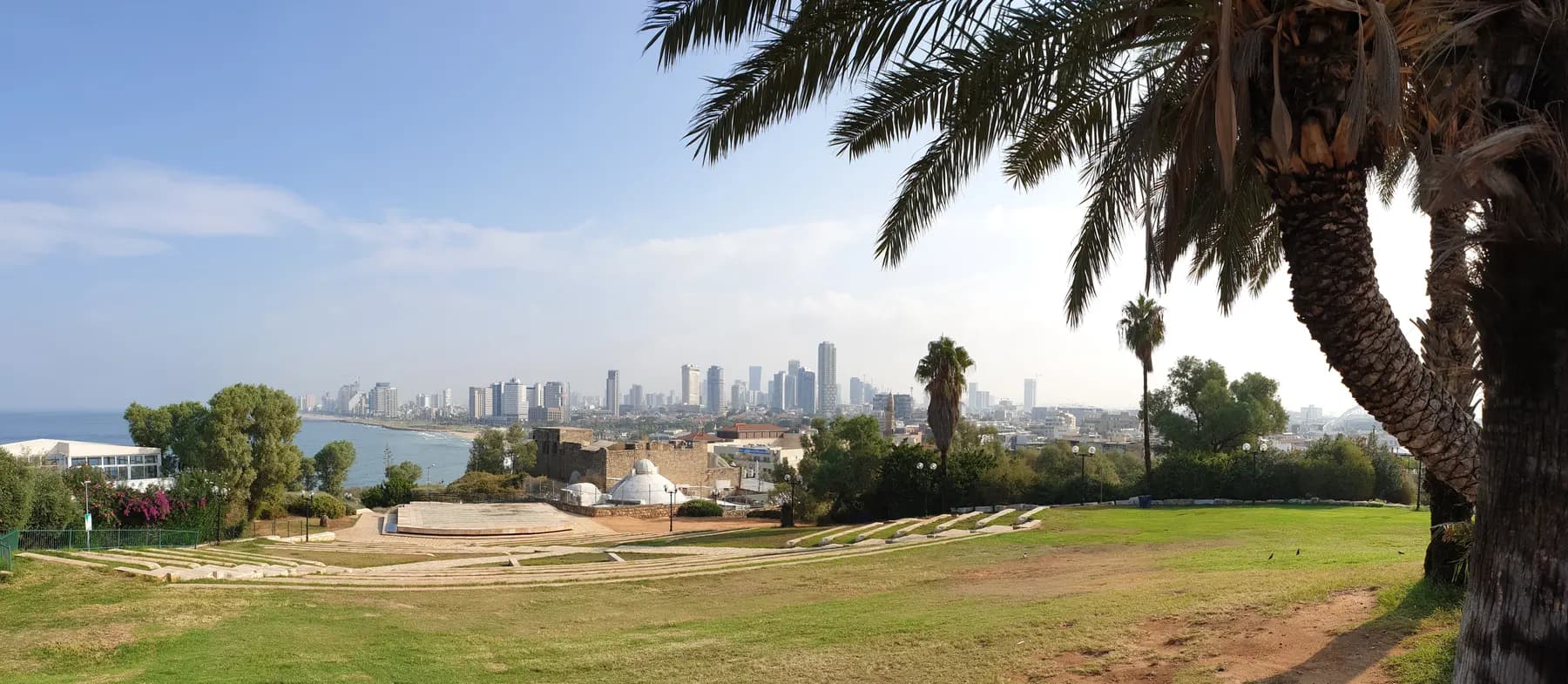
The lawns on top of Old Jaffa are not old: they are the ground left empty after the British blew a quarter of the town apart in June 1936, laid out as a public garden under a 1956 plan and planted by Tel Aviv's city gardener Avraham Karavan, whose nickname Abrasha the park still carries.
Anagoria / CC BY 3.0 · Wikimedia Commons
The hill it sits on
about 40 m
the height of the kurkar sandstone ridge ancient Jaffa was built on, per Wikipedia's Jaffa article
Gate of Faith
1977
the dedication year given by Zman Yisrael and by Hebrew Wikipedia; a Wikimedia Commons file description dates the sculpture 1975
Height of the sculpture's uprights
4 m each
the two pillars of Daniel Kafri's gate, per Zman Yisrael in 2020
Designated a public garden
1956
the year a plan turned the cleared summit of the demolished quarter into HaPisga Garden, per Hebrew Wikipedia
In short
- How long to give it
- about 45 minutes for the garden, the sculpture, the bridge and the excavation, or about 90 minutes taken slowly with the sea walls promenade and a stop in the amphitheatre
- The garden
- Open at all hours. It is a public park with no gate, no ticket desk and no published closing time: the Tel Aviv-Yafo municipality treats it as station eight on its own free Old Jaffa walking route rather than as an attraction with opening times.
- The garden, the Gate of Faith and the Wishing Bridge
- No charge in shekels or otherwise. There is no ticket, no barrier and no perimeter anywhere in Old Jaffa's street network, and the municipality lists all three as stops on a free public walking route.
גן הפסגה
HaPisga Garden, known to almost everyone as Abrasha Park, is the public park covering the summit of the Old Jaffa hill. The Tel Aviv-Yafo municipality calls it the highest point in Old Jaffa and makes it station eight on its own walking route. There is no gate, no ticket and no closing time. What is on it is a run of lawn and mature trees, an amphitheatre used for performances and film screenings, a four metre stone gateway carved with three biblical scenes, an open archaeological trench along the eastern edge, and the parapet everyone photographs Tel Aviv from.
The garden is younger than the view. Until 1936 this was the middle of a dense residential quarter called HaShetach HaGadol, the Great Open Space, a name it acquired only after the British Mandate authorities demolished it. The clearance, the emptying of the remaining population through the 1950s and a 1956 plan that designated the summit as a park are why there is grass here at all. Avraham Karavan, Tel Aviv's city gardener for some four decades, laid out this garden and the slope garden below it, and the popular name Abrasha is his nickname.
So a visitor is standing on three things at once: a tell with an Egyptian fortress in it, the footprint of a destroyed neighbourhood, and a piece of 1960s municipal landscaping. This page keeps them apart, gives the published figures for each, and says where the sources disagree.
Orientation
A lawn, a sculpture, a trench and a parapet
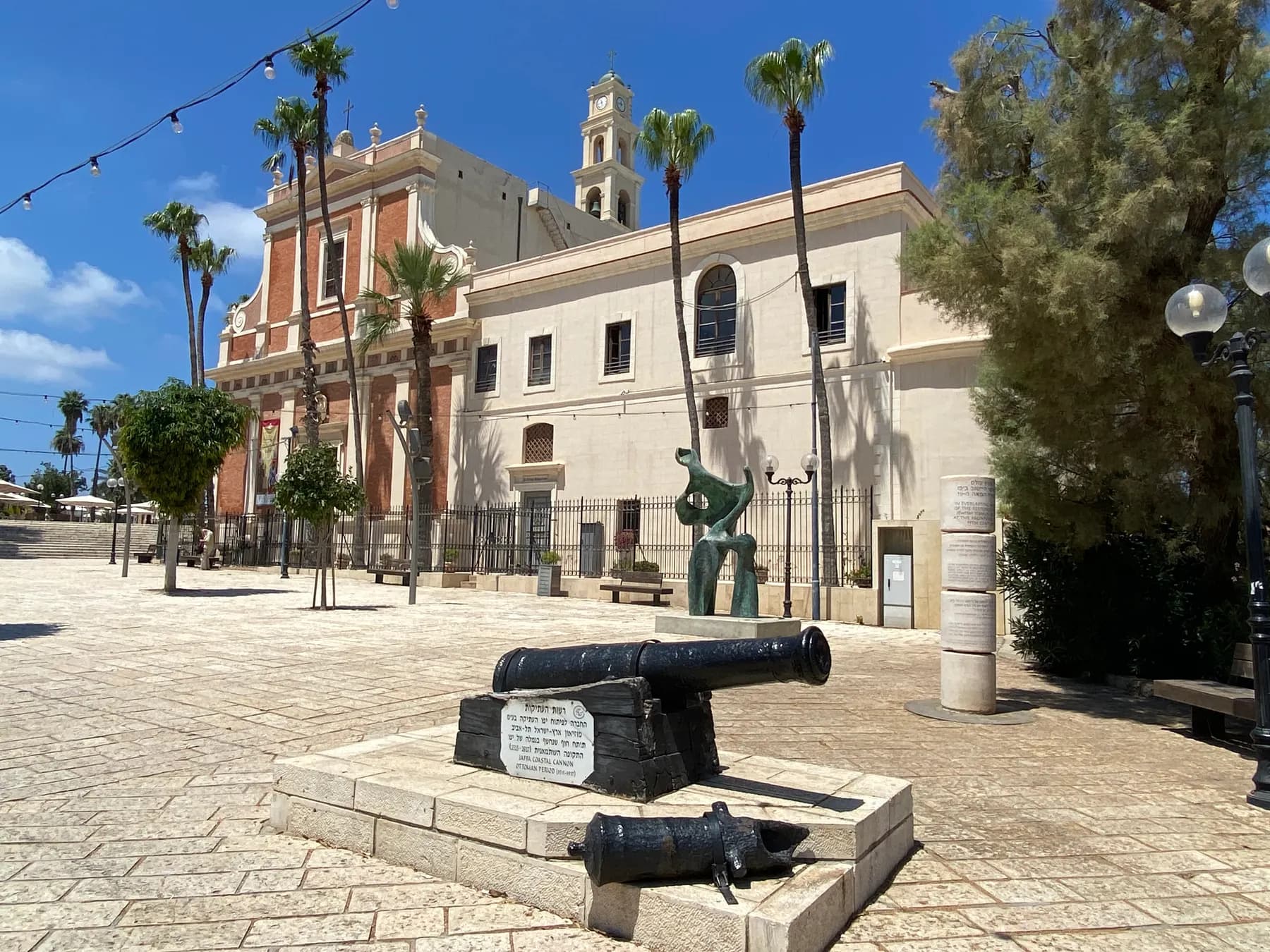
The garden runs along the crown of the ridge above Jaffa Port, with Mifratz Shlomo Street on its western side and the sea walls promenade, Tayelet Homot HaYam, along its northern edge. Kedumim Square and St Peter's Church are across the road to the west, reached by the wooden Wishing Bridge, and the excavation area with the reconstructed Ramesses Gate is at the eastern end.
The planting is deliberate and is the reason the park works in August. Hebrew Wikipedia's account of Old Jaffa records that Karavan's gardens were planted with varied vegetation chosen to stand up to sea wind and salt, with fig and date trees on the summit and broad areas of grass. The trees are now mature, which makes this the only substantial shade in Old Jaffa outside a restaurant.
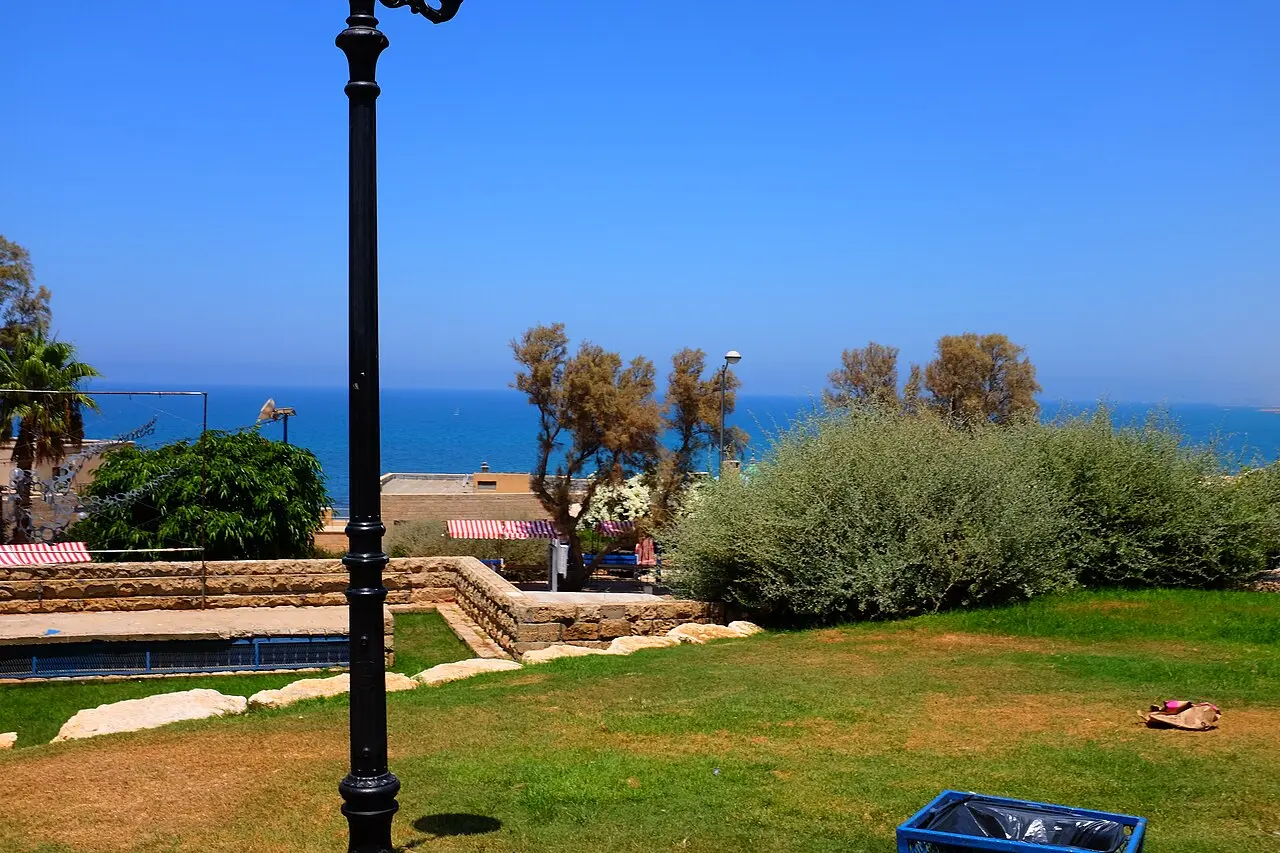
The one built structure that is not landscaping or sculpture is the amphitheatre, a stepped open-air seating bowl set into the garden and used for performances and film screenings. It has no published programme of its own: what runs there is booked by whoever is promoting the event, so a visitor arriving on a random Tuesday will find it empty and available to sit in.
Below the northern edge, at the foot of the slope on the sea walls promenade, stands the Sea Mosque, built in 1675 of kurkar and restored in 1997 and again in 2013. Muslim sailors prayed in it before voyages; by 1962 it was being used as a store, and it was returned to religious use after objections to converting it into a tourist attraction. It is not open to the public, and it is visible from the garden rather than part of it.
leighklotz / CC BY 2.0 · Wikimedia Commons
1936
The park is the shape of a quarter that was destroyed
The open ground here has a specific and unpleasant origin. In June 1936, during the Arab revolt, British Mandate forces carried out what became known as Operation Anchor, blowing broad swathes through the dense lanes of Old Jaffa to open routes to the port. Hebrew Wikipedia's article on Old Jaffa puts the loss at 237 buildings; its article on HaShetach HaGadol says roughly two hundred houses were served with evacuation notices and residents were given about a week to get out, that the demolition took some two weeks, and that people sheltered in schools and on the beach. The Tel Aviv-Yafo municipality, on its own walking route, gives more than two hundred houses.
What was left acquired the name HaShetach HaGadol, the Great Open Space, because that is what it had become. After 1948 most of the remaining Arab population had gone, the surviving buildings decayed, and the area developed a reputation as a centre of crime and prostitution. From 1950 the authorities began clearing the remaining residents systematically. In 1953 the deputy mayor Moshe Aikhilov took charge of restoration work, and the archaeologist Jacob Kaplan began digging.
The garden is the end of that process rather than an ornament added to it. A 1956 plan designated HaPisga as a public garden. In 1961 the government and the Tel Aviv-Yafo municipality founded the Old Jaffa Development Company, which took on the rehabilitation of the whole area and, on its own account, established both HaPisga Garden and the Midron Garden on the slope. The municipal tourism service puts the design of Pisgah Park in the 1960s, as part of the overall plan to renovate Jaffa's old city. Ownership of the company passed wholly to the municipality in 2015.
None of this is marked on the ground. There is no plaque in the garden explaining that the lawn occupies the footprint of houses, and a visitor who does not go looking will read the space as ordinary parkland with a good view. It is worth knowing before deciding how long to stand at the parapet.
- June 1936: Operation Anchor demolishes the quarter; 237 buildings per Hebrew Wikipedia, more than 200 houses per the municipality
- From 1950: the remaining residents are cleared systematically
- 1953: Moshe Aikhilov oversees restoration; Jacob Kaplan begins excavating
- 1956: a plan designates the cleared summit as HaPisga Garden
- 1961: the Old Jaffa Development Company is founded by the government and the municipality
- 2015: full ownership of the company passes to the Tel Aviv-Yafo municipality
Anagoria / CC BY 3.0 · Wikimedia Commons
Sculpture
Daniel Kafri's gate, and the gate found underneath it
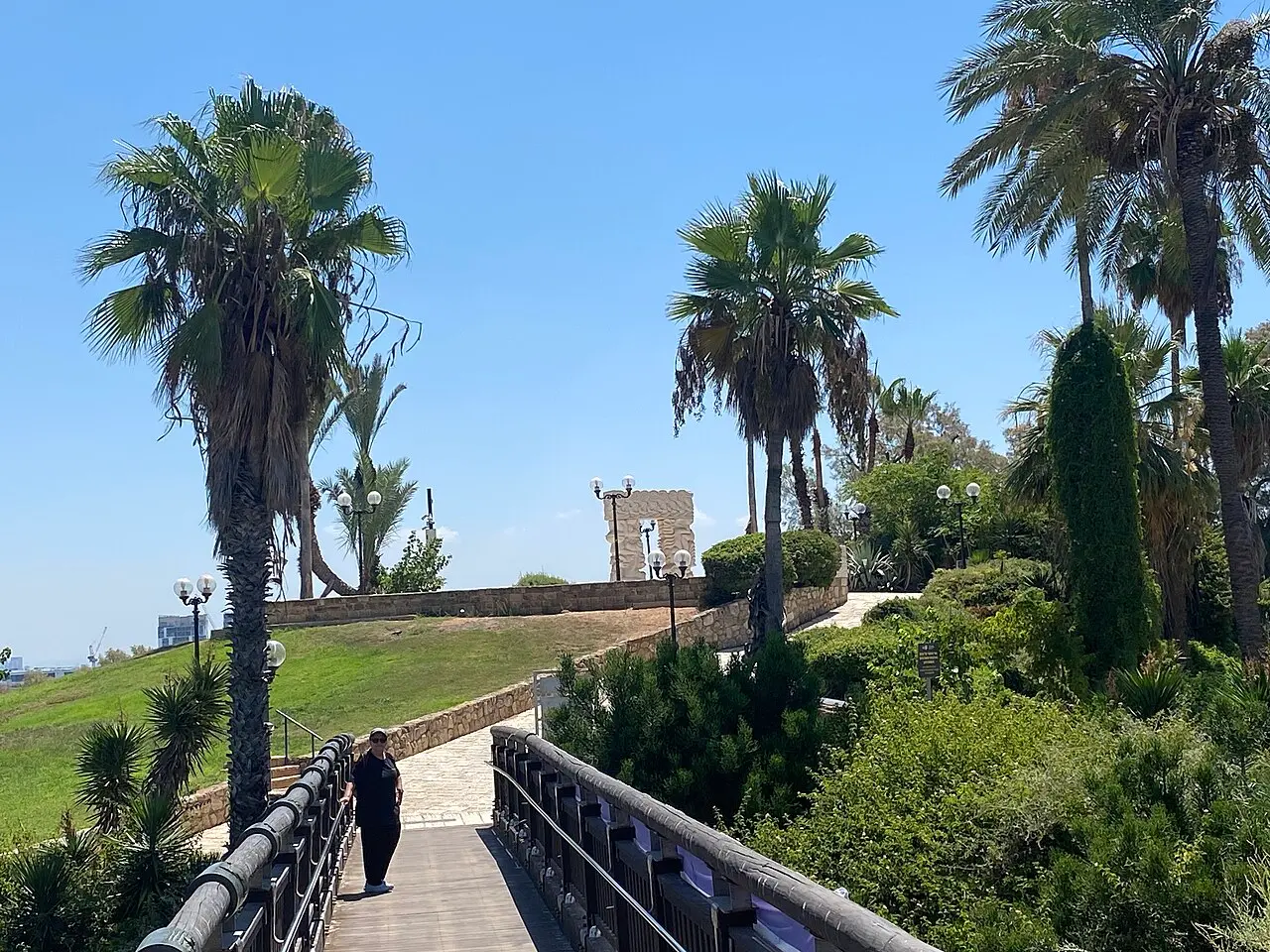
The best known object in the park is a freestanding stone gateway on the observation plaza at the summit: two uprights of four metres each carrying a lintel. It is called Sha'ar HaEmuna, the Gate of Faith, and it is by the sculptor Daniel Kafri, born in Czechoslovakia in 1945, brought to Israel in 1949 and trained at Bezalel in Jerusalem. He took the Jerusalem Prize for sculpture in 1976, made more than seven hundred works, and died on 20 March 2024.
Each of the three faces carries a biblical episode. The right-hand pillar has the binding of Isaac, with Abraham kneeling over the ram and lifting Isaac, and the promise of descendants as numerous as the stars of heaven. The left-hand pillar has Jacob's dream, the ladder with angels going up and down it, and the promise that the land on which he lies will be given to him. The lintel across the top has the fall of Jericho: on one side Israelites blowing shofars at the walls, on the other the Ark of the Covenant being carried.
The date is not settled, and it is worth saying so. Hebrew Wikipedia's article on the sculpture states that it was dedicated in 1977 and is made of Galilee stone; Zman Yisrael, the Hebrew edition of The Times of Israel, gives 1977 as well, in a 2020 piece by Aviva and Shmuel Bar-Am on sculptures drawn from biblical stories. A Wikimedia Commons file description, by contrast, dates the work to 1975 and calls the material limestone. Two sources agree on 1977 and one does not, which is where the matter currently rests.
Two things about the commission are usually left out. The first is why it is a gate: Jaffa was traditionally regarded as the gateway to the Land of Israel, so the form is a pun on the place rather than a generic monument. The second is that this was Kafri's first work after the 1973 Yom Kippur War and after his return to religious observance, which is the more interesting fact and the one that explains the subject matter.
There is a coincidence here that is genuinely odd and is documented rather than invented. Excavations a short distance south of the sculpture uncovered the remains of a real city gate of the thirteenth century BCE whose form closely resembled the sculpted one. Kafri built a symbolic gate on the hilltop; the archaeologists then dug up an actual one beside it.
שלמה רודד / CC BY 2.5 · Wikimedia Commons
The trench
What in the hole is original and what is rebuilt
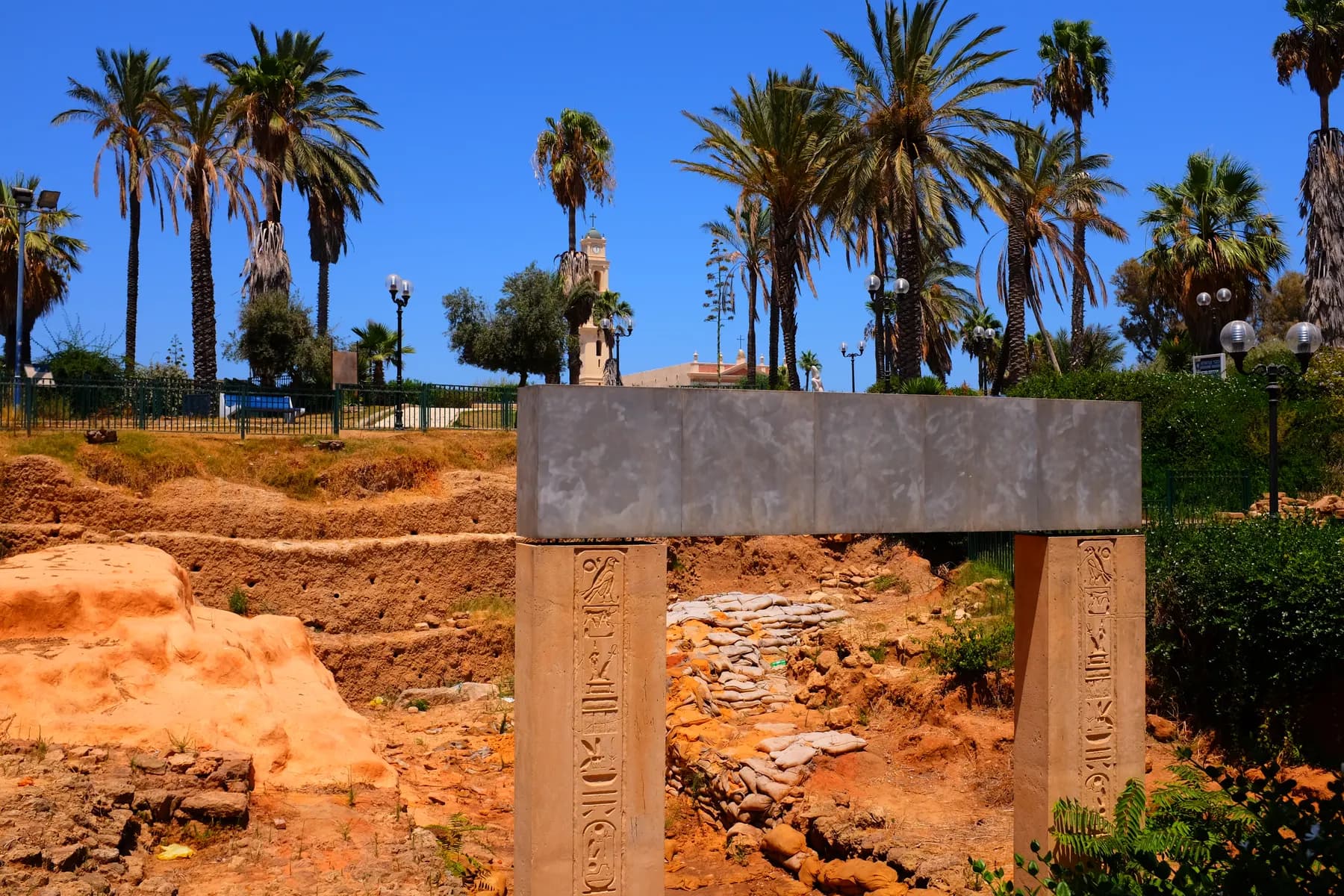
Along the eastern side of the garden the ground is cut away into an open archaeological area, and this is where the confusion on walking tours starts. The municipality's route describes stones from a Canaanite wall of the fifteenth century BCE and an Egyptian gateway of roughly 3,300 years ago, known as the Ramesses Gate, whose reconstructed jambs carry three of the pharaoh Ramesses II's names with titles such as son of the god Horus. The word doing the work in that sentence is reconstructed: the standing gateway a visitor photographs is a rebuild, and the ancient material is the lower courses and the brickwork around it.
The archaeology itself is first rate and is published. Jacob Kaplan dug the gate area for the Jaffa Museum of Antiquities between 1955 and 1962. Half a century later the Jaffa Cultural Heritage Project reopened the fortress area, and the results appeared in the American Journal of Archaeology in 2017, in a field report by Aaron Burke, Martin Peilstöcker and thirteen colleagues covering the seasons from 2011 to 2014.
Their conclusions are the ones to carry up the hill. The Egyptian fortress at Jaffa operated from roughly 1460 to 1125 BCE. It is, on their account, the only Egyptian fortress excavated in Canaan. Two destructions in the second half of the twelfth century BCE were dated by radiocarbon, and the authors propose about 1125 BCE as a terminus post quem for the end of Egyptian rule in Canaan, reading the destructions as local Canaanite resistance mounted from centres on the coastal plain rather than as a single imperial collapse.
What survives to look at is modest against that: a few courses of stone, some mudbrick, the rebuilt jambs and a caption. The trench is open ground, fenced at its edges and readable from the path, with no attendant and no interpretation desk. Anyone who wants the fortress explained properly should read the 2017 report rather than expect the site to do it.
- 1955-1962: Jacob Kaplan excavates the gate area for the Jaffa Museum of Antiquities
- 2011-2014: the Jaffa Cultural Heritage Project reopens the fortress
- 2017: the field report is published in the American Journal of Archaeology, vol. 121 no. 1, pp. 85-133
- Egyptian fortress at Jaffa: roughly 1460 to 1125 BCE
- The upstanding gateway is a reconstruction, not an ancient survival
The parapet
The postcard view, and the bridge people queue on
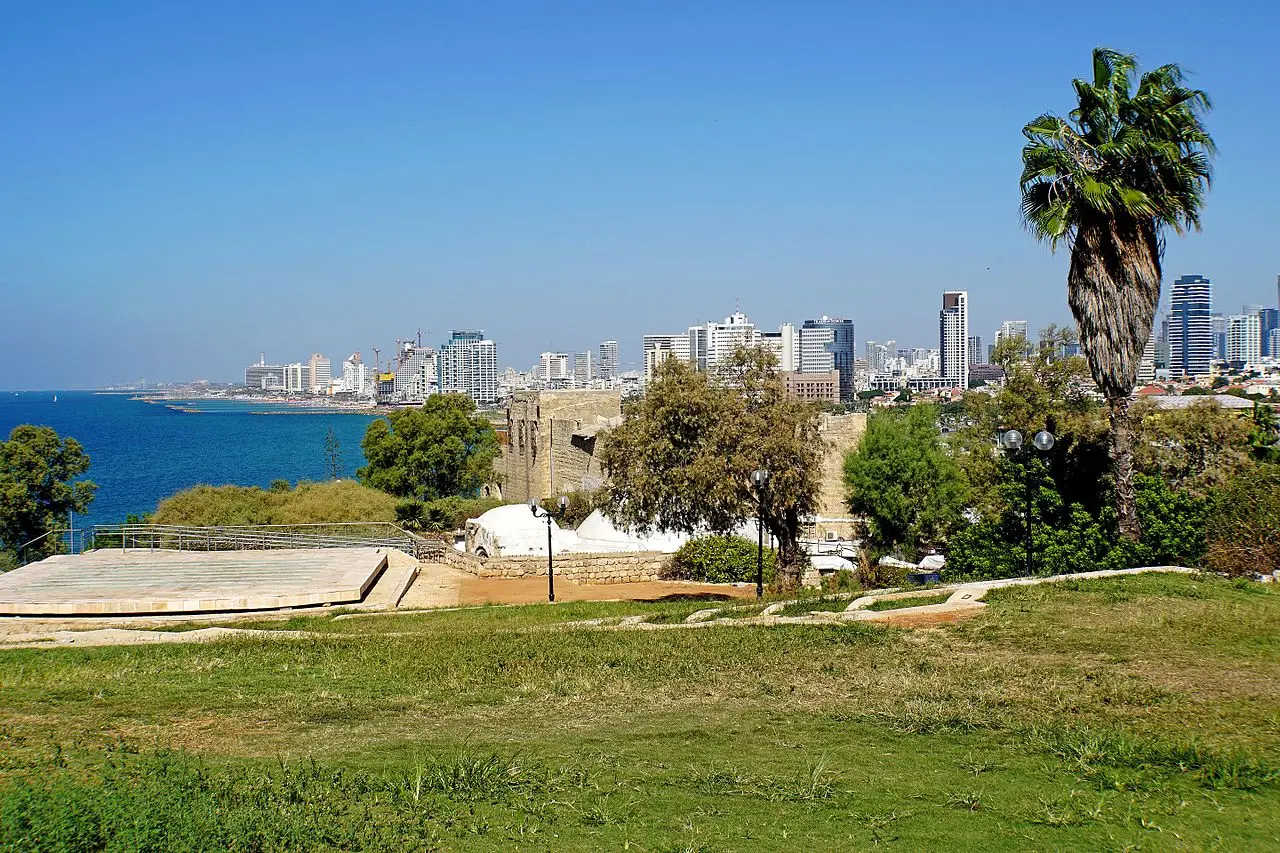
The reason most visitors come up is the view, and the municipality sets it out by compass point at station eight of its route: the Mediterranean to the west, St Peter's Church with its red brick and its tower nearby, the city of Tel Aviv to the north, and Jaffa to the east, where the orange groves that once surrounded the town stood. The northward view along the beach to the Tel Aviv towers is the one that sells the postcards, and it is best in the hour before sunset when the low sun is behind the photographer rather than in the frame.
The Wishing Bridge is the wooden footbridge from the garden across Mifratz Shlomo Street to Kedumim Square. Its rails carry plaques of the twelve signs of the zodiac, and a mosaic of the zodiac wheel is set nearby. The custom, as the municipality itself relates it, is to stand on the bridge holding your own sign and look out to sea, and the wish comes true. The bridge is short and popular, and a queue forms at it in the evening.
The signs are not folklore. When the emptied quarter was rebuilt for artists and craftspeople in the 1960s the lanes below the square were repaved and named after the signs of the zodiac, and the plaques on the bridge take their cue from those street names, which is what makes them a symbol of the renewed old town rather than an astrological ornament. Mazal Dagim and Mazal Aryeh are ordinary street addresses on the map.
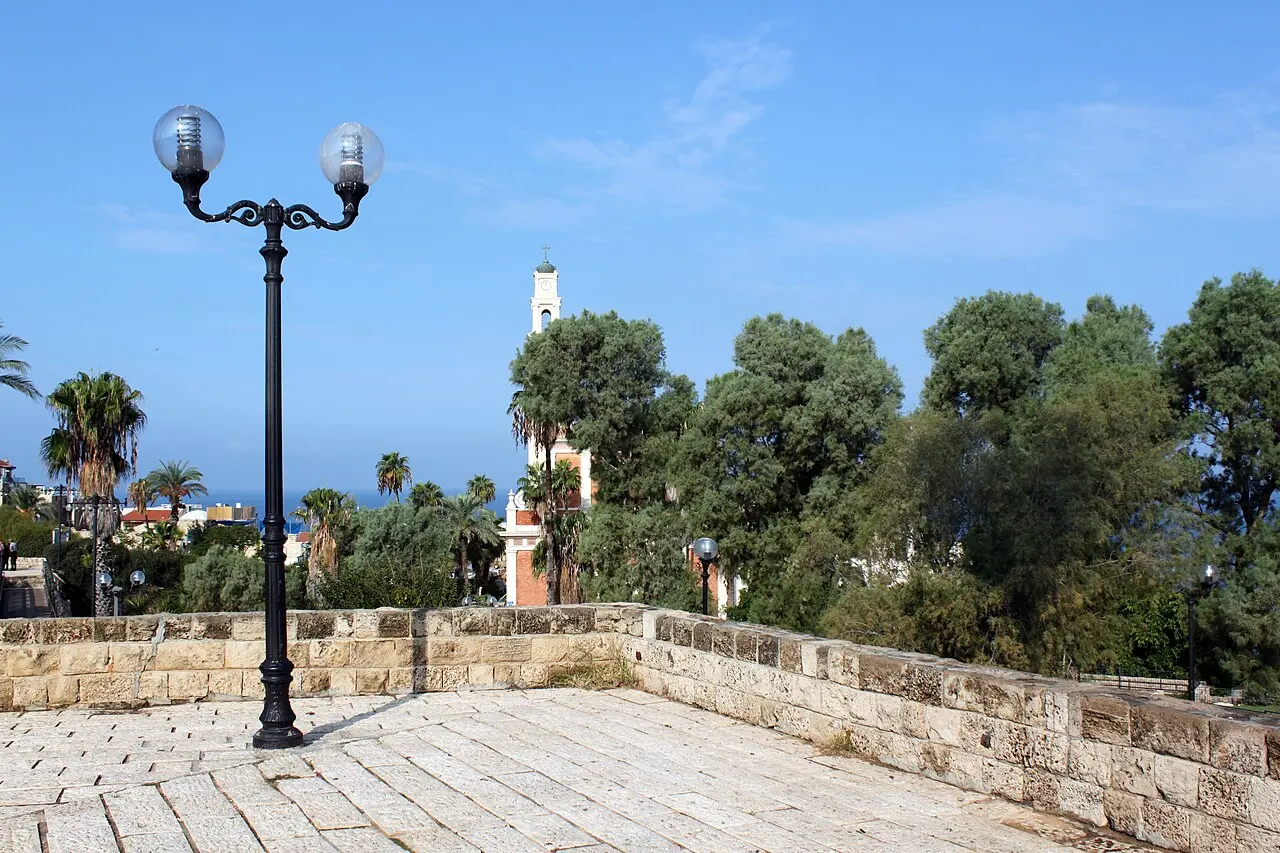
The garden has more than one edge and they show different things. The western parapet above Kedumim Square gives the church and the old town roofs; the northern edge, along the sea walls promenade, gives the beach, the breakwater and the Tel Aviv skyline; the eastern side, above the excavation, gives the flea market quarter and the clock tower. Walking all three takes about ten minutes and most people only do one.
Dennis G. Jarvis / CC BY-SA 2.0 · Wikimedia Commons
What to look for
Things not to walk past at HaPisga Garden (Abrasha Park)
The details that repay knowing about before you are standing in front of them.
The Gate of Faith
Daniel Kafri's stone gateway on the observation plaza, two pillars of four metres carrying a lintel, with the binding of Isaac, Jacob's dream and the fall of Jericho carved across the three faces. Hebrew Wikipedia and Zman Yisrael date the dedication to 1977.
The northward parapet
The edge above the sea walls promenade, where the beach, the breakwater and the Tel Aviv towers line up. The municipality's own route lists the sea to the west, Tel Aviv to the north and Jaffa to the east from this point.
The Ramesses Gate excavation
The open trench along the eastern edge, with stones of a fifteenth century BCE Canaanite wall and the rebuilt jambs of an Egyptian gateway carrying three of Ramesses II's names. The upstanding gate is a reconstruction.
The Wishing Bridge
The wooden footbridge over Mifratz Shlomo Street to Kedumim Square, railed with the twelve signs of the zodiac and matched by a zodiac mosaic nearby. The signs echo the zodiac street names given to the rebuilt lanes in the 1960s.
The amphitheatre
A stepped open-air bowl set into the garden and used for performances and film screenings. Empty most of the time, which makes it the best place in Old Jaffa to sit down without buying something.
The Sea Mosque below the north slope
Built in 1675 of kurkar and restored in 1997 and 2013, on the sea walls promenade at the foot of the garden. Sailors prayed there before voyages; it was a store by 1962 and was returned to religious use, and it is not open to visitors.
The long view
HaPisga Garden (Abrasha Park), in order
15th century BCE
Stones of a Canaanite city wall, later exposed in the excavation along the garden's eastern edge, according to the municipality's walking route.
c. 1460 BCE
An Egyptian garrison is established at Jaffa. The fortress operates, with interruptions, until about 1125 BCE.
13th century BCE
The monumental gateway known as the Ramesses Gate is built. Its jambs carry three of Ramesses II's names and titles such as son of the god Horus.
c. 1125 BCE
Two destructions dated by radiocarbon give the excavators a terminus post quem for the end of Egyptian rule in Canaan, which they read as local resistance rather than imperial collapse.
1675
The Sea Mosque is built of kurkar at the foot of the northern slope, on what is now the sea walls promenade.
1902
Avraham Karavan, the future Tel Aviv city gardener who will lay out this garden, is born in Lviv in Galicia. He reaches Palestine in 1920.
June 1936
Operation Anchor: British forces demolish the quarter on this hill, 237 buildings on Hebrew Wikipedia's count and more than two hundred houses on the municipality's. The cleared ground becomes known as HaShetach HaGadol, the Great Open Space.
1950
The authorities begin systematically clearing the residents remaining in the ruined quarter.
1953
Deputy mayor Moshe Aikhilov takes charge of restoration work, and Jacob Kaplan begins archaeological excavation on the hill.
1955-1962
Kaplan digs the gate area for the Jaffa Museum of Antiquities, the excavation the Ramesses Gate display now sits in.
1956
A plan designates the cleared summit as HaPisga Garden, a public park.
1961
The Old Jaffa Development Company is founded by the government and the Tel Aviv-Yafo municipality. It establishes HaPisga Garden and the Midron Garden on the slope.
1960s
Avraham Karavan lays out the summit and northern slope gardens, planted with salt-tolerant and wind-tolerant species, fig and date trees and broad lawns. The lanes below are repaved and named after the signs of the zodiac.
1968
Karavan dies on 23 March, aged 66, after roughly four decades as Tel Aviv's city gardener. The park keeps his nickname, Abrasha.
1977
The Gate of Faith is dedicated on the summit plaza, Daniel Kafri's first work after the Yom Kippur War and his return to religious observance. A Wikimedia Commons file description dates the sculpture 1975 instead.
1997 and 2013
The Sea Mosque below the north slope is restored, the second time including the minaret and the facades.
2011-2014
The Jaffa Cultural Heritage Project reopens the Egyptian fortress area beside the garden.
2015
Full ownership of the Old Jaffa Development Company passes to the Tel Aviv-Yafo municipality.
2017
Burke, Peilstöcker and thirteen colleagues publish the fortress excavations in the American Journal of Archaeology, vol. 121 no. 1, pp. 85-133.
20 March 2024
Daniel Kafri dies, aged about 79, having made more than seven hundred sculptures. The Gate of Faith is the work he is best known for.
Practical
Visiting HaPisga Garden (Abrasha Park)
Where
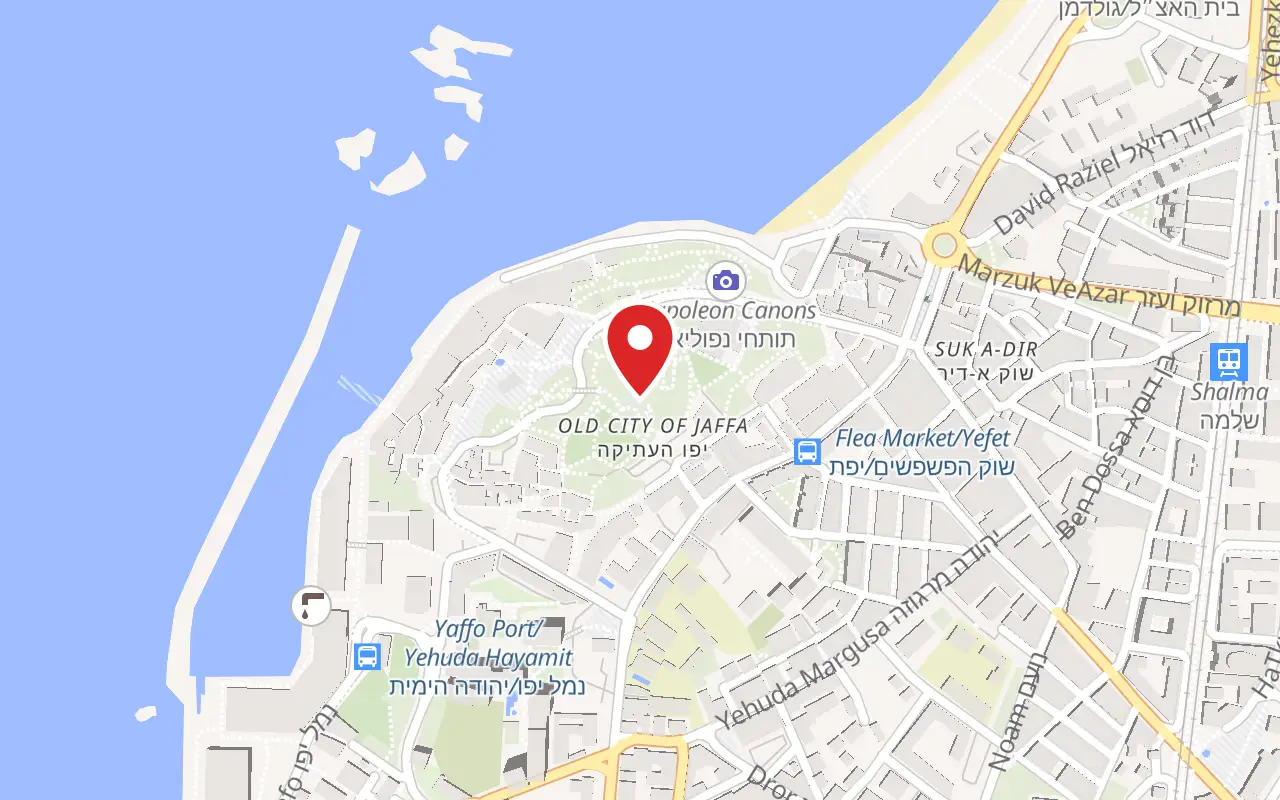
HaPisga Garden, off Mifratz Shlomo Street, Old Jaffa, Tel Aviv-Yafo
What ticket you need
The garden is not inside a ticketed park and needs no ticket of any kind. It sits within the Old Jaffa complex managed by the Old Jaffa Development Company, which is free to walk through in its entirety; the ticketed things nearby are the visitor centre under Kedumim Square and the Ilana Goor Museum, both of which are separate sites with their own admission.
Opening hours
- The garden
- Open at all hours. It is a public park with no gate, no ticket desk and no published closing time: the Tel Aviv-Yafo municipality treats it as station eight on its own free Old Jaffa walking route rather than as an attraction with opening times.source
- The excavation along the eastern edge
- Open ground, fenced at the edge of the trench and readable from the path at any hour. There is no attendant, no gate and no interpretation desk on site, and the municipality's route text is the fullest free explanation of what is in the hole.source
- What the operator publishes
- The Old Jaffa Development Company, which manages the wider Old Jaffa complex, publishes no opening times for this garden, and no hours here are quoted from it.source
Admission
- The garden, the Gate of Faith and the Wishing Bridge
- No charge in shekels or otherwise. There is no ticket, no barrier and no perimeter anywhere in Old Jaffa's street network, and the municipality lists all three as stops on a free public walking route.source
- The Ramesses Gate excavation
- No charge. The trench is beside the path and is not ticketed. The separate ticketed excavation in Old Jaffa is the one under Kedumim Square, which is a different site and is run by the Old Jaffa Development Company.source
- Events in the amphitheatre
- Priced by whoever is promoting the performance or screening, not by the park. No standing shekel price is published for the amphitheatre, so check the listing for the specific event rather than assuming the garden's own free entry applies.source
Access
Honest answer: getting here is the hard part and the garden itself is the easy part. This is the highest point in Old Jaffa, on a kurkar ridge of about 40 metres, so every approach on foot climbs. From Jaffa Port the walk up is steep and involves steps, and a wheelchair cannot do it. From the flea market and the clock tower the approach along the ridge is gentler. Mifratz Shlomo Street runs along the western side of the garden at summit level, so a car or taxi can set someone down at the top and avoid the climb entirely, which is the practical answer for anyone with limited mobility. Inside the garden the main paths are paved and broadly level along the crown of the ridge, but the ground is a hilltop: the lawns slope, the amphitheatre is stepped seating, the excavation area is reached over uneven ground, and the Wishing Bridge is a footbridge rather than a ramp. Neither the municipality nor the Old Jaffa Development Company publishes an accessibility statement for the garden, so nothing here is quoted from one and anyone with a specific requirement should ask before travelling.
On site
- Lawns, benches and mature shade trees
- Amphitheatre for performances and screenings
- Viewpoints west, north and east
- Sea walls promenade along the northern edge
- Open archaeological excavation with the reconstructed Ramesses Gate
- Wishing Bridge across to Kedumim Square
- No cafe, shop or lavatory inside the garden; the nearest are in Kedumim Square
Booking
Nothing about the garden needs booking, and there is nothing to book. The only thing here that can require a ticket is an event in the amphitheatre, which is sold by its promoter rather than by the park.
Hours and prices are given as the operator publishes them and change without much notice, particularly around Shabbat and the festivals. Check the operator's own page before you travel for this.
Official page at oldjaffa.co.il →What people wish they had known
- Do not treat this as a five minute photo stop on the way down to the port. The garden, the sculpture, the bridge and the excavation are four separate things spread over the summit, and the walk between them is what people cut short.
- Come up in the hour before sunset rather than at midday. The northward view puts the sun behind the camera at that time, and the mature trees are the only real shade on the hill if the timing goes wrong.
- The upstanding Ramesses Gate is a reconstruction. The genuinely ancient material is the lower stonework and brick around it, which is easy to walk past because it looks like rubble.
- Walk all three edges. The western parapet gives St Peter's and the old town roofs, the northern edge gives the beach and the Tel Aviv skyline, the eastern side gives the flea market quarter. Most visitors only find one of them.
- Plan the climb, not the visit. Coming up from Jaffa Port is steep and involves steps; coming along the ridge from the clock tower is much gentler, and Mifratz Shlomo Street reaches the garden at summit level if a taxi is easier.
- There is no cafe, shop or lavatory in the garden. The nearest of each are in Kedumim Square, over the Wishing Bridge.
The figures
HaPisga Garden (Abrasha Park) by the numbers
Each figure carries the year it belongs to and links the source it came from.
| Measure | Figure | As of | Source |
|---|---|---|---|
| Height of the ridge the garden covers | about 40 m of kurkar sandstone, the ridge ancient Jaffa was built on | 2026 | en.wikipedia.org |
| Gate of Faith | two uprights of 4 m each carrying a lintel, dedicated in 1977, by Daniel Kafri | 2020 | zman.co.il |
| The Egyptian fortress beside the garden | in operation from roughly 1460 to about 1125 BCE, the only Egyptian fortress excavated in Canaan | 2017 | ajaonline.org |
| Buildings destroyed in Operation Anchor | 237 in June 1936 on Hebrew Wikipedia's count; the municipality says more than two hundred houses | 2026 | he.wikipedia.org |
| Area of the Old Jaffa complex the garden sits in | about 300 dunams of kurkar hill and slope, bounded by Yefet Street and Louis Pasteur Street | 2026 | he.wikipedia.org |
| Residents of Old Jaffa | 1,010 people, which is why the quarter empties of locals rather than tourists at night | 2022 | he.wikipedia.org |
| The Sea Mosque below the northern slope | built 1675, restored in 1997 and again in 2013, when the minaret and facades were repaired | 2026 | he.wikipedia.org |
| Avraham Karavan, who laid out the garden | 1902 to 1968, Tel Aviv's city gardener for roughly four decades, whose nickname Abrasha the park carries | 2026 | he.wikipedia.org |
While you are here
The rest of Jaffa
Everything else in this destination with a page of its own.
Fallaner / CC BY-SA 4.0 · Wikimedia Commons
Landmark
Kedumim Square
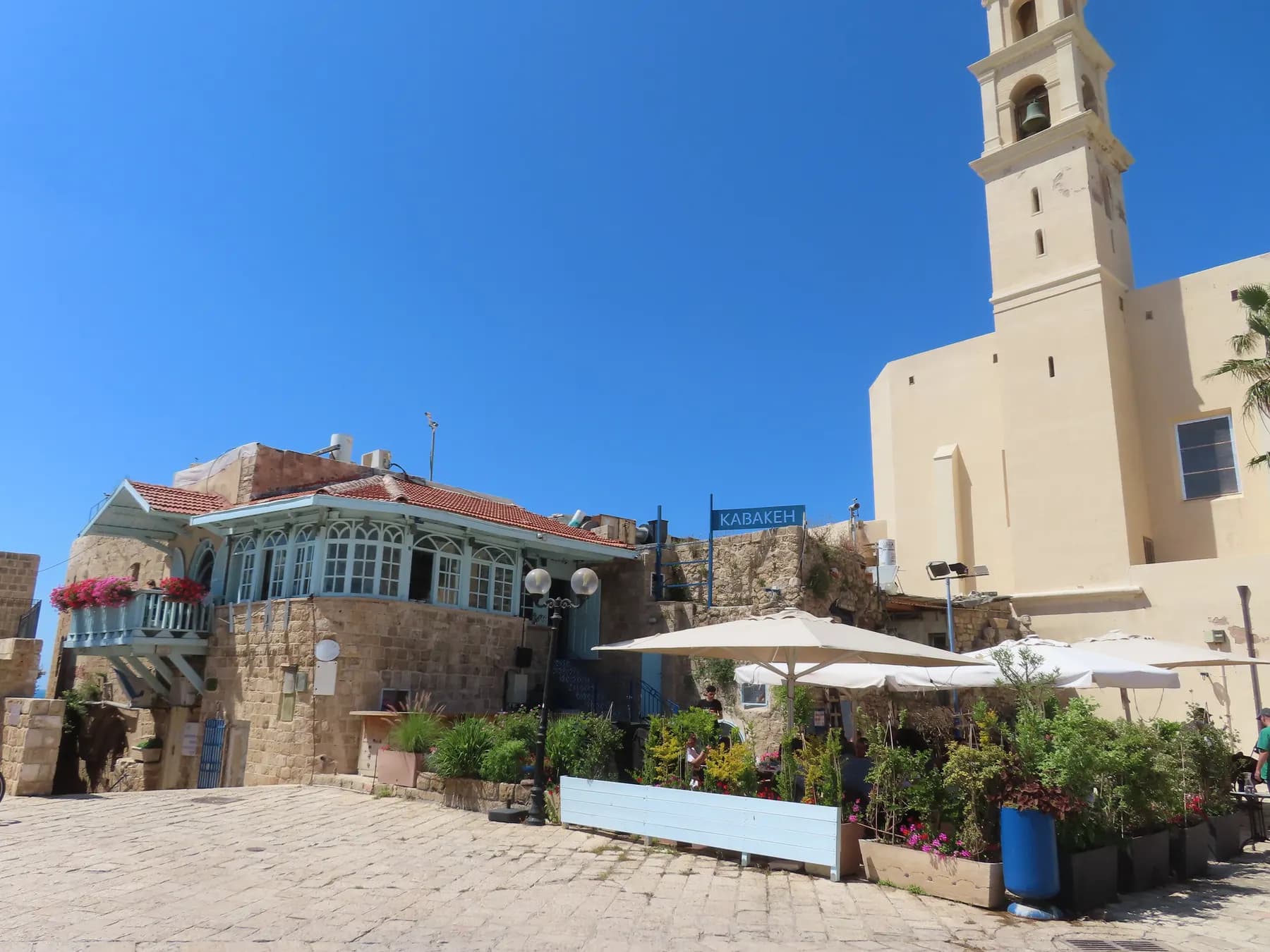
The flagged main square of Old Jaffa is a space the British made by demolition in June 1936, and the Israel Antiquities Authority excavation under its fountain found the drains of one of the houses that came down.
leighklotz / CC BY 2.0 · Wikimedia Commons
Archaeological site
Ramses II Gate Garden
The inscribed portal standing in this excavation is a concrete reconstruction the Israel Antiquities Authority raised in the 1990s; the kurkar blocks that carried the titles of Ramesses II are in the Jaffa Museum of Antiquities.
שלמה רודד / CC BY 2.5 · Wikimedia Commons
Religious site
St Peter's Church
The Custody of the Holy Land runs this as a shrine rather than a parish: a Spanish-funded church of 1888 to 1894 standing on the citadel Louis IX rebuilt, with an altar that faces west instead of east.
Sources and further reading
Every link below was opened and checked when this page was written. Official statements are marked as such: they are the subject's own account, not an independent one.
- OfficialTel Aviv-Yafo Municipalitytel-aviv.gov.ilOld Jaffa and Jaffa Port walking route, stations 8, 9 and 10: Abrasha Park, the Wishing Bridge, and the Jaffa excavations and Ramesses Gate
The operator of the public realm here. Source for the garden being the highest point in Old Jaffa, for the view by compass point, for the Gate of Faith attribution, for the Wishing Bridge custom and its zodiac plaques, and for the Canaanite wall and reconstructed Ramesses Gate in the excavation.
- OfficialThe Old Jaffa Development Company Ltdoldjaffa.co.ilThe Old Jaffa Development Company
The company that manages the Old Jaffa complex and established this garden. No hours or prices on this page are quoted from its site.
- OfficialVisit Tel Aviv, Tel Aviv-Yafo Municipalityvisit-tel-aviv.comOld Jaffa: meet the old city
Source for Pisgah Park having been designed by the municipality in the 1960s as part of its plan to renovate the old city.
- ReportingZman Yisrael, the Hebrew edition of The Times of Israel (Aviva and Shmuel Bar-Am, 8 April 2020)zman.co.ilטיול וירטואלי לחג: מסע מצולם בעקבות פסלים בהשראת סיפורי התנך (A virtual holiday tour: sculptures inspired by biblical stories)
Independent source for the Gate of Faith: Kafri as sculptor, 1977, four metres, the three biblical scenes, the gate form chosen because Jaffa was regarded as the gateway to the Land of Israel, and the thirteenth century BCE gate excavated south of it.
- ReferenceAmerican Journal of Archaeology (Aaron A. Burke, Martin Peilstöcker and thirteen colleagues, vol. 121 no. 1, 2017, pp. 85-133)ajaonline.orgExcavations of the New Kingdom Fortress in Jaffa, 2011-2014: Traces of Resistance to Egyptian Rule in Canaan
The scholarly account of the fortress and gate beside the garden: operation from roughly 1460 to 1125 BCE, the only Egyptian fortress excavated in Canaan, and radiocarbon dates from two twelfth century destructions.
- ReferenceWikipedia (Hebrew)he.wikipedia.orgיפו העתיקה (Old Jaffa)
Source for Karavan designing the summit and slope gardens, the amphitheatre, the salt and wind tolerant planting with fig and date trees, the zodiac mosaic, the 237 buildings lost in Operation Anchor, the roughly 300 dunam complex and the 2022 population of 1,010.
- ReferenceWikipedia (Hebrew)he.wikipedia.orgשער האמונה (Gate of Faith)
Source for the 1977 dedication, the Galilee stone, the four metre pillars, and the specific scenes and inscriptions on each of the three faces.
- ReferenceWikipedia (Hebrew)he.wikipedia.orgדניאל כפרי (Daniel Kafri)
Source for Kafri's birth in Czechoslovakia in 1945, arrival in 1949, training at Bezalel, the 1971 Monaco prize, the 1976 Jerusalem Prize for sculpture, more than seven hundred works, and his death on 20 March 2024.
- ReferenceWikipedia (Hebrew)he.wikipedia.orgאברהם קרוון (Avraham Karavan)
Source for Karavan's dates, 1902 in Lviv to 23 March 1968, his roughly four decades as Tel Aviv's city gardener, and the Summit Garden among the gardens he designed.
- ReferenceWikipedia (Hebrew)he.wikipedia.orgהשטח הגדול (HaShetach HaGadol, the Great Open Space)
Source for the quarter that stood where the garden now is, the June 1936 evacuation notices and two week demolition, the post-1948 decay, the clearances from 1950, Moshe Aikhilov and Kaplan in 1953, and the 1956 plan designating HaPisga as a public garden.
- ReferenceWikipedia (Hebrew)he.wikipedia.orgהחברה לפיתוח יפו העתיקה (The Old Jaffa Development Company)
Source for the company's founding in 1961 by the government and the municipality, its establishment of HaPisga Garden and the Midron Garden, and the transfer of full ownership to the municipality in 2015.
- ReferenceWikipedia (Hebrew)he.wikipedia.orgמסגד הים (יפו) (The Sea Mosque, Jaffa)
Source for the mosque on the northern side of the garden: built 1675 of kurkar, used as a store by 1962, returned to religious use after objections, restored in 1997 and 2013, and closed to the public.
- ReferenceWikipedia (English)en.wikipedia.orgJaffa
Source for ancient Jaffa having been built on a kurkar sandstone ridge about 40 metres high, and for the Ramesses Gate nickname.
- ReferenceWikimedia Commonscommons.wikimedia.orgFile: Gate of Faith in Tel Aviv.jpg
The dissenting date. This file description gives the sculpture as limestone and dates it 1975, against the 1977 of Zman Yisrael and Hebrew Wikipedia. It is a photographer's caption rather than a publication, and is cited here only so the disagreement is visible.
HaPisga Garden (Abrasha Park): common questions
Is HaPisga Garden the same thing as Abrasha Park?+
Yes. HaPisga Garden, Gan HaPisga, is the formal name and Abrasha Park is what almost everyone calls it, including the Tel Aviv-Yafo municipality on its own walking route. Abrasha was the nickname of Avraham Karavan, the city gardener who laid out the summit and slope gardens. He was born in 1902 and died in 1968.
Is there an entrance fee?+
No. The garden is a public park with no ticket, no gate and no perimeter, and the municipality lists it as a free stop on its Old Jaffa walking route. The Gate of Faith, the Wishing Bridge and the Ramesses Gate excavation are all free as well. An event in the amphitheatre is a separate matter and is priced by its promoter.
What are the opening hours?+
There are none: it is open at all hours. Neither the municipality nor the Old Jaffa Development Company publishes opening times for the garden, because there is nothing to open or close.
How long does it take to see?+
About 45 minutes covers the garden, the Gate of Faith, the Wishing Bridge and the excavation at a normal pace. Allow about 90 minutes if the sea walls promenade along the northern edge and a sit in the amphitheatre are included. Half of the time people spend here goes on the parapet, so the number depends on the light.
Is it wheelchair accessible?+
The garden itself is manageable and the approach is the problem. This is the highest point in Old Jaffa on a ridge of about 40 metres, and the walk up from Jaffa Port is steep and stepped. Mifratz Shlomo Street runs past the garden at summit level, so a car or taxi can set someone down at the top. Inside, the main paths are paved and broadly level along the crown, but the lawns slope, the amphitheatre is stepped seating and the excavation is reached over uneven ground. No operator publishes an accessibility statement for the garden.
Is the Gate of Faith ancient?+
No, it is a modern sculpture by Daniel Kafri and was dedicated in 1977 according to Hebrew Wikipedia and Zman Yisrael, though a Wikimedia Commons file description dates it 1975. It carries the binding of Isaac, Jacob's dream and the fall of Jericho. The confusion is understandable, because a genuinely ancient gate of the thirteenth century BCE, resembling it in form, was excavated a short distance to the south.
Can you get inside the Ramesses Gate excavation?+
You can walk up to it and read it from the path, but the trench itself is fenced at the edge and there is no attendant or interpretation desk on site. What stands upright is a reconstruction of the gate jambs, carrying three of Ramesses II's names. The published account of the excavation is the 2017 American Journal of Archaeology field report by Burke, Peilstöcker and colleagues.
Is there shade?+
Yes, and it is the best in Old Jaffa outside a restaurant. Karavan's planting used species chosen to stand up to sea wind and salt, with fig and date trees on the summit, and those trees are now mature. There is still a good deal of open lawn with no cover, so in July and August the trees at the edges are where people end up.
Where exactly is the view of Tel Aviv from?+
From the northern edge of the garden, where it meets the sea walls promenade. The municipality's own route describes the sea to the west, St Peter's Church nearby, Tel Aviv to the north and Jaffa to the east from this point. The beach curving north to the towers is the frame most photographs use.
Is the Wishing Bridge worth the queue?+
That depends entirely on whether the custom appeals, because there is nothing else to it. It is a short wooden footbridge over Mifratz Shlomo Street with zodiac plaques on the rails, and the tradition is to hold your own sign, look out to sea and make a wish. It gets busy in the evening. The bridge is also simply the shortest route between the garden and Kedumim Square, which is reason enough to cross it.