
Archaeological site · Masada
The Western Palace
The Israel Nature and Parks Authority puts this building at 3,700 square metres, which makes it the largest on the Masada plateau, and its four wings held Herod's reception rooms, his storerooms, his workshops and his administration.
Floor area
3,700 sq m
the parks authority's figure; reference works give close to or above 4,000
Wings
4
official core, storerooms, service and workshops, administration
Marks read as a throne
4 depressions
in the plastered floor, where the legs of a canopied throne may have stood
Rebel bakery oven
3 m across
domed, with a grinding post on each side of the door, built here in 66-73 CE
In short
- How long to give it
- about 30 minutes for the palace, inside a plateau visit of two to three hours
- The palace itself
- No separate hours: it is open whenever the plateau is, and there is no gate or ticket desk at the building
- The Western Palace
- No separate charge: it stands inside the park boundary and is covered by the park ticket
הארמון המערבי
The Western Palace is the largest building on the Masada plateau: a four-winged Herodian complex set against the middle of the western casemate wall, holding a reception suite, storerooms, a service and workshop range and an administrative unit inside one boundary. The Israel Nature and Parks Authority gives its area as 3,700 square metres. Reference works give more: the Encyclopaedia Judaica entry by Guy Stiebel puts it at nearly 4,000 square metres, and the Israeli foreign ministry text carried by the Jewish Virtual Library at over 4,000, roughly an acre. None of the three explains what is being counted, and the gap is probably the courtyards and the outer service rooms rather than a disagreement about the walls.
It was built to run the mountain rather than to be admired from below. The Jewish Virtual Library text calls it the main administration centre of the fortress as well as the king's ceremonial palace, and notes that it sits beside the gate facing Judaea and Jerusalem. Unlike the Northern Palace, which was serviced by public storerooms and a large bathhouse some distance away, this one was self-sufficient: everything it needed was inside its own four wings.
For a visitor the reward is on the floor rather than on the horizon. The Northern Palace has the cliff and the view; the Western Palace has the mosaic pavements, the four small depressions that Yigael Yadin read as the seating for a throne, a stepped cold-water pool, and the ovens and forges the rebels of the Great Revolt put into Herod's rooms a century after he died.
The building
Four wings, one courtyard and a gate towards Jerusalem
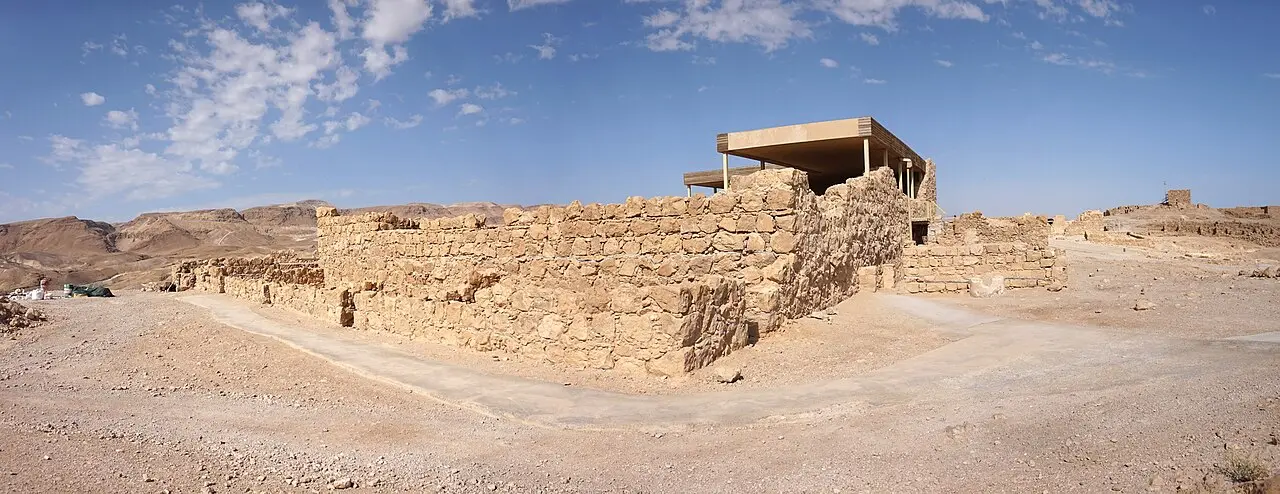
The palace stands along the centre of the western casemate wall, near the main gate that faced Judaea and Jerusalem, which is the practical reason for its position: this was the side goods and people arrived on. The Encyclopaedia Judaica entry describes it as a self-sufficient unit of four wings, an official wing that Stiebel calls 'the core', a storeroom wing, a service wing and an administrative wing. The Jewish Virtual Library text names the same four as an elaborate royal apartment, a service and workshop section, storerooms and an administrative unit.
The official wing was built around a large central court. A large reception hall opened off it and led into the room Yadin interpreted as the throne room. The parks authority's own description of the plateau adds the details a visitor meets first: benches were built into the entrance room, and the walls carried stucco decoration. On the southern side of the courtyard, according to the foreign ministry text, a large room had two Ionic columns holding the roof over a wide opening onto the court, with walls in moulded panels of white stucco.
The wing was not only ceremonial. Stiebel records service rooms alongside it, and bathrooms with tubs, a stepped cold-water pool and other installations, all of them paved with mosaic. The parks authority notes a staircase running up to a second storey, from which the bathhouse and its mosaic floor can be seen.
- Official wing, or 'the core': courtyard, reception hall, throne room
- Storeroom wing
- Service and workshop wing
- Administrative wing
- Bathrooms with tubs and a stepped cold pool, all paved with mosaic
Tiia Monto / CC BY-SA 3.0 · Wikimedia Commons
Herod
Built first, then enlarged, then walled in
Herod ruled Judaea from 37 to 4 BCE, and the parks authority's own site brochure, written by Guy Stiebel with Ehud Netzer as content consultant, describes Masada as both a refuge against his enemies and a winter palace. Netzer showed that the building work on the mountain went in three chronological phases, and the Western Palace appears in two of them.
In the first phase Herod built three small palaces, the core of the Western Palace, a building on the upper terrace of the Northern Palace, soldiers' barracks and three columbaria, all of them arranged around a central courtyard. In the second phase came the Northern Palace complex with its public storerooms and large bathhouse, the water system, and the expansion of the Western Palace. The third phase was the casemate wall that closed the perimeter of the plateau. So the Western Palace was among the first things built here and one of the few he came back to.
The stone tells a similar story of stages and imports. Walls were built from local dolomite, quarried on top of the mountain and out of the huge water cisterns. The more elaborate architectural pieces, the column drums, the capitals, the parts of the architrave, were shaped from a softer stone brought in from elsewhere. Mason's marks in Hebrew letters are visible on all the column drums, which is how the origin of the stonecutters is known.
Whether anything here predates Herod is unsettled. Josephus credits the first fortress on the rock to 'Jonathan the High Priest', and Hasmonean coins have come out of the excavations, but the parks authority's brochure states plainly that no architectural remains at Masada can be dated with certainty to the Hasmonean period.
Armineaghayan / CC BY-SA 4.0 · Wikimedia Commons
The floors
Four dents in the plaster, and a drawing on the wall
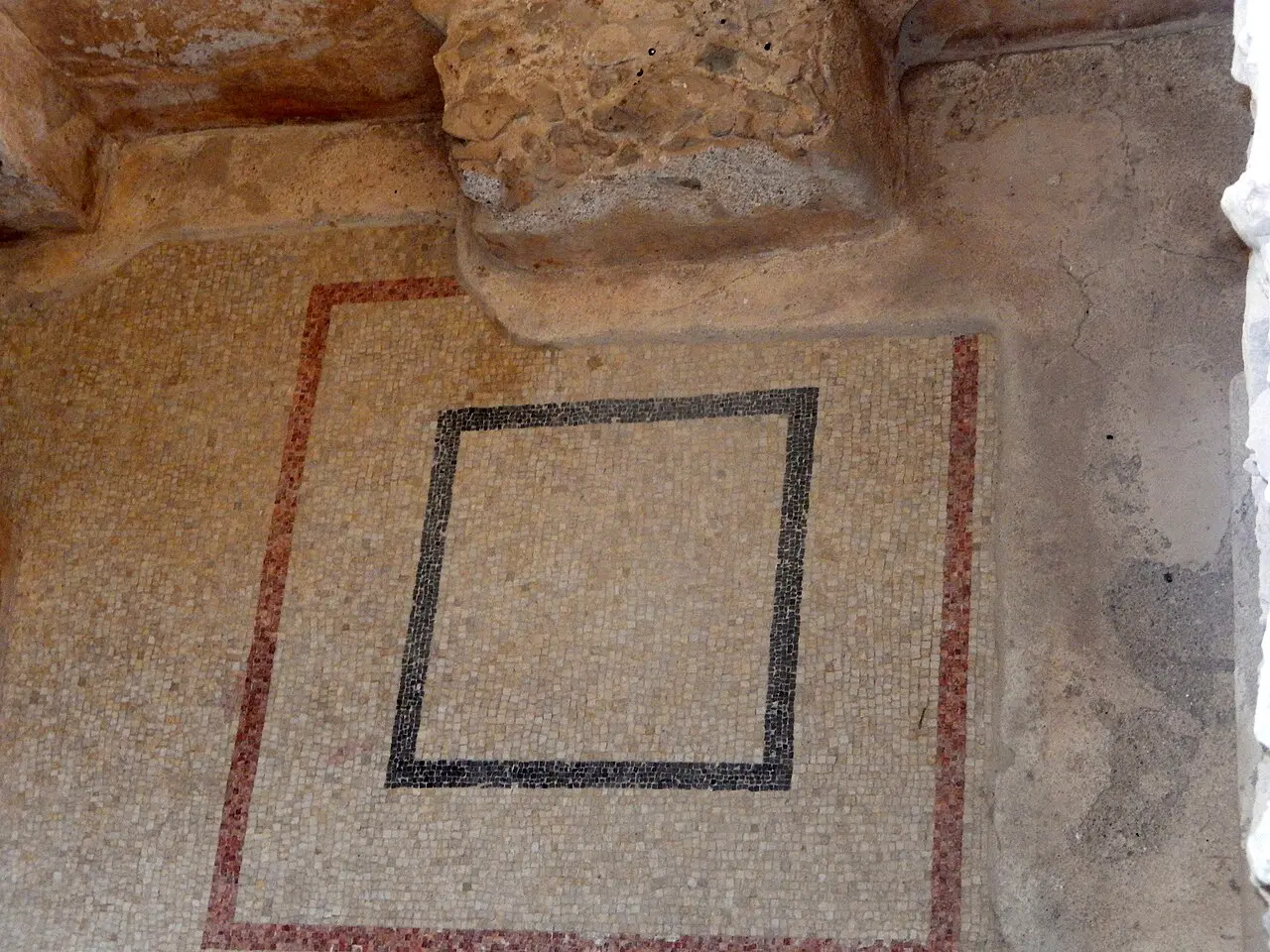
The famous detail is small and easy to walk over. In the floor of a ground-floor room off the reception hall are four depressions in the plaster. Yadin read them as the sockets for the legs of a canopied throne, which is the whole basis for calling the room a throne room. The parks authority prints the reading with its hedge intact, describing the chamber as 'presumably' the throne room, and the foreign ministry text says only that the room 'may have been' Herod's throne room and the seat of authority when he was in residence. Nobody has produced a throne.
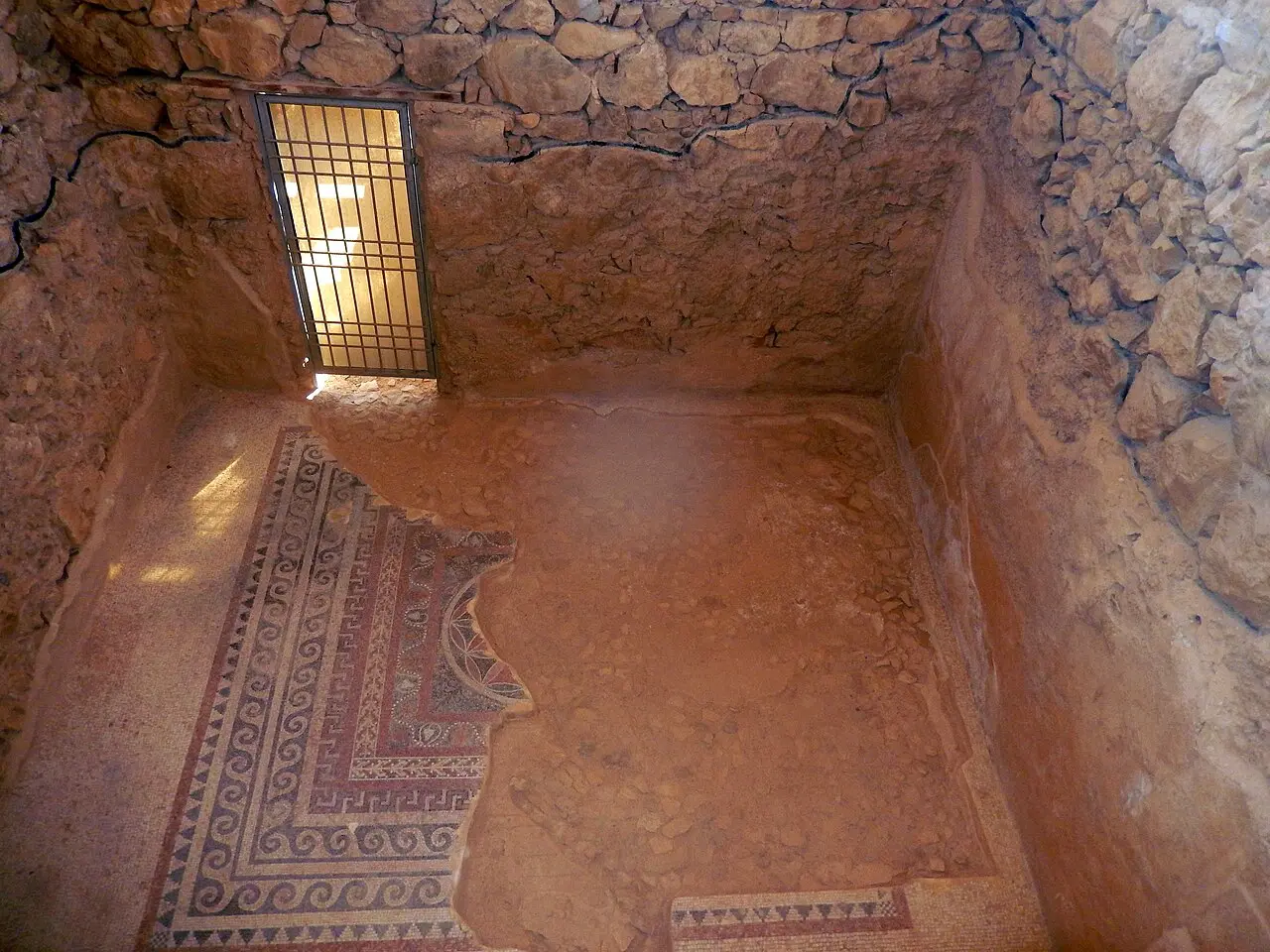
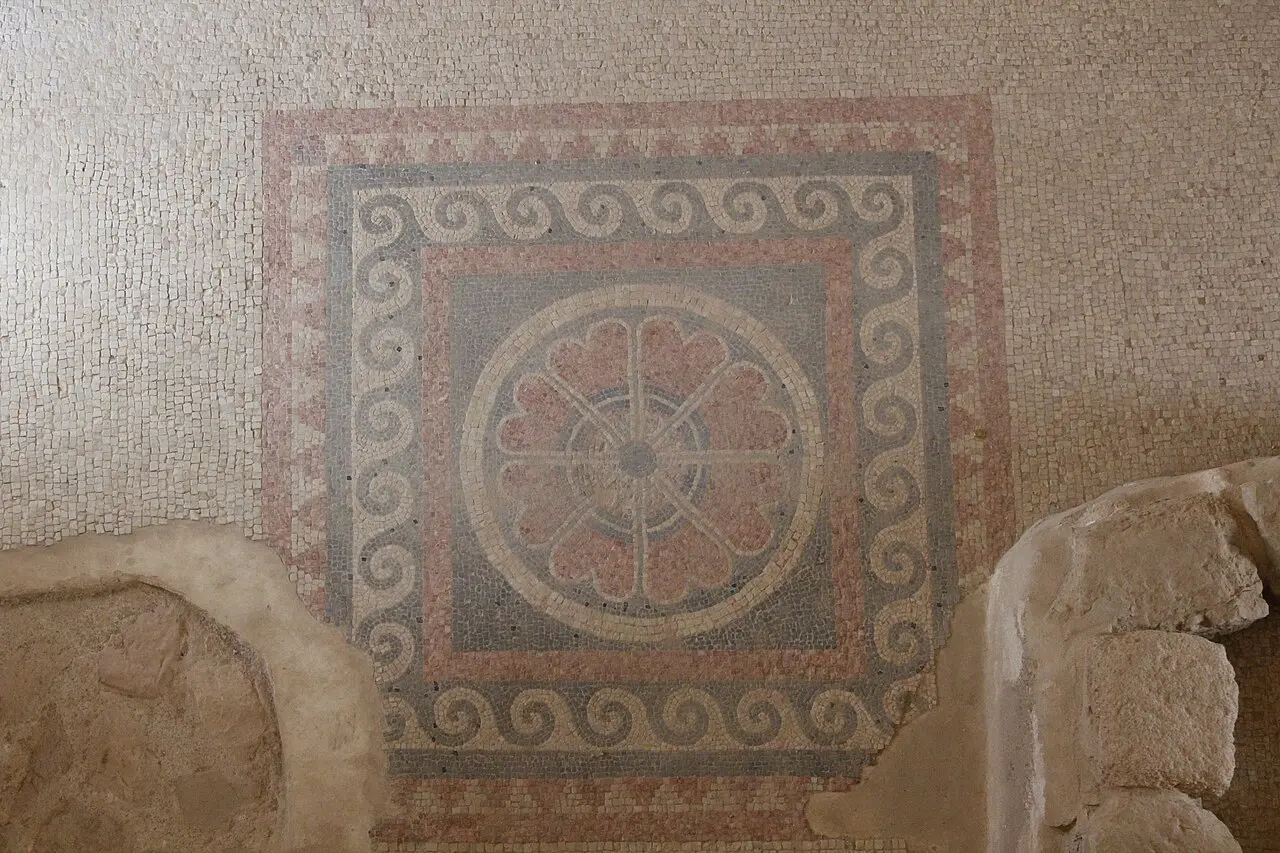
The mosaics are the other reason to stop. Stiebel describes a richly coloured pavement in the hall with circles and border ornaments of plant and geometric design. The foreign ministry account describes the largest room's floor as floral and geometric patterns held inside several concentric square bands, and puts several more coloured mosaic floors in the rooms on the eastern side. Between them the two descriptions list circles, plants and geometry and no human or animal figure at all.
One find here has no parallel elsewhere on the mountain: a charcoal drawing of the mosaic, a working sketch of the pattern, was found on a plastered wall nearby. It is the closest thing Masada has produced to a builder's plan, and it belongs to this room.
- Four depressions in the plastered floor, read by Yadin as a throne's feet
- A coloured mosaic of circles with plant and geometric borders
- Concentric square bands framing the largest room's floor
- More coloured mosaic floors in the rooms on the eastern side
- A charcoal sketch of the mosaic design on a nearby plastered wall
Armineaghayan / CC BY-SA 4.0 · Wikimedia Commons
The argument
Which of Herod's palaces was the ceremonial one
There is a real disagreement behind the signage. Yadin attributed ceremonial functions to the Western Palace. Netzer, who dug at Masada in 1989 and again from 1995 and who advised on the parks authority's own brochure, rejected that and assigned the ceremonial role to the Northern Palace instead. The Encyclopaedia Judaica entry records the dispute without settling it, and the foreign ministry text quietly keeps both readings by calling the building the fortress's administration centre and the king's ceremonial palace in the same sentence.
The ancient evidence does not help as much as it should. Josephus gives one description of Herod's palace on the rock, and it points two ways at once: 'he built a palace therein, at the western ascent. It was within, and beneath the walls of the citadel: but inclined to its north side.' The Encyclopaedia Judaica entry reads that passage as the Northern Palace, on the strength of the three tiers Josephus goes on to describe. The sentence still begins at the western ascent, which is where this building stands.
What is not in dispute is the scale of what the Western Palace did. Whether or not Herod received anyone formally here, the storerooms, the workshops and the administrative wing were the machinery that kept a palace-fortress running in a desert with no spring.
Fallaner / CC BY-SA 4.0 · Wikimedia Commons
The revolt
A storeroom, a bakery and two smithies
When the Sicarii took Masada in 66 CE they did not move into Herod's palaces. Stiebel's account is that the rebels lived in the rooms of the casemate wall and in shacks built against it, and used the Herodian palaces as command posts and public buildings, stripping their decorative architecture for building material and furniture. The Western Palace was given a prominent place in that arrangement.
The largest storeroom at Masada is in this building. When it was excavated, lines of vessels were found still in place, each line marked by an ostracon declaring whether that line was ritually pure or impure. Next to the storeroom stood the community's central bakery: a domed oven three metres across with a grinding post on each side of its door, capable of turning out hundreds of loaves. Distribution appears to have been centralised in the courtyard beside it, where many bread receipts were found, ostraca recording that on a given day a stated number of loaves went to a named man at the head of an extended family or group. Every name on them is male.
Two smithies were also working inside the palace, forging iron trilobate arrowheads. That detail matters for what happened next. Jodi Magness, who has excavated at Masada, notes that the overwhelming majority of arrowheads recovered from the site come from two places, the lower terrace of the Northern Palace and the workshop in the Western Palace, and that both were sealed under collapse from fires. Everywhere else, the Romans appear to have swept the mountain clean of usable iron after the siege. The Western Palace kept its arrowheads because it burned on top of them.
- The biggest storeroom on Masada, its vessel lines tagged pure or impure
- A domed oven three metres across, with two grinding posts
- Bread receipts naming the head of each family or group
- Two smithies forging iron trilobate arrowheads
- Burnt collapse, which is why the arrowheads survived the Roman clean-up
Today
What is original here, and what was put back
Almost everything visible was uncovered in one go. Yadin's Hebrew University expedition excavated the mountaintop between 1963 and 1965, assisted by thousands of volunteers from around the world, and Britannica records that the palaces, storehouses, defence works and Roman siege works were all revealed and cleared. The parks authority's brochure adds the part that shapes what a visitor sees: during those excavations many buildings were conserved and reconstructed, the site was prepared for visitors, and the national park opened in 1966. Conservation and restoration work has been carried out by the parks authority since.
The parks authority does not publish a wall-by-wall breakdown of that work on its site pages, so a visitor who wants to know which courses are Herodian and which are 1960s consolidation is not going to find the answer printed at the building. Treat standing height as restored unless a sign says otherwise, and treat the floors as the honest survivals: the mosaic pavements, the plastered surfaces and the four depressions are what was found, not what was rebuilt.
Painted plaster is the fragile case. Frescoes uncovered by Yadin elsewhere on the summit were exposed to the weather, had to be lifted from the site for preservation, and spent almost twenty years in storage; the set from the commander's residence was returned to Masada in 2014 after restoration led by Maurizio Tagliapietra of the University of Verona. The stucco panels and painted surfaces described in the older accounts of the Western Palace should be read with that in mind.
Excavation here is also not finished. Netzer returned for a short season in 1989, and Hebrew University work resumed in 1995 as part of a development project funded through the tourism ministry, with seasons led by Netzer and Guy Stiebel on the plateau and a season by Gideon Foerster at Roman Camp F and the siege ramp.
What to look for
Things not to walk past at The Western Palace
The details that repay knowing about before you are standing in front of them.
The four depressions
Four small hollows in the plastered floor of a ground-floor room, which Yadin read as the sockets for the legs of a canopied throne. They are the entire evidence for the name 'throne room', and they are easy to step over without noticing.
The coloured mosaic pavement
Circles with plant and geometric borders in the hall, and concentric square bands framing the largest room's floor. These are the coloured floors of the mountain: the Northern Palace's own mosaic is black and white.
The charcoal blueprint
A charcoal drawing of the mosaic design, found on a plastered wall nearby. It is as close as Masada has come to producing a working drawing by the people who laid the floor.
The bathroom and its stepped pool
The official wing had bathrooms with tubs, a stepped cold-water pool and other installations, all paved with mosaic. The parks authority points visitors up a staircase to see the mosaic floor from above.
The rebels' oven
A domed bread oven three metres across with a grinding post on either side of the door, built inside Herod's palace by the community of the Great Revolt. The courtyard beside it produced the ostraca recording who collected how many loaves.
The benched entrance room
Benches were built into the room you enter through and the walls carried stucco decoration, which is the parks authority's small clue that this was a building where people were received and made to wait.
The long view
The Western Palace, in order
103-76 BCE
Josephus credits the first fortress on the rock to 'Jonathan the High Priest', usually identified with Alexander Jannaeus, whose coins turn up in the excavations. No architectural remains at Masada can be dated with certainty to the Hasmonean period.
37-4 BCE
Herod rules Judaea and turns Masada into a palace-fortress in the style of the early Roman East, using it as a refuge and a winter palace.
Herod's first building phase
The core of the Western Palace is built, together with three small palaces, a building on the upper terrace of the Northern Palace, soldiers' barracks and three columbaria, all around central courtyards.
Herod's second building phase
The Western Palace is expanded, alongside the Northern Palace complex with its public storerooms and large bathhouse, and the water system.
Herod's third building phase
A casemate wall is thrown round the perimeter of the plateau, and the Western Palace ends up set against the middle of its western run.
66 CE
The Sicarii take Masada at the outbreak of the Great Revolt. The rebels live in the casemate wall and turn the Herodian palaces into public buildings, giving the Western Palace a storeroom, the community bakery and two smithies.
73 or 74 CE
Flavius Silva's siege ends the occupation. The Western Palace workshop burns, and the collapse seals the arrowheads the Romans otherwise collected from the mountain.
1963-65
Yigael Yadin's Hebrew University expedition excavates the mountaintop with thousands of volunteers, uncovering the palace and reading the four floor depressions as a throne setting. Many buildings are conserved and reconstructed in the same campaign.
1966
Masada National Park opens to visitors.
1989 and 1995 onwards
Ehud Netzer digs a short season, then Hebrew University work resumes under Netzer and Guy Stiebel on the plateau, with Gideon Foerster at Roman Camp F and the siege ramp.
2001
Masada is inscribed on the UNESCO World Heritage List, the first Israeli site on it alongside the Old City of Akko.
Practical
Visiting The Western Palace
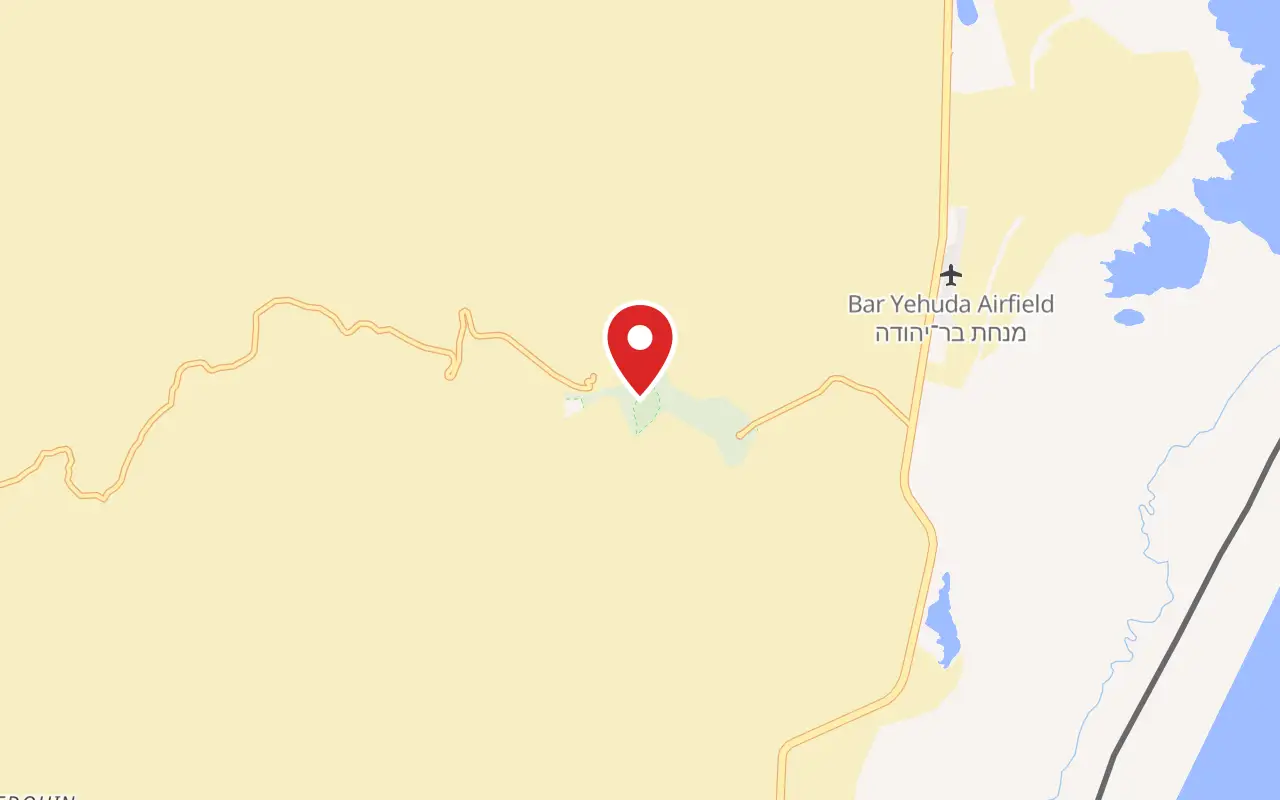
Where
Western side of the Masada plateau, against the middle of the western casemate wall, Masada National Park, Judaean Desert
What ticket you need
The Western Palace is inside Masada National Park, on the western side of the summit. The park entrance fee covers it and there is no separate ticket, gate or opening time. The cost and effort are in getting to the plateau: the cable car is charged on top of the entrance fee, and the Snake Path from the east and the Roman ramp trail from Arad on the west are free to walk but close on a heat schedule.
Opening hours
- The palace itself
- No separate hours: it is open whenever the plateau is, and there is no gate or ticket desk at the buildingsource
- Park, summer, Sunday to Thursday and Saturday
- 08:00 to 17:00source
- Park, summer, Friday and holiday eves
- 08:00 to 16:00source
- Park, winter, Sunday to Thursday and Saturday
- 08:00 to 16:00source
- Park, winter, Friday and holiday eves
- 08:00 to 15:00source
- Yom Kippur eve
- 08:00 to 12:00source
- Last entry and last cable car
- Entry to the park closes one hour before the stated closing time, and the last cable car ascends one hour before closingsource
- Walking up in heat
- In extreme summer heat the last ascent on the Snake Path is 07:00 and on the Roman ramp trail 11:00, set against the Israel Meteorological Service forecastsource
Admission
- The Western Palace
- No separate charge: it stands inside the park boundary and is covered by the park ticketsource
- Adult, park entry, cable car excluded
- ₪37source
- Child
- ₪21source
- Student, or adult in a group
- ₪31source
- Child in a group
- ₪18source
- Israeli senior citizen
- ₪19source
- Yigael Yadin museum, at the eastern entrance
- ₪20, by reservation onlysource
Access
Reachable without a climb, unlike much of Masada. The cable car and the summit bridge are wheelchair accessible, and on the plateau the parks authority lists concrete paths, toilets, railings on steps, benches, shaded gathering places and entry to most of the key sites and lookouts, with models and relief maps adapted for visually impaired visitors. The one exception it names anywhere on the summit is the descent through the Northern Palace, which is many steps; the Western Palace is not that, because it sits at plateau level. What the authority does not publish is a surface-by-surface account of the palace interior, so anyone using a wheelchair should expect an old excavated building with thresholds and uneven ground rather than a level gallery, and should use the coordination form the authority runs for accessible visits. The two walking routes up the mountain, the Snake Path and the Roman ramp trail, are both steep and stepped and are not an option.
On site
- Concrete paths and benches on the plateau
- Accessible toilets on the plateau
- Shaded gathering places
- Railings on steps
- Interpretive models and relief maps on the plateau
- No toilets, shade, water or shop inside the palace itself
Booking
Nothing is booked for the palace itself, but the parks authority asks visitors to reserve a time slot for Masada National Park online, and states that if the slot is full when you arrive you will be asked to show your reservation confirmation to get in. The Yigael Yadin museum at the eastern entrance, which displays finds from the excavations, is entered by reservation only and charged separately.
Hours and prices are given as the operator publishes them and change without much notice, particularly around Shabbat and the festivals. Check the operator's own page before you travel for this.
Official page at en.parks.org.il →What people wish they had known
- Cross the plateau early. The cable car and the Snake Path both land on the eastern side, the palace is against the western wall, and visitors who give the summit ninety minutes tend to run out of time and heat before they reach it.
- Look down rather than out. The mosaic pavements, the stepped pool and the four floor depressions are the point of this building; the views everyone photographs are at the northern tip, in a different palace.
- Do not take the words 'throne room' as settled. Yadin inferred it from four dents in the plaster, the parks authority prints it as a presumption, and Netzer argued the ceremonial rooms were in the Northern Palace instead.
- Assume standing walls are restored. Many buildings on the summit were conserved and reconstructed during the 1960s excavations and the parks authority does not publish which courses are which, so trust the floors rather than the elevations.
- Bring water up and leave food below. The parks authority asks visitors not to carry food onto the mountain, with picnic areas at the entrances instead, and there is nothing to buy on the plateau.
- Pair it with the museum, not with another palace. The finds from these rooms, the ostraca and the small objects, are down at the eastern entrance in the Yigael Yadin museum, which is ticketed separately and entered by reservation only.
The figures
The Western Palace by the numbers
Each figure carries the year it belongs to and links the source it came from.
| Measure | Figure | As of | Source |
|---|---|---|---|
| Floor area, as published by the operator | 3,700 sq m, the largest structure on Masada | 2026 | en.parks.org.il |
| Floor area, as given by the Encyclopaedia Judaica | nearly 4,000 sq m, about 37,500 sq ft | 2007 | encyclopedia.com |
| Wings in the complex | 4: official core, storerooms, service and workshops, administration | 2007 | encyclopedia.com |
| Depressions in the floor of the 'throne room' | 4, read by Yadin as sockets for the legs of a canopied throne | 2026 | en.parks.org.il |
| Diameter of the rebels' domed bread oven | 3 m, with a grinding post on each side of the door | 2007 | encyclopedia.com |
| Herod's reign in Judaea | 37 to 4 BCE | 2018 | static-en.parks.org.il |
| Adult park entry, which covers the palace | ₪37, cable car excluded | 2026 | en.parks.org.il |
| Area of Masada National Park | 3,400 dunams, taking in the plateau and both entrance areas | 2018 | static-en.parks.org.il |
While you are here
The rest of Masada
Everything else in this destination with a page of its own.
Godot13 / CC BY-SA 4.0 · Wikimedia Commons
Archaeological site
Herod's Northern Palace
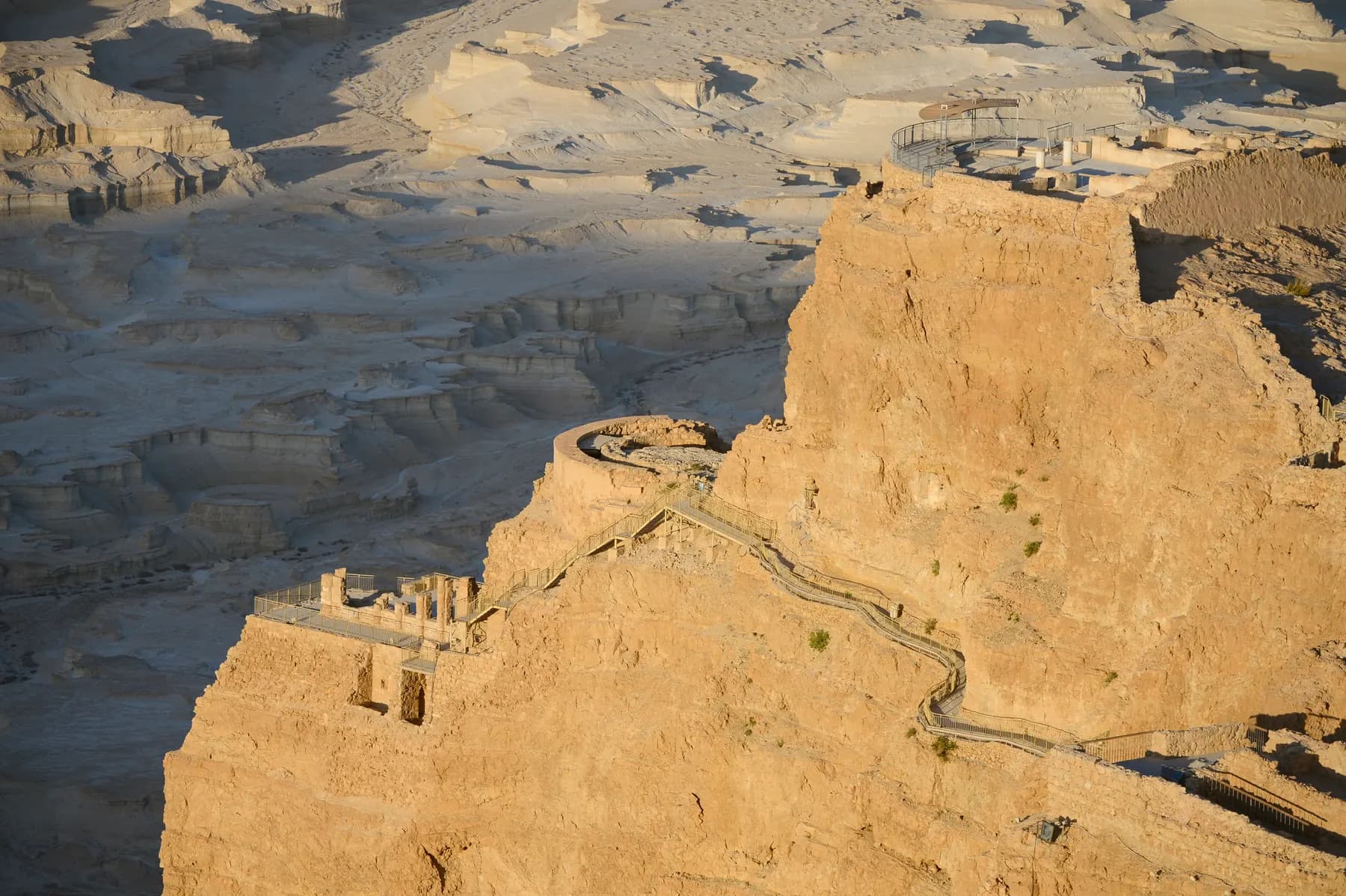
Herod's architects hung a private house on three rock terraces at the northern tip of Masada, with about 30 metres of height between the top terrace and the bottom one and retaining walls holding the lower two onto the cliff.
Carole Raddato from FRANKFURT, Germany / CC BY-SA 2.0 · Wikimedia Commons
Archaeological site
Herod's Large Bathhouse
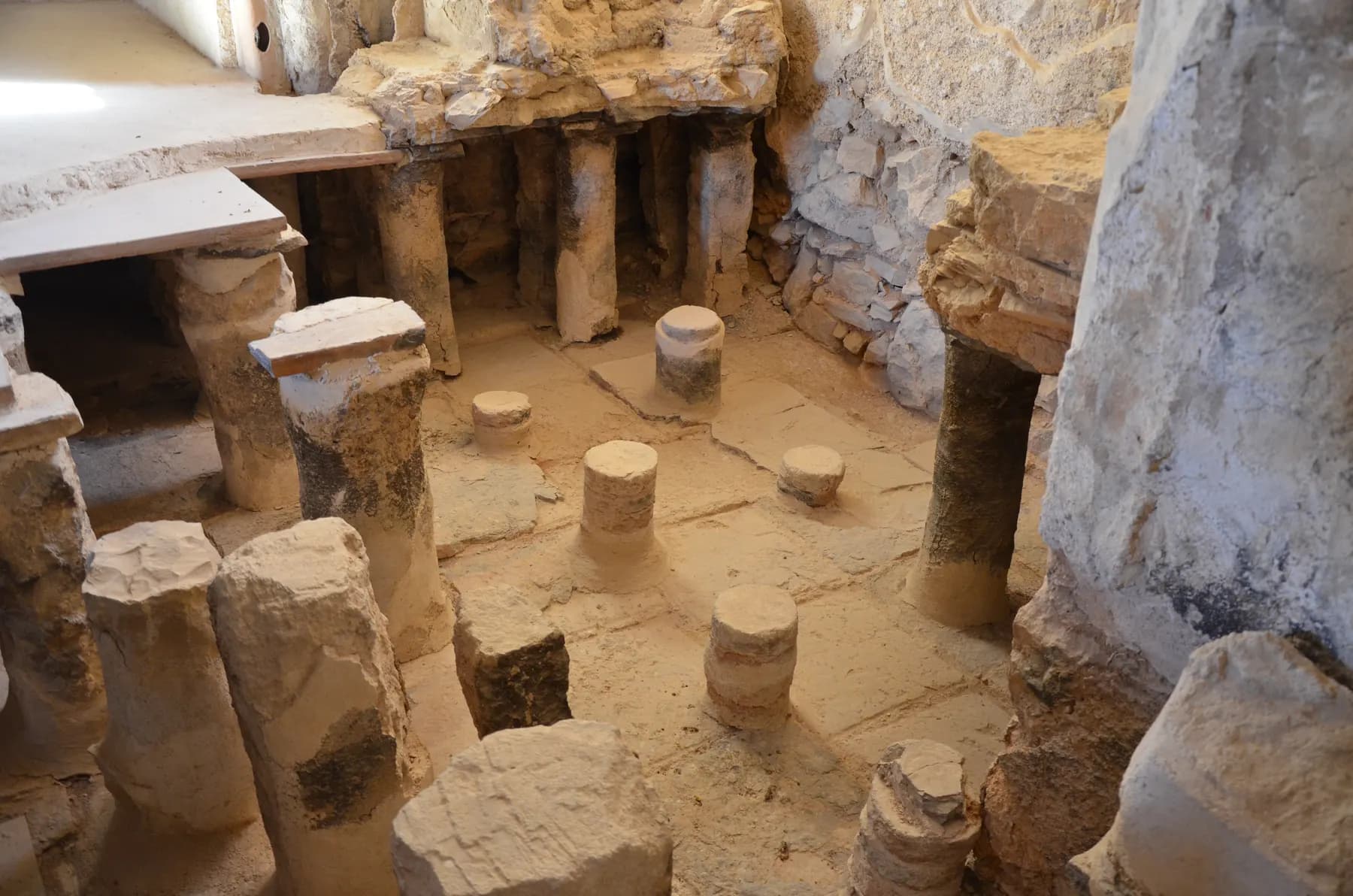
The floor of the hot room still stands on roughly 200 small columns, most of them brick, with the furnace stokehole, the wall flues and the stepped cold pool all in place around it.
Jan Helebrant / CC0 · Wikimedia Commons
Religious site
The Masada Synagogue
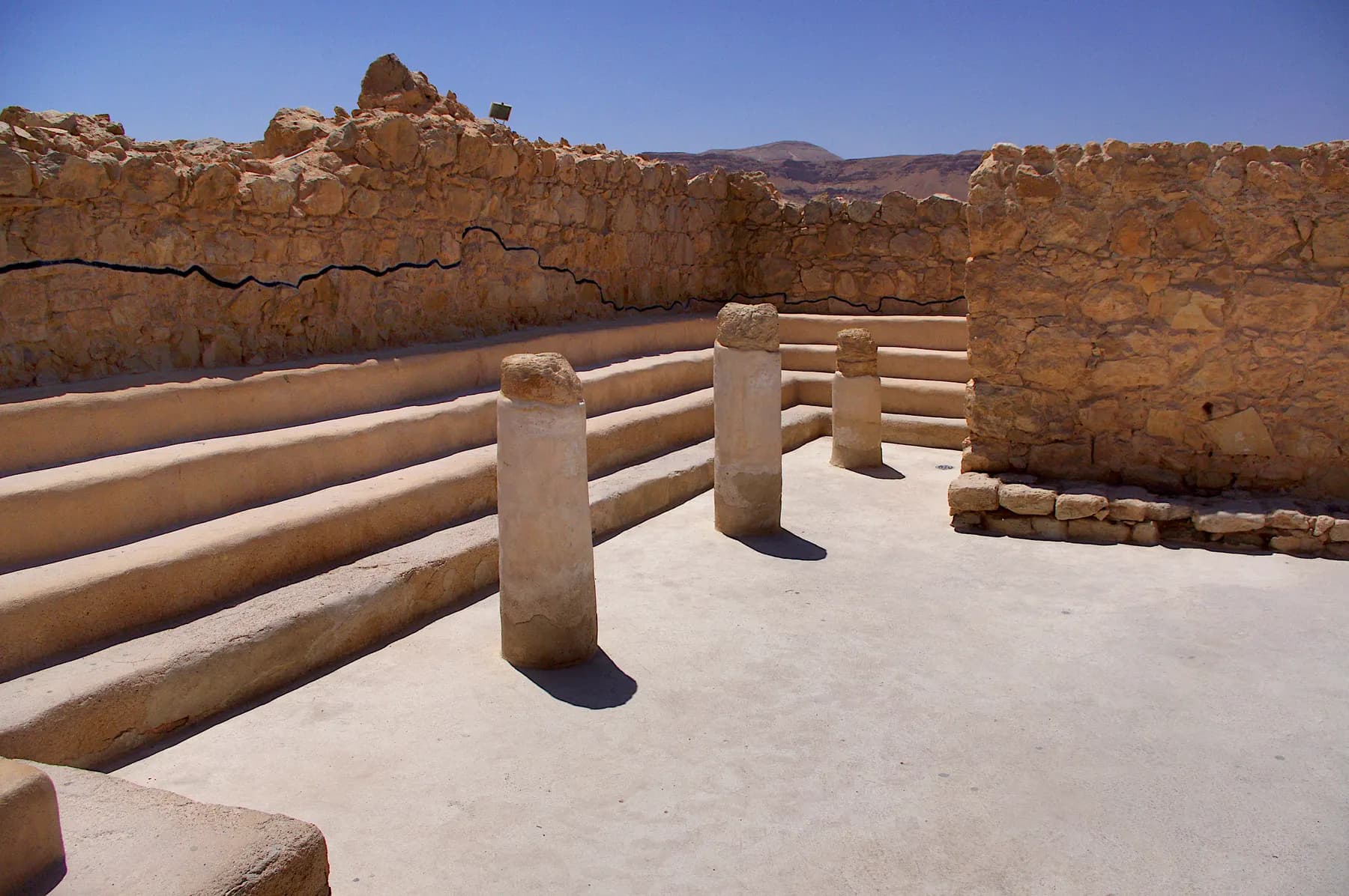
A rectangular room set into the northwestern casemate wall, used as a stable in Herod's day on the parks authority's account and rebuilt during the revolt with four tiers of plastered benches and two pits in the back room floor that held parts of Deuteronomy and Ezekiel.
Sources and further reading
Every link below was opened and checked when this page was written. Official statements are marked as such: they are the subject's own account, not an independent one.
- OfficialIsrael Nature and Parks Authorityen.parks.org.ilMasada National Park – The Plateau
The Western Palace as the largest structure on Masada at 3,700 sq m, the benches in the entrance room, the stucco wall decoration, the ground-floor chamber presumed to be the throne room and the four floor depressions, the staircase to the second storey and the view of the bathhouse mosaic, and the history of research from Robinson and Smith through Yadin to Netzer and Stiebel
- OfficialIsrael Nature and Parks Authorityen.parks.org.ilMasada National Park
Summer and winter opening hours, the Yom Kippur eve closing, last entry and last cable car one hour before closing, the heat schedule for the Snake Path and Roman ramp trail, entrance fees of ₪37 adult, ₪21 child, ₪31 student or adult in a group, ₪18 child in a group, ₪19 Israeli senior and ₪20 for the museum, the reservation system, and the plateau accessibility list
- OfficialIsrael Nature and Parks Authority, written by Guy Stiebel, content consultant Ehud Netzerstatic-en.parks.org.ilMasada National Park site brochure (English)
Herod's reign of 37 to 4 BCE and his use of Masada as refuge and winter palace, the statement that no architectural remains at Masada can be dated with certainty to the Hasmonean period, the Sicarii taking the rock in 66 CE, Yadin's 1963-65 excavations with buildings conserved and reconstructed and the park opening in 1966, Netzer's 1989 season and the renewed Hebrew University work from 1995 under Netzer, Stiebel and Foerster, the park's 3,400-dunam area, and the instruction not to carry food up the mountain
- OfficialIsrael Nature and Parks Authorityen.parks.org.ilWorld Heritage Sites
Masada inscribed on the UNESCO World Heritage List in 2001, in the same year as the Old City of Akko
- ReportingBiblical Archaeology Societybiblicalarchaeology.orgMasada Frescoes Restored and Returned
Frescoes uncovered in Yadin's 1960s excavations exposed to the elements and removed from the site for preservation, and the set from the commander's residence returned to Masada in 2014 after restoration led by Maurizio Tagliapietra of the University of Verona
- ReferenceEncyclopaedia Judaica, entry by Guy D. Stiebel, via Encyclopedia.comencyclopedia.comMasada
The Western Palace at nearly 4,000 sq m as the largest building on the site, its four wings, Yadin's ceremonial reading and Netzer's rejection of it, the central court and reception hall leading to the throne room, the four floor depressions, the richly coloured mosaic with circles and plant and geometric borders, the charcoal blueprint of the mosaic on a nearby plastered wall, the mosaic-paved bathrooms with tubs and a stepped cold pool, Netzer's three Herodian building phases, the dolomite and imported stone with Hebrew mason's marks, and the rebel-period storeroom with purity ostraca, the three-metre bakery oven with grinding posts, the bread receipts and the two smithies forging trilobate arrowheads
- ReferenceJewish Virtual Library, carrying the Israeli Ministry of Foreign Affairs accountjewishvirtuallibrary.orgMasada
The Western Palace at over 4,000 sq m or about an acre, its position along the centre of the western casemate wall near the main gate towards Judaea and Jerusalem, its role as the fortress's main administration centre and the king's ceremonial palace, the four wings named as royal apartment, service and workshop section, storerooms and administrative unit, the large southern room with two Ionic columns and moulded white stucco panels, the coloured mosaic floors on the eastern side and the largest room's floral and geometric floor within concentric square bands, and the hedge that this room may have been Herod's throne room
- ReferenceEncyclopaedia Britannicabritannica.comMasada
Herod's two ornate palaces on the rock, one of them on three levels; the excavation of the entire mountaintop by Yigael Yadin in 1963-65 with thousands of volunteers from around the world, revealing and clearing the palaces, storehouses, defence works and Roman siege works; and the cisterns holding nearly 750,000 litres
- ReferencePenelope, University of Chicagopenelope.uchicago.eduThe Wars of the Jews, Book VII (Whiston translation)
Josephus on the fortress first built by 'Jonathan the High-priest', on the wall of seven furlongs round the summit, and the single description of Herod's palace: 'he built a palace therein, at the western ascent. It was within, and beneath the walls of the citadel: but inclined to its north side'
- ReferencePrinceton University Press, Jodi Magnessassets.press.princeton.eduMasada: From Jewish Revolt to Modern Myth, chapter 1 (PDF)
The overwhelming majority of arrowheads at Masada coming from the lower terrace of the Northern Palace and the workshop in the Western Palace, both buried under collapse from conflagrations and so missed by the Roman clean-up that recovered the iron elsewhere on the mountain
The Western Palace: common questions
What is the Western Palace at Masada?+
It is the largest building on the Masada plateau, a Herodian complex of four wings set against the middle of the western casemate wall. The wings held an official core with a courtyard, reception hall and the room read as a throne room, plus storerooms, a service and workshop range and an administrative unit. The Israeli foreign ministry text describes it as the main administration centre of the fortress as well as the king's ceremonial palace.
How big is the Western Palace?+
The Israel Nature and Parks Authority publishes 3,700 square metres. The reference works give more: the Encyclopaedia Judaica entry says nearly 4,000 square metres and the foreign ministry text says over 4,000, about an acre. All three agree it is the largest building on the mountain, and none of them states what is counted inside the figure, which is the likeliest source of the gap.
Was it really Herod's throne room?+
Nobody knows. The reading rests on four depressions in the plastered floor of a ground-floor room, which Yigael Yadin took as the seating for the legs of a canopied throne. The parks authority describes the chamber as presumably the throne room and the foreign ministry text says it may have been one. No throne, and no other object from it, has been found.
Do I need a separate ticket for the Western Palace?+
No. It is inside Masada National Park and the park entrance fee covers it, with no separate gate or opening time. When the parks authority's Masada page was checked in 2026 the adult entrance fee excluding the cable car was ₪37 and the child fee ₪21. The cable car up is charged on top of that, and the Yigael Yadin museum at the eastern entrance is a further ₪20 by reservation only.
How long does it take to see?+
About half an hour is enough for the palace, inside the two to three hours a plateau visit normally takes. That covers the entrance room and its benches, the courtyard, the reception hall, the four floor depressions, the coloured mosaics and the bathroom with its stepped pool. Add time if you also want the storeroom and bakery the rebels installed in the same building.
Can I reach it in a wheelchair?+
Getting to it is the easy part, and the building itself is the uncertain part. The cable car and the summit bridge are wheelchair accessible and the plateau has concrete paths, railings, benches, accessible toilets and shaded gathering places, with the parks authority naming only the Northern Palace descent as an inaccessible route. It does not publish detail on surfaces inside the Western Palace, which is an excavated building with thresholds and uneven ground, so use the authority's coordination form for accessible visits before travelling. Neither walking route up the mountain is an option: both are steep and stepped.
What did the rebels use the palace for?+
As a working public building rather than as housing. The rebels of the Great Revolt lived in the rooms of the casemate wall and stripped the Herodian palaces of their decorative architecture, but they put Masada's largest storeroom in the Western Palace, its central bakery beside it, and two smithies forging iron arrowheads inside it. The storeroom's lines of vessels were each tagged with an ostracon declaring the line ritually pure or impure.
Is it worth it if I have already seen the Northern Palace?+
Yes, if floors interest you more than views. The Northern Palace is the spectacle, hanging on three terraces off the cliff; the Western Palace is the biggest building on the mountain and holds its coloured mosaic pavements, the throne-room depressions, the charcoal sketch of the mosaic design on a nearby wall, and the rebels' oven. They are also the two buildings the excavators disagreed about, which is easier to follow having stood in both.
Is there shade at the palace?+
Not inside it. The parks authority lists shaded gathering places among the plateau's facilities, but they are provided points rather than cover over the ruins, and the palace itself is open to the sun. In summer the mountain is climbed before dawn for exactly this reason, and the Snake Path can close to ascent as early as 07:00 in extreme heat.
Where exactly is it on the plateau?+
On the western side, set against the middle of the western casemate wall, near the gate that faced Judaea and Jerusalem. The cable car and the Snake Path both arrive on the eastern side, so reaching it means crossing the summit; the Roman ramp trail from Arad comes up on the same western flank.