Archaeological site · Masada
Herod's Large Bathhouse
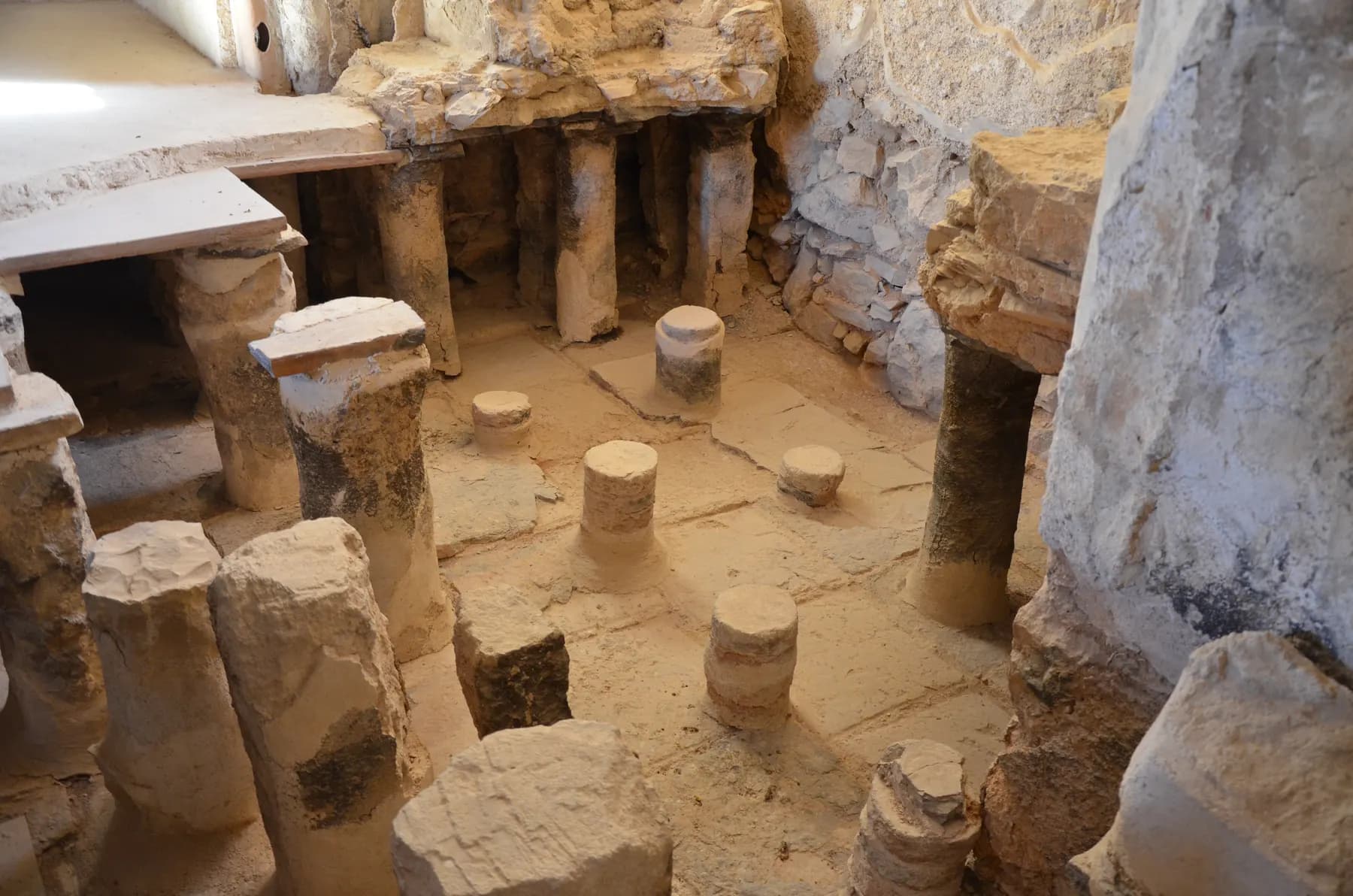
The floor of the hot room still stands on roughly 200 small columns, most of them brick, with the furnace stokehole, the wall flues and the stepped cold pool all in place around it.
Carole Raddato from FRANKFURT, Germany / CC BY-SA 2.0 · Wikimedia Commons
Columns under the hot room
about 200
mostly brick, holding up the caldarium floor, on Guy Stiebel's count in Encyclopaedia Judaica
Built
mid-20s BCE
Herod's main building phase, with the Northern Palace and the storerooms, per the ICOMOS evaluation
Rooms
4 and a court
changing room, stepped cold pool, warm room and hot room, off a colonnaded exercise yard
Rebuilt
anastylosis only
the level of intervention ICOMOS recorded across the summit in 2001
In short
- How long to give it
- about 25 minutes for the bathhouse and its court, inside the two to three hours most visitors give the plateau
- The bathhouse itself
- No separate hours or gate: it is open whenever the plateau is, and there is no ticket at the door
- Adult, park entry, cable car not included
- ₪37
בית המרחץ הגדול
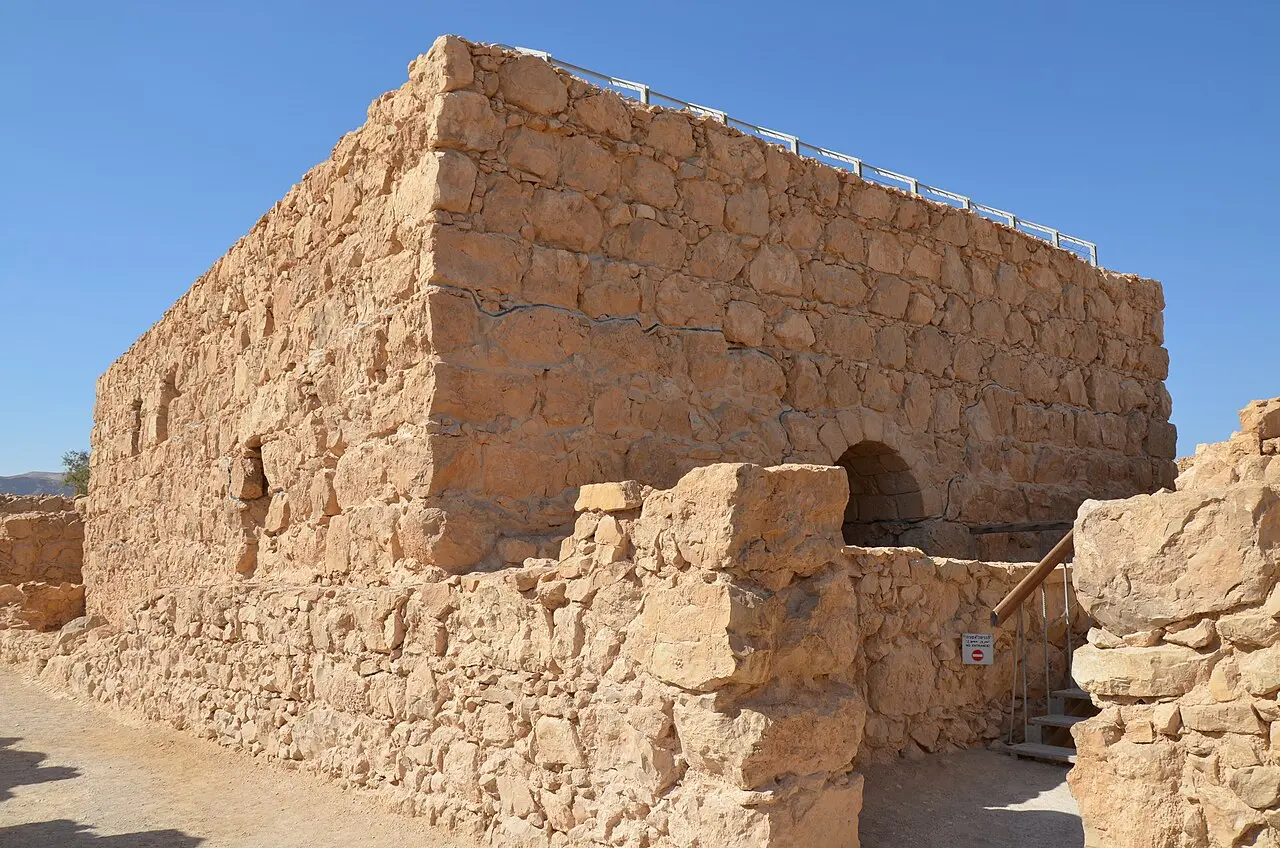
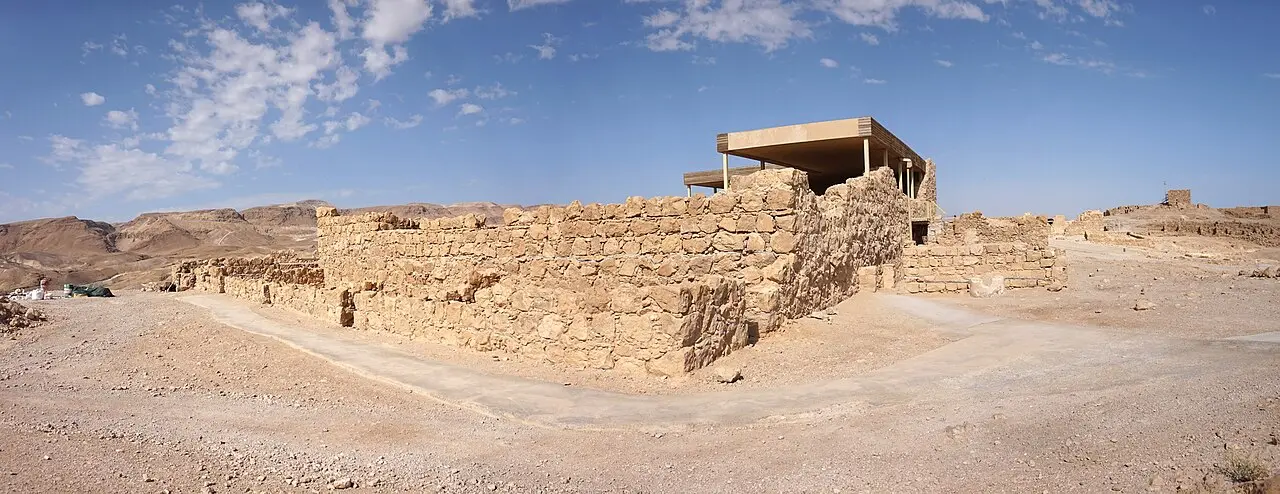
Herod's large bathhouse is a complete Roman bath suite standing on a low rise at the northern end of the Masada summit, a few paces south of the Northern Palace and next door to the long storerooms. It is the building most visitors walk into first after the cable car, and the one where the machinery of a Roman bath is easiest to read: a colonnaded yard for exercise, a changing room with a decorated floor, a stepped pool of cold water, a warm room, and a hot room whose floor is still held above its furnace by rows of stubby columns.
The Israel Nature and Parks Authority, which runs the site, describes the bathhouse as built in Roman style with all its rooms well preserved. That is unusual language for an operator to use about a first-century building, and it is roughly what the record supports. The advisory body report ICOMOS prepared for the 2001 World Heritage inscription noted the palaestra court, the changing room, the stepped pool, and a large hot room that once carried a barrel vault, together with the remains of the heating furnaces and the water installations.
What makes the building worth more than a glance is the layer on top of Herod. The rebels who held Masada from 66 CE lived in a Roman bathhouse and altered it to suit them, cutting an immersion pool into the changing room floor and building a bench out of dismantled column drums. When the Romans took the rock, someone from Legio X Fretensis wrote on a wall in charcoal, and twenty-two potsherds inscribed in Latin with legionaries' names turned up in the ground nearby. Three occupations, in one small building, in the order they happened.
The setting
A bath on the acropolis, between the palace and the granary
The bathhouse sits on a small hill immediately south of the Northern Palace, on the high ground at the northern tip of the plateau. ICOMOS describes that cluster, the palace, the bathhouse and a storage complex of eighteen long rooms, thirteen of them 26 metres long, as a defensible acropolis at the highest point of the hilltop. Encyclopaedia Judaica places the public storerooms east and south of the bathhouse, so the building a visitor walks through today is boxed in on two sides by what was once the food supply of the mountain.
It went up in Herod's main building phase, which ICOMOS dates to the mid-20s BCE, alongside the Northern Palace, the storerooms and the great cisterns. That is the phase in which, on the same reading, the architecture at Masada stops being scattered and becomes Roman in style and tradition, laid out to a plan in two complexes, one around each palace.
Who it was for is not settled. ICOMOS calls it the large bathhouse "for the use of the king and his family and guests". The Israeli foreign ministry's account, republished by the Jewish Virtual Library, says it "probably served the guests and senior officials of Masada", and points out that Herod already had a private bathhouse of his own on the lowest terrace of the Northern Palace, a few minutes' walk downhill. Both can be true of a building used across forty years, and neither is anchored in an inscription.
- On a low rise just south of the Northern Palace, at the north end of the summit
- Storerooms east and south of it: 18 long rooms, 13 of them 26 m
- Built in the main Herodian phase, mid-20s BCE
- A second, smaller bathhouse belongs to Herod's private quarters on the lower terrace
Carole Raddato from FRANKFURT, Germany / CC BY-SA 2.0 · Wikimedia Commons
The sequence
Court, changing room, cold plunge, warm room, hot room
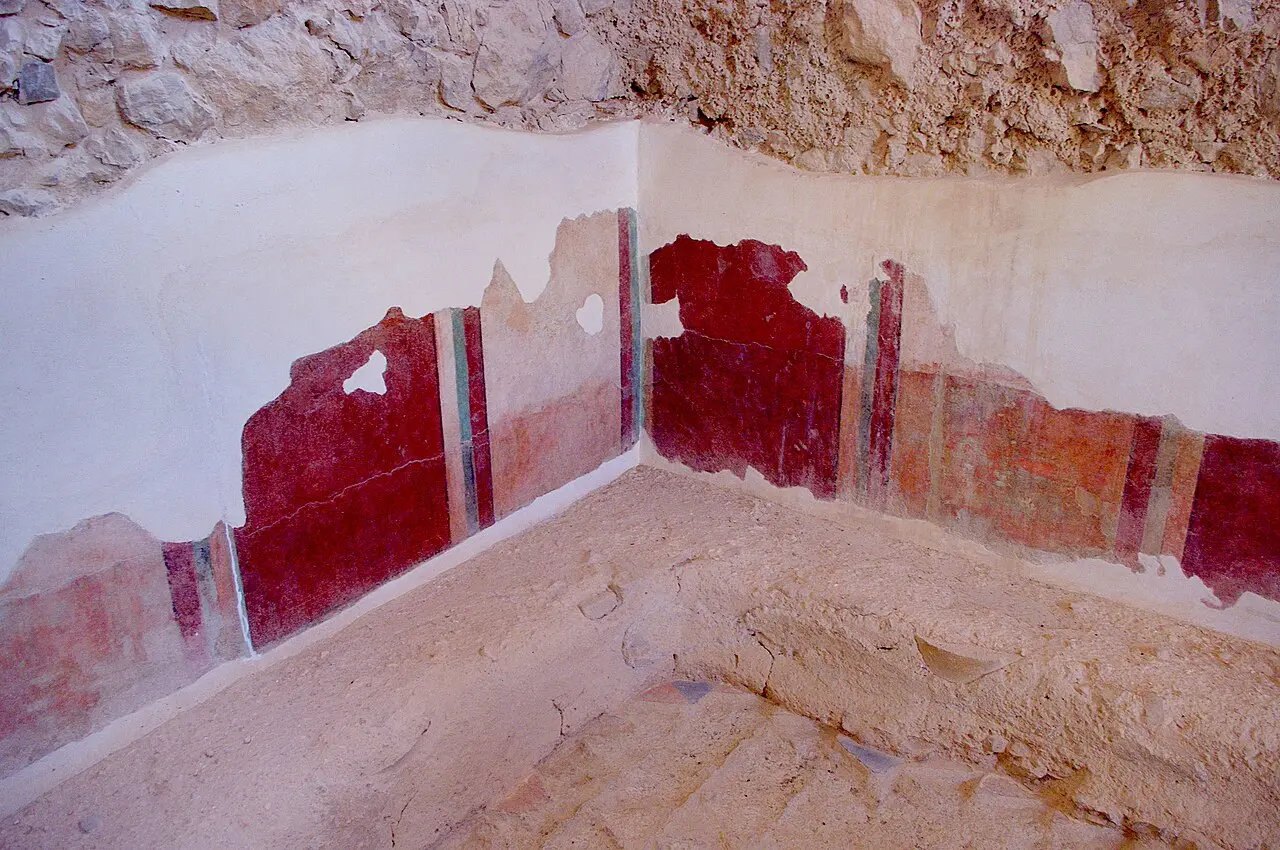
A Roman bath is a route rather than a room, and this one still reads as a route. The parks authority's description starts at the entrance courtyard surrounded by columns, which served as exercise space, the palaestra of a Roman bath. From there the bather went into the dressing room, the apodyterium, which the authority describes as decorated with frescoes and special floor tiles. An opening in its wall leads to the stepped pool of the cold room, the frigidarium. From the warm room, the tepidarium, an opening on the east side leads into the hot room, the caldarium.
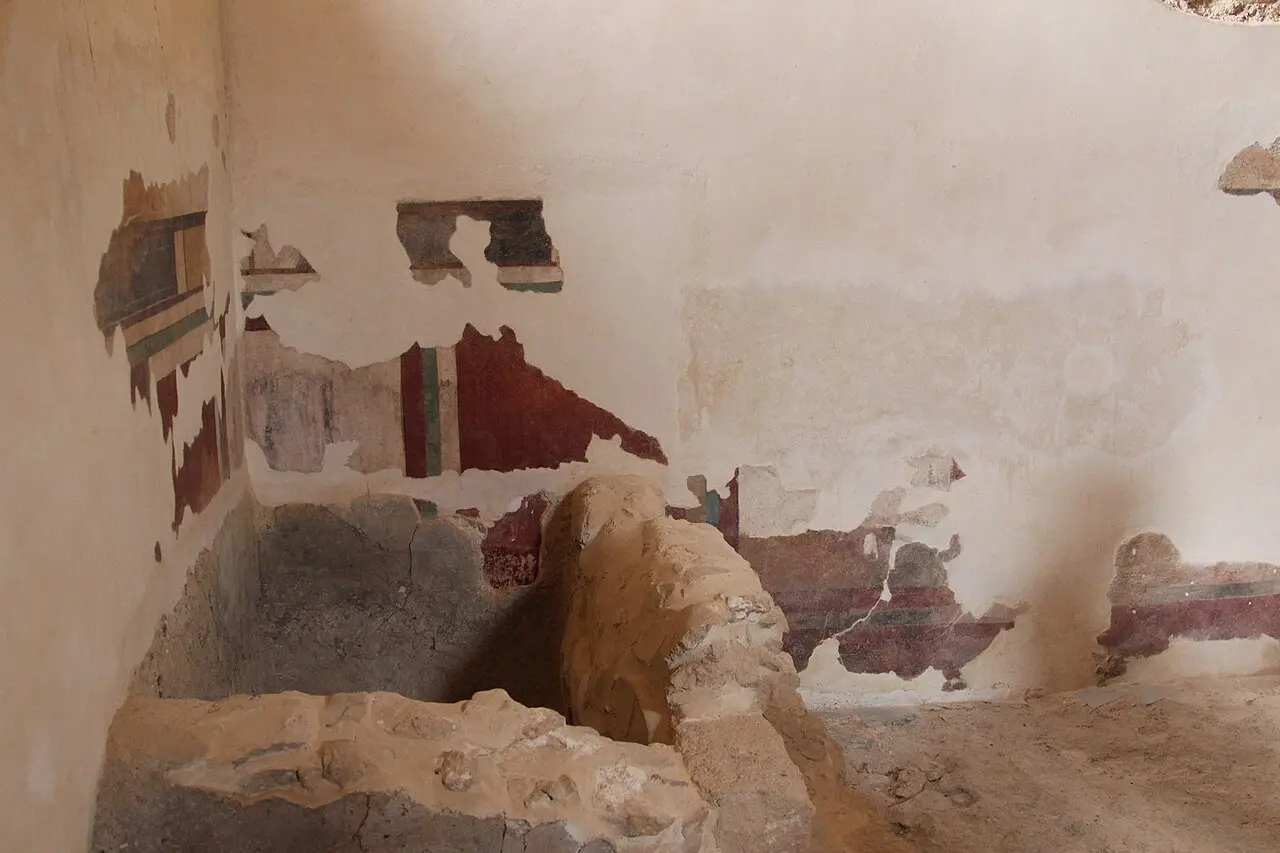
The finishes changed during the building's life. ICOMOS records that the whole complex was originally laid with mosaic floors and wall paintings, and that the floor mosaics were later replaced with coloured stone slabs, opus sectile. Encyclopaedia Judaica is more specific: mosaic in every room except the cold one, replaced by pink and black triangular tiles, with frescoes on the walls throughout. It also notes a Greek inscription praising the tyche found on the changing room wall, which is the sort of thing that survives in a bathhouse and nowhere else.
One caution about labels. The parks authority and Encyclopaedia Judaica both identify the stepped pool as the frigidarium, the cold room. The ICOMOS evaluation calls the same stepped pool a tepidarium. Nothing on the ground changes either way, but the room names on a signboard and the room names in a report do not always agree, and this is one of the places where they do not.
- Palaestra: a courtyard ringed with columns, used for exercise
- Apodyterium: the changing room, frescoed, with a decorated floor
- Frigidarium: a stepped pool entered through an opening in the wall
- Tepidarium: the warm room, opening east into the hot room
- Caldarium: the hot room, the largest, once barrel-vaulted
Jan Helebrant / CC0 · Wikimedia Commons
The hot room
A floor on two hundred little columns
The caldarium is the reason to slow down. Its floor was never laid on the ground: it was suspended, and it still is. Encyclopaedia Judaica puts the count at about 200 tiny columns, mostly made of bricks, standing in rows in the void underneath. That void is the hypocaust. A furnace outside drove hot air into it, and the air passed under the floor and then up the walls through clay pipes set inside a double skin, so that the whole shell of the room radiated heat rather than a single hearth.
The Israeli foreign ministry's description of the same room is written from the engineer's end and matches: a suspended floor supported by rows of low pillars, making it possible to blow hot air from the furnace outside, under the floor and through clay pipes along the walls, to heat the room to the desired temperature. ICOMOS adds that the caldarium had a barrel-vaulted roof and that the remains of the heating furnaces and the water installations are still on site.
Water arrived hot at the far end. Encyclopaedia Judaica records hot water running into a bathtub and into a quartz fountain set in the room's niches. What a visitor sees now is the underside of the system rather than the surface of it: the columns bare, a section of the raised floor slabs still bridging them at one side, and the flue channels open in the wall. The parks authority adds that the bathhouse roof gives a view over the entire plateau, without saying how the roof is reached.
Logistics
Running a steam room where it does not rain
A bathhouse in the Judaean Desert is an argument about water, and the answer is on the slope below. ICOMOS records two rows of rock-cut cisterns dug in the main phase: a lower row of four, 130 metres below the summit, each holding 4,000 cubic metres, and an upper row of eight, 50 metres higher, each able to take 3,000 cubic metres. Encyclopaedia Judaica gives a dozen cisterns totalling about 40,000 cubic metres, which is the same system counted the same way. Dams and plastered channels in the wadis west of the mountain diverted winter floodwater into them.
Getting it from there to the bath was a haul. Encyclopaedia Judaica identifies the northern gate in the casemate wall, the water gate, as standing near the bathhouse and serving mainly to bring water up from the upper row of cisterns. The gate and the bathhouse are neighbours for a reason: every bath drawn here had been carried through that opening by hand or by animal, from a cistern that had filled during a flash flood that might not come.
Josephus, who never saw the place, was told enough about it to be right in outline. Writing of Herod's works on the rock he says that the furniture of the buildings, of the cloisters and of the baths was of great variety and very costly, and that the walls and floors were paved with stones of several colours. The opus sectile underfoot in the changing room is that sentence, checked.
After Herod
An immersion pool in the changing room, Latin names in the soil
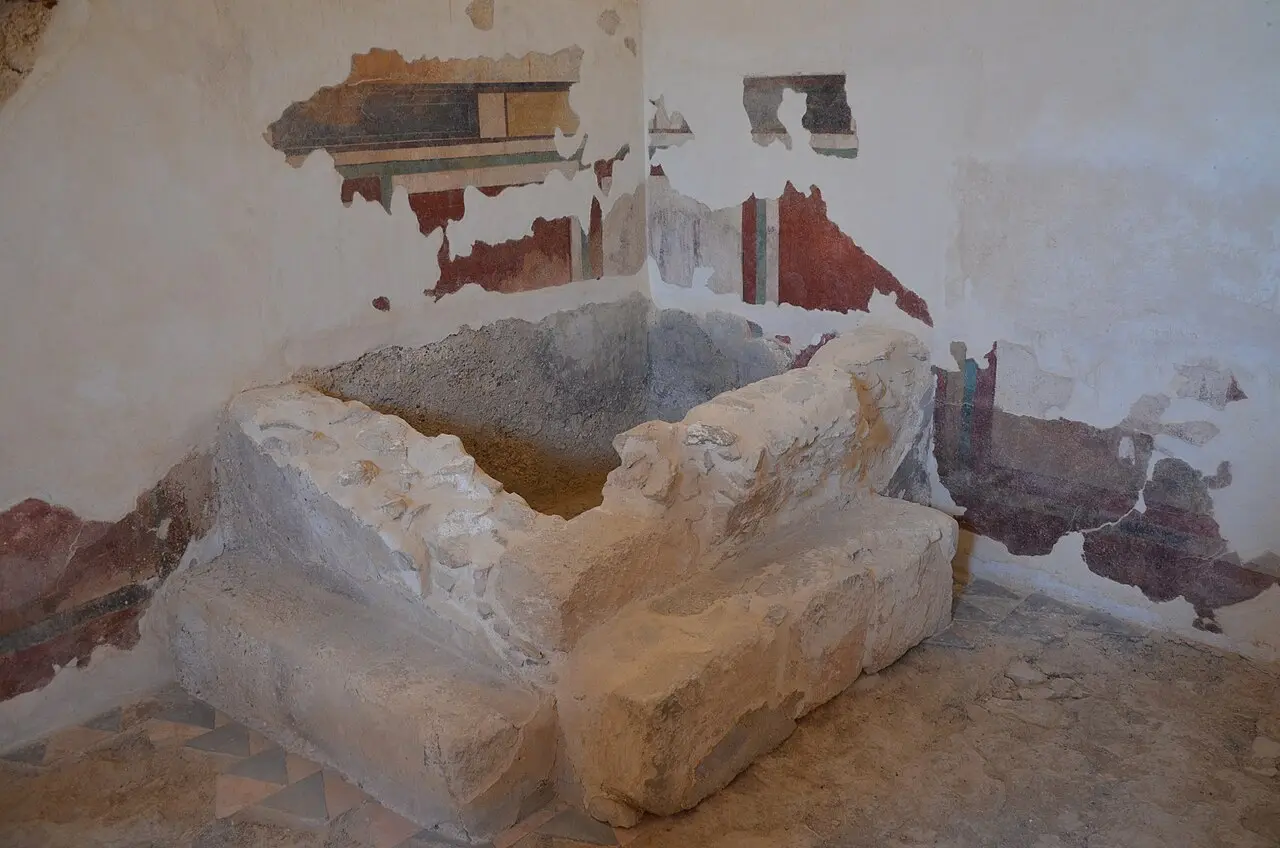
The rebels took Masada in 66 CE and stayed until 73 or 74 CE, and they did not leave the bathhouse alone. The parks authority states that during the revolt a ritual immersion installation was built in the dressing room. Encyclopaedia Judaica describes the same alteration in more detail: an immersion pool, and a bench made from dismantled pillar drums, put into a room that had been Herod's changing room. Two sources, one operator and one reference work, describing the same intervention independently.
That fits the wider picture on the summit. ICOMOS records seven or eight ritual baths identified at Masada, including a large stepped immersion pool south of the Western Palace. Britannica goes further and says the synagogue and ritual bath found on Masada are the earliest yet found in Palestine. Whatever else the people on the rock were, they were building miqva'ot inside a Roman leisure building, using its own columns as the raw material.
The last layer is Roman again. Encyclopaedia Judaica reports a charcoal graffito of Legio X Fretensis in the bathhouse, left by the soldiers who took the place. Jodi Magness, who has excavated at Masada, records twenty-two ostraca inscribed in Latin with the names of Roman soldiers found in the vicinity of the large bathhouse, among them Aemilius, Fabius and Terentius, and notes that they are unusual in being written on the inside of the sherd rather than the outside. A garrison stayed on at Masada into the early second century, and this is one of the few buildings on the mountain where its handwriting survives.
- Immersion pool cut into the Herodian changing room during the revolt
- Its bench built from dismantled column drums
- Charcoal graffito of Legio X Fretensis on a bathhouse wall
- 22 Latin ostraca with legionaries' names found nearby
Carole Raddato from FRANKFURT, Germany / CC BY-SA 2.0 · Wikimedia Commons
Honest looking
What is Herod's, and what went back up in the 1960s
Yigael Yadin's Hebrew University expedition excavated Masada from 1963 to 1965 and uncovered most of the structures on the summit. The parks authority's own brochure says plainly that during the excavations many buildings were conserved and reconstructed, and that the national park opened in 1966 once the site had been prepared for visitors. Conservation and restoration have been the parks authority's job ever since.
How much of that counts as rebuilding is the question a visitor actually wants answered, and the fullest published answer is in the ICOMOS evaluation written for the World Heritage nomination. It found that the buildings had collapsed gradually and lain covered until the 1960s, and that there have been "no additions or reconstruction (beyond an acceptable level of anastylosis)". Anastylosis means re-erecting the original fallen pieces in their original positions, which is a different act from building a replica, though the visual result can look similar from a distance.
The same report is blunt about the first round of work. Conservation began the moment the excavators moved out, following a plan drawn up by a committee of specialists to the prevailing standards of the day, which involved Portland cement, and ICOMOS noted in 2001 that the cement was by then almost entirely replaced. So the honest description of the caldarium is that the columns, the flue pipes and the fabric are ancient, that fallen elements have been stood back up, and that some of the mortar holding the whole thing together is modern and has itself been changed once already.
Masada's management plan rules out further research excavation on the summit "in the present generation", allowing limited digging only where conservation requires it.
Fallaner / CC BY-SA 4.0 · Wikimedia Commons
What to look for
Things not to walk past at Herod's Large Bathhouse
The details that repay knowing about before you are standing in front of them.
The hypocaust under the caldarium
Rows of short brick columns, about 200 of them, standing in the void that once carried hot air under a suspended floor. A section of the floor slabs is still bridging them at one side, which is what makes the arrangement legible rather than abstract.
The clay flue pipes in the wall
The hot room was heated through its walls as well as its floor, by air drawn up through pipes set inside a double skin. The openings are visible where the plaster has gone.
The stepped cold pool
Reached through an opening in the wall of the changing room, and the one room whose floor the excavators found without mosaic. It is the plunge at the cold end of the Roman sequence.
The immersion pool the rebels cut in
The parks authority records a ritual immersion installation built into Herod's dressing room during the revolt, with a bench made from column drums taken from the building itself.
The colonnaded exercise court
The entrance yard, ringed with columns, which the parks authority identifies as exercise space and ICOMOS reads as the palaestra. It is the part most people cross without registering that it was a room.
The storerooms next door
Eighteen long rooms, thirteen of them 26 metres, wrapped around the bathhouse on two sides. Bath and granary were built together as one complex on the high ground.
The long view
Herod's Large Bathhouse, in order
c. 35 BCE
Herod's early building phase on the rock: the nucleus of the Western Palace, three small palaces, an administrative building, barracks, three columbaria, several large cisterns and a swimming pool. No large bathhouse yet.
mid-20s BCE
The main phase. The large bathhouse is built alongside the Northern Palace and the storerooms, in full Roman style and to a plan, and the two great rows of cisterns are cut into the slope below.
c. 15 BCE
The final Herodian phase, dominated by the casemate wall around the summit. The water gate, which stands near the bathhouse and brought water up from the upper cisterns, is not incorporated into it.
66 CE
Rebels seize Masada at the start of the Great Revolt. During their occupation an immersion pool and a bench of dismantled column drums are built into the bathhouse changing room.
73 or 74 CE
Masada falls to the Tenth Legion under Flavius Silva. A charcoal graffito of Legio X Fretensis is left in the bathhouse, and Latin ostraca bearing legionaries' names end up in the ground nearby.
1963 to 1965
Yigael Yadin's Hebrew University expedition excavates nearly the whole summit. Buildings are conserved and reconstructed as the dig proceeds, using Portland cement in line with the standards of the day.
1966
Masada National Park opens to the public, after the site is prepared for visitors.
2001
UNESCO inscribes Masada. The ICOMOS evaluation records no additions or reconstruction beyond an acceptable level of anastylosis, and notes that the early cement is by then almost entirely replaced.
Practical
Visiting Herod's Large Bathhouse
Where
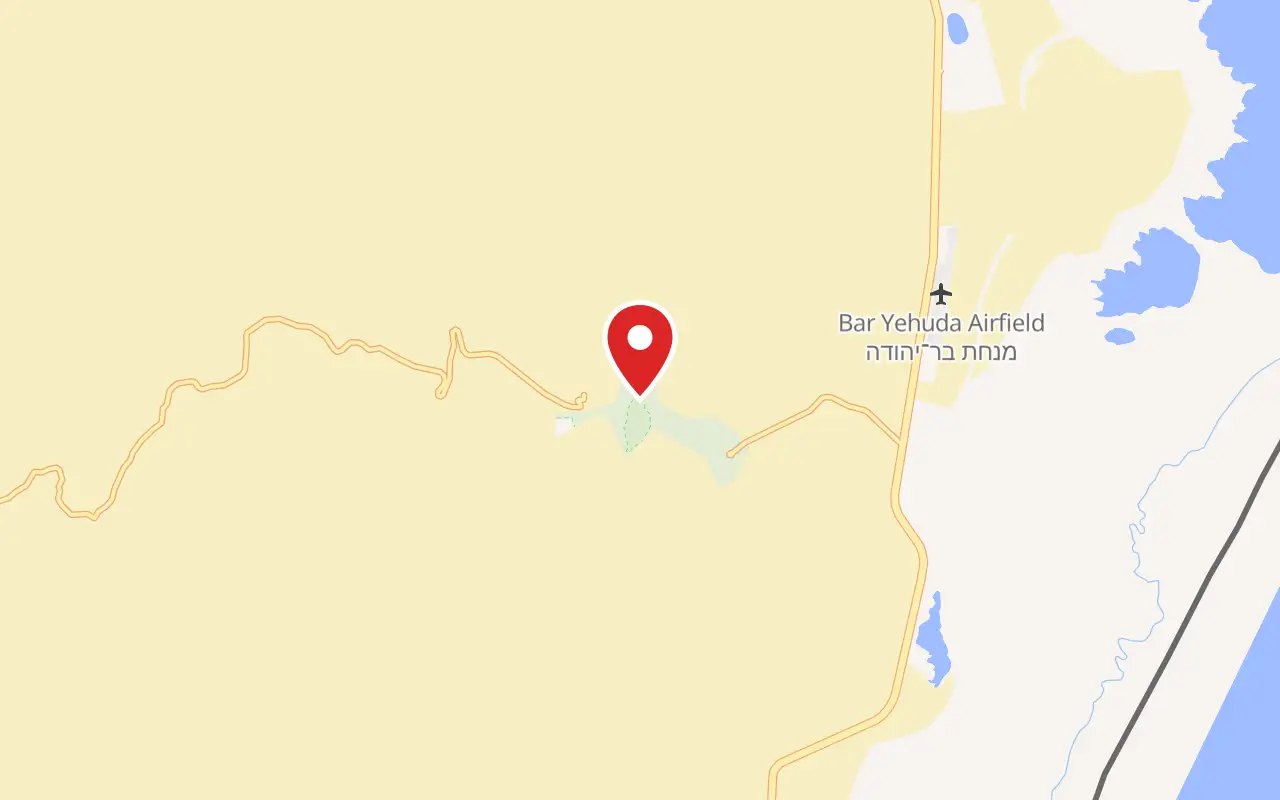
Northern end of the Masada plateau, south of the Northern Palace, Masada National Park, Judaean Desert
What ticket you need
The bathhouse sits inside Masada National Park, on the summit near its northern end. The park entrance fee covers it, and there is no separate gate, ticket or opening time. What costs extra is getting to the top: the cable car is charged on top of the entrance fee, while the Snake Path and the Roman ramp trail are free to walk but close on a heat schedule set against the Israel Meteorological Service forecast.
Opening hours
- The bathhouse itself
- No separate hours or gate: it is open whenever the plateau is, and there is no ticket at the doorsource
- Park, summer, Sunday to Thursday and Saturday
- 08:00 to 17:00source
- Park, summer, Friday and holiday eves
- 08:00 to 16:00source
- Park, winter, Sunday to Thursday and Saturday
- 08:00 to 16:00source
- Park, winter, Friday and holiday eves
- 08:00 to 15:00source
- Yom Kippur eve
- 08:00 to 12:00source
- Last entry
- Entry to the park closes one hour before the stated closing time, and the last cable car up leaves one hour before closingsource
- Walking up in heat
- In normal hot weather the last ascent on the Snake Path is 10:00; when it is very hot, 08:00; in extreme summer heat, 07:00, with the Roman ramp trail closing to ascent at 11:00 on those dayssource
Admission
- Adult, park entry, cable car not included
- ₪37source
- Child
- ₪21source
- Student, or adult in a group
- ₪31source
- Child in a group
- ₪18source
- Israeli senior citizen
- ₪19source
- The bathhouse
- No separate charge: it stands inside the park boundary on the plateau and is covered by the park ticketsource
- Yigael Yadin museum at the eastern foot
- ₪20, by reservation only, holding finds from the summitsource
Access
Reaching the plateau without steps is possible: the parks authority states that the cable car and the bridge at the top are wheelchair accessible, and that the plateau itself has concrete paths, toilets, railings on steps, benches and shaded gathering places, with entry to most of the key sites and lookouts. The bathhouse is one of those key sites, and unlike the Northern Palace, which the authority singles out as a descent by many steps, it is not flagged as a problem. Two honest caveats. The floors inside a first-century bathhouse are uneven, and the parks authority mentions the view from the bathhouse roof without stating how the roof is reached, so nobody should plan a route around getting up there. The authority runs a coordination form for accessible visits, and its models and relief maps on the plateau are adapted for visually impaired visitors.
On site
- Concrete paths on the plateau
- Accessible toilets on the plateau
- Shaded gathering places nearby
- Benches and railings on steps
- Interpretive models and relief maps
- No shade, water or toilets inside the building itself
Booking
There is nothing to book for the bathhouse. The parks authority does ask visitors to reserve a time slot for Masada National Park online, and says that if the slot is full when you arrive you will be asked to show the reservation confirmation to get in.
Hours and prices are given as the operator publishes them and change without much notice, particularly around Shabbat and the festivals. Check the operator's own page before you travel for this.
Official page at en.parks.org.il →What people wish they had known
- Go in before the Northern Palace, not after. Most people come off the cable car, head straight for the palace terraces and arrive at the bathhouse tired and out of time, when it is the closer building and the quicker one.
- Look down before looking around. The single thing worth seeing here is under the floor, and the run of small columns in the hypocaust is easy to walk past as rubble if nobody has said what it is.
- Do not expect a signposted route through the rooms in bathing order. The building is entered as convenient rather than as a Roman would have used it, so work out where the court, the changing room, the cold pool and the hot room are before deciding which way to walk.
- Treat room labels with mild caution. The parks authority and Encyclopaedia Judaica call the stepped pool the frigidarium; the ICOMOS report calls it a tepidarium. The stones are the same either way.
- It is indoors in name only. Roofless rooms in the Judaean Desert give no useful shade at midday, so this is not the place to plan a rest, and the shaded gathering places on the plateau are.
- The braided hair and the small finds are not here. They came out of the small bathhouse on the Northern Palace's lower terrace and are shown at the Yigael Yadin museum at the eastern foot, which is a separate ticket and entry by reservation.
The figures
Herod's Large Bathhouse by the numbers
Each figure carries the year it belongs to and links the source it came from.
| Measure | Figure | As of | Source |
|---|---|---|---|
| Columns under the caldarium floor | about 200, mostly of brick | 2007 | encyclopedia.com |
| Date of the main building phase, which produced the bathhouse | mid-20s BCE | 2001 | whc.unesco.org |
| Storerooms beside the bathhouse | 18 rooms, 13 of them 26 m long | 2001 | whc.unesco.org |
| Cistern capacity feeding the summit | 4 cisterns of 4,000 cubic metres 130 m below the summit, and 8 of 3,000 cubic metres 50 m higher | 2001 | whc.unesco.org |
| Latin ostraca with soldiers' names found near the large bathhouse | 22, including Aemilius, Fabius and Terentius | 2019 | assets.press.princeton.edu |
| Ritual baths identified across the Masada summit | 7 or 8, including the one cut into this bathhouse | 2001 | whc.unesco.org |
| Adult park entry, which covers the bathhouse | ₪37, cable car not included | 2026 | en.parks.org.il |
| Yadin's excavation seasons | 1963 to 1965, uncovering most of the structures on the summit | 2018 | static-en.parks.org.il |
While you are here
The rest of Masada
Everything else in this destination with a page of its own.
Godot13 / CC BY-SA 4.0 · Wikimedia Commons
Archaeological site
Herod's Northern Palace
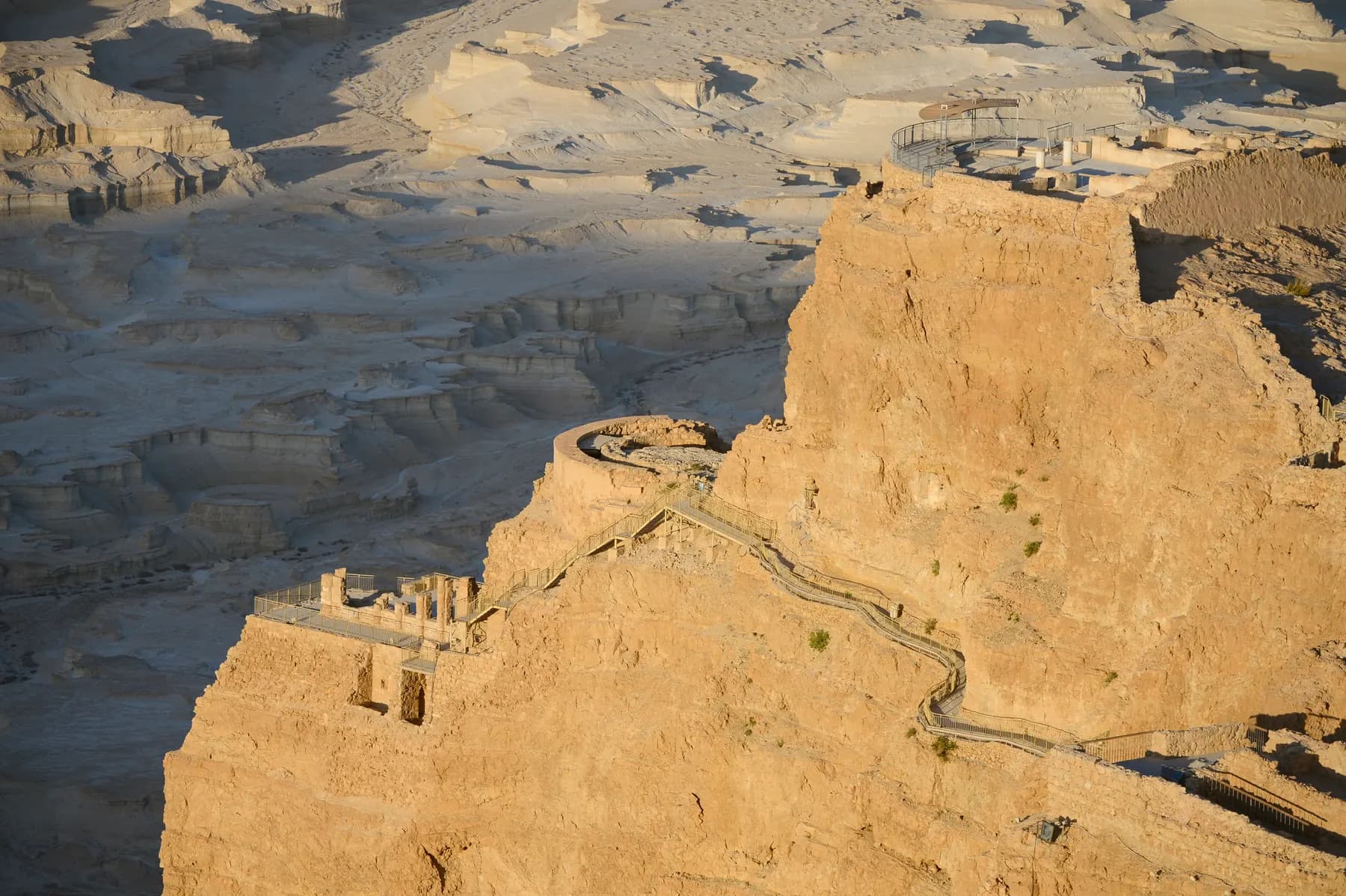
Herod's architects hung a private house on three rock terraces at the northern tip of Masada, with about 30 metres of height between the top terrace and the bottom one and retaining walls holding the lower two onto the cliff.
Tribun militum / CC BY-SA 4.0 · Wikimedia Commons
Archaeological site
The Water Cisterns and Water System
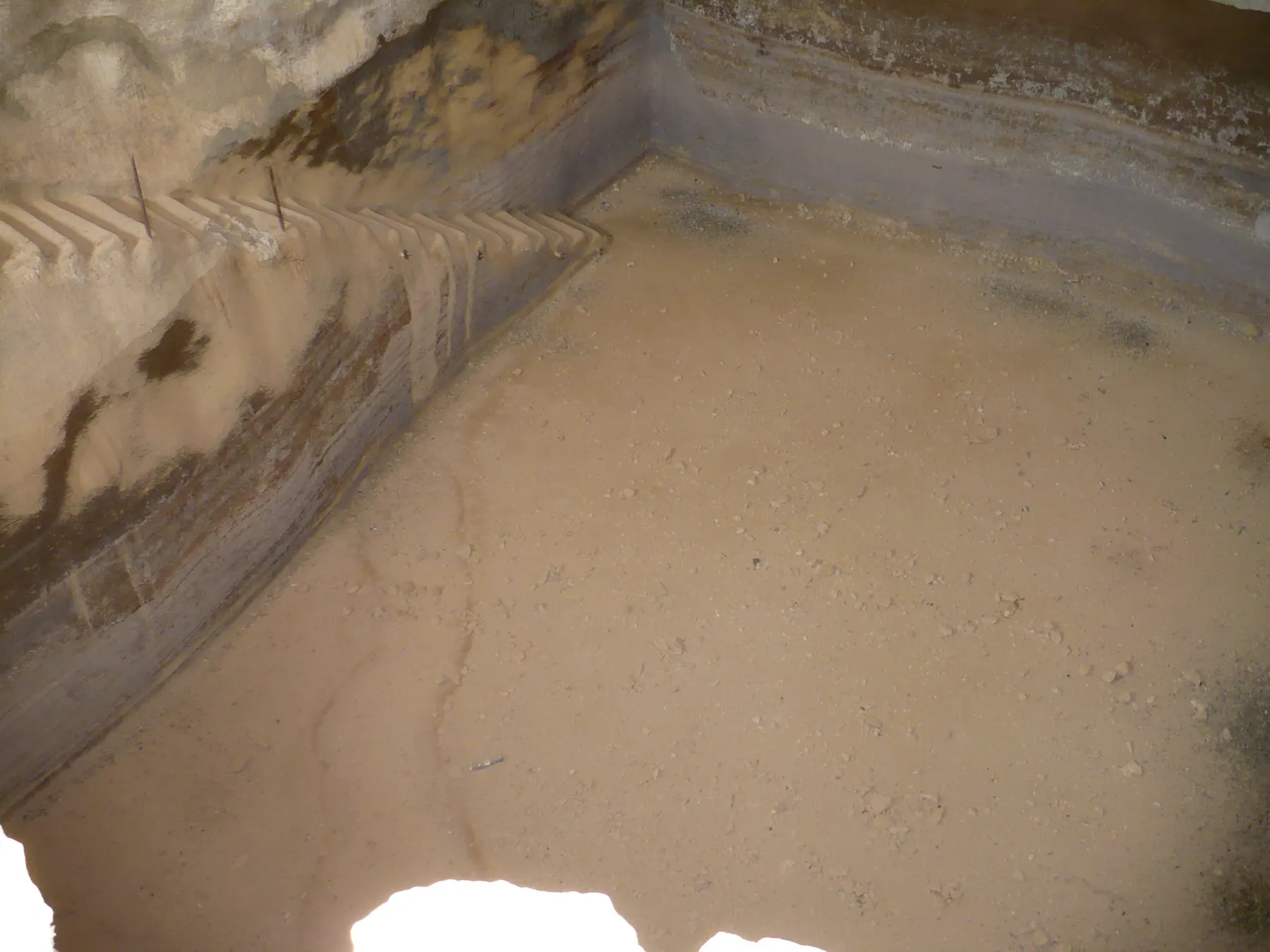
Dams built in the wadi beds diverted flash floods into plastered channels that filled twelve cisterns cut in two rows into the slope, and the parks authority puts their combined capacity at 40,000 cubic metres.
Tiia Monto / CC BY-SA 3.0 · Wikimedia Commons
Archaeological site
The Western Palace
The Israel Nature and Parks Authority puts this building at 3,700 square metres, which makes it the largest on the Masada plateau, and its four wings held Herod's reception rooms, his storerooms, his workshops and his administration.
Sources and further reading
Every link below was opened and checked when this page was written. Official statements are marked as such: they are the subject's own account, not an independent one.
- OfficialIsrael Nature and Parks Authorityen.parks.org.ilMasada National Park: The Plateau
The operator's own account of the bathhouse: built in Roman style with all its rooms well preserved, an entrance courtyard surrounded by columns serving as exercise space, the dressing room (apodyterium) decorated with frescoes and special floor tiles, the ritual immersion installation built there during the revolt, the opening leading to a stepped pool in the cold room (frigidarium), the opening east from the tepidarium into the hot room (caldarium) where the floor rests on small columns, hot air flowing through clay pipes in the walls, and the view of the whole plateau from the bathhouse roof. Also the small bathhouse on the Northern Palace's lower terrace with three skeletons and a woman's preserved braids
- OfficialIsrael Nature and Parks Authorityen.parks.org.ilMasada National Park
Summer and winter opening hours, entry closing an hour before the stated time and the last cable car an hour before closing, the Yom Kippur eve close at 12:00, entrance fees of ₪37 adult, ₪21 child, ₪31 student and adult in group, ₪18 child in group, ₪19 Israeli senior and ₪20 for the museum by reservation, the heat schedule governing the Snake Path and the Roman ramp trail, the online reservation system, and the accessibility statement covering the cable car, the bridge and the concrete paths, toilets, railings, benches and shaded gathering places on the plateau
- OfficialIsrael Nature and Parks Authoritystatic-en.parks.org.ilMasada site brochure (English)
Written by Guy Stiebel with Ehud Netzer as content consultant. The excavation and conservation history: Yadin's Hebrew University excavations from 1963 to 1965 uncovering most of Masada's structures, many buildings conserved and reconstructed during the dig, the national park opening in 1966 after preparation for visitors, the first cable car in 1971, Netzer's 1989 season, the renewed Hebrew University excavations from 1995 under the Tourism Ministry development project, and conservation and restoration carried out by the parks authority
- OfficialIsrael Nature and Parks Authorityen.parks.org.ilWorld Heritage Sites
The operator's record of the 2001 UNESCO inscription, naming Herod's Northern Palace as an outstanding example of a luxurious villa from the Early Roman period and quoting UNESCO on the surrounding siege works as the finest and most complete Roman siege works to have survived, and noting the parks authority's conservation investment and accessibility work over recent decades
- OfficialIsrael Nature and Parks Authorityen.parks.org.ilMasada National Park: The Masada Museum in memory of Yigael Yadin
The parks authority's page for the museum at the eastern foot, which displays the archaeological finds discovered at the site by the Hebrew University of Jerusalem expedition headed by Yigael Yadin, is entered through the reservation system, and supplies recorded tours on personal headphones in seven languages
- ReferenceICOMOS, for the UNESCO World Heritage Committeewhc.unesco.orgAdvisory Body Evaluation, Masada (Israel), No 1040
The 2001 evaluation of the nomination. Places the large bathhouse on a small hill just south of the Northern Palace, with the large courtyard entrance probably used as a palaestra, a changing room (apodyterium), a stepped pool and a large hot room (caldarium) with a barrel-vaulted roof, mosaic floors and wall paintings later replaced by opus sectile, and surviving heating furnaces and water installations. Also the three Herodian building phases (early c. 35 BCE, main mid-20s BCE, final c. 15 BCE), the storeroom complex of 18 rooms with 13 of them 26 m long, the two rows of cisterns at 4,000 and 3,000 cubic metres, the seven or eight ritual baths, the finding of no additions or reconstruction beyond an acceptable level of anastylosis, the early use of Portland cement since almost entirely replaced, and the management decision against further research excavation in the present generation
- ReferenceEncyclopaedia Judaica, entry by Guy D. Stiebel, via Encyclopedia.comencyclopedia.comMasada, in Encyclopaedia Judaica (2nd edition)
The fullest published description of the building: a large bathhouse of four rooms and a court south of the Northern Palace in traditional Roman style, the bathing sequence, mosaic floors in every room except the cold one later replaced by pink and black triangular tiles (opus sectile), frescoed walls, the Greek inscription praising the tyche on the dressing room wall, the immersion pool and bench of dismantled pillar drums built there during the revolt, the hot room's floor standing on about 200 tiny columns mostly made of bricks over a hypocaust, the furnace driving hot air through the floor and the double walls with their clay pipes, hot water running to a bathtub and quartz fountain in the room's niches, the charcoal graffito of Legio X Fretensis, the storerooms east and south of the bathhouse, the twelve cisterns totalling about 40,000 cubic metres, and the water gate near the bathhouse used to bring water up from the upper cisterns
- ReferenceJewish Virtual Library, from Israel Ministry of Foreign Affairs materialjewishvirtuallibrary.orgArchaeology in Israel: Masada Desert Fortress
An independent description of the same building: elaborately built and probably serving the guests and senior officials of Masada, consisting of a large courtyard surrounded by porticos and several rooms with mosaic or tiled floors and some frescoed walls, the hot room (caldarium) the largest, its suspended floor supported by rows of low pillars allowing hot air to be blown from the furnace outside, under the floor and through clay pipes along the walls. Also distinguishes it from the small private bathhouse on the lowest terrace of the Northern Palace
- ReferenceEncyclopaedia Britannicabritannica.comMasada
Herod's reign of 37 to 4 BCE, his two ornate palaces, heavy walls, defensive towers and aqueducts feeding cisterns holding nearly 750,000 litres, Yadin's excavation of 1963 to 1965 with thousands of volunteers, and the statement that the synagogue and ritual bath discovered on Masada are the earliest yet found in Palestine
- ReferenceJodi Magness, Princeton University Press (sample chapter)assets.press.princeton.eduMasada: From Jewish Revolt to Modern Myth, chapter 1
The excavator's account of the Roman material: twenty-two ostraca inscribed in Latin with the names of Roman soldiers, among them Aemilius, Fabius and Terentius, found in the vicinity of the large bathhouse in the northern palace complex, unusual in being written on the inside of the potsherd rather than the outside, alongside the Latin papyri from the site
- ReferencePenelope, University of Chicagopenelope.uchicago.eduThe Wars of the Jews, Book VII (Whiston translation)
Josephus on Herod's works at Masada: the furniture of the edifices, of the cloisters and of the baths being of great variety and very costly, the buildings supported by pillars of single stones, the walls and floors paved with stones of several colours, and the many great pits cut out of the rock as reservoirs for water
Herod's Large Bathhouse: common questions
What is Herod's large bathhouse at Masada?+
It is a Roman-style public bath suite built for Herod on the high ground at the northern end of the Masada summit, a few paces south of the Northern Palace. It has a colonnaded exercise courtyard, a changing room, a stepped cold pool, a warm room and a hot room. The parks authority describes it as built in Roman style with all its rooms well preserved.
Is the hypocaust really original?+
The columns and the fabric are ancient, and the ICOMOS evaluation written for the 2001 World Heritage inscription found no additions or reconstruction at Masada beyond an acceptable level of anastylosis, which means re-erecting original fallen pieces in their original positions. The qualification is the mortar: conservation began as soon as the excavators left in the 1960s and used Portland cement, which ICOMOS reported in 2001 as by then almost entirely replaced. So the honest answer is ancient stone and brick, some of it stood back up, held together in part by modern material.
How long does the bathhouse take?+
About 25 minutes is enough to walk the court, the changing room, the cold pool and the hot room and take in the hypocaust. It sits inside the two to three hours most visitors give the whole plateau, and it is one of the closest buildings to the upper cable car station, so it is cheap in walking terms.
Do I need a separate ticket?+
No. The bathhouse is inside Masada National Park with no separate gate, ticket or opening time, and the park entrance fee covers it. Adult entry without the cable car is ₪37, child ₪21, student or adult in a group ₪31, child in a group ₪18 and Israeli senior citizen ₪19, as published by the Israel Nature and Parks Authority. The cable car and the Yigael Yadin museum are charged separately.
Can a wheelchair get to it?+
Getting to the plateau without steps is possible, since the parks authority states that the cable car and the bridge at the top are wheelchair accessible, and the plateau has concrete paths, benches, railings on steps and accessible toilets with entry to most of the key sites. The bathhouse is not singled out as an exception the way the Northern Palace descent is. Floors inside a first-century building are uneven, though, and the authority mentions the view from the bathhouse roof without saying how the roof is reached, so treat the roof as unplanned for.
Why is there a Jewish ritual bath inside a Roman bathhouse?+
Because the people living on the mountain in the 60s and 70s CE were not the people it was built for. The parks authority records that a ritual immersion installation was built in the dressing room during the revolt, and Encyclopaedia Judaica adds that the rebels also put in a bench made from dismantled column drums taken from the building. ICOMOS counted seven or eight ritual baths across the summit, and Britannica states that the synagogue and ritual bath found at Masada are the earliest yet found in Palestine.
Where did the water come from?+
From rock-cut cisterns on the slope below, filled by winter floodwater diverted from the wadis west of the mountain through dams and plastered channels. ICOMOS records a lower row of four cisterns 130 metres below the summit at 4,000 cubic metres each and an upper row of eight, 50 metres higher, at 3,000 cubic metres each. Encyclopaedia Judaica notes that the water gate in the casemate wall, which stands near the bathhouse, existed mainly to bring water up from the upper row.
Is it the same bathhouse where the skeletons and the braided hair were found?+
No. Those came from the small private bathhouse on the lowest terrace of the Northern Palace, downhill from here, where the parks authority records three human skeletons and a woman's well preserved braids. The large bathhouse is a separate, bigger building on the rise above, and its own notable finds are Roman: a charcoal graffito of Legio X Fretensis, and twenty-two Latin ostraca with legionaries' names found in the ground nearby.
Is there anything to see if the mosaics are gone?+
Yes, though the floors are the weakest part of the visit. The mosaics were replaced in antiquity by coloured stone slabs, opus sectile, which Encyclopaedia Judaica describes as pink and black triangular tiles, and much of that has not survived above ground. What has survived is the structure: the hypocaust columns, the flue openings in the wall, the stepped pool and the shape of the sequence, which is more legible here than in either palace.
Was this Herod's own bath or a public one?+
Sources differ, and no inscription settles it. ICOMOS calls it the large bathhouse for the use of the king and his family and guests; the Israeli foreign ministry's account says it probably served the guests and senior officials of Masada. Both note that Herod also had a small private bathhouse in his own quarters on the lower terrace of the Northern Palace, which is the main reason for reading the large one as the more public of the two.