Market · The Old City of Jerusalem
The Arab Souk and the Old City markets
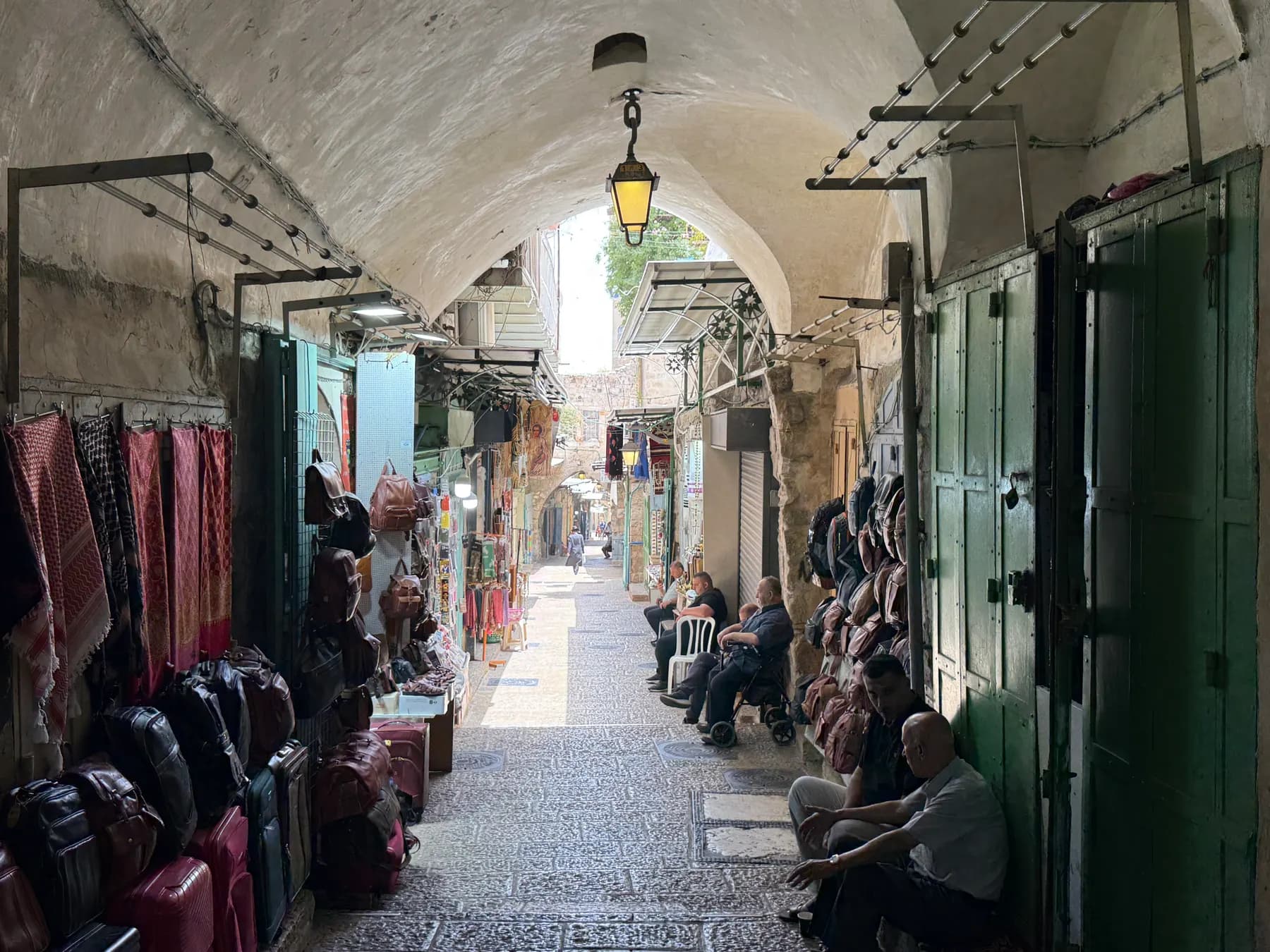
The three parallel covered lanes at the centre of the souk were built as one market in 1152 by Melisende, Queen of Jerusalem, who hired Muslim labourers from Magna Mahomeria, the village now called al-Bireh, to build it.
שלמה רודד / CC BY 2.5 · Wikimedia Commons
Triple market built
1152
by Melisende, Queen of Jerusalem, as three adjoining street markets along the Cardo
Butchers' market
125 m long, 83 shops
3.71 m wide, its groin vaults carried on 28 columns, 6.1 m above the paving
Perfumers' market
77 active shops
about 150 m long across roughly 8 dunams, with four ways in
Entry
Free
public streets inside the Ottoman walls, with no gate and no ticket
In short
- How long to give it
- about 90 minutes
- Most shops, daily
- About 08:30 to 19:00. Individual shopkeepers set their own hours and there is no published closing time for the market as a whole.
- Entry
- Free. These are public streets inside the Old City walls, with no gate, no ticket and no operator selling one.
שוקי העיר העתיקה · أسواق البلدة القديمة
The Arab Souk is the name English speakers give to the whole covered retail network of the Old City rather than to any one market. It is a chain of named lanes, most of them roofed, running inward from Jaffa Gate and Damascus Gate towards the Haram al-Sharif, with no entrance, no ticket and no single owner. Shops here belong variously to families, to church estates and to the Islamic waqf, and the trades they carry have been swapping places for nine centuries.
The spine is easy to draw even when it is hard to follow on foot. David Street drops east from Jaffa Gate in steps and continues as Tariq Bab al-Silsila, the Chain Gate street: 308 metres of Mamluk facades and a suq of 110 shops that ends at a gate of the Temple Mount. Crossing that line from the north is Suq Khan az-Zait, roughly 400 metres of food, spice and cloth shops running down from Damascus Gate, with 108 active retail units counted along it in 2019. Where the two systems meet, the market divides into three parallel roofed lanes, the Crusader triple market, which most visitors walk straight through without registering that it is a single twelfth-century building.
It is also a market in serious trouble, and an honest page has to say so before it says anything about shopping. Jerusalem took 4.4 million visitors in 2019 and 330,000 in 2024, and the Old City's shopkeepers live on that number. Nobody publishes an authoritative count of how many shops are trading on any given morning: the estimates in circulation range from about 1,400 to a little over 2,000, and the gap between them is itself the story.
The map
One souk, six names, and where each of them starts
Nothing here is signposted as the Arab Souk, because the thing has no single name in Arabic. What a visitor experiences as one continuous bazaar is a set of separately named suqs that happen to join up, each with its own history, its own owner and, historically, its own trade.
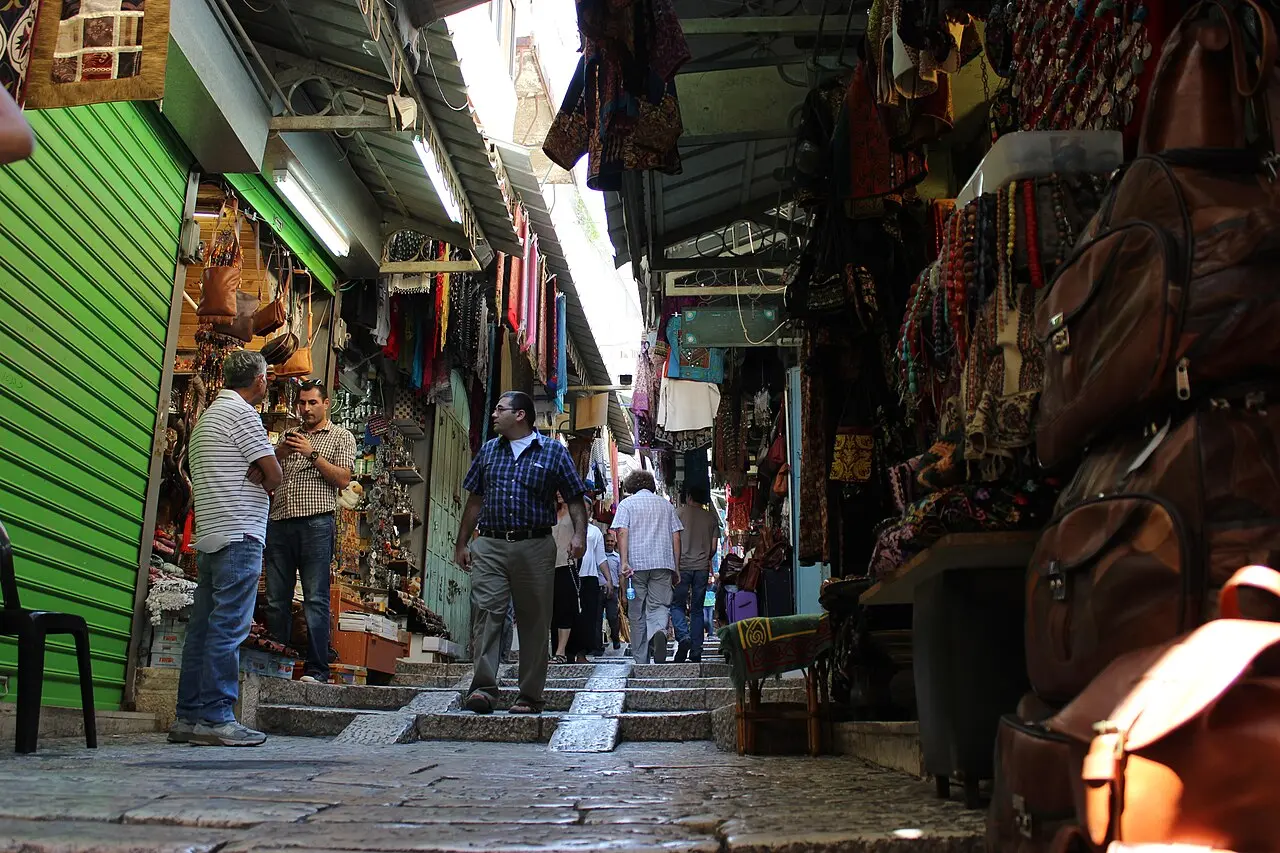
Two entrances feed it. From Jaffa Gate, David Street runs east and downhill in shallow steps along the seam between the Christian and Armenian quarters. It is the most heavily walked lane in the Old City and the most expensive, because it carries worshippers heading to the Western Wall, pilgrims heading to the Church of the Holy Sepulchre and almost every visitor arriving on a coach. From Damascus Gate, Suq Khan az-Zait runs south towards the Holy Sepulchre and the Jewish Quarter, and it is where the Old City does its own shopping. Its name means the street of the oil merchants, after a khan on it used to store olive oil from the Mamluk period onward; a Mamluk olive press survives at the spot. The seventh Station of the Cross is on this street, which is why processions and vegetable crates share it.
At the junction of those two axes the market splits into the three parallel covered lanes usually called the three markets, and beyond them David Street continues east as Tariq Bab al-Silsila. Two set-piece markets sit off the spine and are worth the diversion: Suq al-Qattanin, the Mamluk cotton merchants' market opening east onto the Haram, and Suq Aftimos in the western half of the Muristan.
- David Street: from Jaffa Gate, stepped, souvenirs and textiles at tourist prices.
- Suq Khan az-Zait (Beit HaBad Street): from Damascus Gate, about 400 metres, food, spices, sweets and cloth, 108 retail units counted in 2019.
- The three markets: Suq al-Lahhamin (butchers'), Suq al-Attarin (perfumers') and Suq al-Khawajat, three roofed lanes side by side over the line of the Roman Cardo.
- Tariq Bab al-Silsila: 308 metres east from David Street to the Chain Gate of the Haram, a suq of 110 shops among Mamluk mausoleums and schools.
- Suq al-Qattanin: the cotton merchants' market of 1336–37, 95 metres of barrel vault with 60 shops, a khan and two bathhouses.
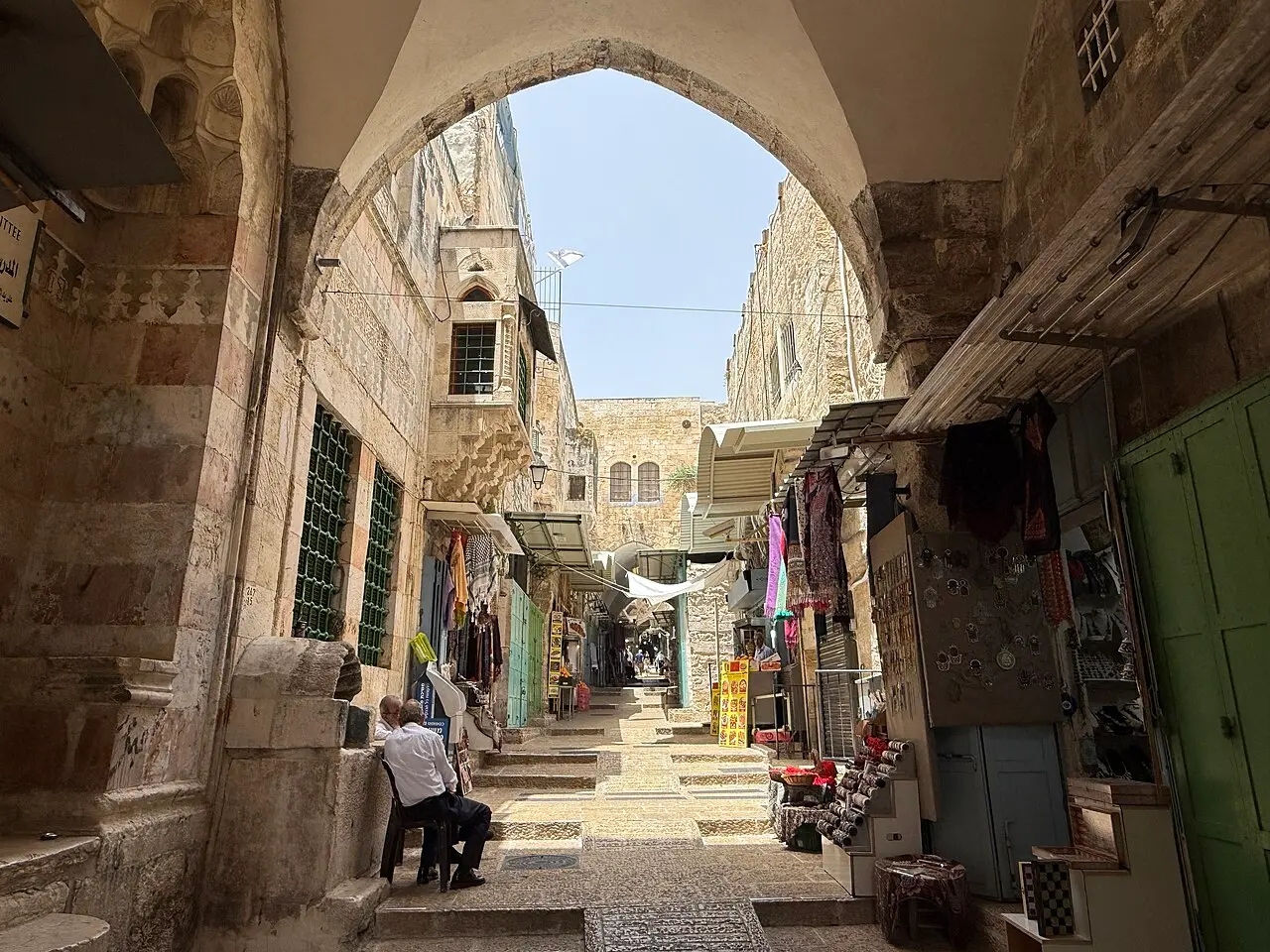
- Suq Aftimos: a small planned market of 1903 inside the Muristan, now largely leather goods and cafes.
blipsman / CC BY 2.0 · Wikimedia Commons
Origins
How a Roman avenue became three covered lanes
The three markets are the clearest surviving fossil of Roman Jerusalem anywhere above ground. Hadrian's Aelia Capitolina had a colonnaded Cardo Maximus running south from what is now Damascus Gate, and the street beneath the butchers' market has been dated to about 70 CE, remaining a single roadway through the Byzantine period. At some point after that, the avenue was subdivided lengthways into three narrow parallel streets and roofed. Jerusalem's own tourism site notes the giveaway: the combined width of the three lanes is the width of the Roman and Byzantine Cardo. It is not certain when the division happened, and the early Muslim period and the Crusader period are both proposed.
The best documented moment is 1152, when Melisende, Queen of Jerusalem, established what the sources call the Triple Market: three street markets adjoining one another, arranged east to west along the Cardo. Adrian Boas records that she employed Muslim labourers from Magna Mahomeria, the village now called al-Bireh, to build it. The western lane was not then a meat market at all but the Rue des Herbes, the Street of Herbs. Meron Benvenisti's account of it lists fish, eggs, poultry, cheese, condiments and fruit, sold by Frankish and Syrian shopkeepers working side by side.
The middle lane had the better name. The Crusaders called it the Malquisinat, which translates as bad cooking or evil cooking, and it sold ready-cooked meals, most plausibly to pilgrims with nowhere to cook. Its ceiling was pierced with shafts to let the smoke out, covered with stone arches or louvres so the rain stayed out. The name stuck: in the fifteenth century the chronicler Mujir al-Din still called it Suq al-Tabbakhin, the cooks' market, and it appears under that name in waqf documents. It is the lane now known as Suq al-Attarin, the perfumers' market, so the smell has changed completely and the building has not.
In 1188, the year after taking the city, Saladin placed the market in a waqf, and it has belonged to one ever since. That is why the Jerusalem waqf, not a municipality or a company, maintains these lanes today.
What survives
Crusader vaults above, everything else replaced below
The honest answer to what is original here is: the roof and the walls, and very little else. Meron Benvenisti's 1970 assessment of the butchers' market was that the Crusader vaults and shops had been preserved but that the paving and the shopfronts had been altered beyond recognition, and that is still the right way to look at all three lanes. Above head height the twelfth century is intact. Below head height it is roller shutters, tiling, strip lighting and stock.
The measurements are worth carrying in your head, because they explain why the lanes feel the way they do. The butchers' market runs 125 metres and is 3.71 metres wide, its groin vaults springing from pointed arches carried on 28 columns, with the crown of the vault 6.1 metres above the street, all of it in Turonian limestone. There are 83 shops, 41 on the west side and 42 on the east. The perfumers' market runs about 150 metres over roughly 8 dunams, is covered by cross vaults with openings punched in the centres to let daylight down, and has four ways in.
There is Crusader graffiti in plain sight for anyone who looks up at the doorways. Some shop arches in the perfumers' market carry the letter T inside a triangular shield, read as a Templar property mark, and others carry a T inside a circle, attributed to the Teutonic Order. Others again are inscribed in Gothic lettering with SCA ANNA: these shops most likely belonged to the estates of the Church of Saint Anne, which drew income from them. After Saladin converted that church into the Salahiyya Madrasa, the same shop rents were redirected to endow the madrasa.
Not everything above the shutters is Crusader, and that is where visitors go wrong. Amnon Cohen's work on the Ottoman court records shows the perfumers' market substantially rebuilt in 1565, in documents that call it the new spice-dealers' market. The coppersmiths' market moved into the northern end of the butchers' market in 1860, and the copper plating for the gates of the Qibli Mosque and the Dome of the Rock was worked there. Suq Aftimos is 1903 town planning on ground assigned to the Greek Orthodox Patriarchate in 1868. The least altered building of the lot is not Crusader at all: Suq al-Qattanin, put up in 1336–37 for the Mamluk sultan al-Nasir Muhammad by his viceroy Tankiz, has undergone no fundamental change since it was built, on Discover Islamic Art's assessment.
The trades
Almost no lane still sells what its name says
The names are historical labels, not shopping directories, and a visitor who takes them literally will spend an afternoon confused. Ottoman regulation once made them accurate: records from 1582 list seven markets each assigned a single trade, and all spices arriving in Jerusalem were required to be sold in the perfumers' market. The rule was broken almost immediately, and a butcher is documented trading in the perfumers' market in the sixteenth century.
The drift since is easy to trace. The butchers' market has 100 shops on the historic count and most are not butchers: a 1987 survey by the geographer Norman Dlin found 13 of 81 still working as butchers. Suq al-Khawajat, the eastern lane, was the goldsmiths' and cloth merchants' market; today only its southern half is open, mostly carpets and textiles. Suq al-Attarin still sells spices, aromatics and folk remedies, the one label that has held: the Swiss physician Titus Tobler counted 67 different medicinal substances in a single shop there in the nineteenth century and called it Jerusalem's drug market.
The trades that have grown are those aimed at people passing through. Suq al-Qattanin, built for cotton, now sells gifts, rosaries and clothing to people on their way to al-Aqsa, and its khan houses offices of the Islamic Awqaf Department and Al-Quds University. Suq Aftimos has gone over largely to leather. On Tariq Bab al-Silsila the handicraft workshops gave way through the twentieth century to grocers, restaurants and cafes, and after 1967 to souvenir shops serving the Western Wall and the Haram.
The exception, and the reason to come on a Friday morning, is Suq Khan az-Zait. Farmers bring produce in to sell along it, and the street still carries the butchered meat, cloth, sweets and spice trade that the Old City's own households buy from. It is the least performed part of the market.
- Suq al-Lahhamin: named for butchers, 100 shops historically, most now selling meat, vegetables and household goods rather than meat alone.
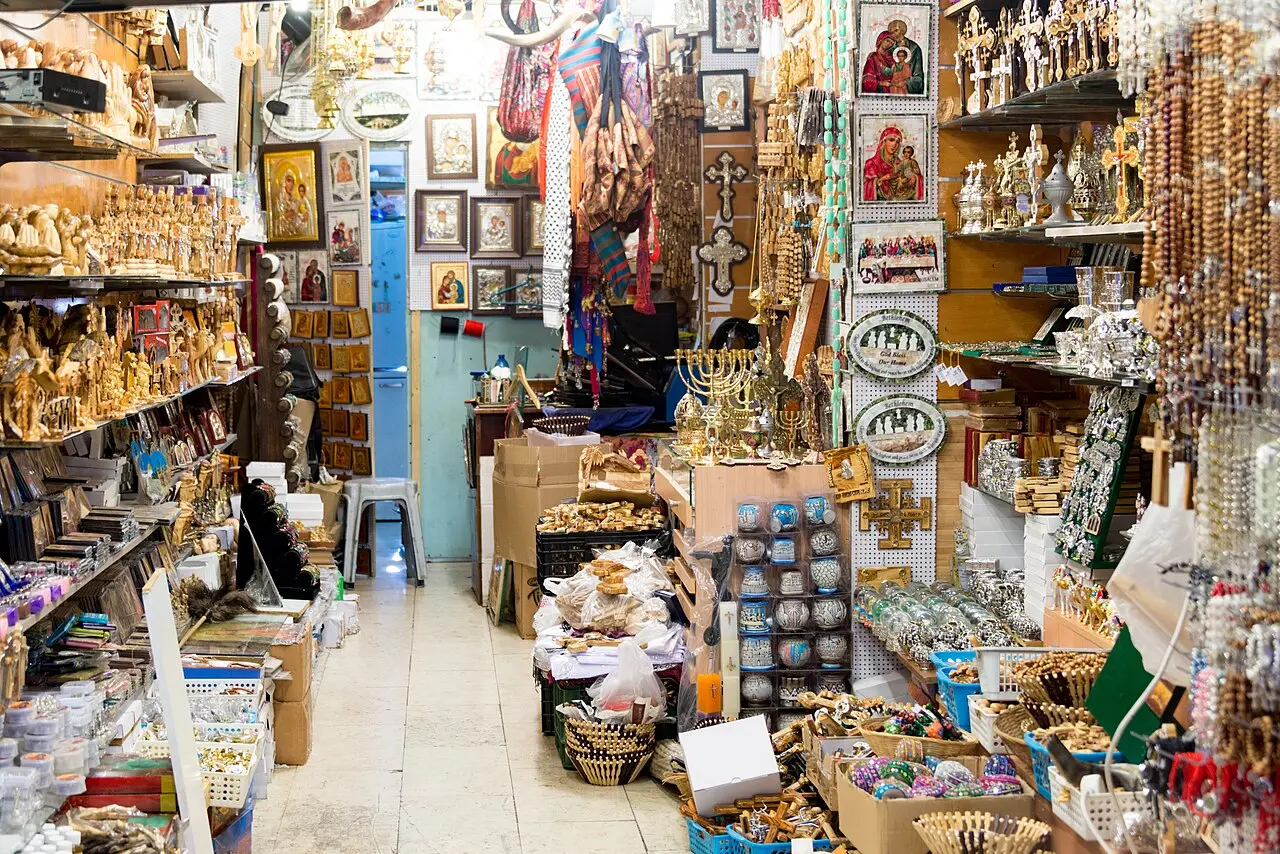
- Suq al-Attarin: perfumes, spices, aromatics and medicinal herbs, alongside jewellery, electronics and clothing.
- Suq al-Khawajat: goldsmiths and cloth merchants historically, now carpets and textiles in the southern half only.
- Suq al-Qattanin: cotton until the Mamluk period, souvenirs and devotional goods now.
- Suq Aftimos: leather goods, craft shops and a few cafes around a fountain.
xiquinhosilva / CC BY 2.0 · Wikimedia Commons
The squeeze
Arnona, checkpoints and a visitor count that fell by nine tenths
The souk has been shrinking for longer than the current crisis, and the traders name the same causes each time they are asked. Arnona, the municipal property rate, comes first: it falls on floor area whether or not anything is sold. Access comes second. Al Jazeera and The New Arab have both reported that the annexation of East Jerusalem in 1967, the checkpoints and the West Bank barrier cut the perfumers' market off from the West Bank customers it was built to serve. In 2016 Al Jazeera Arabic reported 68 of the butchers' market's 100 shops closed, under the headline that the market was drawing its last breath, and named rising taxes and relocation to Musrara as the reasons. It ran a similar report in 2025.
Then came the collapse in visitors. Jerusalem received 4.4 million of them in 2019 and 330,000 in 2024. Jerusalem Story, writing in October 2025, put the share of Old City businesses that had ceased operating at 80 per cent, in a district where 5,920 economic establishments are counted and about 40 per cent of them live off tourism. Hijazi Rashq of the Jerusalem Chamber of Commerce and Industry gives a shop closure rate in the market of around 30 per cent in 2020, rising significantly after October 2023. East Jerusalem's hotel stock has gone from more than 40 hotels and hostels to 24, per Raed Sa'ada of the Palestinian Tourism Association.
Even the size of the thing is contested. A field survey in 2019 and 2020 counted 2,075 stores in the market; the Palestinian Chamber of Commerce estimates about 1,400; Israeli authorities counted 1,896 businesses in the 1990s. Unofficial estimates put the number working in the market at between 2,600 and 3,700. No body publishes a figure it will stand behind, so any number quoted for the souk's size should be read as an estimate with a date on it.
There is money coming the other way, in small amounts. In 2023 the Kuwait Chamber of Commerce and Industry funded the renovation and reopening of 16 shops in the butchers' market, at a reported cost of about 300,000 US dollars. What that means for a particular shutter on a particular lane, nobody can currently say, which is the reason to arrive expecting part of the market to be shut.
שלמה רודד / CC BY 2.5 · Wikimedia Commons
What to look for
Things not to walk past at The Arab Souk and the Old City markets
The details that repay knowing about before you are standing in front of them.
The vaults of the butchers' market
Look up rather than into the shops. The groin vaults spring from pointed arches on 28 columns and close 6.1 metres above the paving, and they are the original twelfth-century roof of a 125-metre street.
The Templar and Teutonic marks
Shop arches in the perfumers' market carry the letter T inside a triangular shield, read as a Templar property mark, and elsewhere a T inside a circle, attributed to the Teutonic Order. They are at doorway height and easy to walk past.
The SCA ANNA inscriptions
Twelfth-century Gothic lettering on arches in the same lane spells SCA ANNA, marking shops held by the Church of Saint Anne. After Saladin turned the church into the Salahiyya Madrasa, the rents from these shops endowed the madrasa instead.
Bab al-Qattanin and the cotton market
The eastern gate of Suq al-Qattanin, opening onto the Haram, has tri-lobed arches and five tiers of muqarnas in banded ablaq stone. Behind it run 95 metres of barrel vault divided into 30 skylit bays over 60 shops, two bathhouses and a khan.
The Mamluk olive press on Khan az-Zait
The street is named after a khan where olive oil was stored from the Mamluk period, and an olive press of that date survives on it. It is the only place on the market spine where the street name still explains itself.
Suq Aftimos and the Muristan
A planned market of 1903, laid out by the Greek Orthodox Patriarchate on ground the Sultan assigned to it in 1868, on the site of the medieval Hospitaller quarter. Short intersecting streets around an ornamental fountain, and the quietest place to sit down in the souk.
The long view
The Arab Souk and the Old City markets, in order
about 70 CE
The street later occupied by the butchers' market is laid out under Roman rule. It stays a single roadway through the Byzantine period.
after 130 CE
Hadrian refounds the city as Aelia Capitolina with a colonnaded Cardo Maximus running south from what is now Damascus Gate.
1152
Melisende, Queen of Jerusalem, establishes the Triple Market: three adjoining street markets along the line of the Cardo. Muslim labourers from Magna Mahomeria, now al-Bireh, build it.
1188
A year after taking Jerusalem, Saladin places the perfumers' market in a waqf, to which it has belonged ever since.
1336–37
Suq al-Qattanin is built for the Mamluk sultan al-Nasir Muhammad by his viceroy Tankiz al-Nasiri: 95 metres of vaulted market with 60 shops, a khan and two bathhouses.
1386–87
Khan al-Sultan, the caravanserai on the western side of Tariq Bab al-Silsila, is renovated under the Mamluks. Mujir al-Din records it operating as a market in the following century.
15th century
Mujir al-Din still calls the middle lane Suq al-Tabbakhin, the cooks' market, preserving its Crusader function as the Malquisinat.
1537
Suleiman the Magnificent builds the Sabil Bab al-Silsila, the drinking fountain on the Chain Gate street.
1565
The perfumers' market is substantially rebuilt, old shops repaired and new ones added. Ottoman documents of the year call it the new spice-dealers' market.
1582
Ottoman records list seven markets in Jerusalem each assigned a single specialised trade, with all spices required to be sold in the perfumers' market.
1587
The waqf is recorded renting out 17 shops in the perfumers' market to 5 Muslims, 1 Christian and 11 Jews, though Amnon Cohen cautions that the tenants may not be the people who worked them.
1860
The coppersmiths' market moves into the northern end of the butchers' market. Copper plating for the gates of the Qibli Mosque and the Dome of the Rock is worked there.
1891
J. E. Hanauer describes seven limestone columns embedded in the shops on the east side of the butchers' market in the Palestine Exploration Fund's Quarterly Statement, reading them as remains of a Byzantine colonnaded street.
1903
The Greek Orthodox Patriarchate builds Suq Aftimos in the western Muristan, on ground assigned to it by the Sultan in 1868.
1970
Meron Benvenisti judges the Crusader vaults and shops preserved but the paving and shopfronts altered beyond recognition.
1987
Norman Dlin's survey of 60 shopkeepers in the butchers' market finds 13 of 81 shops working as butchers, 10 permanently closed, and two families in the same shop for over 120 years.
2016
Al Jazeera Arabic reports 68 of the butchers' market's 100 shops closed, citing the arnona rate and relocation to Musrara.
2023
The Kuwait Chamber of Commerce and Industry funds the renovation and reopening of 16 shops in the butchers' market, at a reported cost of about 300,000 US dollars.
2024
Jerusalem records 330,000 visitors, against 4.4 million in 2019.
October 2025
Jerusalem Story puts the share of Old City businesses that have ceased operating at 80 per cent.
Practical
Visiting The Arab Souk and the Old City markets
Where
The souk runs inward from Jaffa Gate (David Street) and Damascus Gate (Suq Khan az-Zait), Old City, Jerusalem. The three markets lie where the two meet, in the Muslim Quarter.
What ticket you need
The souk is not inside a ticketed park, but it is inside the Old City, so entry runs through the gates and their security checks. Suq al-Qattanin opens directly onto the Haram al-Sharif through Bab al-Qattanin: that gate is not a route into the compound for non-Muslims, who enter only by the Mughrabi ramp beside the Western Wall plaza during designated hours.
Opening hours
- Most shops, daily
- About 08:30 to 19:00. Individual shopkeepers set their own hours and there is no published closing time for the market as a whole.source
- Friday
- Many Muslim-owned shops shut for midday prayers and reopen afterwards. Suq Khan az-Zait is at its fullest on Friday morning, when farmers bring produce in.source
- Sunday
- Christian-owned shops, concentrated on David Street and around the Muristan, are commonly closed.source
- Saturday
- The souk itself trades, but the Jewish Quarter shops at its southern edge do not. There is no day on which everything in the Old City is open.source
Admission
- Entry
- Free. These are public streets inside the Old City walls, with no gate, no ticket and no operator selling one.source
- Suq al-Qattanin and Suq Aftimos
- Also free. Suq al-Qattanin's eastern gate leads onto the Haram al-Sharif, which has its own restricted visiting hours and is not entered this way by non-Muslims.source
Access
Mixed, and better than it was. David Street is a stepped descent from Jaffa Gate and cannot be taken in a wheelchair, and the same is true of several connecting lanes. A municipal accessibility programme has since adapted about 4 kilometres of street across the Muslim, Armenian and Christian quarters and installed roughly 2 kilometres of handrails beside staircases, levelling some of the heavier paving and adding ramps. The main step-free lines run north to south from Zion Gate to Damascus Gate along the Cardo, and east to west from Jaffa Gate and the New Gate to the Church of the Holy Sepulchre and the Western Wall plaza. The free Accessible JLM app, in eight languages, plots a route in real time, and a printed accessible map is given out at the tourist information centre inside Jaffa Gate. Even on the adapted routes the lanes are narrow, the paving is polished stone that is slippery when wet, and traders display goods into the walkway.
On site
- Tourist information centre inside Jaffa Gate
- Cash machines on David Street and Suq Khan az-Zait
- Cafes, juice stalls and bakeries throughout
- Public toilets at the Western Wall plaza and near Damascus Gate
- Free accessible map and the Accessible JLM app
- No cloakroom, no luggage store, no car access
Booking
Nothing here is booked or ticketed. Guided souk walks are sold by private operators and by hotels and are not run by any market authority. Prices on David Street are negotiable and are quoted high to begin with; prices in the food shops on Suq Khan az-Zait generally are not.
Hours and prices are given as the operator publishes them and change without much notice, particularly around Shabbat and the festivals. Check the operator's own page before you travel for this.
Official page at itraveljerusalem.com →What people wish they had known
- Do not treat David Street as the market. It is the tourist frontage, it is the most expensive lane in the Old City, and everything interesting is in the roofed lanes north and east of it.
- Walk in from Damascus Gate at least once. Suq Khan az-Zait is where the Old City buys its own food, and Friday morning is when the farmers are there.
- Look above the shutters in the three markets. The shopfronts are modern, the vaults, the columns and the Crusader property marks are not, and nothing at eye level will tell you which lane you are in.
- There is no single day when everything is open: Christian-owned shops commonly close on Sunday, Muslim-owned ones for Friday midday prayers, and the Jewish Quarter shops from Friday afternoon through Saturday.
- Prices on David Street are quoted to be negotiated and prices in the food shops are not. Confusing the two either overpays or offends.
- Wheelchairs and pushchairs cannot use David Street's steps. Take the adapted Cardo line from Zion Gate or Damascus Gate instead, and pick up the free accessible map at the Jaffa Gate information centre before starting.
The figures
The Arab Souk and the Old City markets by the numbers
Each figure carries the year it belongs to and links the source it came from.
| Measure | Figure | As of | Source |
|---|---|---|---|
| Triple market established by Melisende | 1152 | 1152 | en.wikipedia.org |
| Butchers' market: length, width and shops | 125 m long, 3.71 m wide, 83 shops | 1987 | en.wikipedia.org |
| Perfumers' market: active shops | 77 | 2026 | en.wikipedia.org |
| Suq Khan az-Zait: length and retail units | about 400 m, 108 units | 2019 | en.wikipedia.org |
| Tariq Bab al-Silsila: length and shops | 308 m, 110 shops | 2021 | en.wikipedia.org |
| Suq al-Qattanin: length and shops | 95 m, two rows of 30 shops | 1336 | islamicart.museumwnf.org |
| Stores counted in the market by field survey | 2,075 | 2020 | shomrim.news |
| Visitors to Jerusalem | 330,000, against 4.4 million in 2019 | 2024 | shomrim.news |
While you are here
The rest of The Old City of Jerusalem
Everything else in this destination with a page of its own.
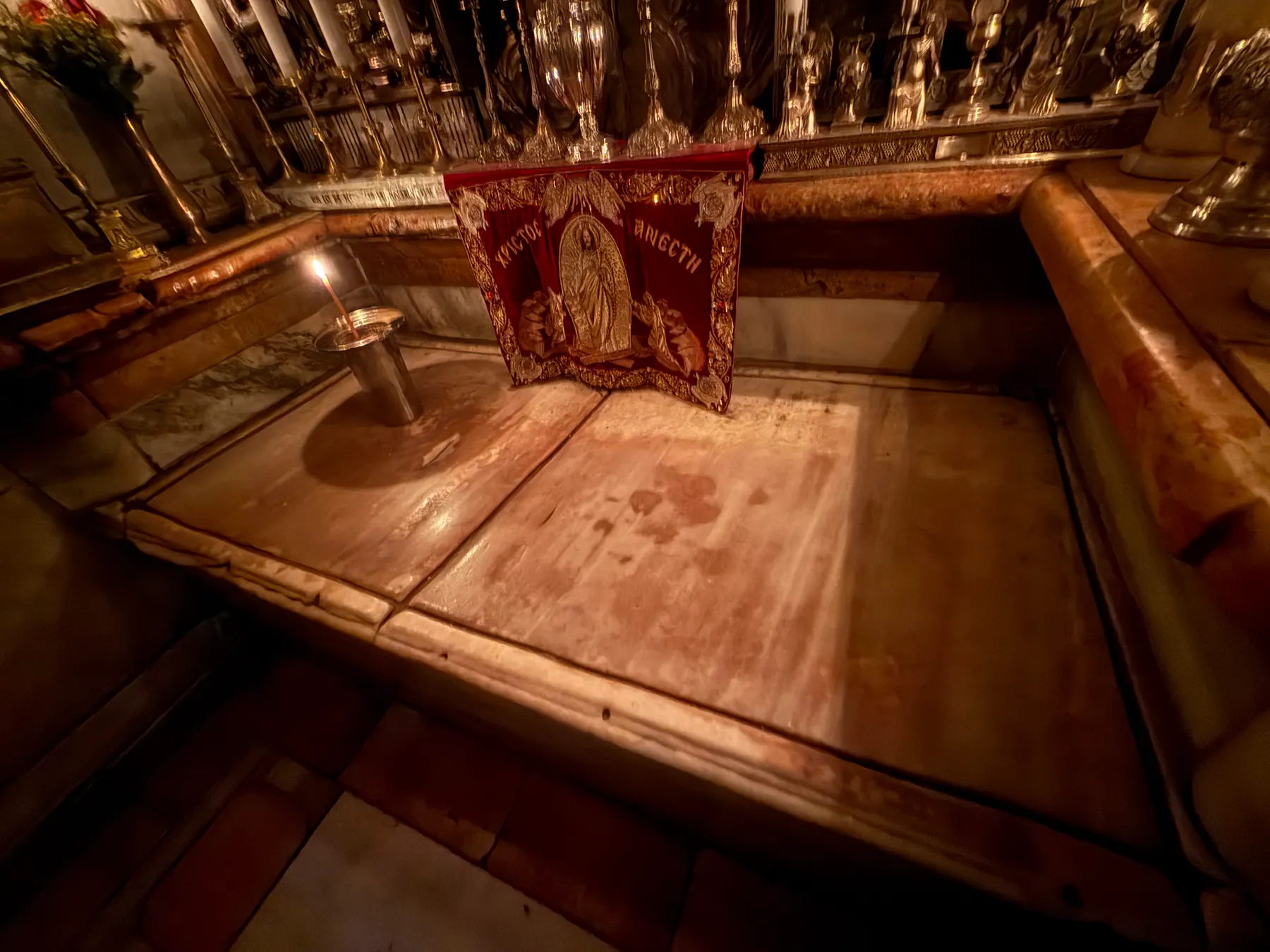
שלמה רודד / CC BY 2.5 · Wikimedia Commons
Religious site
Church of the Holy Sepulchre
Six Christian communities share one building over Golgotha and the tomb, the doors are opened by two Muslim families, and nobody has been charged to walk in since 1831.
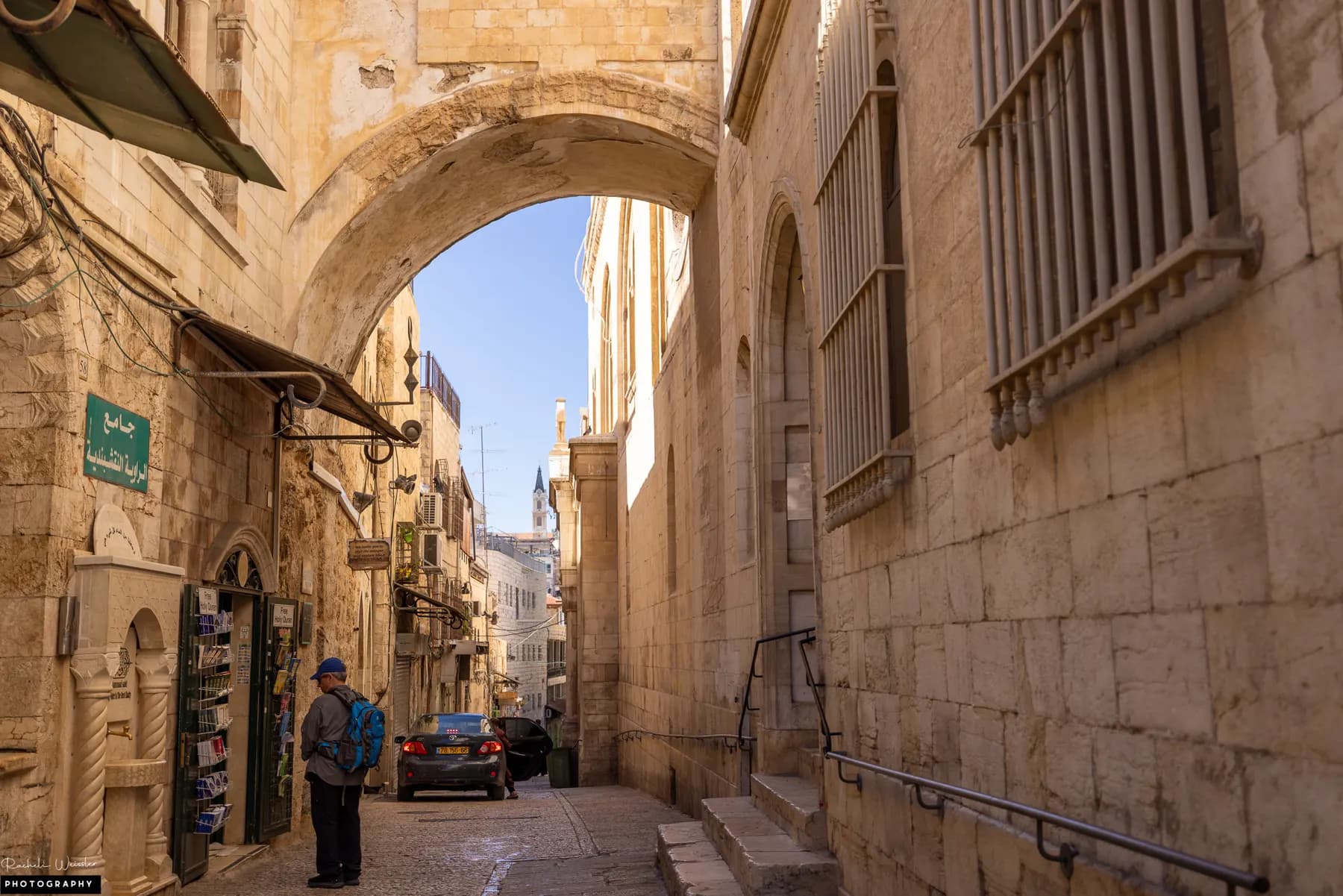
רחל וייסלר / CC BY 2.5 · Wikimedia Commons
Religious site
Via Dolorosa
Fourteen stations over roughly half a kilometre of working market lanes, of which nine are in the street and the last five are inside the Church of the Holy Sepulchre.
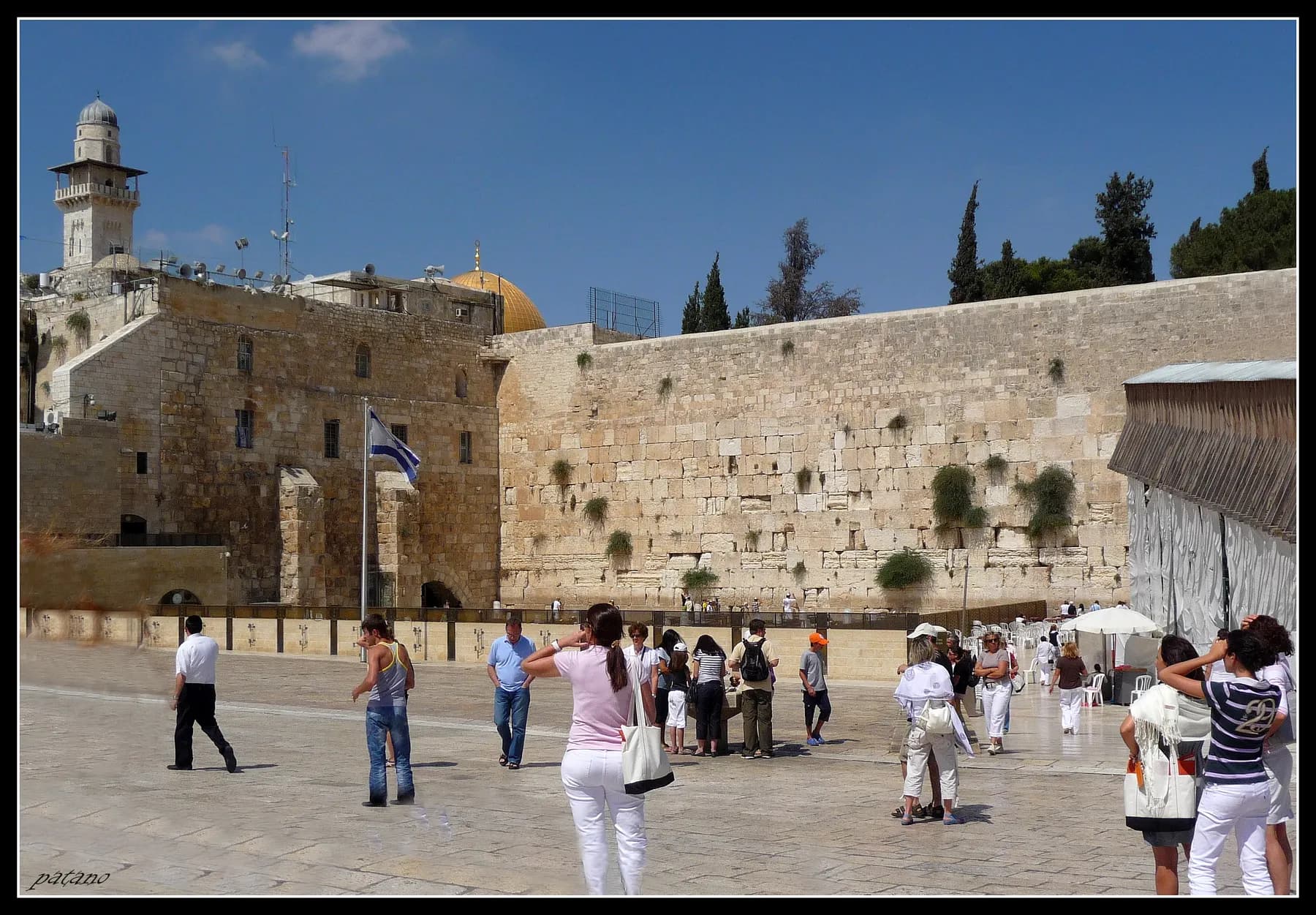
patano / CC BY-SA 3.0 · Wikimedia Commons
Religious site
The Western Wall
The prayer plaza shows about 50 metres of a retaining wall that runs 488 metres in total, and it is open free of charge at every hour of every day of the year.
Sources and further reading
Every link below was opened and checked when this page was written. Official statements are marked as such: they are the subject's own account, not an independent one.
- OfficialiTravelJerusalem, Jerusalem Development Authorityitraveljerusalem.comThe Old City Three Markets: Butchers' Market, Perfume Market, Goldsmiths' Market
Jerusalem's own tourism site on the three roofed parallel lanes, what each sells now, and the observation that their combined width matches the Roman and Byzantine Cardo.
- OfficialiTravelJerusalem, Jerusalem Development Authorityitraveljerusalem.comSuq Khan A-Zeit (Beit Habad Street)
The Damascus Gate to Jewish Quarter run, the Friday produce trade, and the Cardo beneath it.
- OfficialEnjoy Jerusalemenjoyjerusalem.orgSuq al-Qattanin (Cotton Market)
The 1336–37 date, Tankiz, the 95 metres, the 60 shops over two levels, the two baths, and what the shops sell today.
- OfficialEnjoy Jerusalemenjoyjerusalem.orgMarkets and Bazaars
The named suqs one by one, including the finding that only the southern part of Suq al-Khawajat is now open and that it sells carpets and textiles.
- OfficialAccess Israelaisrael.orgThe Old City of Jerusalem: accessible tourism
The 4 kilometres of adapted street, the 2 kilometres of handrails, the Accessible JLM app in eight languages and the free printed map at the Jaffa Gate information centre.
- ReportingShomrimshomrim.newsNo tourists, no income: the collapse of livelihoods in Jerusalem's Old City
April 2026 investigation: Jerusalem's 4.4 million visitors in 2019 against 330,000 in 2024, the competing shop counts of 2,075, about 1,400 and 1,896, the 2,600 to 3,700 workers, and Hijazi Rashq on closure rates.
- ReportingJerusalem Storyjerusalemstory.comJerusalem's Old City economy is in shambles
October 2025: 80 per cent of Old City businesses ceased operating, and the 5,920 economic establishments of East Jerusalem with about 40 per cent of them in tourism.
- ReportingTime Out Israeltimeout.comOld City Market (Arab Souq)
The only published hours found for the market as a whole: daily 08:30 to 19:00, with some shops closed for Friday prayers.
- ReferenceDiscover Islamic Art, Museum With No Frontiersislamicart.museumwnf.orgSuq al-Qattanin (Market of the Cotton Merchants)
The barrel vault in 30 skylit bays, the muqarnas and ablaq of Bab al-Qattanin, and the judgement that the market has not fundamentally changed since it was built.
- ReferenceWikipediaen.wikipedia.orgButchers' market (Jerusalem)
Carries the measurements and shop counts from Norman Dlin's 1987 GeoJournal study, Benvenisti on the Street of Herbs and on the 1970 condition, Hanauer 1891, the 1860 coppersmiths, the 2016 Al Jazeera closure figure and the 2023 Kuwaiti-funded renovation.
- ReferenceWikipediaen.wikipedia.orgPerfumers' Market
Carries Magness and Boas on the 1152 Triple Market and the Malquisinat, the Templar and Teutonic marks, the SCA ANNA inscriptions, Saladin's 1188 waqf, Amnon Cohen on the 1565 rebuilding and the 1582 and 1587 records, and Tobler's 67 medicinal substances.
- ReferenceWikipediaen.wikipedia.orgSuq Khan az-Zait
The Roman origin, the roughly 400 metre length, the 108 active retail establishments counted in 2019, the Mamluk olive khan and press, and the seventh Station of the Cross.
- ReferenceWikipediaen.wikipedia.orgChain Gate street (Tariq Bab al-Silsila)
Carries Nazmi Jubeh's Jerusalem Quarterly portrait of the suq: the 308 metres, the 110 shops, Khan al-Sultan's 1386–87 renovation and Suleiman's 1537 sabil.
- ReferenceWikipediaen.wikipedia.orgMuristan
Suq Aftimos built by the Greek Orthodox Patriarchate in 1903 on ground assigned to it in 1868, its present leather trade and the fountain at its centre.
The Arab Souk and the Old City markets: common questions
Is there an entrance fee for the Arab Souk?+
No. The souk is a network of public streets inside the Old City walls, with no gate, no ticket and no operator that sells one. The only cost of entry is passing the security checks at the Old City gates. Guided souk walks are sold privately, but they buy you a guide rather than access.
What are the opening hours of the Old City market?+
Most shops trade roughly 08:30 to 19:00, though nobody publishes hours for the market as a whole because every shop is independently run. Treat any stated time as the window in which most shutters are up rather than a guarantee about a particular shop. Many Muslim-owned shops close for Friday midday prayers and reopen after, and Christian-owned shops around David Street and the Muristan are commonly shut on Sunday.
What is the difference between the Arab Souk, David Street and the three markets?+
The Arab Souk is an English umbrella term rather than a place with a sign. David Street is one lane of it, the stepped street running east from Jaffa Gate, and it is the most touristed. The three markets are the trio of parallel roofed lanes further in, built as one structure in 1152, where the market is at its oldest and least commercial.
How old is the Jerusalem souk?+
The three central lanes were built as a single market in 1152 by Melisende, Queen of Jerusalem, and the street beneath them was laid out under Roman rule around 70 CE. Suq al-Qattanin dates from 1336–37, Khan al-Sultan on the Chain Gate street was renovated in 1386–87, and Suq Aftimos is as recent as 1903. So the answer depends entirely on which lane you are standing in.
Is the souk worth visiting, or is it just tourist tat?+
Both are true of different lanes, and the split is geographic. David Street and the approaches to the Western Wall are almost entirely souvenirs sold to people passing through. Suq Khan az-Zait, the butchers' market and Suq al-Khawajat are where the Old City's own residents shop, and they are quieter, cheaper and far more interesting. Anyone who walks down David Street and turns round has not seen the market.
Can you get through the souk in a wheelchair or with a pushchair?+
Partly. David Street is a stepped descent and cannot be done on wheels, but a municipal programme has adapted about 4 kilometres of street across the Muslim, Armenian and Christian quarters, with roughly 2 kilometres of handrails beside staircases. The usable step-free lines run from Zion Gate to Damascus Gate along the Cardo and from Jaffa Gate to the Holy Sepulchre and the Western Wall plaza. The free Accessible JLM app plots a route, and a printed map is available at the Jaffa Gate information centre.
How long do you need in the souk?+
About 90 minutes walks the spine from Jaffa Gate to the Chain Gate with a detour through the three markets and a stop for coffee. Half a day is realistic if Suq al-Qattanin, Suq Aftimos and the Damascus Gate end are included, and if any actual shopping happens. The distances are trivial and the times are not, because the lanes are narrow and slow.
Should you haggle in the Jerusalem souk?+
On David Street and in the souvenir lanes, yes: opening prices there are set expecting it. In the food shops on Suq Khan az-Zait and among the greengrocers and butchers, no, because those are fixed-price trades serving local households and haggling reads as rude. If a price is marked, it is not an invitation.
Is the souk safe, and are the shops actually open?+
The lanes are busy and policed and ordinary caution is the main requirement, but the second half of the question is the live one. Jerusalem received 330,000 visitors in 2024 against 4.4 million in 2019, and Jerusalem Story put the share of Old City businesses that had ceased operating at 80 per cent in October 2025. Expect closed shutters, particularly in the butchers' market and the northern half of Suq al-Khawajat, and expect the trading picture to be different again by the time you arrive.
Is there shade, and what is it like in summer?+
The core of the market is genuinely covered, which is its practical advantage over every open-air market in the country. The three markets, Suq al-Qattanin and much of Suq Khan az-Zait are roofed in stone vaulting with skylights, so they stay dim and comparatively cool through the afternoon. David Street and the open junctions are the exposed parts, and the stone underfoot is polished and slippery after rain.