
Jerusalem
The Old City of Jerusalem
Less than a square kilometre behind Ottoman walls, holding the Western Wall, the Haram al-Sharif and the Church of the Holy Sepulchre, and about 35,000 people who live there.
Area inside the walls
about 0.87 km²
870,000 m², per the Jerusalem Institute's 2021 mapping
Quarters
Four
Muslim, Christian, Armenian and Jewish
Residents
about 35,000
2021 estimate, Jerusalem Institute for Policy Research
Ottoman wall
about 4 km
two and a half miles, built under Suleiman in 1538–40
Western Wall
488 m long
of which about 50 m stands exposed at the prayer plaza
Things to do
11 sites, each with its own page
in The Old City of Jerusalem
Restaurants
12 picks
in The Old City of Jerusalem
Hotels
8 picks
in The Old City of Jerusalem
Getting there
7 routes
in The Old City of Jerusalem
When to go
Month by month
in The Old City of Jerusalem
הָעִיר הָעַתִּיקָה · Jerusalem, inside the sixteenth-century Ottoman walls
The Old City is small in a way that surprises people who have read about it for years. Everything inside the Ottoman walls (the Western Wall, the Dome of the Rock, the Church of the Holy Sepulchre, four residential quarters and a working market) fits into about 870,000 square metres, roughly 0.87 of a square kilometre, according to the mapping carried out by the Jerusalem Institute for Policy Research. You can cross it on foot from one gate to the opposite gate in well under half an hour, if nothing stops you, which it always does.
It is also a place where people live. The Jerusalem Institute puts the resident population at around 35,000 in its 2021 study, spread across roughly 6,200 flats, with children going to school, deliveries arriving on hand-carts because vans cannot fit, and washing hung above lanes that Roman surveyors laid out. Against that, the same study estimates some ten million entries a year, about four million of them foreign tourists. The ratio explains a great deal about how the Old City feels: a dense neighbourhood carrying an extraordinary volume of visitors through its front rooms.
What follows is what is actually here: the four quarters and how they differ, the two great sacred compounds and the rules that govern them, the souks, the walls and gates, the archaeology stacked beneath the paving, and how to move through all of it in a day without wasting half of it queuing at the wrong gate.
The map
Four quarters, one street grid
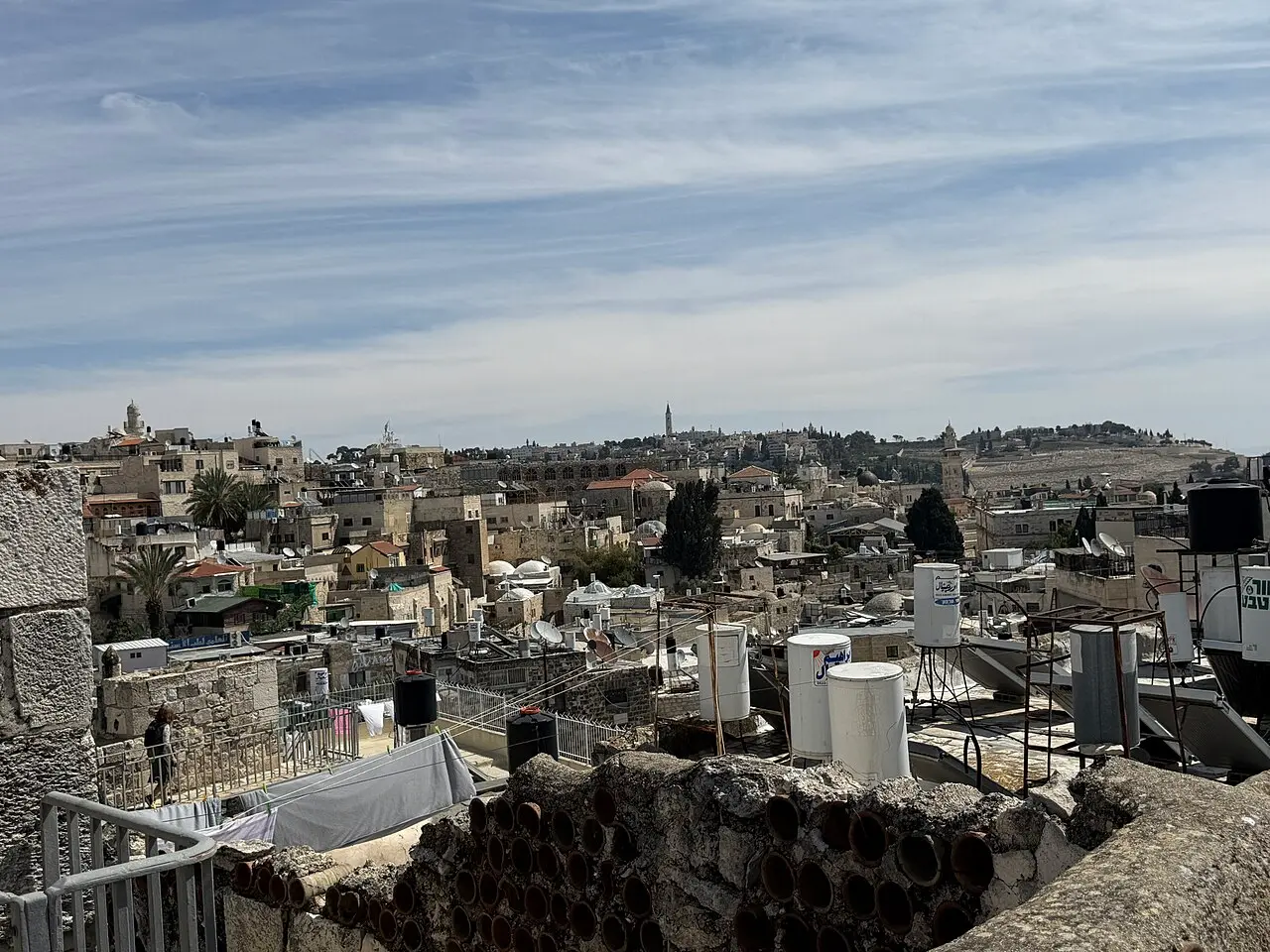
The division into Muslim, Christian, Armenian and Jewish quarters is a nineteenth-century convention laid over a much older street plan, and it is looser on the ground than on a map. The Jerusalem Institute's mapping counts 27,000 Muslims, 5,000 Christians and 3,000 Jews among the roughly 35,000 residents, and finds ownership just as mixed as the population: about half the land in private or public Arab hands, about 30 per cent belonging to churches, and about 20 per cent in public Jewish ownership.
The Muslim Quarter, in the north-east, is the most populous and the busiest, carrying most of the through-traffic between Damascus Gate and the Haram al-Sharif. The Christian Quarter, north-west, is built around the Holy Sepulchre and the hospices and schools that serve it. The Armenian Quarter, south-west, is the smallest and the quietest, largely enclosed behind the Patriarchate's walls; the Times of Israel reported in 2023 that the disputed Cows' Garden, some 11,500 square metres, accounts for about a quarter of the whole quarter, and put the resident Armenian community at around 2,000 after roughly sixteen centuries here.
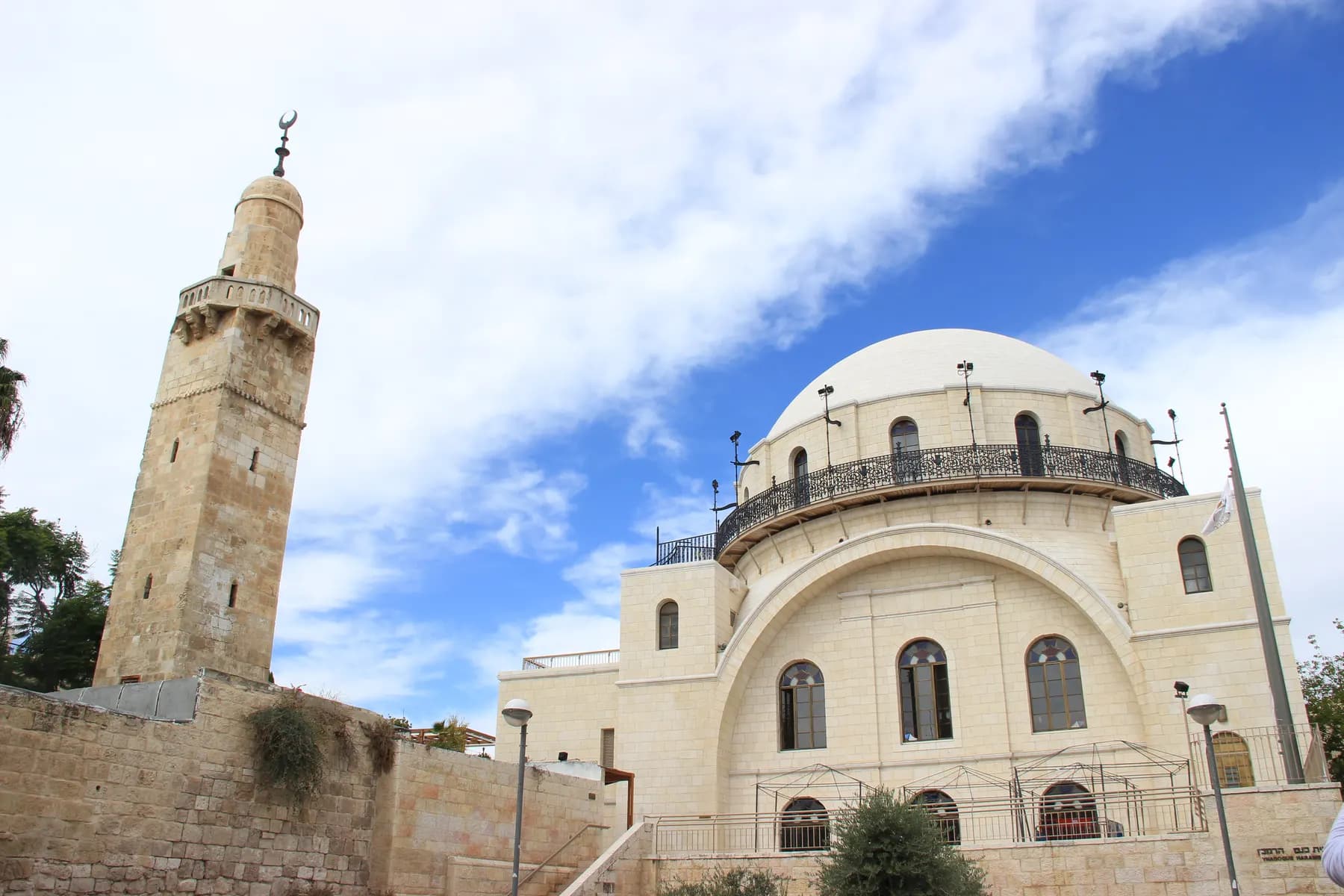
The Jewish Quarter, south-east, is the most obviously modern. Taken by Jordan's Arab Legion in 1948 and rebuilt after 1967, it reads as pale stone and open plazas rather than the vaulted gloom a few streets north. The Hurva Synagogue, destroyed in 1948, was rebuilt from 2005 and rededicated in March 2010; its white dome is the quarter's landmark.
- Muslim Quarter: largest, busiest, the main route from Damascus Gate
- Christian Quarter: Holy Sepulchre, hospices, church institutions
- Armenian Quarter: smallest and quietest, around the St James compound
- Jewish Quarter: rebuilt after 1967, open plazas and the Hurva dome
Unknown author / CC BY 2.5 · Wikimedia Commons

The compound
The Temple Mount and the Haram al-Sharif
The raised esplanade in the south-east corner is the most contested ground in the country. Jews know it as the Temple Mount, site of the First and Second Temples; Muslims know it as the Haram al-Sharif, the Noble Sanctuary, which the Religion Media Centre's 2025 explainer describes as the third-holiest place in Islam after Mecca and Medina and gives an area of 144,000 square metres. Its scale is Herodian (Britannica dates Herod's reconstruction of the Temple to 20/19 BCE) and the retaining walls holding that artificial plateau up are the reason the Western Wall exists at all.
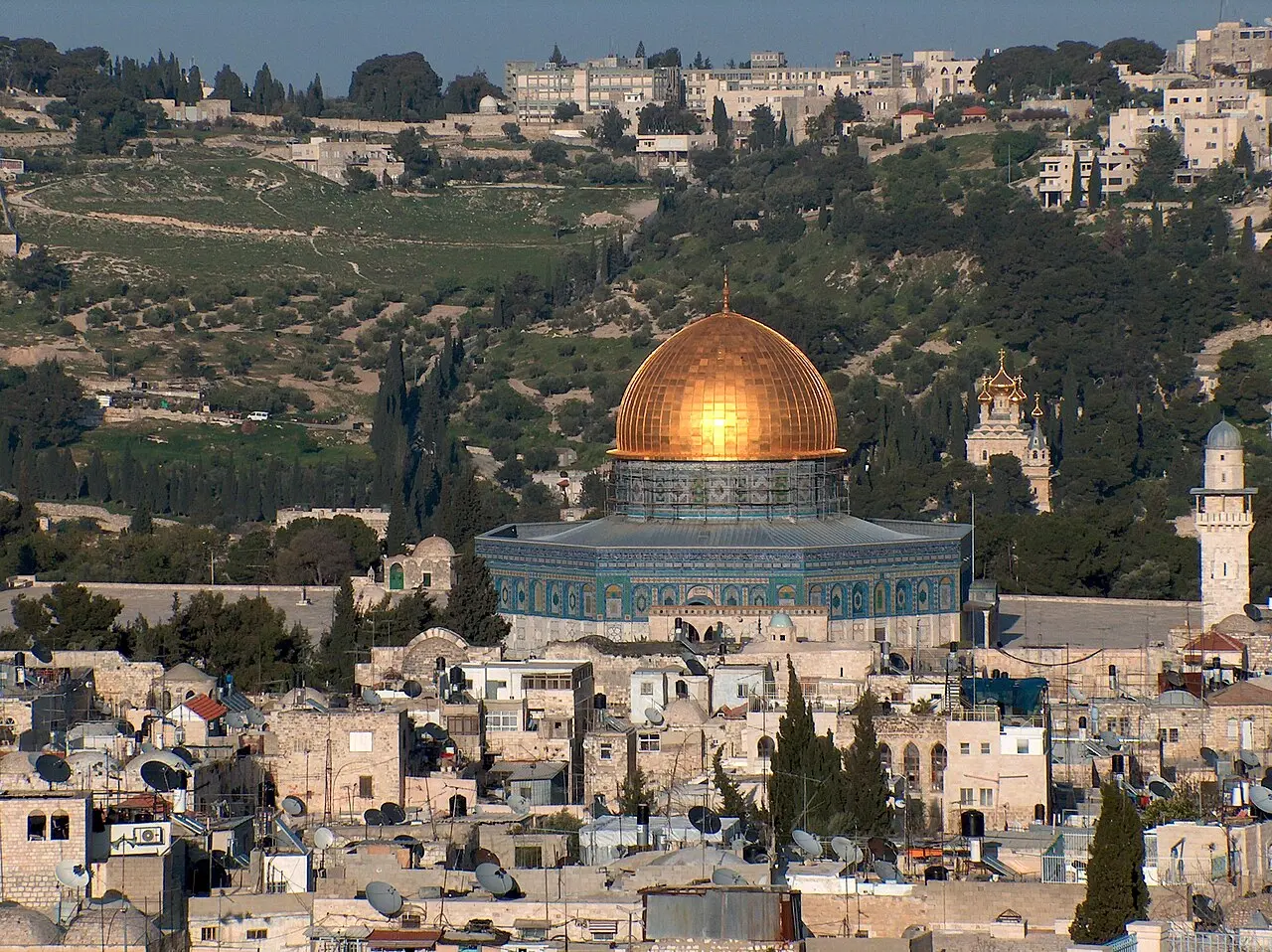
The Dome of the Rock, the gold-capped octagon that fixes Jerusalem in every photograph, was built by the Umayyad caliph Abd al-Malik and, per an inscription inside, completed in 72 AH: 691 or 692 CE. Britannica records the dome as about 20 metres across, raised on a drum above sixteen piers and columns. The rock beneath is venerated by Muslims as the point of the Prophet Muhammad's ascent and by Jews as the Foundation Stone. The silver-domed al-Aqsa Mosque stands at the southern end of the same platform.
Access is governed by an unwritten arrangement usually called the status quo. As the Religion Media Centre sets it out, the compound is managed by the Islamic Waqf, with Jordan holding a recognised role under the 1994 peace treaty, while Israeli police control entry; Muslims may pray there, and non-Muslims may visit during designated hours but are forbidden to pray. Non-Muslims enter by one route, the Mughrabi ramp beside the Western Wall plaza.

The Kotel
The Western Wall, and the tunnels behind it
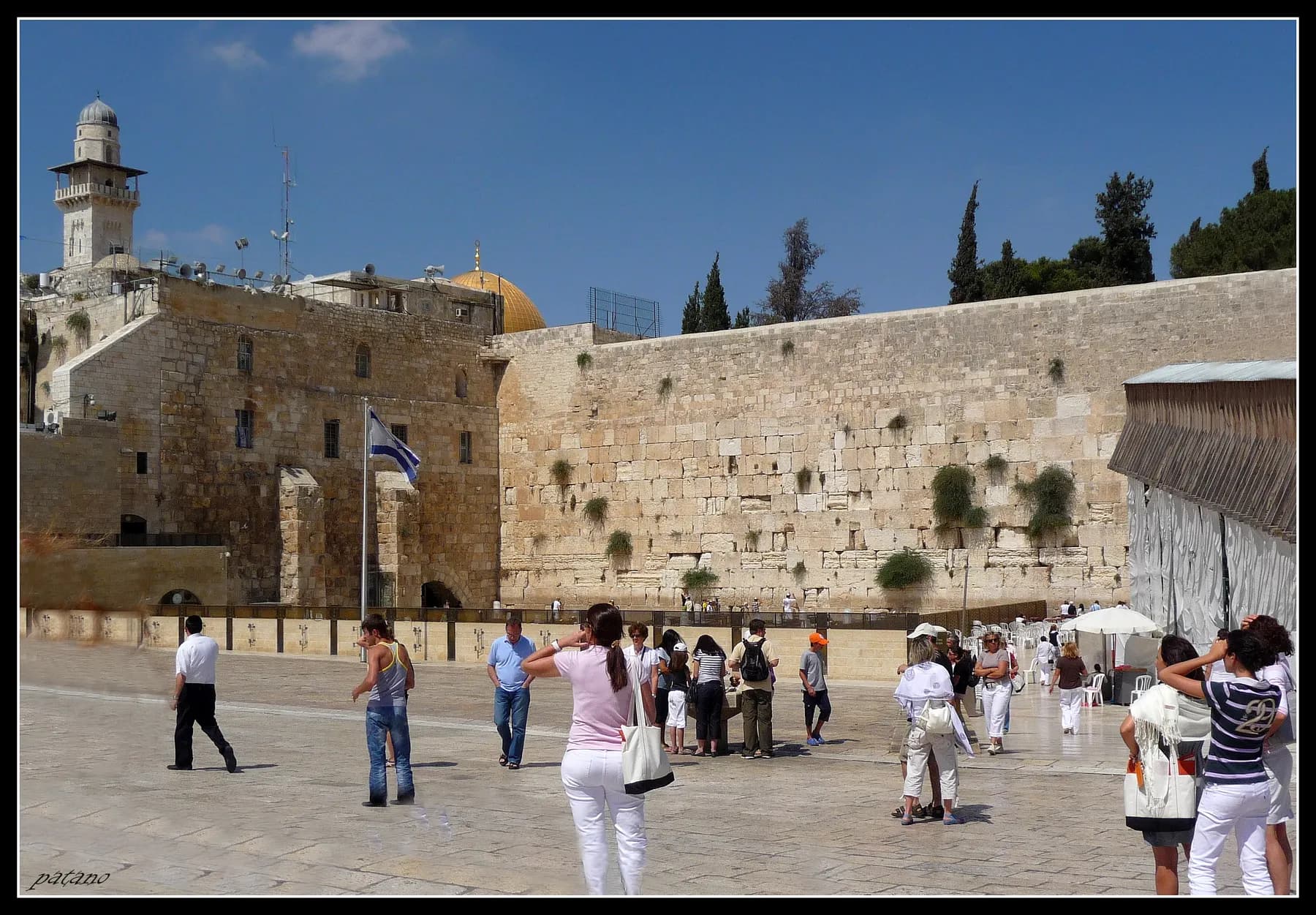
The Western Wall is not the wall of the Temple but the western retaining wall of the platform it stood on: the only substantial remnant, Britannica notes, of the retaining wall that surrounded the Temple Mount, with lower courses of great antiquity and upper sections added later. The Western Wall Heritage Foundation, which runs the site, gives the wall's full length as 488 metres and its greatest height as 55 metres. Far less than that is on show: Britannica puts the exposed stretch at the prayer plaza at about 50 metres long and about 20 metres high, and the rest runs behind and beneath the houses of the Muslim Quarter. At the plaza the wall stands 45 courses deep: 28 above ground, 17 below.
The plaza in front of it is not ancient. It was cleared in the days after Israel took the Old City in June 1967 by demolishing the Mughrabi Quarter, a Muslim neighbourhood of about 135 homes at the foot of the wall. The Times of Israel, reporting the French historian Vincent Lemire's research in 2022, describes minutes of a meeting between mayor Teddy Kollek and the military commander for Jerusalem on 9 June 1967, some 36 hours before the bulldozers, which Lemire reads as evidence of planning rather than improvisation.
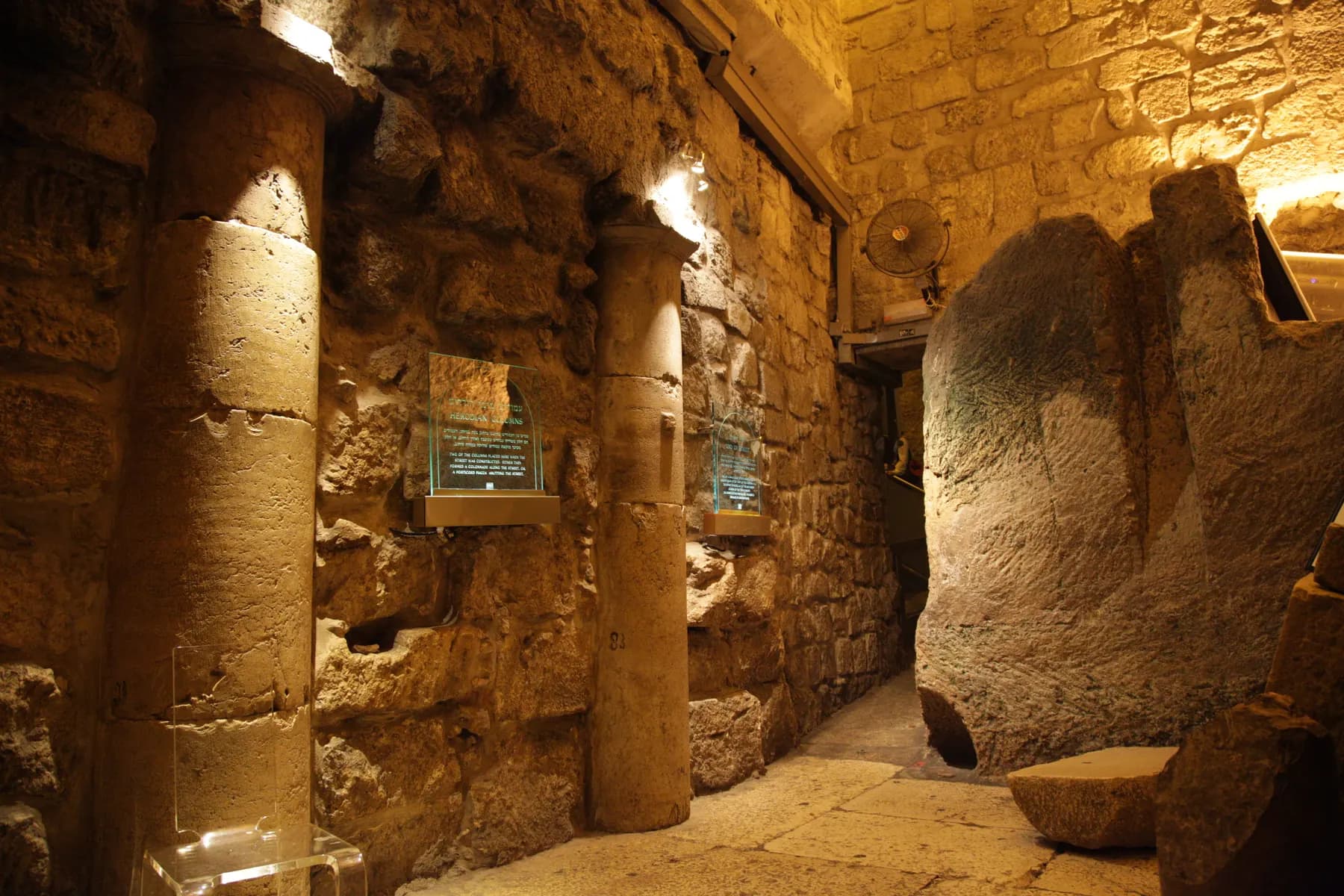
For the wall's hidden length, the Western Wall Tunnels run north from the plaza along the masonry (iTravelJerusalem gives the run along the wall as 485 metres) past Herodian street level, arches and the huge foundation courses. The Foundation runs it as a guided tour by prior booking only, listing 38 NIS for an adult and 25 NIS concession, about an hour and ten minutes, groups capped at 35 (2026 listing). Walk-up places are not reliable.
The church
The Holy Sepulchre and the Via Dolorosa
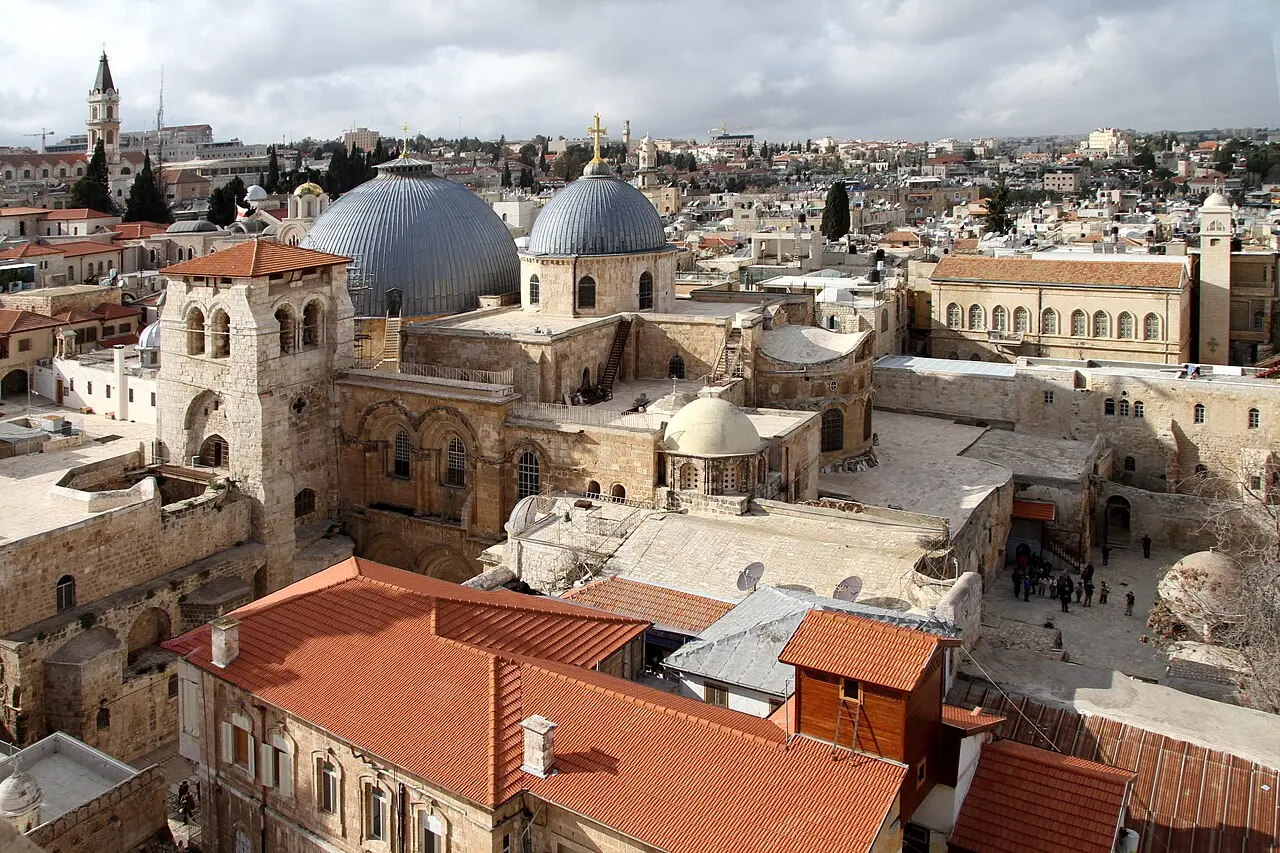
The Church of the Holy Sepulchre encloses, under one roof, the ground Christian tradition identifies as both Golgotha and the tomb. Israel's tourism ministry describes the present building as the Crusader reconstruction of 1149, with more than thirty chapels, maintained by the Greek Orthodox Church and shared with the other denominations that hold rights in it: six communities in all, by the church's own account. Its interior is frozen by the Status Quo, an Ottoman settlement of 1852 that fixed each community's rights down to individual lamps and flagstones and requires unanimity to change anything, which is why a wooden ladder has stood untouched on a ledge above the entrance since the nineteenth century, and why the keys have been kept by two Muslim families, the Nusseibeh and the Joudeh, since Saladin's day.
That paralysis nearly cost the building. The Edicule, the shrine over the tomb, had gone more than two hundred years without restoration and stood inside an iron cage the British bolted on in 1947. A team from the National Technical University of Athens under Antonia Moropoulou restored it between mid-2016 and March 2017 for around four million dollars, funded by the World Monuments Fund, King Abdullah II of Jordan, the Palestinian Authority and church and private donors. During the work the marble slab over the burial bed was lifted for the first time since at least 1555.
Since 2022 the floor has been coming up too. Excavations directed by Francesca Romana Stasolla of Sapienza University of Rome found the site was an Iron Age quarry, later abandoned, used for burials and then cultivated: archaeobotanical and pollen work identified olive and grapevine growing there around 2,000 years ago, on stratigraphic dating, with radiocarbon results still to come. It proves nothing theological and Stasolla is explicit that faith and history are separate fields, but it matches the Gospel of John's description of a garden near the place of crucifixion.
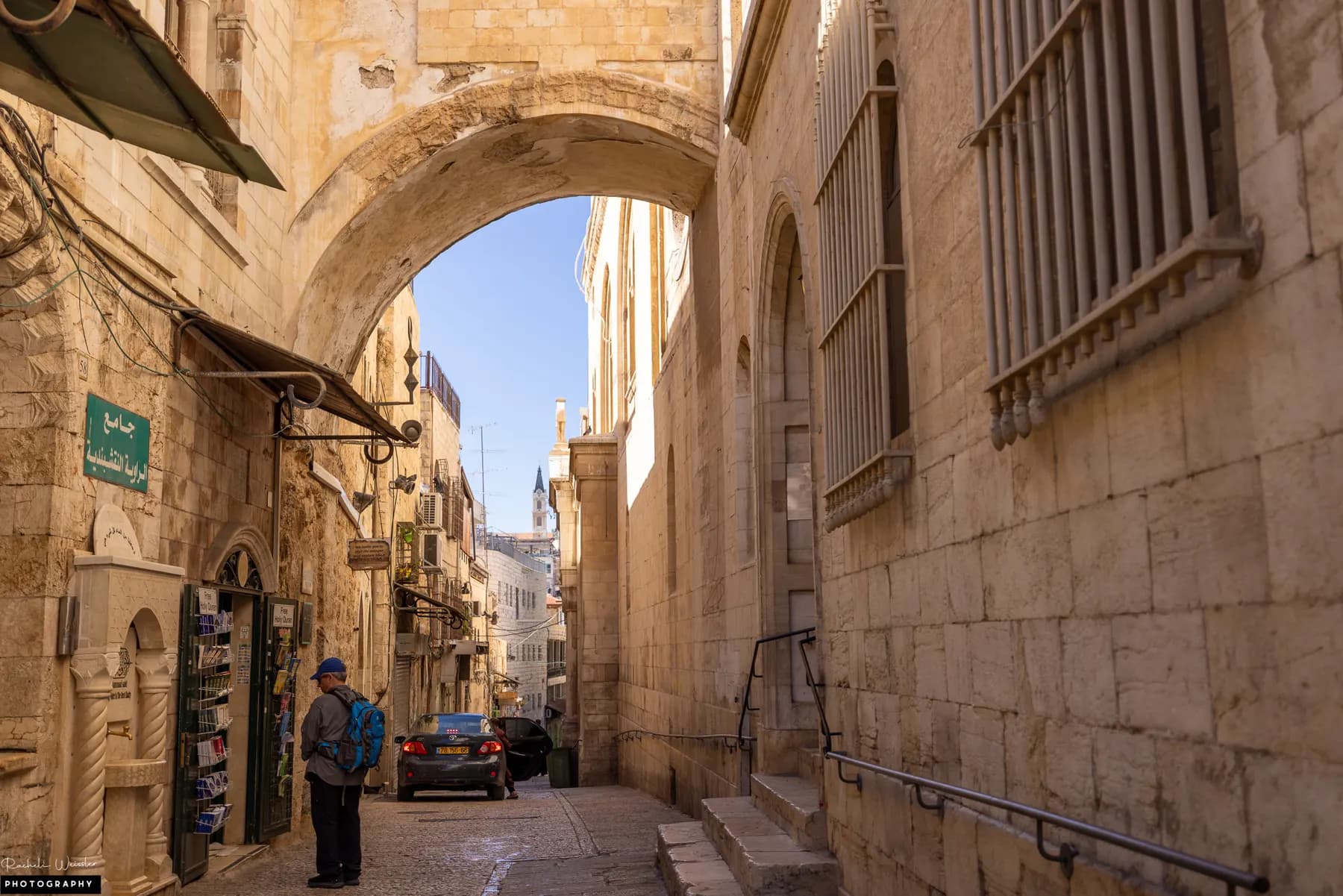
Outside, the Via Dolorosa threads back through the Muslim Quarter towards Lions' Gate: fourteen stations marked by bronze discs set into the walls, the last five inside the church, with Franciscan friars leading a procession along the route. The modern sequence was only settled among Roman Catholics in the nineteenth century.
Gerd Eichmann / CC BY-SA 4.0 · Wikimedia Commons

The markets
The souks, and the Roman street under them
The Old City's markets are not a tourist reconstruction; they are the retail floor of a working neighbourhood, and they sit on a plan drawn by Roman surveyors. When Hadrian refounded the ruined city as Aelia Capitolina after 130 CE he imposed an orthogonal grid, with a colonnaded Cardo Maximus running south from what is now Damascus Gate. The World History Encyclopedia gives its full width as 22 metres, of which only about five metres was carriageway, the rest colonnaded and covered walkway on either side. Two reconstructed stretches are on show in the Jewish Quarter, and the sixth-century Madaba mosaic map shows the same street down the middle of Byzantine Jerusalem.
The medieval markets that replaced it run in triple parallel lanes near the centre (meat, produce and goldsmiths historically kept apart) and continue into the covered bazaar of the Muslim Quarter. The finest piece of market architecture is the Suq al-Qattanin, the Cotton Merchants' Market, built in 737 AH, 1336–37, under the Mamluk sultan al-Nasir Muhammad and his deputy Amir Tankaz: about 95 metres long, with two rows of 30 shops, a caravanserai and two bathhouses under a skylit barrel vault, and entered through a rare portal of banded ablaq stone.
David Street, the steep stepped lane down from Jaffa Gate, is the tourist artery and prices show it; the lanes north of it, towards Damascus Gate, are where the Old City buys its own vegetables, spices and coffee. Christian-owned shops tend to close on Sunday, Muslim-owned ones for Friday prayers, and the Jewish Quarter from Friday afternoon through Saturday; there is no single day when everything is open.
The perimeter
The walls, the gates and the ramparts
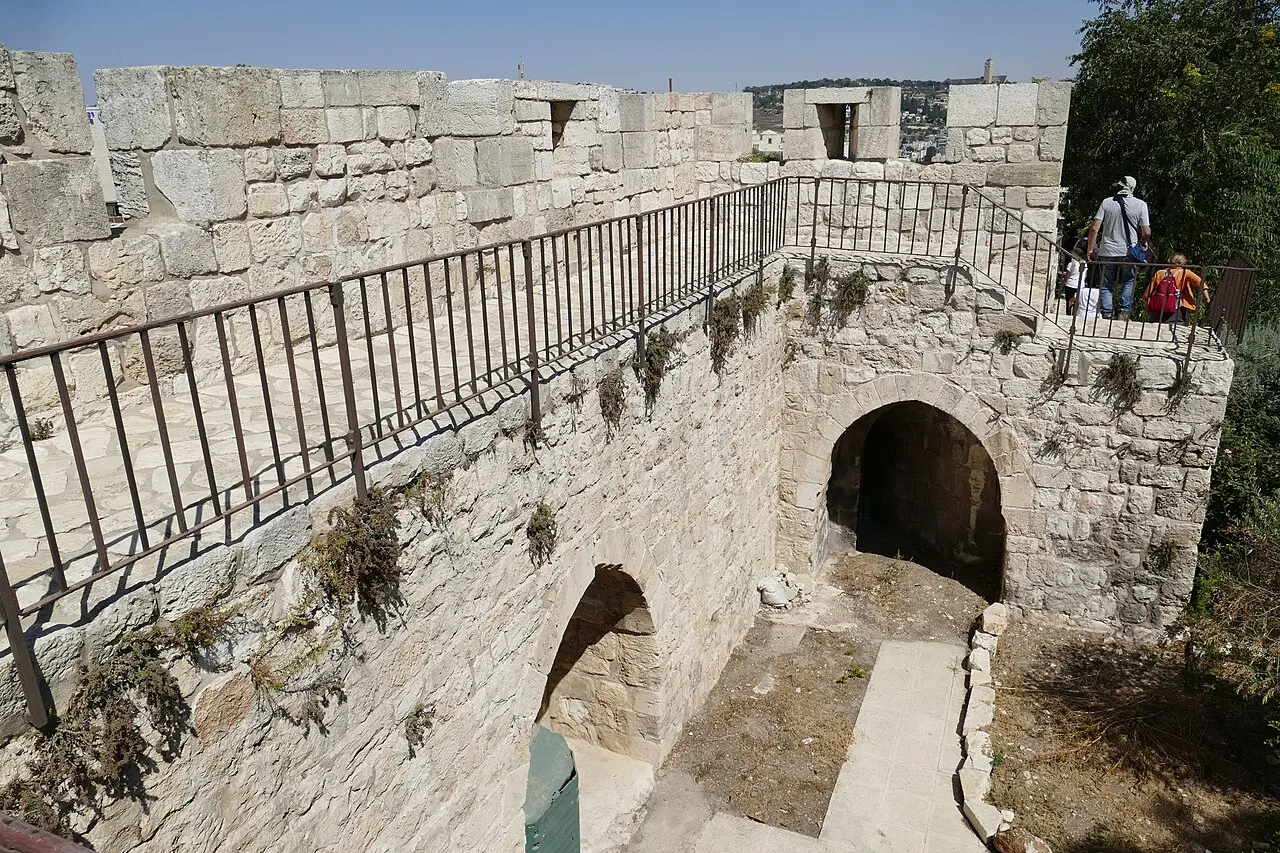
The wall you see is Ottoman. Britannica dates it to 1538–40 under Sultan Süleyman the Magnificent, built largely on earlier foundations: Crusader in most places, Byzantine, Herodian and even Hasmonean in others. The Jewish Virtual Library gives the circuit as approximately two and a half miles, about four kilometres. Seven gates are in daily use: Jaffa, New, Damascus, Herod's, Lions', Dung and Zion. The sealed Golden Gate faces the Mount of Olives.
Beneath Damascus Gate the Roman entrance survives: one of three arched openings of the northern gate of Aelia Capitolina, about 4.85 metres high, beside a guard tower still standing some 12 metres, with a Latin inscription above the keystone recording that the colonia Aelia Capitolina built it by decree of the city councillors. It reopened to visitors on 26 February 2025 with a multimedia exhibit.
You can also walk on top of the wall. The Ramparts Walk runs in two sections from Jaffa Gate: north by the New Gate and Damascus Gate to Herod's Gate, over the Christian and Muslim quarters, and south over the Armenian and Jewish quarters towards Zion and Dung Gates. The official Jerusalem tourism site listed 25 NIS for an adult and 12 NIS concession in 2026. It is the cheapest way to grasp the Old City's shape, and the only way to look down into its courtyards.
- Jaffa Gate: western entrance, citadel and Tower of David Museum inside
- Damascus Gate: northern, busiest, Roman gate preserved beneath
- Dung Gate: nearest access to the Western Wall plaza
- Lions' Gate: eastern, the Via Dolorosa end
- Zion Gate: south, into the Armenian and Jewish quarters
- Golden Gate: sealed, facing the Mount of Olives
Bukvoed / CC BY 4.0 · Wikimedia Commons
Below
The archaeology under the paving
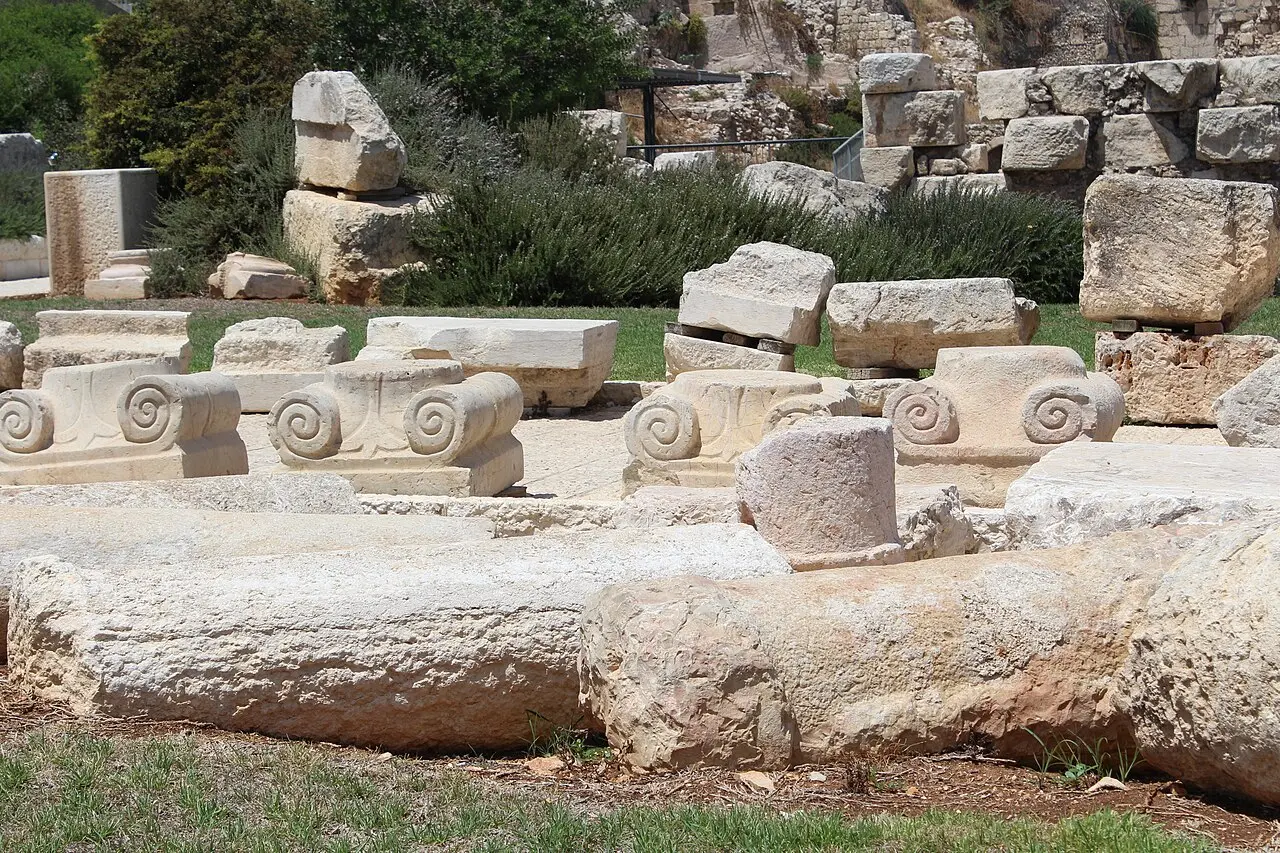
Jerusalem is not one city but a stack of them, and much of the most interesting work is underground. In the Jerusalem Archaeological Park at the south-west corner of the Haram, excavation exposed the main street of Second Temple period Jerusalem running along the base of the retaining wall, along with shops, ritual baths and the steps by which pilgrims climbed to the Temple: finds running, per the tourism ministry, from the First and Second Temple periods through Byzantine, early Muslim and Crusader levels.
South of the walls, the Israel Antiquities Authority spent roughly two decades clearing the Pilgrimage Road, the stepped street that climbed from the Pool of Siloam towards the Temple Mount in the Second Temple period. The Times of Israel reported on 2 February 2026 that the road (about 600 metres long, its original roadway some eight metres wide) had opened to the public on 20 January, the excavation driven underground beneath the Palestinian neighbourhood of Silwan and shored with concrete and steel. It is contested ground: residents objected that the tunnelling damaged houses above, which the archaeologists and the site's operators reject, and the operator itself, the City of David Foundation (ELAD), is disputed for a mission the paper describes as strengthening Jewish presence in Palestinian neighbourhoods.
The layering shows above ground too. At the citadel by Jaffa Gate, the Tower of David Jerusalem Museum reopened on 1 June 2023 after a renovation the Times of Israel reported at 50 million dollars, with conservation of the walls and minaret and two lifts, widened paths and ramps that make an archaeological site almost entirely accessible. It is the best place to get the chronology straight before walking into the lanes.
Deror_avi / CC BY-SA 3.0 · Wikimedia Commons

On foot
How a visitor actually moves through it
There are no cars. Britannica notes that the absence of vehicular traffic through most of the Old City is part of what preserves its character; in practice it means the lanes are stepped, cobbled, often covered, and change level constantly. Distances are trivial and times are not: a straight line on the map can take half an hour once you have met a delivery cart and a procession.
The two great compounds run on their own clocks, and that is the real constraint. The Haram al-Sharif admits non-Muslims only during designated visiting hours, through the Mughrabi ramp beside the Western Wall plaza, and those windows are short and shift with the season, with Ramadan and with the security situation, so if you mean to go up, check on the day and build the rest around it. The Holy Sepulchre keeps long hours but is calmest early. The Western Wall plaza is busiest on Friday evening and at festivals.
A workable first full day: in at Jaffa Gate before nine, the citadel museum for orientation, down David Street through the souks, the Cardo and the Hurva, the Western Wall plaza and the Tunnels if you have booked, then the Via Dolorosa in reverse to the Holy Sepulchre late in the afternoon, and out through Damascus Gate at dusk.
One thing that is not a detail: this is somebody's home and, in places, an active place of worship. Cover shoulders and knees, ask before photographing people, and expect security checks at the gates.
On the ground
What to see at The Old City of Jerusalem
The things worth building a visit around, in the order most people reach them.
The Western Wall plaza
About fifty metres of exposed retaining wall, 28 courses of it above ground, functioning as an open-air synagogue day and night. Busiest on Friday evening as Shabbat comes in.
The Western Wall Tunnels
A guided walk north along the wall's hidden length (485 metres of it, per iTravelJerusalem) past Herodian street level and the vast foundation courses. Pre-booking is compulsory; 38 NIS for an adult in the Foundation's 2026 listing.
The Dome of the Rock
Completed in 691–692 CE under Abd al-Malik, its dome about 20 metres across. Non-Muslims may enter the compound during designated hours but may not pray there.
The Church of the Holy Sepulchre
Golgotha and the tomb under one Crusader roof from 1149, with more than thirty chapels shared by six communities under an 1852 settlement that no one may unilaterally alter.
The Cotton Merchants' Market
A Mamluk market street of 1336–37, some 95 metres long with 60 shops under a skylit barrel vault, described by Discover Islamic Art as one of the most complete surviving suqs in the region.
The Ramparts Walk
Two routes along the top of Suleiman's wall from Jaffa Gate, north and south, listed at 25 NIS for an adult in 2026. The clearest view you will get of how the quarters fit together.
Go deeper
Every site in The Old City of Jerusalem, in full
11 places here have a page of their own: what survives, what it costs, when it opens and how long to give it.
שלמה רודד / CC BY 2.5 · Wikimedia Commons
Market
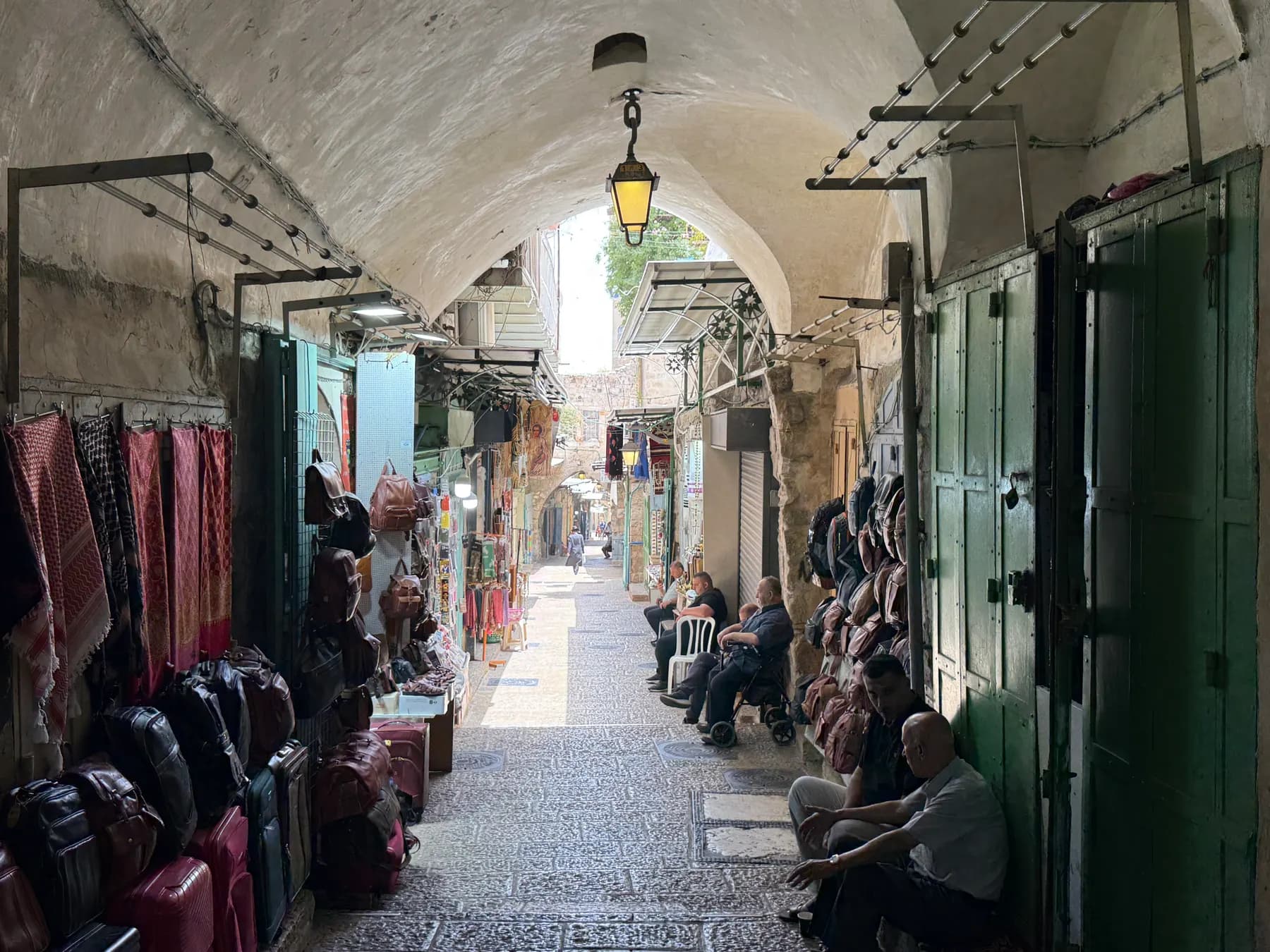
The Arab Souk and the Old City markets
The three parallel covered lanes at the centre of the souk were built as one market in 1152 by Melisende, Queen of Jerusalem, who hired Muslim labourers from Magna Mahomeria, the village now called al-Bireh, to build it.
שלמה רודד / CC BY 2.5 · Wikimedia Commons
Religious site
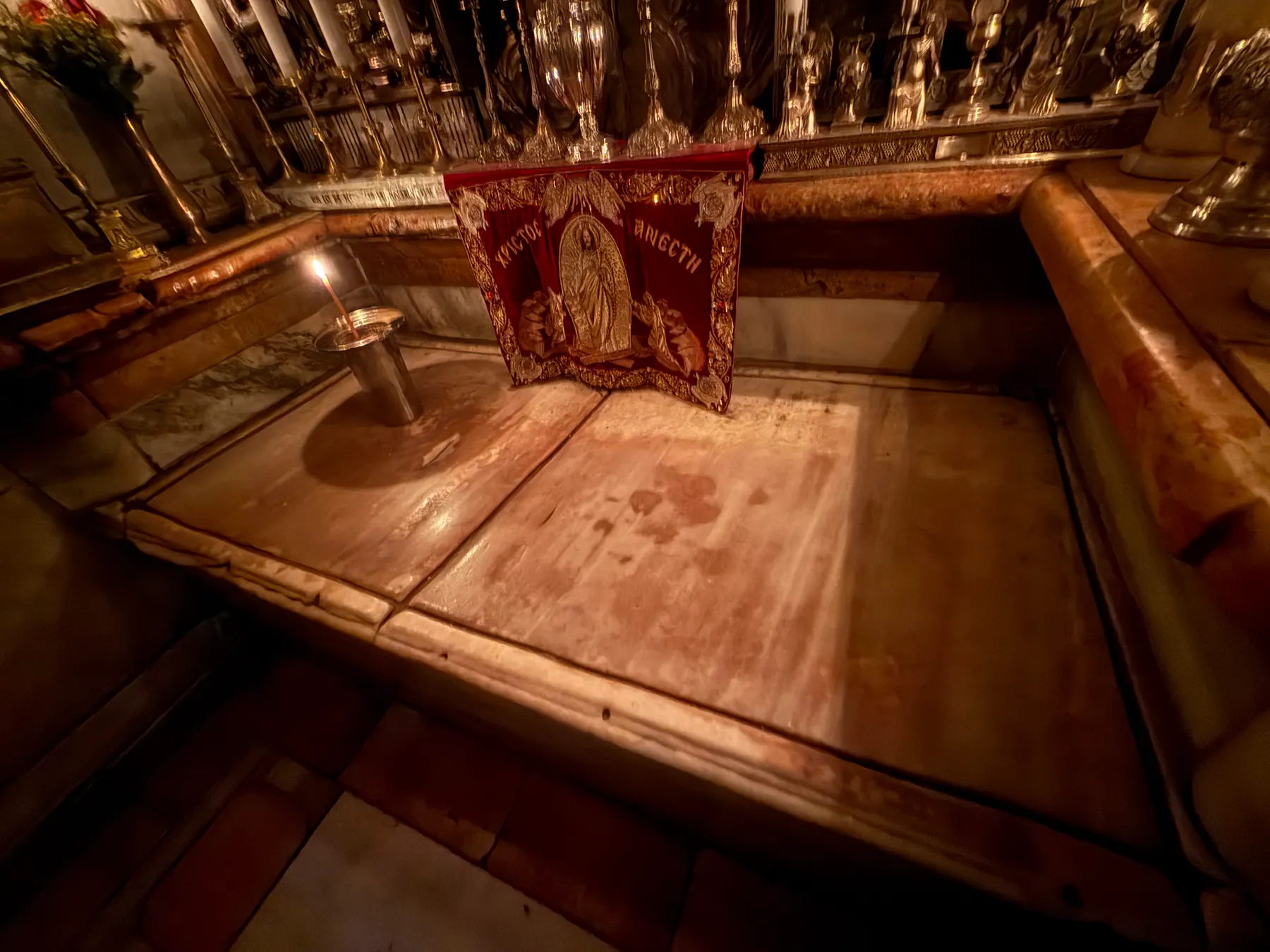
Church of the Holy Sepulchre
Six Christian communities share one building over Golgotha and the tomb, the doors are opened by two Muslim families, and nobody has been charged to walk in since 1831.
Davidbena / CC BY-SA 4.0 · Wikimedia Commons
Archaeological site
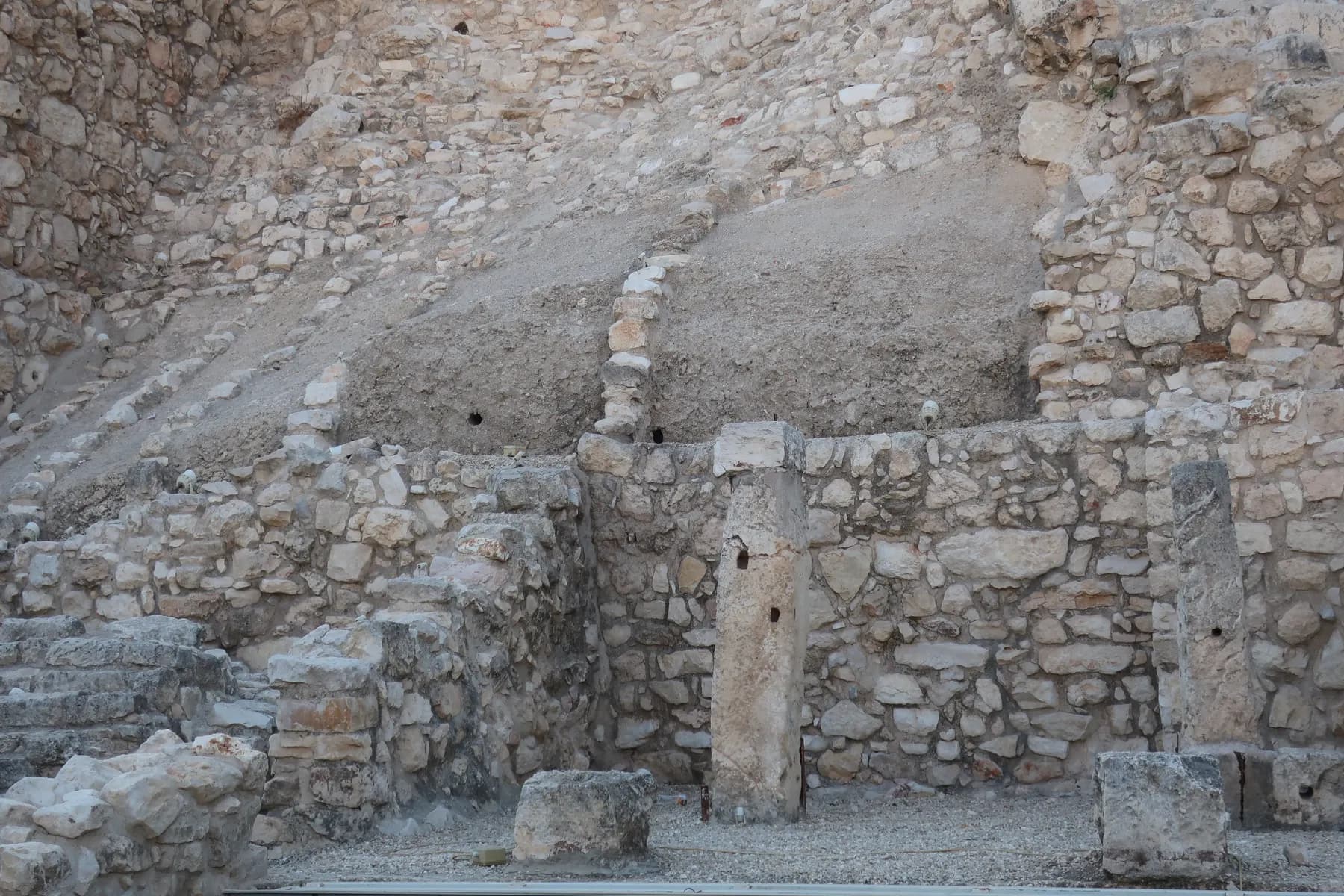
City of David
The ridge where Jerusalem began, outside the Ottoman walls and below Dung Gate, with a water tunnel 533 metres long that visitors still wade in water up to 70 centimetres deep.
Abruth / CC BY-SA 3.0 · Wikimedia Commons
Religious site
Hurva Synagogue
The Jewish Quarter's landmark synagogue was blown up by the Jordanian Arab Legion on 27 May 1948 and rebuilt to its nineteenth-century design, reopening on 15 March 2010 with a walkway round the base of its dome.
Mohammad Shad Siddiqui / CC BY-SA 4.0 · Wikimedia Commons
Archaeological site
Jerusalem Archaeological Park, Davidson Center
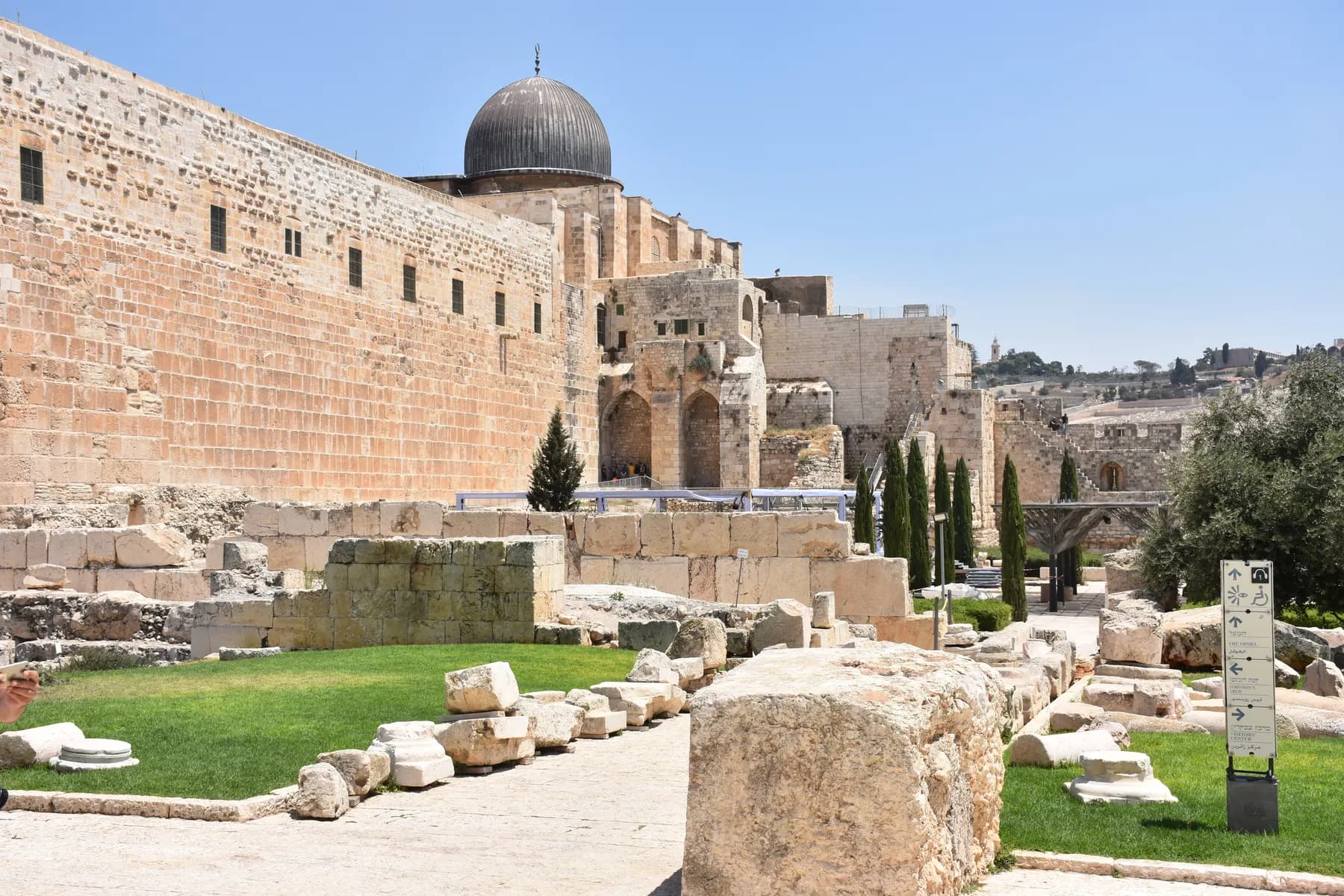
The excavated corner where the Temple Mount's southern and western walls meet, with the paving of the Herodian street still under the heap of masonry the Romans pushed off the top in 70 CE.
Unknown author / CC BY 2.5 · Wikimedia Commons
Activity
The Ramparts Walk
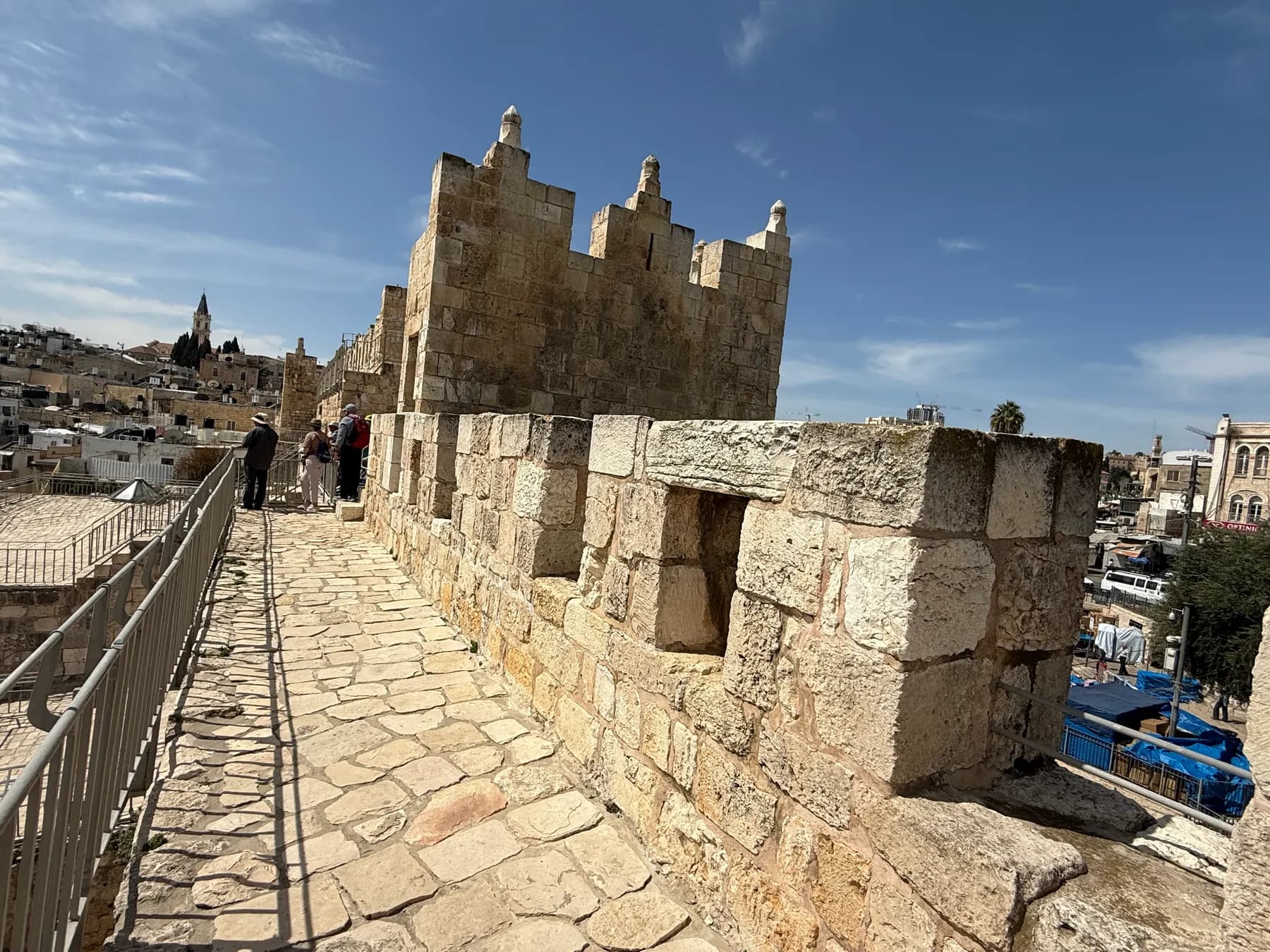
A ticketed footpath along the Ottoman patrol path on top of the Old City wall, walked in two sections that both start at Jaffa Gate and never meet, because the eastern stretch along the Temple Mount is closed to walkers.
arikb / CC BY-SA 3.0 · Wikimedia Commons
Religious site
The Temple Mount and Haram al-Sharif
Everything standing on the esplanade is later than the esplanade itself, which Herod's engineers made from about 19 BCE by wrapping a hilltop in four retaining walls and filling in behind them.
זאב שטיין / CC BY 2.5 · Wikimedia Commons
Museum
Tower of David Museum
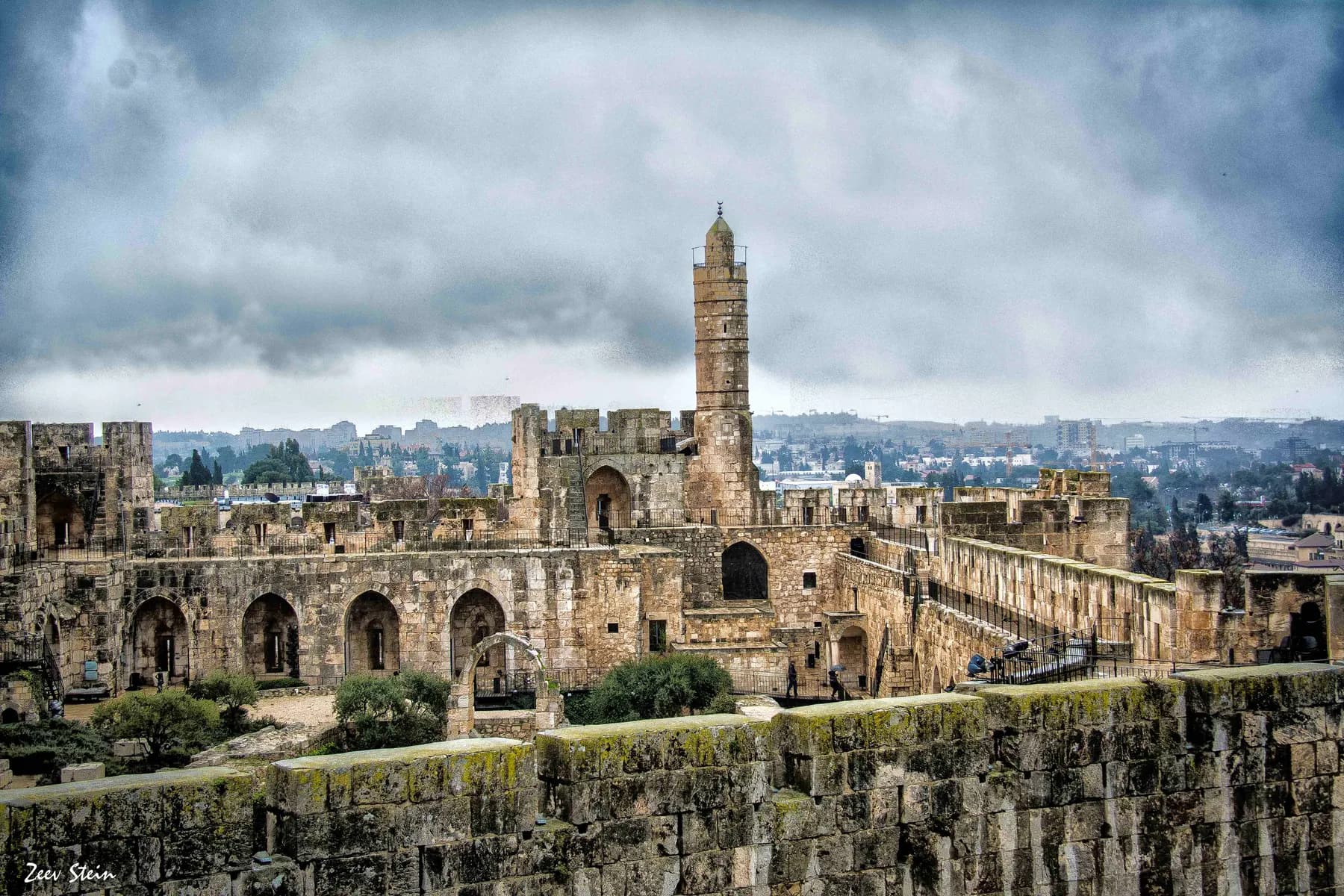
The citadel beside Jaffa Gate is Mamluk and Ottoman work standing on the stump of a Herodian tower, and its museum reopened on 1 June 2023 with a new display of ten galleries.
רחל וייסלר / CC BY 2.5 · Wikimedia Commons
Religious site
Via Dolorosa
Fourteen stations over roughly half a kilometre of working market lanes, of which nine are in the street and the last five are inside the Church of the Holy Sepulchre.
patano / CC BY-SA 3.0 · Wikimedia Commons
Religious site
The Western Wall
The prayer plaza shows about 50 metres of a retaining wall that runs 488 metres in total, and it is open free of charge at every hour of every day of the year.
Archaeological site
Western Wall Tunnels
A guided walk along the buried continuation of the Western Wall, past a single limestone block about 13.6 metres long that is among the largest building stones ever set in place by hand.
The long view
The Old City of Jerusalem, in order
20/19 BCE
Herod begins rebuilding the Temple on a magnificent scale; the retaining walls of its platform still stand.
Early 1st century CE
The stepped Pilgrimage Road is laid from the Pool of Siloam to the Temple Mount, about 2,000 years ago.
70 CE
Rome destroys the Temple; the pilgrimage street is buried and stays sealed under later building for nearly two millennia.
c. 130 CE
Hadrian refounds the city as the colonia Aelia Capitolina with a Roman grid, a 22-metre-wide Cardo and a monumental northern gate.
4th century CE
Constantine transforms the disused quarry, tombs and garden plots north-west of the walls into the first Church of the Holy Sepulchre.
691–692 CE
The Umayyad caliph Abd al-Malik completes the Dome of the Rock over the Foundation Stone.
1149
The Crusader rebuilding of the Church of the Holy Sepulchre, the core of the building standing today, is completed.
1538–40
Süleyman the Magnificent builds the present wall on Crusader, Byzantine, Herodian and Hasmonean foundations.
1852
A firman of Sultan Abdülmecid I fixes the Status Quo in the Holy Sepulchre, freezing each community's rights and requiring unanimity to change anything.
1948
Jordan's Arab Legion takes the Old City; the Jewish Quarter is emptied and the Hurva Synagogue is destroyed.
June 1967
Israel captures the Old City; the Mughrabi Quarter of about 135 homes is demolished within days to create the Western Wall plaza.
January 2026
The Pilgrimage Road opens to the public, about 600 metres of it, after some twenty years of excavation.
Getting there
- Jerusalem's light rail stops at City Hall, a few minutes' walk from Jaffa Gate, the most convenient arrival for a first visit.
- Jaffa Gate is the main western entrance, with the citadel and Tower of David Museum immediately inside; Damascus Gate is the northern entrance and the busiest.
- For the Western Wall, Dung Gate on the south-east is the closest and least stepped approach.
- There is no vehicle access inside most of the walls: everything within is on foot, over steps and cobbles.
Access
The Old City is difficult ground: steps, worn cobbles, steep covered lanes and few handrails. The Western Wall plaza is reachable by the flattest route, from Dung Gate. The Tower of David Jerusalem Museum was rebuilt for access in its 2023 renovation, with two lifts, widened paths and ramps that the Times of Israel reported have made the citadel almost entirely accessible. The souks, the ramparts and the Via Dolorosa are not step-free.
When to go
Spring and autumn are the kindest: Jerusalem sits high and dry, and summer afternoons in the unshaded plazas are punishing while winter can be cold and wet. Early morning is the best hour in the Old City in any season: the souks are opening and the Holy Sepulchre is quiet. Friday and Saturday change the rhythm entirely, with Muslim prayers at midday and the Jewish Quarter closed from Friday afternoon, and any visit to the Haram al-Sharif has to be fitted around its limited non-Muslim visiting hours.
Hours and cost
Every major site here keeps its own hours and they move with the religious calendar and the security situation. The Haram al-Sharif admits non-Muslims through the Mughrabi ramp only during designated visiting hours, which change seasonally and during Ramadan and are not published far ahead. The Western Wall Tunnels run Sunday to Thursday from 7.20am and on Friday mornings, by prior booking only, with a certified guide (Western Wall Heritage Foundation, 2026 listing). Check operators' own pages on the day rather than trusting a printed schedule.
Walking the Old City, entering the Western Wall plaza and entering the Church of the Holy Sepulchre cost nothing. The ticketed attractions are modest: the Western Wall Tunnels tour was listed at 38 NIS for an adult and 25 NIS concession by the Western Wall Heritage Foundation in 2026, and the Ramparts Walk at 25 NIS adult and 12 NIS concession on the official Jerusalem tourism site in the same year. Prices drift; check the operator before you go.
Opening times and prices change. Both are given as published by the operator and should be checked against its own page before you travel.

Practical
What people wish they had known about The Old City of Jerusalem
- Cover shoulders and knees. It is required at the Haram al-Sharif and expected at the Western Wall and in churches.
- Book the Western Wall Tunnels in advance; the Foundation runs them by prior arrangement only, in guided groups capped at 35.
- At the Western Wall the Heritage Foundation asks visitors not to eat, smoke or light candles in the plaza.
- Photography is not welcome at the Western Wall on Shabbat and festivals; ask before photographing worshippers anywhere.
- Carry water and cash in small notes: many shops in the souks do not take cards.
- Do not plan a single day around everything being open: Friday, Saturday and Sunday each close a different part of the Old City.
The figures
The Old City of Jerusalem by the numbers
Each figure carries the year it belongs to and links the source it came from.
| Measure | Figure | As of | Source |
|---|---|---|---|
| Area inside the walls | 870,000 m² (about 0.87 km²) | 2021 | jerusaleminstitute.org.il |
| Residents | about 35,000, in roughly 6,200 flats | 2021 | jerusaleminstitute.org.il |
| Annual entries | about 10 million, of them some 4 million foreign tourists | 2021 | jerusaleminstitute.org.il |
| Western Wall | 488 m long, greatest height 55 m | 2026 | thekotel.org |
| Haram al-Sharif esplanade | 144,000 m² | 2025 | religionmediacentre.org.uk |
| Pilgrimage Road | about 600 m long, original roadway roughly 8 m wide | 2026 | timesofisrael.com |
| Western Wall Tunnels ticket | 38 NIS adult, 25 NIS concession | 2026 | thekotel.org |
| Ramparts Walk ticket | 25 NIS adult, 12 NIS concession | 2026 | itraveljerusalem.com |
Where this is
The Old City of Jerusalem in the length of the country
Israel runs about 420 km from its northern tip to Eilat. Here is where this one sits on that line.
Nearby
Where to go next

Judaean Desert
Masada
A desert plateau some 450 metres above the Dead Sea, carrying Herod's palace, the most complete Roman siege works to survive anywhere, and an unfinished argument about what happened here.

The Jordan Rift Valley
The Dead Sea
The lowest ground on Earth, water nearly ten times saltier than the ocean, and a shoreline retreating by more than a metre a year.

Sources and further reading
Every link below was opened and checked when this page was written. Official statements are marked as such: they are the subject's own account, not an independent one.
- OfficialWestern Wall Heritage Foundationthekotel.orgDo you know how long and how high the Western Wall is?
Western Wall length of 488 m, maximum height 55 m, and 45 courses at the plaza: 28 above ground and 17 below.
- OfficialWestern Wall Heritage Foundationthekotel.orgWestern Wall Tunnels: tours and tickets
Tunnels tour prices (38 NIS adult, 25 NIS concession), duration of an hour and ten minutes, group cap of 35, Sunday–Thursday from 7.20am and Friday mornings, and the prior-booking and certified-guide requirement.
- OfficialWestern Wall Heritage Foundationthekotel.orgVisitor information
Conduct rules at the plaza: no eating, smoking or candle-lighting, and appropriate dress.
- OfficialiTravelJerusalemitraveljerusalem.comThe Western Wall Tunnels
The tunnels run along a 485-metre length of the wall; tour of about 75 minutes.
- OfficialiTravelJerusalemitraveljerusalem.comRamparts Walk
Northern route from Jaffa Gate by the New and Damascus Gates to Herod's (Flower) Gate and southern route to Zion Gate, and ticket prices of 25 NIS adult and 12 NIS concession.
- OfficialIsrael Ministry of Tourismisrael.travelVia Dolorosa, St Anne's Church and the Church of the Holy Sepulchre
Fourteen stations marked by circular bronze discs, the Franciscan procession, the 1149 Crusader rebuilding, over thirty chapels, and Greek Orthodox maintenance with other denominations sharing the building.
- OfficialIsrael Ministry of Tourismisrael.travelDavidson Center: Southern Wall excavations
The archaeological park's contents: First Temple period city walls, the steps leading up to the Temple, the main Second Temple period street, shops and ritual baths, and finds from Byzantine, Muslim and Crusader periods.
- ReportingNational Geographicnationalgeographic.comChrist's burial place exposed for first time in centuries
The October 2016 lifting of marble cladding in place since at least 1555, the project's cost of more than four million dollars, its funders and the National Technical University of Athens team under Antonia Moropoulou.
- ReportingThe Times of Israeltimesofisrael.comHistoric restoration of Jesus's burial shrine in Jerusalem completed
Edicule restoration from June 2016 to March 2017, cost around four million dollars, funding from the World Monuments Fund, King Abdullah II and the Palestinian Authority, and the 1947 British iron cage.
- ReportingThe Times of Israeltimesofisrael.comEchoing Gospel account, traces of ancient garden found under Church of Holy Sepulchre
Excavations from 2022 led by Francesca Romana Stasolla: Iron Age quarry, burials, olive and grapevine pollen from about 2,000 years ago on stratigraphic dating with radiocarbon still pending, and Stasolla's insistence that faith and history are separate fields.
- ReportingThe Times of Israeltimesofisrael.com2,000-year-old Pilgrimage Road to Temple Mount opens to public after years of digging
Published 2 February 2026: the road's roughly 600-metre run and eight-metre original width, twenty years of IAA excavation, the 20 January 2026 public opening, ELAD's operation of the site and the dispute with Silwan residents.
- ReportingThe Times of Israeltimesofisrael.comBiblical-themed exhibit inaugurated at Roman site under Damascus Gate
The Aelia Capitolina gate arch about 4.85 m high, the 12-metre guard tower, the Latin inscription above the keystone, and the 26 February 2025 reopening.
- ReportingThe Times of Israeltimesofisrael.comModern and ancient coexist in $50 million Tower of David renovation
The citadel museum's 1 June 2023 reopening, the $50 million cost, and the two lifts, widened pathways and ramps that made the site almost entirely accessible.
- ReportingThe Times of Israeltimesofisrael.comFrench historian claims Israel abetted 1967 razing of Jerusalem's Mughrabi quarter
The Mughrabi Quarter of about 135 homes at the foot of the Western Wall, its demolition in June 1967, and Vincent Lemire's documentary claims about the 9 June meeting 36 hours beforehand.
- ReportingThe Times of Israeltimesofisrael.comLand dispute in Jerusalem's Armenian Quarter escalates as residents fear eviction
Published December 2023: about 2,000 Armenian Christians in the quarter, some 1,600 years of presence, and the contested Cows' Garden of about 11,500 m², roughly a quarter of the quarter's area.
- ReportingJewish Telegraphic Agencyjta.orgHurva Synagogue rededicated
The March 2010 rededication, the building's destruction after Jordan took the area in the 1948 war, and reconstruction begun in 2005.
- ReportingPAX / Israel Ministry of Tourism datapaxnews.comSigns of recovery: Israel welcomed 1.3M visitors in 2025
Israel's 2025 incoming tourism of 1.3 million visitors per a January 2026 Tourism Ministry release, as context for how busy the Old City currently is.
- DataJerusalem Institute for Policy Researchjerusaleminstitute.org.ilThe Old City: Mapping East Jerusalem Neighborhoods, publication 542
Area of 870,000 m², about 35,000 residents (27,000 Muslims, 5,000 Christians, 3,000 Jews) in roughly 6,200 flats, some 10 million annual entries including 4 million foreign tourists, and the land-ownership breakdown.
- ReferenceEncyclopaedia Britannicabritannica.comWestern Wall
The exposed section at the plaza about 50 m long and about 20 m high; the wall as the surviving remnant of the Temple Mount retaining wall, extending much deeper underground, with later upper courses.
- ReferenceEncyclopaedia Britannicabritannica.comTemple Mount
Herod's reconstruction of the Temple on a magnificent scale in 20/19 BCE, and the significance of the site in Judaism and Islam.
- ReferenceEncyclopaedia Britannicabritannica.comDome of the Rock
Built by the Umayyad caliph Abd al-Malik, completed in 72 AH (691–692 CE), dome about 20 m in diameter on a drum above sixteen piers and columns.
- ReferenceEncyclopaedia Britannicabritannica.comWall of Süleyman
The present wall erected 1538–40 by Süleyman the Magnificent, largely on Crusader, Byzantine, Herodian and Hasmonean foundations.
- ReferenceEncyclopaedia Britannicabritannica.comJerusalem: the Old City
UNESCO World Heritage designation in 1981, the four quarters, and the absence of vehicular traffic within most of the Old City.
- ReferenceJewish Virtual Libraryjewishvirtuallibrary.orgJerusalem: the Old City
Area of roughly 220 acres (about one square kilometre), walls approximately two and a half miles long, and the seven gates in daily use with the Golden Gate sealed.
- ReferenceReligion Media Centrereligionmediacentre.org.ukExplainer: Jerusalem's holy flashpoint
The 144,000 m² esplanade, the site as the third-holiest place in Islam after Mecca and Medina, Waqf administration with Israeli police controlling access, Jordan's role under the 1994 treaty, and the rule that non-Muslims may visit during designated hours but not pray.
- ReferenceDiscover Islamic Art, Museum With No Frontiersislamicart.museumwnf.orgSuq al-Qattanin (Market of the Cotton Merchants)
Built 737 AH / 1336–37 CE under al-Nasir Muhammad and Amir Tankaz; about 95 m long, two rows of 30 shops (60 in all), a caravanserai, two hammams, a skylit barrel vault and an ablaq portal; described as one of the most complete suqs in Greater Syria.
- ReferenceWorld History Encyclopediaetc.worldhistory.orgExploring Aelia Capitolina, Hadrian's Jerusalem
Hadrian's orthogonal grid, the Cardo Maximus 22 m across with a 5 m carriageway and colonnaded walkways, the arched northern gate beneath today's Damascus Gate, and the two reconstructed Cardo sections in the Jewish Quarter.
- ReferenceChurch of the Holy Sepulchre (holysepulchre.com)holysepulchre.comStatus Quo
The six communities, the 1852 firman of Sultan Abdülmecid I, the immovable ladder in place since the nineteenth century, and the Nusseibeh and Joudeh families as key-holders since Saladin's time.
The Old City of Jerusalem: common questions
How big is the Old City, really?+
About 870,000 square metres (under a square kilometre) according to the Jerusalem Institute for Policy Research's 2021 mapping, enclosed by roughly four kilometres of Ottoman wall. Everything you have read about is inside that.
Can non-Muslims go up to the Temple Mount / Haram al-Sharif?+
Yes, in limited windows and under restrictions. Under the long-standing status quo arrangement described by the Religion Media Centre, the compound is managed by the Islamic Waqf with Israeli police controlling access; Muslims may pray there, non-Muslims may visit during designated hours but may not pray. Entry for non-Muslims is by the Mughrabi ramp beside the Western Wall plaza only, and the hours change with the season, with Ramadan and with the security situation, so check locally on the day.
Does it cost anything to visit the Western Wall?+
The plaza itself is an open site that functions as a synagogue and does not operate as a ticketed attraction; the Western Wall Heritage Foundation asks visitors not to eat, smoke or light candles there. The Tunnels beneath it are a separate paid, pre-booked tour: 38 NIS for an adult in the Foundation's 2026 listing.
Who owns and runs the Church of the Holy Sepulchre?+
No one, alone. Six communities hold rights under the Status Quo fixed by an Ottoman firman of 1852: Greek Orthodox, Roman Catholic (the Franciscan Custody), Armenian Apostolic, Coptic, Ethiopian and Syriac Orthodox. Nothing can be changed without unanimity, and the keys have been kept by two Muslim families, the Nusseibeh and the Joudeh, since Saladin's day.
How long do I need?+
A full day covers the four quarters, the Western Wall, the Holy Sepulchre and the souks at a brisk pace. Two days lets you add the Haram in its visiting window, the Tunnels, the Tower of David Museum and the Ramparts Walk without running.
Is the Old City accessible for wheelchair users?+
Only partly. The lanes are stepped and cobbled and much of the fabric is medieval. The Western Wall plaza is reachable by the flattest route from Dung Gate, and the Tower of David Museum was made almost entirely accessible in its 2023 rebuild with two lifts, widened paths and ramps. The souks, ramparts and Via Dolorosa are not step-free.
What is the Pilgrimage Road and can I walk it?+
It is the Second Temple period stepped street that climbed from the Pool of Siloam towards the Temple Mount, excavated by the Israel Antiquities Authority over roughly twenty years. The Times of Israel reported that it opened to the public on 20 January 2026, about 600 metres of it. The excavation runs underground beneath the Palestinian neighbourhood of Silwan and is contested: residents objected that the tunnelling damaged houses above, which the archaeologists and the site's operators reject.
Which gate should I use?+
Jaffa Gate for a first visit and for the citadel; Damascus Gate for the markets and the Roman gate beneath it; Dung Gate for the Western Wall; Lions' Gate for the Via Dolorosa. Seven gates are in daily use; the Golden Gate, facing the Mount of Olives, is sealed.
Is it safe to visit?+
The Old City is a working neighbourhood with a permanent security presence and routine bag checks at gates and at the Western Wall plaza. Conditions vary and flashpoints are real, particularly around the Haram al-Sharif on Fridays and during Ramadan and Jewish festivals. Check your government's current travel advice and local news before you go, and follow police instructions on the ground.
When is the quietest time of day?+
Early morning, before about nine. The souks are still setting up and the Holy Sepulchre is at its calmest; by mid-morning the tour groups are through Jaffa Gate and David Street is solid.
Where to stay near The Old City of Jerusalem
See all hotels & stays →Listings from the Israel.com business directory.
The Sephardic House
Jerusalem
A hotel inside Jerusalem's Jewish Quarter, minutes from the Kotel
Ecce Homo Pilgrim House
Jerusalem
A guesthouse on the Via Dolorosa, over Roman pavement
New Imperial Hotel
Jerusalem
Inside Jaffa Gate, in a 19th-century landmark
Jerusalem Hotel
Jerusalem
A stone-vaulted hotel in East Jerusalem, by the Old City