Religious site · The Old City of Jerusalem
The Western Wall
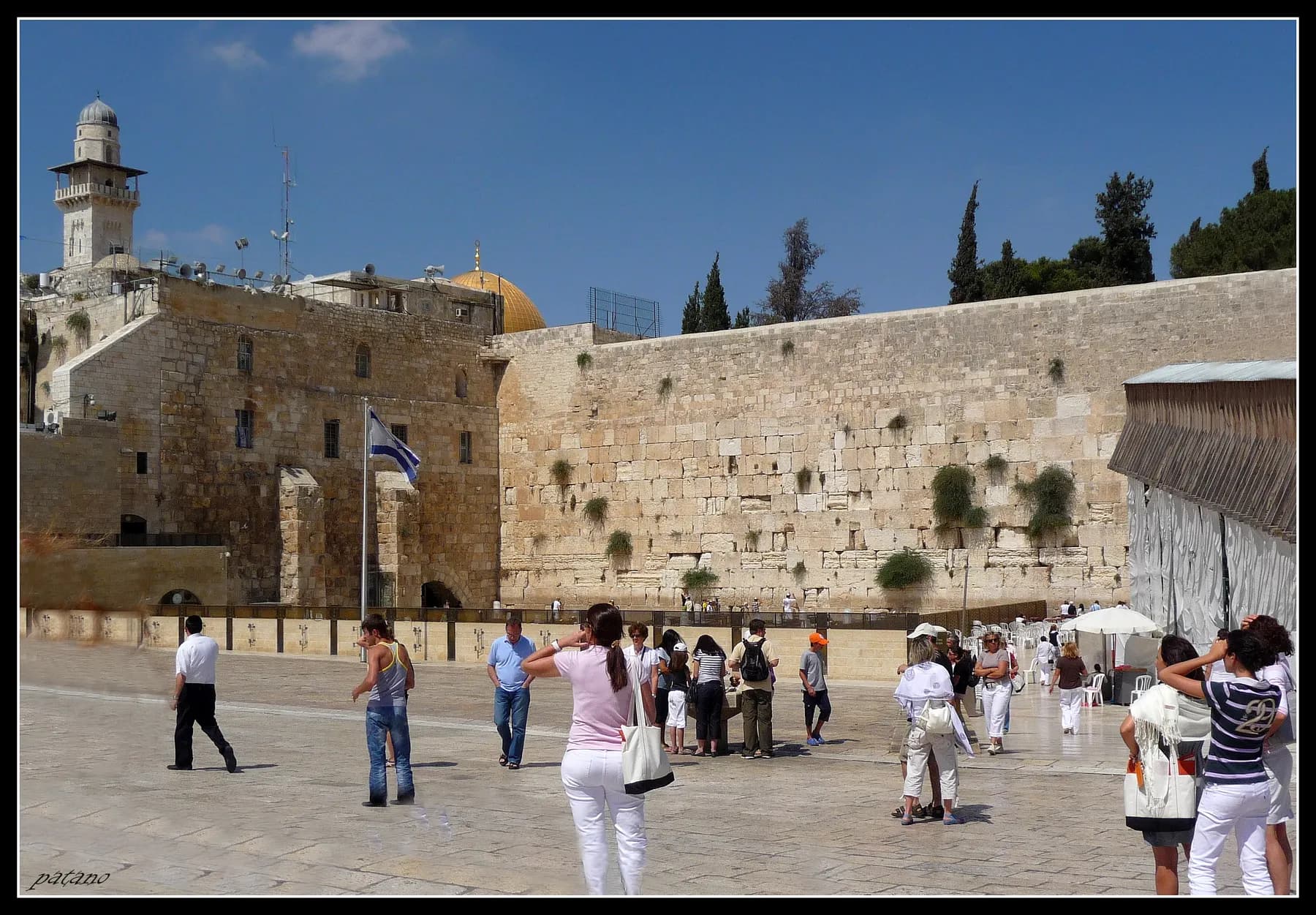
The prayer plaza shows about 50 metres of a retaining wall that runs 488 metres in total, and it is open free of charge at every hour of every day of the year.
patano / CC BY-SA 3.0 · Wikimedia Commons
Full length of the wall
488 m
the figure the Western Wall Heritage Foundation publishes for the whole retaining wall
Exposed at the prayer plaza
about 50 m
and about 20 m high above the paving, per Britannica
Courses of stone
45
28 above ground and 17 below it, on the Foundation's count
Admission and hours
Free, 24/7
the Foundation states the prayer plaza operates all day, every day of the year
In short
- How long to give it
- about 45 minutes for the plaza, the prayer area and the hall under Wilson's Arch, and about two and a half hours if the Tunnels tour is added
- Western Wall Prayer Plaza
- All day, every day of the year
- Western Wall Plaza
- Free. No ticket and no reservation, at any hour
הכותל המערבי
The Western Wall is a retaining wall. It never enclosed the Temple; it held up the artificial platform the Temple stood on, and it is the western face of that platform, left standing when everything above it came down. Britannica calls it the only remains of the retaining wall that surrounded the Temple Mount, and puts the section exposed at the prayer plaza at about 50 metres long and about 20 metres high. The Western Wall Heritage Foundation, the government body that has run the site since 1988, gives the wall's full length as 488 metres and its greatest height as 55 metres. What a visitor sees, then, is roughly a tenth of the structure.
It is also the only major site in the Old City that asks nothing of a visitor in advance. There is no ticket, no timed entry and no closing time: the Foundation states that the prayer plaza operates all day, every day of the year. The one condition is a security check at the gate, and the one gate that matters is the Dung Gate, at the south-east corner of the walls.
The other thing to know before arriving is that almost nothing at ground level is old. The stones are Herodian and later. The plaza in front of them, the paving, the barriers, the lit prayer sections and the covered hall at the north end are all products of the past sixty years, laid over a neighbourhood that was demolished in June 1967. The wall is an antiquity. The place people photograph is a piece of twentieth-century planning built against it.
Orientation
A retaining wall, and only a fraction of it on show
The Temple Mount is not a hill in its natural shape. It is a platform, extended outwards over the slopes on all four sides and held in place by retaining walls, and the Western Wall is the western one. Nothing of the Temple itself survives above ground. What survives is the engineering that carried it, which is why the masonry a worshipper touches is structural rather than sacred in origin, and why its lower courses are so much larger than anything a wall of that height would otherwise need.
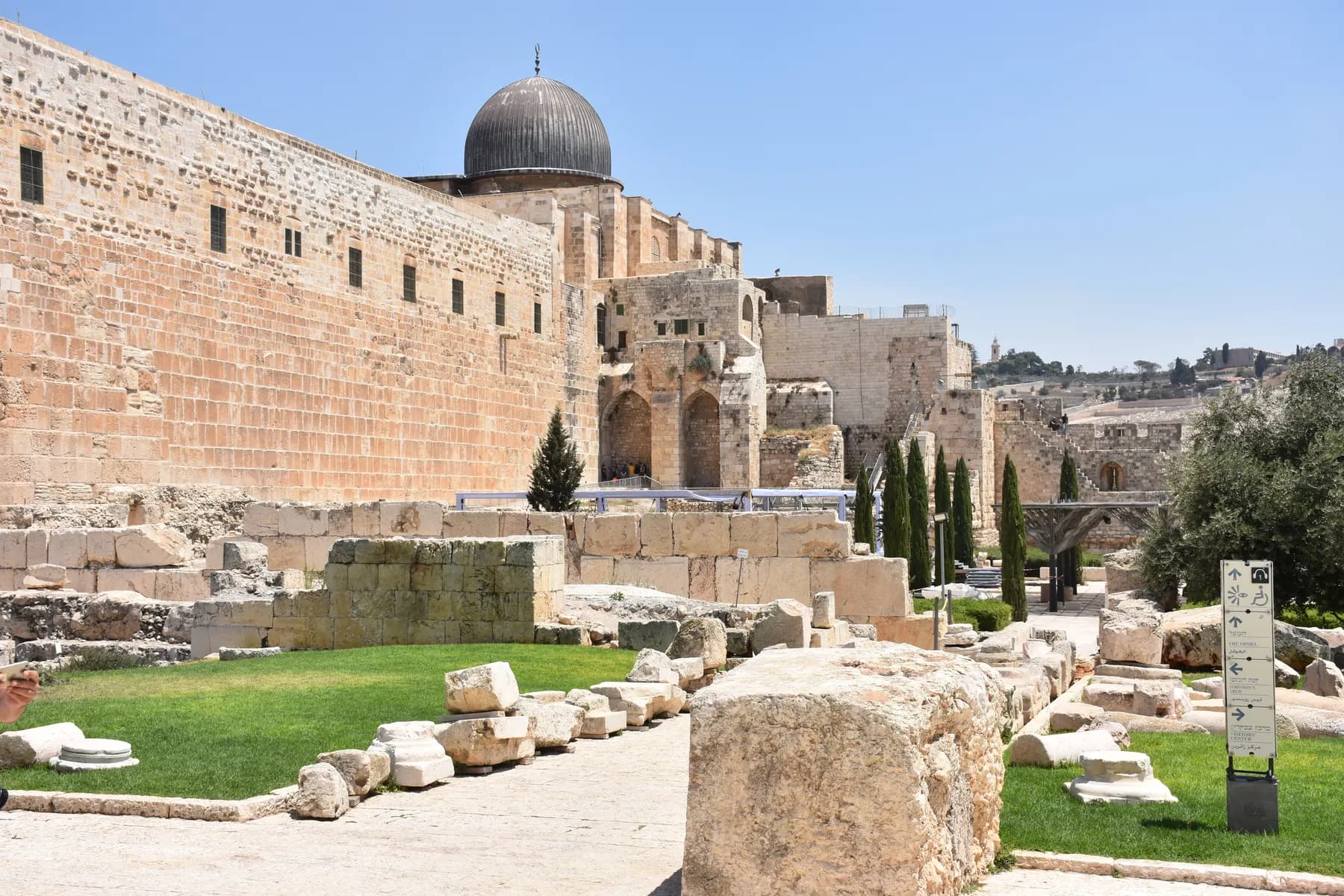
The exposed stretch at the plaza is a short segment of a much longer run. North of the plaza the wall continues behind and beneath the houses of the Muslim Quarter, followed underground by the Western Wall Tunnels. South of the plaza it continues into the excavated ground around Robinson's Arch, where the Second Temple period street and the collapsed stonework from 70 CE lie where they fell. The Foundation counts 45 courses of stone at the plaza, 28 of them above ground and 17 still buried.
At the northern end of the plaza the wall runs into a roofed space. That is the hall under Wilson's Arch, the first arch of a bridge that once carried a road from the Upper City across to the Temple Mount. Only about six metres of the arch is visible now, and the space beneath it was fitted out as a prayer hall after 1967. In practical terms it is the shaded, sheltered and considerably quieter part of the site, and it is the part most first-time visitors walk past.
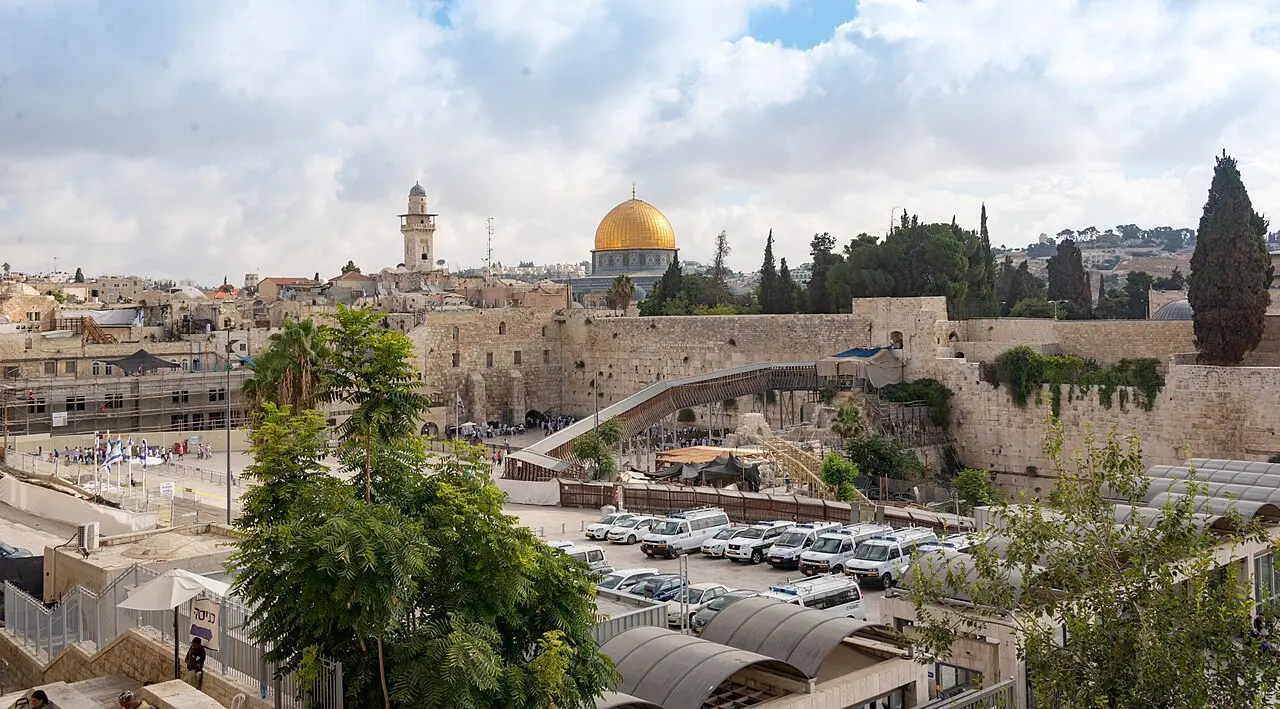
xiquinhosilva / CC BY 2.0 · Wikimedia Commons
Herod
Herod began it, and the coins say he did not finish it
The expansion that produced this wall was Herod the Great's, begun around 19 BCE, and for a long time the whole structure was credited to him without qualification. Excavation at the southern end complicated that. Ronny Reich of the University of Haifa and Eli Shukron of the Israel Antiquities Authority reported coins recovered from beneath the wall's foundation stones near Robinson's Arch that were minted decades after Herod's death in 4 BCE, the latest of them struck under the prefect Valerius Gratus in 17 or 18 CE. A wall cannot be older than the objects sealed underneath it.
The reading the excavators drew from that is that the retaining walls were a multi-generation programme rather than one reign's work, and that the southern stretch was completed long after Herod, which matches Josephus's account of the Temple Mount works still being finished under Agrippa II. It remains a contested reading, because a small number of coins from one sounding is a narrow base for a conclusion about a 488-metre wall.
The strongest dating now comes from the other end of the plaza. Johanna Regev, Joe Uziel, Elisabetta Boaretto and colleagues published radiocarbon results in PLOS ONE on 3 June 2020 from mortar sampled during excavations of 2015 to 2019 under Wilson's Arch. The first bridge, about seven and a half metres wide, dates to between 20 BCE and 20 CE. It was then doubled in width between 30 and 60 CE, which places the enlargement in the years of the Roman prefects rather than of Herod.
Fabric
Which courses are ancient, and which are patched on
The wall reads from the bottom up as a chronology, and it is legible from the plaza without a guide. The lowest visible courses are the Herodian ones: very large limestone blocks, laid dry without mortar, each with a shallow flat border chiselled around a slightly raised centre. That drafted margin is the signature. Above them the stones get abruptly smaller and the joints get untidier, and everything from that line upwards is later repair and heightening, including work added in the early twentieth century.
So the honest description of what a visitor is looking at is a Second Temple period base carrying roughly a millennium and a half of patching. The upper sections, as Britannica puts it, were added at a later date. Nothing here was reconstructed in the modern sense: unlike the Hurva Synagogue a few streets west, the wall was never taken down and rebuilt. It was maintained, raised and repaired, and the repairs were never disguised.
The masonry is also under active watch. On 23 July 2018, hours after the Tisha B'Av fast ended, a stone weighing about 400 pounds worked loose from the wall above the southern prayer platform at Robinson's Arch and fell onto it. One woman was praying there at the time and was not hurt, and the smaller of the two platforms was closed while the Israel Antiquities Authority surveyed the surrounding stones. The plaza itself was unaffected, but it was a reminder that this is a two-thousand-year-old structure that people stand directly beneath.
- Ancient: the large drafted-margin blocks in the lower courses, laid without mortar in the Second Temple period
- Later: the smaller, rougher stones above them, added over centuries of repair and heightening, the topmost courses within the past hundred years or so
- Buried: 17 further courses below the paving, which the Western Wall Tunnels route reaches from the north
- Modern: the plaza, the paving, the barrier dividing the prayer area from the concourse, the lighting and the prayer hall fittings under Wilson's Arch
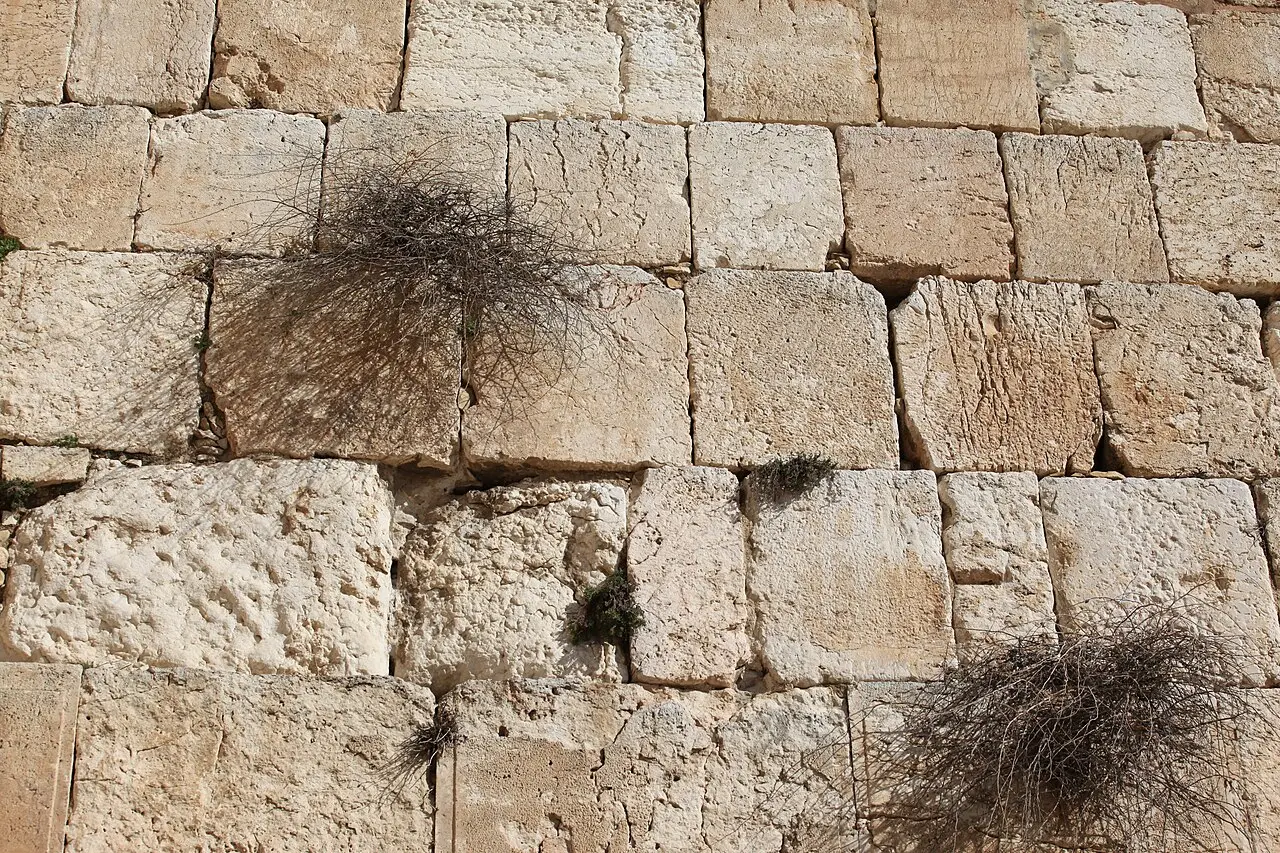
StateofIsrael / CC BY-SA 2.0 · Wikimedia Commons
1967
The plaza is younger than most of the people standing in it
Until June 1967 there was no plaza. Worshippers used an alley, which the Foundation describes as roughly 28 metres long and 3.6 metres wide, hemmed in by the houses of the Mughrabi or Moroccan Quarter. That quarter was not an accident of settlement: Jerusalem Story records it as an endowment established in 1193 by al-Afdal, a son of Salah al-Din, for pilgrims and residents from the Maghreb, and it had stood at the foot of the wall for close to eight centuries.
It was cleared in three days. On the same account the quarter held 135 buildings, 108 families and about 650 residents when Israel took the Old City; residents were given some three hours to leave, bulldozers began work at about eleven at night on 10 June 1967 and finished on the twelfth, at least one resident was killed in her home, and two mosques went with the houses. The French historian Vincent Lemire, publishing in 2022, cited minutes of a meeting held some 36 hours before the demolition at which the destruction was already on the agenda, which he reads as evidence of planning rather than of a decision taken in the moment.
What replaced it is the open ground visitors now cross. The published figures for it do not agree, and it is worth saying so: Jerusalem Story gives the resulting Western Wall Plaza as 20,000 square metres, while the English Wikipedia entry on the plaza gives 10,000 square metres with a stated capacity of up to 400,000 people a day. The length of wall made accessible for prayer roughly doubled, from about 28 metres to the 57-metre frontage the Foundation describes today.
The rules
An open-air synagogue with a disputed floor plan
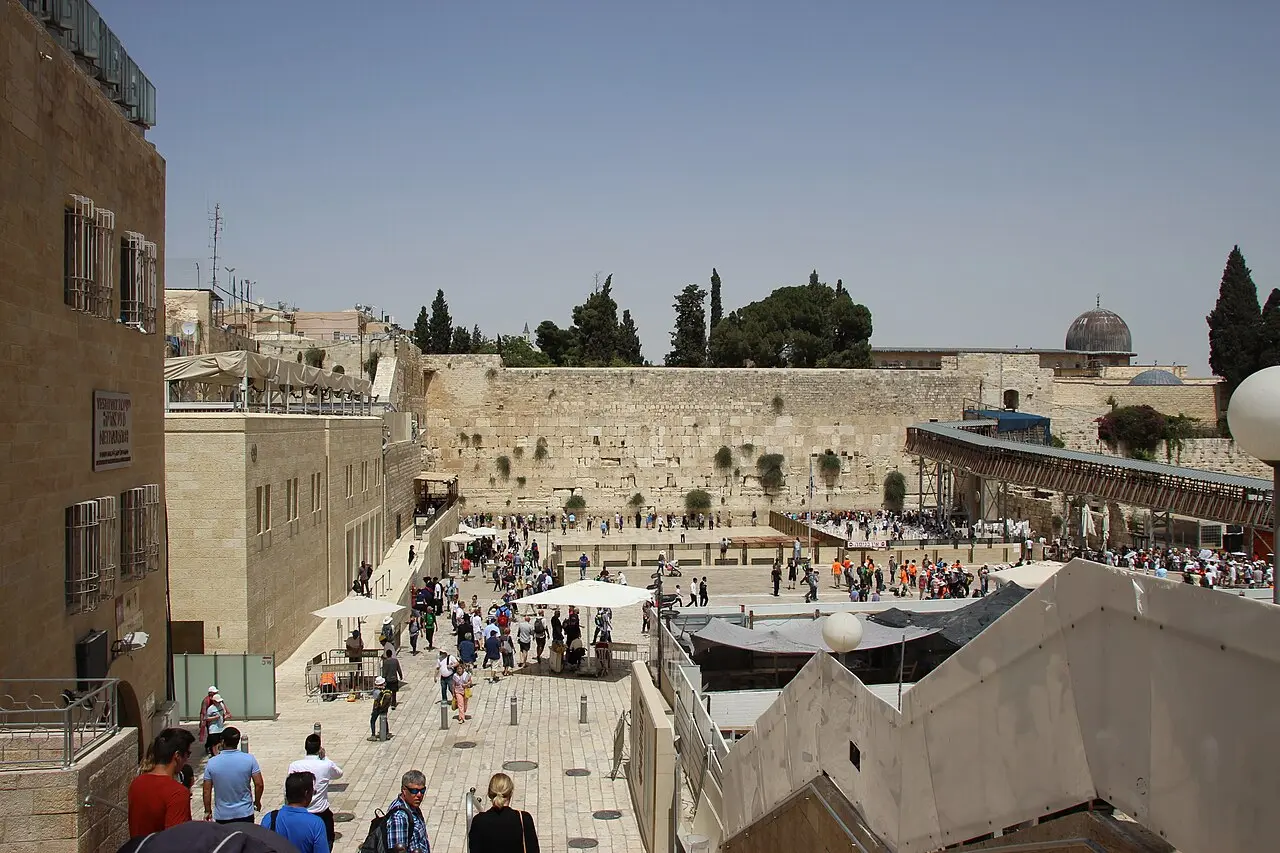
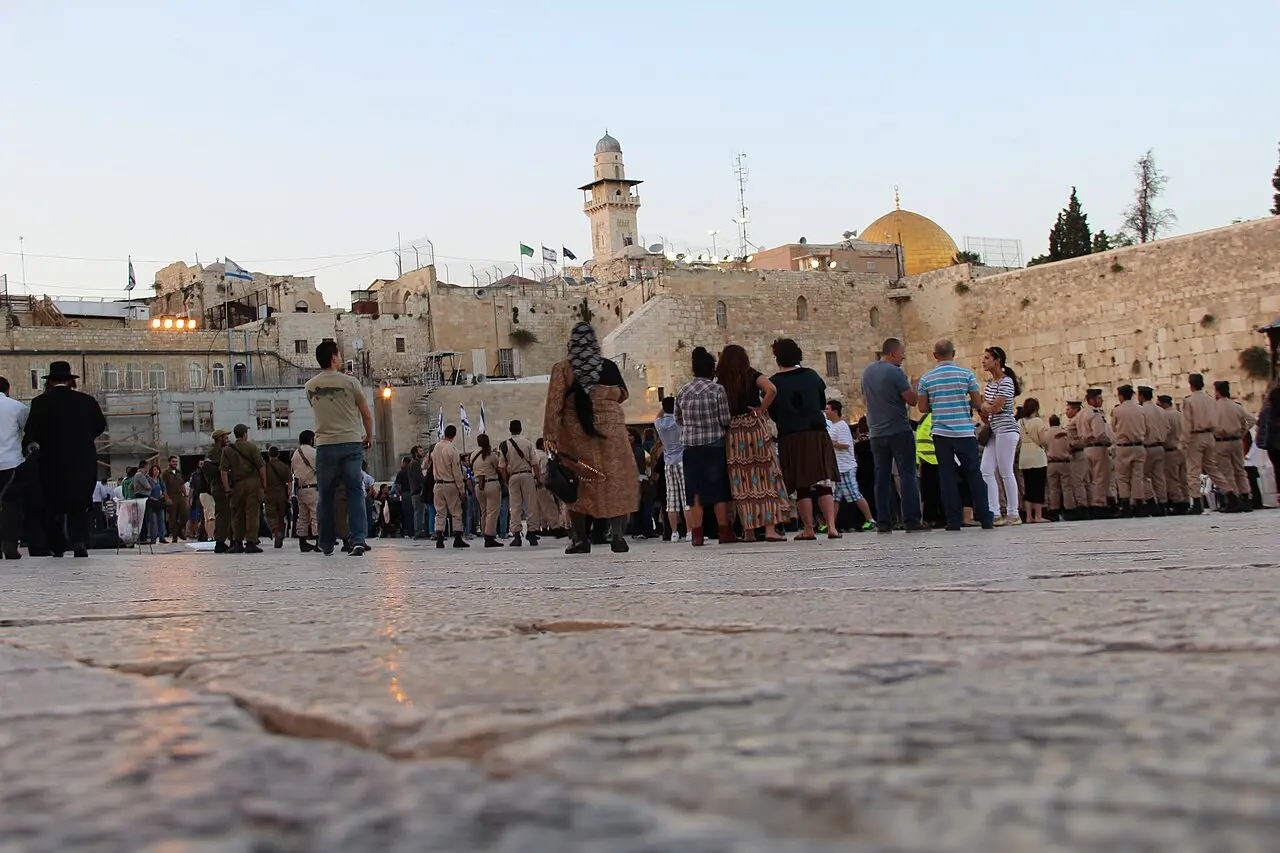
The area immediately in front of the wall is run as a synagogue rather than as a monument, and it is divided by a mechitza into a men's section and a smaller women's section. Behind a low stone barrier the rest of the plaza is a public concourse where nobody is separated and nobody is expected to pray. The Foundation's published rules are short and apply across the whole plaza: dress appropriately, do not eat, do not smoke, do not light candles, and do not bring Torah scrolls in. On Shabbat and Jewish festivals it adds no photography, no writing, no electronic devices and no amplification.
Who may pray in what manner, and where, has been argued over for a century, and it is not settled. Under the British Mandate the question went as far as an international commission after the riots of August 1929, and its findings became law in the Palestine (Western or Wailing Wall) Order in Council of 1931, which confirmed Jewish access for devotions while leaving ownership with the Muslim waqf and prohibiting the blowing of the shofar. Between 1948 and 1967 the wall was under Jordanian control and Jews did not reach it at all.
The modern version of the argument concerns a separate platform. A 450-square-metre space known as Ezrat Yisrael was built in August 2013 at the southern end, by Robinson's Arch, for mixed and non-Orthodox prayer. A government decision of January 2016 would have enlarged it, given it a shared entrance and put representatives of the Reform and Conservative movements on a body governing it; that decision was frozen on 25 June 2017 and the enlargement has not been built. The platform is still there, still in use, and still physically separated from the main plaza by the archaeology between them.
- Men's section: the larger part of the wall frontage inside the prayer area, entered from the left as you face the wall
- Women's section: the smaller part, to the right of the mechitza
- Wilson's Arch hall: roofed prayer space at the northern end of the plaza, fitted out after 1967
- Ezrat Yisrael: the 450 sq m platform for mixed prayer at Robinson's Arch, south of the plaza and reached separately
Larisa sklar giller / CC BY-SA 4.0 · Wikimedia Commons
What to look for
Things not to walk past at The Western Wall
The details that repay knowing about before you are standing in front of them.
The drafted margins on the lower courses
Look for the shallow flat border chiselled around the face of each of the big lower blocks. That border is the Second Temple period mason's mark, and the line where it stops is the line where the ancient wall stops.
The hall under Wilson's Arch
At the northern end of the plaza the wall runs into a roofed prayer hall built under the first arch of a Herodian-era bridge. It is shaded, sheltered and open at hours when the plaza is at its coldest.
The notes in the cracks
The custom of wedging written prayers into the joints dates to the early eighteenth century. The notes are cleared out twice a year, before Passover and before the autumn New Year, and buried on the Mount of Olives rather than thrown away.
The join between the plaza and the archaeology
Walk to the southern edge of the plaza and look over the railing into the Jerusalem Archaeological Park. The same wall continues past Robinson's Arch, with the Second Temple period street and the stones thrown down in 70 CE lying at its foot.
Friday at sunset
Shabbat comes in with singing and dancing in the plaza and the site is at its fullest. It is also the point at which photography and phones stop being permitted anywhere in the plaza, so plan the visit for either side of it.
The long view
The Western Wall, in order
c. 19 BCE
Herod the Great begins the expansion of the Temple Mount platform. The western retaining wall is built to hold the enlarged esplanade up.
20 BCE to 20 CE
Radiocarbon range for the completion of the first bridge at Wilson's Arch, about seven and a half metres wide (Regev and colleagues, PLOS ONE, 2020).
17 or 18 CE
Latest coins found by Reich and Shukron beneath the wall's foundations near Robinson's Arch, struck under the prefect Valerius Gratus, indicating the southern stretch was finished well after Herod's death.
30 to 60 CE
The Wilson's Arch bridge is doubled in width, in the years of the Roman prefects.
70 CE
The Temple is destroyed. The retaining walls survive, and the stonework thrown down at the southern end still lies where it fell.
95 to 155 CE
A small theatre-like structure is begun and left unfinished beneath Wilson's Arch, on the radiocarbon ranges from the 2020 study.
1170
Benjamin of Tudela records Jews coming to pray before the wall in the open court.
1193
Al-Afdal, son of Salah al-Din, endows the Mughrabi Quarter at the foot of the wall as a waqf for Maghrebi pilgrims and residents.
August 1929
Riots centred on rights at the wall. An international commission follows, and its findings become the Palestine (Western or Wailing Wall) Order in Council of 1931.
1948 to 1967
The Old City is under Jordanian control and Jews do not reach the wall.
10 to 12 June 1967
The Mughrabi Quarter is demolished and the Western Wall Plaza is created in its place.
1988
The Western Wall Heritage Foundation is established by the Ministry of Religion to develop and preserve the wall and its tunnels.
August 2013
Ezrat Yisrael, a 450-square-metre platform for mixed prayer, is built at Robinson's Arch.
January 2016
A government decision would enlarge the mixed-prayer platform and give liberal movements a role in governing it.
25 June 2017
That decision is frozen. The enlargement has not been built.
23 July 2018
A stone of about 400 pounds falls from the wall onto the southern prayer platform. Nobody is hurt; the smaller platform closes for a survey of the masonry.
3 June 2020
PLOS ONE publishes the radiocarbon and microarchaeology study that fixes the construction sequence at Wilson's Arch.
Practical
Visiting The Western Wall
Where
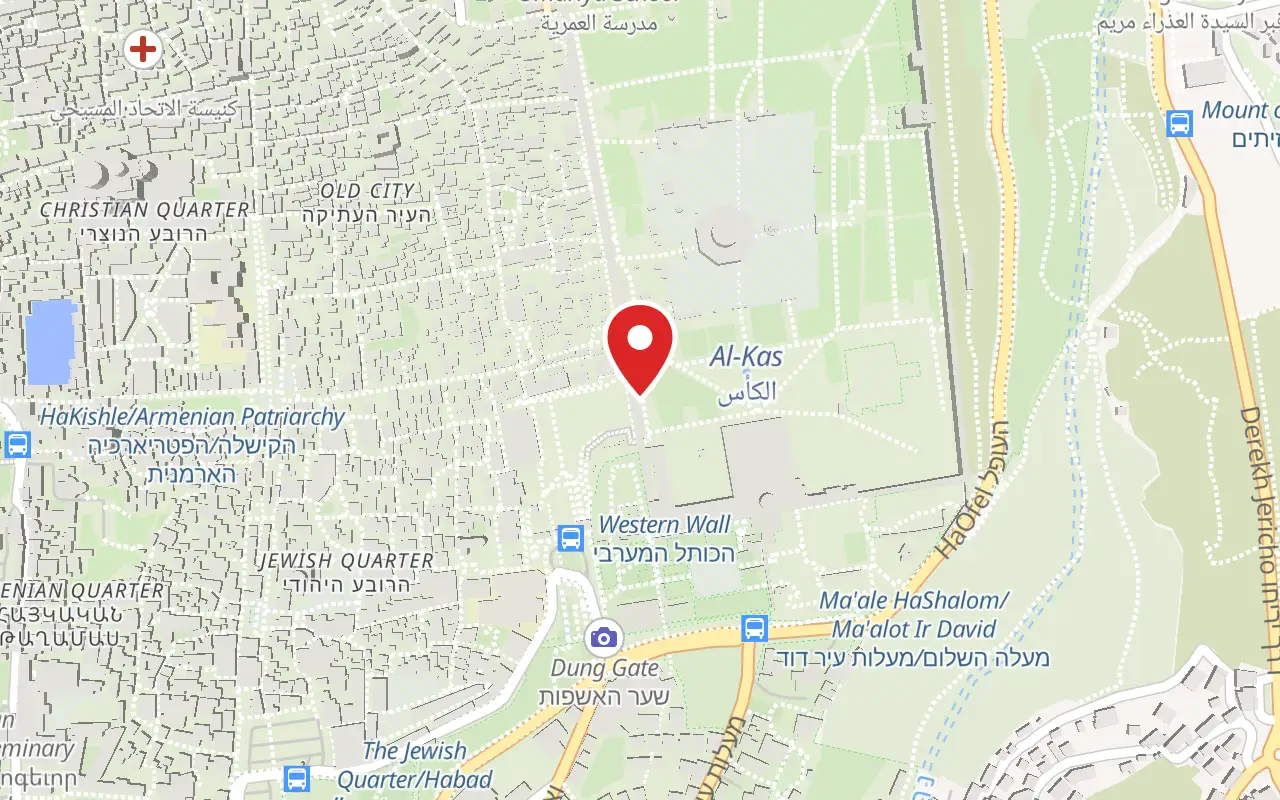
Western Wall Plaza, Old City of Jerusalem, entered from the Dung Gate
What ticket you need
The plaza is not inside a ticketed park and needs no ticket. Two neighbours do: the Western Wall Tunnels, which follow the same wall northwards underground, and the Jerusalem Archaeological Park, which covers the wall's southern continuation past Robinson's Arch. Both are entered separately from the plaza and both charge.
Opening hours
- Western Wall Prayer Plaza
- All day, every day of the yearsource
- Shabbat and Jewish festivals
- Open as usual, but no photography, writing, electronic devices or amplification anywhere in the plazasource
- Western Wall Tunnels (separate, booked tour)
- Sunday to Thursday from 07:20 until late evening; Friday 07:20 to 12:00; Saturday evening by reservationsource
- Shuttle from Jaffa Gate
- Returns every 45 minutes between 10:00 and 16:00, from Karta car park B to Goren Square by the wallsource
Admission
Access
Good, and the best of any major site in the Old City. The plaza is paved, broad and effectively level, and the Foundation directs wheelchair users to the entrance closest to the Dung Gate, which avoids the stepped lanes of the Old City entirely. Buses 1, 2, 3 and 38 serve it, and the light rail reaches Safra Square. The limits are underground: the Foundation states that its 'A Look into the Past' route takes up to five wheelchairs and 'The Chain of Generations' up to two, while 'The Journey to Jerusalem' and the Great Bridge route are not wheelchair accessible at all, and any wheelchair tour has to be arranged in advance rather than joined on the day.
On site
- Security screening at the plaza entrances
- Prayer area with men's and women's sections
- Roofed prayer hall under Wilson's Arch
- Ohel Yitzhak synagogue
- Chain of Generations Centre (ticketed, booked)
- Western Wall Tunnels ticket office
- Shuttle stop at Goren Square
- Guide dogs admitted
Booking
Nothing needs booking to stand at the wall. Everything underground does: the Foundation runs the Western Wall Tunnels as a guided tour by prior arrangement only, capped at 35 people, and the same applies to the Chain of Generations Centre and the other indoor attractions. Walking up and hoping for a place is unreliable, and during Jerusalem Week the Foundation has extended the hours of those attractions specifically on condition that visits are reserved in advance.
Hours and prices are given as the operator publishes them and change without much notice, particularly around Shabbat and the festivals. Check the operator's own page before you travel for this.
Official page at english.thekotel.org →What people wish they had known
- Come in through the Dung Gate, not the Jaffa Gate. It is the only gate that puts a visitor on the plaza without a walk through stepped lanes, and it is the route the Foundation gives for wheelchair users.
- Free and open around the clock applies to the plaza and to nothing else. The Tunnels, the Chain of Generations Centre and the other indoor attractions are ticketed and must be booked ahead, and turning up for a walk-in place is unreliable.
- Check the day before photographing anything. From sunset on Friday until nightfall on Saturday, and on Jewish festivals, the Foundation's rules forbid photography, writing, phones and any electronic device across the whole plaza, not just in the prayer area.
- The prayer area is a synagogue and the concourse behind it is not. The low stone barrier is the line: in front of it men and women are separated by the mechitza, behind it nobody is. Shoulders and knees stay covered on both sides of it.
- Do not treat the plaza as the whole wall. Roughly 50 metres of 488 are on show here; the rest runs north under the Muslim Quarter and south into the Jerusalem Archaeological Park, and the two neighbouring sites exist to show it.
- Night is the underrated visit. The plaza is lit, open and far emptier than in the middle of the day, and the roofed hall under Wilson's Arch at the northern end is the one part of the site that is sheltered from both sun and rain.
The figures
The Western Wall by the numbers
Each figure carries the year it belongs to and links the source it came from.
| Measure | Figure | As of | Source |
|---|---|---|---|
| Full length of the Western Wall | 488 m | 2026 | thekotel.org |
| Courses of stone at the plaza | 45, of which 28 are above ground and 17 below | 2026 | thekotel.org |
| Stone that fell onto the southern prayer platform | about 400 pounds, 23 July 2018 | 2018 | jta.org |
| Section exposed at the prayer plaza | about 50 m long and about 20 m high | 2026 | britannica.com |
| The Mughrabi Quarter in June 1967 | 135 buildings, 108 families, about 650 residents | 2026 | jerusalemstory.com |
| Ezrat Yisrael mixed-prayer platform | 450 sq m, built August 2013 | 2026 | timesofisrael.com |
| Radiocarbon range for the first Wilson's Arch bridge | 20 BCE to 20 CE, widened 30 to 60 CE | 2020 | pmc.ncbi.nlm.nih.gov |
| Western Wall Tunnels admission | ₪38 adult, ₪25 concession, booked in advance | 2026 | thekotel.org |
While you are here
The rest of The Old City of Jerusalem
Everything else in this destination with a page of its own.
Archaeological site
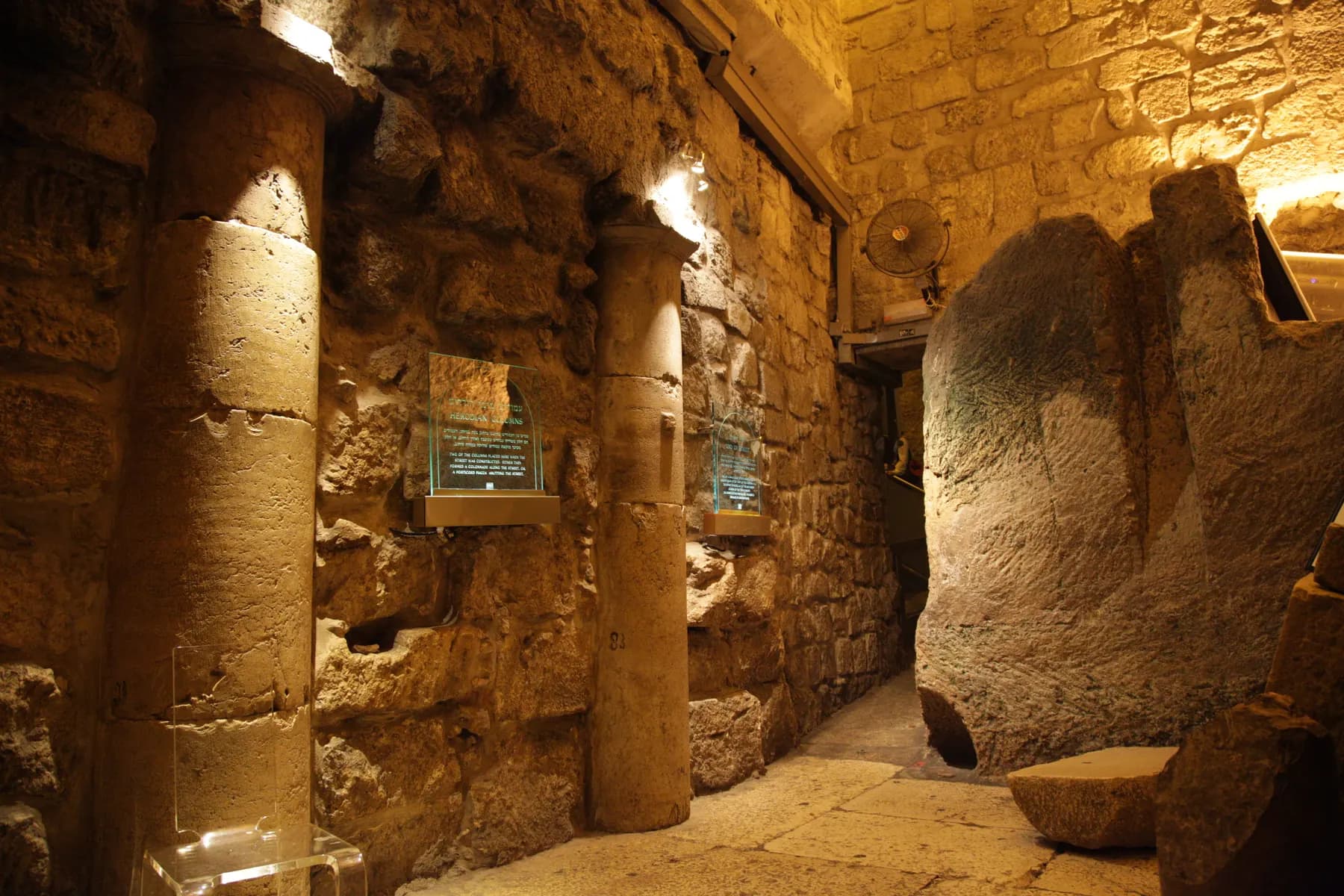
Western Wall Tunnels
A guided walk along the buried continuation of the Western Wall, past a single limestone block about 13.6 metres long that is among the largest building stones ever set in place by hand.
arikb / CC BY-SA 3.0 · Wikimedia Commons
Religious site
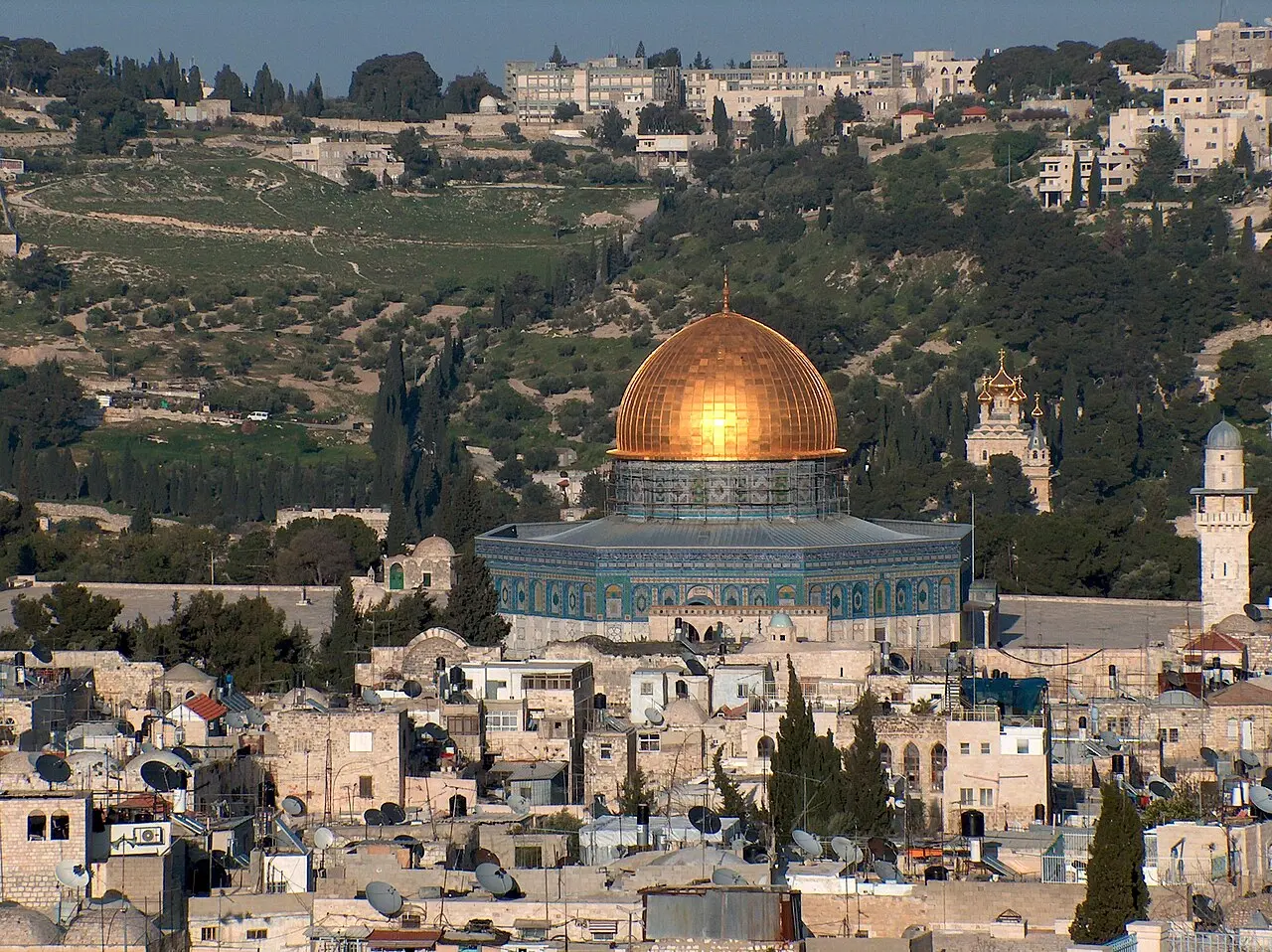
The Temple Mount and Haram al-Sharif
Everything standing on the esplanade is later than the esplanade itself, which Herod's engineers made from about 19 BCE by wrapping a hilltop in four retaining walls and filling in behind them.
Mohammad Shad Siddiqui / CC BY-SA 4.0 · Wikimedia Commons
Archaeological site
Jerusalem Archaeological Park, Davidson Center
The excavated corner where the Temple Mount's southern and western walls meet, with the paving of the Herodian street still under the heap of masonry the Romans pushed off the top in 70 CE.
Sources and further reading
Every link below was opened and checked when this page was written. Official statements are marked as such: they are the subject's own account, not an independent one.
- OfficialWestern Wall Heritage Foundationthekotel.orgWhat is The Wailing Wall in Jerusalem?
The 488-metre length, the 45 courses of stone, the pre-1967 alley of roughly 28 by 3.6 metres, the 57-metre prayer frontage created afterwards, the later Muslim restorations at the top of the wall, and the four ancient gates including Wilson's Arch and Robinson's Arch
- OfficialWestern Wall Heritage Foundationthekotel.orgDirections to the Western Wall
The statement that the prayer plaza operates all day, every day of the year, plus the bus routes, the car parks at Jaffa Gate, Mount Zion and Mamilla, and the shuttle from Karta car park B to Goren Square every 45 minutes between 10:00 and 16:00
- OfficialWestern Wall Heritage Foundationthekotel.orgGuidelines for Behavior at the Western Wall
The published rules for the plaza: dress appropriately, do not eat, smoke or light candles, no Torah scrolls, and on Shabbat and festivals no photography, writing, electronic devices or amplification
- OfficialWestern Wall Heritage Foundationthekotel.orgAccessibility Statement
Entry for wheelchair users by the entrance closest to the Dung Gate, buses 1, 2, 3 and 38, light rail to Safra Square, the wheelchair caps of five and two on two underground routes, and the routes that are not wheelchair accessible
- OfficialWestern Wall Heritage Foundationthekotel.orgThe Western Wall Heritage Foundation
The Foundation's establishment in 1988 by the Ministry of Religion and its remit over the plaza, the tunnels, excavation and preservation
- OfficialWestern Wall Heritage Foundationthekotel.orgWestern Wall Tunnels
₪38 adult and ₪25 concession, the hour and ten minute guided tour, the cap of 35 participants, booking by prior arrangement only, and the tunnel opening hours
- ReportingJewish Telegraphic Agencyjta.orgWhy did a 400-pound stone fall from the Western Wall?
The stone that came away on 23 July 2018 and fell onto the egalitarian platform, the woman praying beneath it, the closure of the smaller platform and the Israel Antiquities Authority survey that followed
- ReportingThe Times of Israeltimesofisrael.comScientists 'set the clock' for ancient Jerusalem, prove who built Temple bridge
Independent reporting on the same study: the bridge at seven and a half metres widened to fifteen, the competing datings the work displaced, and Joe Uziel's caution that linking the theatre's abandonment to the revolt cannot be proven
- ReportingThe Times of Israeltimesofisrael.comWestern Wall egalitarian area used daily for gender-segregated Orthodox prayer
Ezrat Yisrael at 450 square metres built in August 2013, the three-part government decision of January 2016, and its freezing on 25 June 2017
- ReportingThe Times of Israeltimesofisrael.comPurging prayers from the Wall
The notes cleared twice a year, before Passover and at the New Year in the autumn, buried on the Mount of Olives, with the custom dated to the early eighteenth century
- ReferenceEncyclopaedia Britannicabritannica.comWestern Wall
The wall as the only remains of the retaining wall surrounding the Temple Mount, the exposed section of about 50 metres long and about 20 metres high, the later date of the upper sections, and the origin of the name Wailing Wall
- ReferenceRegev, Uziel, Lieberman and others, PLOS ONEpmc.ncbi.nlm.nih.govRadiocarbon dating and microarchaeology untangle the history of Jerusalem's Temple Mount: A view from Wilson's Arch
Published 3 June 2020: the first bridge at Wilson's Arch dated 20 BCE to 20 CE, the widening dated 30 to 60 CE, and the theatre-like structure beneath it dated 95 to 155 CE
- ReferenceWikipediaen.wikipedia.orgWestern Wall
The coins minted after Herod's death found beneath the foundations, the 1929 riots and the resulting Palestine (Western or Wailing Wall) Order in Council of 1931, the Jordanian period from 1948 to 1967, the mechitza, and the composition of the Herodian and later courses
- ReferenceJerusalem Storyjerusalemstory.comThe Destruction of Jerusalem's Moroccan Quarter
The quarter endowed in 1193 by al-Afdal, its 135 buildings, 108 families and roughly 650 residents, the three hours given to leave, the demolition from 10 to 12 June 1967, the resident killed, the two mosques lost and the 20,000 square metre plaza that replaced it
The Western Wall: common questions
Is the Western Wall free to visit?+
Yes. There is no admission charge and no ticket for the Western Wall Plaza, and the Western Wall Heritage Foundation states that it operates all day, every day of the year. Visitors pass through a security check at the entrance to the plaza. The attractions run by the Foundation around the plaza, including the Western Wall Tunnels, are charged and booked separately.
What are the opening hours?+
There are none: the prayer plaza is open 24 hours a day, every day of the year, on the Foundation's own account. That is unusual in the Old City, where the Temple Mount admits non-Muslims only in short designated windows and the churches keep fixed hours. Practically, the quietest hours are late at night and early in the morning, and the fullest is Friday at sunset.
Can non-Jews visit the Western Wall?+
Yes. The plaza is open to visitors of any faith or none, and the prayer area is open to anyone willing to observe its conventions, which are separation by gender at the wall itself and modest dress. The Foundation's published rules cover behaviour rather than belief: no eating, no smoking, no candles, no Torah scrolls brought in, and appropriate dress throughout the plaza.
What should I wear?+
Cover shoulders and knees. The Foundation's guidance is simply to dress appropriately across the whole plaza, and in practice that is the standard applied at the prayer area, where men also cover their heads. The plaza is stone and open, so it is hot and glaring in summer and genuinely cold and windy on winter nights.
How much of the original wall is actually visible?+
About 50 metres of a wall that runs 488 metres, and the lower part of that. Britannica gives the exposed section at the plaza as about 50 metres long and about 20 metres high; the Foundation counts 45 courses of stone there, of which 17 are still below the paving. Only the large drafted-margin blocks in the lower courses are Second Temple period work. Everything above the line where the stones get smaller is later repair and heightening.
Is the Western Wall part of the Temple?+
No, and this is the commonest misunderstanding about it. It is a retaining wall built to hold up the artificial platform the Temple stood on, so it is the surviving engineering rather than a surviving piece of the building. Britannica describes it as the only remains of the retaining wall that surrounded the Temple Mount.
How long should I allow?+
About 45 minutes covers the plaza, the prayer area and the roofed hall under Wilson's Arch at a reasonable pace. Add roughly an hour and ten minutes for the Western Wall Tunnels tour if it has been booked, plus queueing and the security check. Half a day is enough to combine the wall with the Jerusalem Archaeological Park immediately to the south.
Is it wheelchair accessible?+
The plaza itself is, and it is the easiest major site in the Old City to reach without steps: the paving is broad and level and the Foundation directs wheelchair users to the entrance nearest the Dung Gate. The underground routes are the problem. The Foundation states that some tours take a fixed maximum of wheelchairs, five on one route and two on another, and that the Journey to Jerusalem and the Great Bridge route are not wheelchair accessible. Any wheelchair tour must be arranged in advance.
What happens to the notes people put in the wall?+
They are removed twice a year, before Passover and before the autumn New Year, and buried on the Mount of Olives. Because the notes are prayers and often contain the name of God, Jewish law treats them as sacred text that cannot be discarded, so they go to a geniza and then to burial rather than into a bin. Rabbi Shmuel Rabinowitz, rabbi of the Western Wall, accompanies the clearance, which is done with single-use wooden tools so the paper is not damaged. Notes can also be submitted through the Foundation's website.
Why is the women's section smaller than the men's?+
Because the prayer area is administered as an Orthodox synagogue, with a mechitza dividing it, and the division was set that way when the plaza was laid out after 1967. It has been contested for decades. A separate 450-square-metre platform for mixed prayer, Ezrat Yisrael, was built at Robinson's Arch in August 2013; a government decision of January 2016 to enlarge it and give liberal movements a role in running it was frozen in June 2017 and has not been carried out.