
Religious site · The Old City of Jerusalem
The Temple Mount and Haram al-Sharif
Everything standing on the esplanade is later than the esplanade itself, which Herod's engineers made from about 19 BCE by wrapping a hilltop in four retaining walls and filling in behind them.
Area of the esplanade
about 144,000 m²
roughly 35 acres, in the Religion Media Centre's 2025 explainer
Platform built
from about 19 BCE
Herod's rebuilding, dated by Leen Ritmeyer in Biblical Archaeology Review
Dome of the Rock
691–692 CE
72 AH, from the inscription inside the building, per Britannica
Admission
Free
iTravelJerusalem, and only Sunday to Thursday for non-Muslims
In short
- How long to give it
- about 60 minutes on the esplanade, plus a queue at the ramp that can be as long again
- Sunday to Thursday, summer
- 07:00-11:00 and 13:30-14:30
- All visitors
- Free entry, no ticket sold
הר הבית · الحرم الشريف
The Temple Mount, called the Haram al-Sharif or Noble Sanctuary in Islam, is a walled artificial platform in the south-east corner of the Old City carrying the Dome of the Rock, the al-Aqsa Mosque and about a hundred smaller structures. The Religion Media Centre's 2025 explainer gives the esplanade as 144,000 square metres, roughly 35 acres; the Discover Islamic Art database puts it near 145,000. Nobody publishes a reconciled figure, which is itself a fair summary of how the site is documented.
The platform is the oldest thing here and the only part that is unambiguously ancient. Leen Ritmeyer, writing in Biblical Archaeology Review, dates Herod the Great's rebuilding of the Temple and its precinct to 19 BCE and gives the four retaining walls that hold the fill in place as 1,590 feet on the west, 1,536 feet on the east, 1,035 feet on the north and 912 feet on the south: about 485, 468, 316 and 278 metres. Those walls, he writes, were the only part of the compound to survive the Roman destruction of 70 CE. One of them is the Western Wall.
For a non-Muslim visitor this is also the most tightly rationed place in Jerusalem. Entry is free and there is no ticket, but it is open to non-Muslims only on Sunday to Thursday, in two short windows a day, through one gate, and the mosques and the Dome of the Rock cannot be entered at all. The practical question on this page is not what to see but when the door is open and what the rules are once through it.
Orientation
One gate in, and a platform that is mostly empty
Non-Muslims reach the compound by a single route: the covered wooden ramp that climbs from the Western Wall plaza to the Mughrabi Gate, called the Moors' Gate on iTravelJerusalem's own page, which states plainly that visitors can only enter through it. Muslim worshippers use the other gates of the Haram, which open directly off the lanes of the Muslim Quarter. Israeli police run the security check at the foot of the ramp, and the queue there is the part of the visit that takes longest.
What opens out at the top surprises people who know the site only from the postcard. It is not a courtyard around a building; it is a large open plateau, paved and planted, with the buildings set well apart on it. The Dome of the Rock stands on a raised inner terrace reached by flights of steps under free-standing arcades. The silver-domed al-Aqsa Mosque is at the southern end, a separate building several minutes' walk away. Discover Islamic Art counts more than 90 commemorative structures across the three levels of the sanctuary: fountains, prayer platforms, domes, minbars and Mamluk schools built into the edges.
The interiors are closed. iTravelJerusalem states that entry to the mosques and buildings on the mountain is prohibited, which means the Dome of the Rock, al-Aqsa and the underground Marwani prayer hall are all seen from outside only. A visit is therefore a walk on an open esplanade, and the Old City's usual advice about a hat and water applies more here than in the covered lanes below.
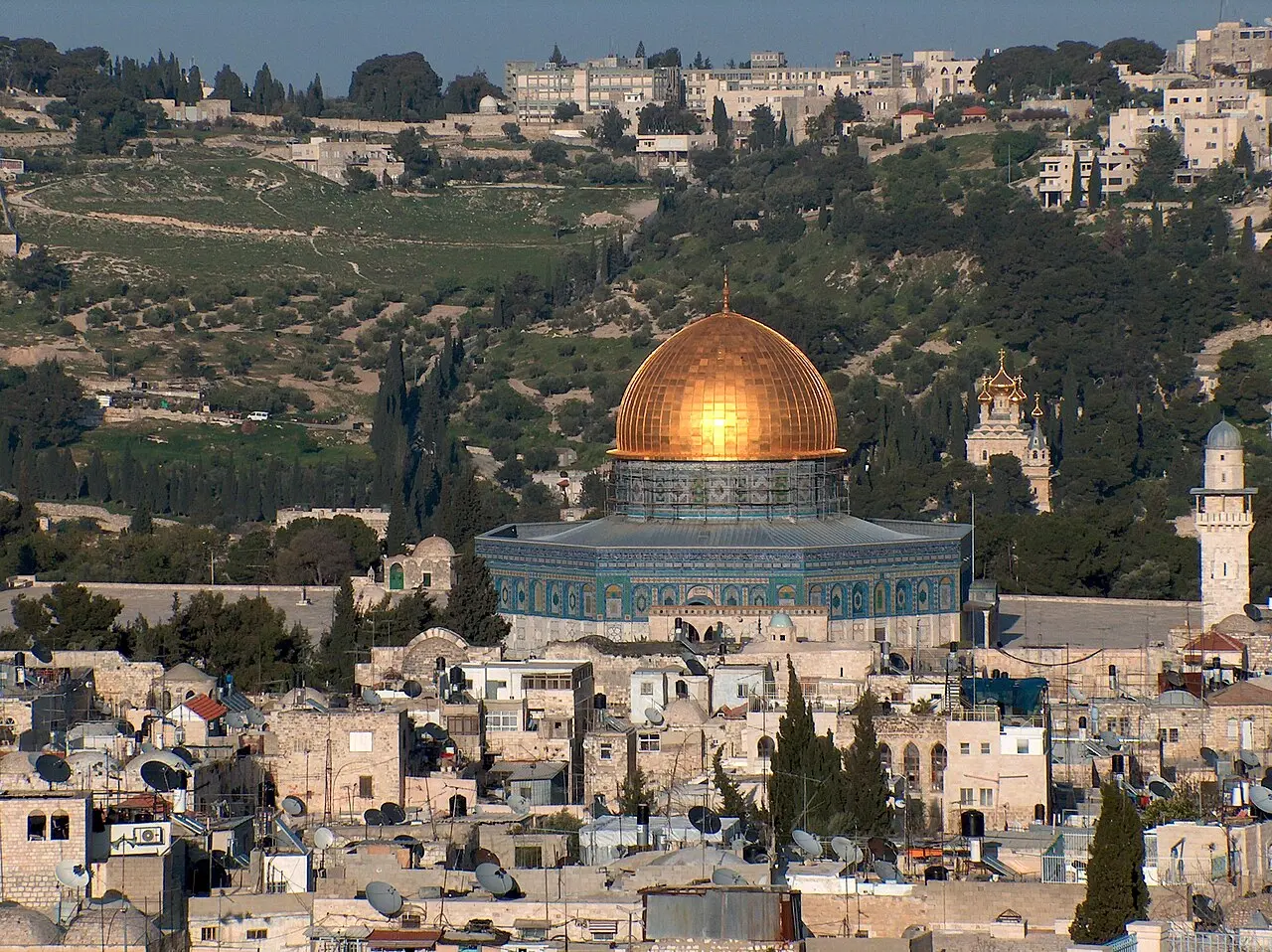
arikb / CC BY-SA 3.0 · Wikimedia Commons
The engineering
Herod built the ground, not the buildings
The hill under the compound was never this shape. Britannica dates Herod's order to rebuild the Temple to 20/19 BCE and says the work took more than a generation. Ritmeyer's reconstruction describes what that involved: the slopes around the summit were filled up and the whole area extended to its present size inside four retaining walls about 15 feet thick, so that a sloping hilltop became a level rectangle. The Smithsonian's account of the site puts the retaining wall at around 100 feet high, built of limestone blocks.
Almost none of that engineering is visible from the top. The walls face outward and downward, and the enormous limestone courses the Smithsonian describes are seen from the streets below, not from the esplanade. It is the reason the sites that explain this platform best are the ones at its foot: the Western Wall, the tunnels behind it and the Jerusalem Archaeological Park under its southern side.
Then it was destroyed. Britannica records that the Temple was reduced to ashes in 70 CE when the Roman commander Titus sent his forces to crush the revolt. Nothing of the Temple itself remains above ground and its exact position on the platform is still argued over. What survived was the box: the walls, the fill, the vaulted substructures at the southern end, and the blocked gates. Everything a visitor now looks at on top of it was put there by later hands.
Two of Herod's gates are still visible in the southern wall from the Jerusalem Archaeological Park below, walled up: the Double Gate and the Triple Gate, by which pilgrims climbed into the precinct. The Western Wall's four gates, known by the names of the nineteenth-century surveyors who found them (Warren, Wilson, Barclay and Robinson), are the same story from the other side.
- Ancient: the four retaining walls, the fill behind them, the vaults beneath the southern end and the blocked Herodian gates
- Umayyad: the Dome of the Rock and the first al-Aqsa, both late seventh or early eighth century
- Later: the tiled skin of the Dome (Ottoman), most of al-Aqsa's fabric (Fatimid onward), the arcades, fountains and Mamluk buildings around the edges
- Gone: the Temple, whose position on the platform has no agreed answer
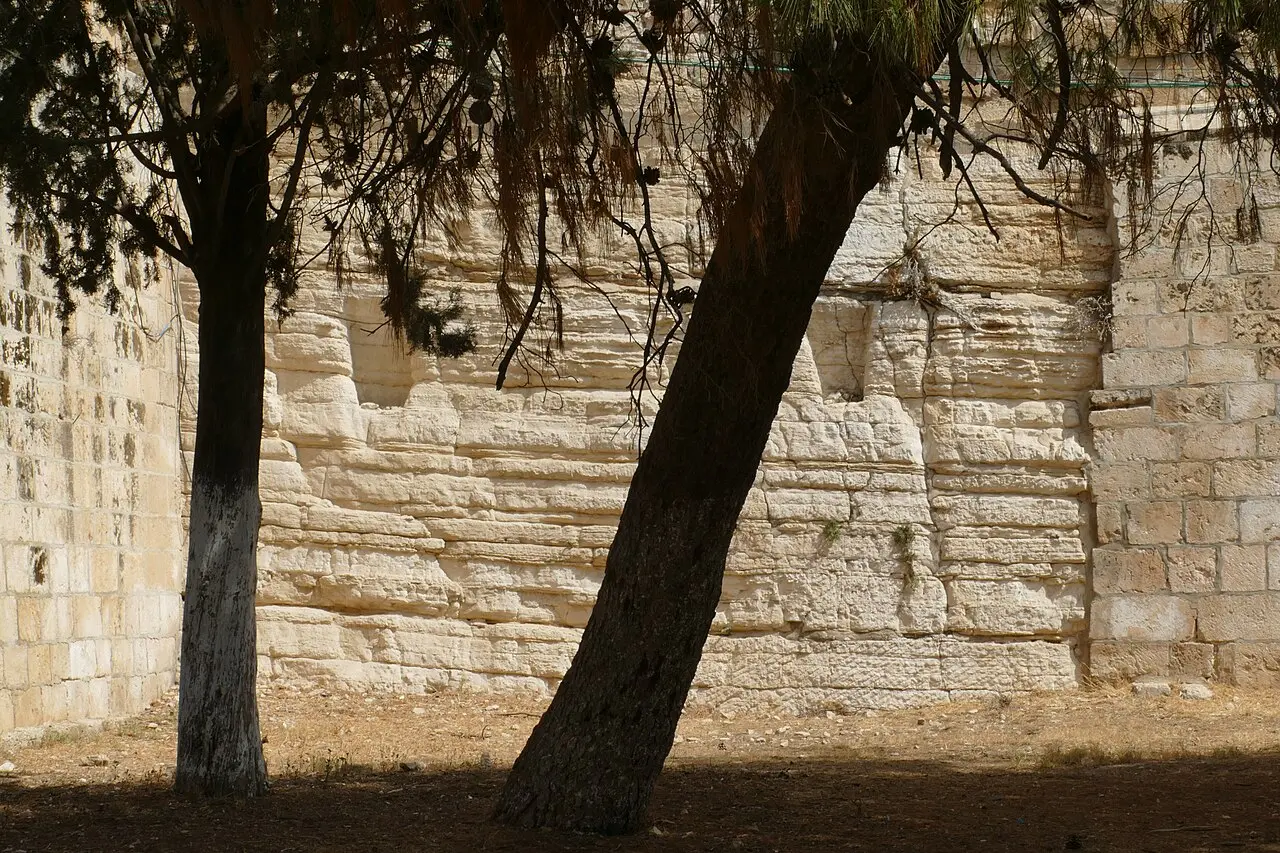
Bukvoed / CC BY 4.0 · Wikimedia Commons
The buildings
What is Umayyad, and what has been replaced since
The Dome of the Rock is the older of the two great buildings and the more original. An inscription inside dates it to 72 AH, 691 or 692 CE, under the Umayyad caliph Abd al-Malik ibn Marwan. Britannica describes an octagonal base under a gilded wooden dome about 20 metres across, raised on a drum above a circle of 16 piers and columns, with a portion of the sacred rock exposed under it behind a railing and a stairway down to a natural cave. Discover Islamic Art gives the inner dome as 20.44 metres in diameter and calls it the oldest wooden structure of its kind still standing.
Its outside is not Umayyad. The original glass mosaic on the exterior did not survive Jerusalem's winters, and Discover Islamic Art records that Sultan Suleiman replaced it with ceramic tiles in AH 952 to 959, 1545 to 1552. The tiles now on the building are twentieth-century replacements following that scheme. So is the gold: the Baltimore Sun reported in April 1994 that the previous restoration in 1964 had used gold-coloured aluminium, and that King Hussein of Jordan sold a villa in London to raise 6.5 million dollars for 24-carat gold leaf. Other accounts put the sum higher, at 8.2 million dollars and 80 kilograms of gold, and the discrepancy has never been resolved in print.
Al-Aqsa has been rebuilt far more often. Discover Islamic Art dates the first mosque to AH 65 to 96, 685 to 715 CE, begun under Abd al-Malik and finished under his son al-Walid, and gives the present building as a rectangle of 50 by 80 metres with seven aisles running north to south and nine entrances. Successive earthquakes brought it down repeatedly; the Fatimid caliph al-Zahir rebuilt it in the 1030s, and the outline standing today is essentially his. The mihrab below the wooden dome is Saladin's, dated AH 583, 1187 CE, the year he took Jerusalem back from the Crusaders.
The most recent loss was deliberate. On 21 August 1969 an Australian, Denis Michael Rohan, set fire to the mosque, destroying the twelfth-century minbar that Nur al-Din had commissioned in Aleppo and Saladin had installed. A replacement was made in Jordan: the Jordanian royal court's own account says the work was ordered in 2002, completed by July 2006 and installed the following year, six metres high and 4.5 metres wide, assembled from 16,500 pieces without glue or nails by the Faculty of Traditional Islamic Arts at Al Balqa University with craftsmen from Egypt, Morocco and Turkey.
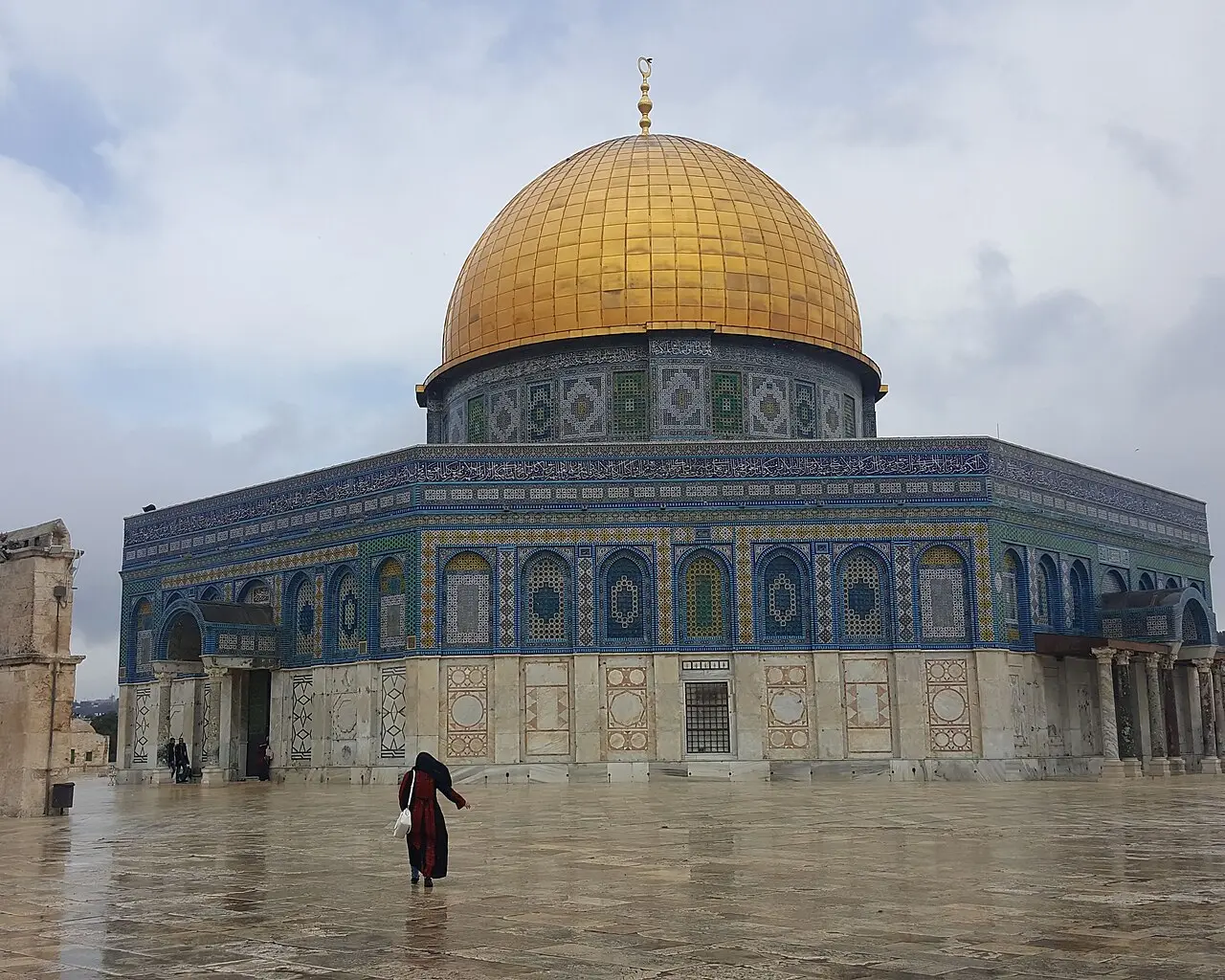
Abdallah Khader / CC BY-SA 4.0 · Wikimedia Commons
The rules
Who runs it, and what a visitor may not do
The arrangement governing the compound is unwritten and is usually called the status quo. Britannica's account is that after Israel took the Old City in 1967 the defence minister, Moshe Dayan, arranged for the Islamic waqf to continue administering the site, and that this was formalised in Israel's 1994 peace treaty with Jordan. Article 9 of that treaty, whose text is on the Avalon Project at Yale Law School, says that Israel respects the present special role of the Hashemite Kingdom of Jordan in Muslim Holy shrines in Jerusalem and will give high priority to the Jordanian historic role when permanent status is negotiated. Israeli police control entry and security; the Waqf runs the compound day to day.
The rule that follows, as the Religion Media Centre states it, is that Muslims may pray at the compound while non-Muslims, including Jews, may visit during designated hours but are forbidden from praying there. iTravelJerusalem's own page is blunter and lists what that means at the gate: prayer and bowing are forbidden anywhere in the compound, singing is not permitted, and Jewish sacred objects, Israeli flags and musical instruments may not be brought in. Bags are searched.
How firmly the prayer ban is now enforced is genuinely disputed, and this page will not pretend otherwise. The Jerusalem Post reported on 21 January 2026 that 68,429 Jews had ascended the compound during 2025, against 56,057 in 2024, and that police had begun permitting a single printed prayer page prepared in advance, while prayer books and phylacteries stayed barred. That change is written down nowhere as policy, and what happens on a given day is a policing decision rather than a published rule.
There is one further practical consequence. Because the compound is administered by the Waqf and policed by Israel, it closes without notice: on Fridays and Saturdays and Muslim holidays as a matter of course, and at other times whenever there is trouble. A closure is announced at the ramp, not in advance.
Below
The most excavated city in the world, with a hole in the middle
No archaeologist digs on the Temple Mount. The Smithsonian's account records that the Waqf has long forbidden archaeological excavation on the platform, regarding it as desecration, with the exception of limited European surveys in the late 1800s and British work between 1938 and 1942. Everything modern archaeology says about the compound is therefore inferred from its outside: the retaining walls, the streets and gates below the southern and western sides, and the literary sources.
The exception arrived as rubble. The Smithsonian reports that in 1996 the Waqf converted the vaults known as Solomon's Stables, at the south-east corner, into the Marwani prayer hall, and that in 1999 work on an emergency exit cut a pit more than 131 feet long and nearly 40 feet deep, with lorries carting away hundreds of tons of soil. In 2004 the archaeologist Gabriel Barkay obtained permission to search the dumped earth, and the Temple Mount Sifting Project has been washing and sorting it ever since.
The project publishes its own running totals: 4,742 of 5,210 tons sifted, 635,378 artefacts recovered and 261,749 people involved in the sifting, which it carries out with volunteers rather than a dig team. Because the material was bulldozed out of context, nothing found in it can be securely dated by where it lay, and the project's results are read accordingly. It is still the only body of material from the platform itself that anyone has studied systematically.
The compound's other contested structure is the sealed Gate of Mercy, the Golden Gate, in the eastern wall facing the Mount of Olives. Its inner chamber had been closed by Israeli order since 2003; in February 2019 the Waqf reopened it for prayer and Israeli police did not stop it, a sequence the Times of Israel covered at the time as a defeat for the Israeli position. Israeli officials have said the works there damaged antiquities. Nobody has been able to check.
What to look for
Things not to walk past at The Temple Mount and Haram al-Sharif
The details that repay knowing about before you are standing in front of them.
The view from the north-west corner
Coming up the ramp and turning right gives the one angle where the Dome of the Rock, its raised terrace and the arcades line up as a single composition. It is also where most visitors stop dead and block the path.
The arcades on the steps
Free-standing rows of columns and arches, called qanatir, stand at the head of each stair up to the Dome's terrace. They carry no roof and no wall and exist to frame the ascent.
The tilework on the octagon
The blue and white skin of the Dome of the Rock follows the scheme Sultan Suleiman ordered between 1545 and 1552 to replace failing glass mosaic. What is on the building now is a twentieth-century renewal of it.
The al-Aqsa Mosque from outside
Fifty metres by eighty, seven aisles wide, at the southern end of the esplanade. Non-Muslims cannot go in, so the lead dome and the nine entrances along its front are what there is to see.
The sealed Gate of Mercy
The blocked double gate in the eastern wall, facing the Mount of Olives, visible from the esplanade side as well as from outside the walls. Its reopening for prayer in February 2019 was a small crisis in itself.
The eastern edge
Walking to the eastern wall gives the drop into the Kidron Valley and the scale of the fill Herod's engineers put in to make the ground level. It is the quietest part of the compound.
The long view
The Temple Mount and Haram al-Sharif, in order
c. 20/19 BCE
Herod the Great orders the rebuilding of the Temple and its precinct, extending the platform to its present size inside four retaining walls (Britannica; Ritmeyer).
70 CE
Titus's forces destroy the Temple. Only the retaining walls survive.
691–692 CE
The Dome of the Rock is completed under Abd al-Malik, dated by an inscription inside to 72 AH.
685–715 CE
The first al-Aqsa Mosque is built, begun under Abd al-Malik and finished under al-Walid.
1030s
After earthquake damage, the Fatimid caliph al-Zahir rebuilds al-Aqsa; the present outline is essentially his.
1099–1187
Crusader rule. The Dome becomes a church and al-Aqsa a royal palace and Templar headquarters, until the Ayyubids retake Jerusalem.
1187
Saladin restores the compound to Muslim use and installs the mihrab dated AH 583 and the minbar made for Nur al-Din.
1545–1552
Sultan Suleiman replaces the Dome of the Rock's failing exterior mosaic with ceramic tiles.
1967
Israel takes the Old City; Moshe Dayan leaves administration of the compound with the Islamic Waqf.
21 August 1969
Denis Michael Rohan sets fire to al-Aqsa, destroying Saladin's minbar.
1993–1994
The dome is regilded in gold leaf, paid for by King Hussein of Jordan after he sold a house in London.
26 October 1994
The Israel-Jordan peace treaty recognises, in Article 9, Jordan's special role in the Muslim holy shrines of Jerusalem.
1996–1999
The Waqf converts Solomon's Stables into the Marwani prayer hall and cuts an exit pit, removing thousands of tons of earth.
2004
Gabriel Barkay is given permission to sift the dumped earth, beginning the Temple Mount Sifting Project.
2007
The reconstructed minbar, made in Jordan from 16,500 pieces, is installed in al-Aqsa.
February 2019
The Waqf reopens the sealed Gate of Mercy for prayer, sixteen years after Israel closed it.
Practical
Visiting The Temple Mount and Haram al-Sharif
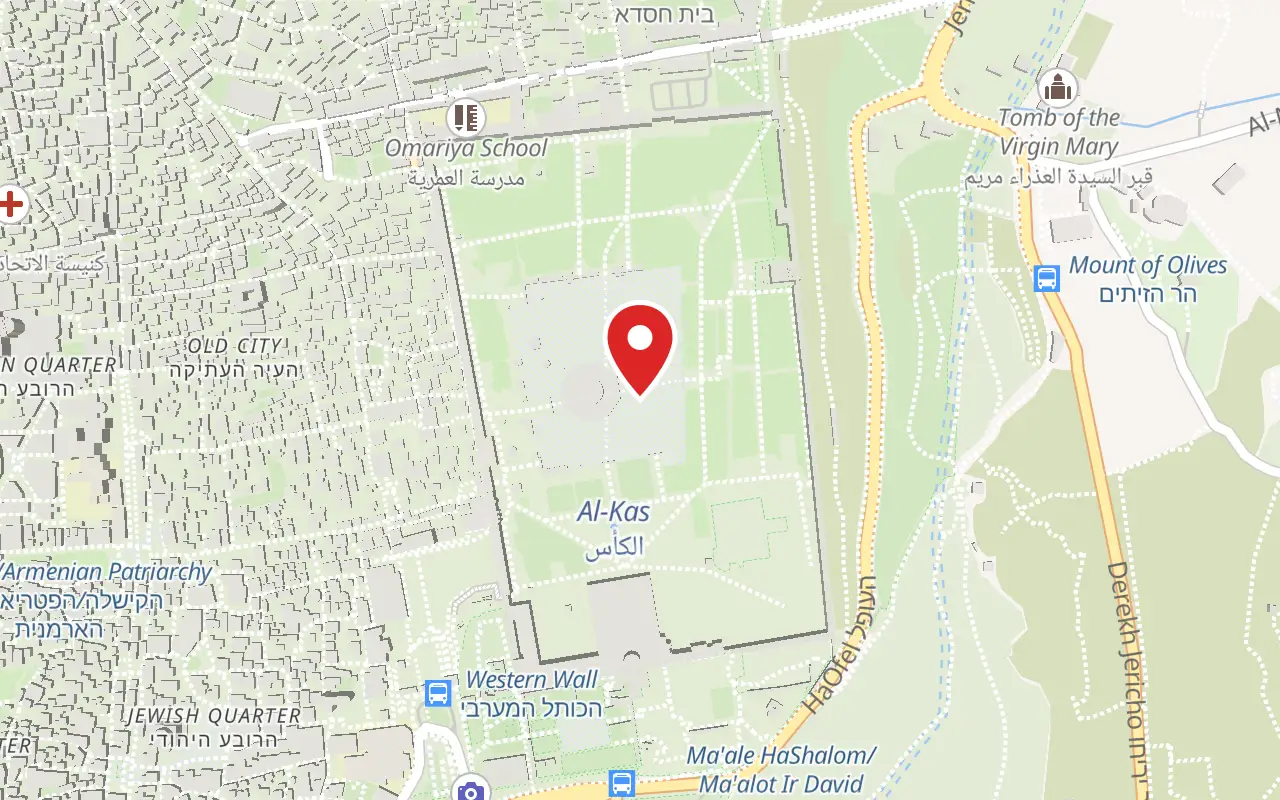
Where
Temple Mount, Old City, Jerusalem. Non-Muslim entry from the Western Wall plaza by the Mughrabi Bridge.
What ticket you need
The compound is not inside a ticketed park and no other ticket covers it. Entry is through the Western Wall plaza, so a visitor passes that site's security first, but a Western Wall Tunnels or Jerusalem Archaeological Park ticket buys nothing here.
Opening hours
Admission
- All visitors
- Free entry, no ticket soldsource
Access
iTravelJerusalem lists the site as not accessible. The approach is the long covered ramp from the Western Wall plaza, and the raised terrace around the Dome of the Rock is reached only by flights of steps under the arcades, so a wheelchair user cannot get to it. The main esplanade is broad and close to level but paved in old, uneven stone, and there is no vehicle access.
On site
- Police security screening at the ramp
- No ticket office
- No entry to any building
- Bag searches; religious articles refused
Booking
There is nothing to book and no ticket to buy. The only thing that helps is arriving at the foot of the Mughrabi ramp before the window opens, because the queue is capped by how fast the security check runs, not by how long the compound is open.
Hours and prices are given as the operator publishes them and change without much notice, particularly around Shabbat and the festivals. Check the operator's own page before you travel for this.
Official page at itraveljerusalem.com →What people wish they had known
- Treat the published window as the closing time, not the opening time. The queue at the Mughrabi ramp is the constraint, and people who arrive an hour into a two-hour window regularly do not get in at all.
- Do not plan this for a Friday or Saturday. Those are the two days most visitors have free in Jerusalem and the two days iTravelJerusalem lists the compound as closed to non-Muslims.
- Check the season before setting an alarm. The published afternoon slot moves from 12:30 in winter to 13:30 in summer, and the morning window is half an hour shorter in winter.
- Leave the religious articles behind. The operator's page lists Jewish sacred objects, Israeli flags and musical instruments among the things that will not pass the check, and bags are searched at the ramp.
- Expect to see the buildings only from outside. Entry to the mosques and to the Dome of the Rock is prohibited, so anyone hoping to stand over the rock itself has misread what the visit is.
- Cover shoulders and knees, and take the prayer ban literally. Prayer and bowing are forbidden everywhere in the compound, and enforcement varies with who is on duty.
The figures
The Temple Mount and Haram al-Sharif by the numbers
Each figure carries the year it belongs to and links the source it came from.
| Measure | Figure | As of | Source |
|---|---|---|---|
| Area of the esplanade | 144,000 m² (about 35 acres) | 2025 | religionmediacentre.org.uk |
| Retaining walls, west and east | 1,590 ft and 1,536 ft (about 485 m and 468 m) | 2014 | biblicalarchaeology.org |
| Dome of the Rock, dome diameter | about 20 m | 2024 | britannica.com |
| Al-Aqsa Mosque, ground plan | 50 m by 80 m, seven aisles, nine entrances | 2024 | islamicart.museumwnf.org |
| Ottoman tile revetment | AH 952–959, 1545–1552 CE | 2024 | islamicart.museumwnf.org |
| Reconstructed minbar | 6 m high, 4.5 m wide, 16,500 pieces | 2006 | kingabdullah.jo |
| Earth sifted from the 1999 works | 4,742 of 5,210 tons, 635,378 artefacts | 2026 | tmsifting.org |
| Admission | Free | 2026 | itraveljerusalem.com |
While you are here
The rest of The Old City of Jerusalem
Everything else in this destination with a page of its own.
patano / CC BY-SA 3.0 · Wikimedia Commons
Religious site
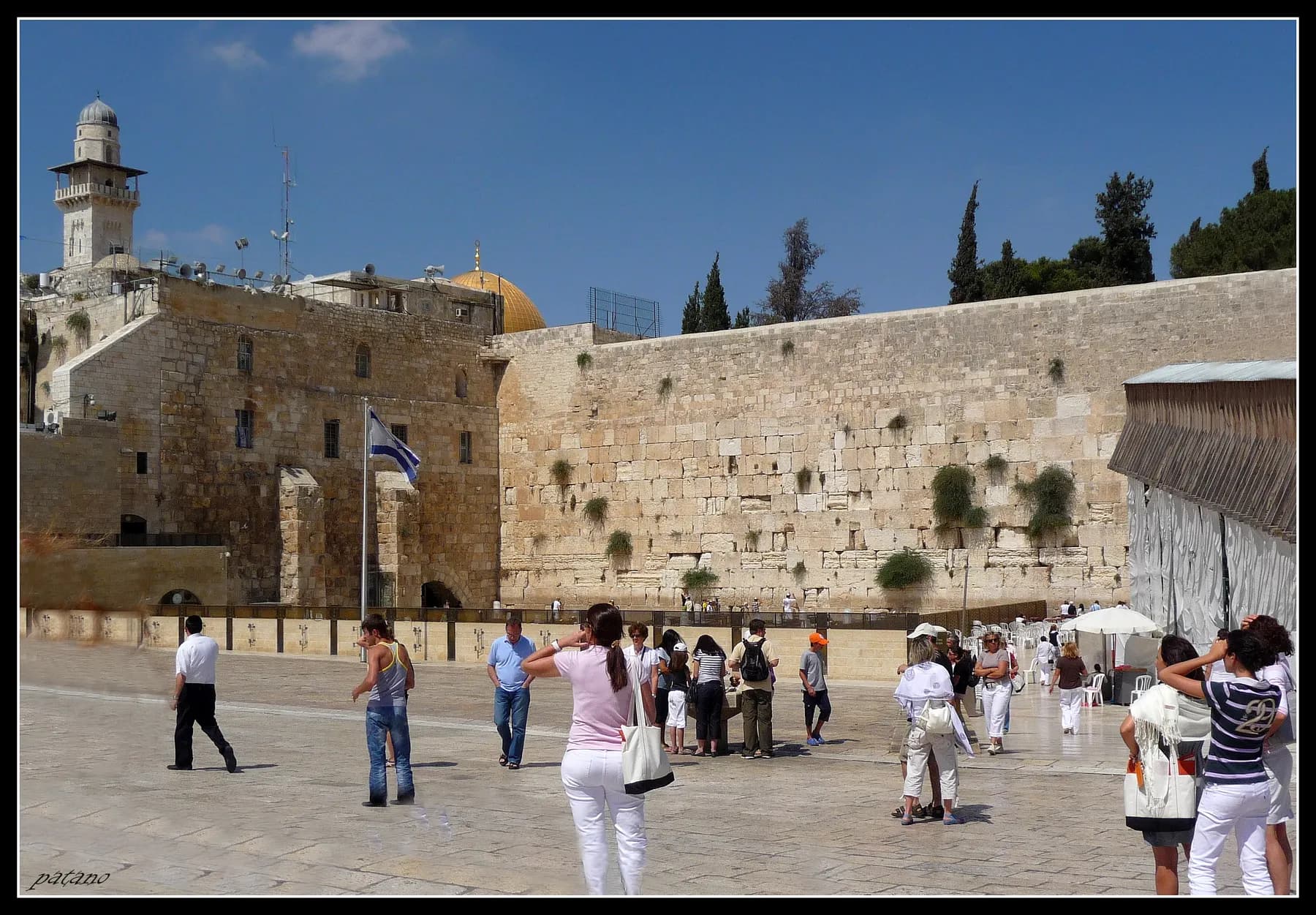
The Western Wall
The prayer plaza shows about 50 metres of a retaining wall that runs 488 metres in total, and it is open free of charge at every hour of every day of the year.
Mohammad Shad Siddiqui / CC BY-SA 4.0 · Wikimedia Commons
Archaeological site
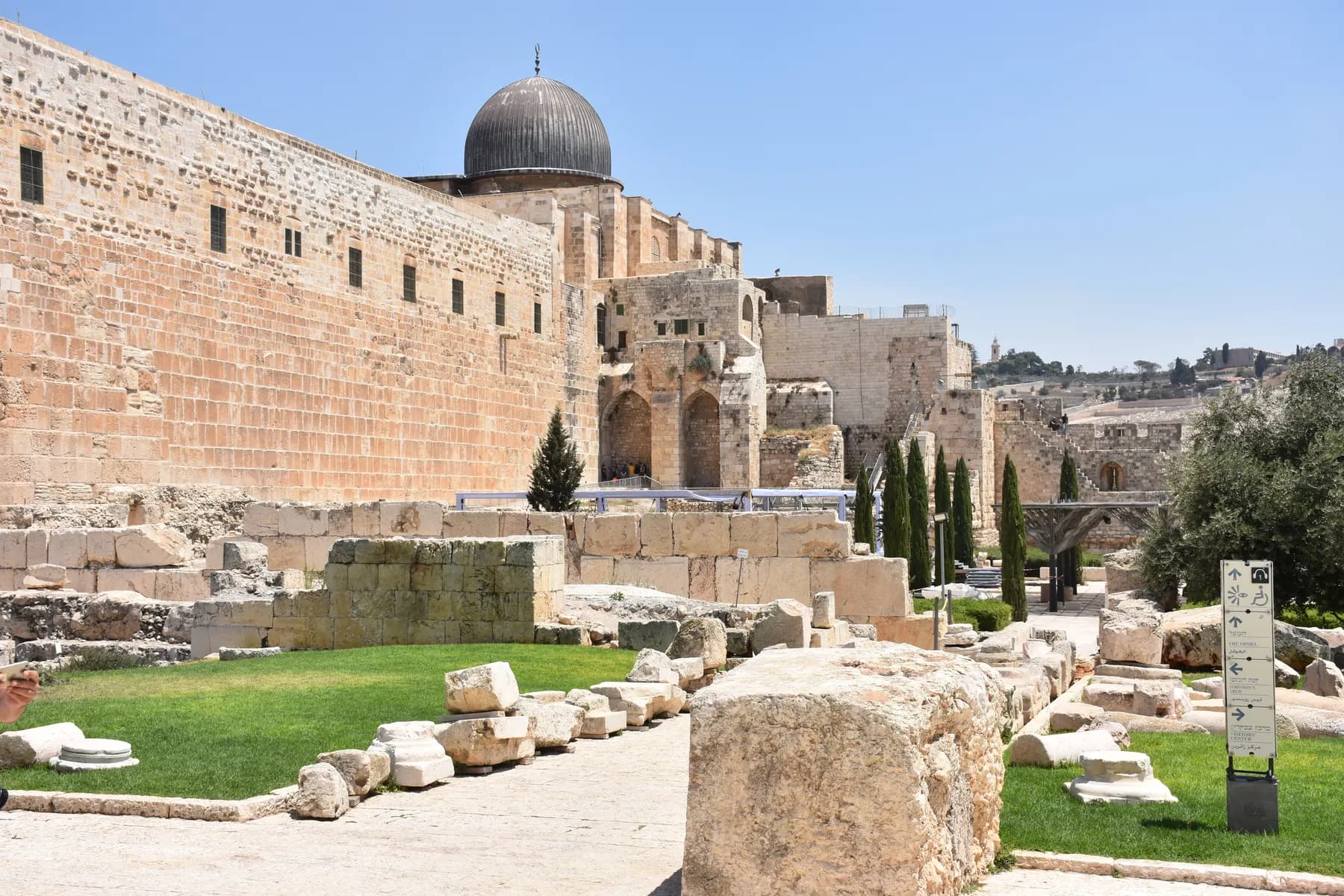
Jerusalem Archaeological Park, Davidson Center
The excavated corner where the Temple Mount's southern and western walls meet, with the paving of the Herodian street still under the heap of masonry the Romans pushed off the top in 70 CE.
Archaeological site
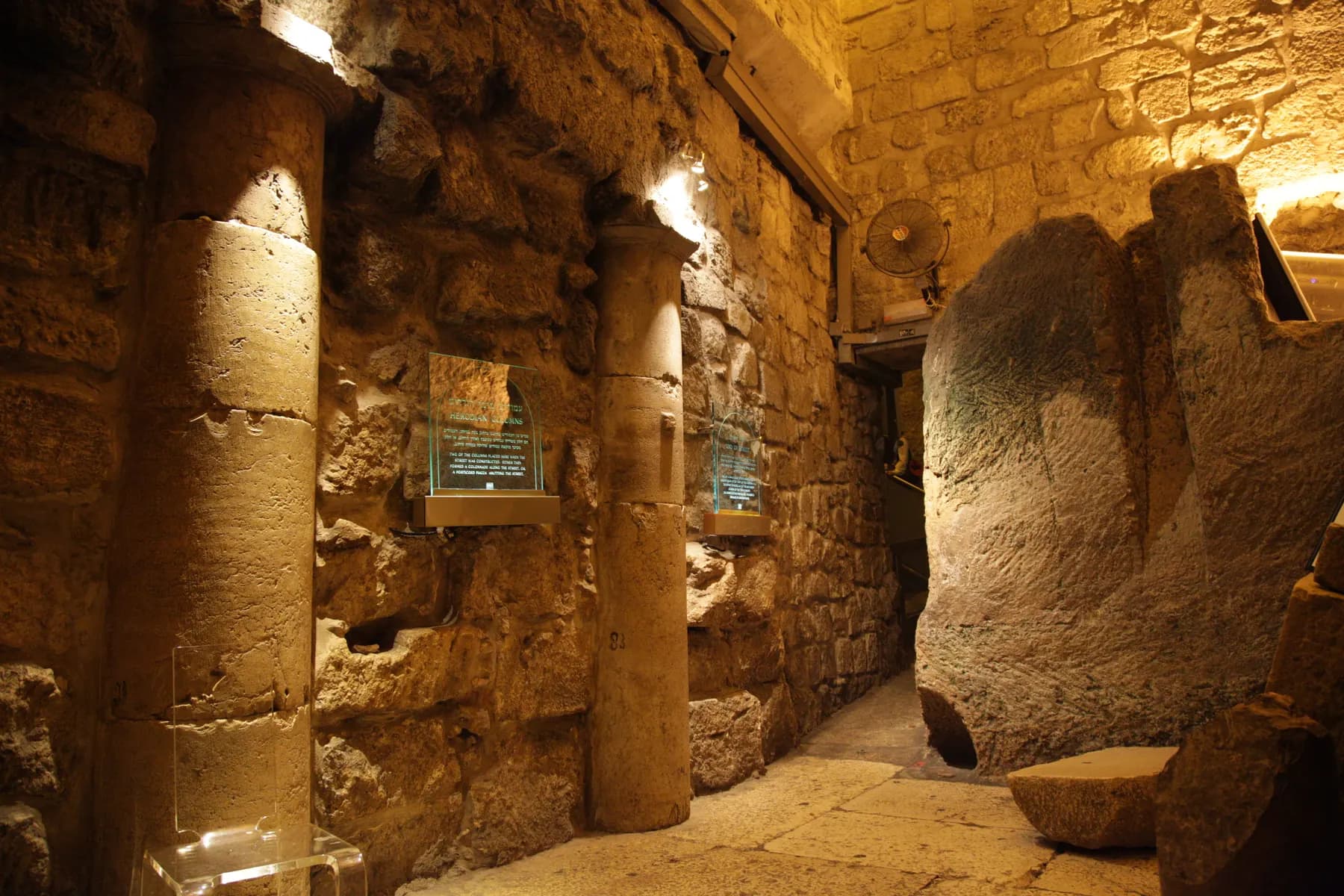
Western Wall Tunnels
A guided walk along the buried continuation of the Western Wall, past a single limestone block about 13.6 metres long that is among the largest building stones ever set in place by hand.
Sources and further reading
Every link below was opened and checked when this page was written. Official statements are marked as such: they are the subject's own account, not an independent one.
- OfficialiTravelJerusalem (Jerusalem Development Authority)itraveljerusalem.comThe Temple Mount
the operator's published visiting windows, free admission, entry gate and list of prohibitions
- OfficialTemple Mount Sifting Projecttmsifting.orgTemple Mount Sifting Project
the project's own running totals for tons sifted, artefacts recovered and volunteers involved
- OfficialKing Abdullah II Official Websitekingabdullah.joWork completed on Al Aqsa Mosque pulpit
the replacement minbar's dimensions, its 16,500 pieces, its makers and the 2002 to 2006 timetable
- ReportingSmithsonian Magazinesmithsonianmag.comWhat Is Beneath the Temple Mount?
the ban on excavation, the 1996 Marwani conversion, the 1999 exit pit and the origin of the sifting project
- ReportingThe Jerusalem Postjpost.comTemple Mount to relax restrictions for Jewish prayer
Jewish visitor totals for 2024 and 2025 and the January 2026 change on printed prayer pages
- ReportingThe Baltimore Sunbaltimoresun.comMosque's gold leaf reflects politics of the Middle East
contemporary reporting on the 1994 regilding, the 1964 aluminium, and how King Hussein paid for it
- ReferenceEncyclopaedia Britannicabritannica.comTemple Mount
Herod's rebuilding in 20/19 BCE, the destruction of 70 CE, and the 1967 and 1994 administrative arrangements
- ReferenceEncyclopaedia Britannicabritannica.comDome of the Rock
the 72 AH inscription, the octagon, and the dome of about 20 metres on 16 piers and columns
- ReferenceBiblical Archaeology Society, by Leen Ritmeyerbiblicalarchaeology.orgThe Temple Mount in the Herodian Period (37 BC-70 AD)
the lengths and thickness of the four retaining walls, the gates, and the point that only the walls survived
- ReferenceDiscover Islamic Art, Museum With No Frontiersislamicart.museumwnf.orgHaram al-Sharif (Noble Sanctuary)
the sanctuary's area, its three levels and the count of more than ninety commemorative structures
- ReferenceDiscover Islamic Art, Museum With No Frontiersislamicart.museumwnf.orgAqsa Mosque
the 50 by 80 metre plan, seven aisles, nine entrances, the rebuildings and Saladin's mihrab of AH 583
- ReferenceDiscover Islamic Art, Museum With No Frontiersislamicart.museumwnf.orgDome of the Rock
the 20.44 metre inner dome, the piers and columns, and Suleiman's tile revetment of AH 952 to 959
- ReferenceReligion Media Centrereligionmediacentre.org.ukExplainer: Jerusalem's holy flashpoint
the 144,000 square metre esplanade and the status quo rule on prayer and visiting
- ReferenceThe Avalon Project, Yale Law Schoolavalon.law.yale.eduTreaty of Peace Between the State of Israel and the Hashemite Kingdom of Jordan, 26 October 1994
the text of Article 9 on Jordan's special role in the Muslim holy shrines of Jerusalem
The Temple Mount and Haram al-Sharif: common questions
Can non-Muslims visit the Temple Mount?+
Yes, but only on Sunday to Thursday and only in short published windows: 07:00 to 11:00 and 13:30 to 14:30 in summer, 07:00 to 10:30 and 12:30 to 13:30 in winter, per iTravelJerusalem. The compound is closed to non-Muslims on Fridays, Saturdays and Muslim holidays, and during Ramadan the access is mornings only. It also closes at no notice when there is trouble.
How much does it cost to go up to the Temple Mount?+
Nothing. iTravelJerusalem lists free entry and there is no ticket office. No other ticket in the Old City, including the Western Wall Tunnels or the Jerusalem Archaeological Park, has any bearing on entry here.
Where is the entrance for non-Muslim visitors?+
The Mughrabi Gate, called the Moors' Gate, reached by the covered wooden ramp that climbs from the Western Wall plaza. iTravelJerusalem states that non-Muslims can only enter through it. The other gates of the compound open off the Muslim Quarter and are for Muslim worshippers.
Can you go inside the Dome of the Rock or the al-Aqsa Mosque?+
No. iTravelJerusalem states that entry to the mosques and buildings on the mountain is prohibited, and that applies to the Dome of the Rock, al-Aqsa and the underground Marwani prayer hall alike. Non-Muslim visitors walk the open esplanade and see the buildings from outside only.
Are Jews allowed to pray on the Temple Mount?+
Under the status quo, no: the Religion Media Centre sets it out as Muslims may pray and non-Muslims may visit but not pray, and iTravelJerusalem lists prayer and bowing as forbidden across the whole compound. In practice enforcement has loosened. The Jerusalem Post reported in January 2026 that 68,429 Jews visited during 2025, up from 56,057 in 2024, and that police had begun allowing a single pre-approved printed prayer page. It remains contested ground, and the position on any given day is a policing decision rather than a published one.
Is the Western Wall the same thing as the Temple Mount?+
No. The Western Wall is one of the four retaining walls that hold the platform up, seen from below and outside; the Temple Mount is the platform itself. Ritmeyer gives the western wall as 1,590 feet long, of which only a short stretch is exposed at the prayer plaza. The two sites have separate entrances, separate rules and separate opening hours.
How long should I allow?+
About an hour on the esplanade, and as long again for the queue at the ramp. There are no interiors to visit and no exhibits, so the time is spent walking the open ground between the buildings. Anyone arriving in the second half of a window should assume the security check will use up the rest of it.
Is any of it original?+
The platform is: the four retaining walls, the fill behind them and the vaults at the southern end are Herodian, from about 19 BCE, and Ritmeyer notes they were the only part of the compound to survive 70 CE. The Dome of the Rock's structure is Umayyad, completed in 691 or 692, but its exterior skin is Ottoman in scheme and twentieth-century in fabric. Al-Aqsa's standing outline is largely the Fatimid rebuilding of the 1030s, and its minbar dates from 2007.
Why is there so little archaeology from the Temple Mount itself?+
Because no one is permitted to dig there. The Waqf has long forbidden archaeological excavation on the platform as desecration, with only limited European surveys in the late nineteenth century and British work from 1938 to 1942 as exceptions. The single body of material anyone has studied systematically is the earth bulldozed out during the 1999 works on the Marwani prayer hall, which the Temple Mount Sifting Project has been washing and sorting since 2004.
Is it worth going if the buildings are closed?+
That depends on whether the interest is architecture or ground. Nobody gets inside, so the payoff is standing on the platform itself, seeing how much open space there is, how the terraces and arcades are arranged, and how the Old City looks from the top of Herod's fill. Visitors who want interiors will get more from the Western Wall Tunnels or the Tower of David for the same hour.