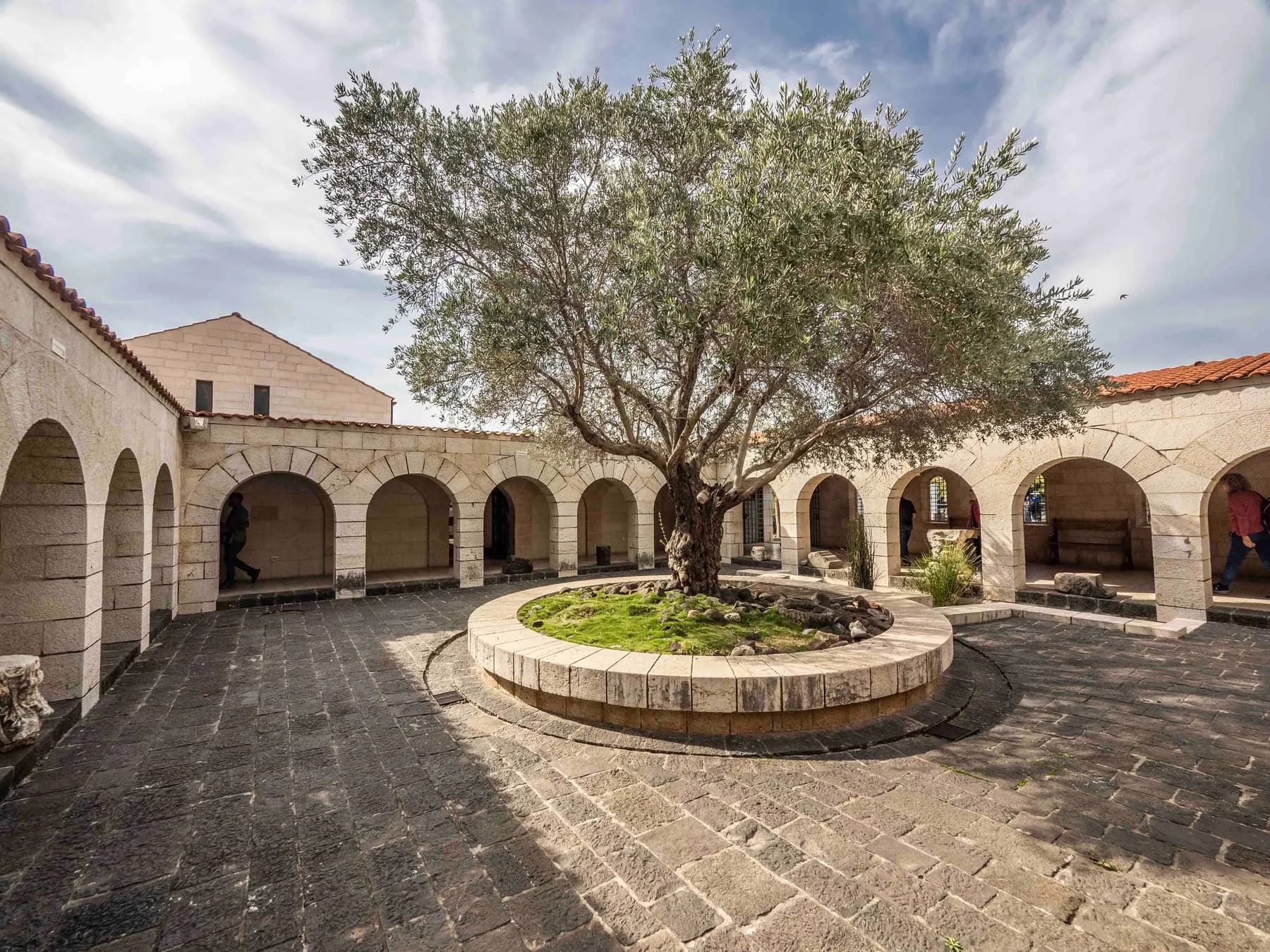
Religious site · The Sea of Galilee
Tabgha
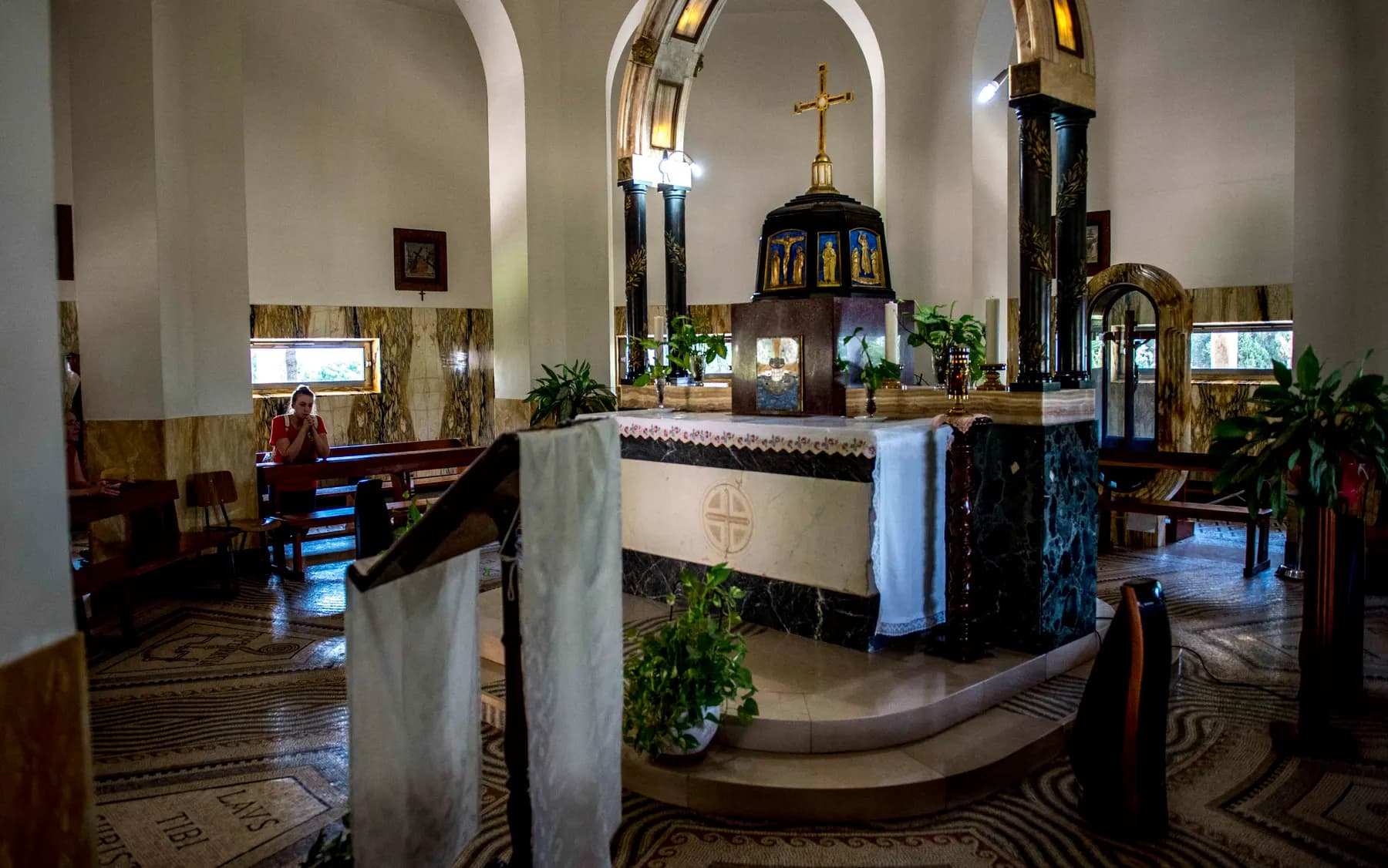
The mosaic in front of the altar shows a basket of four loaves, not the five of the Gospel account, and the usual reading is that the fifth is the one consecrated on the altar above it.
יוסי רון / CC BY 2.5 · Wikimedia Commons
Loaves in the mosaic basket
four
the Gospel account has five; the fifth is read as the one on the altar
Present church built
1980 to 1982
consecrated 23 May 1982, on the fifth-century foundations
Primacy chapel built
1933
Franciscan, over remains of a 4th to 5th century church, restored in 1982
Admission
no fee published
for either church, on the Custody's list dated 7 August 2026
In short
- How long to give it
- about 60 minutes for both churches, or about 30 minutes if you only stop at the Multiplication church
- Church of the Multiplication, Monday to Saturday
- 09:00 to 15:00. These are listed by the Custody's Christian Information Centre as temporary hours, so confirm before travelling; several guides still print the older 08:00 to 17:00
- Church of the Multiplication
- No entrance fee published. The Custody's list, in its edition of 7 August 2026, prints a fee against Capernaum (10 ILS) and none against either Tabgha church
עין שבע · الطابغة
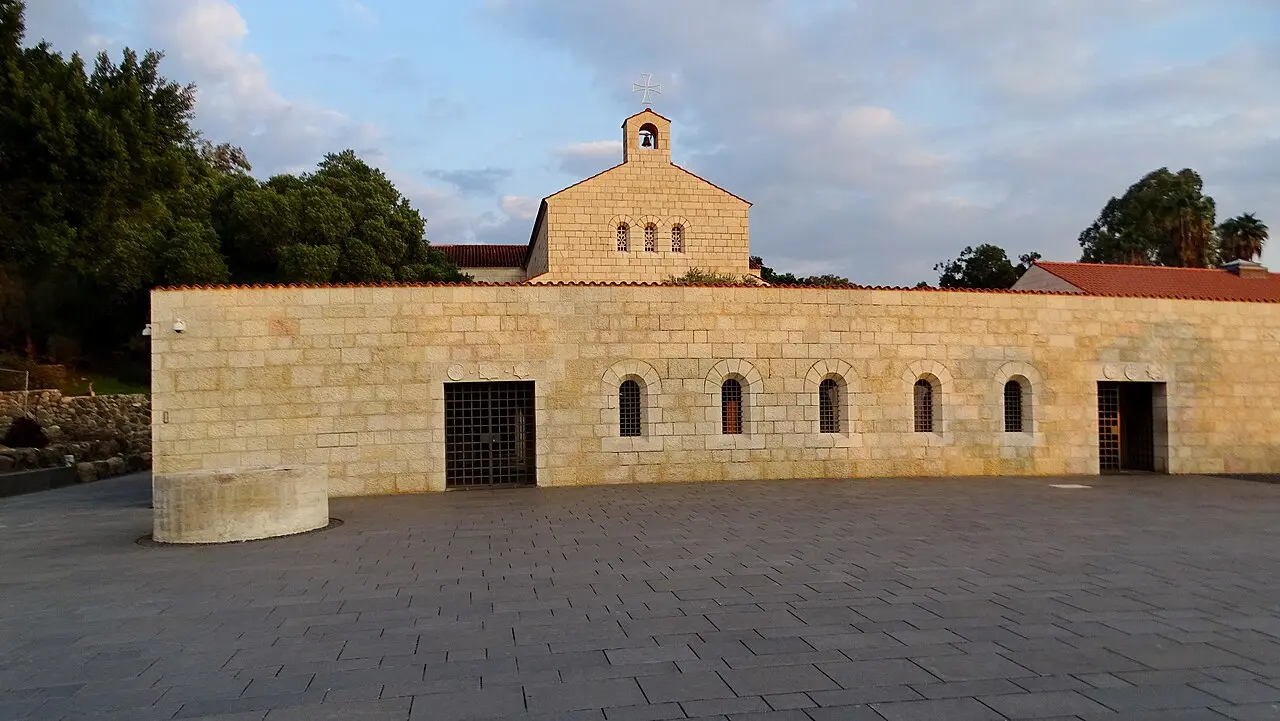
Tabgha is a short stretch of the north-western shore of the Sea of Galilee holding two small Catholic churches a few minutes' walk apart: the Church of the Multiplication of the Loaves and Fishes, kept by German Benedictines, and the Franciscan Chapel of the Primacy of Saint Peter, down on the rocks at the water's edge. Neither building is old. Both stand on the excavated footprint of something that is, and the reason to come is a floor.
The name is a worn-down Greek word. Heptapegon, seven springs, became Tapego and then Tabgha, because classical Arabic has no p, g or o sounds and substitutes b, gh and a or u; the Hebrew Ein Sheva, spring of seven, says the same thing. The springs are warm, sulphurous and saline, they run into the lake, and they draw fish, which is why anyone fished this particular shore in the first place.
Tabgha catches people out in one way. It is not one site with one gate: the two churches are separate properties held by two different religious orders, with different opening hours and different closing days. Neither is a national park, so an Israeli parks pass buys nothing here, and neither publishes an entrance fee.
Setting
Seven springs, a fishing shore, and a village that is not there
The springs are the reason the place exists, and they were engineered early. In the Byzantine period the water was gathered into three towers, Birket Ali edh-Dhaher at the Ein Nur spring, Hammam Ayyub and Tannur Ayyub, and carried by aqueduct to irrigate the Ginosar plain. The Custody of the Holy Land's plan still marks two of them among the numbered features of the site, one polygonal and one circular. Jerome called Heptapegon the erêmos, the lonely place, the same word the Gospels use of the spot where the crowd was fed.
One of those pools has turned into a conservation case. The octagonal reservoir at Ein Nur, on monastery land, is the only known home of Typhlocaris galilea, a blind, unpigmented cave shrimp. Its water runs warm at about 27 degrees, sulphurous and salty, and the species is critically endangered: groundwater extraction lets other water into the pool and shifts its chemistry and temperature. In 2013 the Israel Nature and Parks Authority asked the Jerusalem Biblical Zoo to breed it in captivity, against the day it is lost in the wild.
Tabgha was also an inhabited village, and that half of its history leaves nothing for a visitor to look at. The 1945 government statistics counted 330 people here, 310 Muslims and 20 Christians, on 5,389 dunams that included Tell el Hunud and Khan el Minya. On 4 May 1948, in Operation Broom, Palmach forces attacked with Alexandroni and local Haganah support; the inhabitants were expelled and their houses and tents destroyed on Yigal Allon's orders.
israel zeller / CC BY 2.5 · Wikimedia Commons
Excavation
What two German archaeologists found in 1932
In 1889 the Palestine Association of German Catholics, tied to the Archdiocese of Cologne, bought the land, meaning to put up a hostel for pilgrims. Digging for foundations turned up an older church, and Ottoman law stopped them going further. A first survey followed in 1892 and then nothing for forty years.
The real work came under the British Mandate. Excavations in 1932 and 1936, led by Alfons Maria Schneider and A. E. Mader for the Jerusalem institute of the Görres Society, uncovered walls and mosaic pavements. By 1936 the floors were exposed and roofed over with a temporary church built purely to protect them, and that shed stood here for the next four decades.
What they had uncovered was two churches, one inside the other. The first was a small chapel of about 350, ascribed to Joseph of Tiberias, a Jewish convert whom Epiphanius describes as a member of the Sanhedrin, made a comes by Constantine and licensed to build churches in Galilee. That chapel is probably the shrine Egeria saw at the end of the fourth century, and her account of a well watered place with seven springs where the Lord fed the multitude is the earliest description of Tabgha there is. Around 480 it was taken down and a far larger basilica and monastery went up in its place, attributed to Martyrius, patriarch of Jerusalem from 478 to 486: roughly 56 by 33 metres, with workshops, monks' quarters and pilgrim lodging around the church.
How it ended is not agreed. The common date is 614 and the Persian invasion; some accounts prefer the Arab conquest a generation later. By about 670 the bishop Arculf reported only columns standing, and the site then dropped out of the record for some 1,300 years. The Benedictines have held it since 1939, as a daughter house of the Dormition Abbey in Jerusalem, while the land belongs to the German Association of the Holy Land.
Ștefan Jurcă from Paris, France / CC BY 2.0 · Wikimedia Commons
Mosaics
The oldest figurative church floor in the country
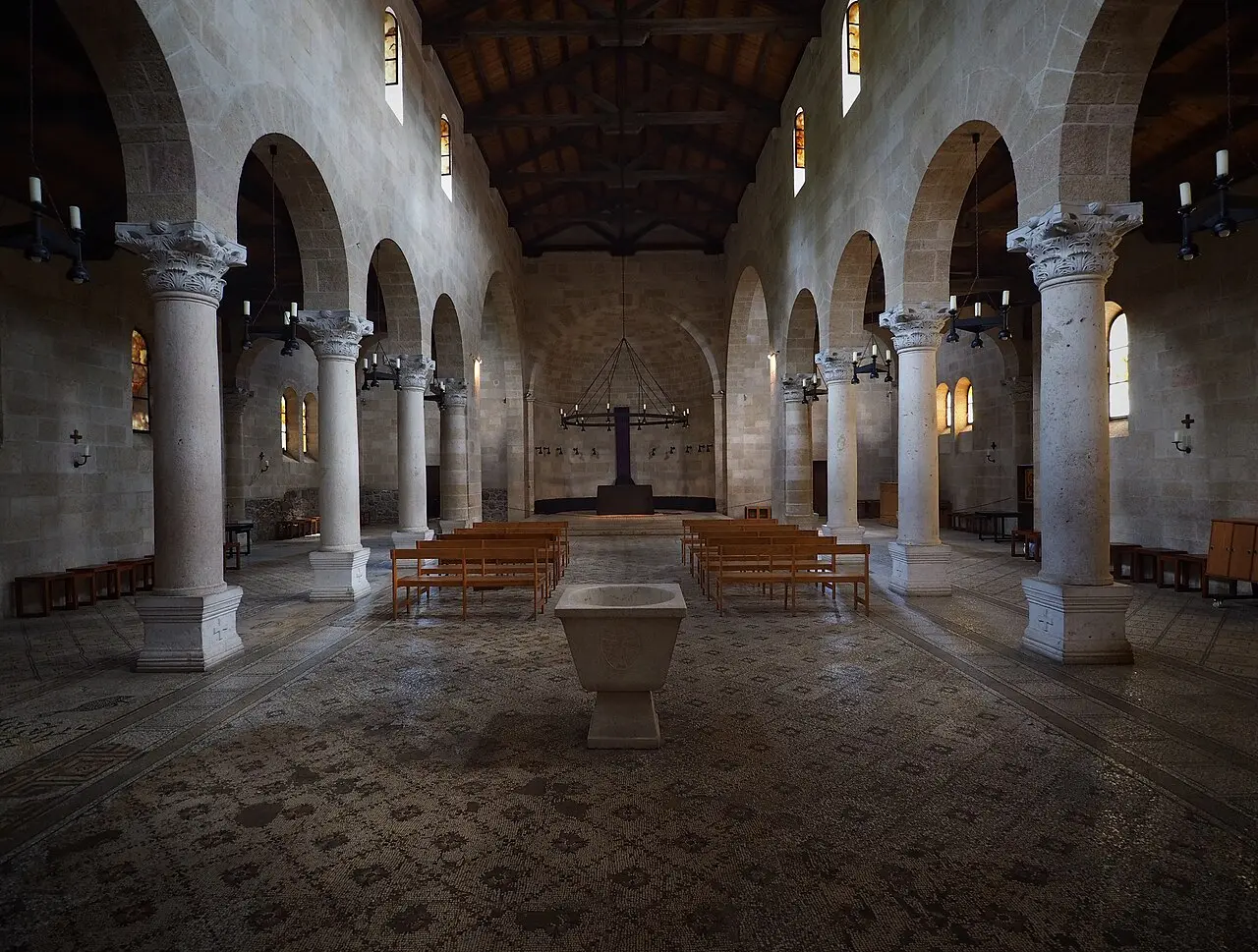
The claim usually made for these floors is a strong one: they are the earliest known figurative mosaics of Christian art in the Holy Land. The panel everybody photographs sits in front of the altar and is very simple, a wicker basket of loaves flanked by two fish. Count the loaves and there are four, where Mark's account has five. The reading offered by the Franciscan foundation Pro Terra Sancta, and repeated by the German literature on the church, is that the missing fifth is the loaf consecrated on the altar above. That is an interpretation rather than a documented intention, but it is the one the building now stages.
The better mosaics are the ones people walk over on the way to that panel. The transepts and aisles carry waterbirds and marsh plants rendered precisely enough that the species can be named: duck, snipe, heron, goose, dove, swan, cormorant, flamingo and stork, among lotus, oleander and lily. The lotus does not grow in Galilee. Its presence marks the design as a Nilotic landscape, a genre popular in Roman and early Byzantine art, and Martyrius being an Egyptian is the usual explanation for why a Galilean church floor looks like the Nile in flood.
One motif in the right transept is stranger than the rest: a tower banded with Greek letters, the numerals for six to ten still legible. It is a nilometer, the graduated column used in Egypt to read the height of the flood. Whether the mosaicist meant it as Egyptian scenery or as a gauge for the level of the Sea of Galilee is not settled, and the lake's level is still the number this country argues about every winter.
The tesserae are limestone, running from blue-black through to white. Blue and green are absent altogether, which is worth knowing before looking at a marsh scene and wondering where the water went. The dating is disputed in a way English-language guides tend to flatten: the German account places the floors in the middle of the fourth century and the loaves-and-fishes panel, as the latest of them, at the start of the fifth, while the standard English summary assigns the whole scheme to the enlargement of about 480.
Bahnfrend / CC BY-SA 4.0 · Wikimedia Commons
Reconstruction
What is fifth-century here and what is 1982
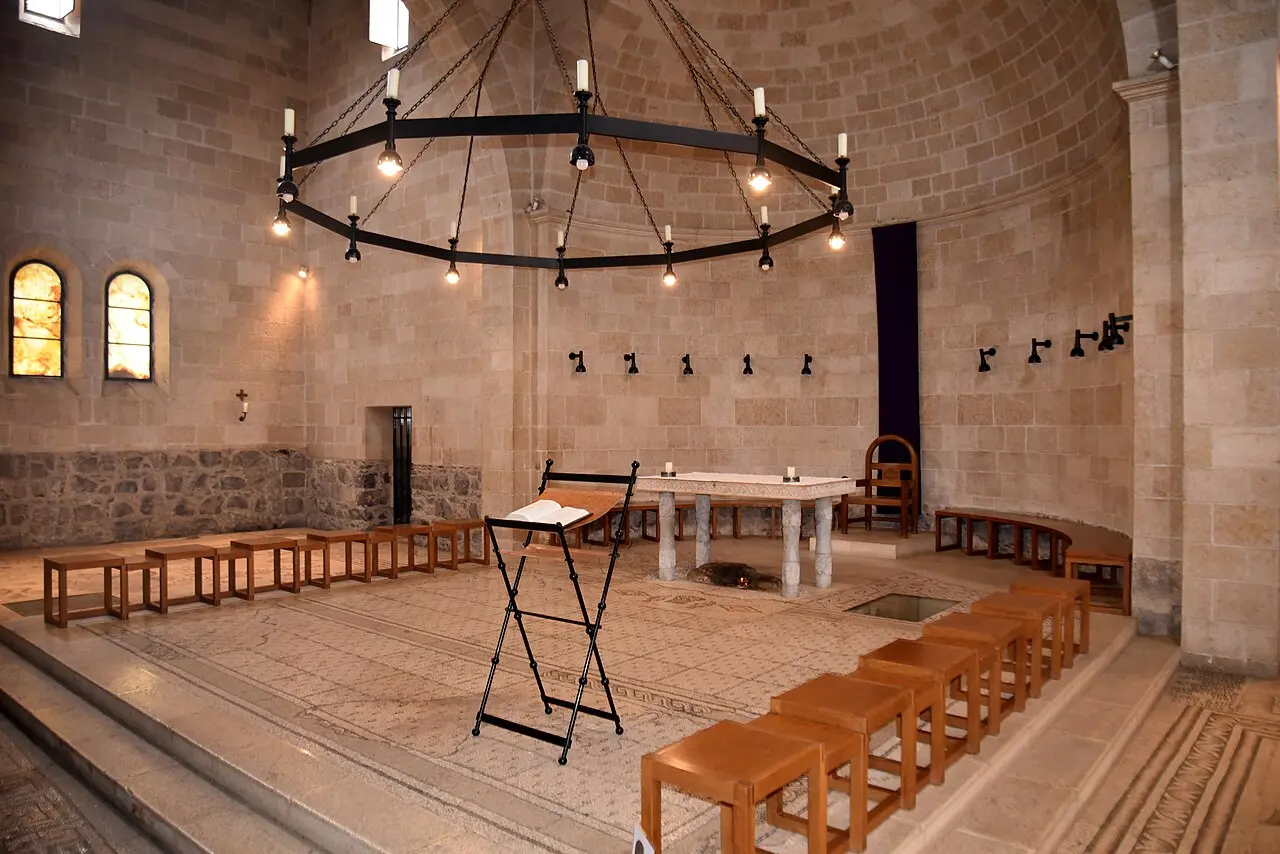
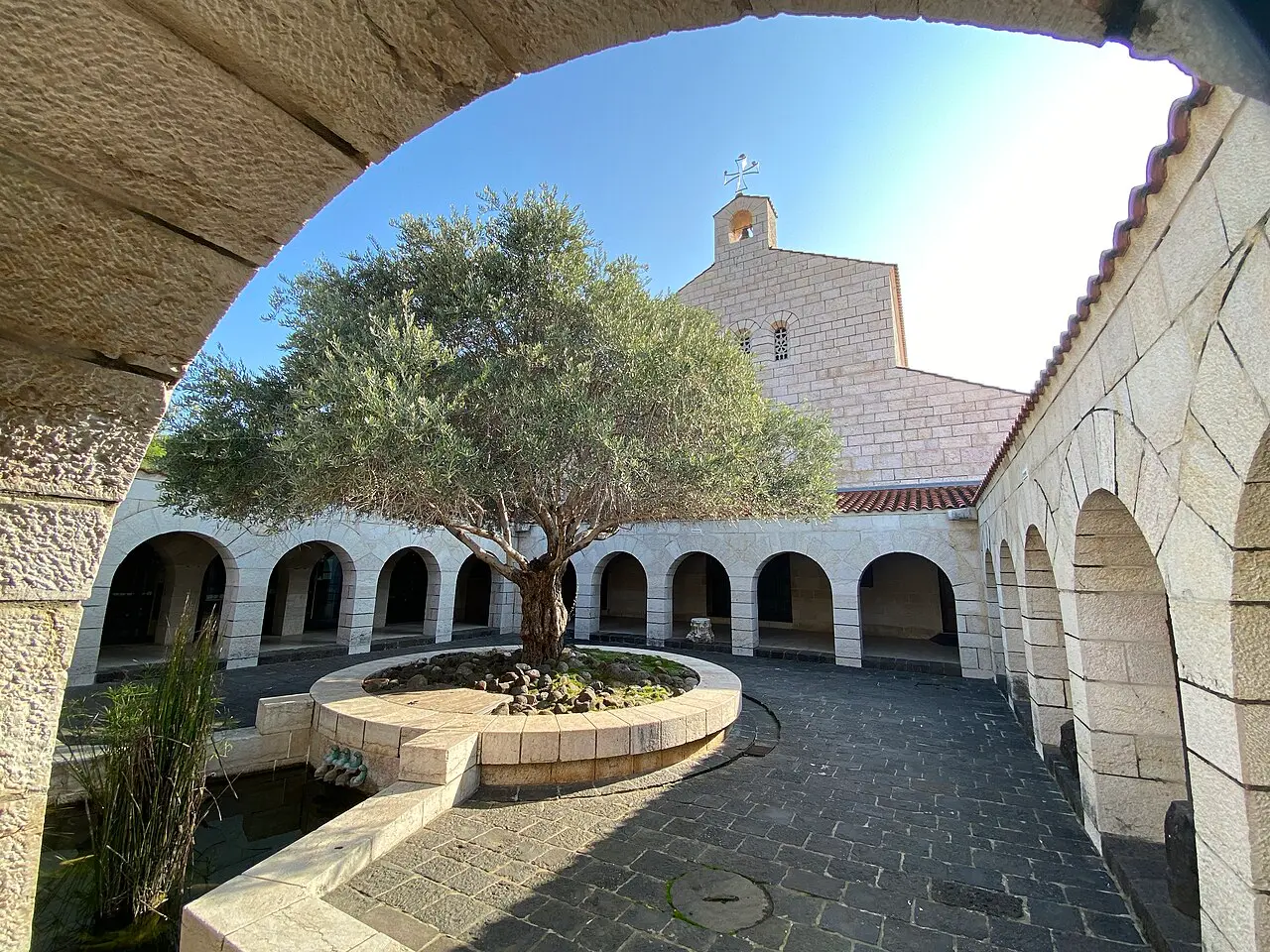
The church a visitor walks into was built between 1980 and 1982 by the Cologne architects Anton Goergen and Fritz Baumann, in a deliberately neo-Byzantine manner, on the fifth-century foundations and to the same floor plan. The Latin Patriarch of Jerusalem, Giacomo Beltritti, laid the foundation stone on 23 May 1980, and Cardinal Joseph Höffner, Archbishop of Cologne, consecrated the finished building exactly two years later. Some English sources give 1984 for the inauguration; the German record and the association's own account both say 1982.
The materials came from three countries: pale limestone quarried at Taybeh, the largely Christian village on the road between Jericho and Ramallah, red roof tiles from Italy, open roof timbering from Germany. The windows are glazed with alabaster panels rather than glass, which is why the interior light is the colour it is, and the bronze portal is by the German sculptor Elmar Hillebrand. Stretches of the original black basalt walling were left showing, so the join between the fifth century and the twentieth is visible at the wall base.
The honest complication is at the altar. The rock venerated as the stone on which the loaves and fish were laid, and the mosaic panel beside it, do not stand where the Byzantine builders put them: Pro Terra Sancta states plainly that the floor was moved forward in front of the altar during the modern reconstruction, more prominently than it originally sat, to press the Eucharistic reading of the image. The most photographed object at Tabgha is a genuine fifth-century floor in a place its makers did not choose. Other fragments are where they were: the sill of the left atrium entrance, basalt paving, part of the apse frieze, and, under a glass panel right of the altar, the foundations of the fourth-century chapel.
שלמה רודד / CC BY 2.5 · Wikimedia Commons
Primacy
The rock on the shore and the Twelve Thrones
The second church is smaller, darker and closer to the water. The Chapel of the Primacy of Saint Peter is built of black basalt, put up in 1933 over earlier remains and restored in 1982, and it belongs to the Franciscan Custody of the Holy Land rather than to the Benedictines up the slope. At the base of the walls opposite the altar the foundations of the fourth-century church show. Its predecessor outlasted every other church in this area and was finally destroyed in 1263. Paul VI came here in 1964 and John Paul II in March 2000.
Inside, a shelf of limestone rock projects in front of the altar. This is the Mensa Christi, the table of Christ, venerated as the spot where the risen Jesus laid out a breakfast of bread and fish and told Peter to feed his sheep, the third resurrection appearance in John 21. Egeria mentions a table, and which of the two Tabgha rocks she meant is disputed; a third Mensa Christi is shown at Nazareth. In the ninth century this place was known instead as the Place of the Coals, after the charcoal fire in the same chapter.
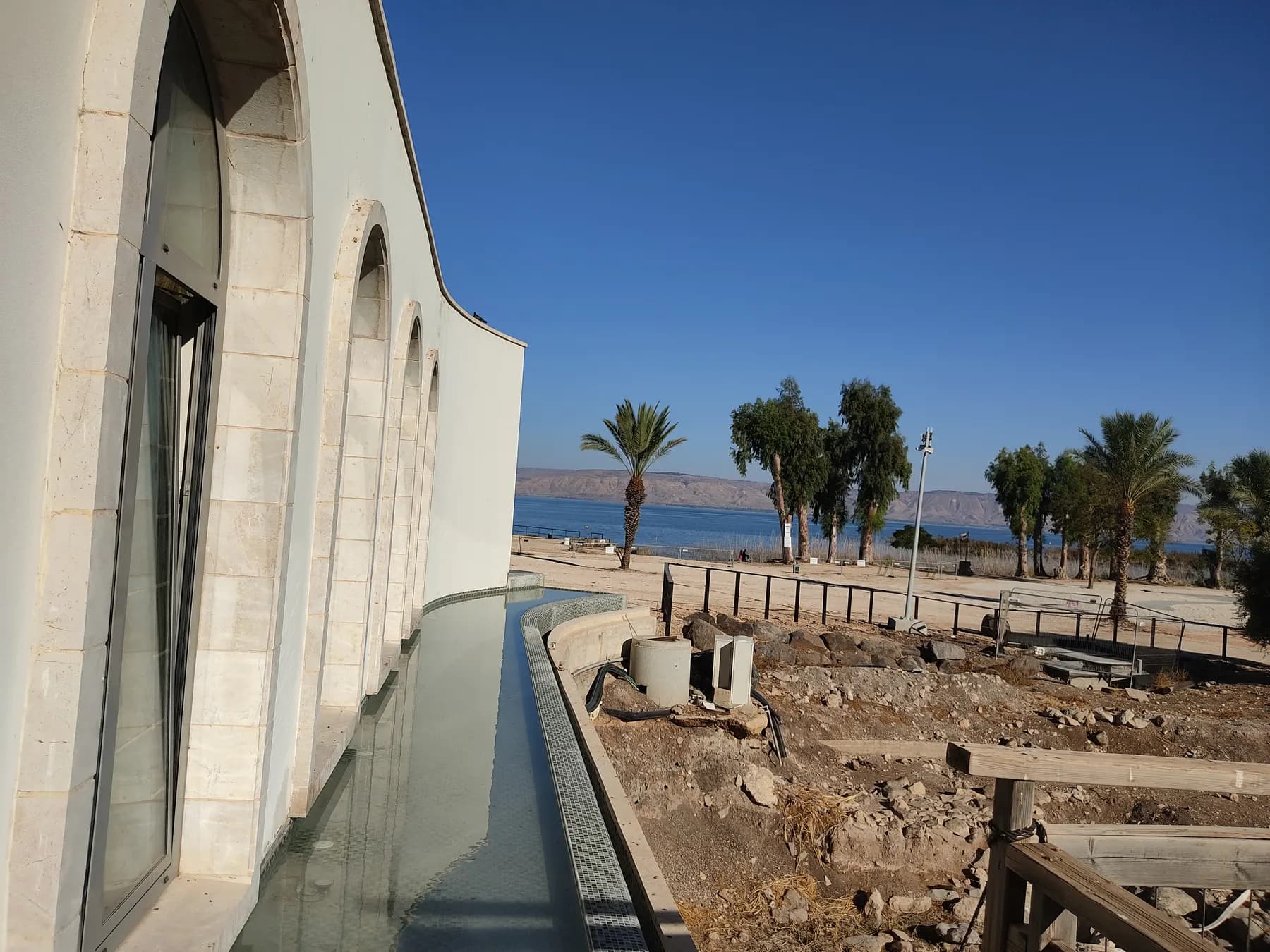
Outside, two things are worth not walking past. Cut into the shore below the chapel are a rocky bench and steps down into the lake, which the Custody identifies with the steps Egeria describes. And on the grass between the chapel and the water lie the Twelve Thrones, heart-shaped stone blocks set out for the apostles and first recorded in 808. Six survive, dated by the Custody to the Byzantine and Arab periods, between the fifth and ninth centuries. Most groups file past them to the water without noticing they are anything at all.
- Built 1933, restored 1982, Custody of the Holy Land
- Mensa Christi: the limestone shelf in front of the altar
- Foundations of a 4th to 5th century church at the wall base
- Rocky bench and steps to the water, identified with Egeria's steps
- Six surviving heart-shaped stones of the Twelve Thrones, 5th to 9th centuries
- Open later than the Multiplication church, to 17:00
2015
The fire, and what it cost to put right
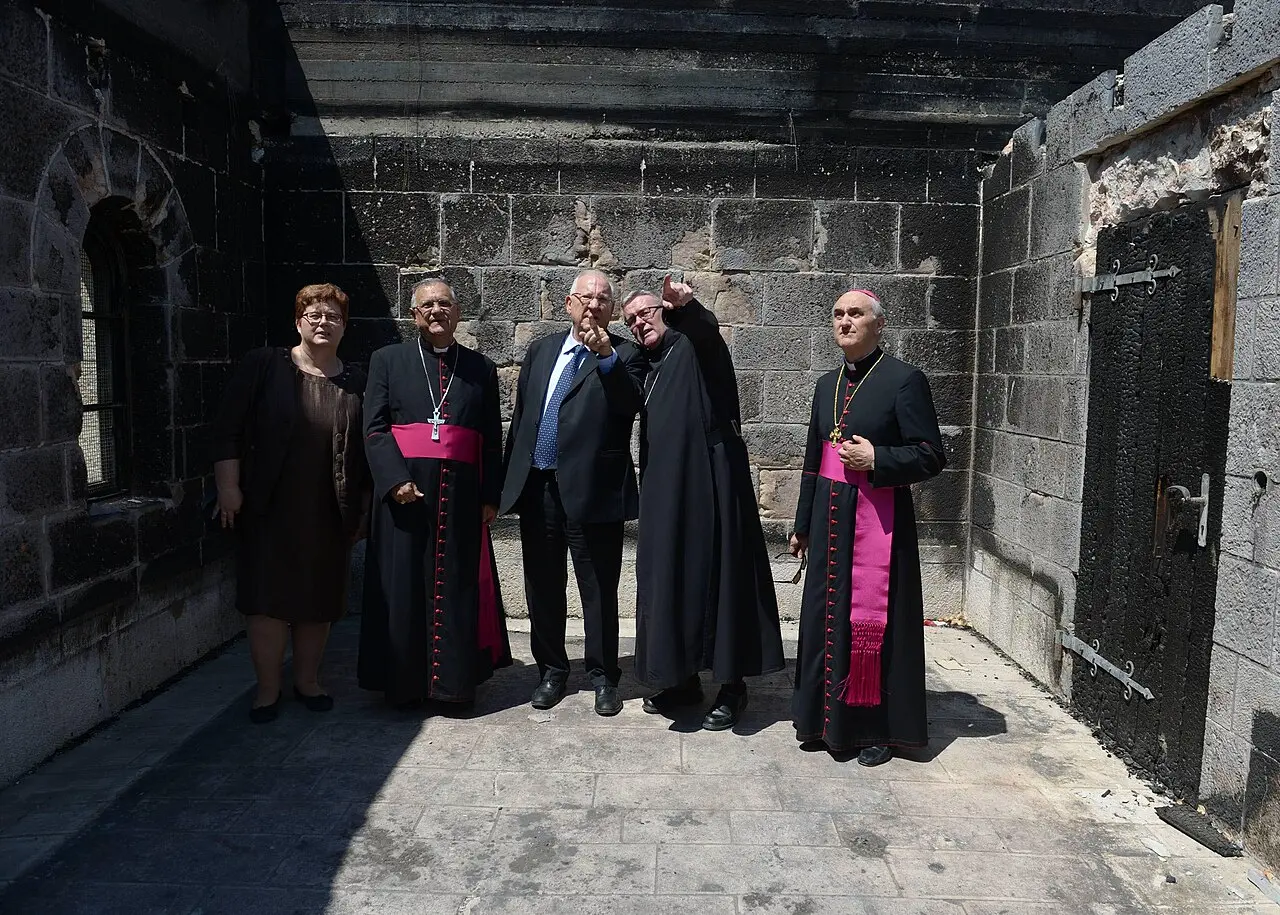
In the early hours of 18 June 2015 a fire was set at the Church of the Multiplication; police were called at four in the morning. Some accounts date it to 17 June, but the Israeli reporting and the emergency call put it on the 18th. The blaze ran mainly on the roof and damaged a book store, offices and an event hall, and the German account puts the worst of it at the entrance, with the gate and southern atrium destroyed outright. A monk and a volunteer were treated for smoke inhalation. Hebrew graffiti in an entrance corridor quoted a line from the Aleinu prayer about false gods being wiped out.
The church itself came through, and so did the mosaics: the fifth-century pavement, basket and fish included, was not damaged. In late July 2015 four Israeli Jews aged between 18 and 24 and an unnamed minor were arrested and indicted, reportedly linked to the ultranationalist hilltop youth. In December 2017 Eyal Reuveni was sentenced to four years in prison for the attack.
The government had promised compensation within days, and the first payments came through in July 2016; with donations from Germany and from the Benedictines, that paid for eight months of work. The church reopened on 12 February 2017, with President Reuven Rivlin at the ceremony alongside Cardinal Rainer Maria Woelki of Cologne, the German ambassador and the Druze spiritual leader Sheikh Muwaffaq Tarif. The Times of Israel reported the repairs at around one million dollars, of which the Israeli state paid nearly 400,000.
Mark Neyman / CC BY-SA 3.0 · Wikimedia Commons
What to look for
Things not to walk past at Tabgha
The details that repay knowing about before you are standing in front of them.
The loaves and fishes mosaic
A basket of four loaves flanked by two fish, set in the floor in front of the altar. It is fifth-century work, but it was moved forward into this position during the 1980s rebuilding.
The nilometer in the transept
A banded tower with the Greek numerals for six to ten still readable, the graduated column used in Egypt to measure the Nile flood. Whether it stands for the Nile or for the lake is unresolved.
The birds in the aisle floors
Heron, flamingo, stork, cormorant, goose and duck among lotus and oleander, laid in limestone tesserae that run from blue-black to white. There is no blue and no green anywhere in the palette.
The glass panel by the altar
To the right of the altar, the foundations of the fourth-century chapel show through the floor. Most visitors head straight for the mosaic and miss it.
The Mensa Christi
The limestone shelf in front of the altar of the Primacy chapel, venerated as the table of the breakfast in John 21. A rival Mensa Christi is shown at Nazareth.
The Twelve Thrones
Heart-shaped stone blocks on the grass between the Primacy chapel and the water, first recorded in 808. Six survive, dated by the Custody to between the fifth and ninth centuries.
The long view
Tabgha, in order
c. 350
Joseph of Tiberias, a convert given the rank of comes by Constantine, builds a small chapel at Heptapegon.
c. 380
The pilgrim Egeria describes the seven springs, the grassy plain and the stone on which the Lord laid the bread.
c. 480
The chapel is taken down and a basilica and monastery of about 56 by 33 metres are built by Martyrius, patriarch of Jerusalem.
614
The Byzantine church is destroyed, on the usual dating, in the Persian invasion. Some accounts prefer the Arab conquest.
c. 670
The bishop Arculf reports that only columns remain. The site then drops out of the record for some 1,300 years.
808
The Twelve Thrones, heart-shaped stones set along the shore for the apostles, are mentioned for the first time.
1263
The church at the Primacy site, the last surviving church in the area, is destroyed.
1889
The Palestine Association of German Catholics, linked to the Archdiocese of Cologne, buys the land for a pilgrims' hostel.
1892
A first archaeological survey. Ottoman law prevents any real excavation.
1932 and 1936
Alfons Maria Schneider and A. E. Mader excavate for the Görres Society and uncover the Byzantine walls and mosaic floors.
1933
The Franciscans build the present basalt Chapel of the Primacy of Saint Peter over the earlier remains.
1936
The exposed mosaics are roofed over with a temporary church, which serves for the next four decades.
1939
Benedictines from the Dormition Abbey in Jerusalem take charge of the site.
4 May 1948
The village of Tabgha is attacked in Operation Broom; its inhabitants are expelled and their houses destroyed on Yigal Allon's orders.
23 May 1980
The Latin Patriarch Giacomo Beltritti lays the foundation stone of the present Church of the Multiplication.
23 May 1982
Cardinal Joseph Höffner consecrates the new church. The Primacy chapel is restored the same year.
18 June 2015
Arsonists set fire to the Multiplication church complex. The mosaics survive; the entrance area and outbuildings do not.
12 February 2017
The church reopens after eight months of work, with President Reuven Rivlin at the ceremony.
December 2017
Eyal Reuveni is sentenced to four years in prison for the arson.
Practical
Visiting Tabgha
Where
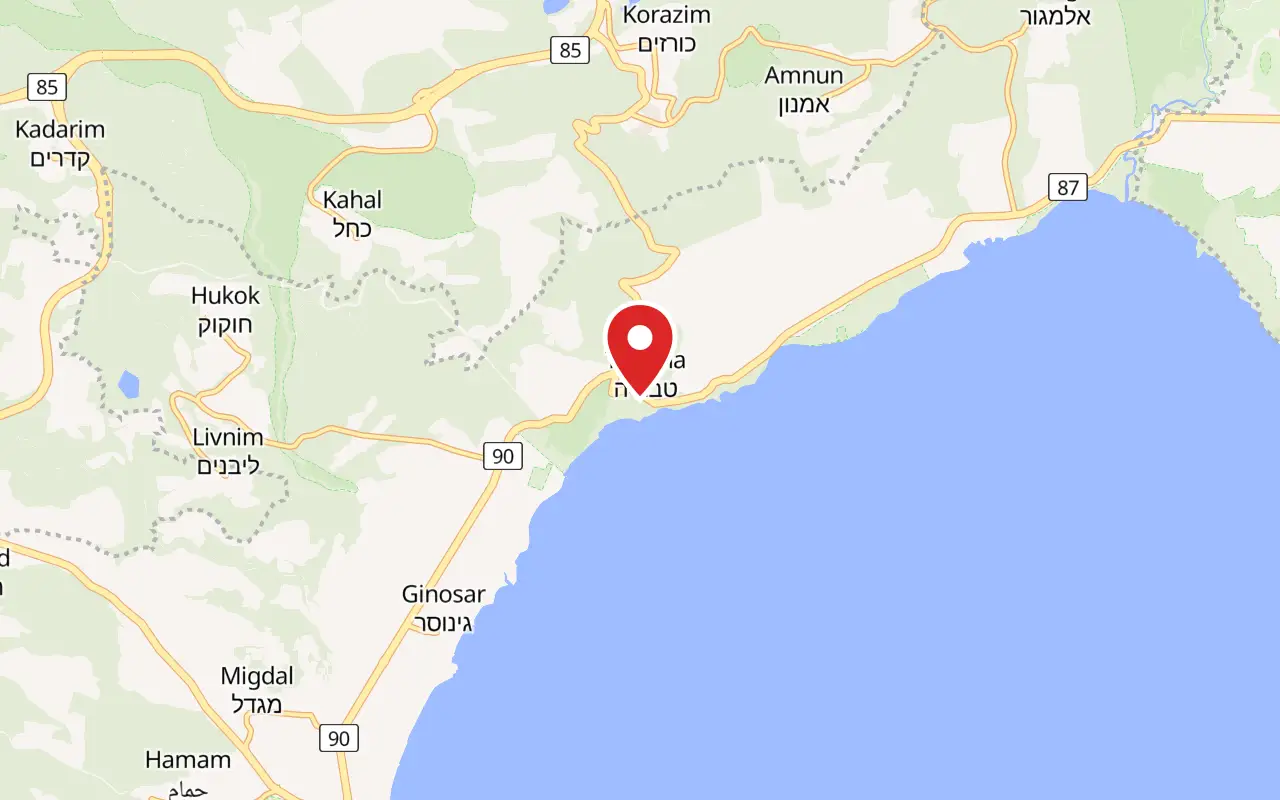
Tabgha, Route 87 on the north-western shore of the Sea of Galilee, about 3 km south-west of Capernaum and below the Mount of Beatitudes. The two churches sit on either side of the road, the Multiplication church inland and the Primacy chapel on the shore.
What ticket you need
Tabgha does not sit inside a larger ticketed park, and no single ticket covers it. The two churches are separate religious properties under two different orders, with their own gates, their own telephone numbers and their own closing times, and the Multiplication church shuts two hours earlier than the Primacy chapel and all day on Sundays. Capernaum, 3 km up the road, is a third property again, with a 10 ILS ticket of its own.
Opening hours
- Church of the Multiplication, Monday to Saturday
- 09:00 to 15:00. These are listed by the Custody's Christian Information Centre as temporary hours, so confirm before travelling; several guides still print the older 08:00 to 17:00source
- Church of the Multiplication, Sunday
- Closed to visitorssource
- Church of the Primacy of Saint Peter, every day
- 08:00 to 17:00, last entry 16:30source
- Primacy of Saint Peter, closed
- Yom Kippur, Christmas Day (25 December) and New Year's Day (1 January)source
- Primacy of Saint Peter, Holy Week Triduum (Thursday to Saturday)
- 08:00 to 12:00 onlysource
- Primacy of Saint Peter, 24 and 31 December
- 08:00 to 12:00, last entry 11:40source
Admission
- Church of the Multiplication
- No entrance fee published. The Custody's list, in its edition of 7 August 2026, prints a fee against Capernaum (10 ILS) and none against either Tabgha churchsource
- Church of the Primacy of Saint Peter
- No entrance fee publishedsource
- Israeli national parks passes
- Not valid and not needed. Neither church is an Israel Nature and Parks Authority site: one belongs to the German Association of the Holy Land and is run by Benedictines, the other to the Franciscan Custody of the Holy Landsource
Access
Easier than most sites on this shore, and much easier than the Mount of Beatitudes above it. The Multiplication church is on flat ground: the route from the car park through the atrium into the church involves no climb, and the mosaics are all at floor level. The Primacy chapel is the harder of the two, sitting below the road on the shore, reached by a sloping path, with uneven basalt underfoot and rock-cut steps running down into the lake that no wheelchair can take. Neither church publishes an access statement, so telephone if it matters: the Benedictine priory is on 04 667 8100 and the Franciscan chapel on 04 672 4767. Next door, the German Association of the Holy Land runs Beit Noah, an encounter centre for people with and without disabilities, built with barrier-free infrastructure, so wheelchair users are a normal presence here rather than an exception.
On site
- Car and coach park
- Atrium, narthex and cloister garden at the Multiplication church
- Benedictine priory on site, not open to visitors
- Outdoor altars for pilgrim groups
- Shore access and rock-cut steps at the Primacy chapel
- Beit Noah encounter centre, run by the German Association of the Holy Land
- Pilgerhaus Tabgha guest house alongside
Booking
Individual visitors need no booking at either church. Groups wanting to celebrate Mass should arrange it in advance: the Benedictine priory takes enquiries on 04 667 8100 or at tabgha@tabgha.net, and the Franciscan chapel on 04 672 4767. Shoulders and knees covered at both.
Hours and prices are given as the operator publishes them and change without much notice, particularly around Shabbat and the festivals. Check the operator's own page before you travel for this.
Official page at custodia.org →What people wish they had known
- Do the Multiplication church first. It closes at 15:00 on the Custody's current listing and all day on Sundays, while the Primacy chapel stays open until 17:00, so the wrong order can lose you the mosaics entirely.
- Arrive before 10:00 if you can. Tabgha is a fixed stop on the coach circuit and the small church fills from mid-morning; the floor is hard to see over a crowd.
- Look right of the altar for the glass panel over the fourth-century foundations, and down at the transepts for the birds and the banded nilometer tower. Almost everyone photographs the loaves and fishes panel and leaves.
- Treat the two churches as two visits. Different orders, different gates, different hours, and a walk between them; there is no combined ticket because there are no tickets.
- Cover shoulders and knees. Both are working churches with Mass said in them daily, and groups are frequently at prayer when others are sightseeing.
- Do not expect the Byzantine layout. The rock and the famous mosaic were brought forward in front of the altar during the 1980s rebuilding; the old arrangement survives in the wall bases and the side-aisle floors.
The figures
Tabgha by the numbers
Each figure carries the year it belongs to and links the source it came from.
| Measure | Figure | As of | Source |
|---|---|---|---|
| Byzantine church and monastery complex | about 56 by 33 m | 2026 | jewishvirtuallibrary.org |
| Loaves in the mosaic basket | four, against five in the Gospel account | 2026 | proterrasancta.org |
| Surviving heart-shaped stones of the Twelve Thrones | six, dated to the 5th to 9th centuries | 2026 | custodia.org |
| Land acquired by the German Catholic Palestine association | 1889, with a first survey in 1892 | 2026 | de.wikipedia.org |
| Present Church of the Multiplication | built 1980 to 1982, consecrated 23 May 1982 | 2026 | de.wikipedia.org |
| Repairs after the 2015 arson | about one million dollars over eight months, of which the Israeli state paid nearly 400,000 | 2017 | timesofisrael.com |
| Village population before 1948 | 330 people on 5,389 dunams, in the 1945 government statistics | 2026 | en.wikipedia.org |
| Temperature of the Ein Nur spring | about 27 °C, sulphurous and saline | 2026 | en.wikipedia.org |
While you are here
The rest of The Sea of Galilee
Everything else in this destination with a page of its own.
Tracy Hunter from Spokane, USA / CC BY 2.0 · Wikimedia Commons
Archaeological site
Capernaum
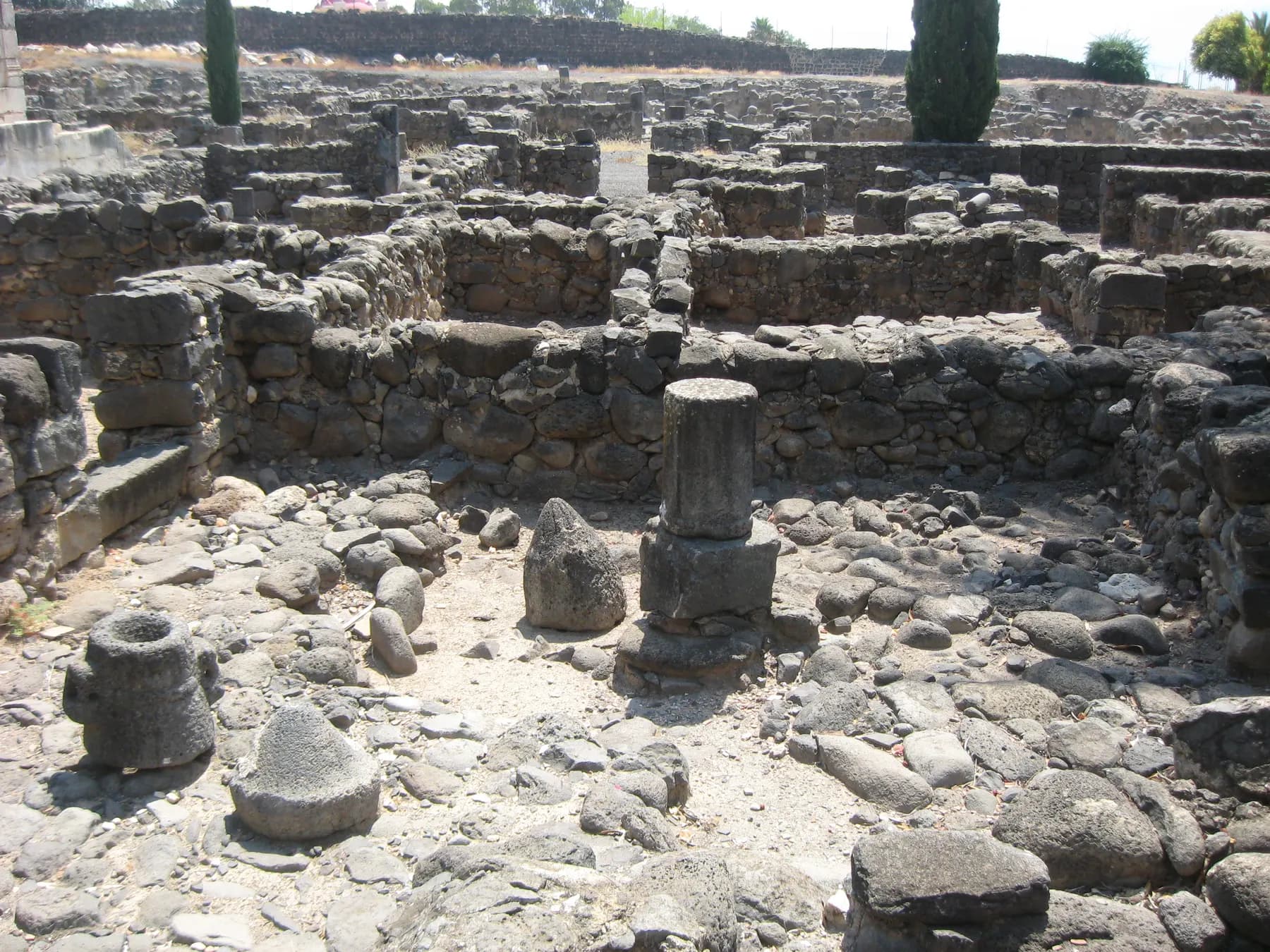
Two thirds of the ruined village belongs to the Franciscans, who finally got the title deeds on 19 September 1894 after eight years of Ottoman paperwork and have dug it in twenty-three seasons since 1968.
Commander, U.S. Naval Forces Europe-Africa/U.S. 6th Fleet / Public domain · Wikimedia Commons
Religious site
Mount of Beatitudes
Antonio Barluzzi gave the church eight sides for the eight beatitudes and set it on a hill about 25 metres below sea level, which makes the summit one of the lowest in the world.
Ovedc / CC BY-SA 4.0 · Wikimedia Commons
Archaeological site
Magdala
A guest house for pilgrims was going up here until the required salvage dig hit a synagogue from the time of the Second Temple in September 2009, and the buildings were redrawn around it.
Sources and further reading
Every link below was opened and checked when this page was written. Official statements are marked as such: they are the subject's own account, not an independent one.
- OfficialCustody of the Holy Landcustodia.orgTabgha
The Custody's own account and site plan: the Egeria text on the seven springs and the stone on which the Lord laid the bread, the church unearthed in 1932 by the Benedictine E. Mader, the Nilotic mosaics, the numbered plan listing the polygonal water tower Birket Ali Edh-Dhaher and the circular Hammam Ayyub, the sacred rock Mensa Christi, remains of the 4th to 5th century church, the rocky bench and steps mentioned by Egeria, and the six heart-shaped stones called Twelve Thrones dated to the Byzantine and Arab periods, 5th to 9th centuries, with the Primacy chapel rebuilt in 1933 and restored in 1982
- OfficialChristian Information Centre, Custody of the Holy Landcicts.orgOpening Hours of Holy Places and Tourist Sites in the Holy Land
The operator-side list in its edition dated 7 August 2026, and the source of every hour on this page: Tabgha Church of the Multiplication (Benedictine Priory), telephone 04 667 8100, tabgha@tabgha.net, temporary hours Monday to Saturday 9:00 to 15:00, closed Sundays; Tabgha Primacy of St Peter, telephone 04 672 4767, 8:00 to 17:00 with last entry at 16:30, closed Yom Kippur, 25 December and 1 January, mornings only during the Triduum and on 24 and 31 December. No entrance fee is printed against either, where Capernaum in the same document carries 10 ILS
- OfficialDeutscher Verein vom Heiligen Lande (German Association of the Holy Land)dvhl.dePriorat Tabgha
The landowner's own page: the property acquired in 1889, excavations forty years later revealing a Byzantine church of the 4th to 5th century with its mosaics, a temporary church in 1936 and the present church in 1982 in Byzantine style, the mosaic of two fish and a basket of four loaves beneath the altar, Benedictines from the Dormition Abbey as guardians since 1939 with Philippine sisters alongside them, and a new monastery built in 2012
- OfficialDeutscher Verein vom Heiligen Landedvhl.deBeit Noah
The encounter centre for young people and people with disabilities immediately beside the Church of the Multiplication, run by the association with barrier-free infrastructure, used as the basis for the accessibility note on this page
- ReportingPro Terra Sancta (Franciscan Association of the Holy Land)proterrasancta.orgThe miracle of the multiplication of the loaves
The basket of four loaves and two fish and the reading that the missing fifth is the one placed on the altar at Mass, and the statement that the famous floor was deliberately repositioned in front of the altar during the modern rebuilding, more prominently than it stood in the Byzantine church
- ReportingThe Times of Israeltimesofisrael.comSea of Galilee church where 'Jesus fed 5,000' torched in suspected hate attack
The fire in the early hours of Thursday 18 June 2015 with police alerted at 4am, damage mainly to the roof plus a book store, offices and an event hall, two people treated for smoke inhalation and released, the Hebrew graffiti quoting the Aleinu prayer in an entrance corridor, and the confirmation that the church structure and the fifth-century mosaics were not significantly damaged
- ReportingThe Times of Israeltimesofisrael.comJesus 'Loaves' church reopens 20 months after arson attack
The reopening on 12 February 2017 after eight months of work costing around one million dollars, of which the Israeli state paid nearly 400,000, and the attendance of President Reuven Rivlin, Cardinal Rainer Maria Woelki, the German ambassador Clemens von Goetze and Sheikh Muwaffaq Tarif
- ReferenceWikipedia (German)de.wikipedia.orgBrotvermehrungskirche
The fullest published account of the fabric: the 1889 purchase by the Palästinaverein der Katholiken Deutschlands, the 1892 survey, the 1932 and 1936 excavations under Alfons Maria Schneider and A. E. Mader for the Görres Society, the protective church of 1936, the tesserae running blue-black to white with blue and green absent, the four loaves and the fifth on the altar, the mosaics dated to the mid-4th century with the loaves-and-fishes panel at the start of the 5th, the 1980 to 1982 rebuilding by Anton Goergen and Fritz Baumann, the limestone from Taybeh, Italian tiles and German roof timber, the alabaster panes, Elmar Hillebrand's portal, the foundation stone laid by Giacomo Beltritti on 23 May 1980 and the consecration by Cardinal Joseph Höffner on 23 May 1982, and the destruction of the gate and southern atrium in the 2015 fire
- ReferenceWikipediaen.wikipedia.orgChurch of the Multiplication
The English summary, used for the chapel of about 350 by Joseph of Tiberias, Egeria's mention in 380, the enlargement of about 480 attributed to Patriarch Martyrius, the Persian destruction of 614, the mosaics as the earliest figurative church floor mosaics in the Holy Land, the Nilotic lotus, the surviving atrium sill, basalt paving and apse frieze, the glass panel over the 4th-century foundations, the basalt oil press and font, and the 1984 inauguration date that this page flags as contradicted by the German record
- ReferenceWikipediaen.wikipedia.orgTabgha
The etymology from Heptapegon through Tapego to Tabgha and the Hebrew Ein Sheva, Jerome's erêmos, the three Byzantine water towers and the aqueduct to the Ginosar plain, Burckhardt's mill and fishermen and Robinson's 1838 village, the 1922, 1931 and 1945 censuses giving 330 people on 5,389 dunams, and the depopulation on 4 May 1948 in Operation Broom under Yigal Allon's orders, citing Morris
- ReferenceWikipediaen.wikipedia.orgChurch of the Primacy of Saint Peter
The 1933 structure incorporating parts of a 4th-century church with its foundations visible at the wall base, the ninth-century name Place of the Coals, the Twelve Thrones first mentioned in 808, the destruction of the predecessor in 1263, the Mensa Christi and the dispute over which rock Egeria meant, and the visits of Paul VI in 1964 and John Paul II in March 2000
- ReferenceJewish Virtual Libraryjewishvirtuallibrary.orgArchaeology in Israel: Tabgha
The 4th-century chapel preceding a 5th-century complex of about 56 by 33 metres with workshops, monks' quarters and pilgrim accommodation, the naturalistic birds and plants of the floors, and the note that the mosaics were undamaged in the 2015 fire
- ReferenceWikipediaen.wikipedia.orgTyphlocaris galilea
The blind cave shrimp endemic to the Ein Nur octagonal pool on monastery land at Tabgha, fed by a warm spring of about 27 °C that is sulphurous and saline, listed as critically endangered because groundwater extraction alters the pool's chemistry and temperature, and the captive breeding programme begun in 2013 by the Israel Nature and Parks Authority with the Jerusalem Biblical Zoo
- ReferenceSee The Holy Land (Catholic Bishops' Conference resource)seetheholyland.netTabgha
Independent confirmation of the layout and distances: Tabgha about 3 km south-west of Capernaum, the warm sulphurous springs that draw fish to this stretch of shore, the basalt Primacy chapel under the Franciscans, and the basket of loaves flanked by two Galilee mullet in the Multiplication church floor
Tabgha: common questions
Is there an entrance fee at Tabgha?+
No fee is published for either church. The Custody of the Holy Land's list of opening hours, in its edition of 7 August 2026, prints an entrance fee of 10 ILS against Capernaum and none against the Church of the Multiplication or the Chapel of the Primacy of Saint Peter. Neither is a national park, so an Israeli parks pass is neither needed nor accepted.
What are the opening hours?+
The Church of the Multiplication is listed as open Monday to Saturday from 09:00 to 15:00 and closed on Sundays, described by the Custody as temporary hours. The Chapel of the Primacy of Saint Peter is open daily from 08:00 to 17:00 with last entry at 16:30. Older guides still print 08:00 to 17:00 for the Multiplication church, which is why it is worth checking the Custody's page before setting off.
Are the mosaics really from the fifth century?+
Yes, the pavements themselves are Byzantine and they are usually described as the earliest known figurative floor mosaics of Christian art in the Holy Land. The dating within that period is argued over: the German literature puts most of the floors in the middle of the fourth century and the loaves-and-fishes panel at the start of the fifth, while the standard English summary assigns the scheme to the enlargement of about 480.
Why does the basket have four loaves and not five?+
The usual explanation is that the fifth loaf is the one consecrated on the altar above the mosaic, so the image is completed by the Mass rather than by the tesserae. Pro Terra Sancta gives that reading, and the German literature on the church repeats it. It is an interpretation of the design, not a recorded statement by whoever laid it.
How much of the church is original?+
The floors are, and stretches of the black basalt walling are, but the building over them was put up between 1980 and 1982 by the Cologne architects Anton Goergen and Fritz Baumann, on the fifth-century foundations and to the same plan. The rock under the altar and the loaves-and-fishes mosaic were moved forward into their present prominent position during that rebuilding.
Was the church burned down in 2015?+
It was set on fire but it did not burn down, and the mosaics were unharmed. The fire in the early hours of 18 June 2015 ran mainly on the roof and destroyed the gate and southern atrium, with damage to a book store, offices and an event hall; two people were treated for smoke inhalation. The complex reopened on 12 February 2017 after eight months of repairs.
How long do I need at Tabgha?+
About an hour covers both churches at a reasonable pace, including the walk between them and the shore below the Primacy chapel. Thirty minutes is enough if you only want the mosaics. Groups celebrating Mass should allow longer and book ahead.
Is Tabgha the same place as Capernaum or the Mount of Beatitudes?+
No, they are three separate sites within a few kilometres of each other on the same shore. Capernaum, the Franciscan village site with the white synagogue, is about 3 km up the road and charges 10 ILS. The Mount of Beatitudes is the hill immediately above Tabgha, with its own church and its own hours.
Can you get down to the water?+
Yes, at the Primacy chapel, where rock-cut steps run from the shore into the lake and are identified with the steps the pilgrim Egeria described. It is a place people come to pray and to put their hands in the water rather than a bathing beach, and the footing on wet basalt is poor.
Is it wheelchair accessible?+
The Multiplication church largely is: the ground is flat, there is no climb from the car park, and the mosaics are at floor level. The Primacy chapel is harder, sitting below the road with a sloping approach, uneven basalt and steps to the water. Neither church publishes an access statement, so telephone ahead on 04 667 8100 or 04 672 4767.