Archaeological site · Jaffa
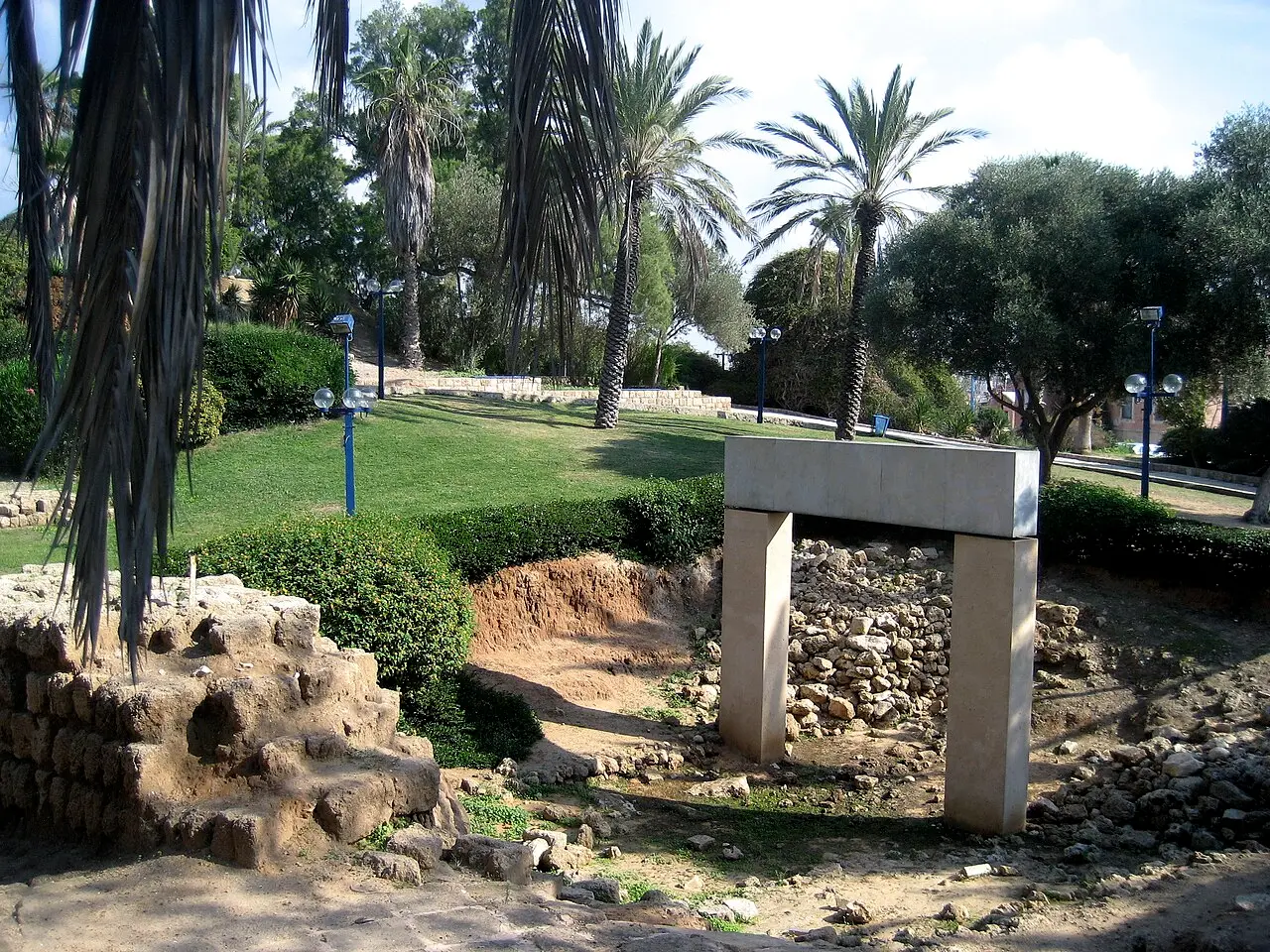
Ramses II Gate Garden
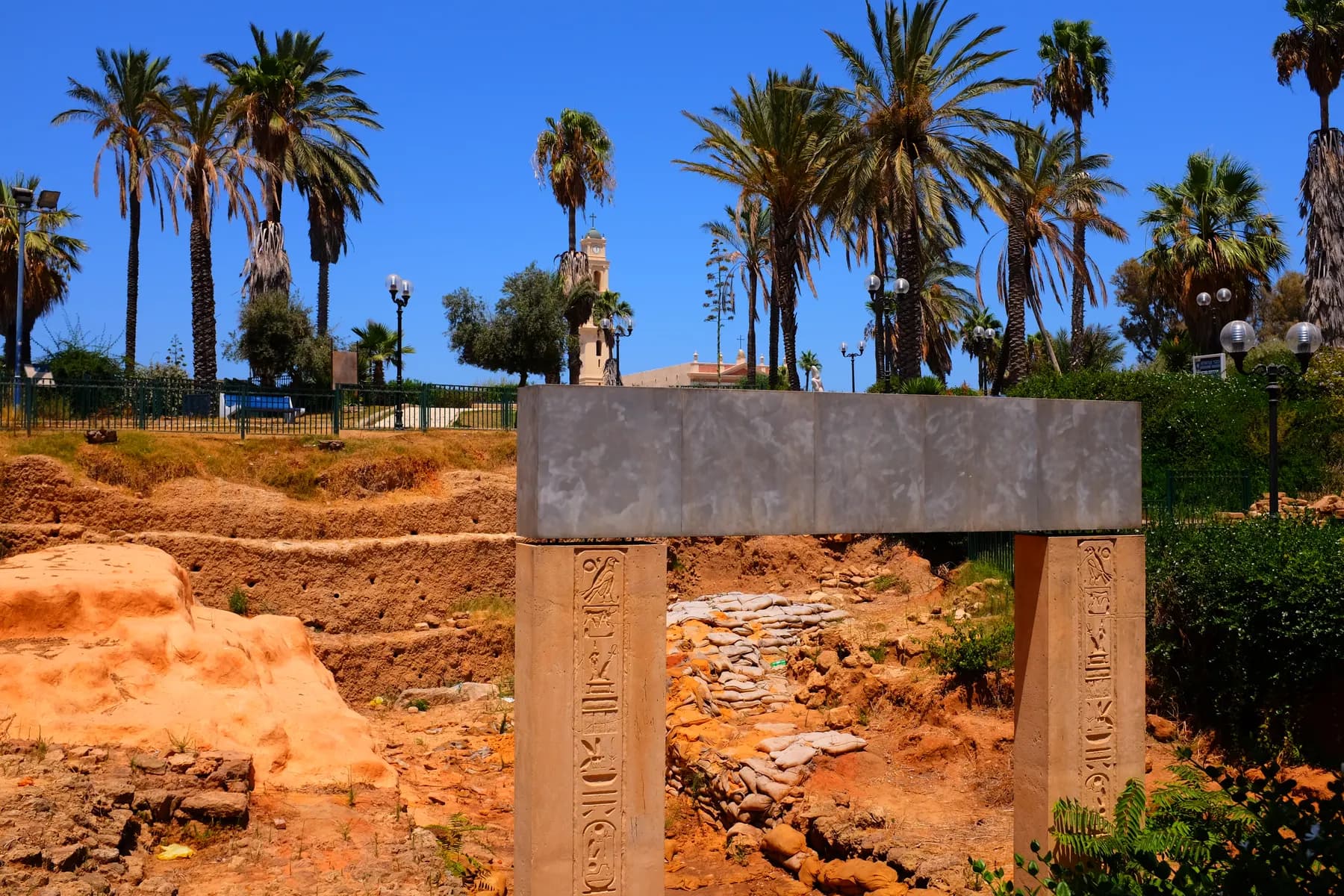
The inscribed portal standing in this excavation is a concrete reconstruction the Israel Antiquities Authority raised in the 1990s; the kurkar blocks that carried the titles of Ramesses II are in the Jaffa Museum of Antiquities.
leighklotz / CC BY 2.0 · Wikimedia Commons
The gate passage
about 18 by 4 m
the only dimension Jacob Kaplan ever published for the Egyptian gateway, quoted in the 2017 field report on the site
Kaplan's seasons here
1955–1962
the excavation of Area A that found the gate and gave it its name, on ground the British had cleared in 1936
Facade recovered
under half
the share of the Ramesses II portal that Kaplan's excavations produced, and none of it found standing
What you photograph
1990s concrete
the Israel Antiquities Authority reconstruction of the facade, identified as such in the American Journal of Archaeology in 2017
In short
- How long to give it
- about 20 minutes for the excavation itself, or about an hour taking in HaPisga Garden, the Statue of Faith and the view from the summit
- The excavation and the garden
- Open at all hours. There is no gate, no attendant and no closing time: the municipality treats the site as station ten on its free self-guided Old Jaffa route, inside a public park, rather than as an attraction with opening times.
- The gate garden
- No charge. There is no ticket desk and no perimeter anywhere on this part of the hill; the site is listed among Old Jaffa's free attractions and sits inside a municipal park.
גן שער רעמסס
The Ramses II Gate Garden is a small open excavation at the south-eastern foot of HaPisga Garden in Old Jaffa, and the tall inscribed portal that everyone photographs in it is not ancient. It is a concrete reconstruction of the gate facade of Ramesses II, raised by the Israel Antiquities Authority in the 1990s and identified as such, in passing and without ceremony, in the caption to an aerial photograph in the 2017 field report on the site. The Tel Aviv-Yafo municipality says the same thing more briefly at station ten of its own Old Jaffa walking route: the gate is a reconstruction, and the original stones are in the Jaffa Museum of Antiquities down the hill.
What is genuine lies under and around it. This is the eastern half of Area A of Tel Yafo, where Jacob Kaplan dug from 1955 to 1962 and found the gateway of an Egyptian fortress: mudbrick towers on stone foundations, a passage he measured at roughly 18 by 4 metres, a threshold of large boulders, and a roadway sloping away to the south-east. The Jaffa Cultural Heritage Project reopened the same ground from 2011 to 2014 and published it in the American Journal of Archaeology in January 2017, in a field report by Aaron Burke, Martin Peilstöcker and thirteen colleagues.
Ten minutes covers the visible remains. The reason to stop is what came out of them: a two-storey gatehouse whose ceiling beams were still lying where they fell, the antlers of thirty-two deer strewn along the passage floor, a 30 kg bronze door hinge full of charred wood, and a radiocarbon sequence that its excavators argue gives the clearest date yet for the end of Egyptian rule in Canaan.
The facade
The gate in the garden is concrete
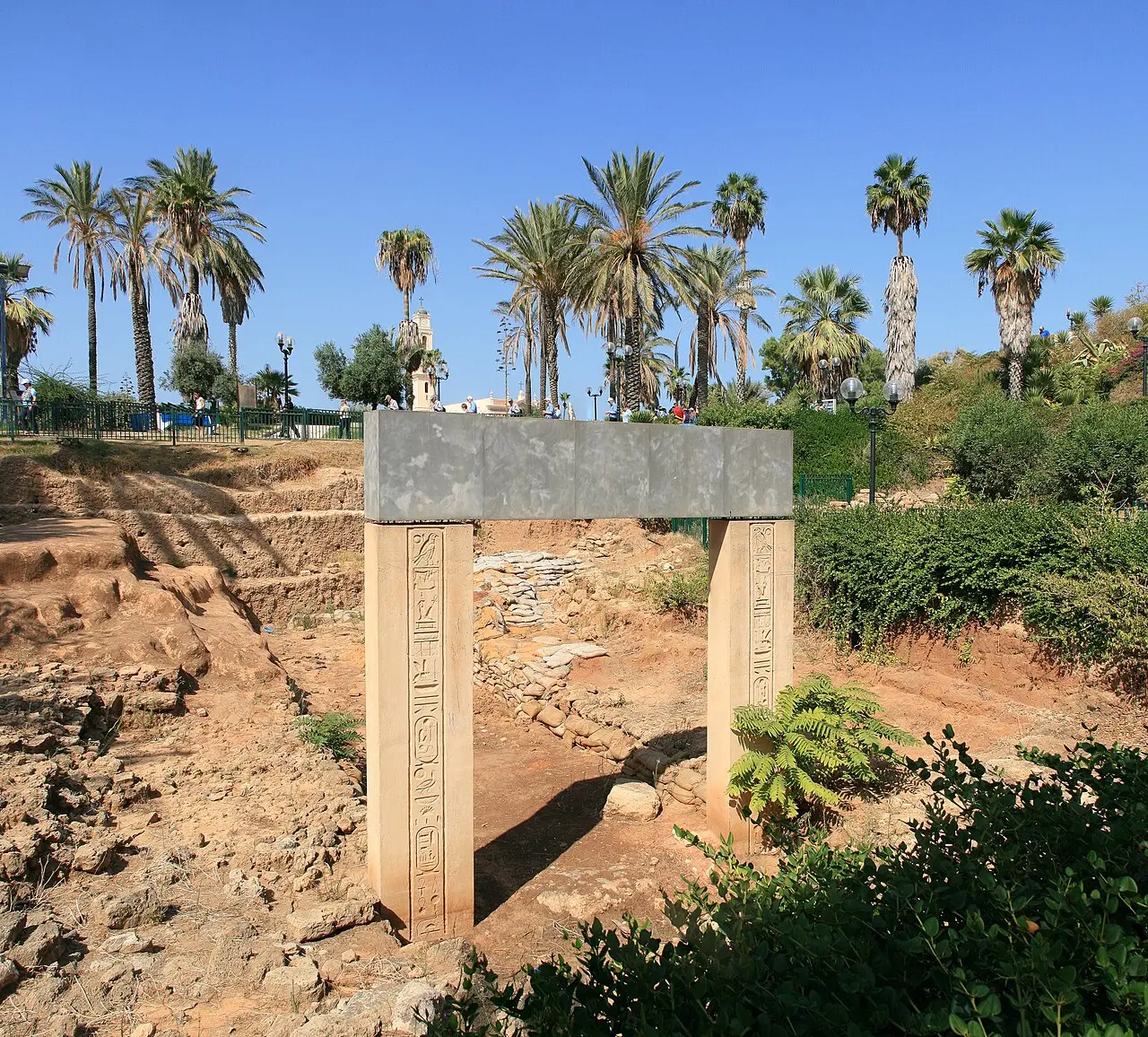
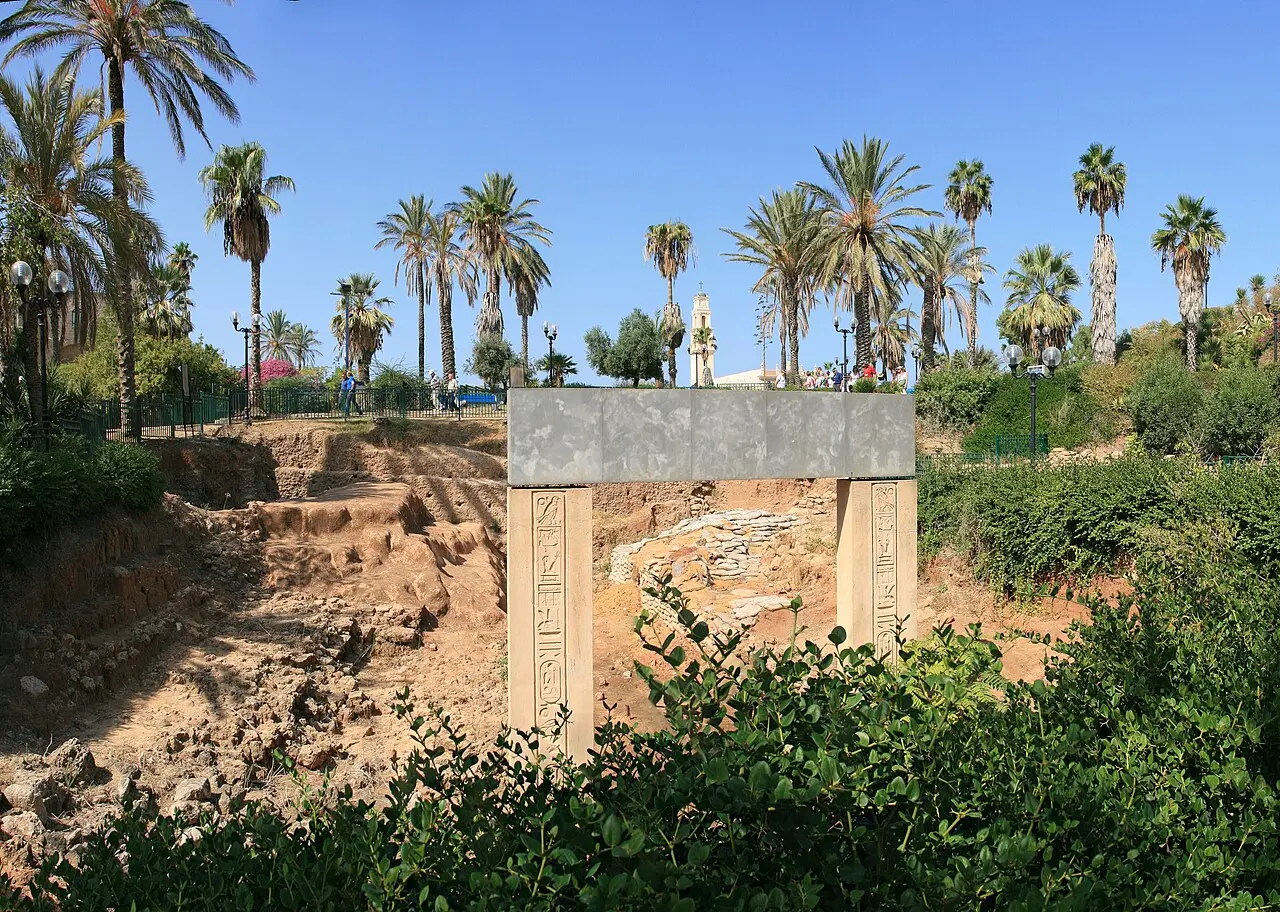
Two sources agree on this and neither makes a fuss about it. The 2017 field report prints an aerial view of the excavation after the 2013 season and notes, in the caption, the concrete reconstruction by the Israel Antiquities Authority of the Ramesses II facade, from the 1990s, standing at the right of the frame. The municipality's audio route calls the structure a reconstruction of the original and sends visitors to the antiquities museum on Mifraz Shlomo Street for the stones themselves.
It is worth understanding why a replica was the only option. Kaplan recovered slightly less than half of the monumental facade, and he did not find any of it in place. The inscribed blocks turned up reused as ordinary building material in the gate that was put up after the one they had decorated burned down, which is how Kaplan dated the earlier gate to Ramesses II in the first place. There was never a standing portal here to conserve, and the reconstruction is a drawing turned into concrete rather than a repair.
The original fabric is the low material the replica sits above. The mudbrick of the tower walls, the stone plinths identified on both sides of the entryway, the boulders of the later threshold that Kaplan left in the eastern part of the passage, and the sloping roadway leading out to the south-east are all excavated remains. They are grey, waist-high and easy to walk past, which is exactly what most visitors do.
- Concrete facade: Israel Antiquities Authority, 1990s
- Inscribed originals: Jaffa Museum of Antiquities, Mifraz Shlomo Street
- Excavated in place: mudbrick towers, plinths, threshold boulders, roadway
- Facade fragments recovered by Kaplan: slightly less than half, none of it in situ
Ludvig14 / CC BY-SA 4.0 · Wikimedia Commons
Titulary
What the pharaoh's gate actually said
The blocks were cut from kurkar, the local wind-cemented sandstone the headland is made of, carved with hieroglyphs, plastered with lime and painted in yellow and red. The field report calls them the most conspicuous artefacts from New Kingdom Jaffa recovered to date, which is a careful way of saying nothing else found here looks remotely as imperial.
The text is a royal titulary rather than a narrative. Roger Atwood, writing in Archaeology in July 2017, gives it as: Horus-Falcon, Strong Bull, Beloved of Maat, King of Upper and Lower Egypt, Usermaatre Setepenre, Son of Re, Lord of Crowns, Ramesses. The municipality's route describes the same thing from the other end, as three of the pharaoh's five names set out with their titles. Aaron Burke's summary of the effect, quoted in the same article, is that the gate said to everyone who came, this is Egypt.
The dating that follows from it is looser than tour patter suggests. Kaplan attributed the gate to Ramesses II on the strength of these blocks, and the renewed excavation confirmed the association. But the field report points out that the facade could have been added to a gateway already standing, so the construction may fall in the late fourteenth or early thirteenth century rather than in the reign itself. The excavators therefore use a provisional date of about 1300 BCE and say plainly that there is no way to be certain at present. Guides here round the whole thing to 3,300 years old.
1955–1974
The dig that was never written up
The ground is open at all because of a demolition. Kaplan's Area A was diggable in 1955 as a result of the British military's Operation Anchor of 1936, which led to the abandonment of much of Jaffa's old city, and it remains available today because Kaplan worked to limit construction on the mound. Every archaeologist who has since dug on this hill has been standing in a hole made by sappers.
He began in 1955 and hit the first evidence of the Egyptian fortress in 1956. He held the post of municipal archaeologist of Tel Aviv-Jaffa from 1955 to 1974, and in all that time the Ramesses Gate produced only a series of very short preliminary notes in the Israel Exploration Journal. His abrupt removal from the post in 1974 followed a change in Tel Aviv's mayors and restricted his access to the finds he needed for a final publication, which is why no plan of the gateway was ever published in his lifetime.
The recovery of that work is a second, slower story. The Kaplan legacy archive, covering more than thirty sites, was deposited with the Israel Antiquities Authority in 1999, the same year Tel Aviv University's soundings on the tell came to an end. The Jaffa Cultural Heritage Project was founded in 2007 as a partnership with the Antiquities Authority, worked out that Kaplan's records could be reconstructed into usable stratigraphy, and reopened the gate itself from 2011 to 2014. Roughly ten metres of the passageway had never been dug at all.
One episode from Kaplan's seasons is worth carrying up the hill with you. In 1956 he exposed the eastern threshold and found, lying in the ash on its southern side, one of the two bronze hinges of the final gate, weighing 30 kg and still oriented as it had been when the doors burned. It was packed with the charred remains of a door no less than 20 cm thick, the nails still protruding from its bronze casing. Within days of its excavation the hinge was stolen, apparently for its weight as scrap metal. The object displayed in the Jaffa Museum is a facsimile made from the preliminary drawings and photographs.
- 1936: Operation Anchor clears the ground Kaplan later digs
- 1955–1962: excavation of the Ramesses Gate in Area A
- 1974: Kaplan removed as municipal archaeologist; no final report follows
- 1999: the Kaplan archive is deposited with the Israel Antiquities Authority
- 2011–2014: the Jaffa Cultural Heritage Project reopens the gate
Ludvig14 / CC BY-SA 4.0 · Wikimedia Commons
Twelfth century
Two fires, and the end of Egyptian Canaan
The gate was destroyed twice in the second half of the twelfth century BCE, rebuilt in between to the same plan, and then not rebuilt again. The renewed excavation dated both events with short-lived botanical samples: grain and olive pits from the floor of the earlier gate, sealed under its collapse, and grain from floors, occupation debris and a storage jar caught on the floor of the last one. Twenty-one samples were run at two laboratories, the Keck accelerator facility at the University of California, Irvine and the Oxford Research Accelerator Unit, and modelled in OxCal against the IntCal13 curve.
The results are unusually tidy. No sample qualified as an outlier under the model's own test. The earlier destruction falls most probably between 1142 and 1125 BCE, the intermediate phase ends most probably between 1134 and 1115 BCE, and the final destruction, which has no later dated context to bracket it, most probably falls between 1127 and 1098 BCE. That last conflagration put an end to Egyptian habitation at Jaffa. The excavators argue that these dates give the clearest basis yet for about 1125 BCE as a terminus post quem for the end of Egyptian rule in Canaan.
Who did it is where the argument sits. The field report reads the sequence as local resistance to the Egyptian garrison, probably organised from Canaanite centres across the coastal plain, rather than as one imperial collapse arriving from outside; it names Gezer as a plausible coordinator of an earlier attack on the gate. Kaplan himself changed his mind more than once, putting the earlier destruction in the third quarter of the thirteenth century in one account and attributing it to Sea Peoples who occupied the Jaffa area in another. The claim that gives Jaffa its weight in this debate is a negative one: no other Egyptian fortress in Canaan has been excavated, so there is nothing to check it against.
Alistair from Montreal, Canada / CC BY-SA 2.0 · Wikimedia Commons
The floor
Antlers, arrowheads and two dozen beams
The 2013 season reached the floor of the passageway beneath the collapse, and what lay on it changed the reading of the building. There were several arrowheads and what may be a spearhead, and a lead weight, which is the expected furniture of a gate taken by assault. There were also the antlers of at least thirty-two deer, whole and carefully cut, strewn along the southern side of the passage: not weaponry but stock, evidence that a trade in antler tools and raw material was carried on inside the gateway. Decorative ivory inlays came off the same floor.
So did thousands of burnt seeds. Barley, emmer and free-threshing wheat, olive pits, grape pips, chickpeas, lentils, grass peas, broad beans, vetch and pistachios were recovered directly from the surface along the whole excavated length, and not one seed came from the thick destruction debris of the upper storey above it. The excavators take that distribution to mean the produce was standing in the gateway in sacks or baskets when the roof came down, rather than being stored overhead. The grains were uncrushed and lay in sorted heaps by type.
The collapse itself yielded about two dozen beam and plank segments from the ceiling, roof and second-storey floor, in cedar of Lebanon, oak and olive wood. The field report calls them the largest group of timbers recovered from Late Bronze Age contexts in Israel to date. Taken together the finds describe a gate that was a market and customs point as much as a defence, which fits what Egyptian sources expect of a harbour base: a place that monitored the passage of people and goods, collected tariffs and stored supplies.
- Antlers of at least 32 deer, whole and cut, along the south side of the passage
- Arrowheads, a probable spearhead, a lead weight and ivory inlays
- Thousands of burnt seeds in sorted heaps, all from the floor and none from the collapse
- About two dozen timbers of cedar, oak and olive from the roof and upper storey
HaPisga
The park the excavation sits in
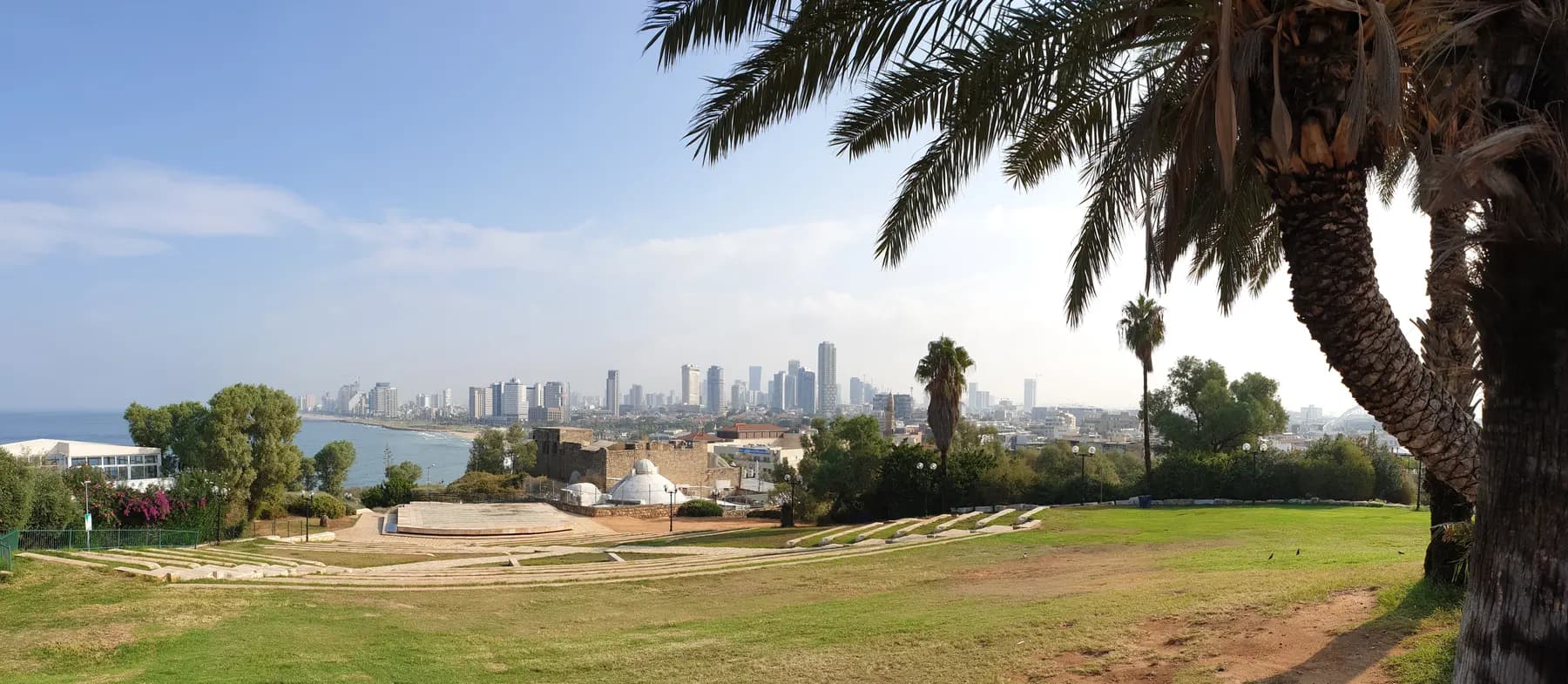
The gate garden is not a separate attraction with a boundary of its own. It occupies the lower, south-eastern part of HaPisga Garden, the terraced park on the summit and northern slope of the Old Jaffa headland that the municipality lays out as station eight of the same walking route, and which is also signposted as Abrasha Park. The municipality calls the summit the highest point in Old Jaffa, and the view from the top takes in the sea, the front of St Peter's Church and the Tel Aviv shoreline as far as Neve Tzedek.
The park is a piece of 1960s municipal design rather than an old garden. The Tel Aviv Hotel Association's visitor service describes it as laid out by the municipality in that decade as part of the plan to renovate the old city. The white arch on the crest above the excavation is the Statue of Faith by Daniel Kafri, its three carved elements showing the fall of Jericho, the binding of Isaac and Jacob's dream. It is the most photographed object on the hill and it has nothing to do with the gate below it.
Practically, this means the excavation is reached on foot from inside a public park, from Kedumim Square over the wishing bridge or up from the port, and that nothing here is ticketed. It also means no interpretation desk, no attendant and no gate: the signage is the municipality's, and the audio commentary on the city's own route is the fullest free explanation on the spot.
Alistair from Montreal, Canada / CC BY-SA 2.0 · Wikimedia Commons
What to look for
Things not to walk past at Ramses II Gate Garden
The details that repay knowing about before you are standing in front of them.
The concrete facade
The standing inscribed portal is an Israel Antiquities Authority reconstruction from the 1990s, raised above the excavated foundations. Read it as a diagram of the gate rather than as the gate.
The threshold boulders
The large stones in the eastern part of the passage are the threshold of the later gate, left in place by Kaplan when he dug the earlier one beneath. It was here, in 1956, that he found the burnt bronze door hinge.
The mudbrick towers
The low brickwork on either side of the passage is the real fabric of an Egyptian gatehouse, rebuilt at least twice on the same plan. Grey bricks in the later phase were made from occupation debris with a high ash content.
The sloping roadway
The surface running out to the south-east from the threshold is the approach road, exposed by Kaplan in 1962. It shows how far the fortress entrance stood above the ground outside it.
The Statue of Faith above
Daniel Kafri's white arch on the crest of HaPisga Garden carries the fall of Jericho, the binding of Isaac and Jacob's dream. It is a 20th-century sculpture and is regularly mistaken in photographs for part of the ancient site.
The originals, indoors
The inscribed kurkar blocks, the restored Cypriot pithos from the destruction and a facsimile of the stolen bronze hinge are all in the Jaffa Museum of Antiquities on Mifraz Shlomo Street, a few minutes downhill.
The long view
Ramses II Gate Garden, in order
c. 1460 BCE
Egyptian control begins at Jaffa, opening the roughly three and a half centuries of New Kingdom presence that the fortress excavation documents.
c. 1300 BCE
The provisional construction date the excavators use for the gate that carried the Ramesses II facade, acknowledging that the inscribed front may have been added to an older gateway.
1142–1125 BCE
The most probable range for the first of the two destructions, from the radiocarbon model published in 2017. The gate is rebuilt to the same plan.
1127–1098 BCE
The most probable range for the final destruction, which ends Egyptian habitation at Jaffa. The gate is not rebuilt.
1936
The British Operation Anchor demolitions lead to the abandonment of much of Jaffa's old city, leaving the ground on the mound open.
1955
Jacob Kaplan opens Area A on the south-eastern side of the mound as municipal archaeologist of Tel Aviv-Jaffa.
1956
Kaplan reaches the first evidence of the Egyptian fortress and exposes the eastern threshold, with a 30 kg bronze door hinge lying in the ash. The hinge is stolen within days.
1962
Kaplan's last season in the gate. The passage plan is never published, and about ten metres of it is never dug.
1974
Kaplan is removed as municipal archaeologist after a change of mayor, losing the access to the finds that a final report needed.
1990s
The Israel Antiquities Authority erects the concrete reconstruction of the Ramesses II facade that stands in the garden today.
1999
The Kaplan legacy archive is deposited with the Israel Antiquities Authority. Tel Aviv University's soundings on the tell end in the same year.
2007
The Jaffa Cultural Heritage Project is founded as a partnership between UCLA's Cotsen Institute and the Israel Antiquities Authority.
2011–2014
The project reopens the Ramesses Gate, completes the plans of the gate phases and takes the samples for the radiocarbon sequence.
January 2017
The field report appears in the American Journal of Archaeology, volume 121, pages 85 to 133, under fifteen authors.
Practical
Visiting Ramses II Gate Garden
Where
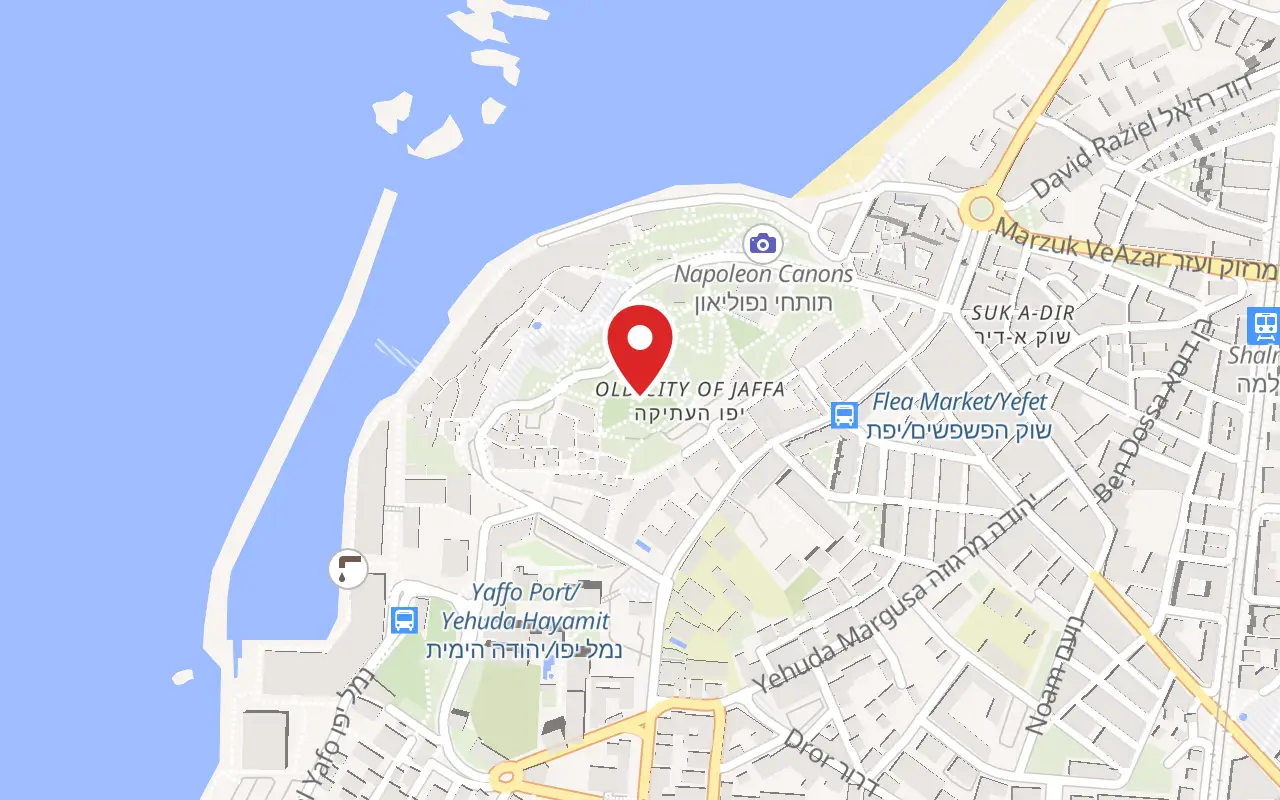
HaPisga Garden (Abrasha Park), Old Jaffa, Tel Aviv-Yafo
What ticket you need
The gate garden lies inside HaPisga Garden, also signposted as Abrasha Park, which is a free municipal park with no ticket, no gate and no closing time. Nothing on this part of the hill is ticketed. The Jaffa Museum of Antiquities, where the inscribed blocks from this excavation are kept, is a separate ticketed building a few minutes downhill on Mifraz Shlomo Street.
Opening hours
- The excavation and the garden
- Open at all hours. There is no gate, no attendant and no closing time: the municipality treats the site as station ten on its free self-guided Old Jaffa route, inside a public park, rather than as an attraction with opening times.source
- The tourist information centre in Kedumim Square
- Published by the Old Jaffa Development Company as 09:00 to 20:00 Sunday to Thursday and Saturday, and 09:00 to 17:00 on Friday, on the visitor information page carrying its telephone numbers 03-6037700 and 03-6037686. Ring before relying on it.source
- The Jaffa Museum of Antiquities
- Where the inscribed originals are. No hours are quoted here; ask at the tourist information centre in Kedumim Square on the day.source
Admission
- The gate garden
- No charge. There is no ticket desk and no perimeter anywhere on this part of the hill; the site is listed among Old Jaffa's free attractions and sits inside a municipal park.source
- HaPisga Garden and the walking route
- No charge. The municipality's twenty-one-station audio route, which covers both the garden and the gate, is free through the city's website and mobile application.source
- The Jaffa Museum of Antiquities
- Ticketed separately by the Old Jaffa Development Company, which sets the price; this page does not quote one.source
Access
Mixed, and the honest answer is that the excavation itself is not step-free. HaPisga Garden is a terraced 1960s park on the steepest part of the Jaffa headland: its upper paths are paved and sloped, but the descent from the summit towards the gate area at the south-eastern foot involves steps, and the excavated surface is uneven ancient stone, brick and gravel rather than a made path. Much of the site can be seen from the paved level above it, which is the practical answer for anyone on wheels. The approach from Kedumim Square over the wishing bridge is the gentlest of the routes in; the climb up from Jaffa Port is the hardest. No step-free route to the excavation floor is published by the operator, and the site should not be assumed to have one.
On site
- Municipal interpretation signs at the excavation
- Free audio commentary on the city's Old Jaffa route
- Benches and shade trees in HaPisga Garden above
- Viewpoint over the sea and the Tel Aviv shoreline
- Statue of Faith by Daniel Kafri on the crest
- Wishing bridge to Kedumim Square
- Tourist information centre in Kedumim Square
- Jaffa Museum of Antiquities on Mifraz Shlomo Street
Booking
Nothing here needs booking, and there is no operator to book with: the excavation is unstaffed public ground. Load the municipality's audio route before arriving, since there is no interpretation on site beyond the signage.
Hours and prices are given as the operator publishes them and change without much notice, particularly around Shabbat and the festivals. Check the operator's own page before you travel for this.
Official page at oldjaffa.co.il →What people wish they had known
- The gate you photograph is concrete. Visitors routinely come away believing they have seen an inscribed Egyptian portal; the standing facade is an Israel Antiquities Authority reconstruction from the 1990s, and the carved kurkar blocks are indoors at the Jaffa Museum of Antiquities.
- Go to the museum on the same trip or the site will not make sense. It is a few minutes downhill on Mifraz Shlomo Street and holds the inscribed fragments, the restored Cypriot storage jar from the destruction and the facsimile of the stolen bronze hinge.
- Do not look for a fortress. Only the gate area of Area A has been excavated, the rest of the Egyptian compound lies under the modern old town, and roughly ten metres of the gate passage itself has never been dug.
- Treat the round number with suspicion. The signs and the guides say 3,300 years; the excavators use a provisional date of about 1300 BCE for the gate and say openly that the inscribed front may have been added to an older structure.
- Come down to the excavation rather than up to it. From Kedumim Square the wishing bridge and the garden path bring you in from above, which is the gentle direction; the climb from Jaffa Port is the one people regret in the afternoon.
- There is almost no shade on the excavation itself. The trees are up in HaPisga Garden, the dig is open gravel and stone, and in summer this is a mid-morning or late-afternoon stop.
The figures
Ramses II Gate Garden by the numbers
Each figure carries the year it belongs to and links the source it came from.
| Measure | Figure | As of | Source |
|---|---|---|---|
| Gate passage | approximately 18 m long by 4 m wide, the only dimension Kaplan published for it | 2017 | ajaonline.org |
| Area of the fortress the gate served | about 2 hectares | 2017 | ajaonline.org |
| Facade recovered by Kaplan | slightly less than half of the original portal, all of it found reused in the following gate rather than in place | 2017 | ajaonline.org |
| Bronze door hinge from the final gate | 30 kg, found in 1956 in ash beside the eastern threshold, filled with charred wood from a door no less than 20 cm thick; stolen within days and now shown as a facsimile | 2017 | ajaonline.org |
| Antlers on the passage floor | from at least 32 deer, whole and cut, indicating a trade in antler tools inside the gateway | 2017 | ajaonline.org |
| Timbers from the collapse | about two dozen beam and plank segments of cedar of Lebanon, oak and olive, called the largest such group from Late Bronze Age contexts in Israel to date | 2017 | ajaonline.org |
| Radiocarbon samples | 21, run at UC Irvine and Oxford and modelled in OxCal against IntCal13; none qualified as an outlier | 2017 | ajaonline.org |
| Most probable destruction ranges | 1142–1125 BCE for the earlier gate and 1127–1098 BCE for the last one, with about 1125 BCE proposed as a terminus post quem for the end of Egyptian rule in Canaan | 2017 | ajaonline.org |
While you are here
The rest of Jaffa
Everything else in this destination with a page of its own.
Anagoria / CC BY 3.0 · Wikimedia Commons
Viewpoint
HaPisga Garden (Abrasha Park)
The lawns on top of Old Jaffa are not old: they are the ground left empty after the British blew a quarter of the town apart in June 1936, laid out as a public garden under a 1956 plan and planted by Tel Aviv's city gardener Avraham Karavan, whose nickname Abrasha the park still carries.
Fallaner / CC BY-SA 4.0 · Wikimedia Commons
Landmark
Kedumim Square
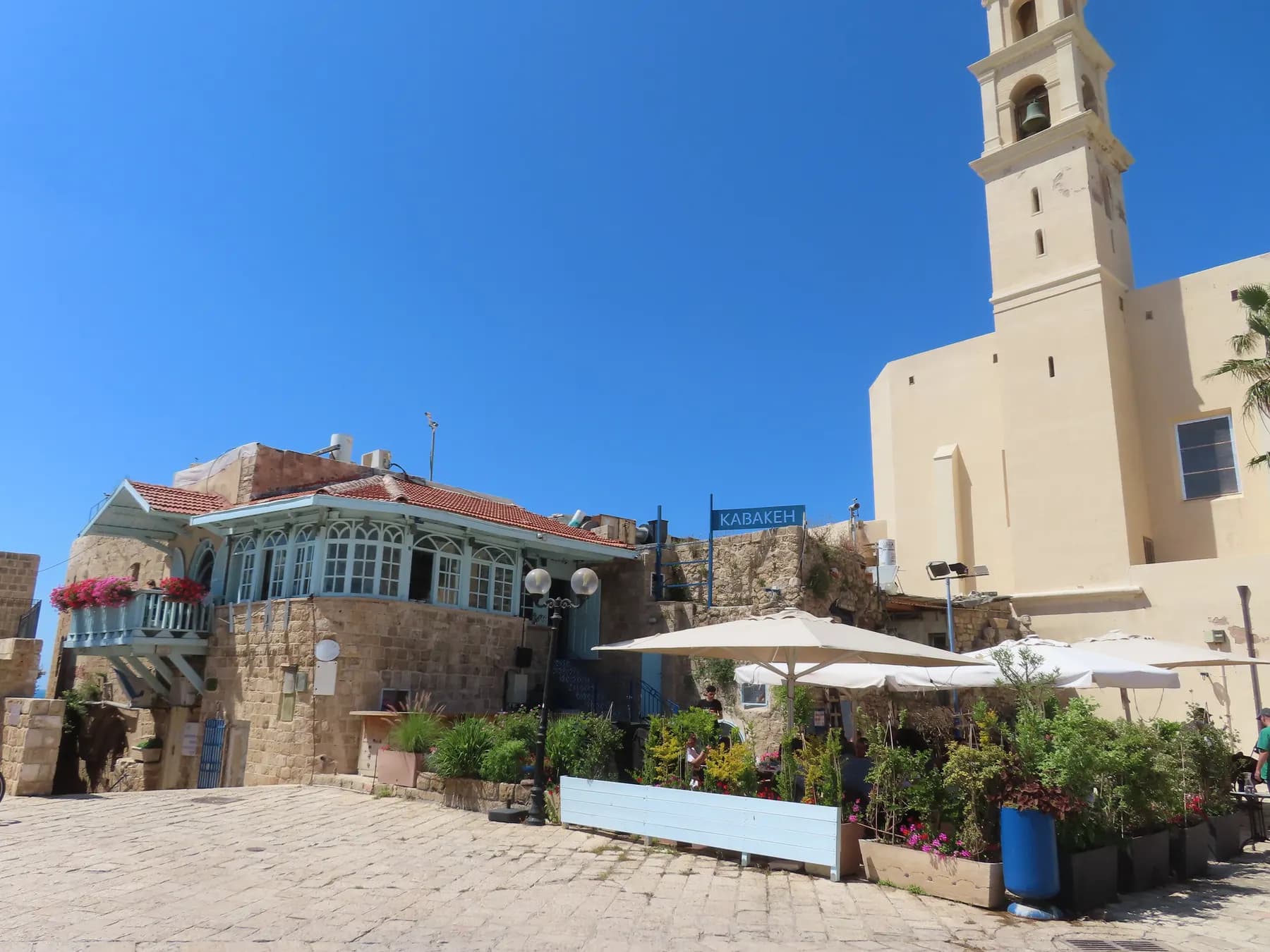
The flagged main square of Old Jaffa is a space the British made by demolition in June 1936, and the Israel Antiquities Authority excavation under its fountain found the drains of one of the houses that came down.
שלמה רודד / CC BY 2.5 · Wikimedia Commons
Religious site
St Peter's Church
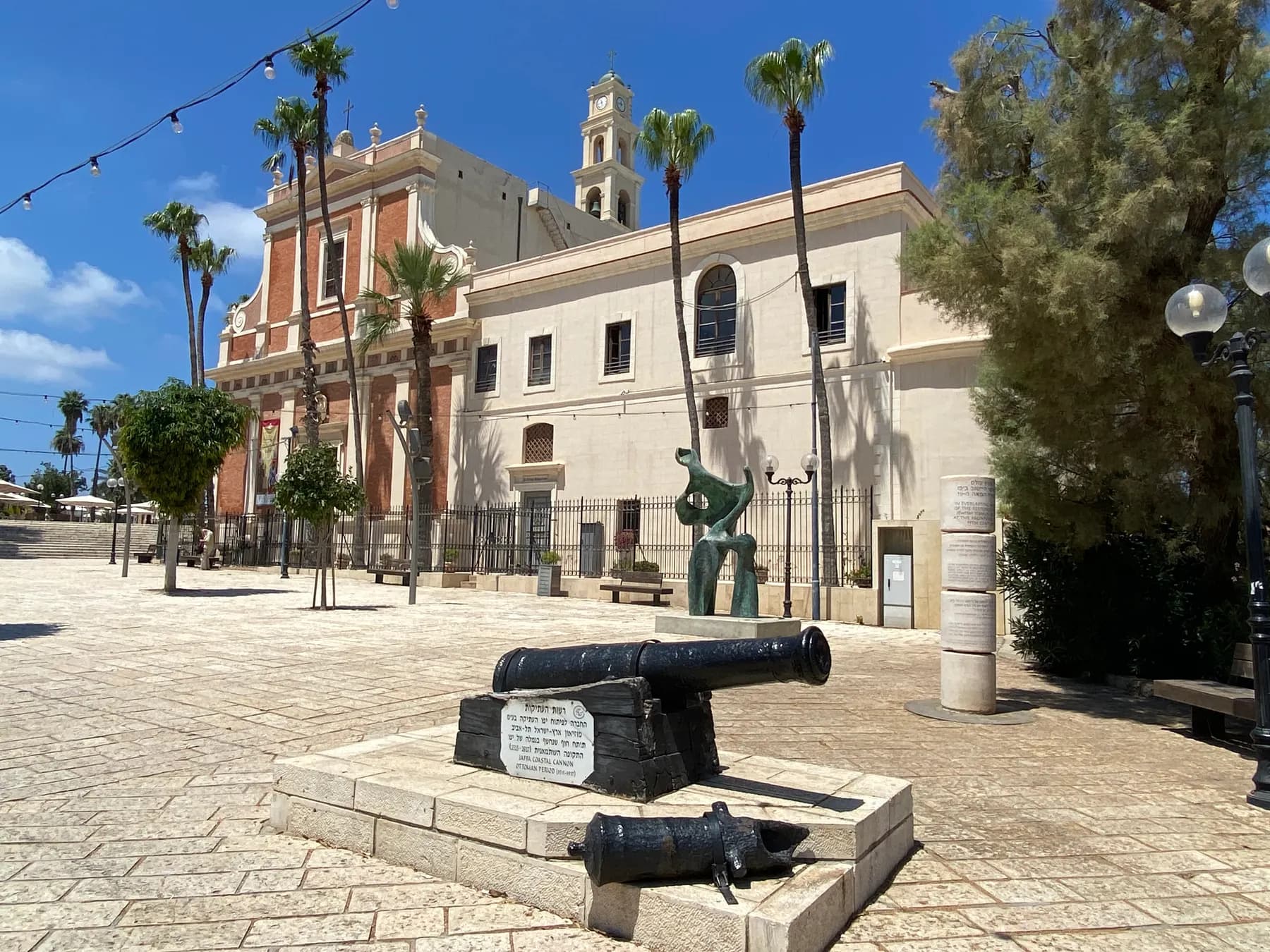
The Custody of the Holy Land runs this as a shrine rather than a parish: a Spanish-funded church of 1888 to 1894 standing on the citadel Louis IX rebuilt, with an altar that faces west instead of east.
Sources and further reading
Every link below was opened and checked when this page was written. Official statements are marked as such: they are the subject's own account, not an independent one.
- OfficialThe Old Jaffa Development Company Ltdoldjaffa.co.ilOld Jaffa Development Company
The operator of the Old Jaffa complex, including the Jaffa Museum of Antiquities where the inscribed gate blocks are kept. No current hours or shekel prices are quoted from it here
- OfficialTel Aviv-Yafo Municipalitytel-aviv.gov.ilOld Jaffa and Jaffa Port walking route, stations 8 and 10
The city's free twenty-one-station audio route. Station 10 is the Ramesses II gate, described as the entrance gate of an Egyptian fortress of about 3,300 years ago in the archaeological tel at the foot of HaPisga Garden, carrying three of the pharaoh's five names with their titles, with the standing structure stated to be a reconstruction and the original stones stated to be in the Jaffa antiquities museum. Station 8 is HaPisga Garden, called the highest point in Old Jaffa, with the Gate of Faith sculpture by Daniel Kafri showing the conquest of Jericho, the binding of Isaac and Jacob's dream
- OfficialCotsen Institute of Archaeology, University of California, Los Angeles (24 October 2016)ioa.ucla.eduPreviously unknown Canaanite revolt against Egypt revealed in ancient Jaffa
The excavating institution's own announcement of the finding, that the Canaanites at Jaffa ousted their Egyptian rulers. Brief, and carried here as the excavators' own framing of the result rather than for any figure
- OfficialVisit Tel Aviv (Tel Aviv Hotel Association)visit-tel-aviv.comOld Jaffa: Meet the Old City
The visitor service's account of Pisgah Park as designed by the Municipality of Tel Aviv-Jaffa in the 1960s as part of its plan to renovate the old city, which is the context the excavation sits in
- OfficialThe Old Jaffa Development Company Ltdrotemm5.wixsite.comOld Jaffa visitor information
The company's visitor information page, giving the tourist information centre hours as 09:00 to 20:00 Sunday to Thursday and Saturday and 09:00 to 17:00 on Friday, with telephone 03-6037700 and 03-6037686 and the address tourism@oldjaffa.co.il
- ReportingArchaeology, July/August 2017 (Roger Atwood), Archaeological Institute of Americaarchaeology.orgEgypt's Final Redoubt in Canaan
The magazine feature on the excavation and the source for the wording of the inscription: Horus-Falcon, Strong Bull, Beloved of Maat, King of Upper and Lower Egypt, Usermaatre Setepenre, Son of Re, Lord of Crowns, Ramesses. Also describes the gate as two mudbrick towers joined by a wide two-storey wooden bridge forming a covered passage, Kaplan's recovery of the facade fragments around 1960, the partly melted deer antlers, the mudbricks reddened as if kiln-fired, and Aaron Burke's remark that the gate said to everyone who came, this is Egypt
- ReportingEZTrip, Israeli travel directoryeztrip.co.ilGan HaPisga (Ramses Gate Garden), Old Jaffa
A Hebrew listing describing the site as the oldest ancient remains of Jaffa, with a modern reconstruction of the gate built above the original foundation stones, the original stones carrying three of Ramses II's five royal names and titles held in the Jaffa Antiquities Museum, and the site listed under free attractions
- ReferenceAmerican Journal of Archaeology 121.1 (January 2017), pp. 85-133 (Aaron A. Burke, Martin Peilstöcker, Amy Karoll, George A. Pierce, Krister Kowalski, Nadia Ben-Marzouk, Jacob C. Damm, Andrew J. Danielson, Heidi D. Fessler, Brett Kaufman, Krystal V.L. Pierce, Felix Höflmayer, Brian N. Damiata and Michael Dee)ajaonline.orgExcavations of the New Kingdom Fortress in Jaffa, 2011-2014: Traces of Resistance to Egyptian Rule in Canaan (full text)
The open-access field report and the source for nearly everything factual on this page: Kaplan's Area A excavations of 1955-1962 and the passage measured at about 18 by 4 m; the facade of local kurkar sandstone inscribed with hieroglyphs, lime-plastered and painted yellow and red, of which slightly less than half was recovered and all of it in reuse in the following gate; the caption to fig. 19 identifying the concrete reconstruction of the Ramesses II facade by the Israel Antiquities Authority in the 1990s; the provisional construction date of about 1300 BCE; the 30 kg bronze hinge found in 1956 in ash at the eastern threshold with charred wood from a door no less than 20 cm thick, stolen within days and now displayed as a facsimile; the antlers of at least 32 deer, arrowheads, spearhead, lead weight and ivory inlays on the passage floor; the burnt seed assemblage; about two dozen cedar, oak and olive timbers described as the largest Late Bronze Age group from Israel to date; the 21 radiocarbon samples run at UC Irvine and Oxford and modelled in OxCal against IntCal13; the ranges 1142-1125, 1134-1115 and 1127-1098 BCE; the 2 ha fortress; Operation Anchor in 1936 as the reason Area A is open ground; Kaplan's removal from his post in 1974; and the deposit of the Kaplan legacy archive with the Israel Antiquities Authority in 1999
- ReferenceAmerican Journal of Archaeology, Archaeological Institute of Americaajaonline.orgExcavations of the New Kingdom Fortress in Jaffa, 2011-2014 (article record and abstract)
The journal's own record for the field report, with the abstract stating the span of Egyptian rule at Jaffa as about 1460 to 1125 BCE, the two twelfth-century destructions, the proposal of about 1125 BCE as a terminus post quem for the end of Egyptian rule in Canaan, and the point that Jaffa's is the only Egyptian fortress excavated in Canaan
- ReferenceHolyLandPhotos (Carl Rasmussen)holylandphotos.orgRamses II Gate, Joppa/Jaffa
A dated photographic record of the standing structure, described in its caption as a reproduction of the monumental gate discovered at Jaffa dating to the days of Ramses II in the thirteenth century BC, inscribed with many honorific titles, with an older gate found beneath it. Useful as an independent statement that what stands is a reproduction
- ReferenceCenter for Online Judaic Studiescojs.orgRamesses II Inscription, 1279-1212 BCE
A short teaching note recording that a hieroglyphic inscription naming Ramesses II was found at Jaffa in the 1950s as part of the remains of a gateway. Thin, and cited only as a second, independent statement of the find's date and context
- ReferenceEncyclopaedia Britannicabritannica.comJaffa: New Kingdom administrative centre and garrison city
Britannica's statement that Jaffa was a prominent administrative centre during the Egyptian New Kingdom and that in the thirteenth century it served as a garrison city for Ramses II, which is the independent corroboration for the site's period and function
- ReferenceHebrew Wikipedia, article 'יפו העתיקה'he.wikipedia.orgOld Jaffa: the tel excavations and the Ramses gate reconstruction
Cited only for the local framing of the site: remains of the city gate of the time of Ramses II uncovered in the south-eastern part of Gan HaPisga with a reconstruction of the gate on display, the garden laid out with excavation areas, restored houses, artworks and cannon, and the finds held in the Jaffa Antiquities Museum. A tertiary source, and nothing on this page rests on it alone
Ramses II Gate Garden: common questions
Is the Ramses Gate in Jaffa real or a reconstruction?+
The standing inscribed portal is a reconstruction, built of concrete by the Israel Antiquities Authority in the 1990s. The 2017 field report on the site identifies it as such, and the Tel Aviv-Yafo municipality says the same on its own walking route. What is original is the excavated material around and beneath it: mudbrick tower walls, stone plinths, the threshold boulders and the roadway.
Where are the original inscribed stones?+
In the Jaffa Museum of Antiquities on Mifraz Shlomo Street, a few minutes downhill from the excavation. Jacob Kaplan recovered slightly less than half of the facade, all of it reused as building material in the gate that replaced the one it had decorated. The museum also holds a restored Cypriot storage jar from the destruction debris.
How much does it cost to visit?+
Nothing. The excavation sits inside HaPisga Garden, a free municipal park with no ticket desk, no perimeter and no closing time, and the municipality's twenty-one-station audio route covering it is free through the city's website and app. The Jaffa Museum of Antiquities is ticketed separately, and its price is not quoted here.
How long does it take to see?+
About 20 minutes for the excavation, or about an hour if HaPisga Garden, the Statue of Faith and the summit view are included. The visible remains are low and compact. Most of what makes the site interesting is in the published excavation rather than in the standing fabric, so reading before arriving changes the visit more than extra time on the ground does.
Is it worth it?+
As a ruin, on its own, no: it is a modest rectangle of brick and stone with a modern facade over it, and anyone expecting Egyptian monumentality will be disappointed. As a stop of ten minutes inside a park you are already walking through, yes. This is the only Egyptian fortress excavated anywhere in Canaan, and the argument about how Egyptian rule ended in the region turns on the burnt layers here.
Can a wheelchair get to it?+
Not onto the excavated surface. HaPisga Garden is terraced on a steep slope, the descent towards the gate area involves steps, and the dig floor is uneven ancient stone, brick and gravel rather than a made path. Much of the site is visible from the paved level above, and the approach from Kedumim Square over the wishing bridge is the gentlest way in. No step-free route to the excavation floor is published.
How old is the gate?+
The inscribed facade belongs to Ramesses II, in the thirteenth century BCE, but the excavators are careful about the gate itself. Because the front may have been added to a structure already standing, the field report uses a provisional construction date of about 1300 BCE rather than a reign date. The gate was rebuilt at least twice on the same plan and destroyed for the last time in the twelfth century BCE.
What does the inscription say?+
It is a royal titulary, not an account of anything. Archaeology magazine gives the carved text as Horus-Falcon, Strong Bull, Beloved of Maat, King of Upper and Lower Egypt, Usermaatre Setepenre, Son of Re, Lord of Crowns, Ramesses. The municipality describes the same stones as carrying three of the pharaoh's five names with their titles.
Who dug it, and when?+
Jacob Kaplan, then municipal archaeologist of Tel Aviv-Jaffa, dug the gate from 1955 to 1962 and published only short preliminary notes. The Jaffa Cultural Heritage Project, a UCLA and Israel Antiquities Authority partnership founded in 2007, reopened the same ground from 2011 to 2014 and published the field report in the American Journal of Archaeology in January 2017.
Is there anything to see at night?+
The garden is open and lit and people walk through it at all hours, but the excavation has no dedicated lighting scheme and the interpretation signs are hard to read after dark. Daylight is the answer for the gate. HaPisga Garden and the view over the Tel Aviv shoreline are a separate matter and are at their best in the evening.