Museum · The Sea of Galilee
The Jesus Boat at Ginosar
An eight-metre fishing hull that lay in the lakebed clay for two thousand years, was dug out in eleven days and nights in February 1986, and then sat in a pool of synthetic wax until 2000 before it could be shown.
Gerd Eichmann / CC BY-SA 4.0 · Wikimedia Commons
Preserved hull
8.2 by 2.3 m
with a preserved depth of 1.2 m, as the excavation director published it in 1991
Radiocarbon average
40 BC, plus or minus 80 years
ten wood samples, giving a span of 120 BC to AD 40
Excavation
11 days and nights
February 1986, run round the clock before the lake could come back
Adult admission
₪40
₪20 for a child aged 6 to 18, seniors, students, soldiers and disabled visitors, as published in 2026
In short
- How long to give it
- about 60 to 90 minutes, of which the boat itself takes ten
- Sunday to Thursday
- 08:00 to 16:00
- Adult
- ₪40
הסירה העתיקה
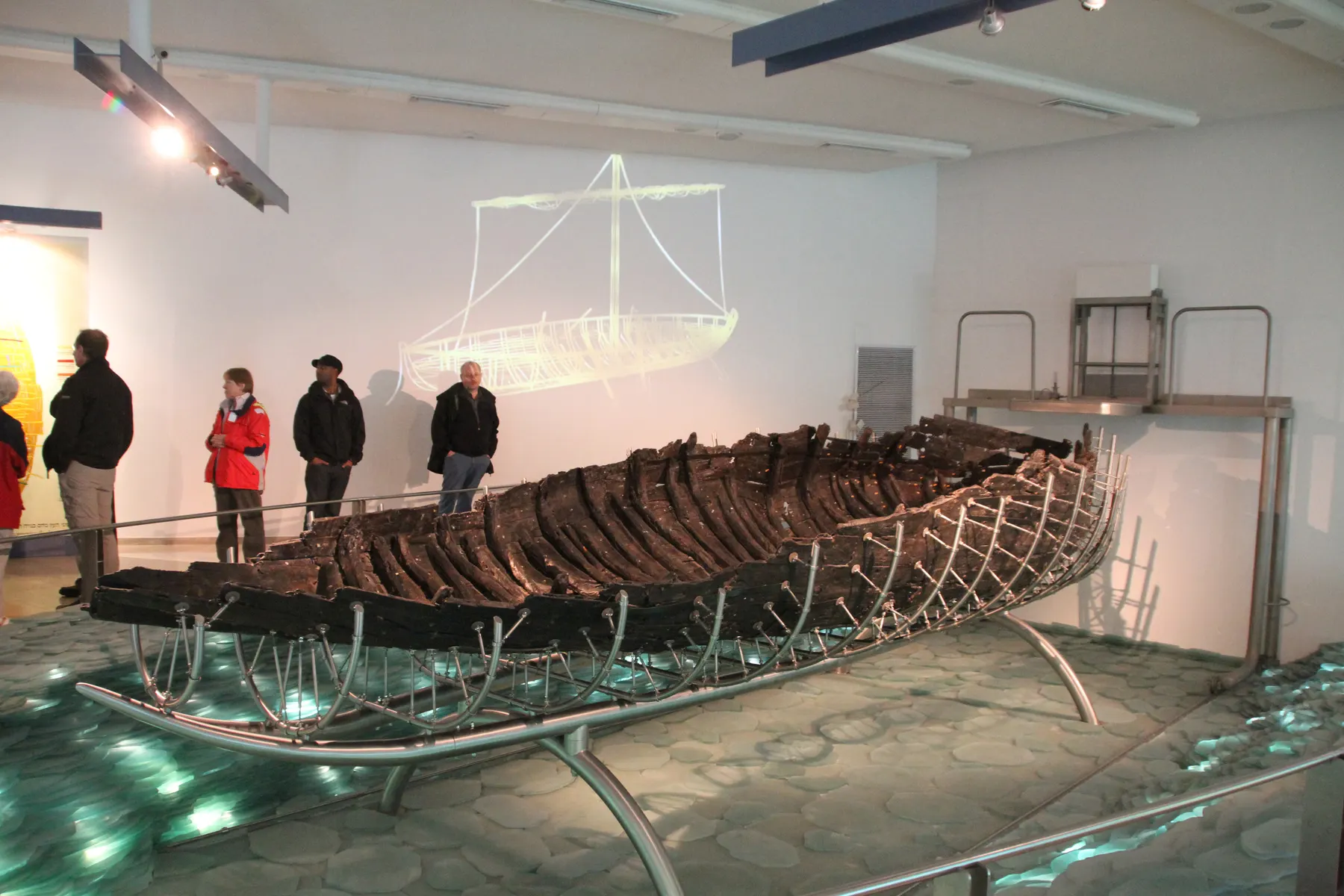
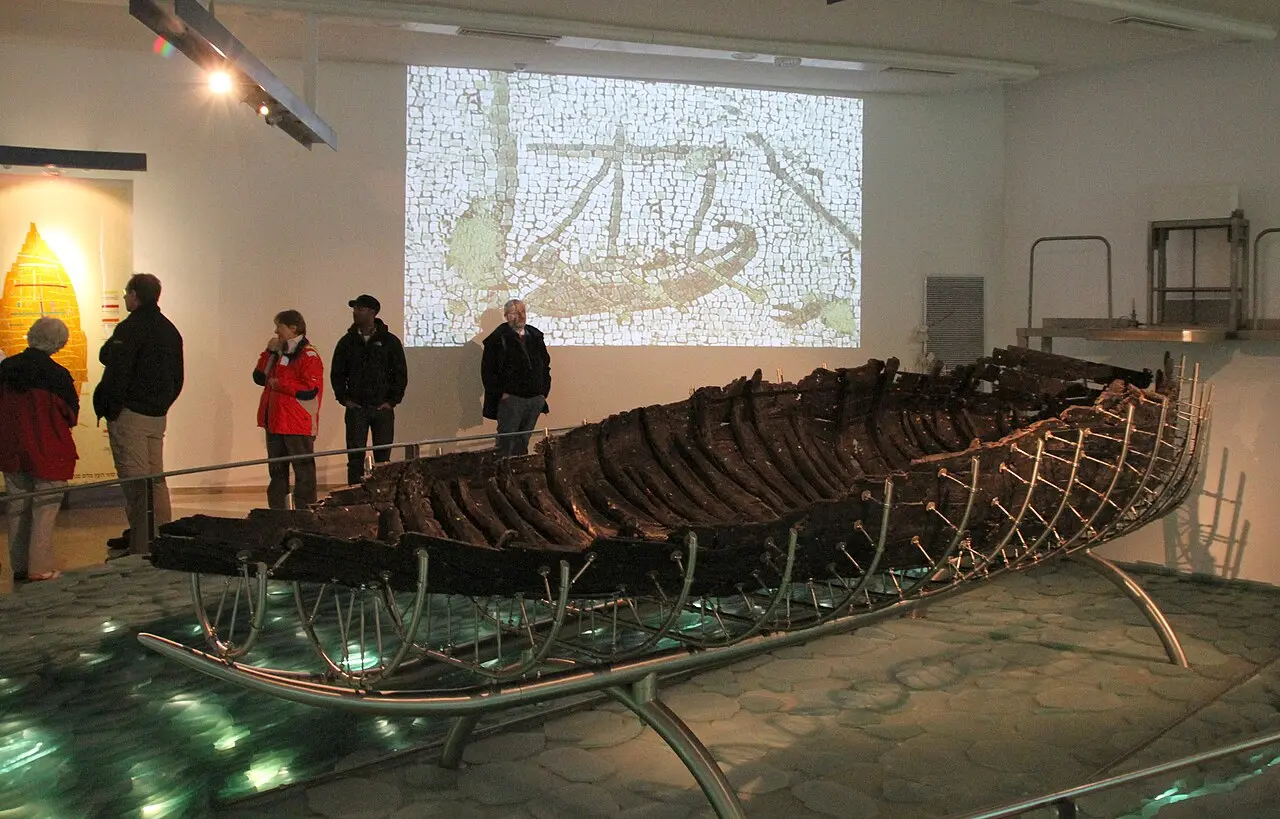
The Jesus Boat is the waterlogged hull of a small first-century fishing boat, roughly 8.2 metres long and 2.3 metres across, displayed in a climate-controlled gallery at the far end of the Yigal Allon Centre in Kibbutz Ginosar. Everything in the case is original timber, and nothing has been rebuilt. What makes the exhibit odd is that it is less than a boat rather than more, because most of the vessel was stripped off it by its own owners before it ever sank.
The nickname is not the museum's. The press attached it during the dig in 1986, and the archaeologist who directed that dig, Shelley Wachsmann, called it a journalistic canard: to the best of anyone's knowledge Jesus never owned a boat and never used this one. What the hull genuinely is, and this is the stronger claim, is the only surviving example of the boat type that Josephus describes on this lake and that a first-century mosaic at nearby Migdal depicts, from the exact stretch of shore the Gospels are set on.
It is also one gallery inside a working regional museum, which catches visitors out. The Yigal Allon Centre sells a single ticket covering the boat, about 150 archaeological objects from the Sanhedrin Trail, a room on the Huqoq excavations visible through its own windows, an exhibition on the level of the Kinneret and a biographical room about Allon himself. It closes at four in the afternoon and, for individual visitors, does not open at all on Friday or Saturday.
Discovery
Two brothers, a receding lake and an oval outline in the mud
The winter of 1985 to 1986 was dry and the Kinneret fell away from its own shore, exposing bands of lakebed normally under water. In January 1986 two members of Kibbutz Ginosar, the brothers Moshe and Yuval Lufan, went looking over the newly dry ground. They were fishermen and keen amateur archaeologists, working an area where a tractor had already churned up ancient bronze coins. What they found instead was the oval outline of a boat, completely buried in the mud.
The centre's own account adds a detail no archaeological report would carry, and it is on the gallery wall: a large double rainbow stood over the lake at the moment the find was revealed, and the photograph somebody took of it hangs beside the hull. Wachsmann titled a chapter of his book after it.
The find came with a practical problem attached. Rumour went round that the boat was full of gold, so the site had to be guarded day and night, and the lake was expected to rise again, which set the clock the operation worked against.
The dig
Eleven days and nights, and a hull floated out inside foam
The excavation began on 16 February 1986, directed by Shelley Wachsmann, then inspector of underwater antiquities for Israel's Department of Antiquities and Museums, with members of the kibbutz and a large number of volunteers. It ran day and night for eleven days. J. Richard Steffy, the ship reconstructor from Texas A&M University, studied the hull where it lay from 20 to 25 February, which is why so much of what is known about how the boat was built was recorded before anything moved.
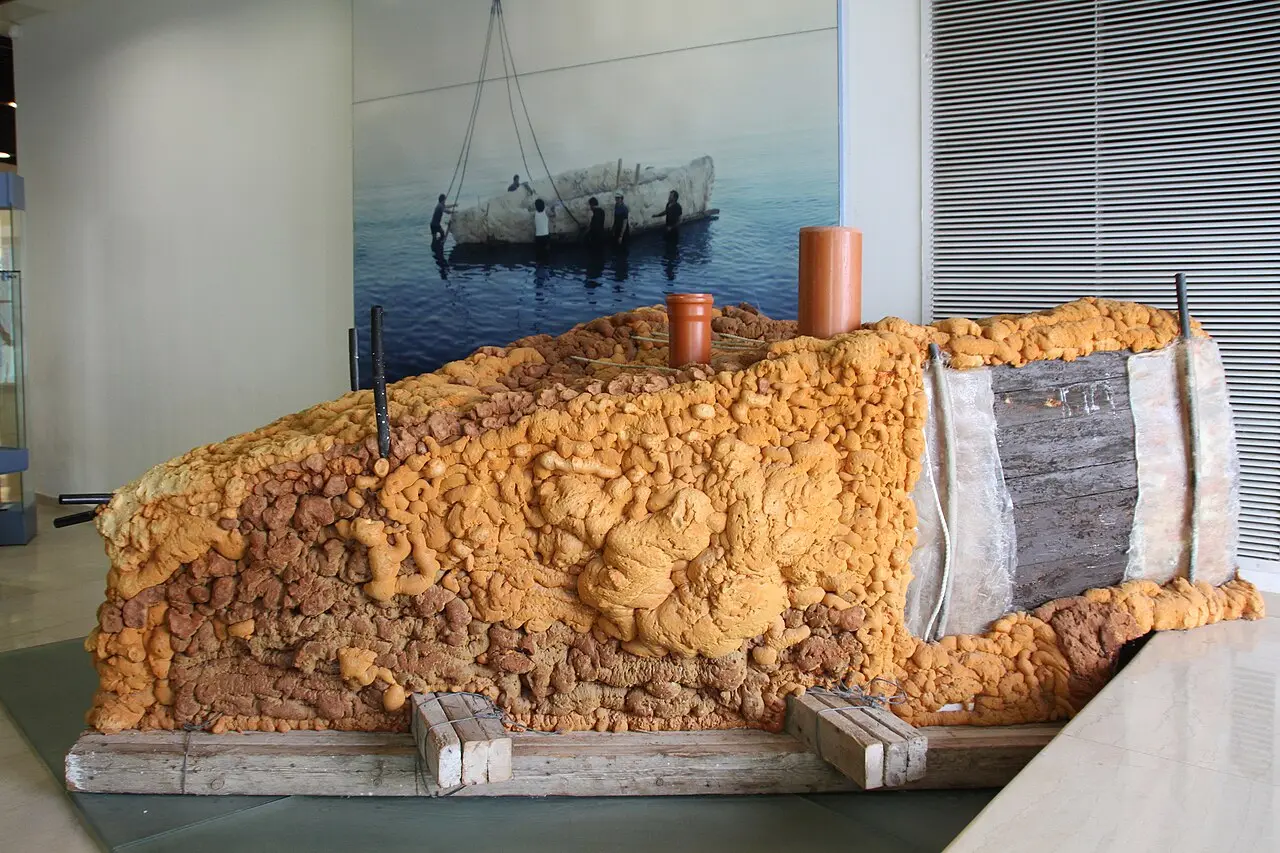
Getting it out in one piece was the harder half, because waterlogged two-thousand-year-old wood will not take its own weight. The excavation's conservator, Orna Cohen, devised a solution with no real precedent: a frame of fibreglass and polyester resin moulded to the shape of the hull, then a jacket of polyurethane foam sprayed round the whole thing. Water was pumped back into the pit, the foam floated, the boat floated with it, and the package was guided out through a cut in the dike, into the lake and along the shore to Ginosar.
How long the dig took is one of the small things published accounts do not agree on. Wachsmann, who ran it, gives eleven days and nights in both 1988 and 1991. The centre's own page says ten days. English Wikipedia says twelve. Trivial in itself, and a fair warning about the rest of the numbers attached to this object.
One result of the dig gets very little attention. The excavators also found parts of two other vessels and a scatter of planks carrying mortise-and-tenon scars, which suggests old boats were brought ashore here, stripped of every usable timber and abandoned in the shallows. On that reading the museum holds one item from a first-century breaker's yard.
Gerd Eichmann / CC BY-SA 4.0 · Wikimedia Commons
The hull
What is original, and what was taken out of it in antiquity
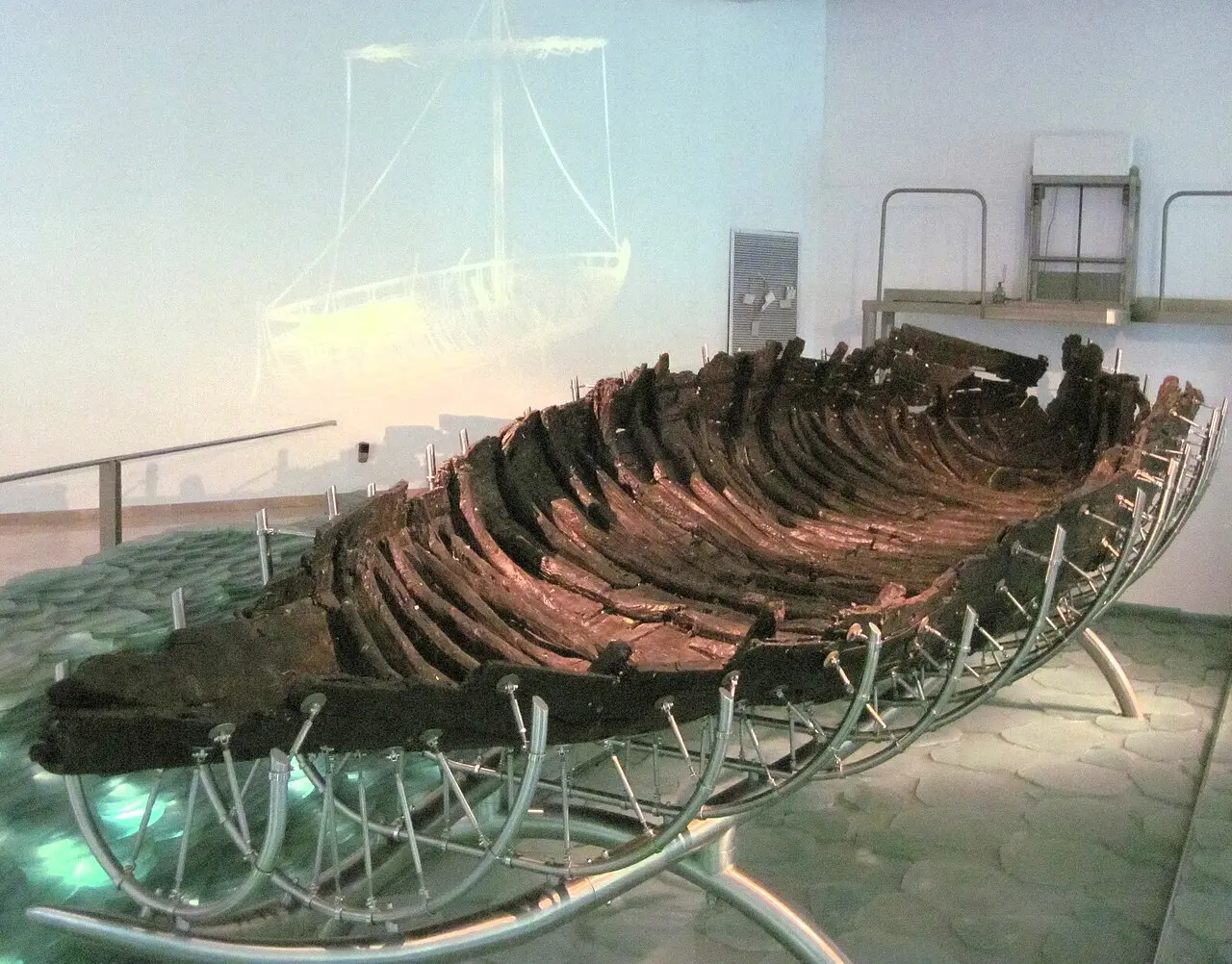
Nothing in the gallery is reconstruction. The timber is the timber that came out of the mud, and the conservation work went into stabilising it rather than completing it. But the boat had already been cannibalised before it sank, and the list of what is missing is long: the stem construction, the stempost, a number of frames and the entire upper structure were all removed, presumably to be reused in other boats. The mast step went the same way, and Steffy only located it by finding four nail holes and a discolouration on the centre of the keel where it had been fastened.
So what stands in the case is the lower shell of a working boat, without a bow post, without upper works and without a mast. The fine cutwater bow and the high recurving stern on every drawing of this vessel are Steffy's reconstruction on paper, read off the run of the surviving planks. They were corroborated on site when two Franciscan archaeologists from Capernaum sketched the boat shown in a first-century mosaic found a mile up the beach at Migdal and produced almost the same shape.
The construction is Mediterranean rather than local: built shell-first, planks edge-joined with mortise-and-tenon joints locked by wooden pegs, frames inserted afterwards. Whoever built it either trained on the coast or was apprenticed to somebody who had. The timber, though, is what a boatyard would normally throw away. Many frames are branches badly fitted to the curve of the hull, several strakes are unusually narrow and look like reused planks with their old mortise scars shaved off, and one length of keel carries a row of mortises that served no purpose in this boat at all.
Wachsmann's account identifies seven woods: Lebanese cedar for most of the strakes, oak for most of the frames, then jujube, Aleppo pine, hawthorn, willow and redbud in smaller quantities, some of them species nobody would choose for a boat. The Yigal Allon Centre says twelve types of wood, all mentioned in the Bible, and does not list them. Both figures circulate widely and this page cannot reconcile them.
- Removed in antiquity: the stem construction, the stempost, some frames, the upper structure and the mast step
- Original and present: the keel, the lower strakes and most of the framing
- Built shell-first, with pegged mortise-and-tenon joints between planks
- Steffy's reading of the shape: a crew of four rowers, two a side, plus a helmsman
Travellers Tinkers / CC BY-SA 4.0 · Wikimedia Commons
Conservation
Fourteen years in a pool of synthetic wax
Waterlogged ancient wood is held up by the water inside its own decayed cells, and left to dry it shrinks, splits and collapses. The standard answer is polyethylene glycol, a synthetic wax that dissolves in water: the object goes into a pool, the concentration of wax is raised slowly over years, and the wax takes the place of the water inside the cells so the timber can come into the air without losing its shape.
A building was put up next to the Yigal Allon Centre specifically to hold the pool, and the boat was floated to it in its fibreglass and foam cocoon. Writing in 1988, Wachsmann expected the treatment to take five to seven years. Writing in 1991, he described the boat as still in the pool and already a tourist attraction in that state, with visitors coming to look at a hull sitting in a tank of wax solution.
It took considerably longer than the first estimate. The Yigal Allon Centre states that the boat was treated for fourteen years, until 2000, when it was judged ready to move into the visitor gallery. English Wikipedia gives twelve years in the wax bath. This page follows the centre, because the centre owned the pool, but the discrepancy is real and may surface in whatever the guide says on the day.
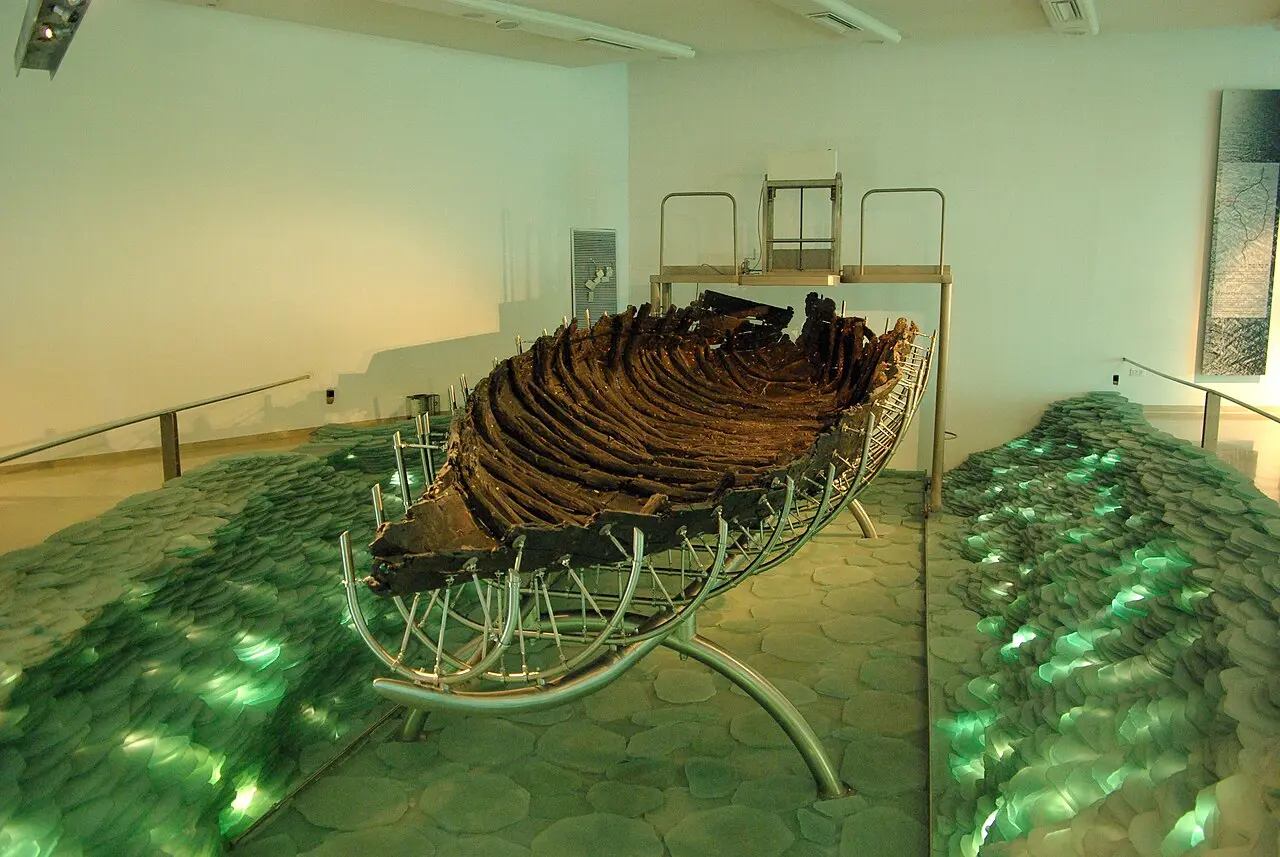
Since 2000 the hull has been displayed in its own hall, with humidity, temperature and air pressure held steady, alongside a film about the discovery and photographs taken on the day it was found.
The name
Why it is called the Jesus Boat, and what the evidence actually carries
The dating is the whole of the connection. Ten wood samples gave a radiocarbon average of 40 BC, plus or minus eighty years, which is a span of 120 BC to AD 40. A cooking pot and an oil lamp found in and around the hull point to the later part of the first century BC through to roughly AD 70. The Yigal Allon Centre publishes the range as 100 BC to AD 100. Any of those windows contains Jesus's ministry on this lake, and also the Jewish revolt against Rome and the naval slaughter Josephus describes off Migdal in AD 67.
That is as far as it goes, and the museum does not pretend otherwise. No inscription, no context and no find ties this hull to any named person. Wachsmann's verdict on the nickname, published while the boat was still in its pool, was blunt: the press invented it, Jesus is not known to have owned a boat, and this is not it.
What the boat does settle is a question the texts could not. Steffy read the hull as a vessel rowed by four men, two a side, with a helmsman at a quarter rudder: exactly the crew Josephus gives for boats manned on this lake with skeleton complements, and exactly what the Migdal mosaic shows once the aftmost 'oar' is recognised as a rudder. Wachsmann estimated capacity from the average height of first-century Galilean male skeletons, about 1.66 metres, at roughly fifteen men. The boats of the Gospels and the boats of the Jewish War turn out to be the same boats.
In March 2023 Pope Francis was given a full-scale working reproduction of it, built by the Aprea shipwrights of the Sorrento peninsula and presented by the Aponte shipping family. The Vatican Museums installed the nine-metre copy on 17 September 2023 and put it on display from 10 October, at the foot of the ramp they call the Way of the Sea. The original stays at Ginosar.
Berthold Werner / Public domain · Wikimedia Commons
The museum
The boat is one gallery, and the ticket buys the other six
Most people come for ten minutes with a hull and leave having spent an hour, because the ticket covers the whole centre. The Sanhedrin Trail exhibition, mounted here by the Israel Antiquities Authority, holds about 150 archaeological objects from along the 120-kilometre route the trail follows from Beit Shearim to Tiberias, with a Mishnah and Talmud room containing a replica of the mosaic floor from the ancient synagogue at Migdal.
Hoquq Secrets looks out at its own subject: Horvat Huqoq is visible from the museum windows. It covers the Roman and Byzantine synagogue and its mosaics, uncovered there between 2011 and 2023 by the Huqoq Excavation Project under Professor Jodi Magness of the University of North Carolina at Chapel Hill, and the hiding system and agricultural installations found by the antiquities authority's community dig from 2017. The curator is Dr Einat Ambar-Armon.
There is also a display of the Magdala Stone, the carved limestone block from the first-century synagogue at Migdal carrying the oldest known depiction of the Temple lamp found in a synagogue. The centre's description says the stone was first shown in the Israel Museum and afterwards placed as close as possible to its original site, and does not say on that page whether what stands at Ginosar is the stone itself or a copy. Worth asking at the desk.
The remaining rooms are the Yigal Allon memorial room, with his desk, diary and papers; an exhibition on the water level of the Kinneret running from the opening of the Degania dam in 1933 through a century of water policy; and a display of Yiftach Allon's children's book illustrations. Outside is a sculpture trail above the lake. The escape rooms are booked and ticketed separately.
Gerd Eichmann / CC BY-SA 4.0 · Wikimedia Commons
What to look for
Things not to walk past at The Jesus Boat at Ginosar
The details that repay knowing about before you are standing in front of them.
The stripped bow and stern
The two ends of the hull are where the boat is most obviously incomplete. The stempost and the whole stem construction were taken off for reuse before it sank, so the profile drawings on the wall show a vessel the timber itself no longer describes.
The keel where the mast stood
Four nail holes and a patch of discolouration in the centre of the keel are all that is left of the mast step, which was also removed in antiquity. It is the detail that proves the boat carried a sail.
The double rainbow photograph
Displayed beside the hull, taken at the moment the find was revealed in January 1986. It is the museum's own story rather than the archaeologists', and it explains the tone of a lot of what is written about this object.
The Migdal mosaic floor
In the Mishnah and Talmud room, a replica of the mosaic from the ancient synagogue at Migdal, a mile up the same beach. The boat depicted in the original mosaic is what confirmed the reconstruction of this hull.
The Huqoq room
The site it describes is visible through the museum windows. It covers the synagogue mosaics found between 2011 and 2023 and the hiding system and agricultural installations excavated from 2017.
The sculpture trail outside
Open-air works on the slope above the lake, included in the same ticket and skipped by almost every group that arrives on a coach schedule.
The long view
The Jesus Boat at Ginosar, in order
120 BC to AD 40
The span given by the radiocarbon average of ten wood samples, 40 BC plus or minus 80 years. Pottery found with the hull points to the later first century BC through to about AD 70.
1st century AD
The boat, already old and much repaired, is stripped of its stempost, mast step, upper works and usable frames and pushed into the lake, where mud seals and preserves what is left.
January 1986
Moshe and Yuval Lufan of Kibbutz Ginosar find the oval outline of a buried hull on lakebed exposed by drought.
16 February 1986
Excavation begins under Shelley Wachsmann for the Department of Antiquities and Museums, and runs round the clock for eleven days under guard.
20 to 25 February 1986
J. Richard Steffy of Texas A&M University records the hull in situ and draws the first reconstruction of its lines.
February 1986
Orna Cohen encases the hull in fibreglass and polyurethane foam, the pit is reflooded, and the boat floats out through the dike and along the shore to a conservation pool built for it at Ginosar.
1986 to 2000
Treatment in polyethylene glycol. Wachsmann expected five to seven years in 1988; the Yigal Allon Centre says the work took fourteen.
2000
The hull is moved into its own climate-controlled visitor gallery at the Yigal Allon Centre, where it remains.
15 March 2023
Pope Francis is presented with a full-scale working reproduction built by the Aprea shipwrights of the Sorrento peninsula and donated by the Aponte family.
17 September 2023
The nine-metre reproduction is installed in the Vatican Museums, on display from 10 October at the foot of the ramp called the Way of the Sea.
Practical
Visiting The Jesus Boat at Ginosar
Where
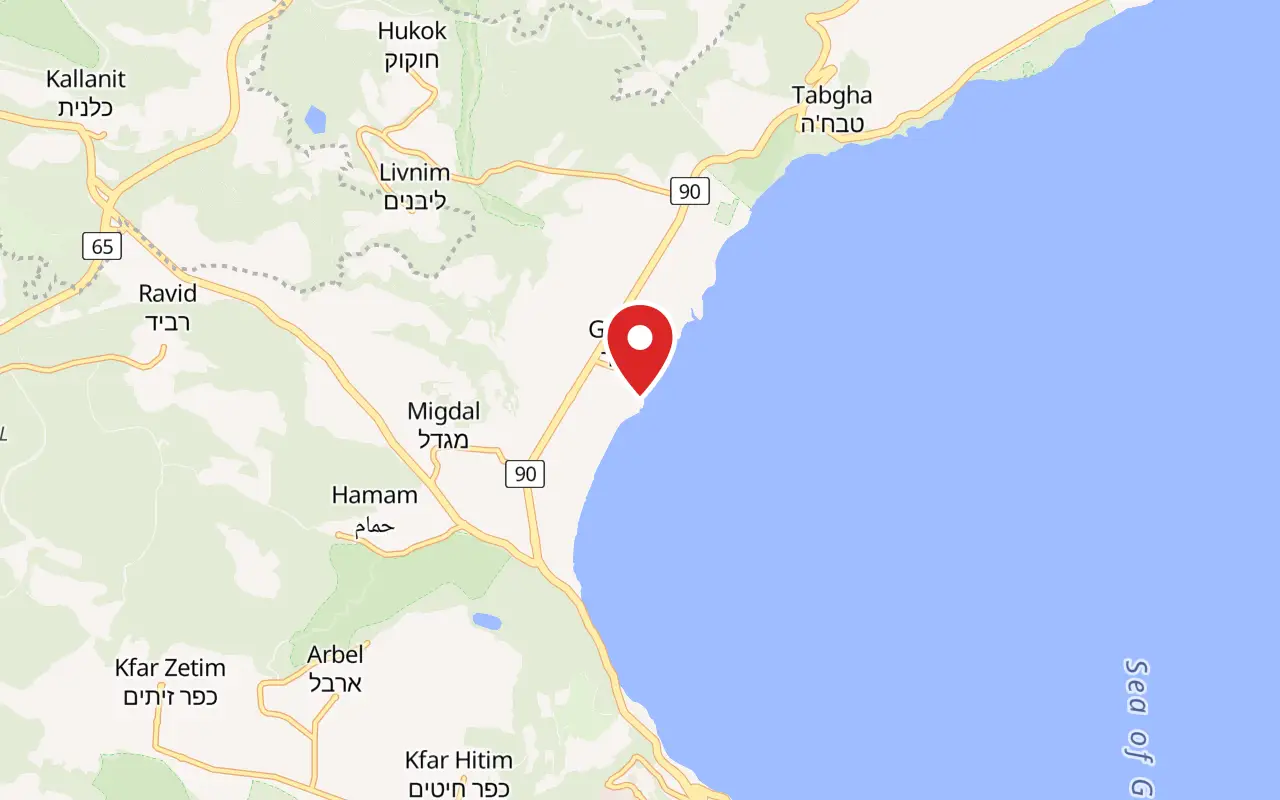
The Ancient Boat gallery, Yigal Allon Centre, Kibbutz Ginosar, on the north-western shore of the Sea of Galilee off Route 90
What ticket you need
The boat is not a separate attraction with its own gate. It sits in a gallery at the far end of the Yigal Allon Centre, and the centre's ticket is the only ticket; there is no cheaper option that covers the hull alone. The wooden tourist launches that run cruises from the Ginosar waterfront are modern boats operated by other businesses and have nothing to do with the hull inside.
Opening hours
- Sunday to Thursday
- 08:00 to 16:00source
- Friday and Saturday
- Groups of at least 20 people, by prior arrangement onlysource
- Last admission
- Not published; the centre gives a closing time of 16:00 and nothing about a cut-off for entrysource
- An older English mirror of the site
- Still lists 08:00 to 17:00, which the centre's current pages do not. Treat 16:00 as the closing timesource
Admission
- Adult
- ₪40source
- Child, aged 6 to 18
- ₪20source
- Senior citizen, on production of a card
- ₪20source
- Student or soldier, on production of a card
- ₪20source
- Visitor with a disability certificate
- ₪20source
- With or without a guide
- Same price either way; guiding is scheduled according to the site's guiding hourssource
- Israelis evacuated from their homes since 7 October
- Free, on production of an identity cardsource
Access
This is an indoor museum on the flat shore plain at Ginosar, so there is no climb, no steps outside and no rough ground on the approach. The centre publishes only two accessibility facts of its own: marked disabled parking near the main entrance, and counters that are wheelchair accessible. Its accessibility statement covers the website rather than the building and says only that certain parts are not fully accessible, without saying which. Anyone who needs certainty about the route from the lobby to the boat gallery at the far end should phone ahead on +972-4-6727700. The sculpture trail outside is on a slope above the lake.
On site
- Cafeteria in the main lobby
- Gift shop opposite the boat
- Toilets off the air-conditioned lobby
- Marked disabled parking
- Film about the discovery
- Escape rooms, booked separately
- Outdoor sculpture trail
- Lake views from the terrace
Booking
Tickets are sold on the centre's own website and at the desk, at the same price with or without a guide. Friday and Saturday are the exception that catches people out: the centre opens then only for groups of at least twenty by prior arrangement, so an individual turning up on a Saturday will not get in.
Hours and prices are given as the operator publishes them and change without much notice, particularly around Shabbat and the festivals. Check the operator's own page before you travel for this.
Official page at yigal-allon-centre.org.il →What people wish they had known
- Come in the morning. The centre closes at 16:00 Sunday to Thursday, which is earlier than most people assume, and a lot of visitors try to fit it in after Capernaum and Tabgha and arrive to a locked door.
- Do not plan it for a Saturday. Friday and Saturday opening is for groups of at least twenty by prior arrangement only, so an individual visitor on Shabbat has no way in.
- Expect a hull, not a ship. What survives is the lower shell: no stempost, no upper works, no mast. The graceful vessel on the drawings beside it is a reconstruction on paper, and half the disappointment reported about this exhibit comes from not knowing that in advance.
- Budget for the rest of the building. The ticket covers the whole centre, and the Sanhedrin Trail collection, the Huqoq room and the Kinneret water exhibition are what turn a ten-minute stop into an hour well spent.
- Claim the concession if you have one. Adults pay ₪40 and everyone else on the centre's list, children aged 6 to 18, seniors, students, soldiers and visitors with a disability certificate, pays ₪20, and the guided option costs no extra.
- Ignore the boats at the water's edge. The wooden launches that take pilgrims out from Ginosar are modern craft built for the trade, and are not related to the object in the gallery.
The figures
The Jesus Boat at Ginosar by the numbers
Each figure carries the year it belongs to and links the source it came from.
| Measure | Figure | As of | Source |
|---|---|---|---|
| Preserved length of the hull | 8.2 m | 1991 | nauticalarch.org |
| Preserved beam | 2.3 m | 1991 | nauticalarch.org |
| Preserved depth | 1.2 m | 1991 | nauticalarch.org |
| Radiocarbon average of ten wood samples | 40 BC, plus or minus 80 years | 1988 | cojs.org |
| Wood species identified by the excavators | Seven | 1991 | nauticalarch.org |
| Wood types the museum states | 12 | 2026 | yigal-allon-centre.org.il |
| Length of the excavation | 11 days and nights | 1991 | nauticalarch.org |
| Conservation, as the museum gives it | 14 years, ending in 2000 | 2026 | yigal-allon-centre.org.il |
While you are here
The rest of The Sea of Galilee
Everything else in this destination with a page of its own.
Ovedc / CC BY-SA 4.0 · Wikimedia Commons
Archaeological site
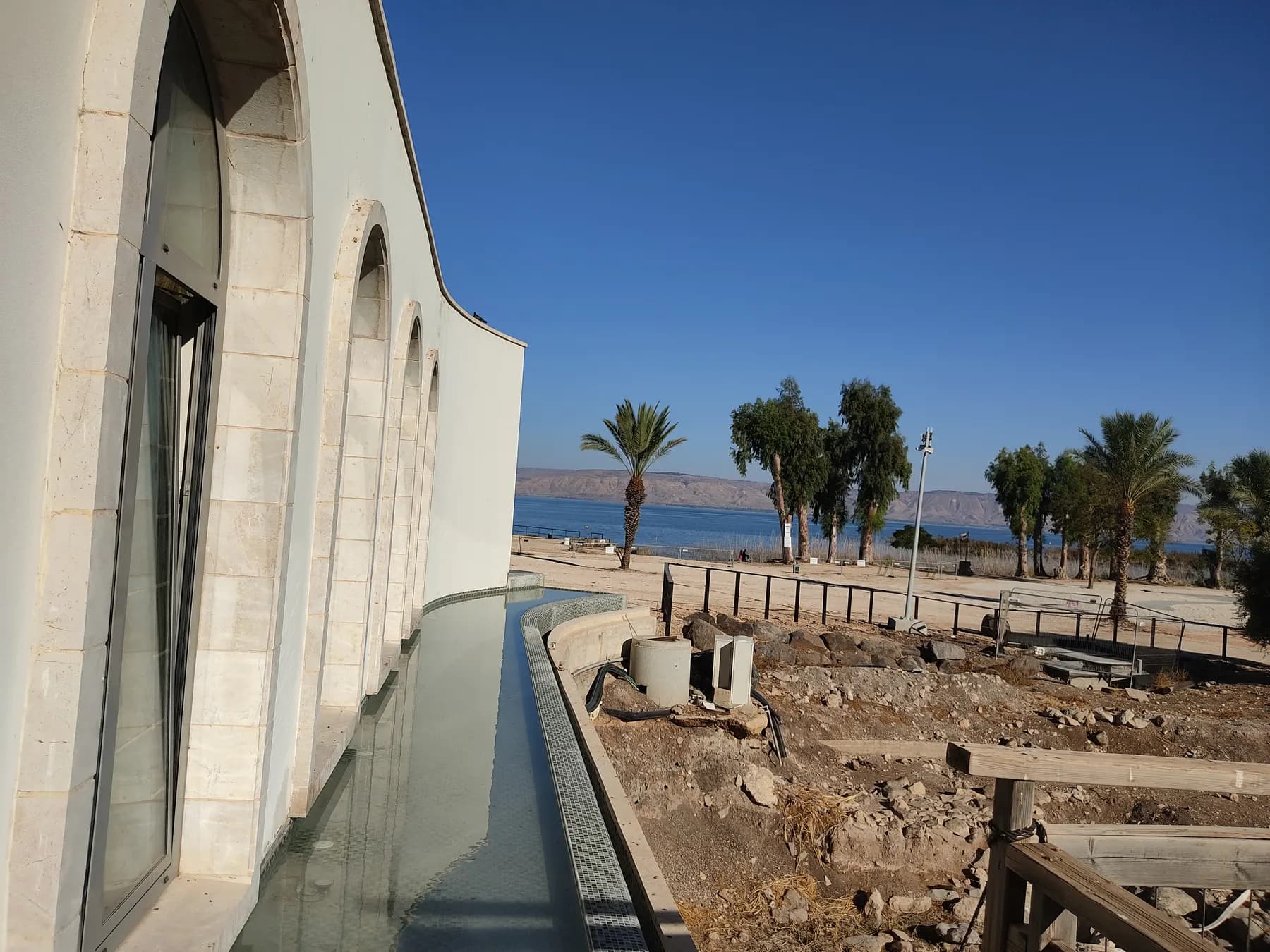
Magdala
A guest house for pilgrims was going up here until the required salvage dig hit a synagogue from the time of the Second Temple in September 2009, and the buildings were redrawn around it.
יוסי רון / CC BY 2.5 · Wikimedia Commons
Religious site
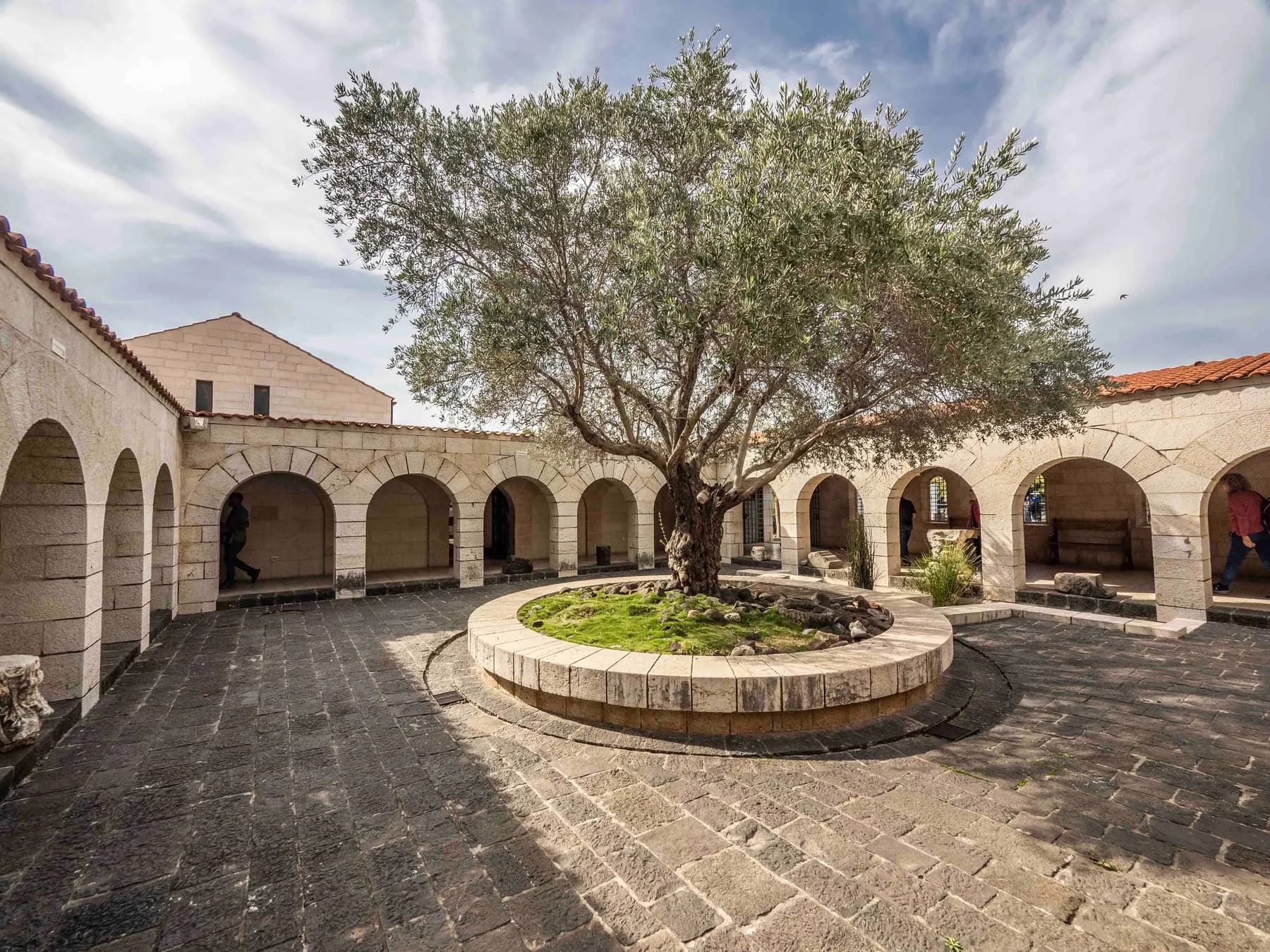
Tabgha
The mosaic in front of the altar shows a basket of four loaves, not the five of the Gospel account, and the usual reading is that the fifth is the one consecrated on the altar above it.
Tracy Hunter from Spokane, USA / CC BY 2.0 · Wikimedia Commons
Archaeological site
Capernaum
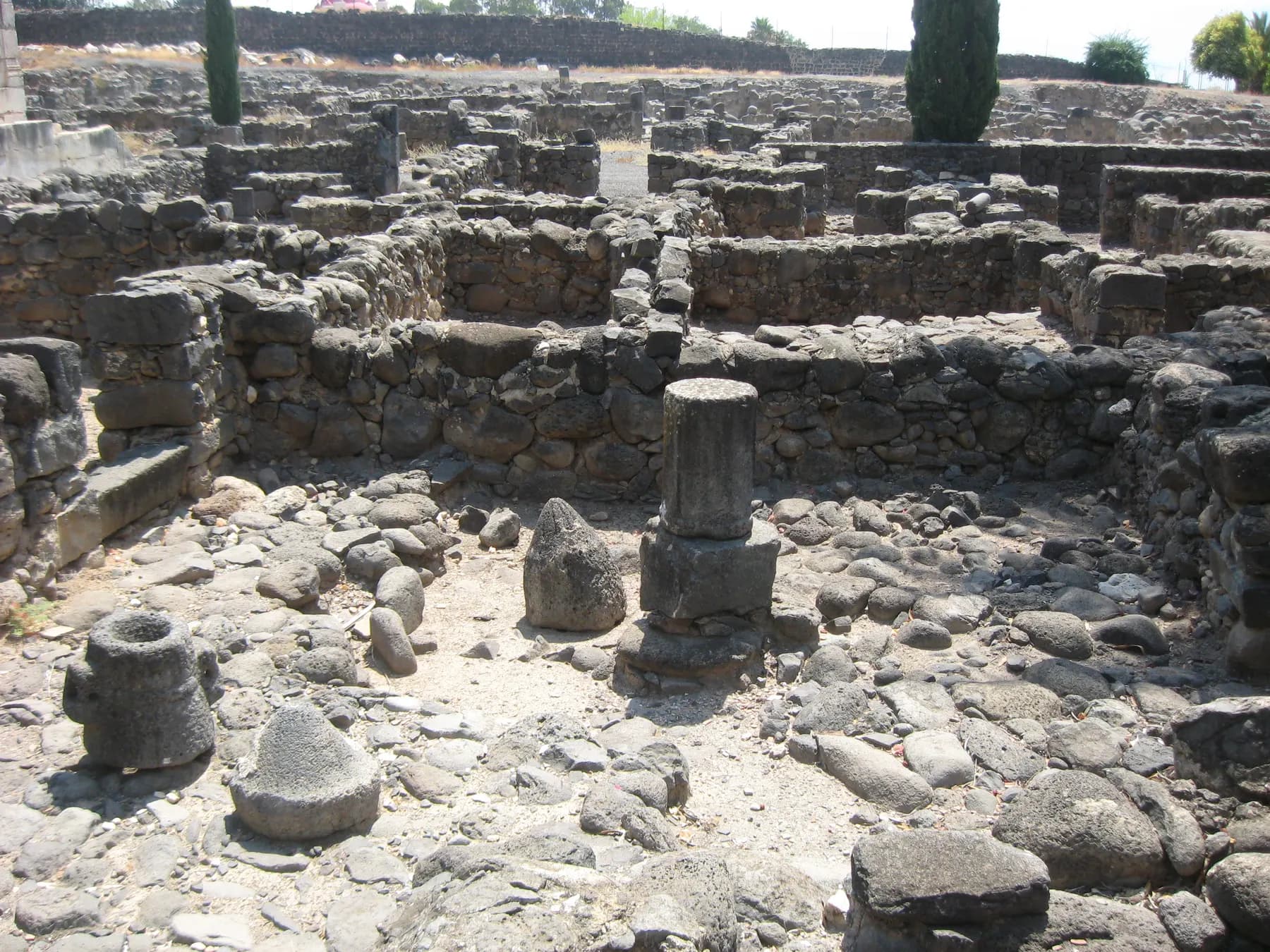
Two thirds of the ruined village belongs to the Franciscans, who finally got the title deeds on 19 September 1894 after eight years of Ottoman paperwork and have dug it in twenty-three seasons since 1968.
Sources and further reading
Every link below was opened and checked when this page was written. Official statements are marked as such: they are the subject's own account, not an independent one.
- OfficialYigal Allon Centreyigal-allon-centre.org.ilThe Ancient Boat
the operator's own account: January 1986, the Lufan brothers, about 8 metres, twelve wood types, a dig completed in ten days, fourteen years of conservation to 2000, the gallery, the film and the double rainbow photograph
- OfficialYigal Allon Centreyigal-allon-centre.org.ilInformation
opening hours of 08:00 to 16:00 Sunday to Thursday, the Friday and Saturday group-only rule, the cafeteria, the gift shop opposite the boat, the lobby toilets, disabled parking and wheelchair-accessible counters
- OfficialYigal Allon Centreyigal-allon-centre.org.ilEntry to Beit Yigal Allon (ticket page)
the published prices: ₪40 adult, ₪20 for child aged 6 to 18, senior, student or soldier and disability-certificate holders, guided and unguided at the same rate, and free entry for evacuees
- OfficialYigal Allon Centreyigal-allon-centre.org.ilPermanent exhibitions
the Sanhedrin Trail collection of about 150 objects, the Hoquq Secrets room and its curator, the Magdala Stone display, the Kinneret water level exhibition, the Allon memorial room and the Migdal mosaic replica
- OfficialYigal Allon Centre (older English site)en.yigal-allon-centre.org.ilThe Museum
the older English mirror, still publishing a 17:00 closing time that the current pages give as 16:00
- OfficialVatican Museumsmuseivaticani.vaPeter's Boat docks in the Pope's Museums
the nine-metre reproduction installed on 17 September 2023 and displayed from 10 October at the foot of the Way of the Sea ramp, with the original named as the boat kept at the Yigal Allon museum in Ginosar
- ReportingRome Reportsromereports.comExact replica of ancient boat from Holy Land donated to Vatican
independent account of the same reproduction: about two years to build, over fifteen passengers, the Aponte family and the International Diplomatic Institute
- ReferenceShelley Wachsmann, via the Center for Online Judaic Studiescojs.orgThe Galilee Boat: 2,000-Year-Old Hull Recovered Intact, Biblical Archaeology Review 14:5
the excavation director's 1988 account: the discovery in January 1986, the dig from 16 February, eleven days and nights, Steffy on site from 20 to 25 February, the pottery and radiocarbon dates, Orna Cohen's fibreglass and foam extraction, and the five to seven years of PEG then expected
- ReferenceShelley Wachsmann, Institute of Nautical Archaeologynauticalarch.orgAncient Seafaring on the Sea of Galilee, INA Newsletter 18:3
the 1991 account: 8.2 by 2.3 by 1.2 m, shell-first mortise-and-tenon construction, the timbers stripped in antiquity, the seven wood species, the Migdal mosaic, the four rowers and a helmsman, the fifteen-man capacity and the 'journalistic canard' verdict on the nickname
- ReferenceEnglish Wikipediaen.wikipedia.orgSea of Galilee Boat
the widely repeated twelve-day excavation and twelve-year wax bath figures, cited here because they differ from the excavator's and the museum's and a reader will meet them elsewhere
- ReferenceSee the Holy Landseetheholyland.netJesus Boat
an independent summary agreeing on the eleven-day excavation and the 2000 move into the museum, and giving the hull as 8.3 by 2.3 by 1.3 m
The Jesus Boat at Ginosar: common questions
What is the Jesus Boat?+
It is the surviving hull of a small fishing boat from the first century, about 8.2 metres long, found in the mud of the Sea of Galilee in 1986 and now displayed at the Yigal Allon Centre in Kibbutz Ginosar. The museum calls it the Ancient Boat. It is real timber, conserved rather than rebuilt, and it is the only boat of its period recovered from this lake.
Is it really Jesus's boat?+
No, and nobody who worked on it has ever said it was. The link is entirely one of date and place: radiocarbon and pottery put the boat somewhere in the window that also contains Jesus's ministry on this shore. Shelley Wachsmann, who directed the excavation, called the nickname a journalistic canard and pointed out that Jesus is not known to have owned a boat at all.
How old is the boat?+
Ten wood samples gave a radiocarbon average of 40 BC, plus or minus eighty years, which is a span of 120 BC to AD 40. A cooking pot and an oil lamp found with the hull point to the later first century BC through to roughly AD 70. The Yigal Allon Centre publishes the range as 100 BC to AD 100. The boat also shows heavy repairs, so it was already old when it was abandoned.
How much does it cost to see the Jesus Boat?+
The Yigal Allon Centre charges ₪40 for an adult and ₪20 for a child aged 6 to 18, a senior citizen, a student, a soldier or a visitor with a disability certificate, on production of the relevant card. The guided option is sold at the same price as the unguided one. Israelis evacuated from their homes since 7 October enter free on production of an identity card.
What are the opening hours?+
Sunday to Thursday, 08:00 to 16:00, with Friday and Saturday reserved for groups of at least twenty by prior arrangement. An older English mirror of the centre's website still shows 17:00 as the closing time, and the current pages do not, so plan around 16:00 and telephone if the last hour matters.
How long does a visit take?+
The boat itself takes about ten minutes, plus the film. The whole centre is worth an hour to ninety minutes, because the same ticket covers the Sanhedrin Trail collection of about 150 objects, the Huqoq exhibition, the Magdala Stone display, the Kinneret water level room and the Yigal Allon memorial room. Coach groups usually get twenty minutes and see the hull only.
Is any of it reconstructed?+
No. The hull on display is original timber, conserved in polyethylene glycol and then moved into a climate-controlled gallery in 2000. What is missing was taken off in antiquity, not lost in the ground: the stempost, the stem construction, several frames, the mast step and the entire upper structure were stripped out for reuse before the boat sank. The bow and stern you see drawn on the panels are a reconstruction on paper.
Is there a replica anywhere?+
Yes, in Rome. A full-scale working reproduction was built by the Aprea shipwrights of the Sorrento peninsula, presented to Pope Francis by the Aponte family in March 2023, installed in the Vatican Museums that September and put on display from 10 October 2023 at the foot of the ramp they call the Way of the Sea. The original has not left Ginosar.
Is it accessible for a wheelchair?+
Partly, and the centre publishes less than it should. It states that there is marked disabled parking near the main entrance and that its counters are wheelchair accessible, and its accessibility statement is about the website rather than the building. The museum is indoors on flat ground with no climb involved, but the boat gallery is at the far end of the building, so phone +972-4-6727700 first if the route matters.
Is it worth going out of the way for?+
It depends on what you want from it. As spectacle it is modest: a dark, incomplete hull in a case, and visitors who arrive expecting a ship often say so. As evidence it is unmatched, because it is the only surviving vessel of the type Josephus describes and the Migdal mosaic depicts, from the shore the Gospels are set on. Ginosar also sits five minutes off Route 90 between Tiberias and Tabgha, so the detour costs almost nothing.